Home Theater Acoustic Panels: Best Placement & Setup Guide [2026]
Do I need acoustic panels home theater treatment can’t skip? Yes — but panels in the wrong spots add cost without improving sound.
Most home theaters still have harsh reflections and muddy bass even after adding panels. The frustration comes from untreated first reflection points on side walls and ceiling — reflections that no speaker system can overcome without acoustic treatment.
The right placement approach clears up dialogue intelligibility, tightens bass, and lets your system perform at its actual capability.
We’ll walk you through placement priorities, coverage targets, and what to avoid below.
Most home theaters benefit much from acoustic treatment. Panels improve dialogue clarity, tighten bass response, and enhance surround sound immersion.
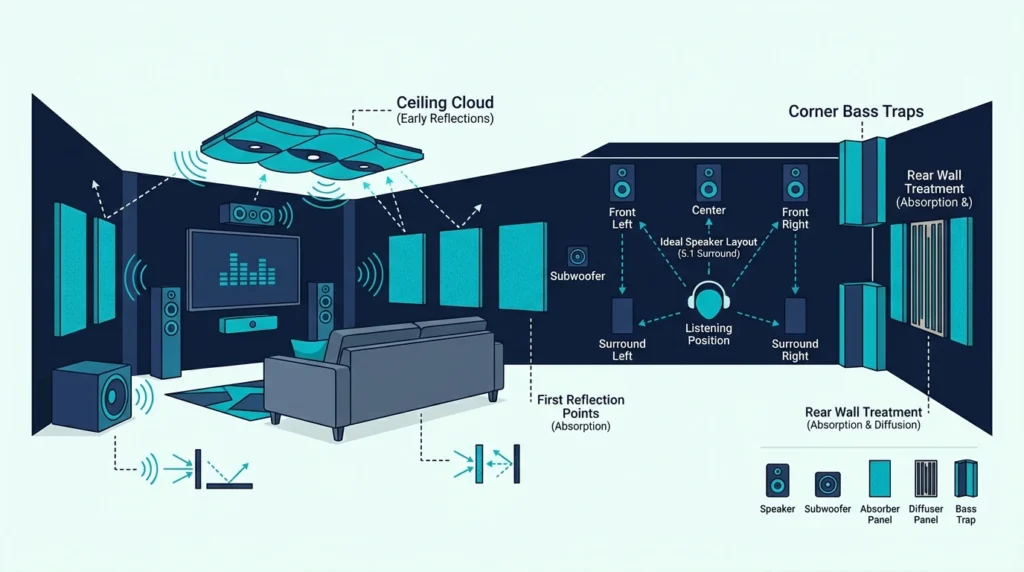
Focus on first reflection points on side walls, ceiling treatment for Atmos systems, and bass traps in corners. Budget 30-50% wall coverage for meaningful improvement.
For the actual installation, check the acoustic panel hanging guide to match hardware to your wall type.
For step-by-step setup, the full installation guide covers every mounting method for both drywall and masonry.
Start with first reflection point placement before treating any other surface — it delivers the biggest improvement per panel.
Do You Actually Need Acoustic Panels for Home Theater?
The short answer is yes for any dedicated or semi-dedicated theater space. The longer answer depends on your room and expectations.
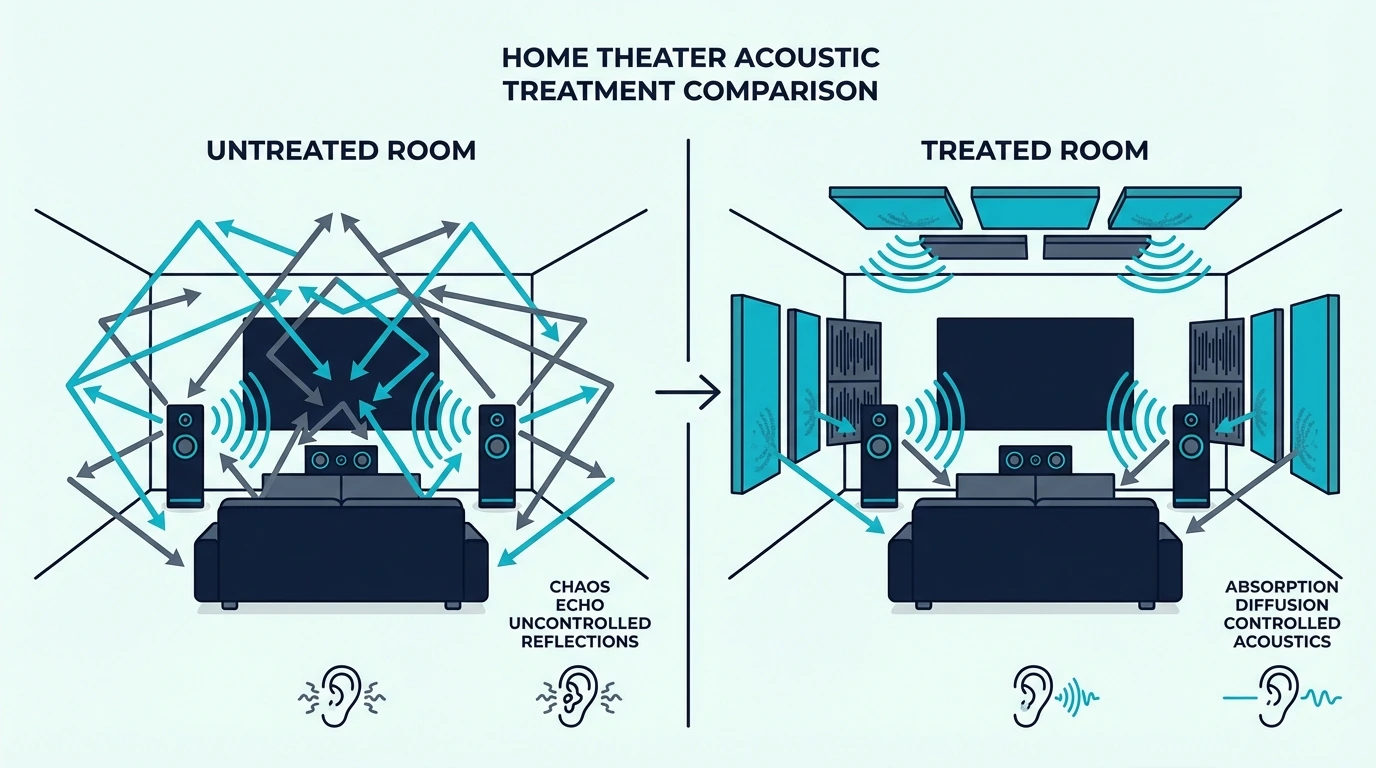
Untreated rooms sabotage even expensive audio equipment. Sound bounces off hard surfaces — drywall, hardwood, glass — and reaches your ears milliseconds after the direct sound from your speakers. your brain can’t separate these reflections from the original audio, so everything sounds muddy and unclear. Understanding the difference between absorption and soundproofing is key to solving this.
When Are Panels Essential?
Dedicated theater rooms with hard surfaces need treatment. If your walls are drywall, your floor is hardwood or tile, and your ceiling is standard height, you’re dealing with real acoustic problems.
Rooms where you’ve noticed echo or boomy bass are obvious candidates. Try the clap test: stand in the center of your theater and clap once sharply.
If you hear a ringing tail or flutter echo, treatment will make a dramatic difference.
When Can you Skip Them?
Living rooms with lots of soft furniture, carpet, and curtains may not need additional treatment. These elements already absorb sound and reduce reflections naturally.
Casual viewers who mostly watch with dialogue-heavy content at moderate volumes might not notice enough improvement to justify the investment. But anyone who watches action movies, listens critically, or has a surround sound system will hear the difference immediately.
What Problems Do Untreated Home Theaters Have?
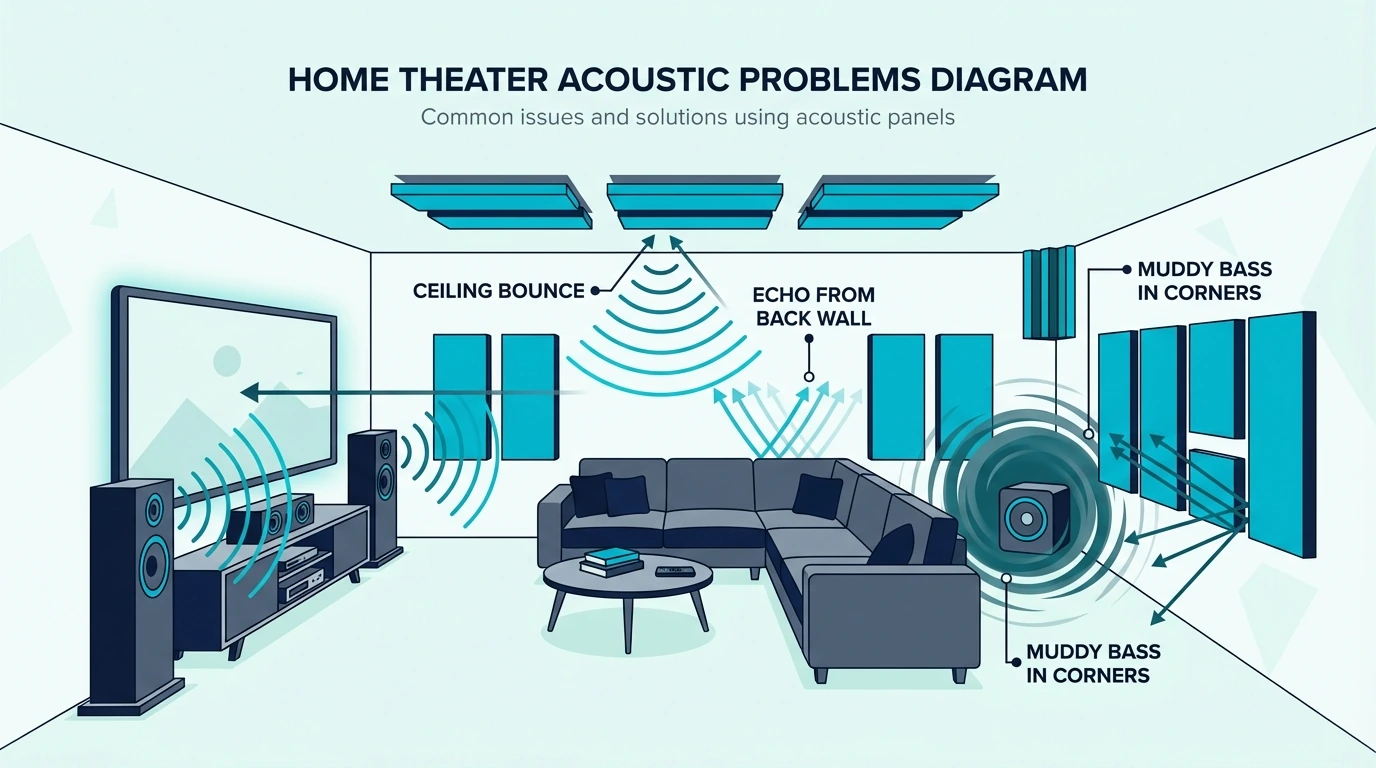
So what exactly goes wrong in untreated rooms? Understanding the specific problems helps you target the right solutions.
Untreated theaters suffer from three main categories of problems that panels address directly.
Why Does Dialogue Sound Muddy?
First reflections from side walls arrive at your ears within 25 milliseconds of the direct sound. your brain fuses these together, and the result is smeared, unclear dialogue. Actors sound like they’re speaking through a blanket.
The center channel in a home theater carries almost all dialogue. When reflections from nearby walls interfere with that channel, every conversation becomes harder to follow. you’ll find yourself reaching for the volume or rewinding to catch what was said.
Why Does Bass Sound Boomy or Uneven?
Low frequencies behave differently than mid and high frequencies. Bass waves are physically large — a 50Hz tone has a wavelength of about 22 feet.
These long waves bounce around your room and pile up in certain spots while canceling out in others.
Corners are the worst offenders. Bass energy accumulates there, creating boom and muddiness.
Meanwhile, your seating position might be in a null where certain bass frequencies nearly disappear. This is why your subwoofer sounds great in one spot and terrible two feet away.
What Happens to Surround Sound?
Surround speakers are supposed to create an immersive soundfield that wraps around you. But in untreated rooms, reflections from walls confuse the spatial cues your brain relies on to locate sounds.
The result is a flat, unconvincing surround experience. Effects that should come from behind you get smeared across the side walls. Choosing panels with the right NRC rating ensures effective absorption at surround speaker positions.
The “bubble” of immersion collapses into a vague sense that sound exists somewhere besides the front speakers.
Get Studio Tips Weekly
Join 5,000+ creators getting acoustic treatment advice every week.
No spam. Unsubscribe anytime.How Do Acoustic Panels Improve Home Theater?
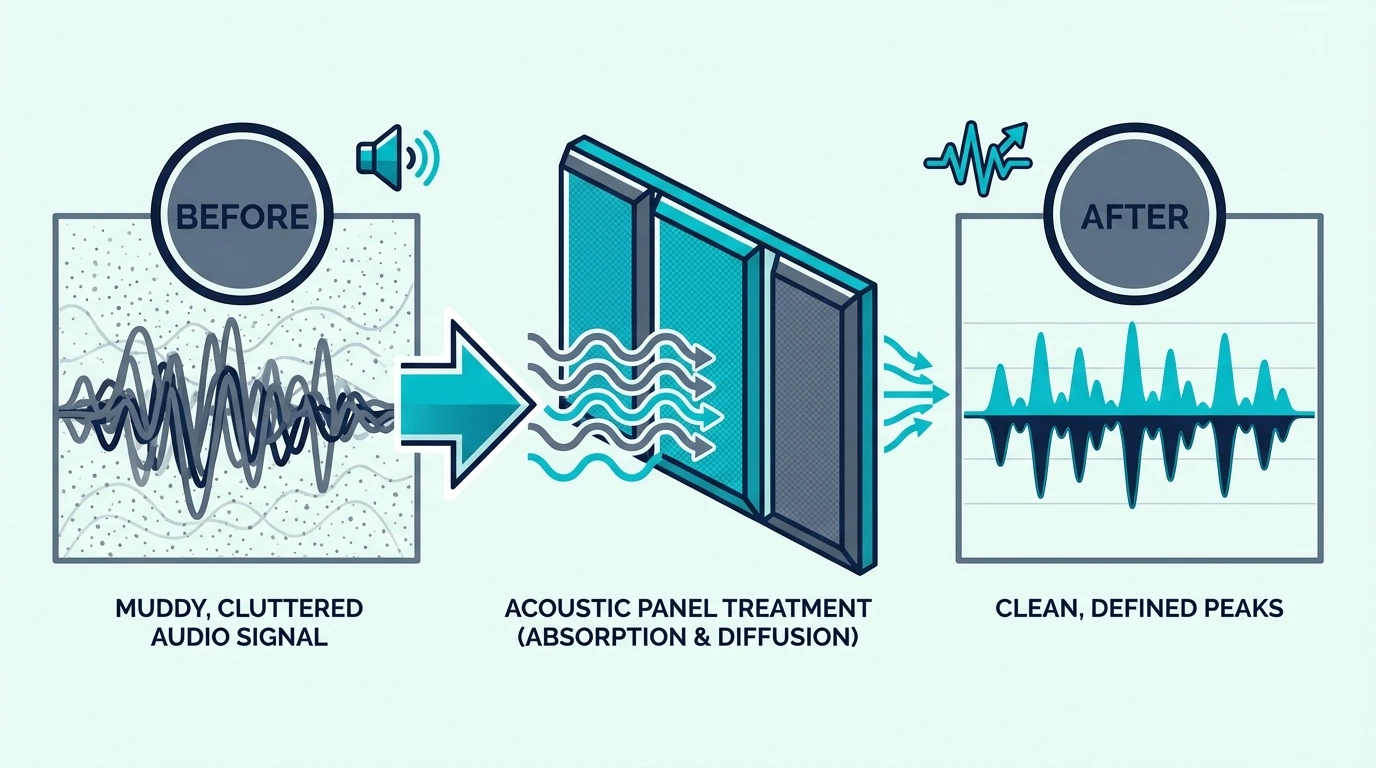
Panels solve each of these problems directly. The improvements are immediate and obvious to anyone who listens critically.
How Do Panels Improve Dialogue Clarity?
Panels at first reflection points absorb the early reflections that smear dialogue. When those competing arrivals disappear, the center channel comes through clean and clear.
The improvement is dramatic. Dialogue that required concentration to follow becomes effortless to understand. you’ll stop reaching for the remote to rewind, and you’ll hear details in voices you never noticed before.
Can Panels Improve Bass Response?
Standard wall panels don’t absorb much bass — that requires thicker treatment or dedicated bass traps. But even thin panels help by reducing mid-bass mud that masks low-frequency detail.
Bass traps in corners address the real low-frequency problems. They absorb the energy that accumulates there, tightening bass response and reducing the boom that makes action scenes fatiguing.
Four-inch panels in corners work as effective bass traps.
What About Surround Sound Performance?
Treating the walls around surround speakers restores the spatial precision your system was designed to deliver. Effects localize properly, and the immersive bubble returns.
Ceiling treatment becomes critical for Dolby Atmos and DTS:X systems. Height channels rely on overhead reflections that get confused in untreated rooms.
Panels above the seating area let those height effects work as intended. For detailed placement strategies, the panel placement guide covers best positioning.
Where Do Panels Go in a Home Theater?
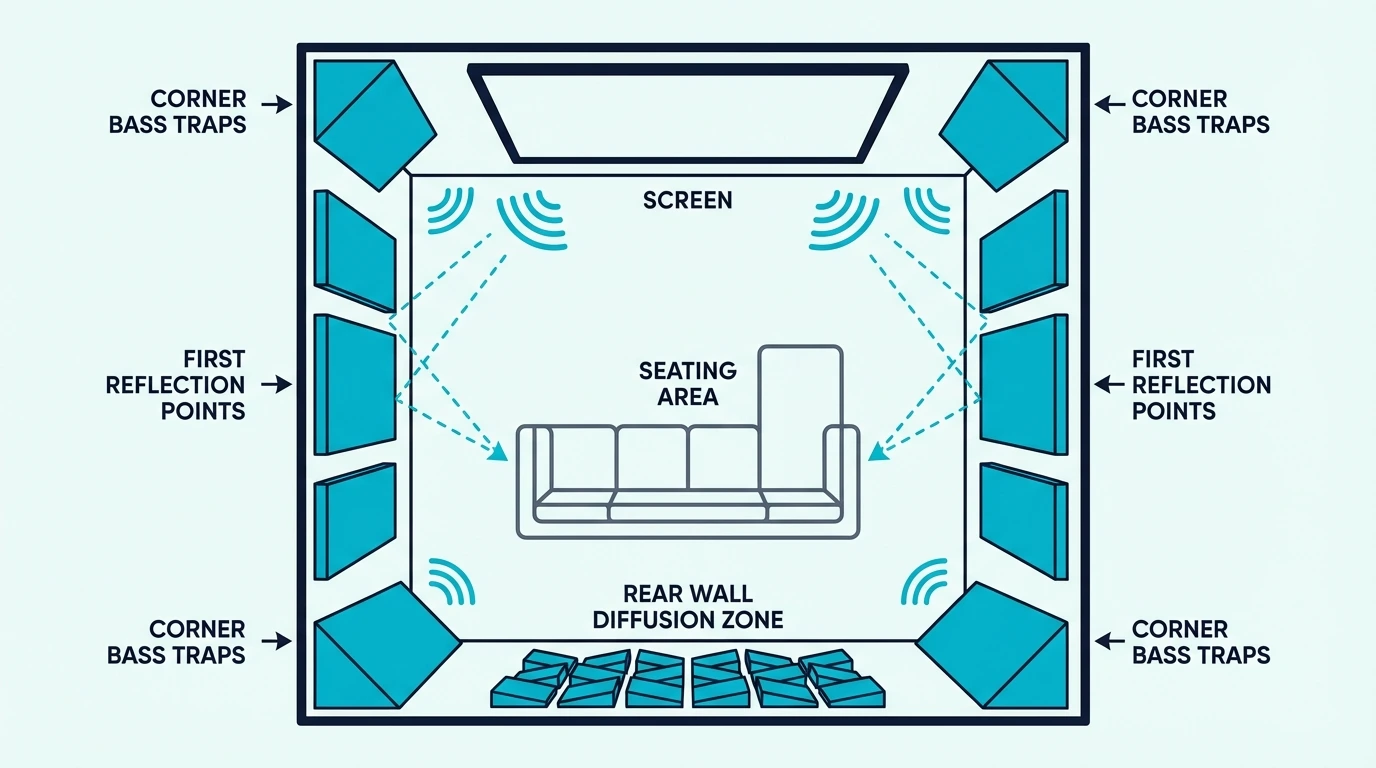
Placement matters as much as panel quantity.
Strategic positioning delivers better results than covering every available surface.
What Are First Reflection Points?
First reflection points are the spots on your walls where sound bounces directly from your speakers to your ears. Find them using the mirror trick: sit in your main viewing position, have someone slide a mirror along the wall, and mark every spot where you can see a speaker reflected.
These are your highest priority treatment locations. Panels here eliminate the reflections that cause the most audible problems.
Two panels per side wall at first reflection points often delivers 80% of the improvement you’ll get from wall treatment.
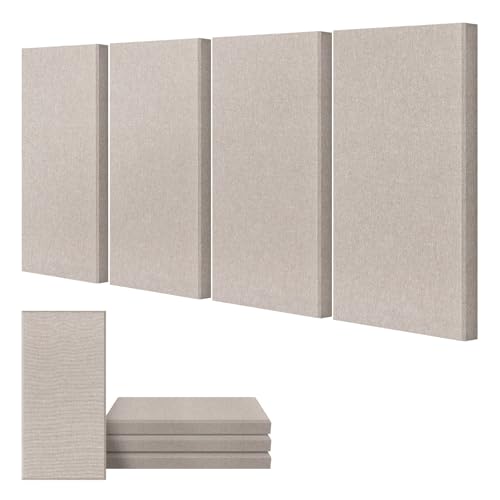
For first reflection points, 2-inch thick fiberglass panels work best. The UMIACOUSTICS 4-Pack Acoustic Panels include mounting hardware and provide the absorption you need at these critical locations.
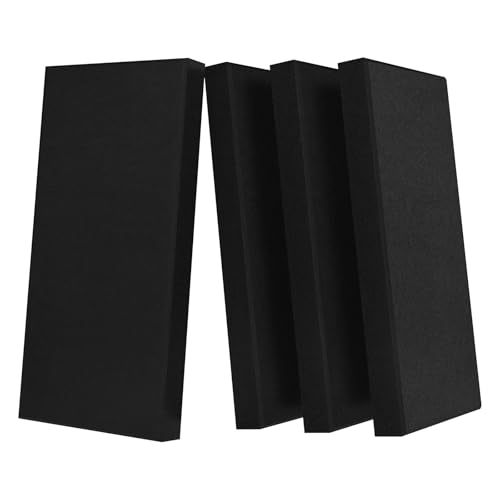
UMIACOUSTICS 4-Pack Acoustic Panels
Should You Treat the Rear Wall?
The rear wall matters, but the approach differs from side walls. Pure absorption can make the room feel dead and uncomfortable for movie watching.
Consider a mix of absorption and diffusion on the rear wall. Diffusion scatters sound rather than absorbing it, maintaining some liveliness while eliminating distinct echoes.
Alternatively, heavy absorption on the lower portion with diffusion above works well in many theaters.
What About the Front Wall?
The front wall behind your speakers is often overlooked. Treatment here can improve imaging and soundstage, making the audio seem more three-dimensional.
Keep treatment to the sides of your screen or projection area. Avoid covering the entire front wall — you want some reflection to maintain the sense of space that makes movies feel cinematic.
Don’t Forget the Ceiling Treatment
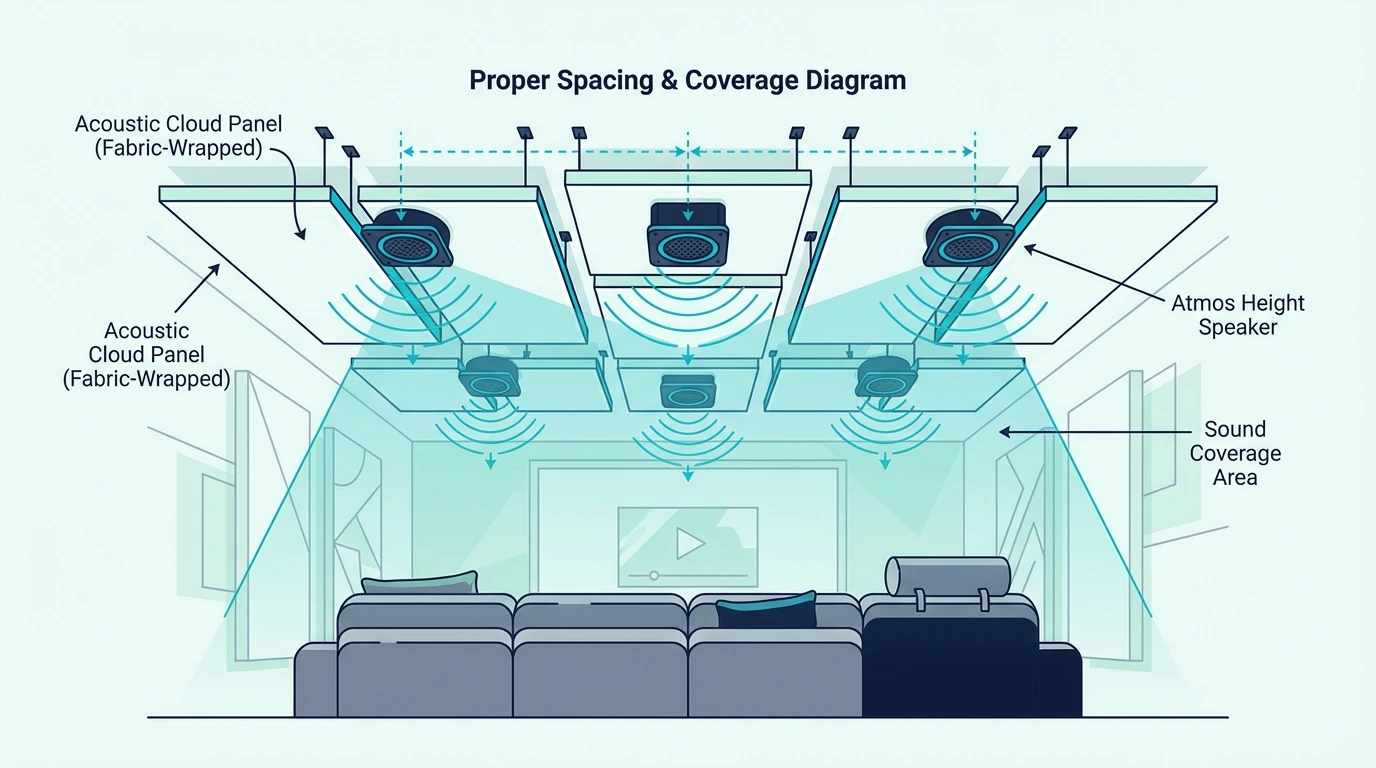
Wall treatment handles the obvious problems, but here’s what most people miss. Ceiling treatment is where many home theaters fall short.
The ceiling reflects just as much sound as the walls, and it’s the critical surface for height channel performance.
Why Is Ceiling Treatment Critical for Atmos?
Dolby Atmos and similar formats use height information to place sounds above you. In-ceiling speakers or upfiring modules rely on controlled overhead acoustics to work properly.
Without ceiling treatment, height effects get smeared and lose their sense of coming from above. The overhead dimension of the mix collapses back down to ear level, defeating the purpose of your Atmos investment.
How Much Ceiling Coverage Do you Need?
Focus on the area directly above your seating positions. A rectangular zone covering the primary and secondary seating rows handles most reflection problems.
For most rooms, 30-40% ceiling coverage over the seating area provides excellent results. you don’t need to treat the entire ceiling — just the zone where first reflections from speakers would reach your ears. the ceiling treatment guide for installation methods.
Why Bass Traps Matter for Home Theater
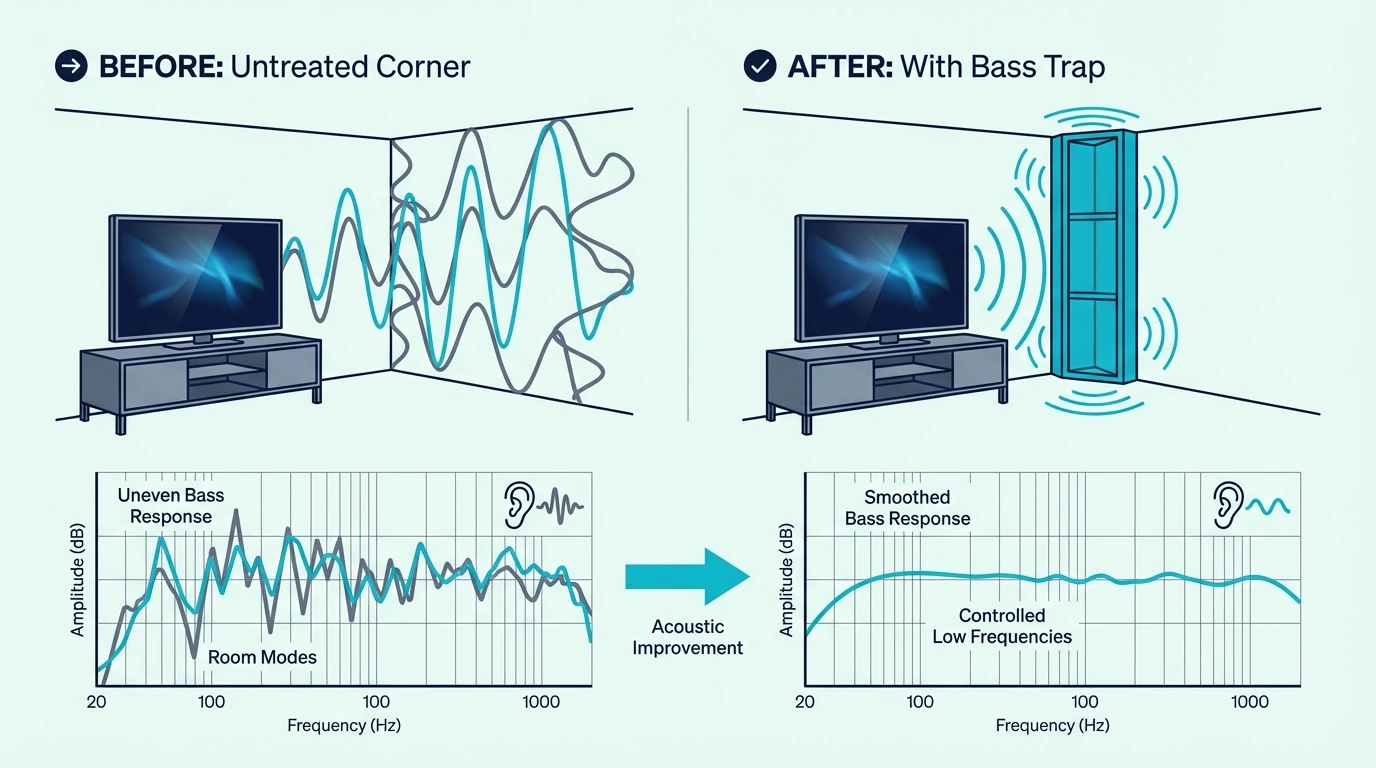
Those wall and ceiling panels address mid and high frequencies. But here’s what they can’t do — standard acoustic panels don’t solve bass problems.
Low frequencies require dedicated treatment that most home theater owners overlook.
What Are Bass Traps?
Bass traps are thick absorbers designed to control low frequencies. They work by providing enough depth for long bass wavelengths to lose energy as they pass through the absorptive material.
Effective bass traps are typically 4-6 inches thick minimum, often thicker. Corner-mounted traps work best because bass energy concentrates in room corners where walls meet.
Where Should Bass Traps Go?
Start with the front corners — where your front wall meets the side walls. These corners see the most bass energy from your main speakers and subwoofer.
Rear corners matter too, especially for rooms with real bass problems. Floor-to-ceiling traps in all four corners represents the gold standard for bass control, though even two front corner traps make a noticeable difference.
How Many Bass Traps Do you Need?
Two corner traps is the minimum for meaningful improvement. Four corner traps (front and rear) provides full bass control for most rooms.
For budget-friendly corner treatment, the JBER 4-Pack Bass Trap covers the basics. For serious low-frequency control, professional options like the ATS Acoustics Corner Bass Trap extends absorption into the lowest frequencies.
Rooms with severe bass problems — concrete construction, small dimensions, or multiple subwoofers — may need additional treatment on walls or ceiling. But start with corners and evaluate before adding more.
How Many Acoustic Panels Does a Home Theater Need?
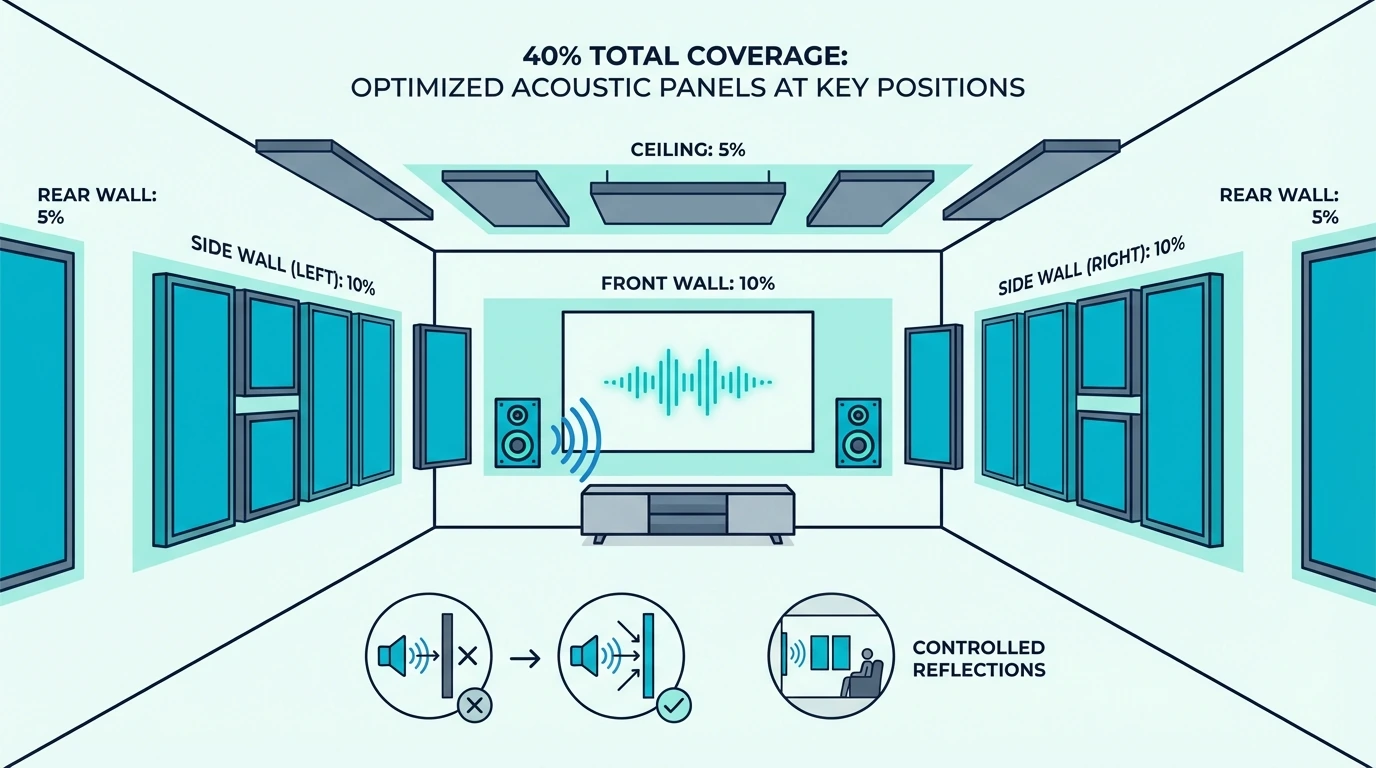
With wall panels, ceiling treatment, and bass traps covered, the next question is quantity. Coverage percentage provides a useful guideline, but quality of placement beats quantity of panels.
What’s the Minimum Effective Treatment?
First reflection points on both side walls plus two corner bass traps represents the minimum meaningful treatment. This might be as few as 6 panels total, but positioned correctly.
you’ll hear immediate improvement with this basic setup. Dialogue clears up, surround imaging improves, and bass tightens noticeably.
From here, additional treatment provides diminishing but still valuable returns.
How Do You Calculate Coverage?
Aim for 25-35% coverage of your wall surfaces for a balanced sound. More absorption (40-50%) works for critical listening but can make the room feel too dead for casual movie watching.
Calculate total wall area, then plan panel placement to hit your target percentage while prioritizing first reflection points.
Use our free tool: the acoustic panel calculator takes your room dimensions and tells you exactly how many panels you need for your target coverage. Enter your room size, select your treatment goals, and get a specific panel count — no guesswork required.
Can You Over-Treat a Home Theater?
Yes — and it’s a common mistake. Rooms with too much absorption feel uncomfortable.
Dialogue sounds unnaturally dry, and the cinematic sense of space disappears.
Keep some surfaces reflective. The goal is control, not elimination.
A well-treated theater should sound clear and defined, not anechoic.
What About Room Shape and Size?
Room dimensions affect which frequencies cause problems. Rectangular rooms with parallel walls create predictable standing waves that treatment can address.
Oddly shaped rooms may have fewer modal problems but can still benefit from first reflection treatment.
Smaller rooms (under 2,000 cubic feet) typically have more bass issues because the problematic frequencies fall in the audible range. Larger rooms push those modal frequencies lower, sometimes below what most content contains.
Either way, first reflection treatment helps regardless of room size.
Budget: How Much Should You Spend?
Understanding what you need helps you spend wisely.
Panels vs Equipment: What Gives Better Value?
Here’s an uncomfortable truth: $500 in acoustic treatment typically improves your listening experience more than $500 in speaker or receiver upgrades.
your equipment can only perform as well as your room allows. A $2,000 speaker system in an untreated room sounds worse than a $1,000 system in a treated room.
The room is the bottleneck, and panels remove it.
What’s a Reasonable Budget Range?
Basic effective treatment runs $300-600 for DIY panels or $600-1200 for commercial products. This covers first reflection points plus corner bass traps.
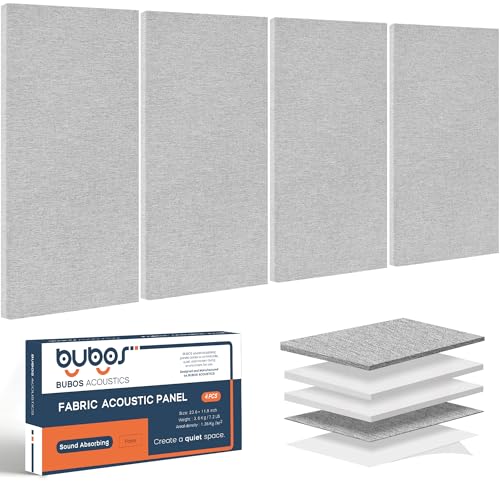
At the budget end, options like these fabric-wrapped acoustic panels let you start with first reflection points for under $100. Mid-range fiberglass panels like the Olanglab Fiberglass Panels offer better absorption at reasonable prices.
Full treatment — full side wall coverage, ceiling panels, and extensive bass trapping — ranges from $1000-3000 depending on room size and whether you DIY or buy commercial. For top-rated options at various price points, the panel recommendations cover the best values.
Common Home Theater Treatment Mistakes
These are the mistakes that waste panels and money.
Over-Dampening the Room
Covering every surface with absorption creates a dead, uncomfortable space. Movies feel lifeless, and you’ll find yourself avoiding the theater because it’s unpleasant to spend time in.
Leave some surfaces reflective. The goal is control, not elimination.
A well-treated theater should sound clear and defined, not anechoic.
Ignoring Bass Treatment
Spending everything on wall panels while skipping bass traps leaves the biggest problem unsolved. you’ll have clear mids and highs with boomy, undefined bass.
Budget for corner treatment from the start. Two quality bass traps cost roughly the same as four wall panels but address problems the wall panels can’t touch. the panels vs bass traps comparison explains when each type works best.
Treating Only Behind the Seating
Some people only treat the wall behind where they sit. While rear wall treatment helps with echo, it misses the first reflection points that cause most dialogue clarity problems.
Side wall treatment at ear level provides more bang for your buck than rear wall treatment alone. Do both if budget allows, but prioritize the sides.
Wrong Panel Placement
Random placement wastes panels. Treating areas that don’t cause problems while ignoring first reflection points gives disappointing results.
Do the mirror trick. Find your actual first reflection points and treat those first.
Strategic placement of fewer panels outperforms random placement of many panels.
These panels consistently deliver results in dedicated home theater setups:
UMIACOUSTICS 4-Pack Acoustic Panels with Brackets
UMIACOUSTICS Standard Fiberglass Acoustic Panels
BUBOS 4-Pack Fabric Wrapped Acoustic Panels
Conclusion
Home theater acoustic treatment comes down to three priorities in order: first reflection panels on side walls, bass traps in corners, and ceiling treatment for height channels. Start with the mirror trick to find your reflection points, treat those first, then expand based on what you hear.
Budget $300-600 for DIY or $600-1200 for commercial panels to cover the basics. That investment typically improves your listening experience more than the same amount spent on equipment upgrades — because the room is the bottleneck, and panels remove it.
Frequently Asked Questions
These are the questions that come up most often about home theater acoustic treatment.
Do All Home Theaters Need Acoustic Panels?
Most dedicated or semi-dedicated theaters benefit much from treatment. Living rooms with lots of soft furnishings may already have adequate absorption naturally.
Do the clap test — if you hear ringing or echo, treatment will help.
Will Panels Improve My Sound System?
Yes, sharply. Panels remove the room as a limiting factor, letting your equipment perform as designed.
The improvement is often more noticeable than upgrading speakers or receivers.
Should I Treat Walls or Ceiling First?
Walls first, specifically the first reflection points on side walls. Ceiling treatment matters most for Atmos systems.
Start with side walls plus corner bass traps, then add ceiling treatment if budget allows.
Can I Skip Panels If I Have an Expensive System?
Expensive systems benefit even more from treatment. High-quality speakers reveal room problems that cheaper speakers mask.
The better your equipment, the more you’ll gain from correct acoustics.
How Long Does Treatment Take to Install?
A basic setup of 6-8 panels takes a few hours for most DIYers. Commercial panels with included mounting hardware install quickly.
Ceiling panels take longer due to overhead work. the installation guide covers the complete process step by step.
What NRC Rating Should Home Theater Panels Have?
Look for panels with NRC ratings of 0.85 or higher. This means the panel absorbs 85% of sound that hits it.
Lower-rated products like thin foam (NRC 0.30-0.50) won’t provide meaningful improvement for theater applications.