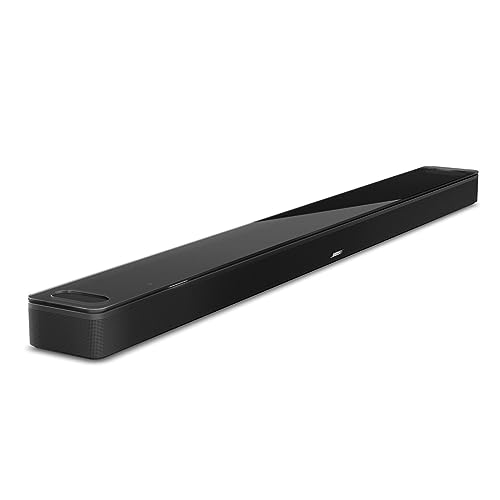
5.1 Surround Sound vs Soundbar: Which System Actually Fits Your Room?
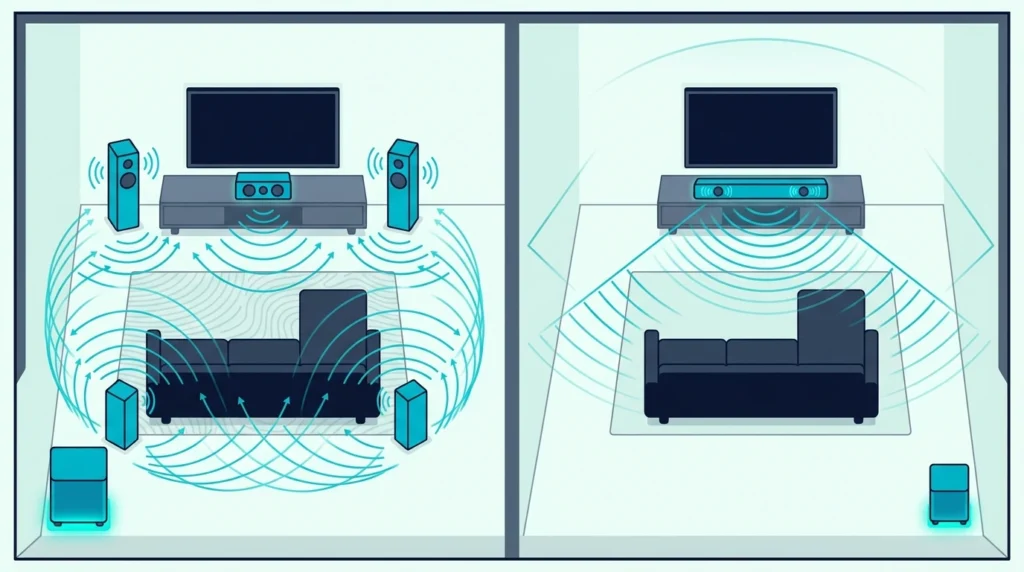
The 5.1 surround vs soundbar question sounds like a simple battle between better audio and easier setup, but the better system on paper is not always the better fit in a real living room.
That is where many buyers get it wrong.
They assume discrete 5.1 automatically wins.
Then they discover the bigger issue was speaker placement, cable runs, and receiver setup that turn the room into a project long before the extra performance pays off.
Once you separate raw performance from real-world fit, the decision gets much easier.
You can choose the setup that matches your room, your budget, and your tolerance for installation instead of paying for hardware you never position or calibrate properly.
The first move is to compare how each system handles movies, daily TV, gaming, and setup complexity.
That tells you when 5.1 surround is worth the hassle and when a soundbar is the smarter buy.
A discrete 5.1 surround system still wins on true directional audio, upgrade flexibility, and the highest ceiling for movie performance. A soundbar wins on simplicity, cleaner installation, lower total cost, and the fact that it is far easier to set up correctly in an ordinary living room.
If you have a dedicated room and do not mind an AV receiver, separate speakers, and calibration, 5.1 is better. If you want the most practical upgrade over TV speakers with less hardware and less friction, a soundbar package is usually the smarter buy.
What Is the Real Difference Between 5.1 Surround and a Soundbar?
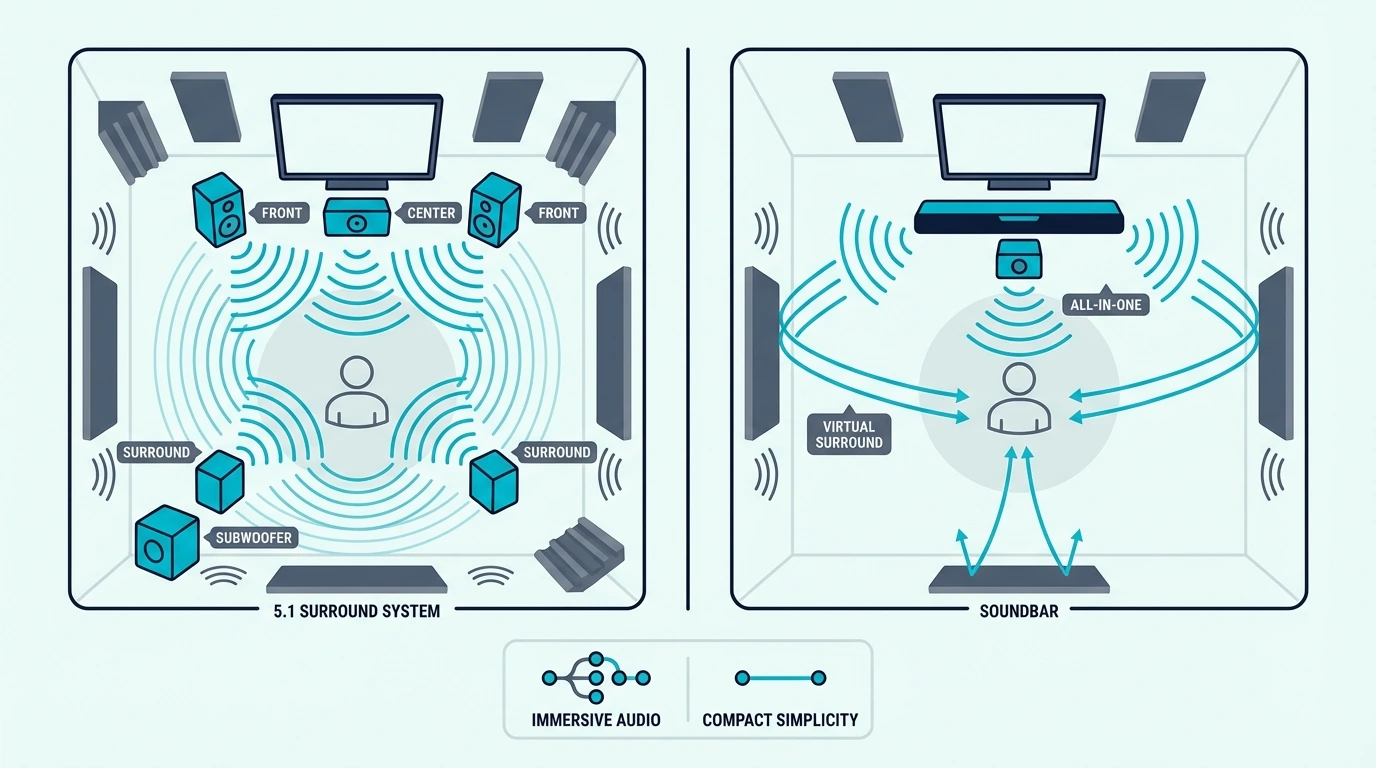
The term “5.1” appears in both categories, but the hardware behind it is not the same.
One approach uses separate speakers placed around the room.
The other compresses most of the job into a bar that lives under the TV.
Discrete 5.1 Surround Sound
A discrete 5.1 system has six physical components.
You get a left front speaker, a center speaker, a right front speaker, a left rear surround speaker, a right rear surround speaker, and a subwoofer.
All six connect to an AV receiver that decodes the audio signal and routes each channel to its dedicated speaker.
Each speaker handles only its assigned channel.
The center speaker plays only dialogue and the rear speakers play only surround effects.
This physical separation means there is zero overlap between channels, so every sound comes from exactly the direction the content creator intended.
The AV receiver also handles amplification, room calibration, and format decoding like Dolby Digital, DTS, and Dolby Atmos.
Higher-end receivers run automatic room correction.
That measures your specific room’s acoustics and adjusts each speaker’s output to compensate for reflections, distance, and frequency response.
Soundbar Systems
A soundbar compresses multiple channels into a single front bar.
Some packages add a subwoofer and wireless rear speakers to get closer to real surround.
That makes the system far easier to place, wire, and live with even before you talk about audio quality.
For buyers who want the soundbar version of surround without a receiver stack, current examples include Samsung Q800F 5.1.2ch Q Series Soundbar + Subwoofer for a more cinematic living-room package and Bose Smart Ultra Dolby Atmos Soundbar when you care more about minimal hardware and day-to-day simplicity.
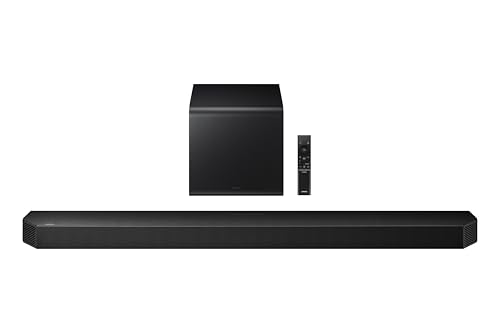
Samsung Q800F 5.1.2ch Q Series Soundbar + Subwoofer
At that point, the question shifts from whether soundbars can mimic surround at all to how much installation complexity you want to keep out of the room.
The Core Difference
A discrete system puts real speakers at real positions around your room.
A soundbar puts all or most of its speakers in front of you.
It uses driver design, processing, and sometimes wireless rears to compress that experience into a smaller package.
That processing has gotten remarkably good.
In a moderately sized room with solid side walls, a good soundbar can sound more convincing than many buyers expect.
But physics still favors a speaker that is actually behind you over a speaker that bounces sound off your wall to approximate the same effect.
When Does 5.1 Surround Beat a Soundbar, and When Does a Soundbar Win?
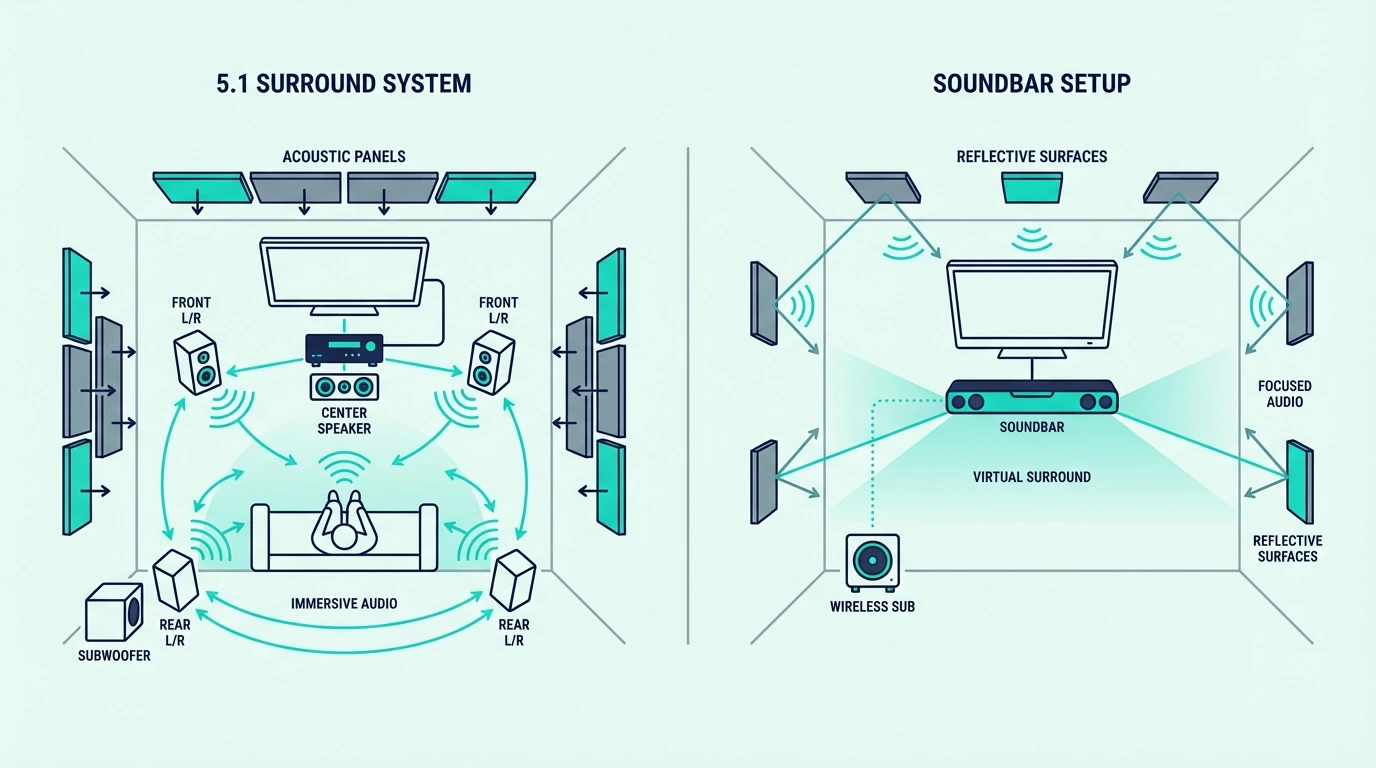
The performance gap between discrete 5.1 and a soundbar varies dramatically depending on what you’re listening to and how your room is configured.
Movies and Cinematic Content
This is where discrete 5.1 earns its biggest advantage.
Films are mixed with specific audio elements assigned to specific channels.
That can mean a helicopter panning from left front to right rear, rain falling from the surround channels, or dialogue anchored to the center.
A discrete system reproduces this mix with physical precision.
Each sound comes from its intended direction because there is a real speaker at that position.
A soundbar approximates this with processing.
While the effect can be convincing in a well-shaped room, it never matches the pinpoint accuracy of discrete speakers placed at calibrated positions.
For serious movie watchers who notice the difference between a sound coming from their actual left-rear and a sound bouncing off their left wall to simulate that direction, discrete 5.1 is the clear winner.
Casual TV and Streaming
For everyday TV watching like news, sitcoms, reality shows, and sports, the surround advantage shrinks dramatically.
Most TV content has simple stereo or basic surround mixes where the rear channels carry minimal audio.
A soundbar handles casual TV content as well as a discrete system in practical terms. The center channel (in a 3.1+ bar) keeps dialogue clear, and the front stereo image is wide enough for non-cinematic content.
Music
Music is mixed in stereo, so neither a 5.1 discrete system nor a soundbar’s surround processing adds meaningful value to a two-channel recording. For music, the quality of the speakers matters more than the channel count.
Discrete speakers — especially bookshelf or tower speakers designed for music — generally produce richer, more detailed sound than a soundbar’s built-in drivers.
If music listening is a priority, dedicated speakers outperform soundbars at every price point.
Our soundbar vs receiver guide explains why component-based systems still appeal to enthusiasts.
Gaming
Gaming audio often includes full surround mixes with positional cues — footsteps behind you, gunshots from specific directions, environmental audio that changes as you move. A discrete 5.1 system reproduces these cues with physical accuracy.
A soundbar with rear speakers approximates the effect well. A front-only soundbar struggles with rear positioning regardless of how sophisticated the virtual surround processing is.
Setup and Daily Use
A discrete 5.1 system requires speaker placement at specific positions, cable management or wireless receiver connections, an AV receiver that occupies shelf space, and initial calibration.
Changing inputs, adjusting settings, and troubleshooting multiple connected components adds daily friction.
A soundbar plugs into your TV with one HDMI cable and works immediately — our HDMI ARC guide covers the connection.
Volume syncs with your TV remote.
There is nothing to calibrate, no cables to run across the room, and no receiver to manage.
For most households, the simplicity of a soundbar means it actually gets used daily. A discrete system that’s poorly set up or calibrated often sounds worse than a decent soundbar that’s connected correctly.
Shared Living Spaces and the Best Middle Ground
A full 5.1 system often loses on practicality before audio quality even enters the conversation.
Rear speaker stands, visible wire runs, and a receiver rack are hard sells in living rooms shared with partners, kids, or roommates, even when the sound is objectively better.
That is where soundbar packages with wireless rear speakers earn their keep.
They give you actual speakers behind the couch, better directional effects than a front-only bar, and far less installation friction than a receiver-based 5.1 system.
They still do not match the upgrade flexibility or channel separation of discrete speakers, but they close more of the real-world gap than many buyers realize.
If you want a simpler system now with room to expand later, the Sony HT-A3000 is the kind of soundbar that makes more sense than jumping straight into a receiver-based system you may never fully wire and calibrate.

Sony HT-A3000
Get Studio Tips Weekly
Join 5,000+ creators getting acoustic treatment advice every week.
No spam. Unsubscribe anytime.The Bottom Line
A discrete 5.1 surround system delivers the more convincing movie experience because it puts real speakers around the room.
A soundbar wins by removing the receiver stack, cable runs, and setup friction that keep many living-room theater plans from ever working as intended.
Choose discrete 5.1 if you have a dedicated media room with space for five speakers, a budget for a receiver plus speakers, and the patience to run cables and calibrate. If you are still deciding whether a receiver-based path fits your room at all, our soundbar vs receiver guide is the better next step.
Choose a soundbar if you want a meaningful audio upgrade with minimal hardware, live in a space where rear speakers are impractical, or know convenience matters more than squeezing out the last bit of surround precision. If you want the most direct next step on soundbar channel counts, our 3.1 vs 5.1 soundbar comparison is the better follow-up.
If budget is the primary constraint, a competent soundbar usually makes more sense than trying to stretch the same money across a receiver, five speakers, and a subwoofer.
For shopping rather than theory, the best budget soundbar guide is the useful next click.
The gap between them narrows every year as soundbar processing improves, but physics still gives the edge to speakers that are actually around you instead of simulated from the front.
Start with the soundbar fundamentals hub for the broader category view.
If you want a higher-channel soundbar comparison next, the 5.1 vs 3.1.2 soundbar guide is the right continuation.
Frequently Asked Questions
Is a 5.1 system better than a soundbar?
A 5.1 discrete system produces better spatial separation and directional accuracy because the speakers are physically positioned around your room. The audio quality ceiling is higher for movies and immersive content.
A soundbar is better for practical daily use — simpler setup, less hardware, easier to live with.
For casual viewing, the difference is minimal.
Do soundbars replace 5.1 systems?
Soundbars have replaced discrete 5.1 for the majority of living rooms because they deliver a significant TV audio upgrade with dramatically less hardware and complexity.
For dedicated home theater enthusiasts, discrete systems still offer performance that soundbars cannot fully replicate.
Premium soundbar systems with wireless rear speakers come closest to discrete 5.1 performance while maintaining the simplicity advantage.
Is Netflix 5.1 or normal audio?
Netflix supports 5.1 surround sound on most content when your hardware supports it.
Look for the “5.1” badge on titles.
That content will output a full surround signal if your soundbar or receiver and TV connection like HDMI ARC or eARC support surround decoding.
Standard plans stream in stereo by default, while premium plans unlock Dolby Atmos on select titles. Our HDMI ARC guide covers the connection requirements for surround audio.