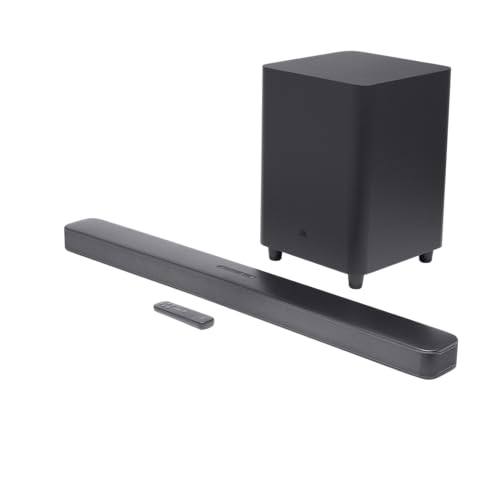
JBL Soundbar 9.1 vs 5.1: Is Dolby Atmos Worth the Upgrade?
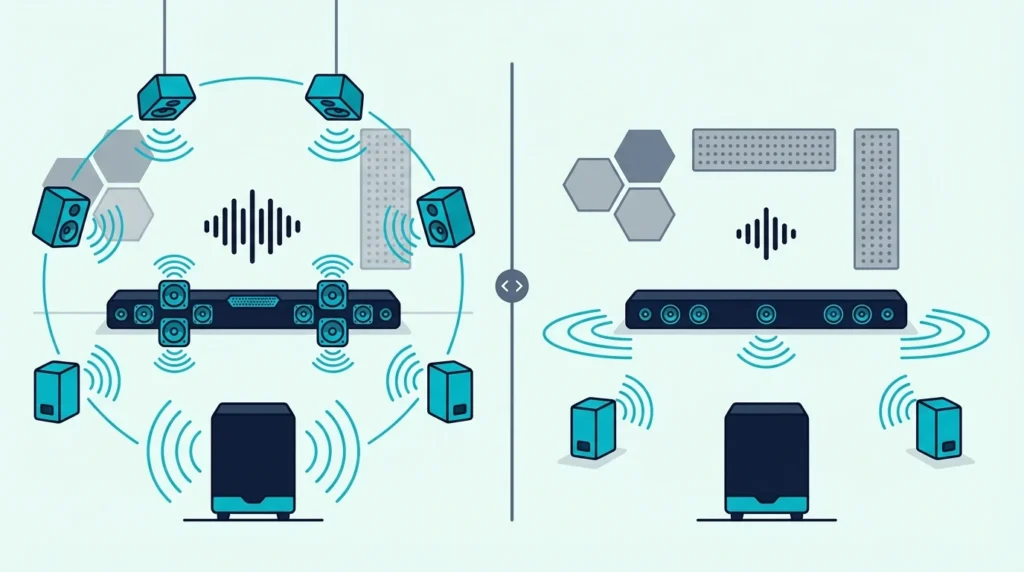
The JBL soundbar 9.1 vs 5.1 decision looks simple at first: pay more, get Dolby Atmos. The catch is that the Atmos upgrade only pays off when your room can actually return those height effects.
That is where buyers get burned. The 9.1 can sound far more cinematic in the right room, but vaulted ceilings, ceiling fans, and extra ceiling height can scatter the reflected sound enough that the premium lands flat.
The good news is that this choice gets much easier once you match each bar to your room and content mix. You can usually tell pretty quickly whether the 9.1 will earn its premium or whether the 5.1 already gives you the smarter value.
Below, we’ll break down what each JBL system includes, how the Atmos upgrade performs in real rooms, and which setup fits different budgets and room configurations. That should make the next move obvious before you spend on the wrong JBL package.
The JBL Bar 5.1 is the better value for most rooms because it already gives you detachable wireless surrounds and a powerful 10-inch subwoofer. If most of your viewing is standard streaming, cable, or non-Atmos discs, it covers the experience that matters.
The JBL Bar 9.1 earns its premium only if you have a flat standard-height ceiling and regularly watch Atmos content. If your ceiling is vaulted, very high, or broken up by fans, save the premium and go with the 5.1.
What Does Each JBL System Actually Include?
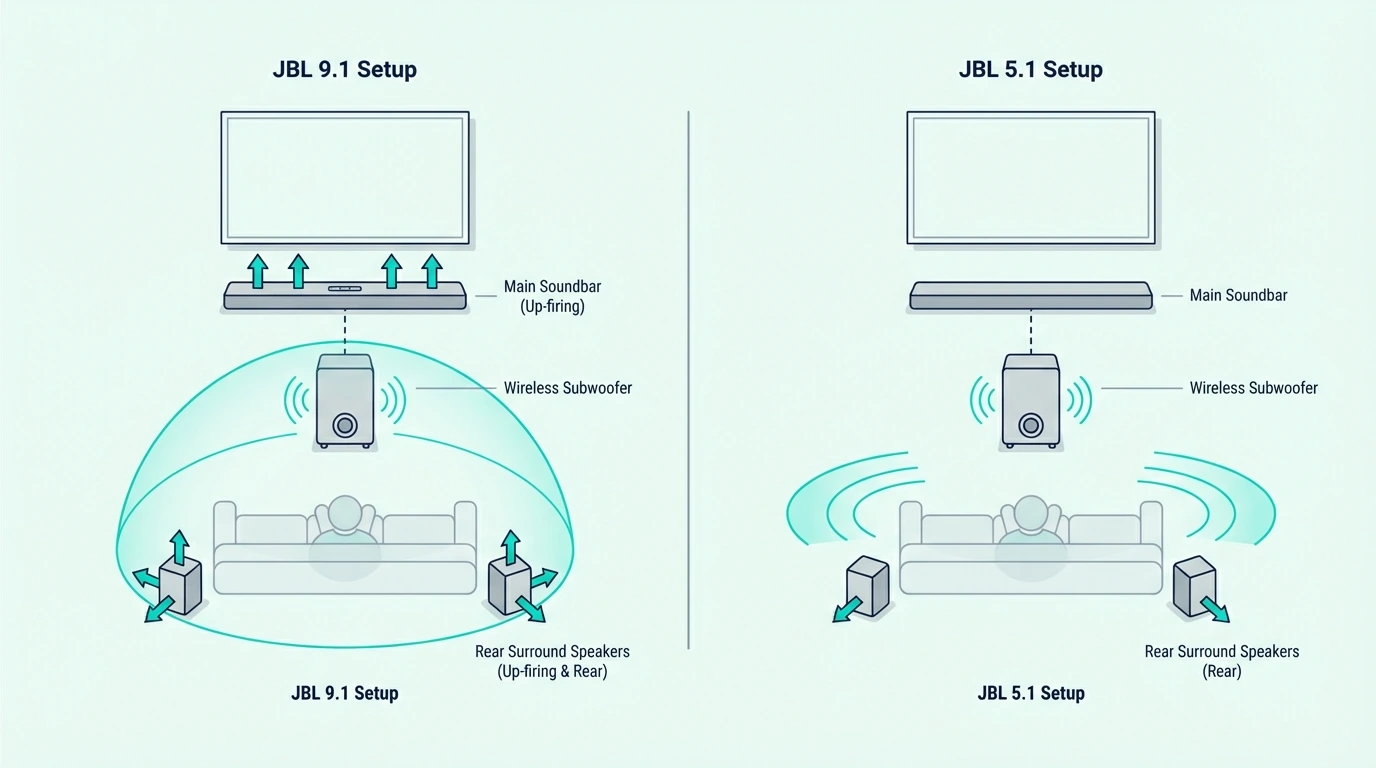
Both JBL systems share the same core design philosophy — a main soundbar with detachable wireless surround speakers that magnetically attach to the bar for charging and detach for room placement during use. The difference is entirely in the Atmos height channel hardware.
What Does the JBL Bar 5.1 Actually Give You?
The JBL Bar 5.1 is a 5.1-channel system with three front channels (left, center, right) in the main bar, two detachable wireless battery-powered surround speakers, and a 10-inch wireless subwoofer. The surround speakers charge by magnetically attaching to either end of the main bar and run for up to 10 hours on a single charge when detached.
This design solves the biggest problem with traditional 5.1 soundbar systems. You get true discrete surround from physically separated rear speakers without running speaker wire across your room, and the surround speakers deliver genuine rear channel audio that bar-only surround simulation cannot match.
If you want the broader buying context behind that step-up, the best Dolby Atmos soundbar guide shows where physical rears and height effects start to matter. It is a good next read if you are still deciding whether detachable rears matter more than Atmos branding.
The 5.1 supports virtual Dolby Atmos processing through its standard drivers, simulating height effects without dedicated upfiring hardware. That adds some perceived height but is noticeably less convincing than the physical upfiring drivers in the 9.1, and the soundbar buying guide explains how channel counts translate into real use.
What Does the JBL Bar 9.1 Add Over the 5.1?
The JBL Bar 9.1 is technically a 5.1.4 Dolby Atmos system — the same 5.1 base configuration as the Bar 5.1 plus four dedicated upward-firing drivers specifically designed to bounce sound off your ceiling and back down to your listening position. Two upfiring drivers sit in the main bar, and two are built into the detachable surround speakers.
These upfiring drivers handle the Dolby Atmos height channel, creating the perception of sound coming from above — rain falling overhead, helicopters passing over, ambient atmospheric effects that add a vertical dimension to the soundstage. The effect is most pronounced during Atmos-encoded content available on Netflix, Disney+, Apple TV+, and 4K Blu-ray discs.
The 9.1 uses the same 10-inch wireless subwoofer and the same detachable surround speaker design as the 5.1, with the surround speakers being slightly larger to accommodate the upfiring drivers inside. Our soundbar fundamentals guide explains how different driver configurations affect audio performance, and the best overall soundbar guide helps frame when bigger channel counts are actually worth paying for.
How Does Real-World Performance Change by Room?
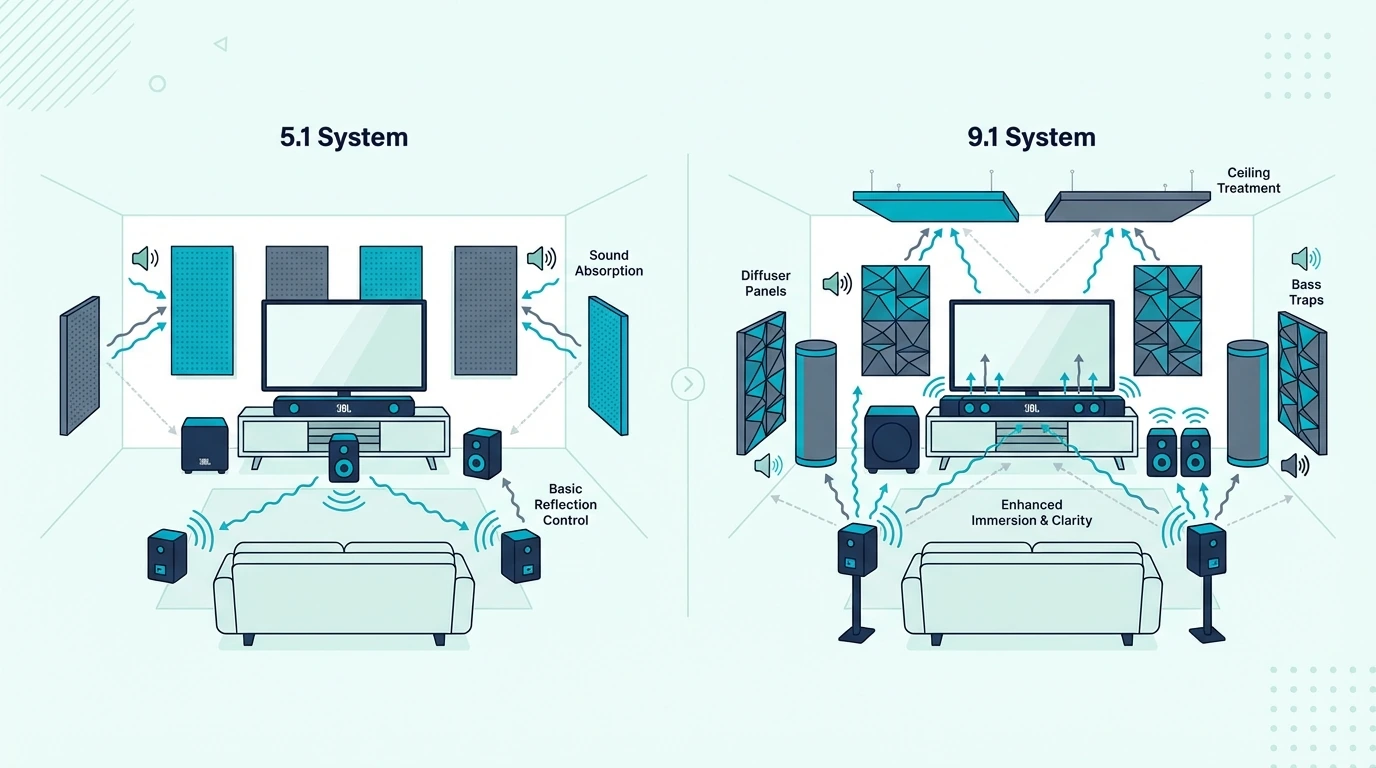
The spec sheet makes the 9.1 look like a straightforward upgrade, but real-world Atmos performance depends heavily on your room’s physical characteristics in ways that standard surround does not. That is why the same price jump can feel dramatic in one room and underwhelming in another.
Why Do Atmos Height Channels Depend So Much on Your Ceiling?
The upfiring drivers in the JBL Bar 9.1 work by projecting sound upward at an angle so it reflects off the ceiling and arrives at your ears from above. This reflection trick requires a flat, hard ceiling at standard height (8-10 feet), because vaulted, angled, or very high ceilings scatter the reflected sound before it lands cleanly.
In a room with a flat ceiling at 8-9 feet, the Atmos effect from the 9.1 is genuinely impressive — overhead rain, flyover effects, and ambient height audio are clearly perceptible and add a layer of immersion the 5.1 cannot deliver. In a room with a 12+ foot ceiling or cathedral-style vaulting, the Atmos effect is subtle to undetectable, making the price premium hard to justify.
If you’re trying to price the upgrade path, the best overall soundbar guide helps frame the broader budget ladder. The best Dolby Atmos soundbar guide shows when paying more for height effects makes more sense.
How Similar Are These Bars With Standard Surround Content?
For standard 5.1 surround content (which is the majority of movies and TV shows), both systems perform identically — the same front channels, same wireless surround speakers, and same subwoofer deliver the same surround experience. The 9.1’s additional Atmos drivers only activate when receiving Atmos-encoded content.
If most of your viewing is standard 5.1 content from cable TV, standard streaming, or non-Atmos Blu-rays, the 5.1 delivers the full experience without the Atmos premium. For large-room movie use, a current example is JBL Bar 700MK2 5.1.2ch Soundbar System with Subwoofer and Rear Speakers, which is a stronger fit for more immersive movie playback.
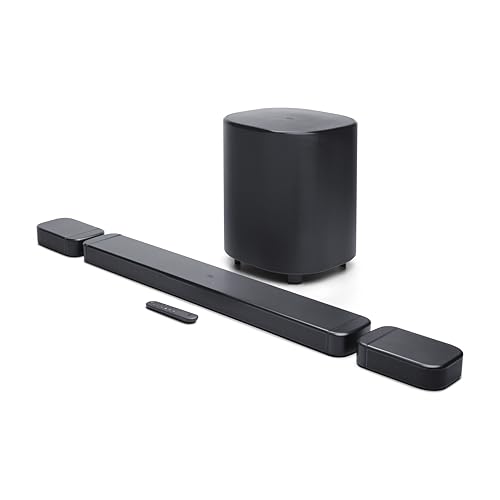
JBL Bar 700MK2 5.1.2ch Soundbar System with Subwoofer and Rear Speakers
The TV-to-soundbar guide explains why HDMI eARC matters for Dolby Atmos passthrough. The soundbar-to-TV connection guide covers the setup basics for both systems.
Which JBL Bar Is the Better Value?
The JBL Bar 9.1 typically costs several hundred dollars more than the Bar 5.1, and that premium buys four upfiring drivers plus native Atmos decoding — a worthwhile investment if your room supports Atmos and you regularly watch Atmos content. Buyers who want the full JBL ecosystem with a smaller price jump can look at the JBL Bar 700MK2, which gives you 5.1.2-channel Dolby Atmos with physical rear speakers and a wireless subwoofer at a lower price than the 9.1.
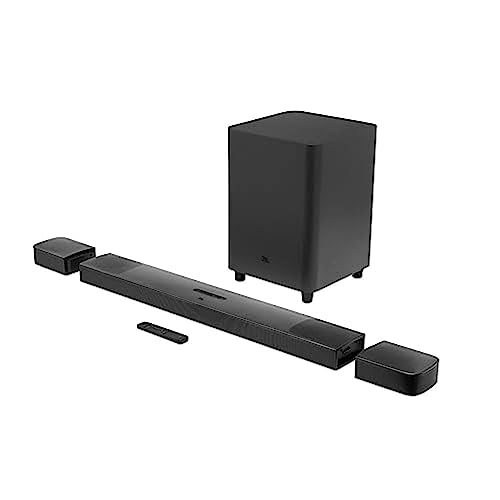
JBL Bar 9.1
The best Dolby Atmos soundbar guide covers the soundbar side of that value question if you are still comparing premium Atmos options. The soundbar setup guide covers the configuration work both JBL systems still need after you buy.
Which Rooms Should Just Buy the JBL Bar 5.1?
If your ceiling is vaulted, very high, or interrupted by fans, the Bar 5.1 is usually the smarter buy because it gives you the same detachable surrounds and subwoofer without asking the room to cooperate with reflected height effects. The best overall soundbar guide is the next stop if you want to compare that value play against other strong systems in the same budget band.
The 5.1 also makes more sense if your content mix is mostly standard streaming, cable, sports, or older discs. In those cases, the best soundbars for dialogue guide and the TV-to-soundbar guide help more than paying extra for Atmos hardware you rarely trigger.
Who Should Stretch for the JBL Bar 9.1?
The 9.1 is the better pick if you have an 8-10 foot flat ceiling and you actually watch Atmos-heavy movies, premium streaming mixes, or immersive games often enough to notice the height layer. Buyers in that lane should also compare it against the best Dolby Atmos soundbar roundup and the best gaming soundbar guide before paying flagship money.
It also makes more sense if you want the most theater-like JBL package without stepping to a receiver and separate speakers. If you are still weighing that jump, the broader soundbar hub helps map the rest of the category.
Get Studio Tips Weekly
Join 5,000+ creators getting acoustic treatment advice every week.
No spam. Unsubscribe anytime.The Bottom Line
The JBL Bar 5.1 is the better value for most rooms — it delivers true wireless surround with detachable rear speakers and a powerful subwoofer that handles the vast majority of movie and TV content at its best. The 9.1 is worth the upgrade only if you have a flat ceiling at standard height and regularly watch Atmos-encoded content.
Our JBL vs Polk soundbar comparison covers how JBL’s systems compare to Polk’s dialogue-focused alternatives, and the broader soundbar hub maps the next decision path if you still want to compare brands, setups, and room fits. That gives you an easy next step if this comparison narrowed the field but did not fully close the decision.
Frequently Asked Questions
Is JBL 9.1 worth buying?
The JBL Bar 9.1 is worth buying if you have a flat ceiling at standard height (8-10 feet) and regularly watch Dolby Atmos content on Netflix, Disney+, or 4K Blu-ray. The four upfiring Atmos drivers create a genuinely immersive overhead audio effect that the 5.1 cannot replicate — but in rooms with vaulted or very high ceilings, the effect is significantly diminished.
Is JBL Bar 5.1 worth it?
The JBL Bar 5.1 is excellent value for a true wireless surround system — the detachable battery-powered rear speakers deliver genuine 5.1 separation without speaker wire, and the 10-inch subwoofer provides deep bass for movies and music. It handles the vast majority of content at full quality and is the better choice for rooms where Atmos ceiling reflection won’t work effectively.
For large-room movie use, a current example is JBL Bar 5.1, which is a strong fit for TV and movies when you want fuller bass. It makes the most sense when you want the JBL layout without paying flagship Atmos money.
Does the JBL 9.1 have Dolby Atmos?
Yes, the JBL Bar 9.1 has native Dolby Atmos with four dedicated upward-firing drivers — two in the main bar and two in the detachable surround speakers. These physical upfiring drivers bounce sound off your ceiling for genuine overhead audio effects, unlike soundbars that only simulate Atmos through DSP processing on standard forward-facing drivers.

