How to Soundproof a Hot Tub Motor Without Blocking Its Vents
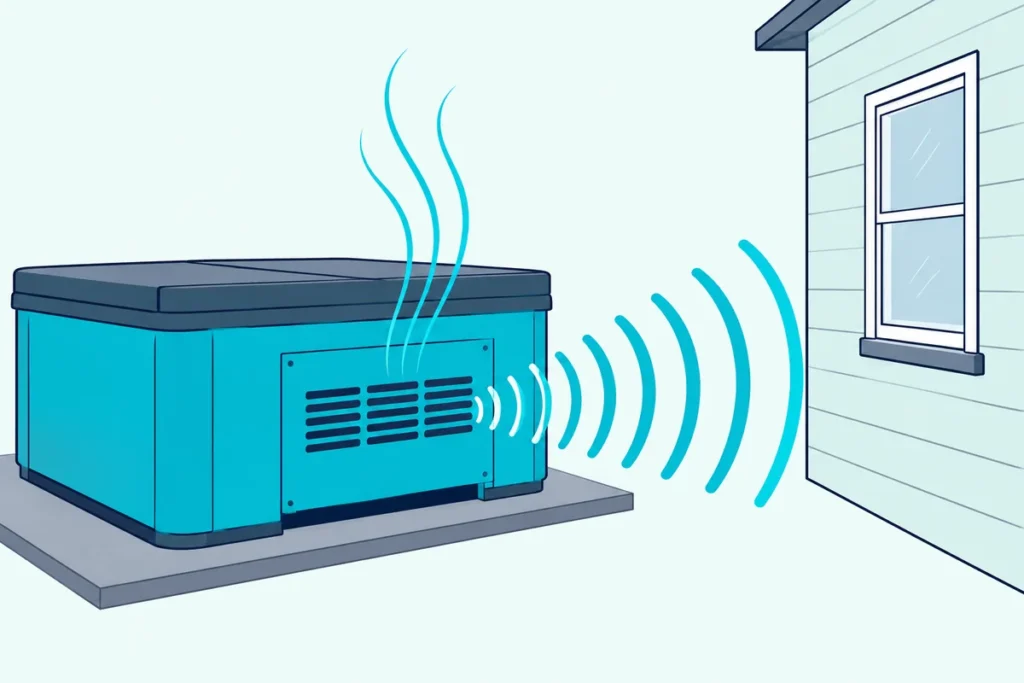
If you’re working out how to soundproof a hot tub motor, start with the pump, its mounting and its filter schedule, then block the sound outside the cabinet, because spa makers want air moving through it.
That hum usually comes from a jet pump on its filter cycle or a circulation pump that may run all night, carrying straight to a bedroom window.
Done in that order, the fixes take the edge off the noise without starving the motor of the cooling air it needs.
The first check is free: Bullfrog’s manual says a shipping bolt left near the pump’s foot can cause vibration noise, and a gurgle may only be trapped air.
The steps below run from free checks to a barrier wall, and the sections after them show what each maker allows in and around the cabinet.
How to Soundproof a Hot Tub Motor in Eight Steps
That order matters because the cheap steps treat the pump itself, while the costly ones only catch its sound on the way out.
| Step | What to do | Why it helps |
|---|---|---|
| 1 | Rule out a fault | Laing names air, a worn bearing and debris as causes of a noisy pump |
| 2 | Remove any shipping bolt | Bullfrog says one left in place can cause vibration noise |
| 3 | Support the pump and its pipes | Aqua-Flo lists plumbing vibration under pump noise |
| 4 | Move the filter cycles | Bullfrog’s and Jacuzzi’s controls let you reschedule them |
| 5 | Keep the vents and the air gap clear | Hot Spring and Bullfrog tie blocked vents to an overheating pump |
| 6 | Add distance | About 6 dB less per doubling of distance (FHWA) |
| 7 | Block the line of sight with a solid wall | Barriers suit sources at or below ground level (HUD) |
| 8 | Leave part swaps to the dealer | Hot Spring counts component changes as alterations that can void its warranty |
Nothing on the list seals up the cabinet, and the sections below explain why. If your spa’s pump sits on its own equipment pad instead, the steps to soundproof a pool pump fit it better.
What Makes the Noise in a Hot Tub’s Equipment Bay?
Those steps work on several machines that share one compartment, so it helps to determine which one is running. The jet pumps and the circulation pump do the long runs, while the ozone injector, the diverter valve and freeze protection explain sounds that worry owners but are normal.
| What you hear | Likely source | What the maker says |
|---|---|---|
| A steady low hum, day and night | Circulation pump | Hot Spring calls its Silent Flo 5000 a quiet pump that provides continuous filtration |
| A louder run twice a day | Jet pump on low speed during a filter cycle | Bullfrog spas without a dedicated filtration pump filter on jet pump 1 |
| Every pump starting on a frosty night | Freeze protection | Bullfrog says all jet pumps turn on when freezing conditions are detected |
| A gurgle at one fitting | Ozone injector | Laing says ozone injection can gurgle without a pump problem |
| Louder rushing between jet settings | Diverter valve | Jacuzzi calls higher sound levels between valve positions normal |
Jacuzzi describes the circulation pump as a low-flow “hush pump” that moves water through the filtration system. A spa with one can do its main filtering without the jet pump, while Bullfrog spas without one run jet pump 1 for every filter cycle.
Get Studio Tips Weekly
Join 5,000+ creators getting acoustic treatment advice every week.
No spam. Unsubscribe anytime.Is the Noise a Fault You Should Fix First?
Everything in that table is normal, which is why a new grind, rattle or gurgle deserves a look before any soundproofing. Yes, check first: a faulty pump makes noise no wall will stop, and the makers’ troubleshooting and maintenance pages name the usual causes.
| Sound | Likely cause (source) | What to do |
|---|---|---|
| Vibration noise in a new spa | A shipping bolt near the pump’s foot (Bullfrog) | Remove it, an optional start-up step |
| Gurgling after a refill | Air still in the system (Laing) | Cycle the pump on and off, then purge if it persists |
| Grinding or a sudden new noise | Dry running, a worn rotor bearing or debris (Laing) | Switch off at once and call your supplier |
| A hum with shaking pipes | Unsupported lines or suction-side cavitation (Aqua-Flo) | Support the lines and check the suction line |
| Jets surging on and off | Low water or dirty filters (Bullfrog) | Top up and clean the filters |
| Excessive noise or a burning smell | A defective pump motor (Bullfrog) | Call an authorized dealer |
The shipping bolt is the fault most owners can fix themselves, and Bullfrog’s A Series owner’s manual says spas with a circulation pump carry a similar bolt on that pump too. Hot Spring adds that a jet pump which shuts itself off in an older spa could indicate failing motor bearings.
Laing’s E-10 circulation pump manual, in Spatex’s copy for Australian owners, says a properly purged pump should run quietly. Turn off the breaker before you open the cabinet, since Hot Spring’s manual says to disconnect the spa before servicing its electrical components.
Can You Move the Filter Cycles Away From Bedtime?
Once the pump checks out, the cheapest quiet comes from changing when it runs. Usually yes: Bullfrog’s and Jacuzzi’s controls let you change the filtration schedule, though freeze protection and 24-hour circulation still run at night.
Bullfrog’s A Series ships with 1.5-hour filter cycles at 8:00 in the morning and 8:00 at night, and its manual shows how to edit them or add more. Jacuzzi’s J-300 owner’s manual starts an 8-hour primary filtration at midnight by default and lets you move its start and end times.
Shift the long cycle into the day rather than cutting it short, because Jacuzzi’s advice is to follow the maker or run the circulation pump at least eight hours a day. Jacuzzi also deducts circulation runs outside a cycle, such as heating, from the next cycle, so a new schedule won’t stop every night-time run.
Winter changes the rules: Bullfrog’s freeze protection starts every jet pump when it detects freezing conditions, and Jacuzzi says to run the primary cycle for 24 hours below 32°F. Hot Spring builds its spas around 24-hour filtration with a pump it calls quiet, so there the fault checks and the mounting matter more than the schedule.
Will an Anti-Vibration Mount Quiet a Hot Tub Pump?
Rescheduling moves the noise in time, but vibration takes a second path, from the pump’s feet into whatever it’s mounted on. It can, when that path is the problem: Hayward’s help page for its pool pumps says vibration from a pump’s feet and base can make it noisy, and suggests rubber between the base and the pad.
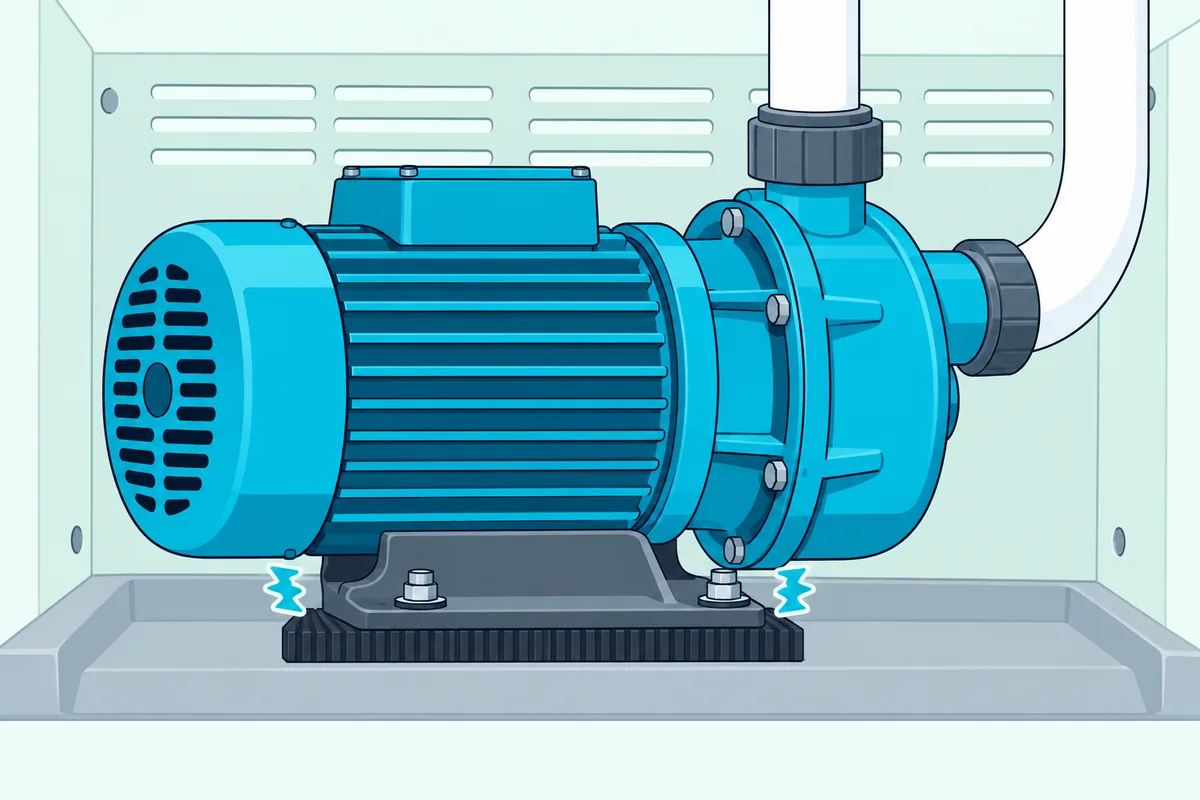
Jandy’s VS FloPro manual says to bolt its pool pump to a solid foundation or set it on a rubber mat to reduce the chance of vibration noise. Inside a spa cabinet the pump must still stay put: Laing wants its circulation pump screwed to a solid base, with the tubing supported separately.
The Spa Depot Silencer pump base is a ribbed rubber base with bolt grommets that its listing says fits 48 and 56 frame motors from Waterway, Aquaflo, LX, HydroMaster and most other pump brands, so the pump stays bolted down with rubber in between. Check the pump’s mounting bracket first, since the listing says some motors need two bases or cutting, and the nuts, bolts and washers aren’t included.
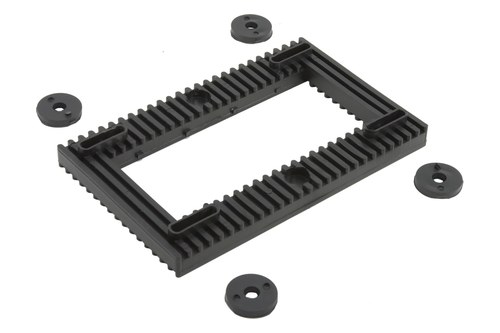
The Spa Depot Silencer pump base
The tub’s own base matters too: Jacuzzi recommends a poured, reinforced concrete slab at least 4 inches thick and says not to shim the spa, and Bullfrog wants no voids beneath it. Our reading is that a tub sitting flat on solid ground gives pump vibration less to rattle against.
Can You Insulate the Cabinet Around a Hot Tub Motor?
A rubber mount quiets what the pump touches, and the next temptation is to wrap the compartment, which is where the makers draw a firm line. Only within the maker’s limits: Hot Spring offers an insulating kit for its equipment compartment through its dealers, but says it must come out when the weather warms to about 60 to 70°F, to keep the jet pump from overheating.
Hot Spring’s 2026 Highlife owner’s manual explains that a jet pump shroud vents the motor’s heat out of the compartment, and that a vent blocked by masonry, grass or debris can overheat the pump. The air gap at the bottom of the compartment must not be blocked either.
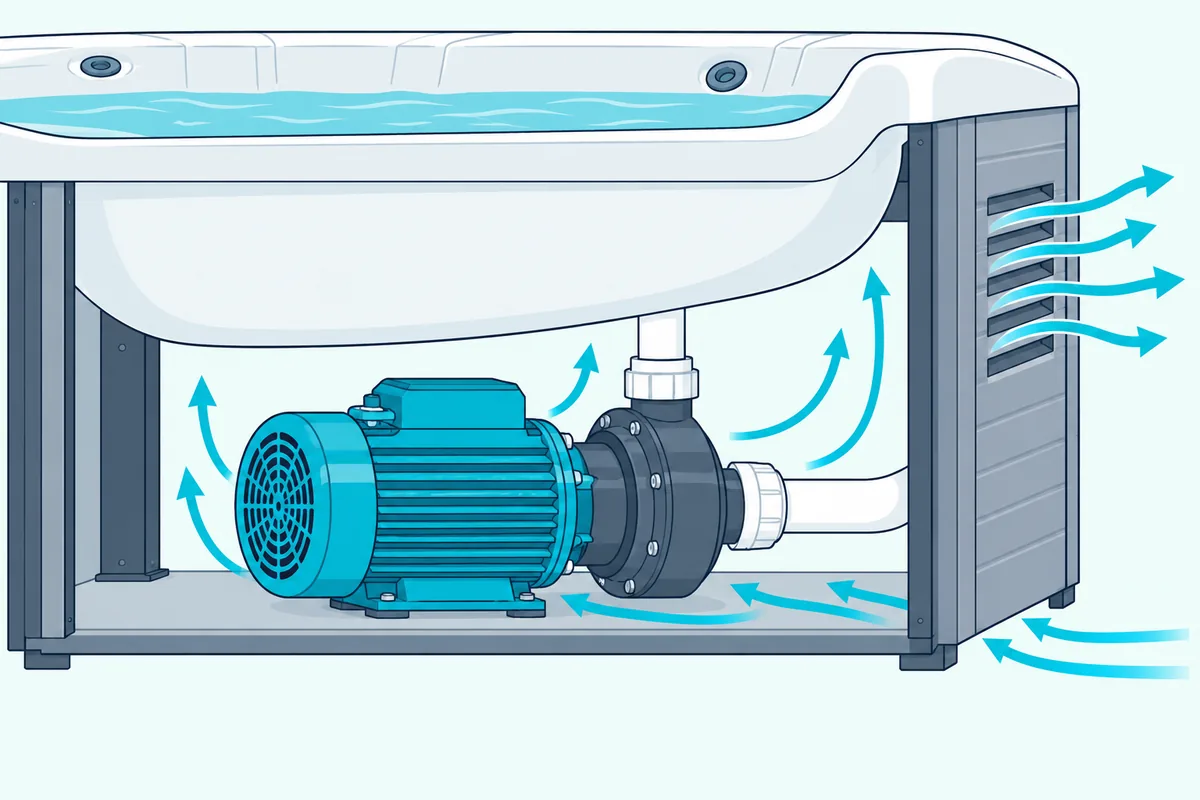
Bullfrog says never to block the air vents that lead to the equipment compartment, and lists blocked vents on the equipment door as one reason a pump shuts off. Aqua-Flo’s pump instructions ask for a fresh air supply, unclogged vents and louvered openings free of debris.
Pump makers treat a hot tub skirt as an enclosure too: Hayward requires adequate ventilation and free circulation of air beneath one, Pentair’s IntelliFlo3 guide rules it out unless the pump is marked for it, and Jandy’s VS FloPro manual rules it out entirely.
That rules out the common DIY advice to glue soundproofing material over every inner wall and seal the panel seams. If you want an acoustic lining anyway, ask your dealer where it can go without blocking a vent, since Hot Spring counts component changes as alterations that can void its warranty.
Indoor appliances draw the same line, and a dishwasher’s own sound blanket has to stay off the door springs and clear of the vent.
Does a Wall or Box Outside the Cabinet Help?
Because the cabinet has to breathe, the rest of the work happens outside it, between the equipment side of the tub and whoever hears it. Yes, a wall can reduce noise if it blocks the line of sight: HUD’s Noise Guidebook says barriers are most effective for sources at or below ground level, and one that doesn’t break the line of sight loses much of its effect.
HUD’s other rules apply too: a barrier works better closer to the source, and one heavier than 4 pounds per square foot with no openings usually lets through a negligible amount of sound. Gaps undo it, since openings totaling 10% of its area cap a barrier at about 4 dB.
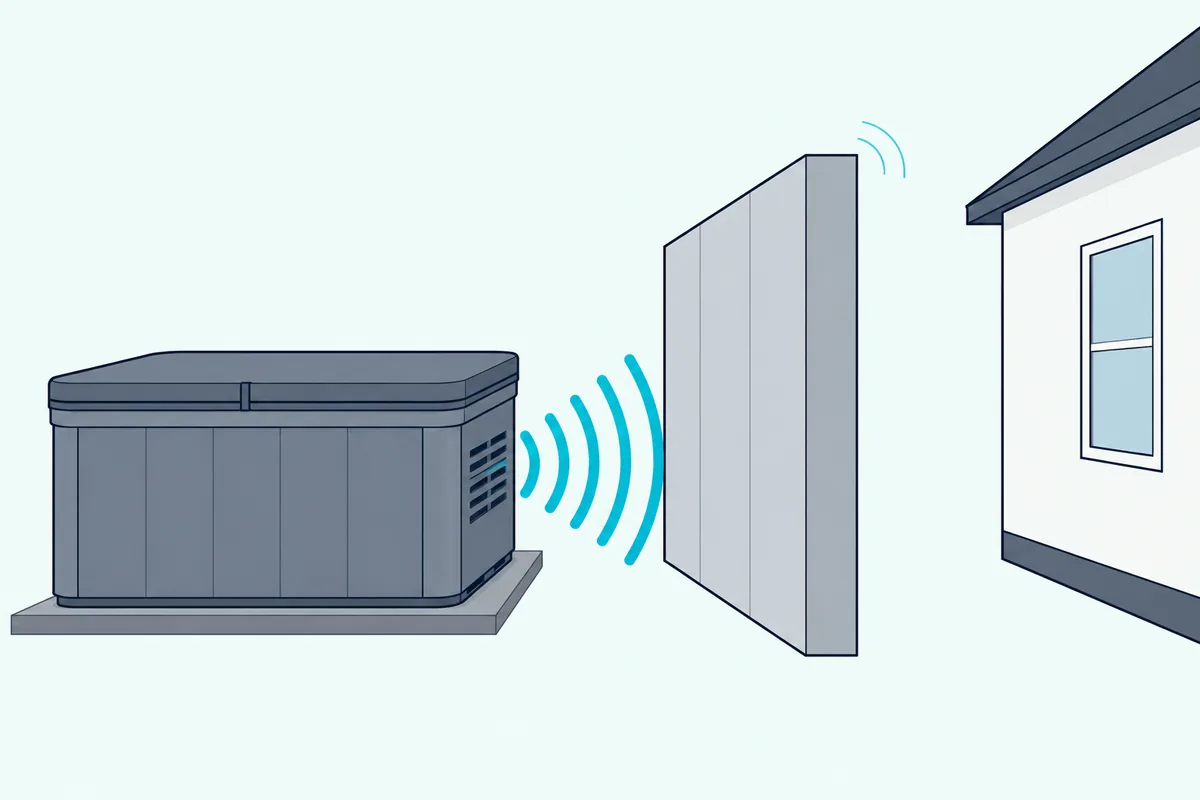
WorkSafe Victoria suggests barriers and screens where a reduction of about 5 to 7 dB is enough, and puts a partial enclosure at about 10 dB. Its 30 to 40 dB figure belongs to relatively airtight full enclosures, which a spa cabinet that has to vent can’t become.
Maintaining access matters as much as the wall: Jacuzzi recommends planning for full access to the entire spa, even when it sits in a deck or a surround, and Bullfrog wants access to the equipment compartment kept clear. Our reading is to keep the wall a step back from the vents and leave its top open.
If you’d rather box in the equipment side, our guide to build a soundproof box with baffled vents covers the lining and vent paths, within the cabinet rules above. For a fence along the property line, Burton Acoustix’s backyard noise guide covers what outdoor barriers can do.
Where Should the Equipment Side of a Hot Tub Face?
A wall is easier when the tub is well placed in the first place, and distance does real work outdoors. Away from bedrooms: the FHWA noise primer says sound from a point source drops about 6 dBA each time the distance doubles, and Hayward warns, for its pool pumps, that the motor’s cooling fan can be heard, so a spot under a bedroom window may not be ideal.
By that rule, moving the equipment side from 15 to 30 feet from a window cuts about 6 dB, more than the 5 dB the FHWA calls readily perceptible. When you plan the pad and its surrounds, point the equipment side away from bedrooms, and if the noise still gets in, the bedroom side of the problem starts with windows, doors and vents.
How Do You Check That a Fix Worked?
That 6 dB rule is easier to judge with a reading than by ear. Measure before and after from the same spot, with the same pump at the same speed and the same time of day.
Then compare the change with the FHWA scale: 3 dB is barely perceptible, 5 dB readily perceptible and 10 dB half as loud. Use the same phone each time, since what you’re after is the change rather than the exact level.
The Bottom Line
Fix the faults, pull any shipping bolt, mount the pump firmly on rubber and move the filter cycles into the day, and you’ve treated the source without touching its airflow.
Then block the line of sight with a solid, gap-free wall, keep the vents, the bottom air gap and the service panels clear, and leave any replacement parts to the dealer.
Frequently Asked Questions
Can you put a soundproof box over a hot tub pump?
Not inside the cabinet. Bullfrog says never to block the air vents that lead to the equipment compartment, and Hot Spring says even its own insulating kit must come out in warm weather. Outside the cabinet, a solid wall or a ventilated box with lined, bent air paths can help if it leaves the vents and service panels clear.
Why does my hot tub run all night?
Usually it’s the filtration schedule. Jacuzzi’s J-300 starts an 8-hour primary filtration at midnight by default, Hot Spring spas filter 24 hours a day, and Bullfrog’s freeze protection turns every jet pump on when it detects freezing conditions. You can move most filter cycles, but Bullfrog calls freeze protection normal operation, so let it run.
Is it normal for a hot tub pump to gurgle?
Often, yes. Laing’s circulation pump manual says gurgling may mean air is still in the system after a refill, that switching the pump on and off several times generally clears it, and that ozone injection can gurgle on its own. If it persists, purge the system again, and if it turns into grinding, switch off and call your supplier.
What is the quietest kind of hot tub pump?
Makers single out the circulation pump: Hot Spring calls its Silent Flo 5000 a quiet, water-cooled pump, and Jacuzzi calls a circulation pump a low-flow “hush pump.” Adding or replacing one is a component change, which Hot Spring’s warranty terms count as an alteration, so talk to your dealer first.
How can you get a neighbor’s hot tub to quiet down at night?
Ask about the schedule first, since moving it costs nothing: Bullfrog and Jacuzzi both let owners move filter cycles, and Jacuzzi’s J-300 runs its primary cycle from midnight by default. Then ask whether a shipping bolt is still fitted, and check your local noise rules if talking doesn’t help.