How to Compare Samsung Sound Bars, Series by Series

To compare Samsung sound bars without drowning in model numbers, start with the letters: Q, S or B at the front, and a year code at the end.
Bars from 2024, 2025 and 2026 are all on sale this fall, so a 2024 model can sit next to a 2026 one with almost the same name and a different set of ports.
Get the letters straight and the rest falls into place, because each series has its own channel range, its own wireless tricks and its own TV features.
This guide lines up the current Q, S and B series from Samsung’s own manuals: channels, up-firing drivers, Dolby Atmos and DTS:X, subwoofers, rear speakers, Q-Symphony, HDMI and Wi-Fi.
The quick table comes first, then the name decoder, the head-to-heads and five bars worth buying from the table.
How Do You Compare Samsung Sound Bars at a Glance?
The short version fits in one table. Samsung’s US soundbar page, as saved on 14 October 2026, splits its range into four lines and lists these features for each:
| Line | Layouts | Q-Symphony | Wireless Dolby Atmos | SpaceFit Sound Pro | Connection | Smart extras |
|---|---|---|---|---|---|---|
| Q-Series | 3.1.2 to 11.1.4 | Yes | Yes | Yes | Wi-Fi and Bluetooth | Built-in Alexa, Tap Sound, AirPlay 2 |
| Ultra Slim | 3.1 to 3.1.2 | Yes | Yes | No | Wi-Fi and Bluetooth | Built-in Alexa, Tap Sound, AirPlay 2 |
| All-in-One | 3.0 to 5.0 | Yes | Yes | No | Wi-Fi and Bluetooth | Built-in Alexa, Tap Sound, AirPlay 2 |
| Soundbars with Subwoofers (B-Series) | 2.0 to 5.1 | B750F and B650F only | No | No | Bluetooth | Adaptive Sound Lite, Bass Boost |
The Q-Series is the only soundbar line with SpaceFit Sound Pro, Samsung’s automatic room tuning, and the B-Series is the only one that skips Wi-Fi.
Samsung’s footnotes matter here: Wireless Dolby Atmos is listed for 2022 to 2025 Samsung TVs, and Q-Symphony needs a compatible Samsung TV from 2020 to 2025. If you’d rather start from ranked picks, our best Samsung soundbar for every budget guide does that, while this page sticks to how the lines differ.
What Do the Letters and Numbers in a Samsung Model Name Mean?
That table names lines, but the box names a model, and every model name packs three clues. The first letter after HW- is the series, the number is the step within it, and the last letter is the model year.
RTINGS decodes the year letters this way: H is 2026, F is 2025, D is 2024, C is 2023, B is 2022, A is 2021 and T is 2020 (RTINGS). So the HW-Q990H is the 2026 version of the Q990, the HW-Q990F is 2025’s and the HW-Q990D is 2024’s.
The number works like a ladder: within a series, a higher number usually means more speakers in play. Samsung’s 2026 Q-series guide shows it, from the 3.1.2 Q600H through the 5.1.2 Q800H and 7.1.2 Q900H to the 9.1.4 Q930H and 11.1.4 Q990H.

Watch the letter B, though, because it does two jobs. At the front, as in the HW-B750F, it’s the series; at the end, it marks a 2022 model.
A slash code can follow the name too, such as HW-Q800F/ZA on the US guide Abt hosts or HW-B550F/ZC on Samsung’s Canadian manual. Match that code when you download a manual, because regional editions can differ in features.
Get Studio Tips Weekly
Join 5,000+ creators getting acoustic treatment advice every week.
No spam. Unsubscribe anytime.What’s the Difference Between Samsung’s B Series and Q Series?
The year letter tells you when, and the series letter tells you what you’re getting. The biggest difference between the B Series and the Q Series is height: every Q-Series bar plays Dolby Atmos with height channels, and the B-Series bars Samsung documents here don’t play Atmos at all.
Take a 2025 pair. Samsung’s HW-Q600F manual lists Dolby Atmos, Dolby TrueHD and Dolby Digital Plus among its formats and outputs 3.1.2, while the HW-B750F manual lists LPCM 2ch, Dolby Digital, DTS and DTS Virtual:X and outputs 5.1 (Abt’s copy of Samsung’s HW-B750F manual).
Think of it as width versus height: the B750F spreads more sound around you, and the Q600F adds a ceiling layer for streaming movies mixed in Atmos.
The TV link differs too. The B750F, B550F and B400F manuals connect wirelessly by Bluetooth only, while the Q-Series flagships add Wi-Fi, AirPlay and a Wi-Fi Dolby Atmos link to some Samsung TVs.
The B-Series also tops out lower, from the one-piece HW-B400F’s 2.0 to the B750F’s 5.1.
What About the S Series and Ultra Slim Bars?
Height and width explain the Q and B lines, and the S line is about shape instead. Samsung’s S bars trade size for looks: the HW-S60D is a one-piece All-in-One bar, and the HW-S800D is an Ultra Slim bar with a separate wireless subwoofer.
Out of the box the S60D is a 5.0 bar, and its manual outputs 5.1 with the SWA-W510 subwoofer and 7.1 with that sub and the SWA-9200S rears, both sold separately.
The S800D goes the other way: its manual lists 3.1.2 with the included subwoofer and 5.1.4 with the optional SWA-9500S rears.
Both S bars keep most of the Q-Series smarts on Samsung’s 2024 manuals: Wi-Fi, AirPlay, Alexa, Chromecast, Q-Symphony and SpaceFit Sound. The step down is in height: the S60D has none of its own, and the S800D’s 3.1.2 matches the entry Q600F rather than the Q800F.
Samsung’s table also lists the Music Frame, a 2.0 framed speaker with Q-Symphony and Wireless Dolby Atmos. Our Samsung Music Frame vs soundbar comparison covers when it can stand in for a bar.
Where Do Atmos, DTS:X and Up-Firing Drivers Show Up?
Those S-Series numbers raise the real question, which is how much height each bar actually has. In a layout label the third number counts height channels, so a 5.1.2 bar has two and an 11.1.4 system has four; CyberShack’s Samsung series guide says the Q-Series plays them through upward-firing drivers.
Our guide to what soundbar channel numbers mean breaks down the first two digits.
| Model (year) | Layout in the box | Height | Dolby Atmos | DTS:X in Samsung’s tables |
|---|---|---|---|---|
| HW-Q990H (2026) | 11.1.4 | 4 | Yes | Yes |
| HW-Q930H (2026) | 9.1.4 | 4 | Yes | Not listed |
| HW-Q800H (2026) | 5.1.2 | 2 | Yes | Not listed |
| HW-Q600H (2026) | 3.1.2 | 2 | Yes | Not listed |
| HW-Q990F / Q930F (2025) | 11.1.4 / 9.1.4 | 4 | Yes | Yes |
| HW-Q800F (2025) | 5.1.2 | 2 | Yes | Yes |
| HW-Q600F (2025) | 3.1.2 | 2 | Yes | No (DTS Virtual:X) |
| HW-S800D (2024) | 3.1.2 | 2 | Yes | No (DTS Virtual:X) |
| HW-S60D (2024) | 5.0 | 0 | Yes | No (DTS Virtual:X) |
| HW-B750F (2025) | 5.1 | 0 | No | No (DTS Virtual:X) |
The DTS:X column needs a caution. Samsung’s 2025 guide lists DTS:X input for the Q800F, but RTINGS says the older Q800D supports DTS formats that its successors, the Q800F and Q800H, don’t, and Samsung’s 2026 guide lists DTS:X only for the Q990H, adding that DTS:X “may not be supported depending on the model or region” (Syndigo’s copy of Samsung’s 2026 Q-series guide).
So if your Blu-ray collection is mostly DTS:X, the Q990 is the safe pick, and anything lower is a check-the-spec-sheet buy. The S60D is the odd one out in the other direction: it plays Atmos soundtracks, but its output table lists no height channel.
Can You Add a Wireless Subwoofer and Rear Speakers?
Height is fixed by the bar, but surround speakers often aren’t. Most Samsung bars take a wireless rear kit later, but the lines use different kits, so check the number first.
Samsung’s manuals pair them like this: the SWA-9500S with the 2025 Q900F and Q800F, the 2026 Q900H, Q800H and Q600H, and the S800D; the SWA-9250S with the Q600F, B750F and B550F; and the SWA-9200S with the S60D and S700D. The Q990 and Q930 models already have surround speakers in the box.
The jump matters more on the cheaper bars. Samsung’s tables take the B550F from 2.1 to 4.1 with rears, the B750F from 5.1 to 7.1 and the Q600F from 3.1.2 to 5.1.2.

The subwoofer story is simpler. Every Q-Series bar and the S800D ship with one, the S60D takes the SWA-W510 as an add-on, and the B400F’s box holds the bar alone.
How Do HDMI eARC, Inputs, Wi-Fi and Voice Control Compare?
Rear speakers decide the room, and ports decide the cabinet. All the bars here connect to the TV over HDMI, but in 2025 and 2026 only the Q990 and Q900 models add two HDMI inputs for a console or streaming box.
Samsung’s 2025 and 2026 Q-series guides show HDMI 1 and HDMI 2 inputs on the Q990 and Q900 models and a single HDMI input on the Q930, Q800 and Q600 models, all with an HDMI TO TV (eARC/ARC) port (Abt’s copy of Samsung’s 2025 US Q-series guide). The 2026 guide adds that the Q990H and Q900H need a certified Ultra High Speed HDMI cable for UHD signals.
Lower down, the port labels change. The B750F’s TV port reads HDMI TO TV (ARC) rather than eARC, the B550F and B400F list a single HDMI (ARC) port and no HDMI input mode, and the S60D’s manual covers only its HDMI (eARC) link to the TV.
Wi-Fi follows the same split as the table at the top. The B750F, B550F and B400F manuals have no Wi-Fi section, and neither does the 2025 Q600F’s UK manual, so Samsung’s “Wi-Fi and Bluetooth” for the Q-Series doesn’t cover every model.
Voice control is the last wrinkle. Samsung’s 2025 Q990F, Q930F and Q800F guide lists Alexa, Chromecast, AirPlay, Spotify and Roon Ready once the bar is on Wi-Fi, but the 2026 guide doesn’t mention Alexa at all, so don’t assume a 2026 bar has it until Samsung’s own spec sheet says so.
Our walkthrough for connecting a Samsung soundbar to your TV covers the eARC and Wi-Fi setup itself.
What Changed in Samsung’s 2026 H Models?
That missing Alexa line is one of several small changes in the 2026 range. The 2026 H models keep the 2025 F models’ ladder of layouts and add features rather than new hardware.
Samsung’s 2026 guide adds Sound Elevation, which lifts the sound to match the height of the screen when the bar sits below the TV, plus AVA Pro voice tuning, Sound Grouping and Private Rear, which plays audio through the rear speakers only. It also notes that SpaceFit Sound Pro, AVA Pro and Surround Speaker settings aren’t supported on the Q600H, which can use room tuning only through a Samsung TV’s Adaptive Sound+ setting.
RTINGS calls the Q990H’s upgrades over the Q990F incremental, and it found the Q800D extremely similar in performance to the Q800F, with the 2026 Q800H adding only small changes. Wired made the same case for buying last year’s Q990, noting the series’ hardware has stayed largely unchanged for several generations (Wired).
That’s why the cards lean on 2024 and 2025 models. On 20 October 2026 the Amazon listings for the Q990H and Q800H didn’t yet have the 4.0 stars and 50 reviews Burton requires, so they’re in the tables but not the picks.
Which Samsung Sound Bar Should You Buy From the Table?
Those small year-to-year gaps make the choice easier, because you can buy by series and layout rather than by year. These five each cover one row of the tables, and each had at least 4.0 stars and 50 reviews on Amazon and was in stock on 20 October 2026; no prices appear because they change often.

For the full Q-Series system, the Samsung HW-Q990D gives you Samsung’s biggest layout. RTINGS and Wired both found the newer Q990s only slightly changed, which is why the 2024 model gets the card.
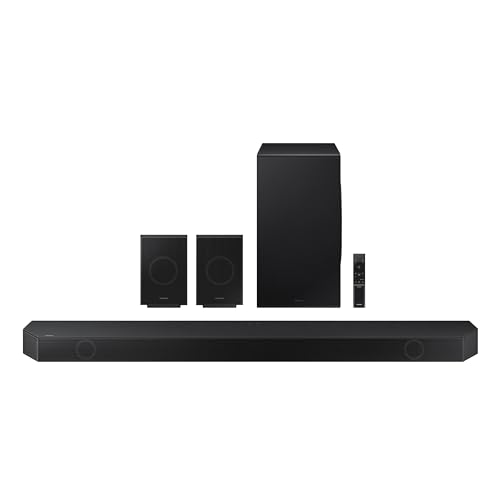
the Samsung HW-Q990D
For Atmos height on a mid-size budget, the Samsung HW-Q800F is the middle of the ladder. Add the SWA-9500S kit later and Samsung’s guide takes it to 7.1.4.
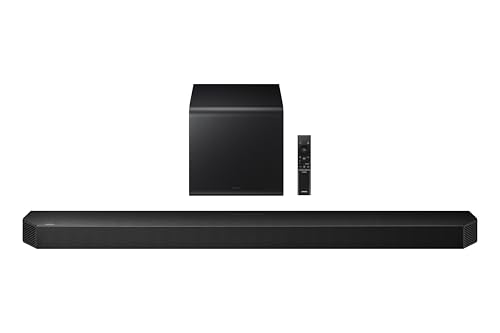
the Samsung HW-Q800F
For the cheapest way into Atmos, the Samsung HW-Q600F keeps a center channel and two height channels. The SWA-9250S rears take it to 5.1.2.
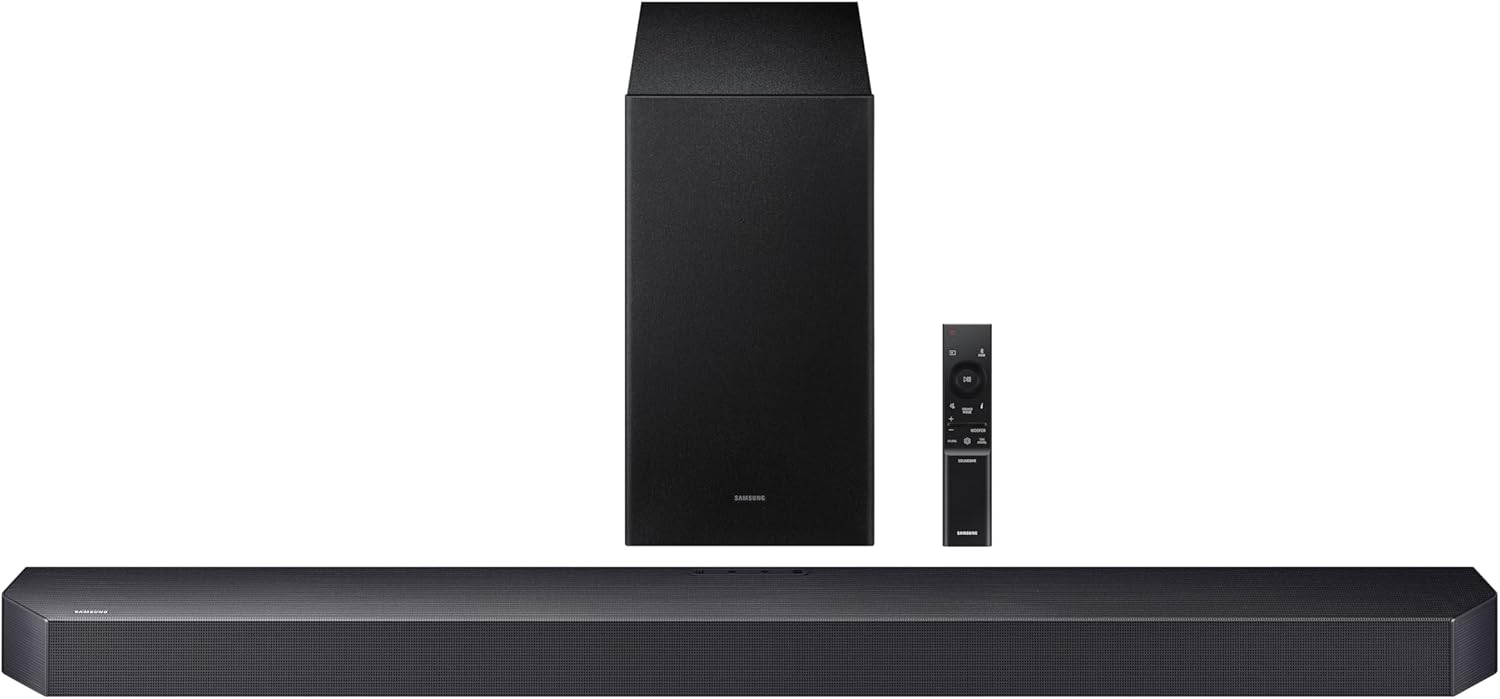
the Samsung HW-Q600F
For one bar and no subwoofer box, the Samsung HW-S60D is the S-Series pick. It’s the bar to choose when the room or the look matters more than the rumble.

the Samsung HW-S60D
For the most channels without Atmos, the Samsung HW-B750F is the B-Series bar to get. Its SWA-9250S rear kit takes it to 7.1.
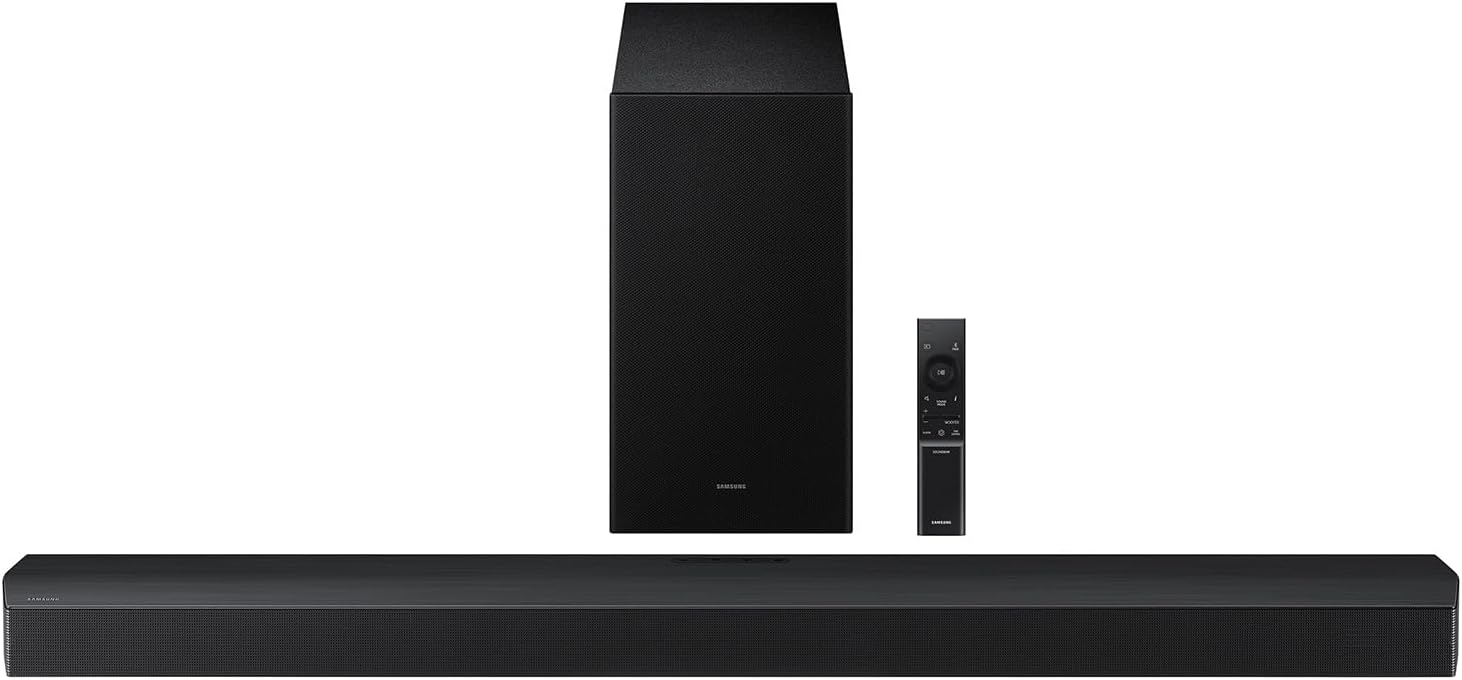
the Samsung HW-B750F
Two others stayed off the cards on stock alone. The S800D and the B550F each showed only one left on Amazon on 20 October, which is too thin for a page that goes live later.
The Bottom Line
The fastest way to compare Samsung soundbars is to read the name, not the box. The first letter gives you the series and its features, the number gives you the layout, and the last letter gives you the year.
From there, choose height (Q), shape (S) or value (B), then check two things the series doesn’t settle: DTS:X if you care about discs, and the number of HDMI inputs if your console plugs into the bar. Once it’s home, Burton Acoustix’s Samsung soundbar settings guide gets each sound mode right.
Frequently Asked Questions
Which Samsung soundbar series is the best?
The Q-Series is Samsung’s top line. It’s the only one with Dolby Atmos height channels across the range, SpaceFit Sound Pro room tuning on the 2025 and 2026 models, and the Q990’s surround speakers in the box.
That doesn’t make it the best for every room. The S-Series suits small rooms and slim setups, and the B750F gives you 5.1 without Atmos.
Is the Samsung B series or C series better?
CyberShack’s 2023 guide describes Samsung’s C-Series as entry bars with a wireless subwoofer that link to the TV by Bluetooth. Samsung’s US comparison table of October 2026 names B models in its subwoofer line and no C models, so a new budget Samsung bar is a B model.
Within the B-Series, compare layouts and Q-Symphony: the B750F and B650F have Q-Symphony in Samsung’s US table, and the others don’t.
Do all Samsung soundbars work with Q-Symphony?
No. Samsung’s US table lists Q-Symphony for the Q-Series, Ultra Slim and All-in-One lines, but only for the B750F and B650F among the B-Series bars.
It also needs a compatible Samsung TV, and Samsung’s footnote names models from 2020 to 2025. The 2026 guide says it works over an HDMI cable, an optical cable or Wi-Fi, and the TV and bar play together rather than the TV speakers switching off.
Do Samsung soundbars support DTS:X?
Some do. Samsung’s tables list DTS:X input for the Q990 and Q930 models of 2024 and 2025 and for the 2026 Q990H, while the Q600F, S-Series and B-Series bars list DTS Virtual:X, a virtual surround mode, instead.
The Q800 is the one to check. Samsung’s 2025 guide lists DTS:X for the Q800F, but RTINGS says the Q800F and Q800H lack the DTS support of the older Q800D, so confirm on the exact model and region before buying for DTS discs.