Acoustic Panels vs Diffusers: Which Do You Need? [2026]
Acoustic panel vs diffuser is usually a “panels first” answer.
But if you keep adding absorption without a plan, you can overshoot and end up with a room that feels small and dead.
The symptom is familiar: smeared speech, harsh cymbals, or vague imaging.
The cause is usually early reflections bouncing off bare walls and ceilings and arriving a split-second after the direct sound.
Make the direct sound more dominant, and dialogue snaps into focus while mixes translate.
Start by treating first reflection points with acoustic panels, then consider diffusion on the rear wall only after echo is controlled.
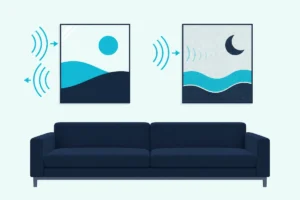
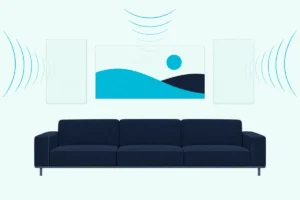
Acoustic panels absorb sound waves, reducing echo and reverb. Diffusers scatter sound waves, maintaining room liveliness while preventing focused reflections.
Most rooms need absorption panels first. Diffusers are advanced treatment for rooms that sound too dead after adding panels, or for rear wall placement in studios where you want spaciousness without flutter echo.
What’s the Difference Between Acoustic Panels and Diffusers?
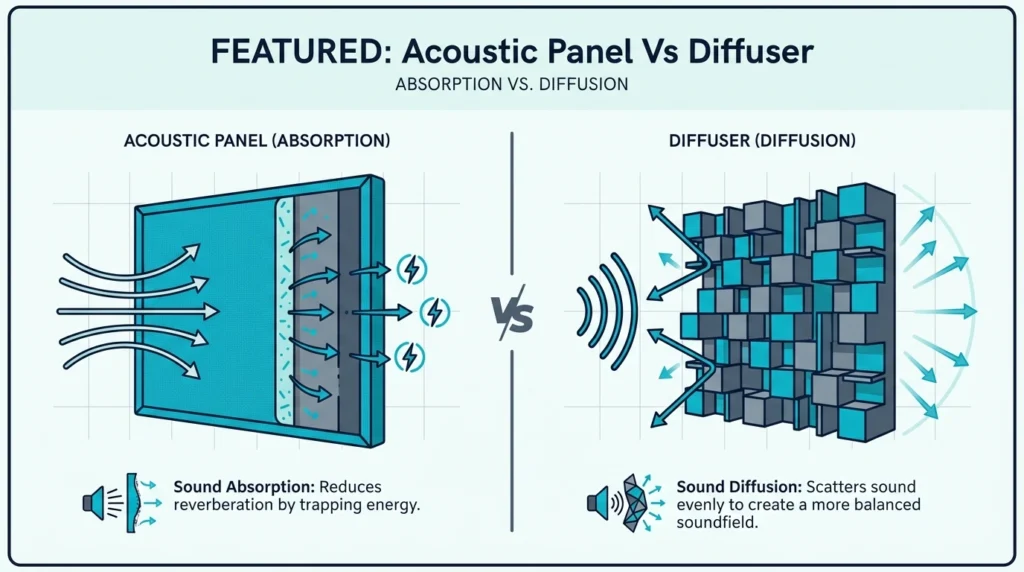
Panels absorb sound energy; diffusers redirect it. Understanding the physical mechanism behind each one makes it completely obvious where they belong in your room.
When acoustic energy hits a flat drywall surface, it bounces back as a clean, strong reflection—exactly like a laser beam hitting a mirror. A diffuser acts more like frosted glass, taking that single strong reflection and breaking it into dozens of weaker reflections scattered at different angles. An absorber acts like a black curtain, taking the energy in and letting almost nothing bounce back.
Acoustic Panels = Absorb Sound
Absorption relies on friction. Acoustic panels use dense, porous materials—typically fiberglass, mineral wool, or heavy polyester fiber—wrapped tightly in fabric. When sound waves enter the material, they are forced to navigate the microscopic maze of fibers, converting their acoustic energy into tiny amounts of heat.
For a first absorber, a large 2-inch fiberglass board like the UMIACOUSTICS Large Panels pulls a massive amount of energy out of the room at the first reflection points.
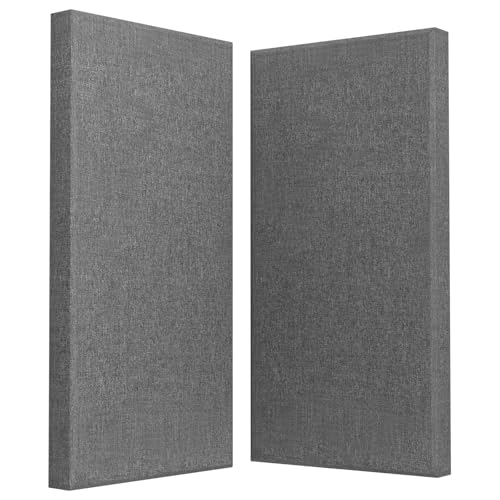
UMIACOUSTICS Large Panels
The result of that friction is simply less sound energy bouncing around the room. By stripping that energy away, you eliminate the distinct repetitions of an echo, shorten the sustained wash of reverb, and kill the rapid metallic flutter that happens between two parallel walls. For most untreated rooms, pulling this chaotic energy out of the air is the only way to restore speech clarity and music fidelity.
Diffusers = Scatter Sound
Diffusion relies on complex geometry instead of friction. Diffusers are constructed from rigid surfaces—wood, hard plastic, or dense polystyrene—featuring mathematically calculated patterns of varying depths. Because the sound waves hit the different depths at slightly different times, the reflection breaks apart and scatters uniformly across the room.
For rear-wall diffusion, a QRD-style diffuser shatters those reflections mathematically.
Because the energy is scattered rather than absorbed, the room retains its natural acoustic liveliness without suffering from focused, phase-canceling reflections. This maintains a sense of physical space and tonal balance, since you aren’t selectively sucking high frequencies out of the air.
Diffusion is far more complex to execute than absorption. A random bumpy surface does not scatter sound evenly—real diffusers like QRD (Quadratic Residue Diffuser) blocks use prime number sequences to guarantee uniform scattering. If you prefer a furniture-grade look, the BXI wood diffuser provides the same mathematical scattering, though it still requires several feet of distance to allow the waves to disperse before reaching your ears.
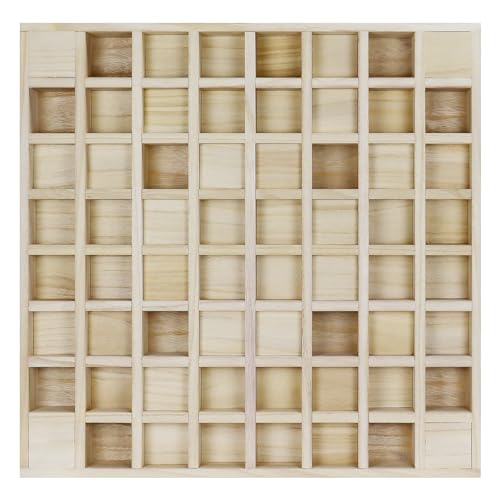
the BXI wood diffuser
What Are Acoustic Panels Good For?
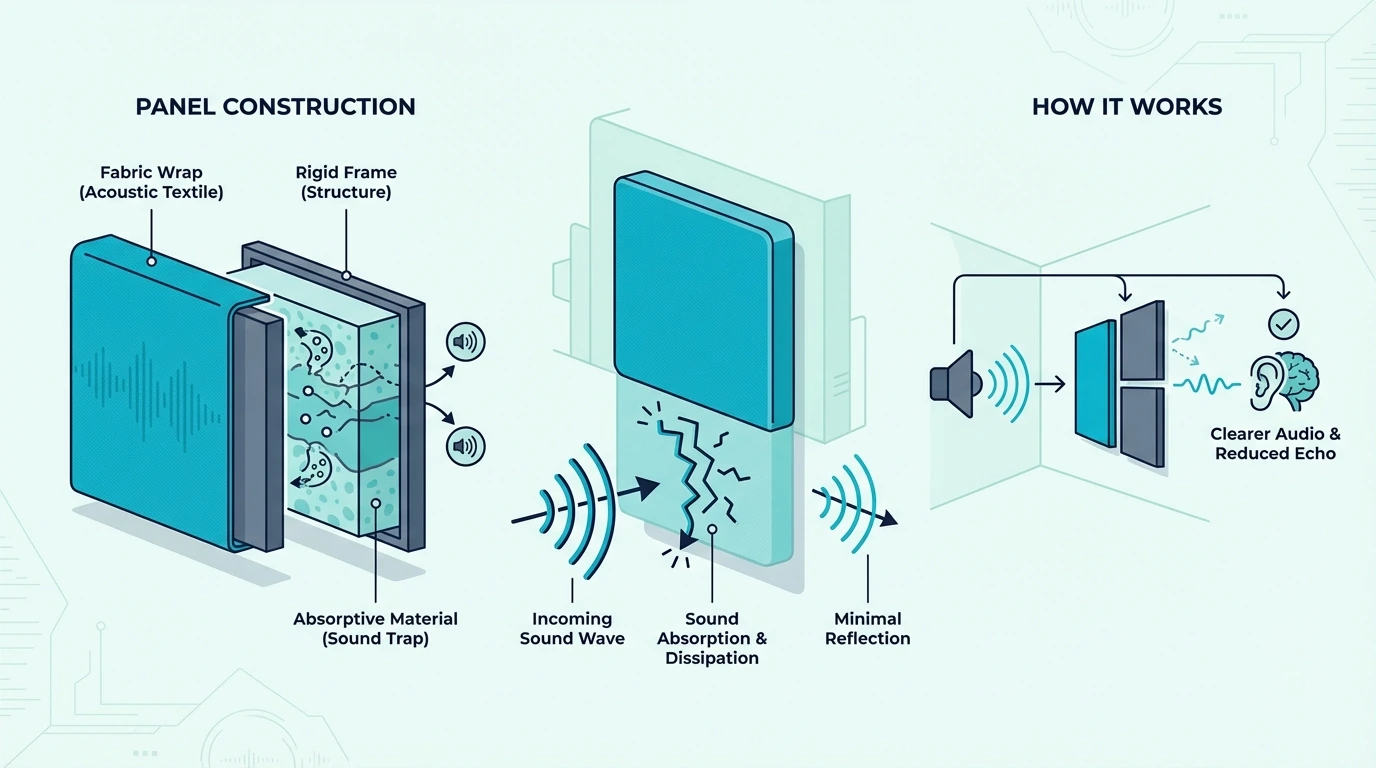
Most real-world rooms simply have far too much acoustic energy bouncing around, meaning they require heavy absorption first. Acoustic panels are the direct solution to the problems you notice immediately: ringing echo, harsh highs, and blurry stereo imaging.
Controlling Echo and Reverb
When people complain that a room sounds “too echoey” or that voices are “muddy,” they are describing phase interference. This happens when the reflected sound bounces off the drywall and arrives at your ears just milliseconds after the direct sound from the speaker, tricking your brain into hearing a smeared, confusing signal.
Acoustic panels solve this instantly when placed at the first reflection points—the exact spots where the sound takes its first bounce toward your chair. By killing that specific bounce path, the direct sound dominates, and clarity returns immediately. The panel placement guide covers the mirror trick for finding these critical positions.
Recording and Mixing Environments
In recording studios, that clarity is non-negotiable because you are trying to capture the source instrument, not the sound of your bedroom walls. Panels strip away the room coloration so that your vocal takes sound dry and professional, ensuring they will translate properly when played on other systems.
Mixing rooms require even tighter absorption control. If you are making critical decisions about EQ, panning, and adding digital reverb, you have to hear the actual mix coming out of the monitors, not the room’s physical contribution. The recording studio panels guide and a calculated panel spacing strategy matter so much for producers.
Speech Intelligibility
That exact same physics problem plagues conference rooms, classrooms, and home offices. Excessive reverb makes it exhausting to understand fast speech, a problem that gets multiplied when cheap laptop microphones pick up the room reflections and broadcast them over a Zoom call.
Strategic panel placement—typically on the wall behind the speaker and the wall directly facing them—massively improves speech intelligibility by killing the flutter echo. A compact fiberglass pack like the Olanglab 4-Pack Fiberglass Panels covers those specific speech zones without making the office look like a recording studio.
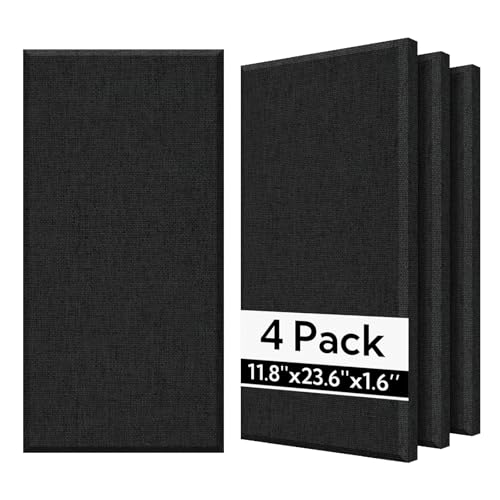
Olanglab 4-Pack Fiberglass Panels
If your goal is clearer dialogue for movies rather than meetings, the exact same reflection logic applies. The home theater panels guide maps out which walls matter most for surround sound clarity.
Get Studio Tips Weekly
Join 5,000+ creators getting acoustic treatment advice every week.
No spam. Unsubscribe anytime.What Are Diffusers Good For?
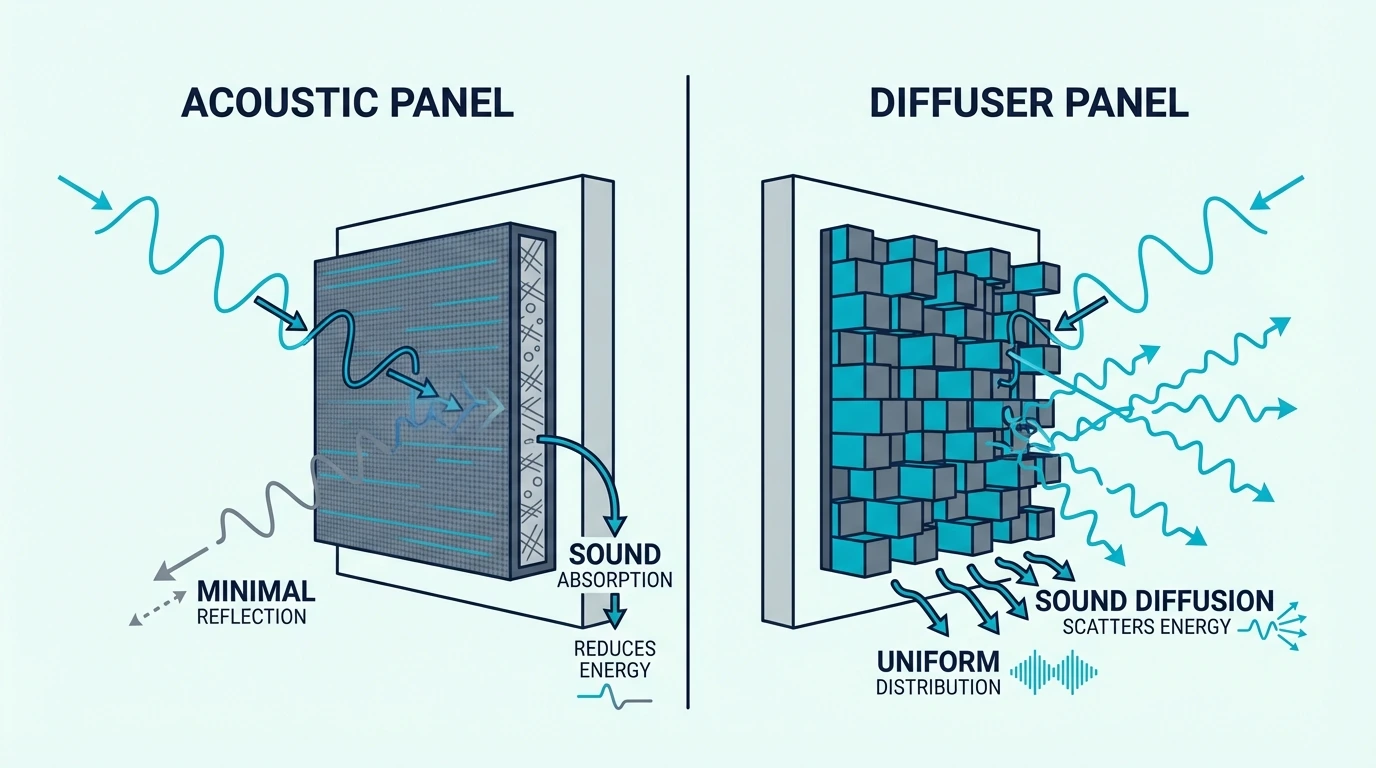
Diffusers are precision tools that solve the specific problems created when a room has too much absorption. They keep a room feeling lively and energetic without allowing hard, focused reflections to ruin the audio.
Preventing Over-Damped Rooms
The most common amateur mistake in acoustics is adding absorption to absolutely every bare surface. Plastering a room entirely in thick fiberglass kills the reverb, but it also creates a space that feels uncomfortably dead, claustrophobic, and strangely unnatural to sit in.
Diffusers solve this by maintaining the room’s natural liveliness while completely preventing focused slap-echoes. You get to keep the psychological sense of being in a real, breathing space without suffering from the comb filtering of an untreated room.
Rear Wall Treatment
The rear wall of a listening room or studio presents a unique acoustic trap. Hitting the back wall with heavy absorption can make the room feel artificially small and closed-in, but leaving it bare throws a massive, delayed reflection straight back at the back of your head, smearing the stereo image instantly.
Mounting deep diffusers on the rear wall shatters that returning reflection. The acoustic energy still makes it back to the listening position to maintain spaciousness, but it arrives as a scattered, diffuse wash rather than a focused slap, making it the default professional choice for high-end control rooms.
Live Recording Spaces
Rooms designed specifically for tracking drums, acoustic guitars, or ensemble performances actually require room ambience to sound good. Full absorption would completely choke the natural reverb that makes acoustic instruments sound massive and alive on a record.
Diffusion allows engineers to control that ambience rather than kill it. The room still contributes its natural character and decay tail to the microphones, but the diffusers ensure that the reverb is smooth and dense rather than chaotic and harsh.
When Should You Use Panels First?
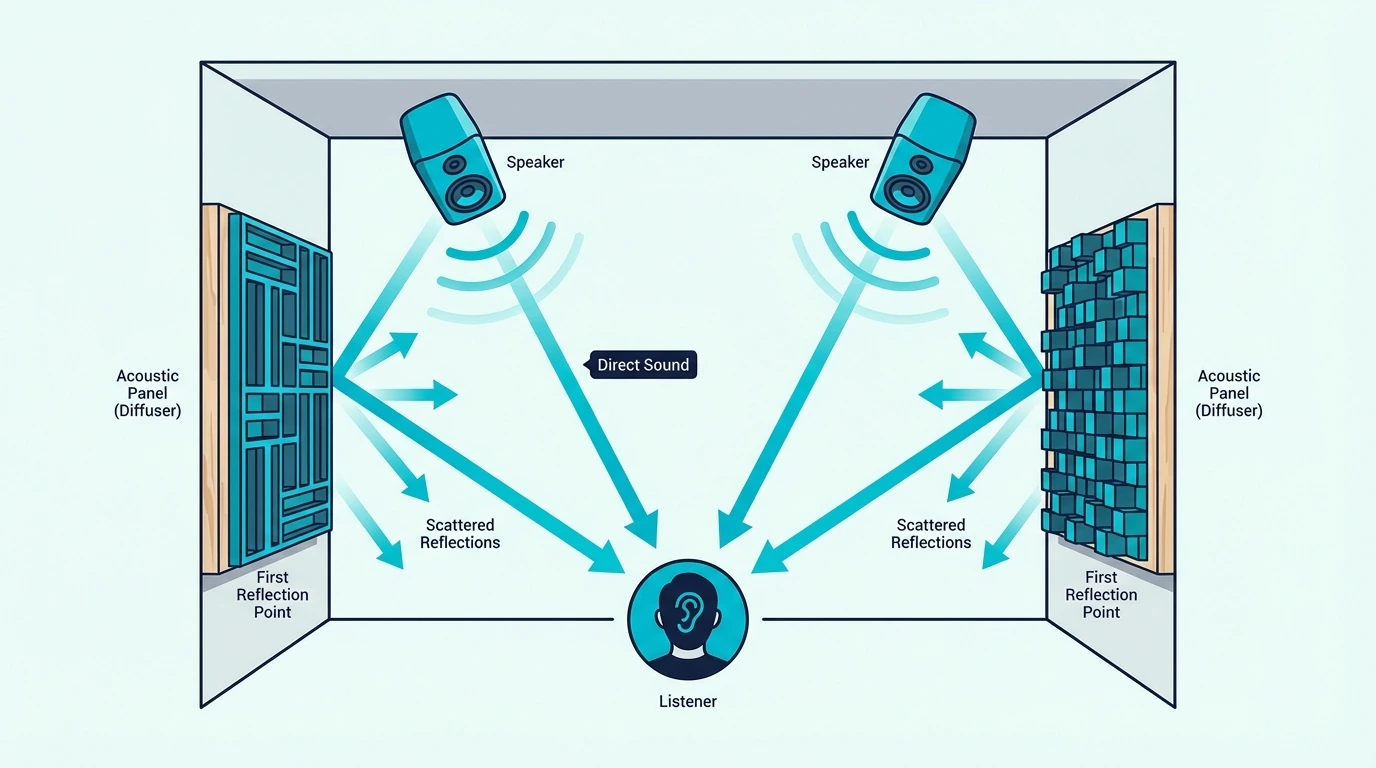
For 95% of rooms and home studio owners, acoustic panels must come first. Untreated drywall and hardwood floors cause far more audible damage to a mix than a missing diffuser ever will.
Untreated rooms simply have too much raw reflection energy bouncing between parallel surfaces, creating the flutter and ringing that ruins recordings. Because a 2-inch fiberglass panel absorbs sound according to highly predictable, lab-tested coefficients, you know exactly what problem you are solving when you mount it. Diffuser performance, by contrast, relies heavily on complex design quality, the physical depth of the wells, and requiring enough physical distance from the listener to allow the waves to scatter.
If you are frustrated by echo, reverb tails, or vague panning, you have an absorption problem. You should immediately target the first reflection points on your side walls, the ceiling cloud directly above your chair, the front wall behind your speakers, and the corners with thick bass traps.
If you plan to tackle the ceiling reflection, the ceiling installation guide covers the exact mounting hardware needed to suspend a cloud safely. To figure out exactly how many panels it will take to cover those critical zones, the panel coverage calculator provides a room-specific target.
When Should You Consider Diffusers?
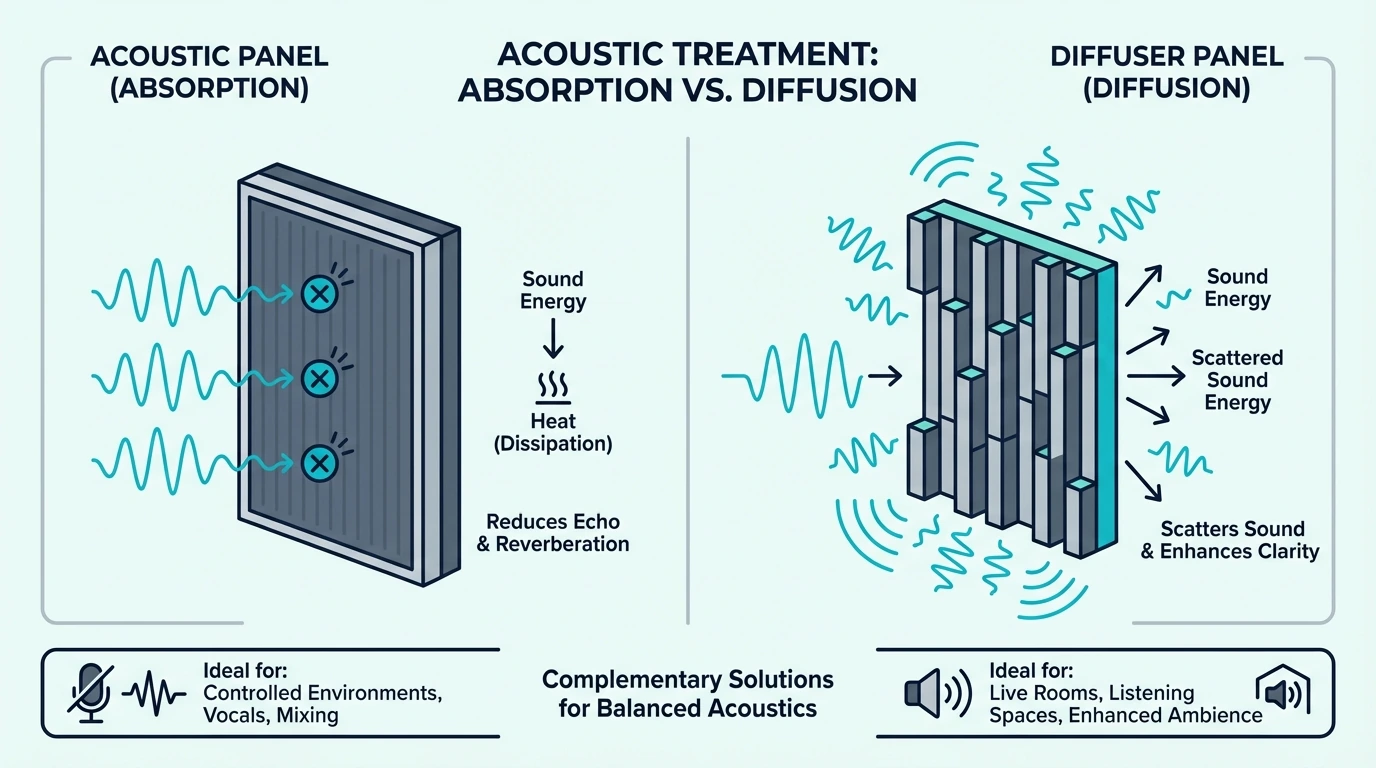
You should only start shopping for diffusers after you have successfully locked down the room’s basic absorption needs and evaluated the resulting decay time.
If you’ve installed panels at all the first reflection points and the space suddenly feels uncomfortably dead—like talking inside a coat closet—swapping some of the rear-wall absorption for diffusion will restore the liveliness without bringing the harsh echoes back.
They are also the right choice when you explicitly want controlled ambience. Live tracking rooms, dedicated home theaters chasing an immersive surround field, and audiophile listening rooms all benefit from diffusion’s unique ability to maintain spatial cues and energy while preventing slapback.
If you are designing an advanced studio build from scratch, professional acousticians will often model a combination of absorption and diffusion from day one. But if you are treating a spare bedroom and aren’t even sure if absorption is the right first step, checking the NRC ratings of standard panels will show you exactly how much mid-range chaos they pull out of a small space.
Can You Use Both Together?
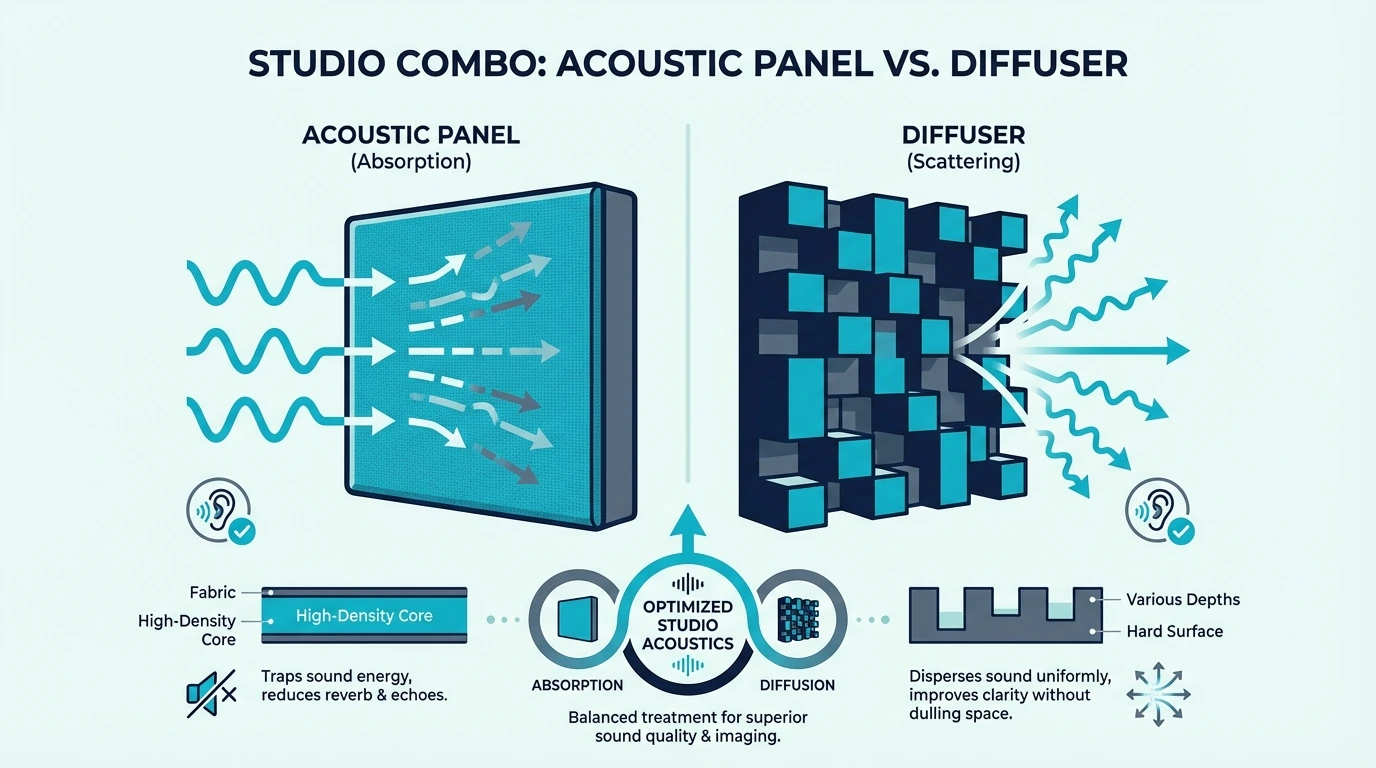
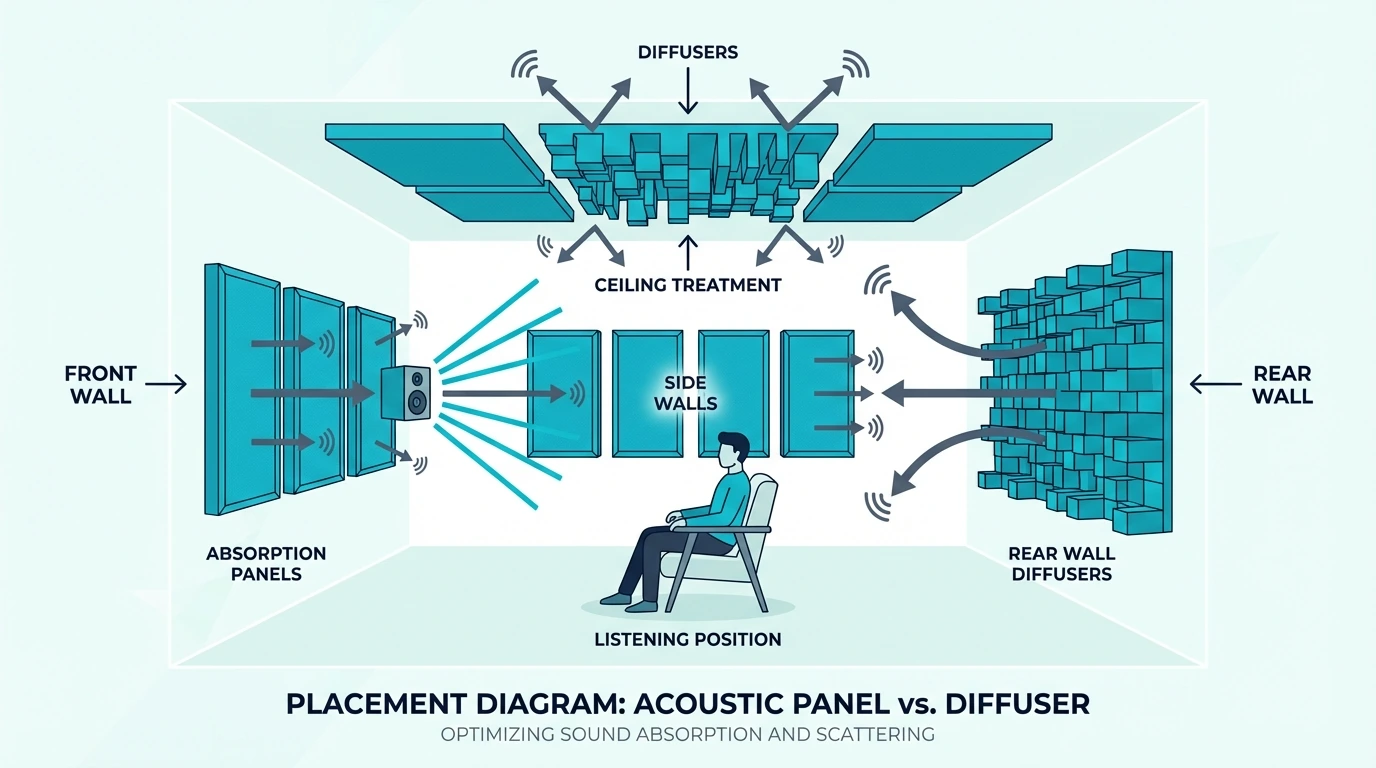
Most professional studios rely on a hybrid of both. They deploy dense absorption to kill the early reflections at the critical monitoring spots, while leaning on heavy diffusion to keep the rear of the room lively and energetic.
The Combination Approach
A standard professional layout treats the room in distinct zones. The front half of the room gets aggressive absorption at the side wall and ceiling first reflection points, backed by heavy absorption directly behind the monitors to control low-mid buildup. Thick bass traps are wedged into the vertical corners to tame the room modes.
The rear half of the room then switches entirely to diffusion. QRD blocks or 3D scattering panels coat the back wall, ensuring that any sound making it past the mix position is shattered and returned as a smooth ambient wash rather than a destructive echo.
This layout successfully treats the most critical monitoring zones—where early reflections cause devastating phase issues—while maintaining the room’s overall acoustic character through the rear diffusion.
The only critical limitation to this hybrid approach is physical distance. Diffusers require several feet of space between the wooden wells and the listener’s ears to function properly—typically at least 6 to 10 feet. Slapping a QRD diffuser on a wall 3 feet behind your mixing chair will not provide real diffusion; the scattered reflections will arrive too quickly and too focused, completely defeating the purpose of the block.
If you simply want to lock down all your first reflection points in one pass before worrying about the back wall, a 4-panel set like the UMIACOUSTICS 4-Pack with Hanging Brackets provides exactly enough fiberglass to hit both side walls and the ceiling cloud, with the specialized hardware included for the overhead mount.
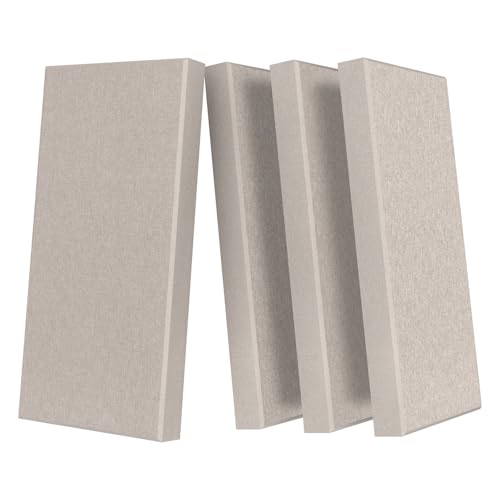
UMIACOUSTICS 4-Pack with Hanging Brackets
How Do Acoustic Panels and Diffusers Compare?
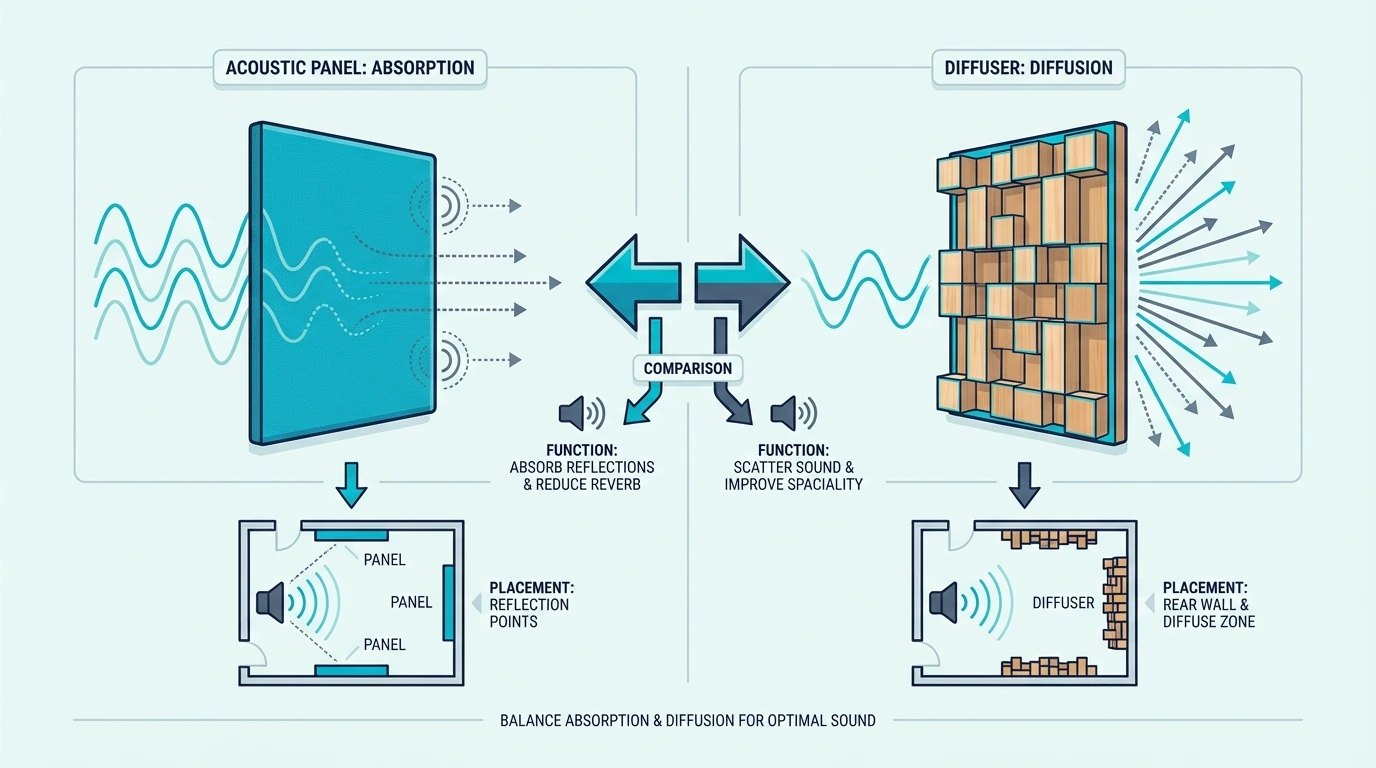
| Feature | Acoustic Panels | Diffusers |
|---|---|---|
| Function | Absorb sound waves | Scatter sound waves |
| Effect on Room | Reduces reverb/echo | Maintains liveliness |
| Problem Solved | Too much reflection | Dead-sounding rooms |
| Typical Materials | Fiberglass, mineral wool, polyester | Wood, polystyrene, plastic |
| Installation Distance | Can mount directly on wall | Needs 6-10+ feet from listener |
| Cost | Budget to premium | Mid-range to premium |
| When to Use | First treatment for most rooms | After absorption, if room is too dead |
| DIY Friendly | Yes—fabric-wrapped panels | Harder—requires precise geometry |
How to Decide What You Need
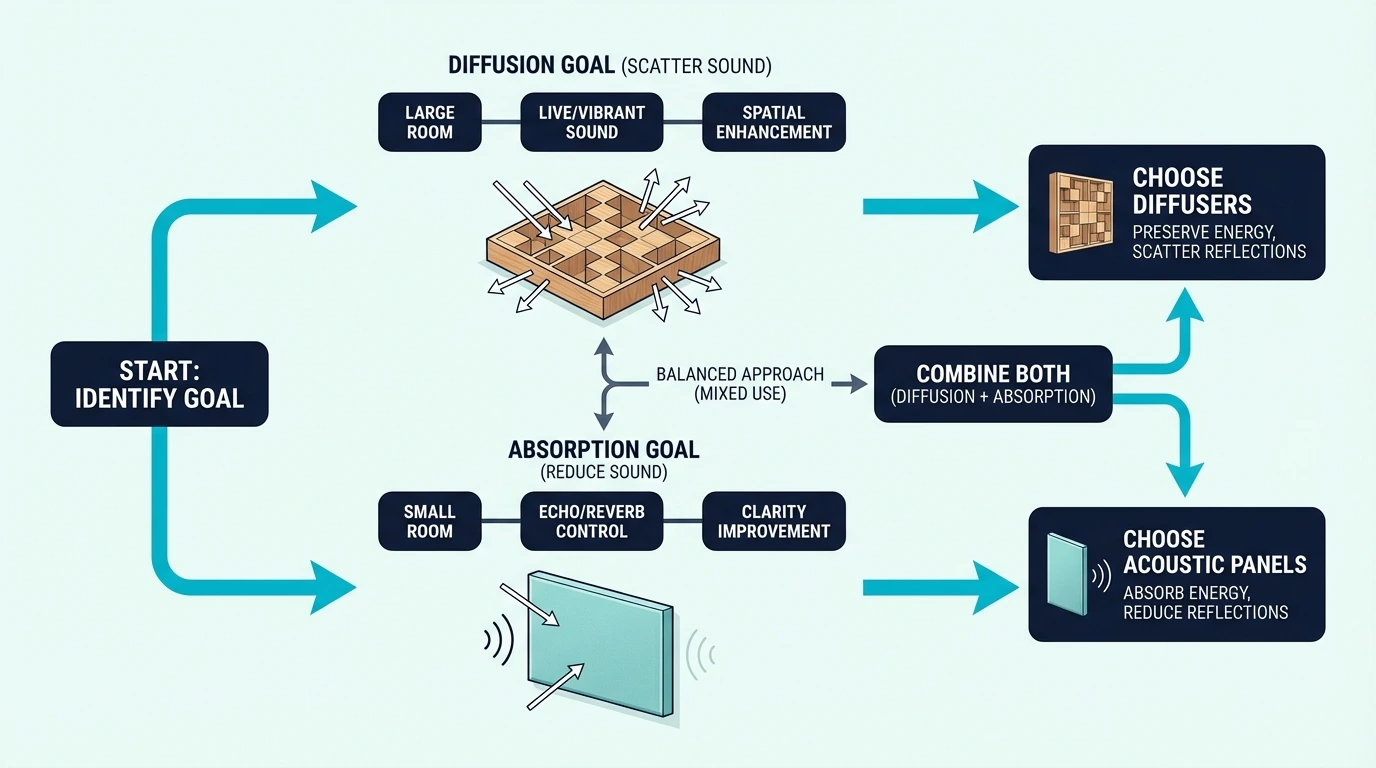
Instead of guessing whether you need absorption or diffusion, use your ears to diagnose the room and let the symptoms dictate the solution.
If you clap your hands in the center of the room and hear a harsh metallic ringing or a sustained reverb tail, you have an absorption problem. You must start by mounting acoustic panels at the first reflection points to pull that chaotic energy out of the air. For 80% of home studios and listening rooms, this single step completely solves the problem.
You only move to step two if the room suddenly feels uncomfortably dead or artificially dry after hanging those panels. That sense of claustrophobia means you have over-absorbed the high frequencies, and replacing some of your rear-wall absorption with diffusion will restore the room’s liveliness without bringing the harsh flutter echo back.
The golden 80/20 rule of acoustics applies here: 80% of your acoustic improvement comes purely from correct absorption placement at the reflection points. Diffusion handles the final 20% of refinement for rooms demanding advanced treatment.
Conclusion
Panels come first for nearly every room. They solve the reflection problems you actually hear—echo, reverb, and blurry imaging—while diffusers address a more subtle issue most rooms never reach.
If you treat first reflection points and the room still feels too dead, that is when diffusion earns its place on the rear wall.
Frequently Asked Questions
Should I Get Acoustic Panels or Diffusers for My Home Studio?
Start with acoustic panels—most home studios have untreated rooms with excessive echo and reverb. Add panels at first reflection points, then treat behind speakers and corners with bass traps before thinking about diffusion.
Diffusers become relevant only if the treated room sounds too dead. For most home studios, typical treatment levels do not over-absorb.
Can Diffusers Replace Acoustic Panels?
No—diffusers scatter sound but do not remove it from the room. If you have echo or reverb problems, diffusers will not fix them; they just spread the reflection energy around instead of eliminating it.
Do I Need Both for a Good Listening Room?
Not necessarily—many excellent listening rooms use only absorption. Diffusion adds refinement, but it is not required for great sound.
If absorption gives you clarity without making the room feel dead, you can stop there. Add diffusion only if you specifically want more room liveliness while controlling the rear wall.
Where Should I Put Diffusers in My Room?
The rear wall is the most common position—behind the listening position in a studio or theater—because diffusers need at least 6–10 feet of distance from the listener. Avoid first reflection points; those positions need absorption to control the early reflections that cause imaging and tonal problems.