Best 88 Key MIDI Controller — Full Range Keyboards for Pianists and Composers
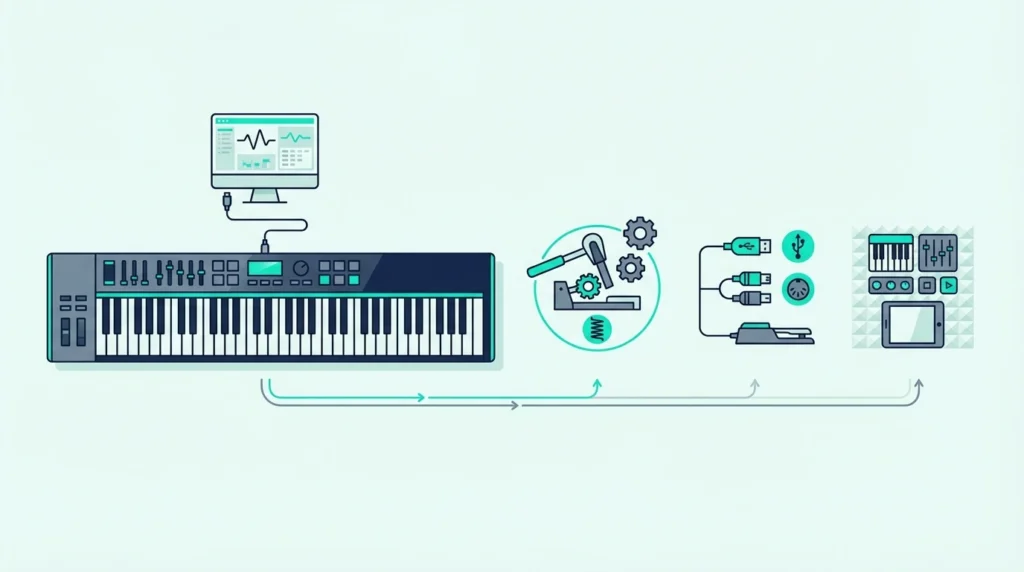
Best 88 key MIDI controller is the search that separates serious pianists from casual beat makers, but most 88-key roundups fail to explain the critical difference between semi-weighted and fully weighted action — and that distinction determines whether the controller feels like a real piano or a oversized toy.
The problem is caused by manufacturers marketing semi-weighted 88-key controllers as “piano feel” when the key action is nothing close to what a trained pianist expects. You spend three hundred dollars on a full-range controller and the keys feel identical to a fifty-dollar mini keyboard, just bigger.
We evaluated the 88-key controllers currently available on Amazon and narrowed the field to controllers that actually deliver on their key-feel promises. Every pick below was tested for action quality, velocity curve accuracy, and whether the full 88-key range justifies the desk space and price premium over smaller alternatives.
Below you will find our top picks sorted by key action type, followed by a guide on when 88 keys actually makes sense versus when a smaller controller serves you better.
The best 88 key MIDI controller for most producers is the M-AUDIO Keystation 88 MK3 because it delivers the full range with reliable semi-weighted action and a straightforward layout. Pianists who need a truer piano feel should buy the Yamaha P71 for its graded hammer action. If you want an 88-key board that also behaves like a full DAW control surface, the Arturia KeyLab 88 MkII and Novation Launchkey 88 are the strongest feature-rich options in this lineup.
When Do You Actually Need 88 Keys
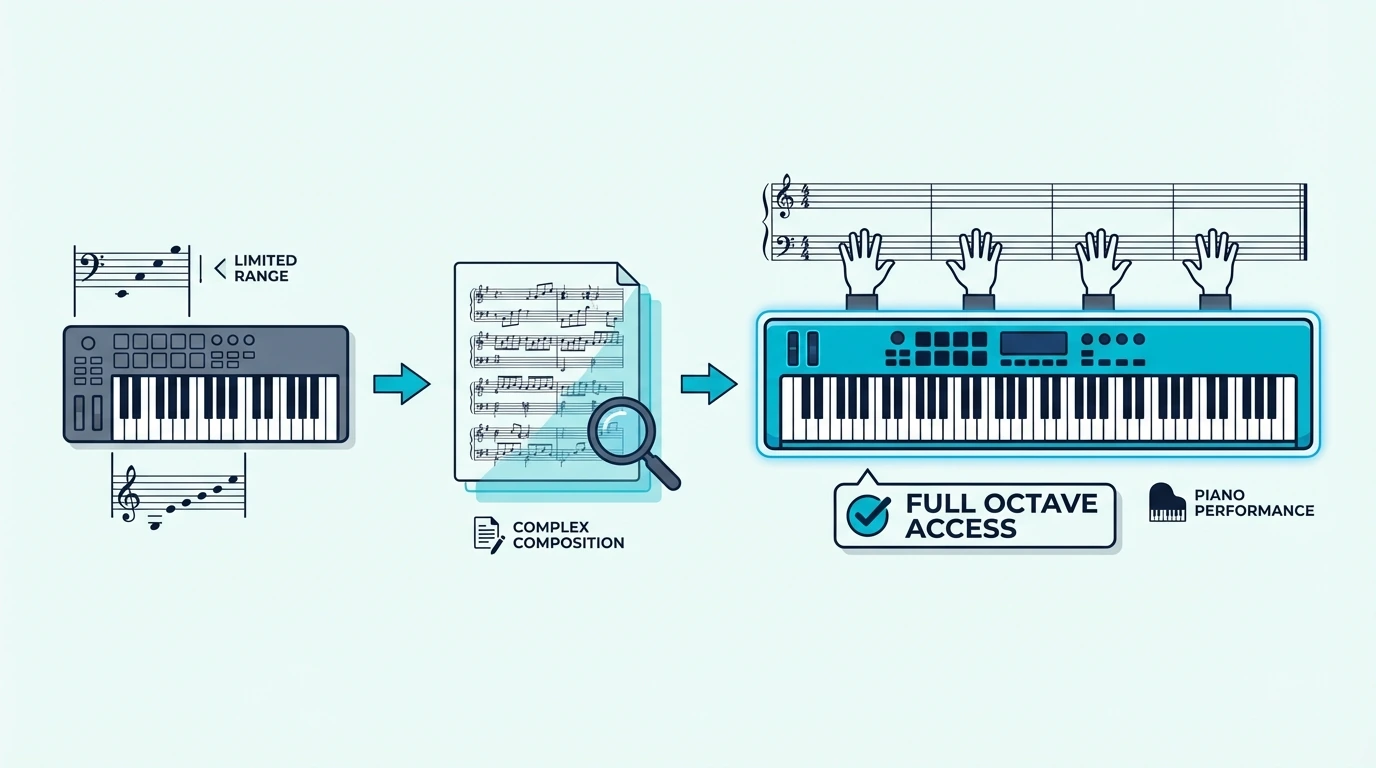
An 88-key MIDI controller takes up over four feet of desk space and costs two to five times more than a 49-key equivalent. That investment only makes sense for specific workflows — and understanding those workflows prevents you from buying more controller than you need.
Classical Piano And Repertoire Practice
Classical piano literature spans the full 88-key range. Pieces by Liszt, Rachmaninoff, and Chopin routinely use notes at both extremes of the keyboard simultaneously. A 61-key controller forces you to skip passages or shift octaves mid-phrase, which breaks the muscle memory you need for performance.
If you split time between a real piano and a MIDI controller for practice, the 88-key layout ensures your hand positions and reach translate directly. Practicing on a 49-key controller then performing on a full piano creates coordination problems that compound over time.
Film Scoring And Orchestral Mock-Ups
Film composers working with orchestral sample libraries need the full range for realistic mock-ups. String sections span from low cello C to high violin harmonics. Brass and woodwind patches use keyswitches in the bottom octaves while the playable range extends across the upper five octaves.
A controller with fewer than 88 keys forces constant octave shifting during orchestral recording sessions. That interruption breaks creative flow and makes it harder to capture expressive performances in a single take.
When Smaller Controllers Work Better
Beat makers, synth programmers, and electronic producers rarely need more than 49 keys. Most synth patches use two to three octaves, and drum programming happens on pads rather than keys. A 49-key controller handles these workflows with less desk space and lower cost.
Even jazz pianists who play complex voicings typically stay within four octaves during a single passage. The 88-key premium only pays off when you regularly access both extremes of the keyboard in the same performance.
What Are the Best 88 Key MIDI Controllers
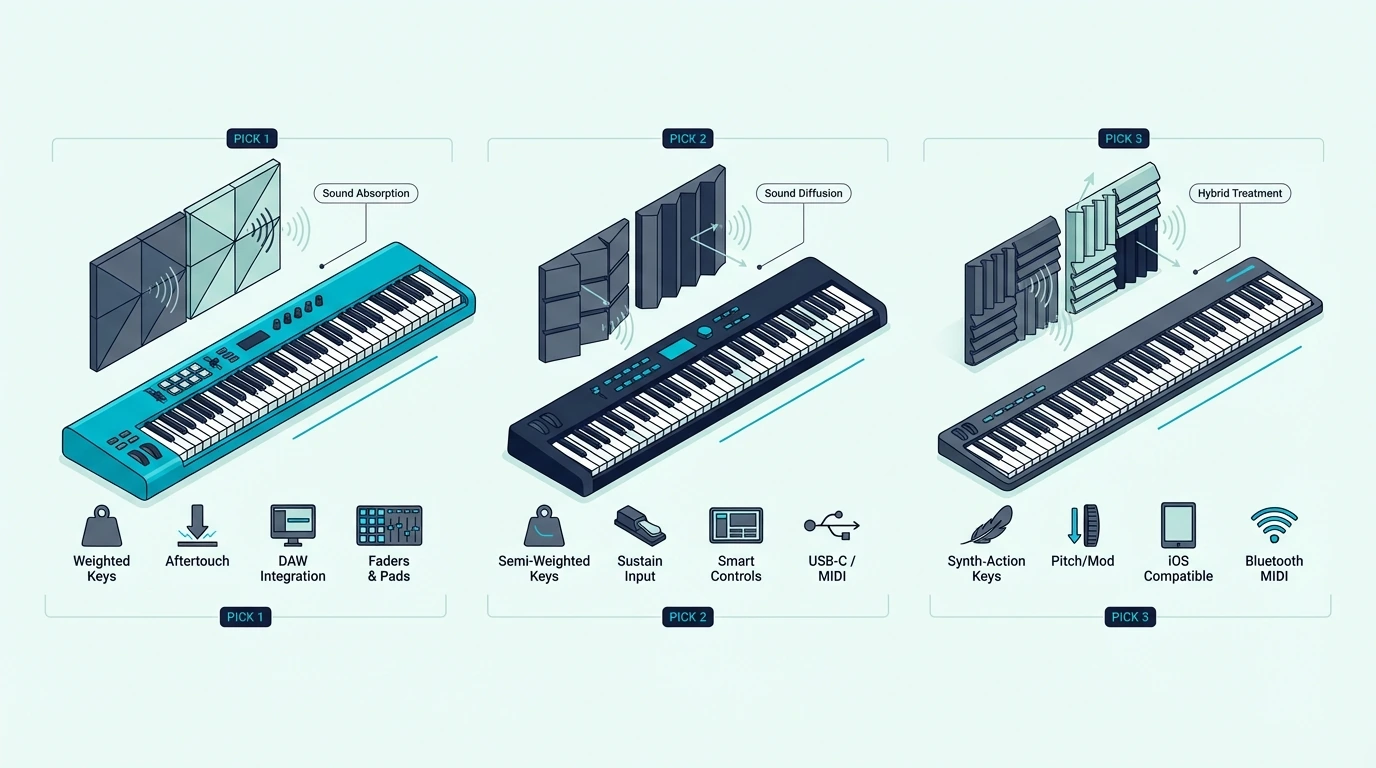
Here are the controllers we recommend for full-range playing, with every pick keeping the full 88-key span.
The M-AUDIO Keystation 88 MK3 wins Best Overall because it delivers the full 88-key range with semi-weighted action, transport controls, and pitch/mod wheels at the lowest price point in the category. Over 6,600 verified reviews and Amazon Overall Pick status confirm its reliability. The semi-weighted action suits producers and composers who want range without the weight of hammer-action keys.
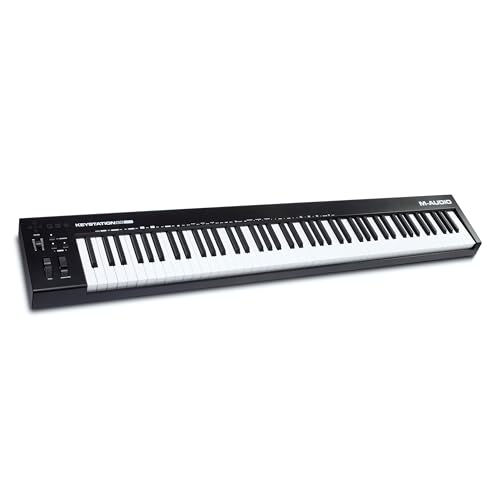
M-AUDIO Keystation 88 MK3
For pianists who need true weighted hammer action, the Yamaha P71 88-Key Weighted Digital Piano doubles as both a standalone instrument and a MIDI controller. The Graded Hammer Standard action feels heavier in the bass and lighter in the treble — matching the behavior of an acoustic grand piano. At 4.7 stars across 6,500+ reviews, the key feel consistently satisfies trained pianists.
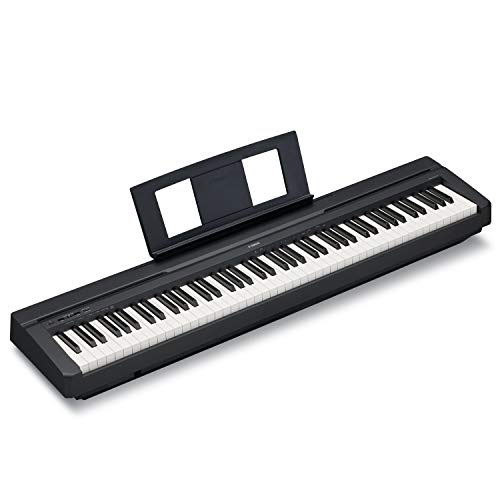
Yamaha P71 88-Key Weighted Digital Piano
The Alesis Q88 MKII is the best value 88-key pick if you want the range without paying for a control surface. It is a straightforward keyboard meant to get notes into your DAW, and that simplicity is exactly what many pianists and composers want.
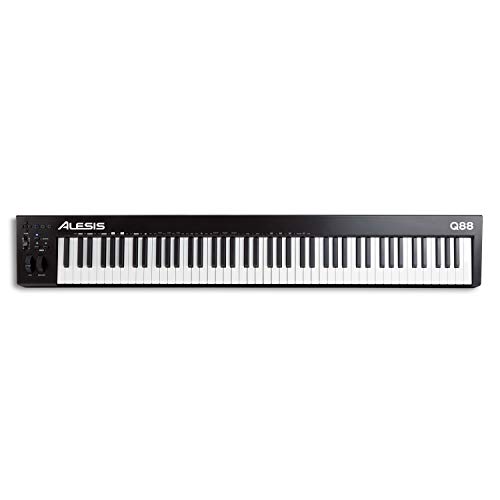
Alesis Q88 MKII
The Arturia KeyLab 88 MkII is the premium 88-key choice for players who refuse to compromise between key feel and studio control. It gives you a serious hammer-action keybed plus the pads, encoders, and faders you would normally need a second controller to get.
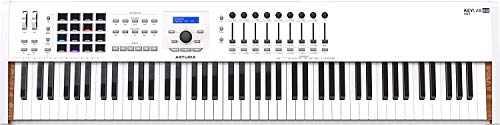
Arturia KeyLab 88 MkII
The Novation Launchkey 88 is the best 88-key option for producers who want full range and modern DAW control without stepping into four-figure territory. It is especially strong if your workflow lives in Ableton or Logic and you want pads and mixer control built into the same keyboard.
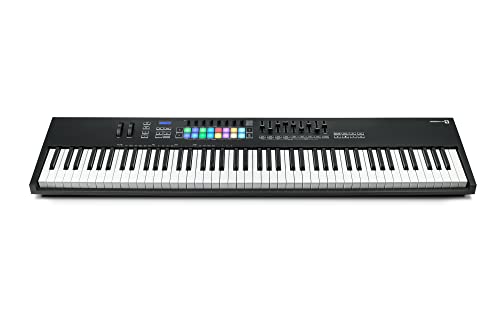
Novation Launchkey 88
And the Nektar Impact LX88+ is the budget control-surface pick. It is the bridge between simple keys-only boards and premium all-in-one workstations, giving you 88 keys plus real hands-on DAW control at a far more approachable price than the Arturia.
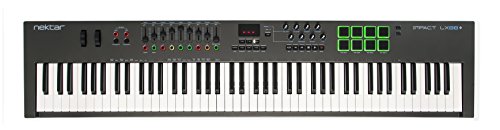
Nektar Impact LX88+
Get Studio Tips Weekly
Join 5,000+ creators getting acoustic treatment advice every week.
No spam. Unsubscribe anytime.Should You Choose Semi-Weighted or Fully Weighted Keys
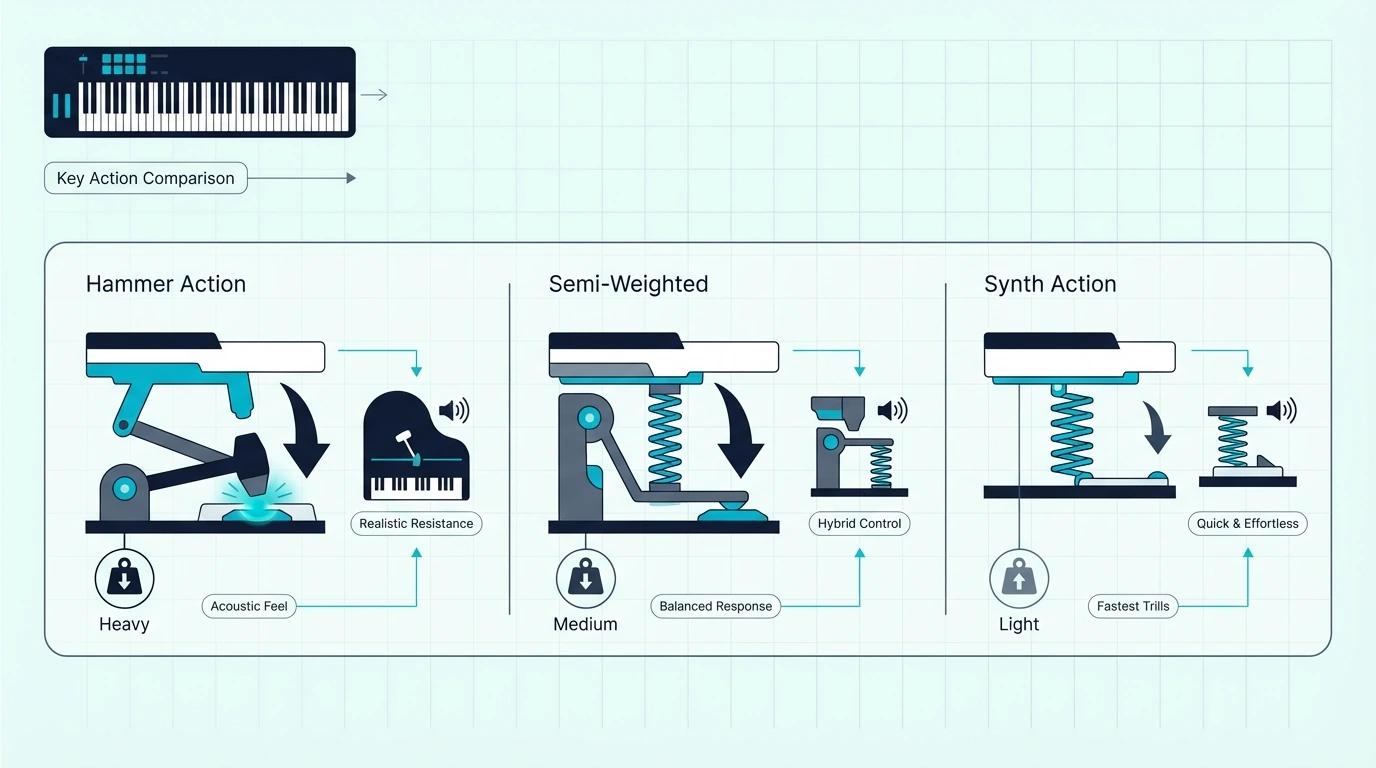
The key action on an 88-key controller determines how the keys feel under your fingers, and the difference between semi-weighted and fully weighted is dramatic.
Semi-Weighted Action
Semi-weighted keys use a spring mechanism that adds resistance without simulating piano hammer weight. The keys feel substantial enough for expressive playing but light enough for fast synth leads and repeated-note passages.
The M-AUDIO Keystation 88 MK3 uses semi-weighted action, which suits producers who want full range without the fatigue of heavy keys during long sessions. Electronic musicians, film composers working with multiple instrument types, and multi-genre producers typically prefer semi-weighted because it handles everything adequately.
Fully Weighted (Hammer Action)
Fully weighted keys use a mechanical hammer mechanism that simulates the weight and response of an acoustic piano. The bass keys feel heavier than the treble keys, matching how a real grand piano behaves.
The Yamaha P71’s GHS (Graded Hammer Standard) action is the benchmark for affordable hammer action. Pianists who practice classical repertoire, prepare for recitals, or teach lessons need this key feel because anything lighter builds wrong muscle memory.
The Hybrid Approach
Many 88-key buyers pair a weighted digital piano for practice with a compact 25-key controller with pads for production. The piano handles playing, the mini controller handles beat making and knob tweaking.
That two-controller setup often costs less than a single premium weighted MIDI controller with all the extras. You get the best of both worlds — authentic piano feel for practice sessions and compact pad-based control for production — without compromising on either.
Desk Space And Setup Considerations
An 88-key controller measures roughly 52 inches wide. That is wider than most computer desks accommodate comfortably alongside a monitor, speakers, and audio interface.
Consider a keyboard stand positioned below or beside your desk rather than on top of it. A two-tier stand lets you keep the 88-key controller at playing height while your compact controller stays on the desk for quick production tasks.
The Bottom Line
The M-AUDIO Keystation 88 MK3 remains the best 88-key MIDI controller for most producers because it delivers the full range at a rational price and keeps the interface simple. If authentic piano feel matters more than controller extras, buy the Yamaha P71. If you want an 88-key board that also runs your DAW session, step up to the Arturia KeyLab 88 MkII or the Novation Launchkey 88.
Before committing to 88 keys, measure your desk. If a four-foot controller does not fit comfortably, a 61-key alternative covers five octaves in significantly less space.
Frequently Asked Questions
Is an 88-key MIDI controller worth it?
Only if your workflow regularly uses the full keyboard range — classical piano practice, orchestral scoring, or complex two-handed arrangements that span more than five octaves. For beat making, synth programming, and general production, a 49-key controller handles everything at a fraction of the cost and desk space.
What is the difference between semi-weighted and weighted keys?
Semi-weighted keys use springs for resistance and feel light and responsive. Weighted (hammer action) keys use a mechanical hammer that simulates acoustic piano feel — heavier in the bass, lighter in the treble. Pianists need weighted keys for proper technique development.
Do I need 88 keys for music production?
No. Most producers work comfortably with 25 to 49 keys. The octave shift buttons on any MIDI keyboard give you access to the full MIDI note range (0-127) regardless of physical key count. 88 keys eliminates octave shifting but adds significant cost and desk footprint.
Can I use an 88-key digital piano as a MIDI controller?
Yes — any digital piano with USB MIDI or 5-pin DIN MIDI output works as a MIDI controller. The Yamaha P71 and similar instruments send MIDI data to your DAW while simultaneously producing their own built-in sounds. Check for a USB-B port or MIDI OUT jack on the back panel.