Best 25 Key MIDI Controller — Compact Boards That Pack More Than You Expect
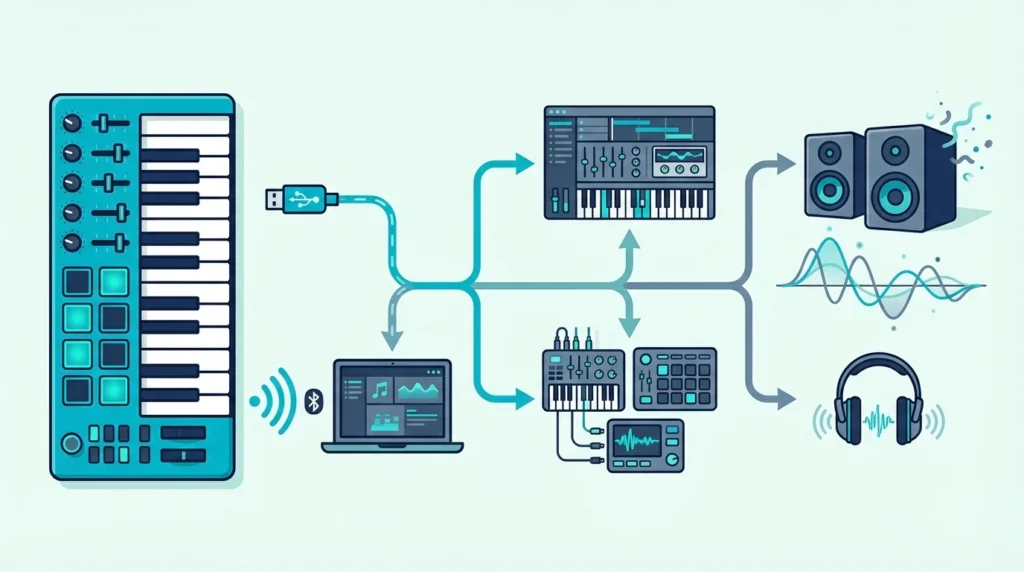
Best 25 key MIDI controller is the most popular size category for a reason, but the controllers in this bracket vary wildly — some give you just keys while others pack pads, knobs, arpeggiators, and bundled software into a package that won’t fit in a product photo.
The problem is caused by the 25-key format attracting two completely different buyer types. Beat makers want pads and knobs alongside minimal keys. Keyboard players want the best possible key feel in the smallest footprint. A controller optimized for one group frustrates the other, and most reviews fail to distinguish between them.
We sorted the 25-key controllers by what they actually prioritize — keys-only simplicity versus all-in-one production — so you can match the controller to your workflow instead of guessing from a spec sheet. Every pick below was evaluated on build quality, velocity response, and whether the extras genuinely add value or just add clutter.
Below you will find our top picks sorted by feature philosophy, followed by a guide on when 25 keys is the right choice and when you should size up.
The best 25 key MIDI controller is the Akai MPK Mini MK3 for producers who want keys, pads, and knobs in one unit. For keys-only simplicity at under fifty dollars, the Nektar SE25 delivers velocity-sensitive input with DAW integration. Bluetooth users should look at the M-VAVE 25 Key for wireless iPad and phone connectivity.
Why 25 Keys Dominates The Market
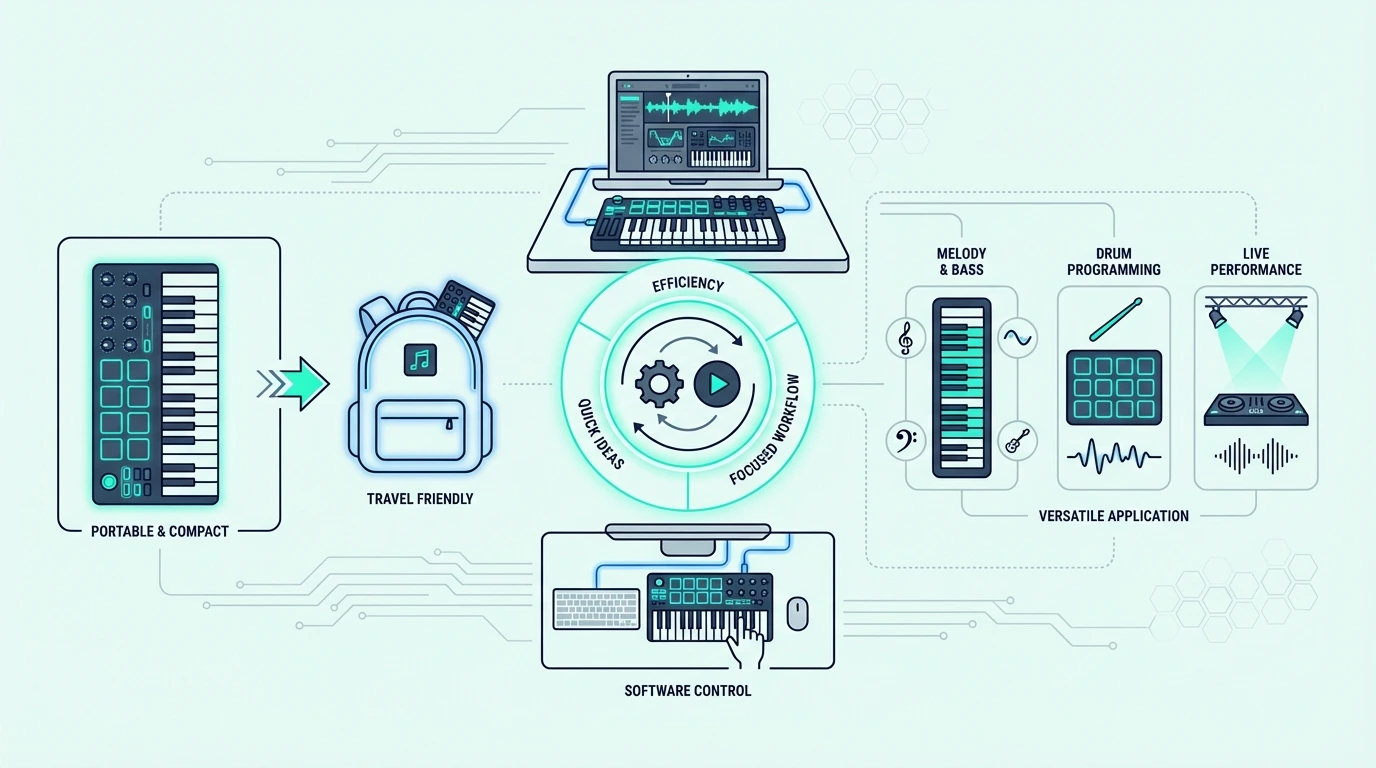
Twenty-five keys span two octaves — enough for single-hand melodies, bass lines, synth leads, and basic chord stabs. That range covers the core input needs of beat makers, electronic producers, and anyone who programs notes more than they perform them.
Portability Is The Primary Advantage
A 25-key controller fits in a backpack, sits beside a laptop without dominating the desk, and weighs under two pounds for the lightest models. That portability makes it the default choice for mobile production — coffee shops, dorm rooms, hotel rooms, and any setup where desk space is limited.
The size advantage compounds when traveling. A 49-key controller requires a dedicated bag or case. A 25-key controller slides into the laptop compartment of a standard backpack alongside your computer.
All-In-One Controllers Change The Equation
The real innovation in the 25-key bracket is not the keys themselves — it is what manufacturers pack alongside them. The Akai MPK Mini MK3 includes 8 MPC-style drum pads, 8 assignable knobs, a joystick for pitch/mod control, a built-in arpeggiator, note repeat, and bundled MPC Beats software. That feature density turns a two-octave keyboard into a complete production command center.
Standalone pad controllers and knob controllers cost fifty to a hundred dollars each. A 25-key all-in-one that includes both eliminates two separate purchases and simplifies your MIDI routing to a single USB cable.
When 25 Keys Is Not Enough
Two-handed chord progressions require at least four octaves. If you play piano-style parts where the left hand covers bass notes while the right hand plays melody, 25 keys runs out of room immediately.
The octave shift buttons work around this limitation, but pressing a button mid-performance breaks the musical flow. Every octave shift interrupts the physical connection between your fingers and the music.
If you’re weighing whether the buttons are enough, how many keys you need on a MIDI keyboard shows how far they reach on Novation’s 25, 49 and 61-key boards.
Producers who find themselves constantly shifting octaves should upgrade to a 49-key or 61-key controller. The 25-key format serves best as a primary controller for one-handed input or as a secondary travel controller alongside a larger home studio keyboard.
If both boards stay plugged in, the computer sees two controllers, and our page on using two controllers together explains the routing.
Velocity Sensitivity Matters More At 25 Keys
With fewer keys available, the expressiveness of each key press matters more than on a larger controller. A 25-key board with accurate velocity curves lets you create dynamic performances with subtle volume variation across just two octaves.
Budget controllers sometimes compress the velocity range, making soft and hard key presses sound nearly identical. Every pick on this list delivers a usable velocity curve that captures the dynamics your DAW needs to make MIDI performances sound musical rather than mechanical.
| Product | Link |
|---|---|
Best Overall 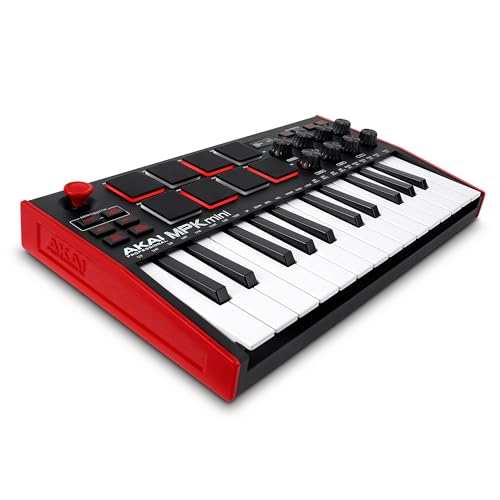 | See ratings |
Best Bluetooth 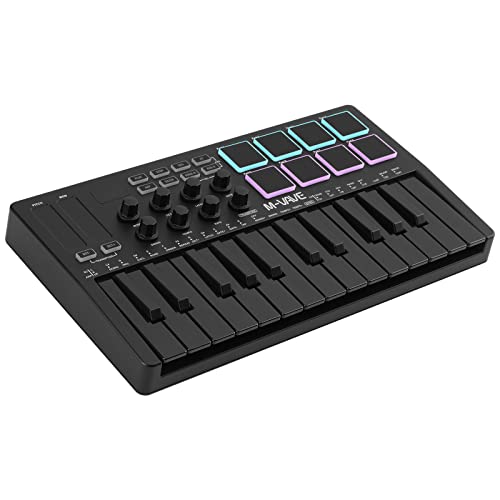 | See ratings |
Best for FL Studio 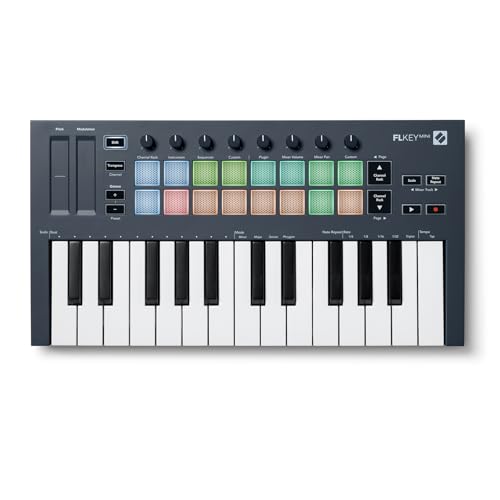 | See ratings |
Best Budget 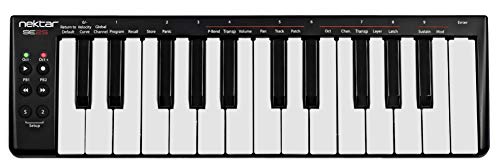 | See ratings |
Best 49-Key Upgrade 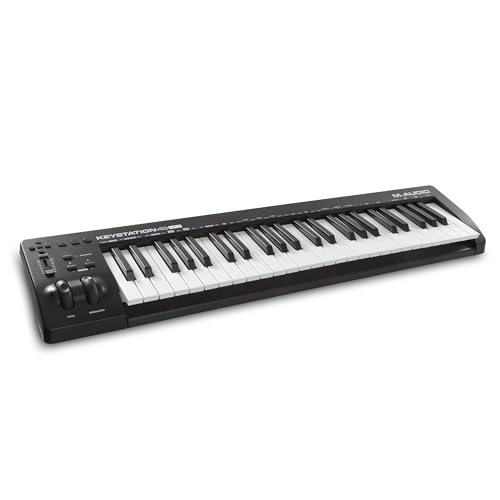 | See ratings |
Best Under 40 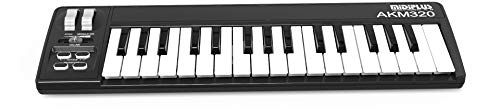 | See ratings |
What Are the Best 25 Key MIDI Controllers
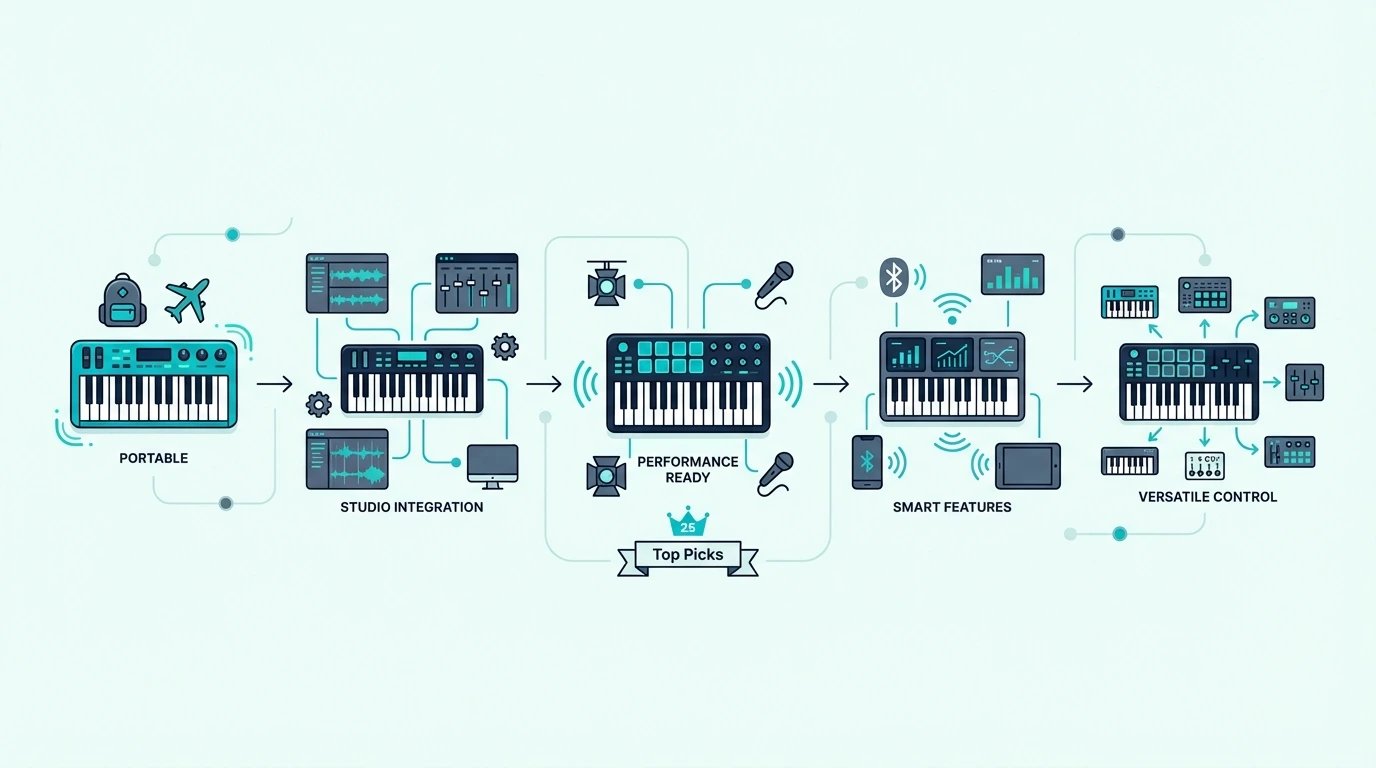
Here are 6 controllers sorted by feature philosophy, from the most feature-complete to the most minimal.
The Akai Professional MPK Mini MK3 wins Best Overall because no other 25-key controller matches its combination of keys, pads, knobs, arpeggiator, and bundled software at ninety-nine dollars. Beat makers, synth programmers, and electronic producers all benefit from having every control type in one compact unit.
Akai Professional MPK Mini MK3
The M-VAVE 25 Key MIDI Controller takes Best Bluetooth for producers who want wireless connectivity with iPad, iPhone, or Android devices. The Bluetooth MIDI pairs directly without adapters, and USB mode is available for latency-critical recording on desktop DAWs.
M-VAVE 25 Key MIDI Controller
The Novation FLkey Mini earns Best for FL Studio because it is the only 25-key controller with native FL Studio integration. The pads control the channel rack, the knobs control the mixer, and the keys play instruments — all mapped automatically without any manual MIDI learn setup.
Novation FLkey Mini
The Nektar SE25 delivers Best Budget with 25 velocity-sensitive keys and DAW integration for under fifty dollars. At 1.3 pounds, it is the lightest controller on this list — ideal for producers who want pure key input without extras.
Nektar SE25
If you want to step up to full-size keys, the M-AUDIO Keystation 49 MK3 gives you four octaves of full-size synth-action keys with transport controls. The natural upgrade path when 25 mini keys start feeling limiting.
M-AUDIO Keystation 49 MK3
And the midiplus AKM320 at under forty dollars gives you 32 mini keys — seven more than the standard 25-key layout — for the lowest price on the list. No pads or knobs, but the velocity sensitivity captures dynamics that mouse input cannot.
midiplus AKM320
Get Studio Tips Weekly
Join 5,000+ creators getting acoustic treatment advice every week.
No spam. Unsubscribe anytime.Should You Choose Keys-Only or an All-In-One Controller
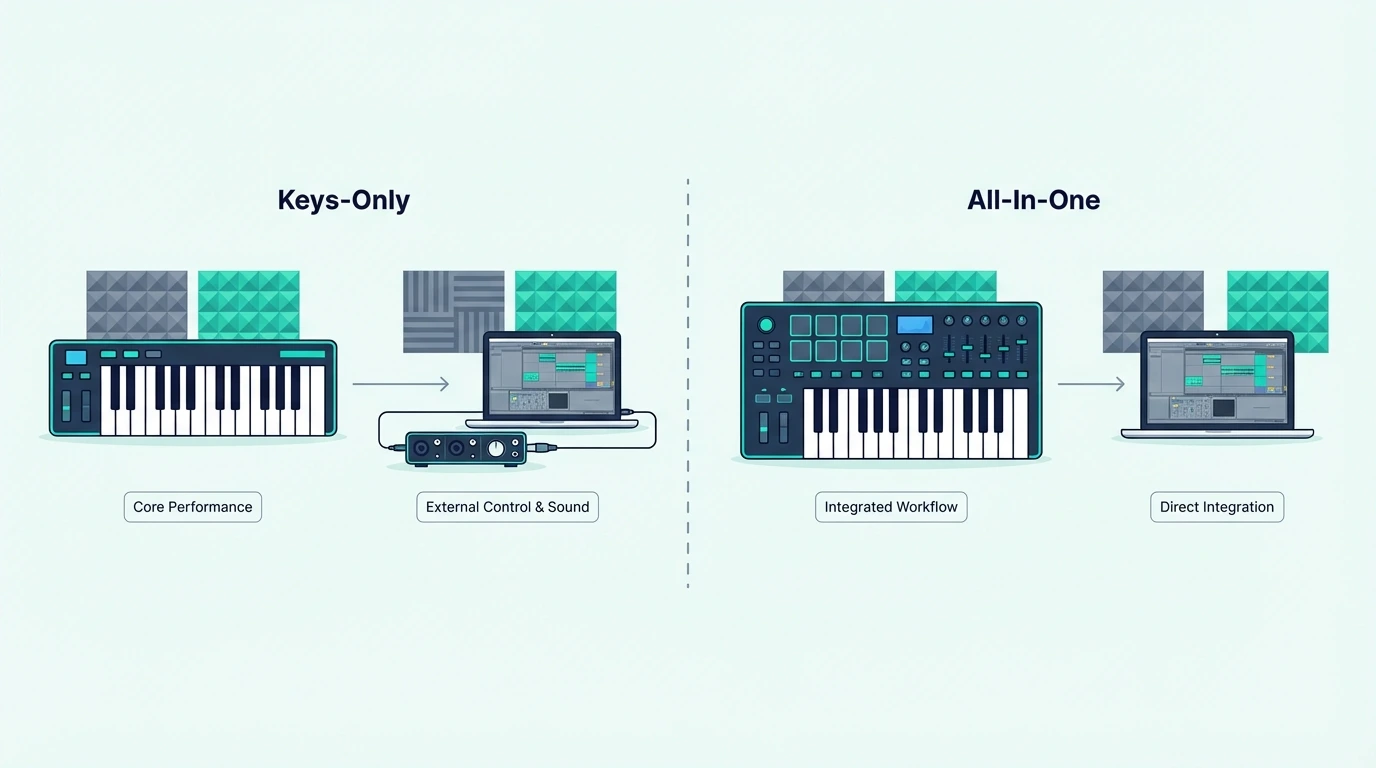
The biggest decision in the 25-key bracket is not which controller to buy — it is which type of 25-key controller fits your workflow.
Keys-Only Controllers (Under 50 Dollars)
Controllers like the Nektar SE25 and midiplus AKM320 give you velocity-sensitive keys and nothing else. That simplicity has genuine value for producers who already own a separate pad controller or who only need keyboard input for melody and chord entry.
The lower price also makes keys-only controllers ideal as a second keyboard. Keep a 49-key board at your desk and a keys-only 25-key in your bag for travel.
All-In-One Controllers (80 To 120 Dollars)
The Akai MPK Mini MK3, M-VAVE, and Novation FLkey Mini bundle pads, knobs, and keys into a single unit. The higher price buys you three control types that would cost over two hundred dollars if purchased separately.
All-in-one controllers make the most sense as a primary and only controller — especially for beginners who do not own any MIDI hardware yet. One purchase covers keys, beat making, and parameter control without requiring additional gear.
The Decision Framework
If you answer “yes” to any of these, choose an all-in-one: Do you make beats with drum samples? Do you want hands-on knob control for synth parameters? Do you need a complete production setup in one device?
If you answer “no” to all three, a keys-only controller saves you money without sacrificing the input you actually need. Upgrade to an all-in-one later only if your workflow demands it.
The beauty of the 25-key market is that both types exist at accessible price points. You can start with a forty-dollar keys-only board, discover you need pads six months later, and upgrade to the MPK Mini MK3 without feeling like your first purchase was wasted — the keys-only controller becomes your travel backup.
The Bottom Line
The Akai MPK Mini MK3 is the best 25-key controller for most producers — keys, pads, knobs, and software in one compact package for ninety-nine dollars. Budget-conscious buyers should start with the Nektar SE25 for pure key input at under fifty dollars.
If you find 25 keys limiting for your playing style, step up to 49 keys for two-handed work. The 25-key format works best for beat making, synth programming, and portable production — not for piano practice.
Frequently Asked Questions
Is 25 keys enough for music production?
For beat making, synth programming, and one-handed melody input, 25 keys covers the core workflow. The two-octave range handles most electronic production tasks. Two-handed playing and wide chord voicings require at least 49 keys.
Should I get a 25-key controller with pads or keys only?
If you make beats, trigger samples, or want hands-on knob control, choose an all-in-one like the Akai MPK Mini MK3. If you only need keyboard input for melodies and chords, a keys-only controller like the Nektar SE25 saves money without sacrificing functionality.
What is the best cheap 25-key MIDI controller?
The Nektar SE25 at under fifty dollars is the best pure-budget option with 25 keys. For slightly more, the midiplus AKM320 at under forty dollars gives you 32 keys. Both deliver velocity sensitivity and USB plug-and-play connectivity.
Can I learn piano on a 25-key MIDI controller?
You can learn basic note reading and finger independence, but the two-octave range prevents two-handed piano practice. Serious piano learners should start with at least 49 keys for proper technique development.