Best Dolby Atmos Soundbar — Top Picks For True 3D Audio
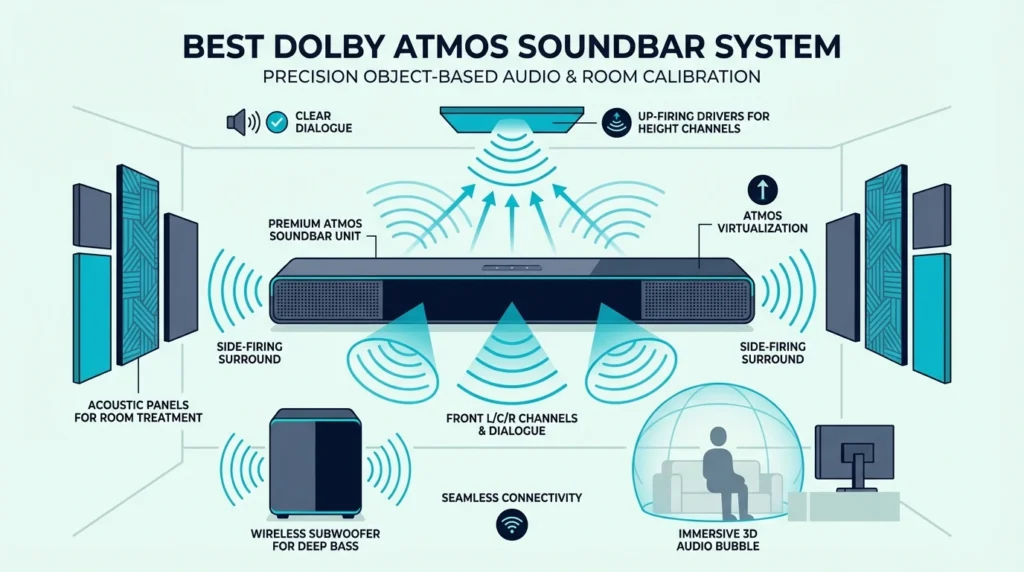
The best Dolby Atmos soundbar can put sound above, around, and behind you from a single bar — but only if the bar uses real up-firing drivers instead of faking the effect with digital processing.
Most soundbars that advertise “Atmos support” are using virtual processing to simulate height channels. The result sounds wider than stereo, but it never delivers the overhead audio that makes Atmos genuinely different from standard surround sound.
A soundbar with real Atmos drivers bounces sound off your ceiling to create a height layer that virtual processing cannot replicate. That overhead dimension is what makes rain fall above you, helicopters pass overhead, and concert halls feel three-dimensional instead of flat.
Start with the channel layout number — the third digit after the decimal tells you how many up-firing Atmos drivers the bar has, so you can filter out the virtual-only options before you spend a dollar.
The best Dolby Atmos soundbar for most rooms is the JBL Bar 700MK2 — it delivers 5.1 Atmos with a wireless subwoofer, PureVoice dialogue enhancement, and automatic room calibration in a package that still undercuts flagship theater systems. For budget buyers who want Atmos without a subwoofer, the Samsung S60D offers wireless Dolby Atmos in a clean all-in-one package for under $350.
How We Chose The Best Dolby Atmos Soundbar

Dolby Atmos soundbars range from $150 virtual-only bars to $1,500 full-theater systems with rear speakers. We tested what actually matters for the Atmos experience — whether height effects are audible, whether dialogue stays clear during complex Atmos scenes, and whether the bar justifies its premium over a non-Atmos alternative.
Up-Firing Drivers vs Virtual Atmos
The single most important distinction in Atmos soundbars is physical up-firing drivers versus virtual height processing. Bars with up-firing drivers (indicated by the third number in layouts like 3.1.2 or 5.1.4) bounce sound off the ceiling to create genuine overhead audio.
Virtual Atmos bars use psychoacoustic processing to simulate the height effect. The simulation works reasonably well in small rooms with low ceilings, but it falls apart in larger spaces where the ear can tell the sound is coming from the bar, not from above.
We prioritized bars with physical up-firing drivers for every pick except the budget tier, where virtual Atmos is the only option under $300. This distinction alone eliminates roughly half of all “Atmos” soundbars on the market.
Room Calibration and Atmos Processing
Atmos effectiveness depends heavily on room acoustics — ceiling height, ceiling material, and room shape all affect how well up-firing drivers perform. Bars with automatic room calibration consistently delivered better Atmos height effects than bars without it.
Samsung’s SpaceFit Sound, JBL’s MultiBeam calibration, and LG’s AI Room Calibration all adjust the Atmos processing based on your specific room. Bars without calibration rely on factory defaults that may not match your ceiling height or room layout.
Content and Connection Requirements
Dolby Atmos requires an HDMI eARC connection to pass the full Atmos signal from your TV to the soundbar. Optical connections cannot carry Atmos audio — they downmix to stereo or basic 5.1 at best.
Atmos content is widely available on Netflix, Disney+, Apple TV+, and Amazon Prime Video in growing libraries of movies and shows. Blu-ray discs offer the highest-quality lossless Atmos tracks, but streaming Atmos is good enough that most buyers will never need physical media to hear the difference.
If movie night is the main reason you’re buying, soundbars that suit film soundtracks best compares six Atmos bars by bass, dialogue and surround.
The soundbar guide covers non-Atmos options for buyers who prioritize value over immersive audio features.
| Product | Link |
|---|---|
Best Overall Atmos 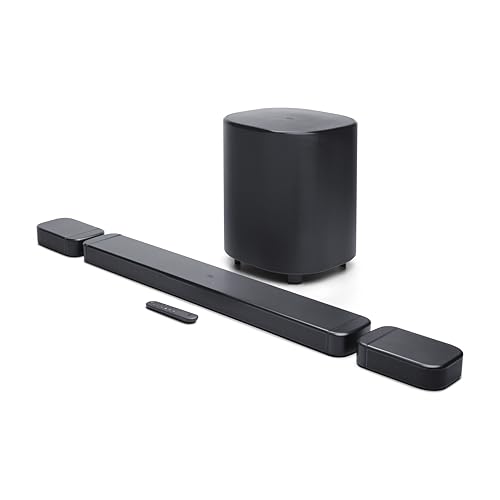 | See ratings |
Best Budget Atmos  | See ratings |
Best Value Atmos With Sub 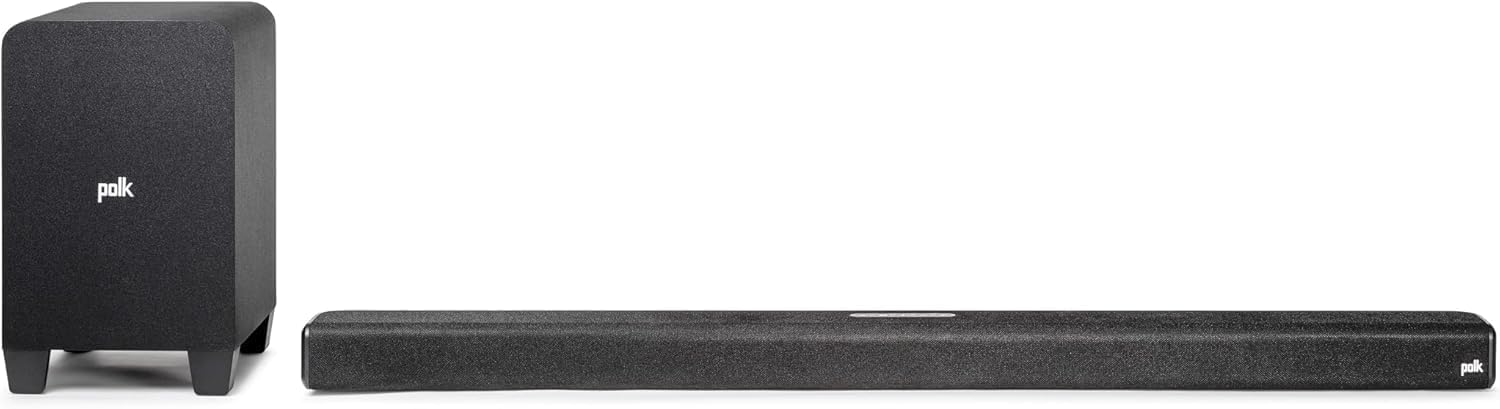 | See ratings |
Best Samsung 3.1.2 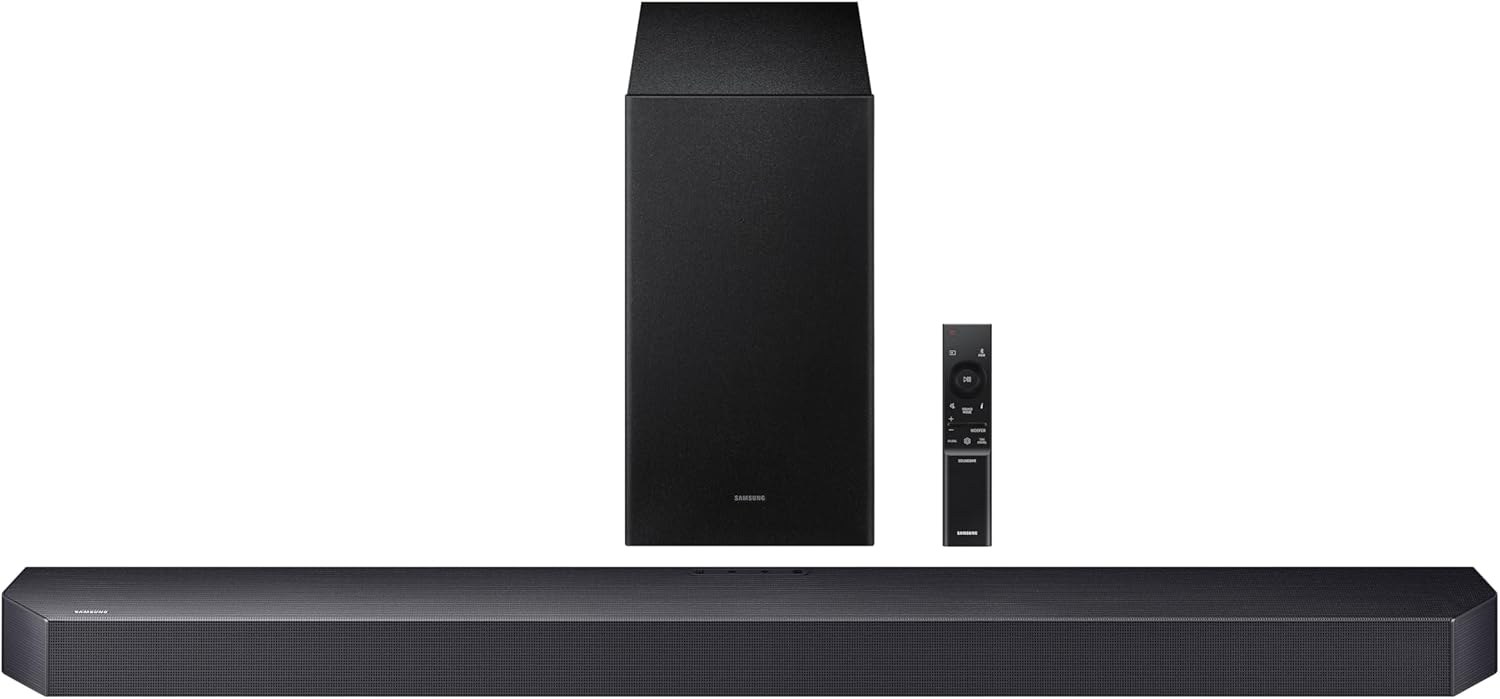 | See ratings |
Best Premium Atmos 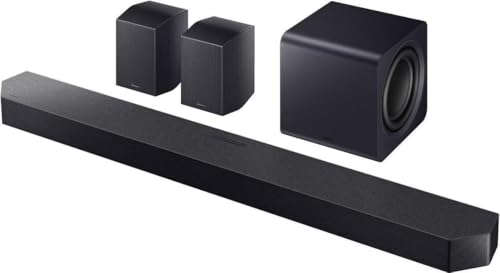 | See ratings |
Best LG TV Match 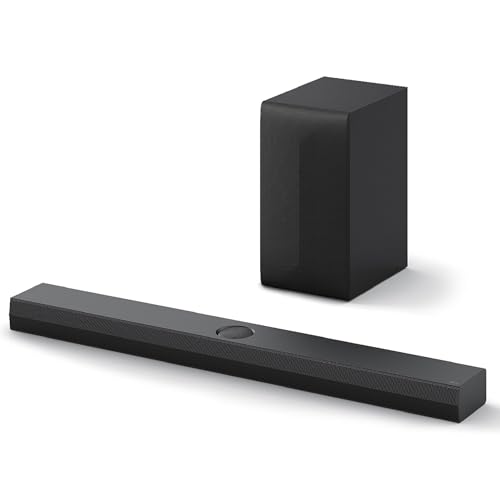 | See ratings |
True Atmos vs Virtual Atmos — Why It Matters
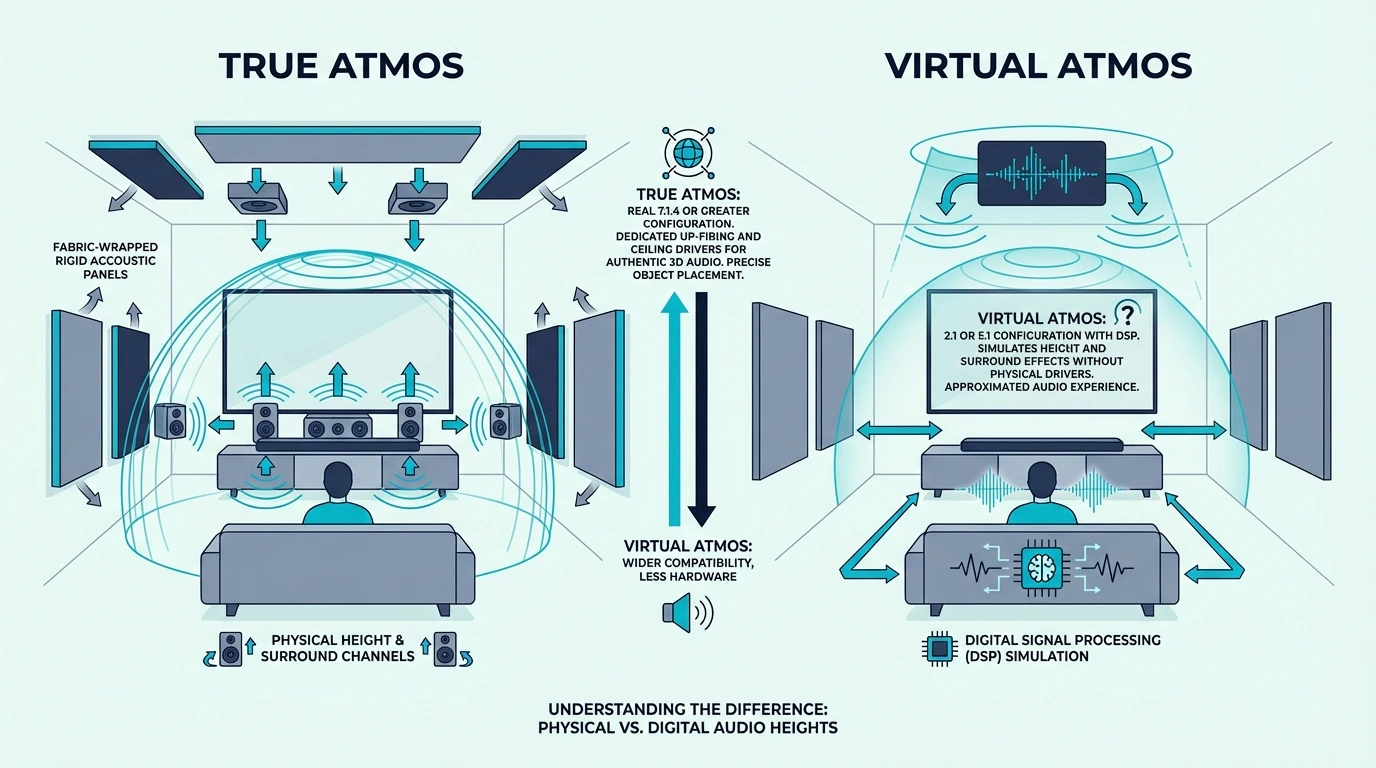
Understanding the difference between true and virtual Atmos prevents the most common buying mistake — paying extra for an “Atmos” label that delivers no meaningful height effect.
How True Atmos Works In A Soundbar
True Atmos soundbars use dedicated up-firing drivers angled at approximately 15 degrees toward the ceiling. The sound bounces off the ceiling and reaches your ears from above, creating the height layer that Atmos content is mixed for.
The effect works best with flat, hard ceilings between 7 and 10 feet high. Vaulted ceilings, cathedral ceilings, and textured acoustic ceilings scatter the reflected sound and reduce the height effect significantly.
Channel layouts tell you exactly what you get. A 3.1.2 bar has three front channels, one subwoofer channel, and two up-firing Atmos drivers.
A 5.1.4 bar has five front channels, one sub, and four up-firing drivers for even more precise overhead audio. The higher the third number, the more height drivers the system uses to create overhead sound placement.
How Virtual Atmos Works
Virtual Atmos uses DSP (digital signal processing) to manipulate the phase and timing of sound from regular forward-firing drivers. The processing tricks your brain into perceiving sound as coming from above and to the sides.
The effect is subtle at best and inaudible at worst. In small rooms with low ceilings, virtual Atmos can add a slight sense of height to overhead effects like rain or flyovers.
In larger rooms, the effect disappears completely. The further your ears are from the bar, the less convincing the virtual height processing becomes.
Virtual Atmos bars are worth buying only when Atmos is a bonus feature on an otherwise good bar — not when Atmos is the primary reason for the purchase.
When Virtual Is Good Enough
For bedrooms under 150 square feet with ceilings under 8 feet, virtual Atmos can deliver a noticeable spatial effect. The Samsung S60D and similar all-in-one bars use virtual Atmos processing that works surprisingly well in compact spaces.
For living rooms, dedicated theater rooms, or any space over 200 square feet, physical up-firing drivers make a significant audible difference. The soundbar guide covers why sub-equipped systems usually do a better job separating bass weight from Atmos detail.
Get Studio Tips Weekly
Join 5,000+ creators getting acoustic treatment advice every week.
No spam. Unsubscribe anytime.The Best Dolby Atmos Soundbars — Our Top Picks
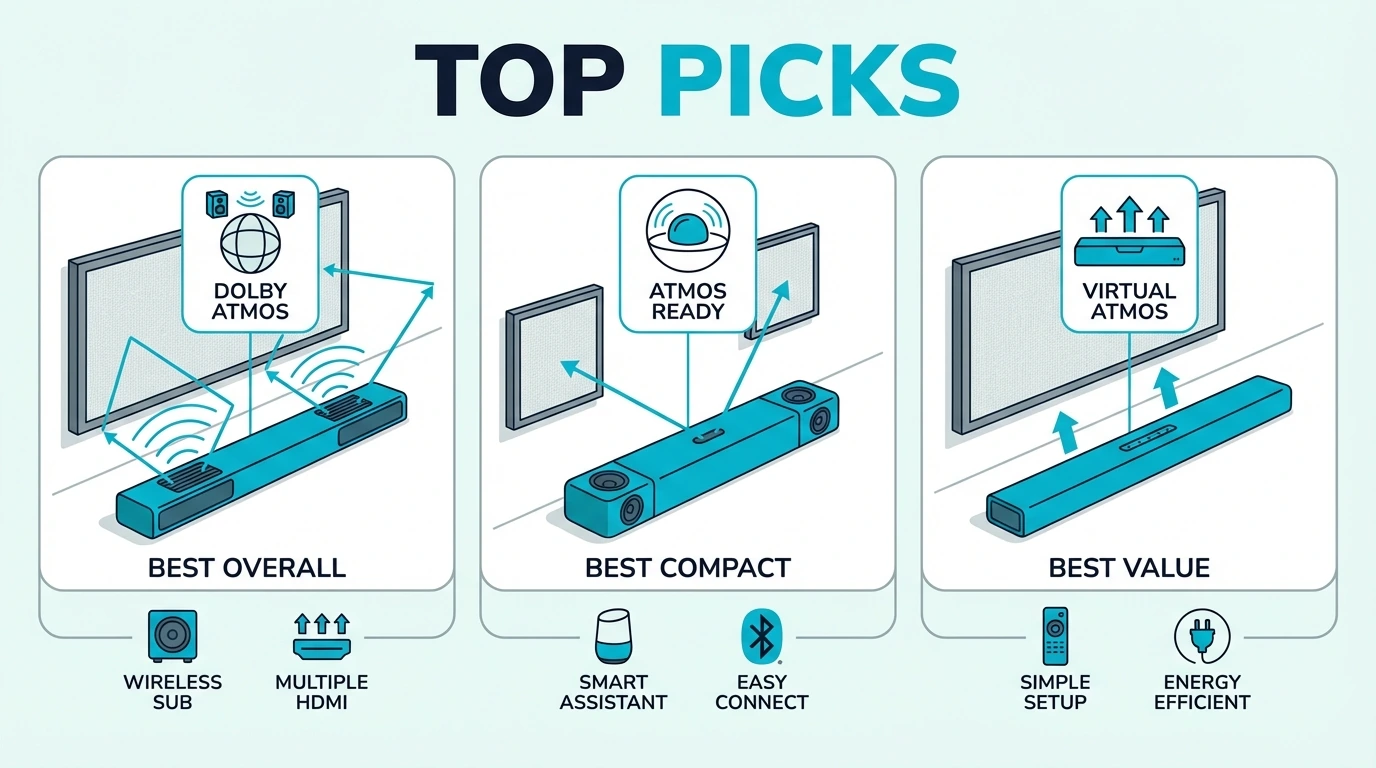
Each pick below earned its spot by delivering genuinely audible Atmos height effects at its price tier. We prioritized bars where Atmos makes a real difference over bars where it is just a spec-sheet checkbox.
Best Overall Atmos: JBL Bar 700MK2
The JBL Bar 700MK2 delivers the best balance of Atmos performance, bass quality, and dialogue clarity in the serious mid-range Atmos tier. The 5.1 layout with a dedicated wireless 10-inch subwoofer provides genuine low-end impact.
JBL Bar 700MK2
MultiBeam automatic room calibration measures your room and optimizes the Atmos processing for your ceiling height and wall distances. The calibration takes about two minutes and makes a clearly audible improvement in height channel accuracy.
PureVoice dialogue enhancement is JBL’s answer to the most common soundbar complaint — dialogue drowned out by music and effects. The feature works independently of the Atmos processing, so you get clear speech without sacrificing the immersive surround effect.
The 10-inch wireless sub handles frequencies below 80Hz with authority, which frees the bar’s drivers to focus on mid-range clarity and Atmos height effects. For most living rooms, this is the sweet spot between the Sonos Arc Ultra’s premium price and budget Atmos bars that cut corners on bass.
For buyers comparing JBL against other premium options, the soundbar guide explains where the JBL Bar 700MK2 fits in the wider market across price tiers and feature sets.
Best Budget Atmos: Samsung S60D
The Samsung S60D is the most affordable way to get Dolby Atmos processing in a soundbar from a major brand. The all-in-one design requires no separate subwoofer or rear speakers.
Samsung S60D
The 5.0 channel layout uses virtual Atmos processing rather than physical up-firing drivers. In rooms under 200 square feet, the virtual height effect adds a noticeable spatial dimension to Atmos content — especially overhead rain, flyovers, and ambient environmental audio.
Q-Symphony integration syncs the S60D with compatible Samsung TV speakers from 2020 onward, effectively adding two more sound sources to the system. The combined output creates a wider soundstage than the bar alone can achieve.
The trade-off is clear — without physical up-firing drivers, the S60D cannot deliver the dramatic overhead effects that true Atmos bars produce. It is an excellent entry point for buyers who want to experience Atmos on a budget.
For serious Atmos listeners who want genuine overhead audio, a bar with physical up-firing drivers is the better long-term investment. The soundbar guide covers when an all-in-one Atmos bar like the S60D makes more sense than a bigger sub-equipped package.
Best Value Atmos With Sub: Polk Audio Signa S4
The Polk Audio Signa S4 is the least expensive way to get true Dolby Atmos with physical up-firing drivers and a wireless subwoofer included in the box. The 3.1.2 layout puts two dedicated height drivers on top of the bar.
Polk Audio Signa S4
The up-firing drivers create genuine overhead audio that virtual-only bars cannot match. Rain, thunder, and helicopter scenes produce a height layer that is clearly distinct from the front channels — exactly what Atmos is designed to deliver.
VoiceAdjust is Polk’s dialogue enhancement feature, and it is one of the best in the mid-range tier. You can boost center-channel speech volume without touching the surround or Atmos mix, which solves the nighttime viewing problem cleanly.
The wireless sub fills rooms up to 300 square feet with adequate movie bass. It is not as powerful as the JBL Bar 700MK2’s 10-inch sub, but it handles most action movie sequences without distortion.
For buyers comparing the Signa S4 against other sub-equipped options in this price range, the soundbar guide breaks down when a more traditional bar-plus-sub package beats a simpler all-in-one Atmos bar.
Best Samsung 3.1.2: Samsung HW-Q600F
The Samsung HW-Q600F is the pick for Samsung TV owners who want real height channels without paying flagship prices. It’s a 3.1.2 system with a wireless subwoofer in the box.
Samsung HW-Q600F
The HW-Q600F uses up-firing channels to project sound overhead, plus a dedicated center channel for dialogue. SpaceFit Sound Pro tunes the output to your room.
The included wireless subwoofer adds bass depth the bar can’t produce on its own. For rooms under 300 square feet, the combined system covers Atmos height effects and movie bass without extra speakers.
Samsung TV owners get Q-Symphony (with a compatible 2020–2025 Samsung TV) on top of the Atmos features. Non-Samsung TV owners still get Atmos over HDMI, but miss the ecosystem perks.
The dedicated center channel makes the Q600F a strong choice for dialogue in the mid-range Atmos tier. The soundbar guide explains when center-channel clarity should matter more than raw Atmos scale.
Best Premium Atmos: Samsung HW-Q990F
The Samsung HW-Q990F is the most capable Atmos soundbar system available from any manufacturer. The 11.1.4 channel layout includes the main bar, a wireless subwoofer, and wireless rear speakers — all in the box.
Samsung HW-Q990F
Four up-firing Atmos drivers (two in the bar, two in the rear speakers) create the most precise height layer of any soundbar system tested. Overhead effects are localized and convincing, with clear front-to-back movement that cheaper systems cannot reproduce.
SpaceFit Sound Pro calibrates each speaker individually using the TV’s microphone, adjusting the Atmos processing based on your specific room dimensions and ceiling material. The calibration dramatically improves the height effect accuracy compared to the default factory settings.
At $1,498, this system competes directly with dedicated AV receiver and passive speaker packages. It only makes sense for buyers with Samsung TVs and a dedicated viewing room where rear speaker placement is possible.
Buyers who regularly watch Atmos Blu-rays or high-quality streaming content will hear a clear difference over cheaper systems. For everyone else, the soundbar guide covers options that deliver most of the experience for well under half the price.
Best LG TV Match: LG S70TY
The LG S70TY is the best Atmos entry point for LG TV owners who want ecosystem integration comparable to Samsung’s Q-Symphony. WOW Orchestra syncs the bar with LG TV speakers to create a combined soundstage.
LG S70TY
The 3.1 layout with a dedicated center channel prioritizes dialogue clarity — the feature LG TV owners request most. Dolby Atmos processing is virtual rather than physical, but the WOW Orchestra integration adds spatial width that partially compensates for the missing up-firing drivers.
At just under $300, this is still one of the more affordable Dolby Atmos bars from a major brand. It works with any TV via HDMI eARC, but LG TV owners get the full benefit of WOW Orchestra and remote integration.
For LG TV owners who want to step up to physical up-firing Atmos drivers, LG’s premium bars offer true height channels at a higher price point. The soundbar guide covers how LG-oriented Atmos setups compare with the rest of the market.
Atmos Channel Layouts Compared
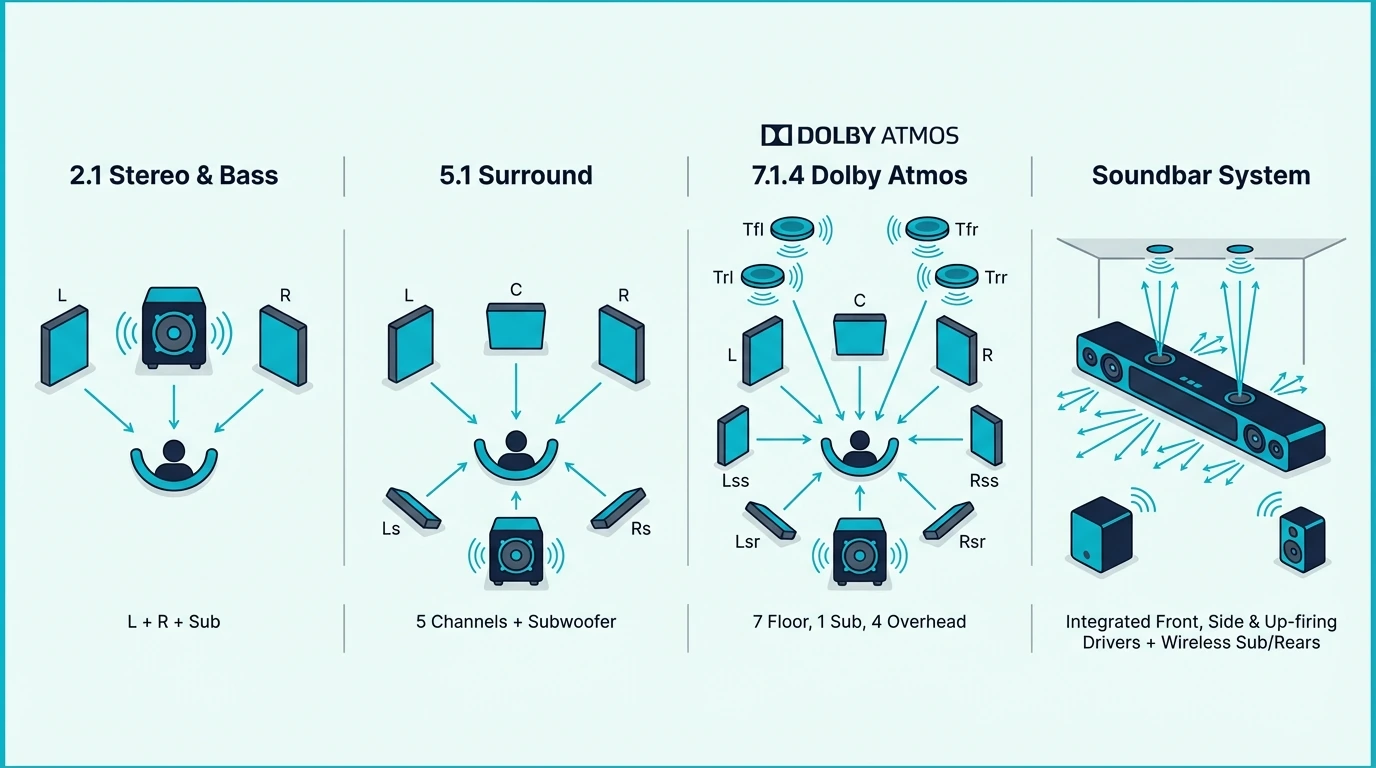
The channel layout number tells you exactly what speakers a soundbar system includes. Understanding this notation prevents overpaying for channels you cannot hear in your room.
3.1.2 — The Sweet Spot For Most Rooms
A 3.1.2 system has three front channels (left, center, right), one subwoofer, and two up-firing Atmos drivers. This is the minimum layout for true Atmos with physical height drivers.
The Polk Signa S4 and Samsung HW-Q600F both use 3.1.2 layouts with up-firing drivers. For rooms between 150 and 350 square feet, a 3.1.2 bar delivers clearly audible Atmos height effects without requiring rear speakers or complex installation.
The center channel is critical for dialogue clarity in this layout. Bars that skip the dedicated center (like 2.1.2 layouts) often blur dialogue across the left and right drivers, which makes speech harder to understand during complex Atmos scenes.
5.1 and 5.1.2 — Adding Side Channels
A 5.1 system adds two side-firing drivers that bounce sound off your walls to simulate surround channels without rear speakers. The JBL Bar 700MK2 uses this approach with five front-facing and side-firing channels plus a dedicated wireless 10-inch subwoofer.
Adding the .2 suffix (5.1.2) means two up-firing Atmos drivers sit on top of the five-channel base. This layout offers the best combination of surround width and overhead height from a single bar without rear speakers.
For rooms wider than 12 feet, the side channels in a 5.1 layout create a noticeably wider sound field than a 3.1 bar. The surround effect is not as precise as dedicated rear speakers, but it fills the room more convincingly than a three-channel bar.
7.1.4 and 11.1.4 — Full Theater Layouts
Systems with 7.1.4 or 11.1.4 channels include dedicated wireless rear speakers. The rear speakers add genuine behind-the-listener audio that no front-firing bar can simulate convincingly.
The Samsung HW-Q990F’s 11.1.4 layout is the most ambitious soundbar system currently available. Four up-firing Atmos drivers (two in the bar, two in the rears) create a complete hemisphere of overhead audio that approaches a custom-installed ceiling speaker system.
These layouts only make sense for dedicated home theater rooms where rear speakers can be placed behind the listening position. For open-plan living rooms without walls behind the sofa, a 3.1.2 or 5.1 bar delivers better value because rear speakers need a wall behind them to anchor the surround effect properly.
Choosing The Right Layout
Match the layout to your room size and seating arrangement. Small rooms under 200 square feet get full benefit from a 3.1.2 bar.
Medium rooms between 200 and 400 square feet benefit from 5.1 or 5.1.2 layouts that add meaningful surround width with side-firing drivers. Large dedicated rooms over 400 square feet need 7.1.4 or 11.1.4 systems with rear speakers to deliver the full Atmos experience.
The soundbar guide covers layouts that skip the subwoofer entirely for buyers who prioritize simplicity over bass impact.
How The Flagship Atmos Bars Compare
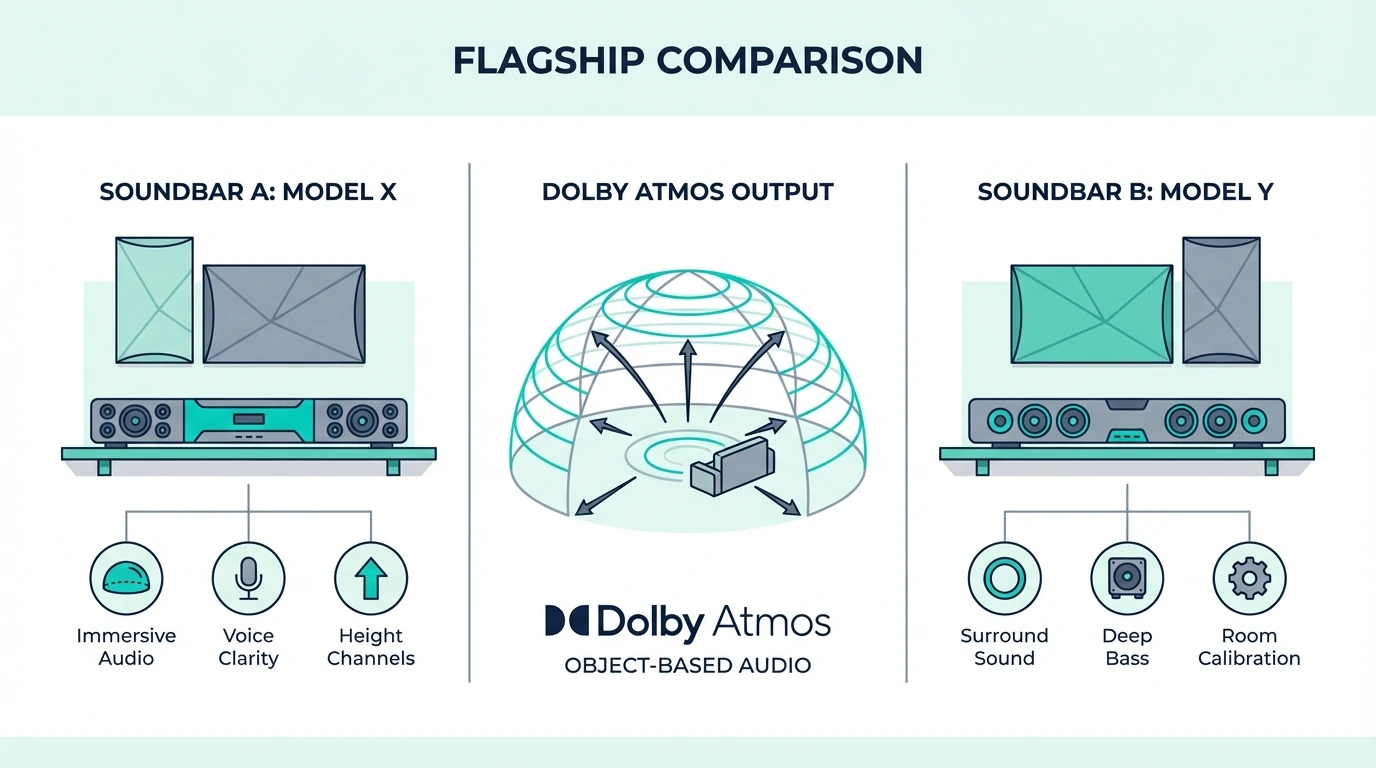
The premium Atmos tier is dominated by three ecosystems — Samsung with the Q990F, JBL with the Bar 700MK2, and Sonos with the Arc Ultra. Each excels in different areas.
Samsung’s Q990F wins on raw channel count (11.1.4) and Samsung TV ecosystem integration via Q-Symphony and SpaceFit Sound Pro. It is the only premium system that includes rear speakers and a subwoofer in the box, which makes it the best choice for buyers who want a complete theater system without buying separate add-ons.
The JBL Bar 700MK2 wins on value at well under half of the Q990F’s price. It delivers 5.1 Atmos with a powerful 10-inch sub and room calibration that rivals systems twice its cost.
For buyers who want excellent Atmos without the complexity of rear speakers, the JBL is the pragmatic choice. Optional wireless rear speakers are available separately if you want to expand later.
The Sonos Arc Ultra commands a premium for its multi-room ecosystem and streaming flexibility. AirPlay 2, Spotify Connect, and voice control integration make it the best Atmos bar for households already invested in Sonos speakers.
The Arc Ultra’s TruePlay room calibration uses your phone’s microphone to optimize the Atmos output for your specific room geometry. The soundbar guide covers where multi-room Atmos bars like the Arc Ultra fit against more traditional theater packages.
Sony’s Bravia Theater Bar 9 is the dark horse — it uses beam-forming technology instead of up-firing drivers to create height effects that are less dependent on ceiling geometry. The soundbar guide breaks down how beam-forming alternatives compare with classic up-firing Atmos bars.
For Bose fans, the Bose Smart Ultra Soundbar uses PhaseGuide virtual Atmos that works surprisingly well in small rooms. The soundbar guide compares virtual Atmos bars against competitors with physical up-firing drivers.
Setting Up Your Atmos Soundbar For Best Results
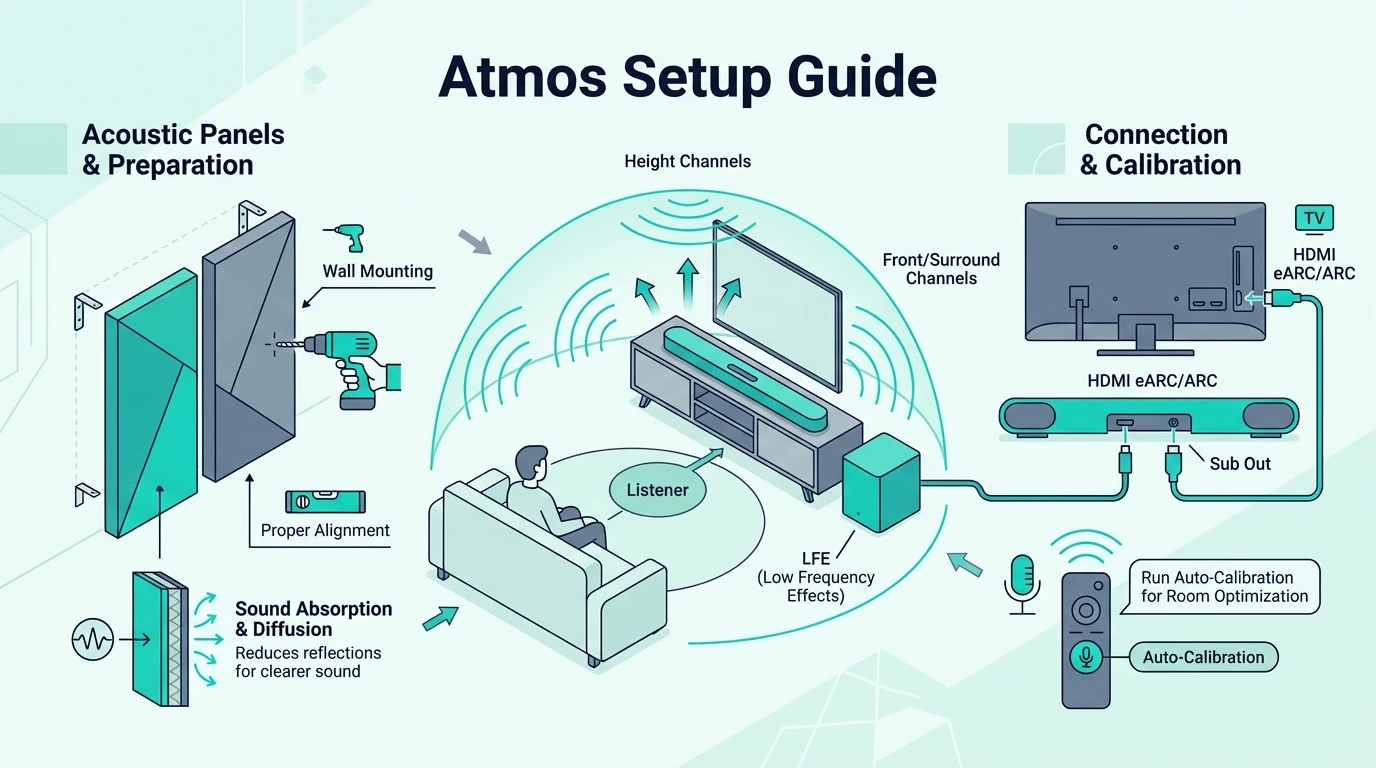
Getting the most from an Atmos soundbar requires the right connection and room setup. These three factors have the biggest impact on Atmos quality.
HDMI eARC Is Non-Negotiable
Connect your soundbar to your TV’s HDMI eARC port — not optical, not regular HDMI ARC. Only eARC can pass the full Dolby Atmos bitstream from your TV to the soundbar without downmixing to lossy formats.
Most TVs made after 2019 include at least one HDMI eARC port. If your TV only has ARC (without the “e”), you will get Dolby Digital Plus Atmos from streaming apps, but you will lose the lossless TrueHD Atmos tracks from Blu-ray discs.
Ceiling Height and Material
Up-firing Atmos drivers perform best with flat, hard ceilings between 7 and 10 feet high. Standard drywall ceilings reflect sound cleanly and create a convincing height layer.
Ceilings above 10 feet diffuse the reflected sound too much for the height effect to be convincing. Textured or popcorn ceilings scatter the reflections and reduce Atmos accuracy.
Cathedral and vaulted ceilings make up-firing drivers essentially useless because the reflected sound never reaches your ears at the correct angle. In these rooms, a beam-forming bar or a virtual Atmos bar often outperforms a bar with physical up-firing drivers.
If your ceiling does not suit up-firing drivers, a bar with virtual Atmos processing like the Samsung S60D or a beam-forming bar like the Sony Bravia Theater Bar 9 may actually outperform a bar with physical up-firing drivers in your specific room.
Run The Room Calibration
Every Atmos bar with automatic room calibration should be calibrated during initial setup and recalibrated if you move the bar, rearrange furniture, or change the room layout. The calibration adjusts the Atmos bounce angle and frequency response for your specific space.
Samsung’s SpaceFit Sound, JBL’s MultiBeam, and LG’s AI Room Calibration all run in under three minutes. The improvement is clearly audible — calibrated bars produce tighter, more focused Atmos height effects than uncalibrated bars running on factory defaults.
The soundbar guide covers which TV-specific calibration features matter and which ones are mostly ecosystem extras.
The Bottom Line
The best Dolby Atmos soundbar depends on your room size, ceiling type, budget, and whether you want physical up-firing drivers that bounce sound off the ceiling or are satisfied with virtual Atmos processing that simulates height effects digitally.
For the best overall Atmos experience short of flagship pricing, the JBL Bar 700MK2 delivers 5.1 Atmos with a wireless 10-inch sub and automatic room calibration that rivals systems costing twice as much. For budget Atmos on a tight budget, the Samsung S60D offers clean virtual Atmos processing in a compact all-in-one package that requires no subwoofer or rear speakers.
Buyers with Samsung TVs and dedicated theater rooms should consider the HW-Q990F for the most complete Atmos soundbar system available. For everyone else, a 3.1.2 bar like the Polk Signa S4 or Samsung HW-Q600F delivers clearly audible Atmos height effects at a fraction of the flagship price.
The soundbar guide ranks these priorities against non-Atmos alternatives so you can decide whether the Atmos premium is worth it for your setup.
For PC and gaming setups where Atmos spatial audio is increasingly common, the soundbar guide covers what to prioritize for desktops, consoles, and TV-connected gaming rooms.
Frequently Asked Questions
Is Dolby Atmos worth it in a sound bar?
Yes — if the bar has physical up-firing drivers and your ceiling is flat and under 10 feet high. The overhead audio layer adds a genuine third dimension to movies and music that standard surround cannot match.
Virtual Atmos bars add a subtle spatial effect, but the difference over non-Atmos bars is less dramatic. For the full Atmos experience, prioritize a bar with physical up-firing drivers and a dedicated subwoofer.
What soundbar has the best Dolby Atmos?
The Samsung HW-Q990F has the highest channel count (11.1.4) and the most precise Atmos height effects of any soundbar system. For most buyers, the JBL Bar 700MK2 offers the best Atmos value with 5.1 channels, a wireless sub, and room calibration without forcing you into flagship pricing.
Which is better, Dolby 7.1 or Dolby Atmos?
Dolby Atmos is the newer and more capable format. Standard 7.1 surround places sound in a flat ring around you, while Atmos adds a height layer above you that creates a three-dimensional sound field.
Every Atmos soundbar is backward compatible with 7.1 and 5.1 content, so you lose nothing by choosing Atmos. The Atmos processing also enhances non-Atmos content by upmixing it into the height channels.
Does Dolby Atmos work with any TV?
Dolby Atmos works with any TV that has an HDMI eARC port, regardless of TV brand. The TV passes the Atmos signal from streaming apps or connected Blu-ray players through to the soundbar.
Some older TVs with only HDMI ARC (without the “e”) can still pass Dolby Digital Plus Atmos from streaming services, but not lossless TrueHD Atmos from Blu-ray discs. The soundbar guide covers the compatibility basics that matter across TV brands, including budget sets.