Should Acoustic Panels Be Touching Each Other? A Spacing Guide [2026]

Should acoustic panels be touching each other? They can, but touching isn’t the “pro” default.
If your room still sounds echoey or boxy after you hang panels, spacing isn’t usually the culprit—it’s placement and coverage across the walls.
Get the panels in the right spots and you’ll hear cleaner speech, tighter imaging, and less slapback without covering every inch of drywall.
Start by marking your first reflection points, then decide whether a small gap helps you spread treatment across the wall. Below you’ll find spacing ranges, layout patterns, and a quick checklist for different room types.
Acoustic panels don’t need to touch. Start with first reflection points, then use about 1–4 inches of spacing to spread coverage and keep the layout looking intentional.
How Far Apart Should Acoustic Panels Be?
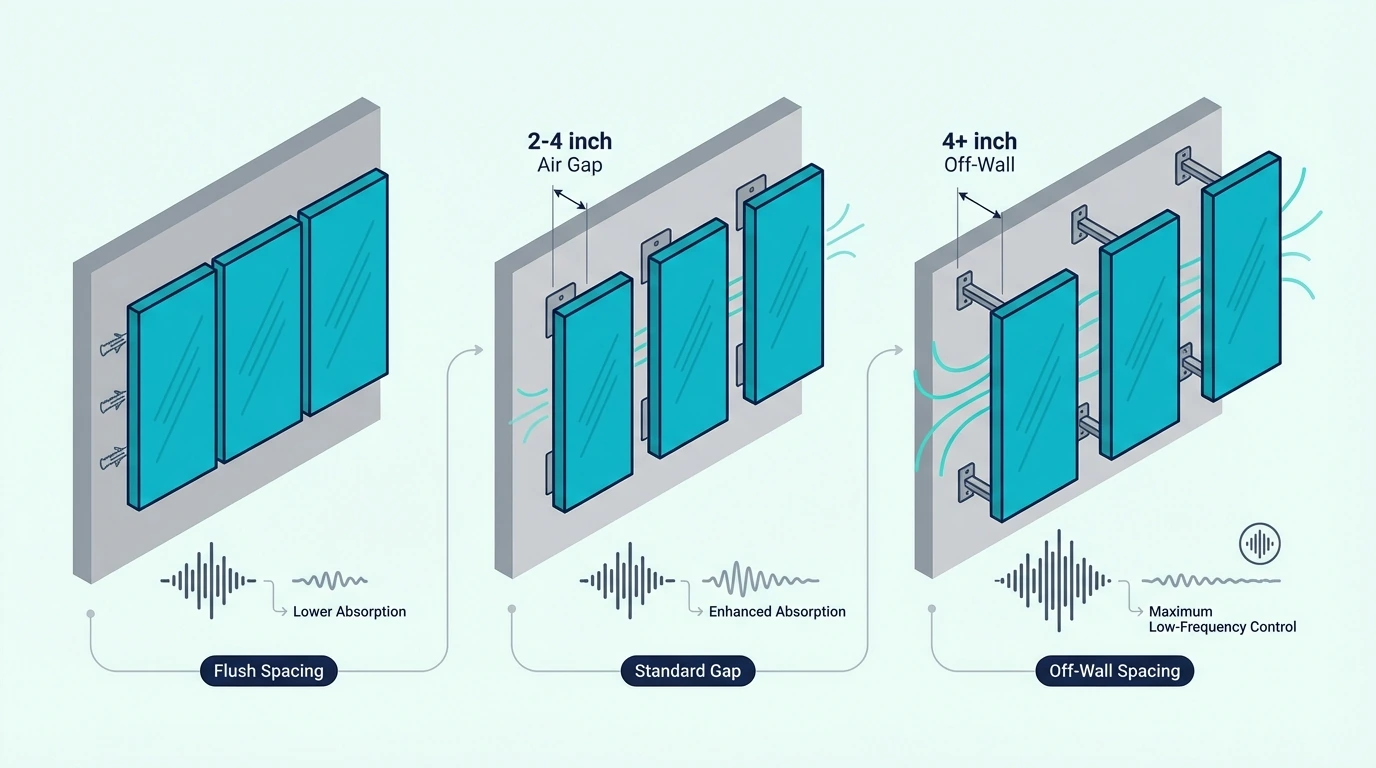
The ideal spacing between acoustic panels is 1-4 inches for most installations. This range gives visual separation, minor adjustment room, and more even coverage across the wall.
There is no magic number—the 2-inch vs 4-inch comparison confirms that 2 inches works as well as 4 inches acoustically. The best choice depends on wall dimensions, panel count, NRC rating, and how polished the layout should look.
Should Acoustic Panels Be Touching Each Other?
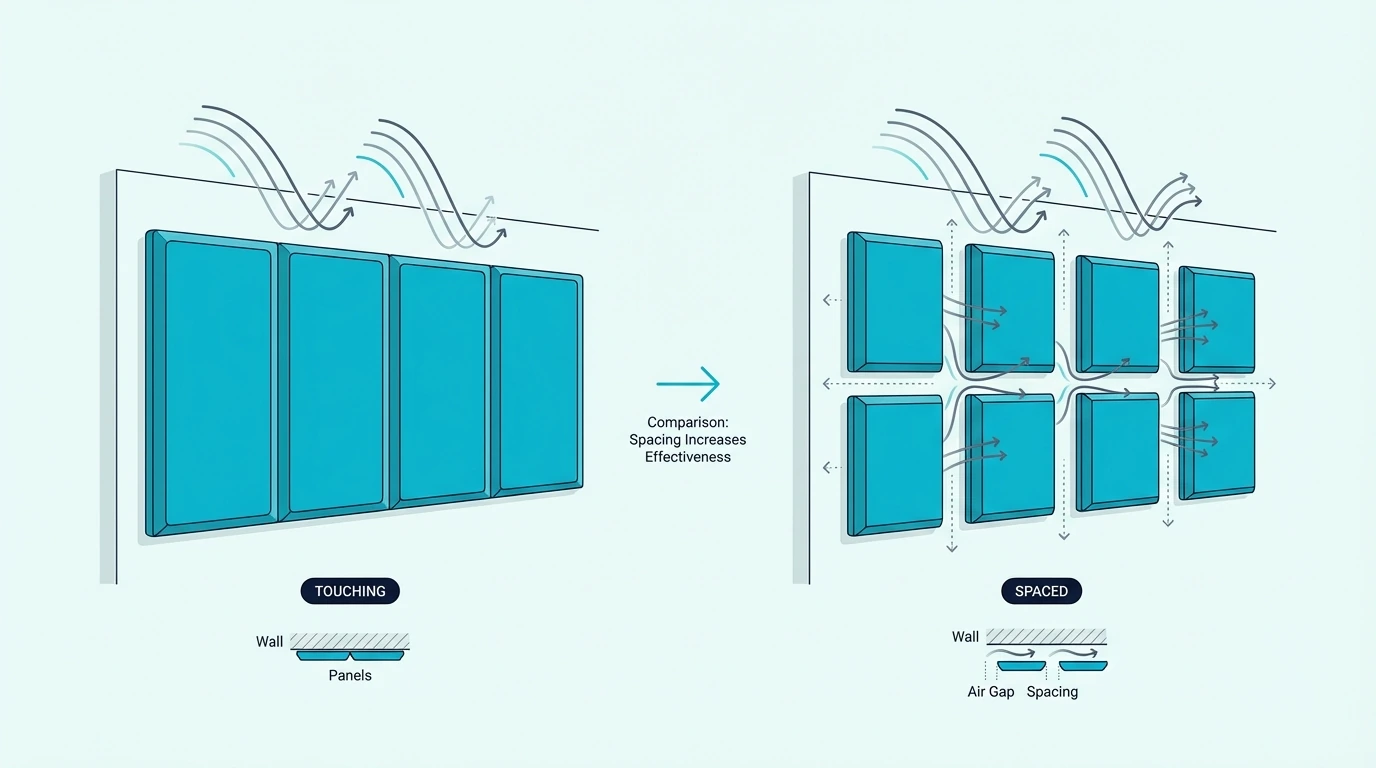
Panels can physically touch without creating any negative acoustic side effects, but deciding whether to jam them together or space them apart depends on balancing visual design with coverage limits.
No Acoustic Problem with Touching
When panels touch edge-to-edge, they simply function exactly like one massive, single panel. Sound absorption depends on the density of the fibrous material, and the acoustic waves don’t care if there happens to be a seam in the fabric wrap where two panels meet.
If your room lacks low-end control and you’re worried your treatment isn’t powerful enough, touching panels won’t solve it. Total square footage and physical thickness dictate absorption far more than how tightly you pack the frames together.
In those cases, density is usually the spec that explains why one wall absorbs better than another.
Why Spacing Often Works Better
While jamming panels together won’t hurt the acoustics, introducing intentional gaps between them provides several massive practical advantages.
The most obvious benefit is distributed coverage. If you only have six panels, spacing them 3 inches apart allows you to stretch that treatment across far more linear wall space than you could if they were all touching.
By spreading the coverage, you catch more secondary reflection paths across the entire wall rather than hyper-treating one small center spot.
Visually, evenly spaced gaps make the treatment look like a designed, professional installation rather than a desperate cluster. Those small gaps also provide installation flexibility—a 2-inch gap hides the minor misalignment that would be glaringly obvious if the frames were touching.
When Touching Makes Sense
Despite those spacing benefits, there are still specific scenarios where touching panels remains the smartest approach. If you are building floor-to-ceiling corner bass traps, you absolutely want those panels stacked tightly together to function as a single, massive low-frequency absorber.
Touching also makes sense on very narrow walls where intentional gaps would push the outer panels awkwardly close to a doorframe or window. In dedicated recording studios where maximum broadband treatment is required, seamless wall-to-wall paneling is often the goal.
If you plan to experiment with both tight clusters and spaced grids, the UMIACOUSTICS Large Panels are built with rigid enough edges to work cleanly in either configuration without sagging.
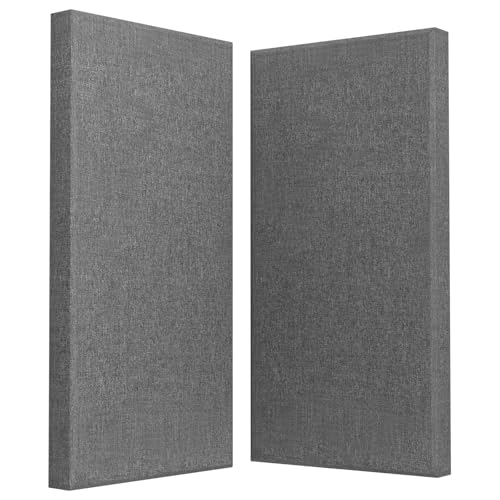
UMIACOUSTICS Large Panels
Get Studio Tips Weekly
Join 5,000+ creators getting acoustic treatment advice every week.
No spam. Unsubscribe anytime.What’s the Best Spacing Pattern?
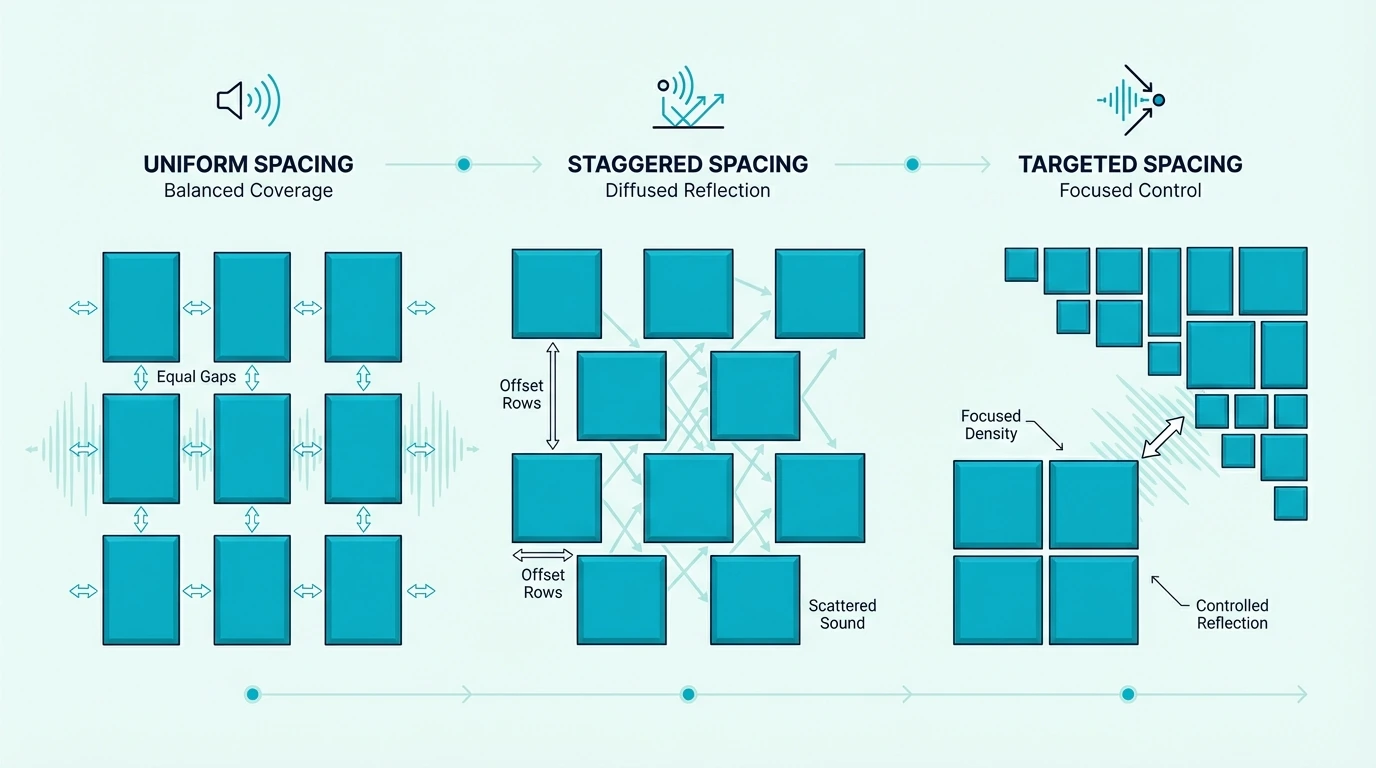
Panel arrangement goes beyond just measuring gap widths. You can use the negative space between panels to create distinct visual patterns that actually complement the room.
Evenly Spaced Grid
The most common and foolproof approach is a simple grid: panels arranged in strict rows and columns with identical gaps on all sides. This creates a clean, organized appearance that guarantees even treatment distribution across the surface.
For example, taking six 24×48” panels and arranging them in a 2×3 grid with 3-inch gaps allows you to treat an 8-foot wide span of drywall. If those same six panels were touching, your treatment zone would shrink to just 6 feet.
Checkerboard Pattern
If you want to maximize the visual footprint of your treatment using the absolute fewest panels, alternating panels and empty wall space creates a checkerboard effect. The human eye perceives the pattern as cohesive wall treatment even though half the grid is empty.
This works exceptionally well in large living rooms or corporate spaces where you want to treat a massive wall area but don’t have the budget to buy thirty panels. The intentional gaps feel like a deliberate design choice rather than missing pieces.
Asymmetric Placement
You can also abandon grids entirely and place panels solely based on acoustic necessity. In this asymmetric approach, panels are mounted specifically at the known reflection points, behind the listening position, or wherever a flutter echo is loudest.
The spacing gaps happen completely naturally based on where the acoustic problems exist. This prioritizes pure audio function over visual symmetry, and the panel placement guide maps out exactly where those problem spots land in different rooms.
Staggered Rows
If a rigid grid feels too corporate, you can offset each horizontal row so the vertical seams don’t align—exactly like a brick wall pattern. This creates visual interest and makes the treatment feel much more dynamic on camera.
Staggered placement technically provides slightly more even sound diffusion across the wall because it breaks up the continuous vertical channels of reflective drywall, but that acoustic difference is negligible compared to standard aligned grids.
Does Panel Spacing Affect Acoustic Performance?
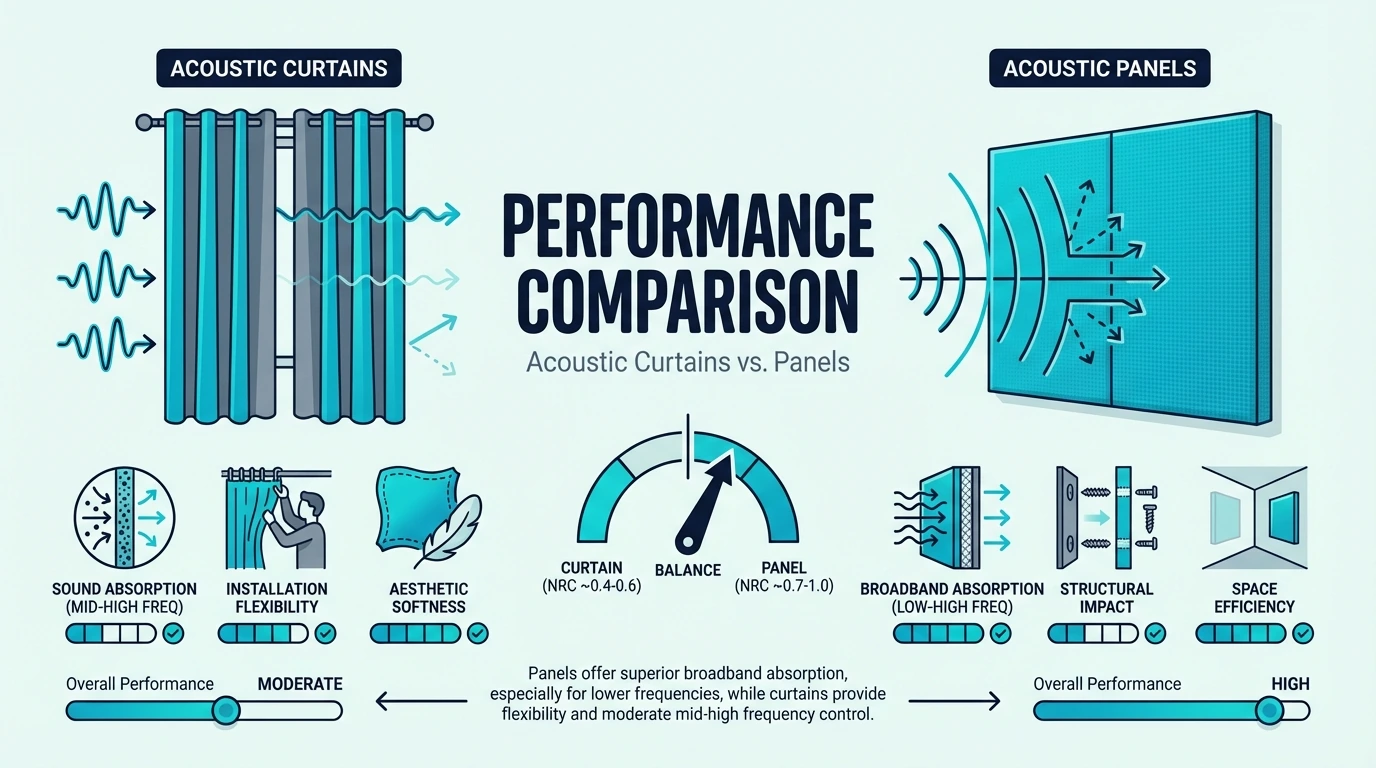
People obsess over exact gap measurements, but the physical spacing between the frames has almost zero direct impact on the sound.
The Short Answer: Minimal Impact
For typical room treatment, spacing versus touching makes no measurable acoustic difference to the panels themselves. A 2-inch gap does not magically boost absorption, nor does it create weird reflection channels.
The panels absorb the exact same amount of sound energy regardless of how close they sit to their neighbors.
What actually dictates your room’s sound is the total square footage of treatment across the entire room, the raw density of the core material, and whether you’ve implemented an air gap behind the panel (which actually does boost bass absorption by a wide margin).
Distributed vs Concentrated Treatment
The only real acoustic side effect of spacing is how it distributes your total absorption across the room geometry.
If you take six panels and jam them together in the exact center of a long wall, you create one intensely treated dead zone flanked by massive areas of untreated, reflective drywall. Taking those exact same six panels and spacing them evenly across the entire length of the wall provides a much more natural, distributed absorption pattern.
For most rooms, this distributed approach works better because sound waves reflect wildly off the entire wall surface, not just the dead center. Spreading your panels out catches far more random reflection paths.
First Reflections Matter Most
All of this debate about gap widths completely ignores the golden rule of acoustics: touching or spacing barely moves the needle compared to simply putting the panels at the correct first reflection points.
A perfectly spaced, mathematically beautiful grid mounted on the wrong wall will provide substantially less acoustic benefit than three ugly, touching panels slapped exactly where the speaker sound bounces to your ears. You must prioritize the reflection points first; you can worry about making the spacing look pretty with whatever panels you have left over.
How Much Wall Coverage Do You Need?
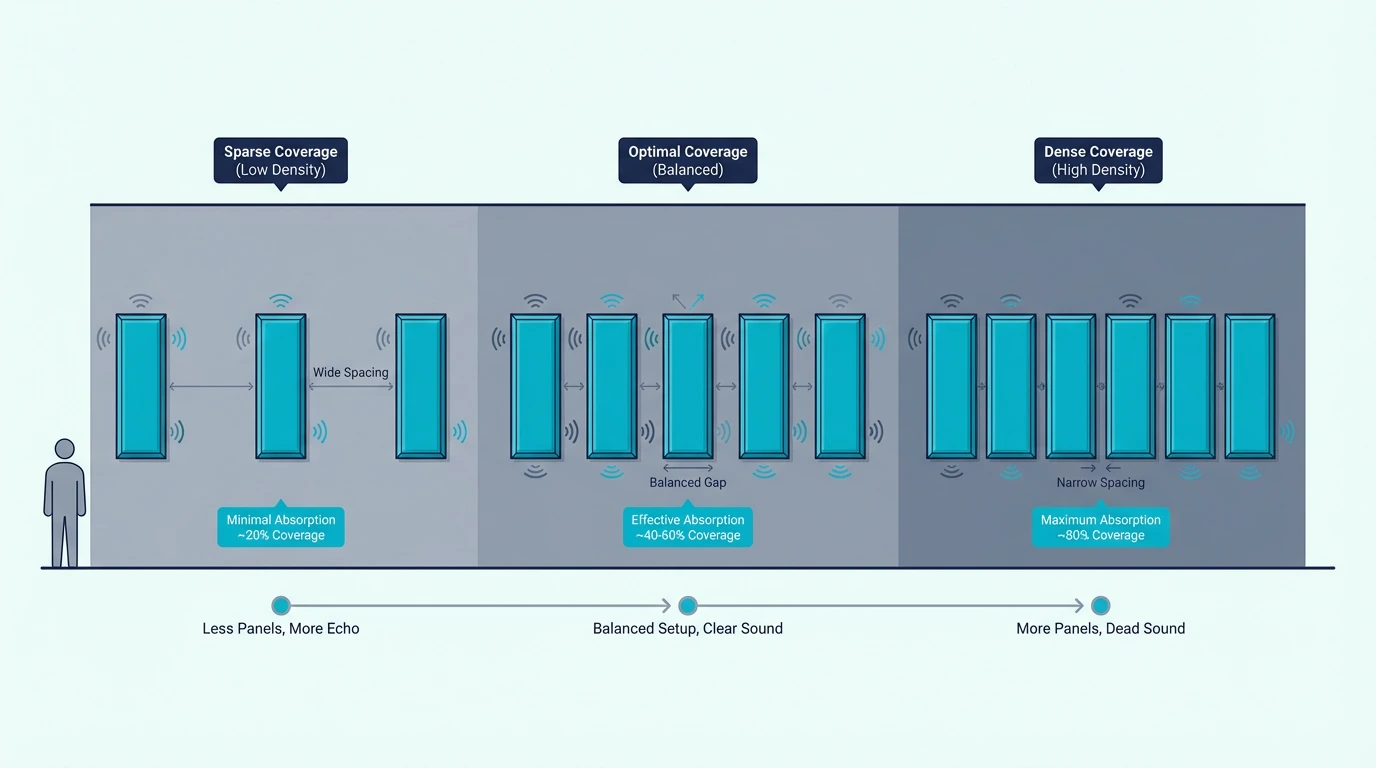
You cannot decide on a spacing pattern until you know exactly how many panels your room actually requires to function properly.
Coverage Percentages
The total number of panels you buy dictates how wide your gaps must be to cover the remaining wall. For critical spaces like home studios and listening rooms—which the panel quantity guide sizes by exact room dimensions—you generally want to hit 20-30% total wall coverage to tame harsh echoes.
If you are pushing for a strictly controlled mixing environment, that target jumps to 40-50% coverage. Anything past 60% coverage pushes you into an aggressively dead room, where you will likely be forced to mount panels so closely together that touching becomes unavoidable.
Spacing Calculation Example
The math of spacing proves why it is such a powerful tool for budget-conscious builders. If you own eight 24×24” panels and need to treat a massive 12-foot wall, your spacing choice determines the entire layout.
If you insist on the panels touching edge-to-edge, your eight panels only yield 8 feet of linear width, leaving the remaining 4 feet of the wall entirely bare and highly reflective. By simply adding a 6-inch gap between each column, those exact same eight panels stretch out to cover a massive 10.5-foot footprint.
Spacing allows you to fill vastly more visual and acoustic space with the exact same material—making it the easiest way to maximize the value of your existing panels without having to order another box.
What Spacing Works Best for Different Room Types?
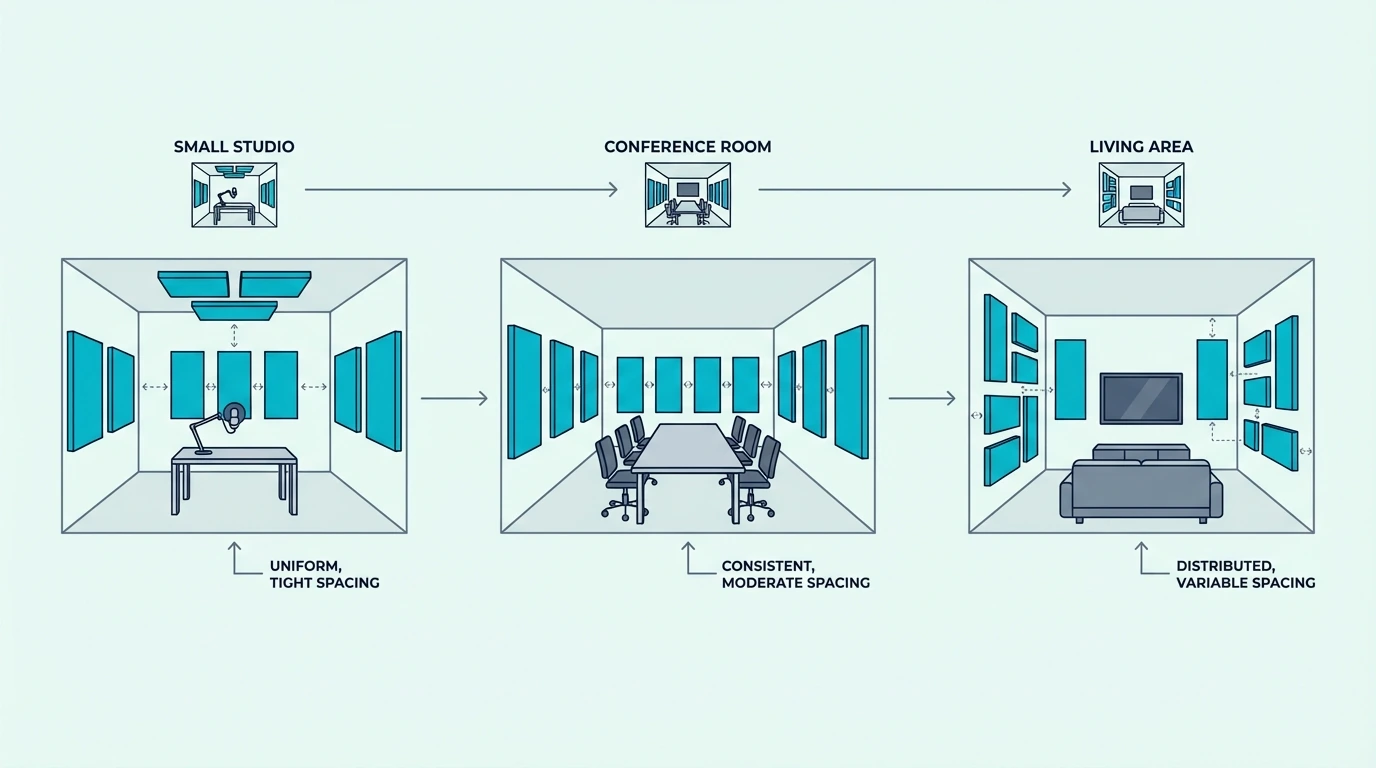
A recording studio attempting to hit strict decay times and a home theater trying to preserve surround sound dynamics call for completely different visual and acoustic spacing strategies.
Recording Studios
Professional mixing environments typically rely on extremely tight 1-to-2 inch spacing to create dense, focused zones of absorption exactly at the first reflection points. The goal is brutal efficiency: killing the early reflections completely so the mixing engineer only hears the direct sound from the studio monitors.
Because they demand so much treatment, studios often mix approaches—using tightly touching bass trap stacks crammed into the corners while transitioning to perfectly spaced, breathable grids for the broadband wall panels.
Home Theaters
Dedicated cinema rooms require a much more breathable approach, benefiting massively from distributed 4-to-6 inch spacing across the side and rear walls. You want to control the dialogue clarity without completely deadening the room.
Wide spacing maintains enough reflective drywall between the panels to preserve the immersive, ambient energy of the rear surround speakers, preventing the explosive action sequences from sounding choked or muffled.
Offices and Conference Rooms
Corporate spaces and home offices prioritize clean aesthetics right alongside the echo reduction. In these environments, evenly spaced grids are mandatory because they look like intentional, architectural design choices.
The smartest approach is to abandon standard measurements entirely and simply match your panel gaps to the room’s existing architecture. Aligning your panel edges with window frames, door trim, or existing artwork creates a visual harmony that makes the acoustic treatment feel built-in rather than tacked on.
Home Studios and Podcasting
In smaller 10×10 bedroom studios or podcast booths, wall real estate is at a severe premium. You are usually forced into tighter spacing or touching clusters simply to fit enough absorption into the room to handle the low-mid buildup.
The UMIACOUSTICS Compact Panels are highly effective in these cramped booths because their narrow width allows you to sneak them into tight gaps between desks and doors where massive 48-inch panels simply cannot fit.
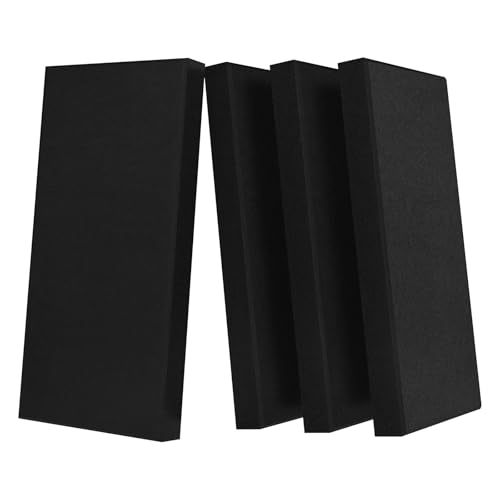
UMIACOUSTICS Compact Panels
How Do Spacing Approaches Compare?
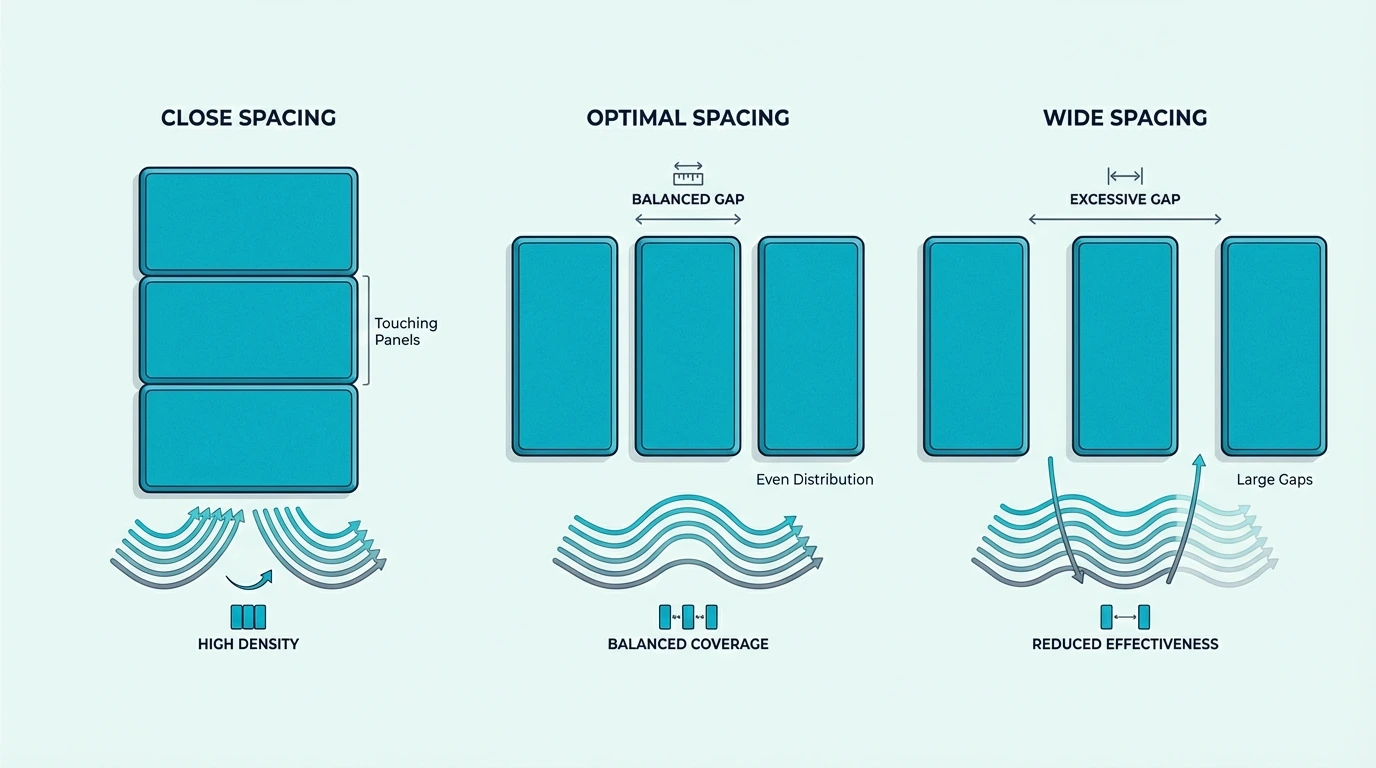
| Approach | Coverage | Appearance | Best For |
|---|---|---|---|
| Touching (0”) | Concentrated | Seamless wall | Bass traps, full coverage |
| Tight (1-2”) | Slightly distributed | Near-seamless | Studios, tight spaces |
| Standard (2-4”) | Distributed | Professional grid | Most applications |
| Wide (4-8”) | Very distributed | Design element | Offices, theaters |
| Strategic | Targeted | Varies | Acoustic priority |
How Do You Install Evenly Spaced Panels?
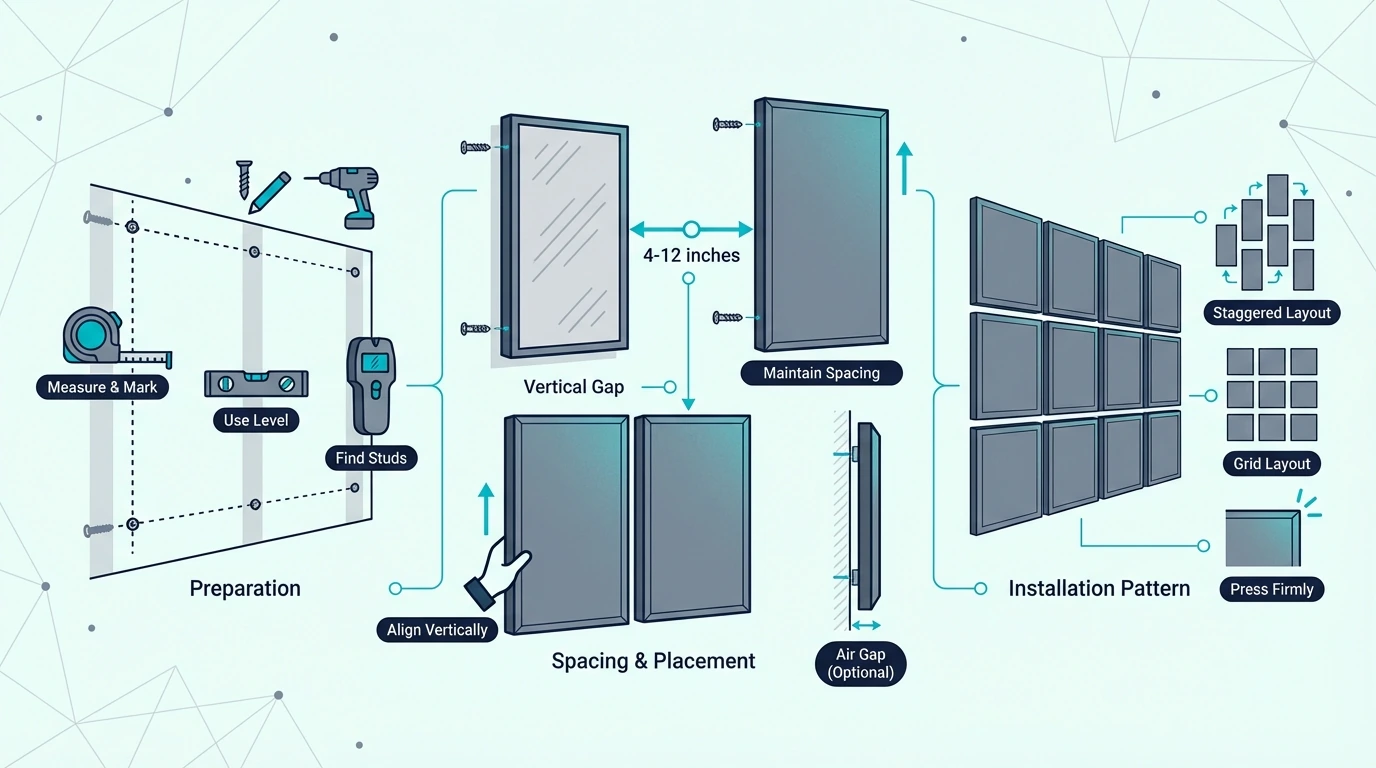
Achieving perfectly consistent gaps across a massive 12-foot wall requires careful prep work. If you try to eyeball the layout as you go, you will inevitably end up with crooked lines and uneven spacing by the time you reach the final panel.
Measure and Mark First
The golden rule of spaced grids is to calculate the total coverage width—including all the gaps—before drilling a single hole. Always find the exact center of the wall and mark your panel centers expanding outward from that point.
Starting at the left edge and working your way right without a plan usually leaves you with an awkward, glaringly uneven gap at the far corner.
Use Spacer Templates
You can eliminate the tedious process of measuring every single gap by creating a physical template. Cut a piece of rigid cardboard or scrap wood to match your exact desired gap width (like 3 inches), and hold it against the first panel while you position the second one.
This guarantees absolute consistency across the entire wall in half the time.
Level Each Panel
Because the human eye is very good at spotting parallel lines that aren’t quite parallel, spacing makes minor alignment errors hyper-visible. You must use a spirit level or laser level on every single panel, not just the anchor piece—even a quarter-inch tilt on the second panel will compound massively by the time you mount the fifth one in the row.
Consider Adjustable Mounting
The reality of drywall is that it is rarely perfectly flat, meaning fixed picture hooks can sometimes leave your spaced panels sitting at slightly different depths. Z-clips and French cleats allow you to slide the panels slightly left or right after installation to perfect the spacing—the installation guide and hanging methods guide compare these sliding hardware options.
If you want a low-profile mount that locks the frame flush to the wall while still allowing lateral adjustments, French Cleat Z Hangers are the standard professional choice. Once the metal track is leveled on the wall, the panels sit perfectly aligned every time.
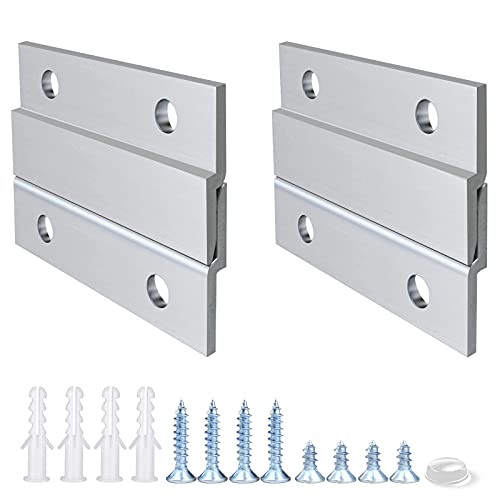
French Cleat Z Hangers
Conclusion
Spacing is mostly a layout and coverage decision, not an acoustic “rule.” In most rooms, 1–4 inches of gap is an easy default that looks intentional and helps you spread treatment.
If you still have echo after you hang panels, revisit placement and coverage first, then thickness and density. Spacing is usually the last knob to turn.
Frequently Asked Questions
Should Acoustic Panels Be Touching Each Other?
No requirement exists for panels to touch. Spacing them 1-4 inches apart often works better by distributing coverage—touching isn’t wrong, it just concentrates treatment rather than spreading it.
The choice is primarily aesthetic and practical, not acoustic. Both approaches provide similar sound absorption for the same panel quantity.
How Far Apart Should Acoustic Panels Be?
For most applications, 2-4 inches between panels works well. This provides visual separation, allows installation flexibility, and distributes treatment across more wall surface.
There’s no acoustically “correct” spacing—choose based on your wall dimensions, panel quantity, and aesthetic preference.
Does Panel Spacing Affect Sound Absorption?
The total square footage matters far more than whether panels touch—six touching panels absorb the same sound as six spaced panels. Spacing just distributes that absorption across more wall area for more even treatment.
What Spacing Pattern Looks Best?
Evenly spaced grids with consistent gaps look most professional. 2-3 inch gaps between 24” panels creates clean visual rhythm without appearing sparse.
Staggered or asymmetric patterns can work for specific design goals, but consistent grids suit most rooms. Match spacing to room architecture when possible.