Where to Put a Soundbar for the Best Sound
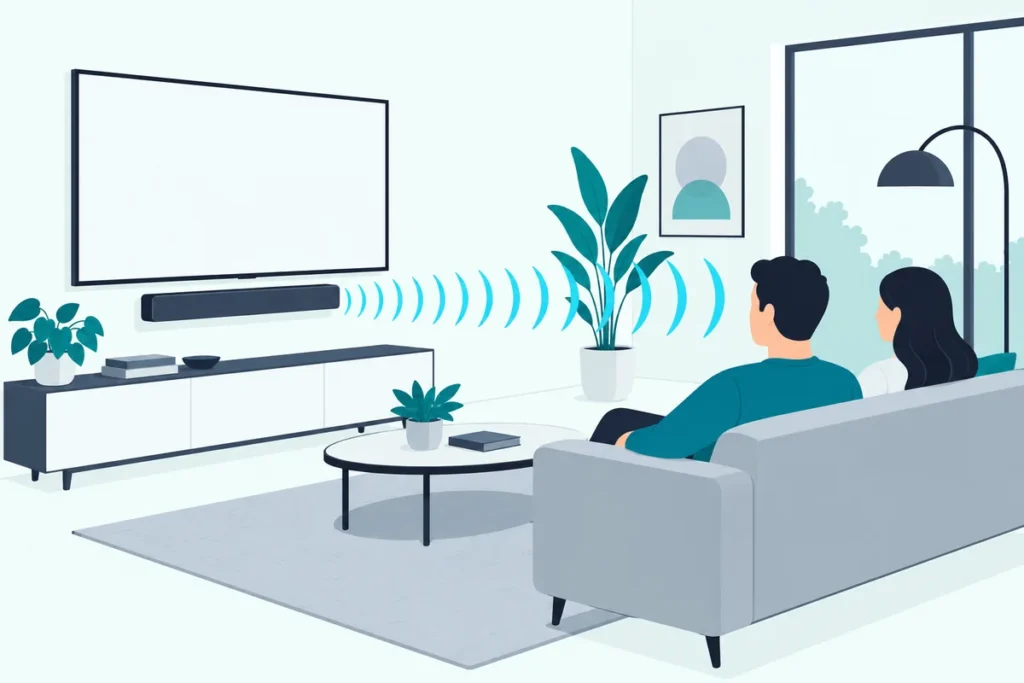
Deciding where to put a soundbar seems simple until the voices start coming from somewhere near the floor while the faces sit a foot above them.
Most bars end up wherever the TV stand leaves room, often pushed back into a cabinet or tucked behind a lip that blocks the speakers.
A few inches in the right direction can make dialogue clearer and, on a Dolby Atmos bar, bring back the overhead effects you paid for.
Here’s where Dolby, Yamaha and the soundbar makers say a bar should go, with the heights and distances to aim for.
It covers TV stands, shelves and wall mounts, plus the subwoofer and rear speakers that come with many bars.
Where Should a Soundbar Go?
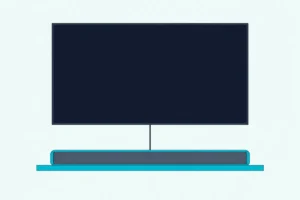
That “voices from the floor” problem has a simple cure: keep the bar close to the picture. Put the soundbar centered directly below the TV, as close to the screen as is practical, and near the height of your ears when you’re seated (Dolby).
Dolby’s reasoning is about where the sound seems to come from. A bar that’s off-center, too high or too low makes the sound seem to come from somewhere other than the action on screen.
Three more rules cover most homes:
- Keep it in the open. Dolby says to avoid placing a soundbar behind or inside enclosed furniture.
- Keep the front clear. Nothing, including the lip of a TV stand, should sit between the bar and your seat.
- Keep your distance. Dolby’s setup guide suggests sitting at least 4 to 5 feet (1.2 to 1.5 meters) from a Dolby Atmos bar.
Everything below is a variation on those rules for a particular setup.
Where to Put a Soundbar on a TV Stand
Those rules are easiest to follow on a TV stand, which is where most soundbars live. Put the bar on the stand’s top surface, centered on the screen, and pull it forward to the front edge.
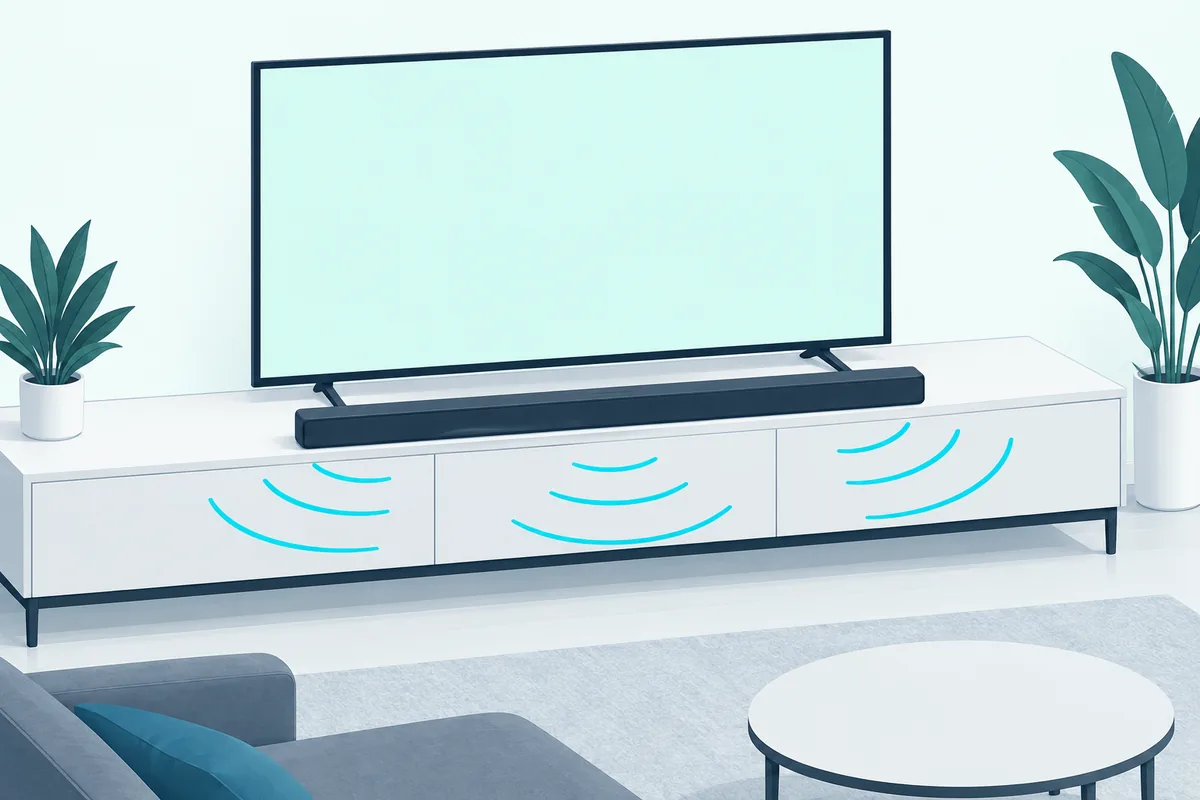
The front edge matters for two reasons. A bar pushed back behind a raised lip or a decoration has part of its sound blocked before it reaches you.
For Atmos bars with upward-firing speakers, Dolby’s soundbar setup guide adds a second reason: when possible, place the bar in front of the TV so the screen doesn’t interfere with the sound bouncing off the ceiling (Dolby setup guide).
Check two things once it’s in place. The bar shouldn’t cover the bottom of the picture, and it shouldn’t block the TV’s remote sensor, which on many TVs sits along the bottom edge of the screen.
Get Studio Tips Weekly
Join 5,000+ creators getting acoustic treatment advice every week.
No spam. Unsubscribe anytime.How High Should a Soundbar Be?
Once the bar sits in front of the TV, its height is the next decision. Aim for roughly the height of your ears when you’re seated.
Yamaha puts seated ear height at about 42.5 inches from the floor, and suggests mounting a bar as close to that height as the setup allows (Yamaha). In practice, Yamaha notes, that’s below the TV in about 95% of real homes.
For Atmos bars with upward-firing speakers, Dolby’s guide says at, or slightly above, seated ear level works best. It also warns against placing the bar so low that you’re looking down on its top, which disrupts the effect.
That rules out the floor. A bar on the floor or a very low shelf sends its sound into your knees and furniture rather than your ears.
How Far Below the TV Should a Soundbar Be?
That ear-height target only works if the TV isn’t mounted too high above the bar. Keep the gap between the bottom of the TV and the top of the soundbar as small as is practical.
Samsung’s HW-B550 manual asks for at least 5 centimeters (about 2 inches) between a wall-mounted TV and a soundbar mounted below it (Samsung HW-B550 support). Other makers’ manuals give their own minimums, so check yours before drilling.
Much more than a few inches, and the sound starts to separate from the picture. Dolby’s advice is to place the bar and TV as close together as is practical, because the TV screen should sit at about eye level and the bar at about ear level.
Yamaha’s formula helps set the TV height to match. Subtract half the TV’s height from 42.5 inches, and that’s where the bottom of the screen should be.
Where to Put a Soundbar on a Wall-Mounted TV
A wall-mounted TV raises the same question with a drill in hand. Mount the soundbar on the wall directly below the TV, level with it and centered on it.

Dolby adds one exception: if the TV is mounted low on the wall, the bar can go above it instead. Either way, Dolby says to keep the bar and the screen as close together as practical.
Yamaha has three practical tips for the install:
- Plan the cables. Run the connecting cables inside the wall from behind the TV to behind the bar, so no cable hangs between them.
- Plan the power. You’ll need a power outlet behind the soundbar, or a power extender.
- Check the weight. Most soundbars are light enough that drywall anchors are usually safe, though you should always follow your bar’s own mounting instructions.
MantelMount, which makes TV mounts, suggests mounting the bar 2 to 4 inches below the screen, and prefers screwing into studs where you can. Its reasoning is that a bar’s vibration and leverage can loosen a weak mount over time, and a flexing bracket rattles during bass-heavy scenes (MantelMount).
Our step-by-step guide to mounting a soundbar covers the brackets, templates and drilling.
What If the TV Is on a Swivel Arm?
That fixed-wall advice changes when the TV moves. If your TV sits on an articulating arm, attach the soundbar to the TV mount instead of the wall, so the sound turns with the screen.
Both Dolby and Yamaha recommend this. A bar left on the wall while the TV swivels toward the kitchen ends up pointing at an empty couch.
Brackets that bolt the bar to the TV’s own mounting pattern do this job. The USX MOUNT universal soundbar mount fits TVs with VESA patterns from 150 to 600 mm and holds bars up to 17.6 lbs.
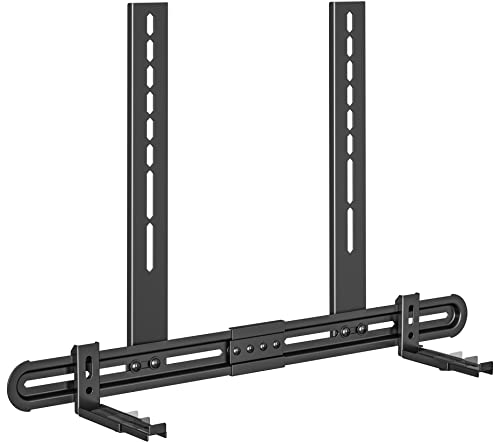
USX MOUNT universal soundbar mount
For lighter bars up to 15 lbs, the Mounting Dream soundbar mount bracket is a cheaper option that can hold the bar above or below the screen.
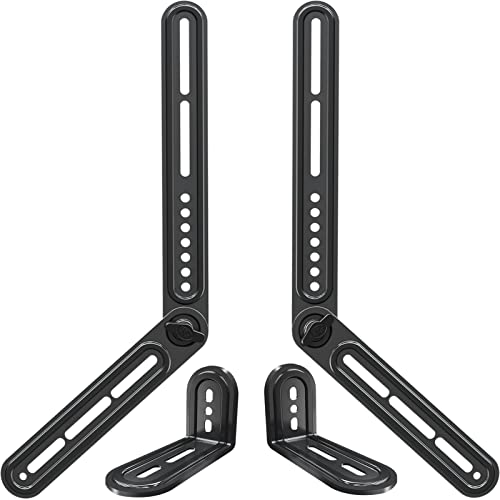
Mounting Dream soundbar mount bracket
Can You Put a Soundbar in a Cabinet or on a Shelf?
That TV-mounted bracket doesn’t suit every setup, and plenty of bars end up on a shelf instead: an open shelf works, but a closed cabinet doesn’t. Dolby’s general advice is to avoid placing a soundbar behind or inside enclosed furniture, and its Atmos setup guide is firmer: avoid mounting the bar in a cabinet or under a soffit.
If the cabinet was meant to keep the bar out of sight, our page on how to hide a soundbar covers what each maker allows behind the TV, on an open shelf and behind fabric.
An open shelf below the TV is fine if you follow the same rules as a TV stand. Slide the bar to the front edge, keep it centered on the screen, and leave the space above it open.
Dolby’s guide notes that bars with side-firing speakers also need a clear line to the side walls. A shelf with solid sides boxes those speakers in.
If the only option is a shelf with a shelf above it, that’s worth changing for an Atmos bar. For a basic bar without upward-firing speakers, a clear front matters more than the space above it.
Where Should a Dolby Atmos Soundbar Go?
Those upward-firing speakers are what make Atmos bars pickier than the rest. The drivers bounce sound off the ceiling, so Dolby’s setup guide says they need a clear line of sight to it.
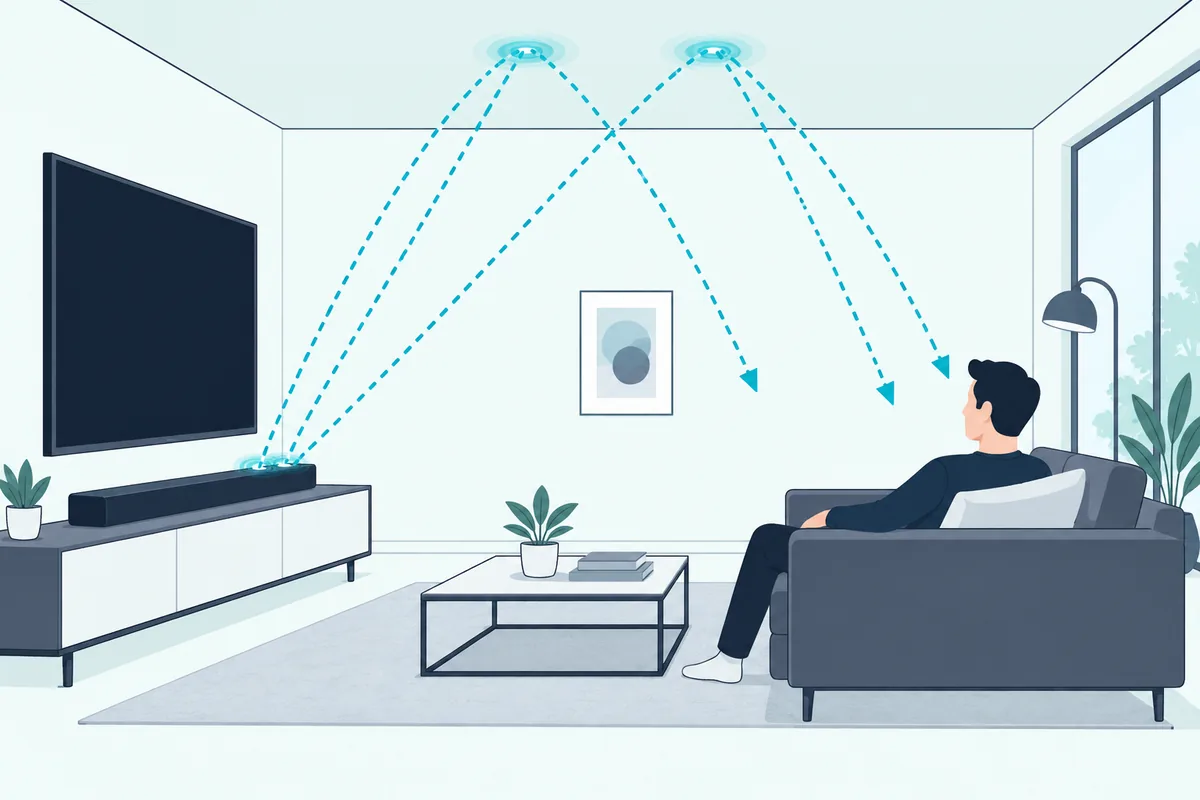
The ceiling matters as much as the bar. Dolby lists the ideal as:
| Ceiling feature | What works best |
|---|---|
| Height | 7.5 to 12 feet (2.3 to 3.66 meters) |
| Shape | Flat; a shallow vaulted ceiling is acceptable |
| Surface | Drywall, plaster, hardwood or another hard surface |
| Avoid | Acoustic ceiling tiles, which absorb the overhead sound |
Some things don’t matter, which surprises people. Dolby says a popcorn-finish ceiling, chandeliers and can lights don’t hurt the effect.
Bars that create height effects virtually, without upward-firing speakers, are more forgiving. Dolby says those need no special room setup: put the bar below the TV at about ear level, face the seats toward it, and keep the space between clear.
Our roundup of Dolby Atmos soundbars worth buying notes which bars use which approach.
Can You Put a Soundbar Above a Fireplace?
A TV over a fireplace is the hardest case in this guide, because the screen already sits well above eye level. MantelMount’s advice is to mount a bar above a fireplace only if it’s unavoidable, and to angle it downward toward the seats.
Heat is the other problem. Samsung’s HW-B550 manual says to protect the soundbar from excess heat, and names a fireplace as the example, so a bar on a mantel that gets warm when the fire’s lit is at risk.
If you use the fireplace often, a TV mount that pulls the screen down to viewing height, with the bar attached to it, solves both problems at once. If you rarely light it, a bar on the mantel’s front edge, tilted slightly down, is the practical compromise.
How Much Space Does a Soundbar Need Around It?
Even on a wall or a mantel, the bar needs a little room to breathe. Samsung’s HW-B550 manual asks for 7 to 10 centimeters (about 3 to 4 inches) of space around the bar for ventilation, with its vents left uncovered.
The same manual says not to set the bar on top of amplifiers or other equipment that gets hot, and to keep it out of direct sunlight. A cable box or game console directly under the bar counts, so give it a shelf of its own.
The front needs space for a different reason. MantelMount lists decorations and picture frames in front of the grille among the most common placement mistakes, since they block the sound before it reaches you.
Where Should a Soundbar Go in a Small Room or Bedroom?
Those space rules get tighter in a small room, but the goal doesn’t change. Dolby calls a compact, all-in-one soundbar a great choice for a small room, and it follows the same placement as a big one: centered, close to the screen and near ear height.
In a bedroom, that usually means one of two spots. If the TV sits on a dresser, put the bar at the front edge of the dresser, centered on the screen.
If the TV is on the wall, mount the bar just below it rather than leaving it on a dresser across the room. Dolby’s guide also says to face the seating toward the TV, which in a bedroom means the bed, so angle the TV and bar toward where you actually watch.
Where Do the Subwoofer and Rear Speakers Go?
Unlike the bar itself, a separate subwoofer can sit almost anywhere. Dolby says you can place it just about anywhere around the seating area, because low bass notes aren’t directional.
That freedom has limits in practice: wireless range, cabinets and walls all affect how it sounds. Our guide to where to place a subwoofer with a soundbar covers the best spots and a simple test for finding yours.
Rear or surround speakers, when a bar comes with them, belong beside or slightly behind your seats. Dolby’s speaker guides say to angle speakers toward a central seat and keep them at about seated ear height (Dolby).
Frequently Asked Questions
Should a soundbar be above or below the TV?
Below, in most homes. Dolby says a soundbar is typically best below the TV, and that above works when the TV itself is mounted low on the wall.
How far should a soundbar be from where I sit?
For a Dolby Atmos bar, Dolby’s guide suggests at least 4 to 5 feet (1.2 to 1.5 meters), and says to avoid sitting too close to the bar.
Does a soundbar have to be centered on the TV?
Yes. Dolby says an off-center bar makes the sound seem to come from somewhere other than the action on screen.
Can I put a soundbar on the floor?
It’s best avoided. Dolby warns against placing a bar so low that you look down on its top, and the floor puts the speakers well below your ears.
Is wall-mounting a soundbar better than a TV stand?
It can be. Dolby says wall mounting can improve sound projection and clarity, especially when the bar sits at ear level with nothing in front of it.