How Many Keys Do I Need on a MIDI Keyboard? 25, 49, 61 or 88
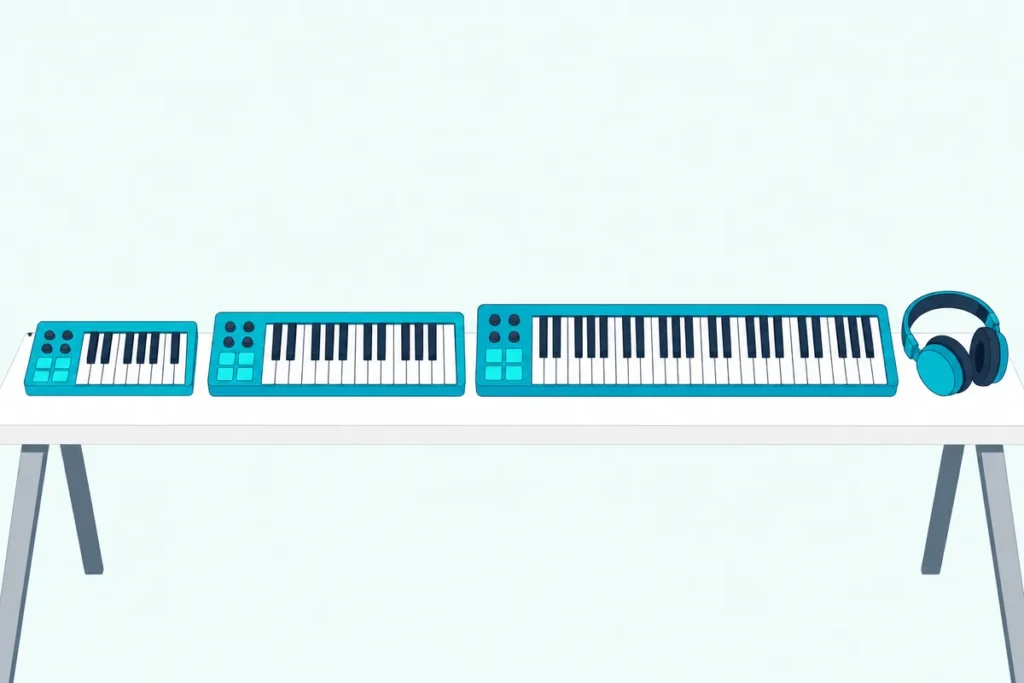
The short answer to how many keys do I need on a MIDI keyboard is 49 for most music, 25 for beats and 88 only for piano playing.
Buy too few and every chord turns into a dance on the octave button, while buying too many puts a board more than four feet wide where your laptop and mouse used to sit.
The choice comes down to two things you can measure: how many octaves your hands cover and how much desk you can spare.
Below, you’ll see what each size covers, how wide and heavy each one gets, and which size matches the music you make.
Start with the short version, then the reasons.
How Many Keys Do I Need on a MIDI Keyboard?
Most people making music on a computer do well with 49 keys, which gives you four octaves and room for both hands. A 25-key controller covers beats, bass lines and one-handed melodies, and 88 keys only pay off when you play piano parts across the full range.
This table matches each size to the job:
| What you mostly do | Keys to look for |
|---|---|
| Beats, drum pads and bass lines | 25 |
| Synth leads and single-line melodies | 25 to 37 |
| Melodies and chords with both hands | 49 |
| Piano or orchestral parts with wide chords | 61 |
| Piano practice and classical pieces | 88, with weighted keys |
Every row rests on the same two limits, how far your hands reach and how much desk you have. Our guide on how to choose a MIDI controller covers the other decisions, such as pads and knobs.
What Do Key Counts Mean in Octaves?
Each row in that table is really a range in octaves, because an octave is 12 keys: seven white and five black (Classic FM). That makes 25 keys two octaves plus one extra key, 49 keys four octaves plus one, and 61 keys five octaves plus one.
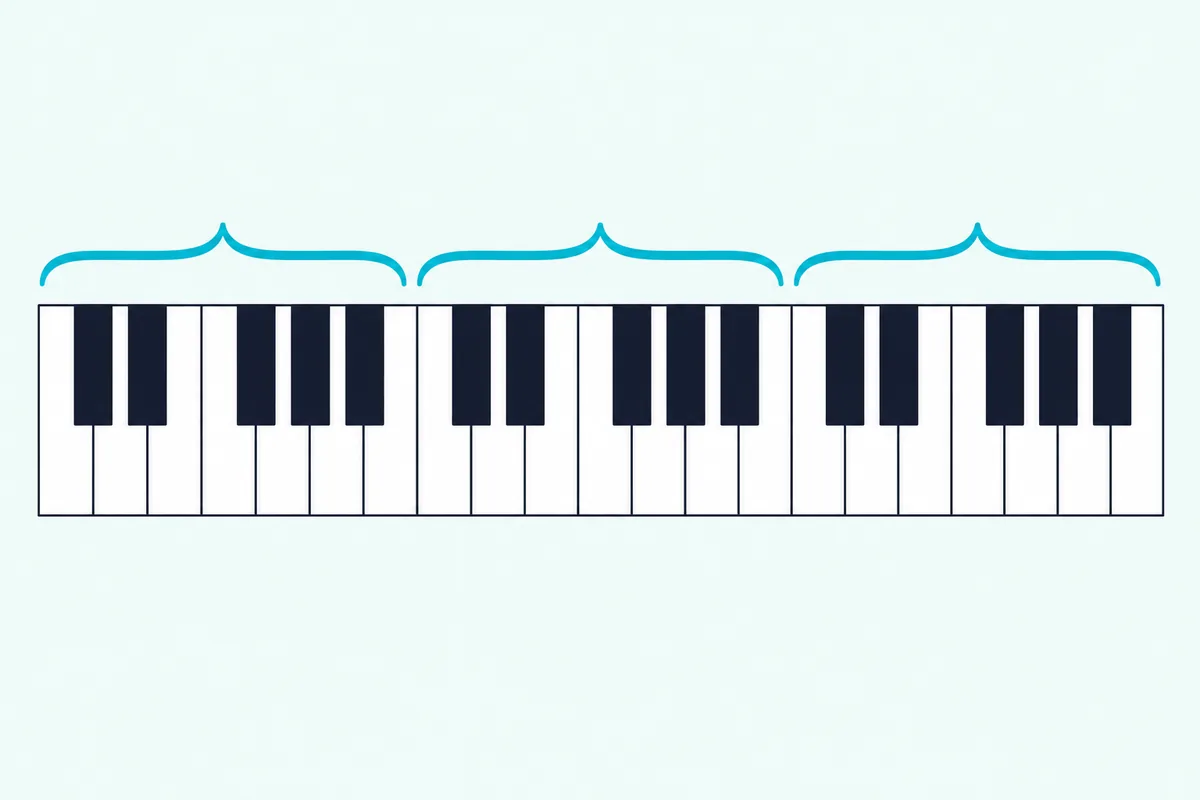
A full piano has 88 keys, 52 white and 36 black, which Classic FM describes as seven octaves plus three lower notes below the bottom C. Steinway settled on that layout in the late 1880s, and other makers followed.
Novation’s user guides give exact starting ranges for three sizes, so the next table shows how much each board reaches before you touch an octave button (Novation):
| Keys | Octaves | Range when powered on | Octave-shift range |
|---|---|---|---|
| 25 (Launchkey Mini 25 MK4) | 2 plus 1 key | C2 to C4 | -4 to +5 octaves |
| 49 (Launchkey 49 MK4) | 4 plus 1 key | C1 to C5 | -3 to +4 octaves |
| 61 (Launchkey 61 MK4) | 5 plus 1 key | C1 to C6 | -3 to +3 octaves |
Novation calls middle C “C3” and says MIDI has 128 notes in all. The Mini’s shift range of -4 to +5 octaves is wide enough to walk its two octaves across that whole span.
Get Studio Tips Weekly
Join 5,000+ creators getting acoustic treatment advice every week.
No spam. Unsubscribe anytime.Is 25 Keys Enough for Music Production?
That two-octave window explains where 25 keys works and where it doesn’t. It works when your parts sit inside it, such as beats, bass lines and one-handed melodies.
Akai’s MPK Mini MK3 shows the idea, with 25 velocity-sensitive keys, a 10-octave range from its octave up and down buttons, eight pads and eight knobs (Akai). The catch is two-handed playing, because a left-hand chord and a right-hand melody won’t both fit in two octaves and you’d change octave between them.
For a 25-key start, the Akai MPK Mini MK3 is a compact place to begin. Akai lists it at 12.5 by 7.13 inches, and our roundup of the best 25-key MIDI controllers compares more.
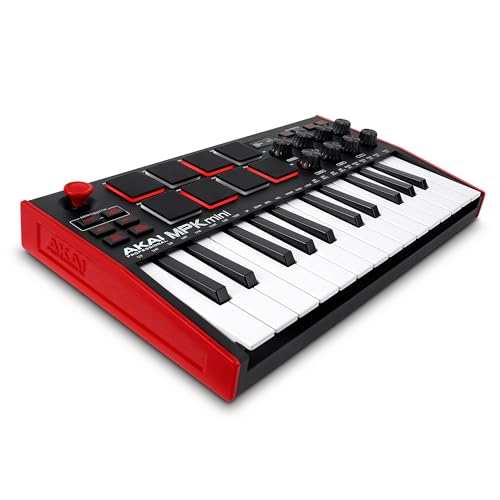
the Akai MPK Mini MK3
Is 49 Keys Enough for Music Production?
The step up from that two-octave window is where both hands start to fit. Yes for most music, since Novation’s Launchkey 49 MK4 has 49 semi-weighted piano-style keys (Novation) and powers on at C1 to C5 (user guide).
That range holds a bass line in your left hand and chords or a lead in your right, and the octave buttons move it by -3 to +4 octaves when a part sits elsewhere. Split mode stretches it further, because keys below the split point play one part and keys from the split point up play another, with the split set to C3 by default (Novation).
Novation’s own example is a mono bass synth on the low notes and a polyphonic pad above. Since you can also draw in notes you can’t play, the keyboard only has to capture the idea.
If you want the Novation Launchkey 49 MK4, Novation lists it at 730 millimeters wide (28.7 inches) and 4.08 kilograms. We’ve compared more in the best 49-key MIDI keyboards.
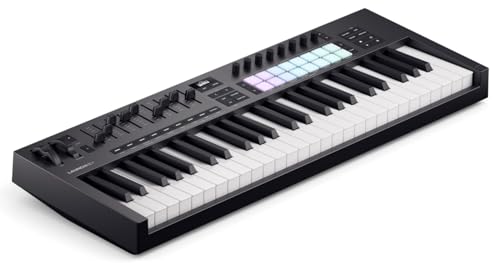
the Novation Launchkey 49 MK4
When Do 61 Keys Make Sense?
That 49-key split has one weakness, which is that each side gets only about two octaves. With the split at C3, the lower part runs from C1 to B2 and the upper part from C3 to C5.
Sixty-one keys give you five octaves, and Novation’s Launchkey 61 MK4 has semi-weighted piano-style keys (Novation) and powers on at C1 to C6 (user guide). Choose it when your hands play far apart, such as a bass note two octaves under a chord, or when you layer piano and string parts.
The extra 12 keys cost width and weight, though. On Novation’s numbers, the 61-key board is 895 millimeters wide against 730 for the 49-key, and 4.78 kilograms against 4.08.
The Launchkey 61 MK4 keeps the same encoders, faders and pads as the 49, per Novation. Our list of the best 61-key MIDI controllers has other five-octave options.
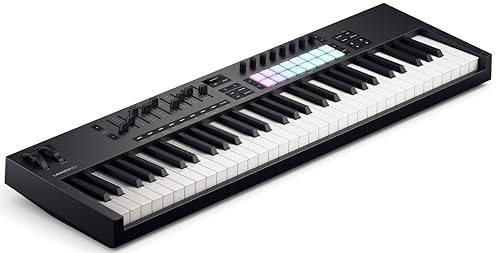
The Launchkey 61 MK4
Do I Need 88 Keys on a MIDI Keyboard?
Going from 61 to 88 adds another 27 keys, and the extra reach only matters for one kind of player. You need 88 keys when you play music written for the full piano range or want the same layout as the piano from earlier.
Everything else costs you space. Novation’s Launchkey 88 MK4 is 1274 millimeters (50.16 inches) wide and weighs 8.04 kilograms (17.73 pounds), and M-Audio lists its Keystation 88 MK3 at 54.24 inches wide and 13.75 pounds (Novation, M-Audio).
Feel is the other trade. Both of those boards are semi-weighted, while Roland’s A-88MKII uses a PHA-4 Standard keyboard with escapement and ivory feel and comes in at 1,429 millimeters wide and 17.5 kilograms (Roland).
For a full-range board without hammer-action weight, the M-Audio Keystation 88 MK3 has 88 full-size semi-weighted keys, per M-Audio. Our page on the best 88-key MIDI keyboards covers heavier options.
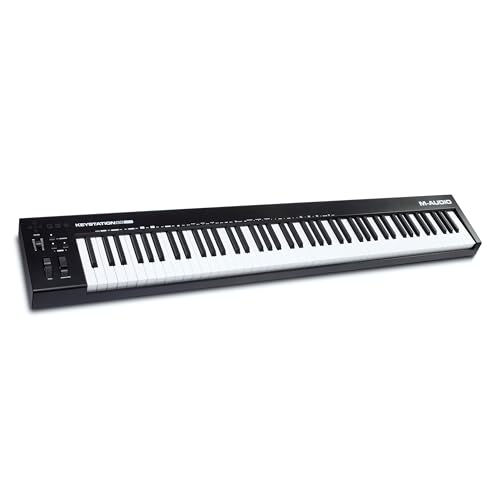
the M-Audio Keystation 88 MK3
Do Weighted Keys Matter More Than Key Count?
That Roland spec points to the other half of the answer, which is how the keys feel. Novation describes its 25 and 37-key boards as synth-style and its 49, 61 and 88-key boards as semi-weighted piano-style, while Roland’s A-88MKII uses hammer action.
Synth-style keys are the lightest of the three and suit pads, bass lines and fast single-note parts. Semi-weighted keys add some resistance for chords, and hammer action, the mechanism an acoustic piano uses, gives the most piano-like touch.
For piano practice, action matters as much as count, because 88 light keys still won’t feel like an acoustic piano. For everything else, count the octaves you play before you pay for weight.
How Much Desk Space Does Each Size Take?
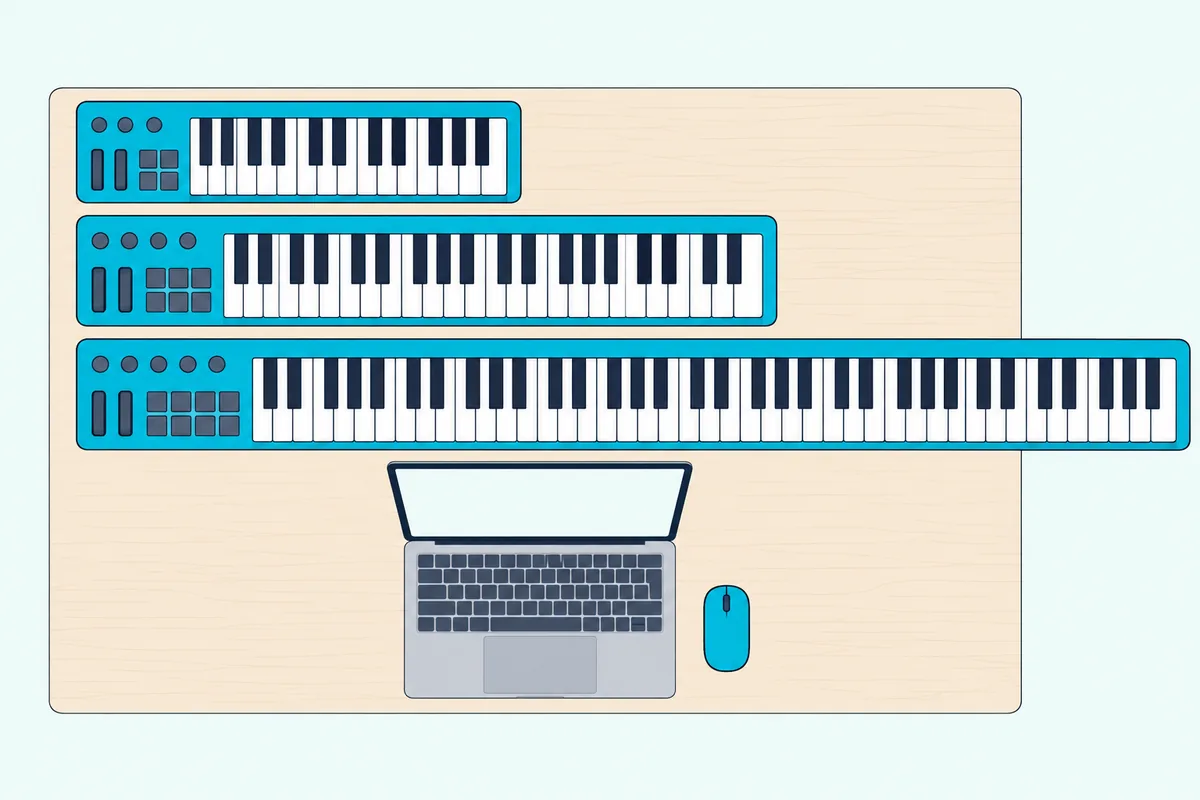
Those weights and widths are easier to judge side by side, so here they are from each maker’s own page:
| Keys | Model | Width | Weight |
|---|---|---|---|
| 25 mini keys | Novation Launchkey Mini 25 MK4 | 338.5 mm (13.3 in) | 0.78 kg (1.7 lb) |
| 25 mini keys | Akai MPK Mini MK3 | 318 mm (12.5 in) | 0.75 kg (1.65 lb) |
| 25 full-size keys | Novation Launchkey 25 MK4 | 461 mm (18.1 in) | 1.8 kg (4.0 lb) |
| 37 full-size keys | Novation Launchkey 37 MK4 | 557 mm (21.9 in) | 2.18 kg (4.8 lb) |
| 49 semi-weighted | Novation Launchkey 49 MK4 | 730 mm (28.7 in) | 4.08 kg (9.0 lb) |
| 61 semi-weighted | Novation Launchkey 61 MK4 | 895 mm (35.2 in) | 4.78 kg (10.5 lb) |
| 88 semi-weighted | Novation Launchkey 88 MK4 | 1274 mm (50.2 in) | 8.04 kg (17.7 lb) |
| 88 semi-weighted | M-Audio Keystation 88 MK3 | 1378 mm (54.24 in) | 6.2 kg (13.75 lb) |
| 88 hammer action | Roland A-88MKII | 1,429 mm (56.3 in) | 17.5 kg (38.6 lb) |
Read those widths against your desk before you read the reviews. A board that fits on paper can still crowd a laptop and a mouse, so leave room on both sides.
The growth isn’t linear. From 49 to 88 keys, Novation’s boards go from 730 to 1274 millimeters wide, a gain of 544 millimeters for 39 extra keys, and from 4.08 to 8.04 kilograms.
Do Mini Keys Change the Answer?
The two 25-key rows from Novation show it best. The Launchkey Mini 25 MK4 is 338.5 millimeters wide and the full-size Launchkey 25 MK4 is 461, so the same key count sits 122.5 millimeters apart.
Novation describes the Mini’s keys as synth-style mini-keys and the Launchkey 25’s as synth-style full-size keys. Mini keys save desk space and suit pads, one-finger lines and travel, while full-size keys give your fingers more room for chords.
Where Does a 37-Key Board Fit?
Three octaves is the size in between, and Novation’s Launchkey 37 MK4 shows what you get: 37 synth-style keys, 557 millimeters of width and 2.18 kilograms of weight (Novation). That’s 173 millimeters narrower than the 49-key board and about half its weight.
It suits synth leads and bass lines played with one hand, and it’s a sensible pick when 25 keys feels tight but 49 won’t fit the desk. The trade is that both hands won’t sit comfortably in three octaves, so chord work still means shifting.
Can Octave Buttons and Split Mode Replace Extra Keys?
Both of those boards lean on octave buttons to make up the difference, and the buttons have limits. Shifting is one setting for the whole board, so you can’t hold a bass line two octaves under a melody with the buttons alone.
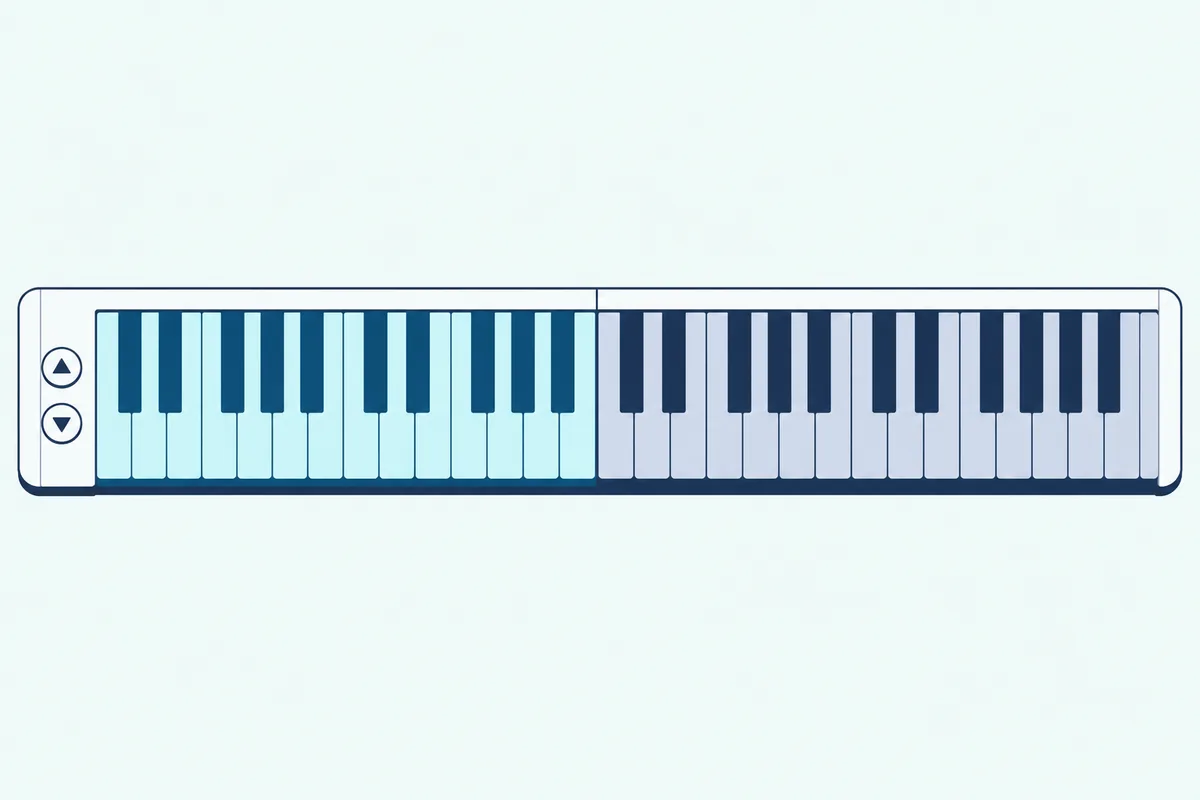
That’s the job of split mode, which on the Launchkey 49 sends the keys below the split point to one part and the rest to another. At the default split of C3, that leaves 24 keys on the low side and 25 on the high side.
Transposing covers the other case. Novation’s guide lets you shift the keys up or down by as many as 12 semitones, which helps when a song sits in an awkward key.
Do Software Instruments With Keyswitches Need More Keys?
Split mode and transposing help with your own parts, but some software adds demands of its own. Sample libraries often use keyswitches, which are keys that change how the instrument behaves instead of playing a note, and Native Instruments’ Kontakt Player manual colors them red on its on-screen keyboard and the playable keys blue (Native Instruments).
If a library puts its keyswitches just below the notes you play, a 25-key board means an octave change each time you switch articulation. That’s a practical reason to consider 61 keys or more if you write with orchestral libraries.
Can You Buy Too Many Keys?
Yes, and Novation’s own numbers show the cost. The Launchkey 88 MK4 is about 3.8 times as wide as the Launchkey Mini 25 MK4 (1274 millimeters against 338.5) and roughly ten times as heavy (8.04 kilograms against 0.78).
Too few keys costs you playing range, and you can’t add keys later. Too many costs desk space and portability, which is why the 49-key row in the table above works as the middle option.
How Can You Check What Range You Actually Play?
That trade is easier to judge with your own music in front of you. Open your last few projects and look at the lowest and highest notes in each part, because the piano roll shows the span of every part you’ve played.
If each part fits inside two octaves, 25 keys covers you, and if your hands play two parts at once, count both spans together. Ranges beyond four octaves point to 61 keys, and piano repertoire is the case for 88.
Which Size Fits the Music You Make?
Those limits point to a simple rule: buy the smallest board that never forces a button press in the middle of a part. Beat makers who live on pads and one-handed lines can stop at 25 keys, and electronic producers who play bass and lead together fit a 37 to 49 key board with a split.
Songwriters who play chords under a melody usually want 49 to 61 keys. Composers who layer orchestral parts often want 61, and pianists who practice repertoire want 88 keys with weighted action.
If you’re still unsure, pick 49. It never runs out of reach the way 25 keys can, and Novation’s spec puts it under 29 inches wide.
What About the Pads, Knobs and Faders Around the Keys?
Key count also decides what else fits on the board, and Novation’s range shows the pattern. The Launchkey Mini 25, 25 and 37 MK4 each carry 8 encoders and 16 pads, while the 49, 61 and 88 add nine faders (Novation).
Akai’s MPK Mini MK3 packs eight pads, eight knobs and a thumbstick into 12.5 inches. So a 25-key board can control more of your software than its key count suggests, and faders on Novation’s range mean stepping up to 49 keys or more.
A Short Checklist Before You Buy
Run any size through four checks before you pay for it:
- Measure the desk. Compare the widths in the table with the space you have left after your laptop and mouse.
- Count your hands. If both hands play at once, start at 49 keys, and if one hand plays, 25 to 37 is enough.
- Check the feel. Semi-weighted keys suit synth and production parts, while piano practice points to hammer action.
- Look at the ranges. If a part sits more than two octaves from the rest, plan for a split or a larger board.
The Bottom Line
Pick 49 keys if you want one answer: four octaves fit both hands, a split covers bass and lead, and the board stays under 29 inches wide. Drop to 25 for beats, pads and travel, step up to 61 when your hands play far apart, and choose 88 only when you play piano music.
Then check the width against your desk and the feel against your hands. Those two checks decide more than any spec sheet.
Frequently Asked Questions
Is 49 keys enough for music production?
Yes for most work. Four octaves fit a bass line and chords at once, the octave buttons move that window when a part sits elsewhere, and any note you can’t play can be drawn into the piano roll afterward.
Is a 25-key MIDI keyboard enough for a beginner?
Yes if you mostly play beats, bass lines and one-handed melodies. Akai’s MPK Mini MK3 gives you a 10-octave range from its octave buttons, and it weighs 1.65 pounds, but two-handed chords will feel tight.
Do I need 88 keys to learn piano?
An acoustic piano has 88 keys, so a smaller board can’t play every note in piano music without shifting octaves. Feel is a separate question: Roland calls its A-88MKII keyboard hammer action, while Novation and M-Audio describe their 88-key boards as semi-weighted.
Do more keys make a MIDI keyboard sound better?
No. Akai says the MPK Mini MK3 sends MIDI messages to software on your computer to generate sound (Akai), so the key count changes what you can play and never how it sounds.
Should I buy 49 or 61 keys?
Buy 49 if your parts fit in four octaves, since Novation’s board is 730 millimeters wide against 895 for the 61-key. Buy 61 if your hands play far apart or you use split mode, because each side keeps more room.
Is 37 keys enough for music production?
Yes for one-handed synth and bass parts, since three octaves plus the octave buttons cover a lot of range. Chords with both hands will still feel tight.
What size is best for travel?
A 25-key board. Novation’s Launchkey Mini 25 MK4 weighs 0.78 kilograms and is 338.5 millimeters wide, and Akai’s MPK Mini MK3 is 12.5 inches wide.