How to Soundproof French Doors: Seal the Seam Before the Glass
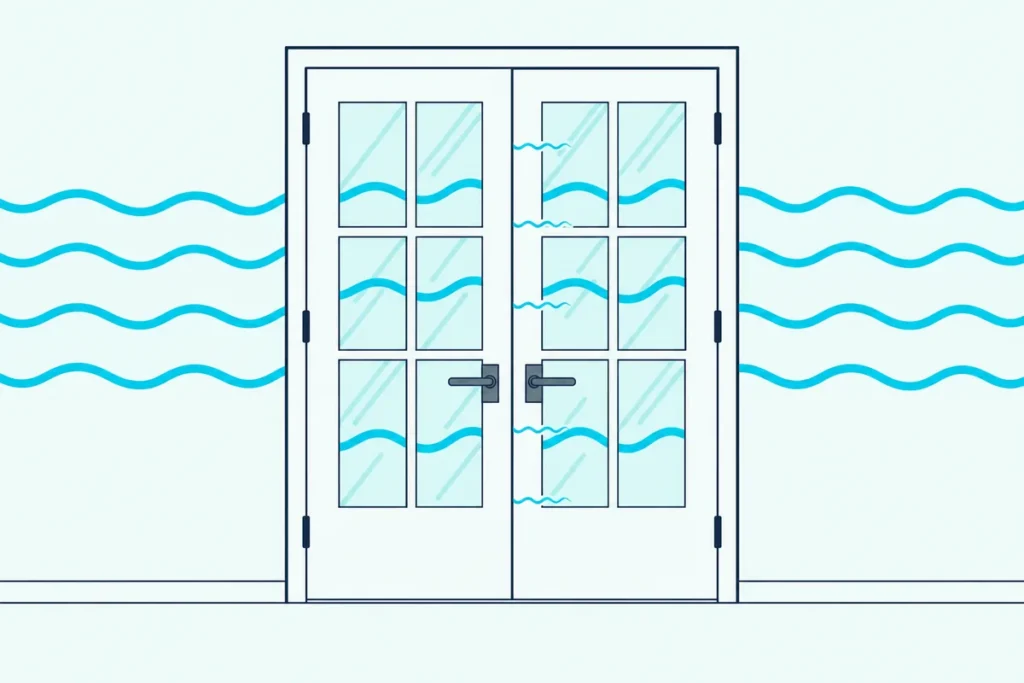
You close both French doors for the evening and still hear the television in the next room, which is when you start searching for how to soundproof French doors.
The glass blocks only as much as its thickness and layers allow, and the seam where the two doors meet stays open along its whole height.
This guide uses Marvin’s and Andersen’s sound data, Guardian’s glass tables, HUD’s noise guidebook and National Guard Products’ sheet on pairs of doors to rank the fixes.
You’ll see what to seal first, what actually helps the glass, which upgrades are worth paying for and when to replace the doors.
Start with the four steps, because the seam comes first.
How to Soundproof French Doors in Four Steps
That order puts the seam first because National Guard Products says the gap where two doors meet is the hard part of any pair. You soundproof French doors by finding the leaks, sealing the center seam, the edges and the bottom, treating the glass, and replacing the doors only if the target is higher than that can reach.
| Step | What you do | Why it comes here |
|---|---|---|
| 1. Find the leaks | Light one room, close the doors and look from the dark side along the seam, the edges and the bottom | Light shows where sound can follow |
| 2. Seal the seam, edges and bottom | Foam on the center seam and edges, and a sweep under each door | NGP calls the meeting edge the challenge with pairs |
| 3. Treat the glass | A heavy curtain as a bonus, or better glass if you own the doors | Glass is the next limit once the gaps are closed |
| 4. Replace the doors | Doors with laminated glass and a published STC | Marvin lists STC 32 to 36 for its tested builds |
Steps one and two cost little, and the seal details match the ones in our guide to soundproofing single doors.
Skip to step four only if you were already planning new doors, because sealing first tells you how much is left.
Why Are French Doors So Hard to Soundproof?
Those steps start with the seam because a pair of doors has more edges to seal than a single door and glass where a slab would be. French doors are hard to soundproof because the glass is the weak panel and the pair adds a long vertical gap, which is why an older wood French door with brass weatherstripping rates only STC 26 in HUD’s table (HUD).
HUD adds that doors are acoustically even weaker than windows and more difficult to treat, and that any door lowers the rating of the wall around it.
National Guard Products says pairs of doors are intrinsically more difficult to control sound through, and that sealing the gap between the meeting edges is challenging and takes properly coordinated gasketing (NGP).
The published numbers show how much the build matters.
| Source | What it rates | STC |
|---|---|---|
| HUD | Wood French door with brass weatherstripping (older government data) | 26 |
| Andersen | A typical dual-pane window, for comparison | 25 to 30 |
| Marvin | Ultimate sliding French door, tested builds | 30 to 32 |
| Marvin | Ultimate inswing and outswing doors with 3 in stiles, which Marvin says cover its French Door G2 products | 32 to 36 |
Marvin’s best builds use a laminated pane, and Andersen says laminated glass works because its rigidity cuts the vibration of the glass.
Get Studio Tips Weekly
Join 5,000+ creators getting acoustic treatment advice every week.
No spam. Unsubscribe anytime.How Do You Seal the Center Seam Between French Doors?
Once you’ve found the leaks, the center seam is the one to fix first. You seal it by closing the vertical gap with an overlapping strip, an astragal, or with foam that presses against the other door when they close.
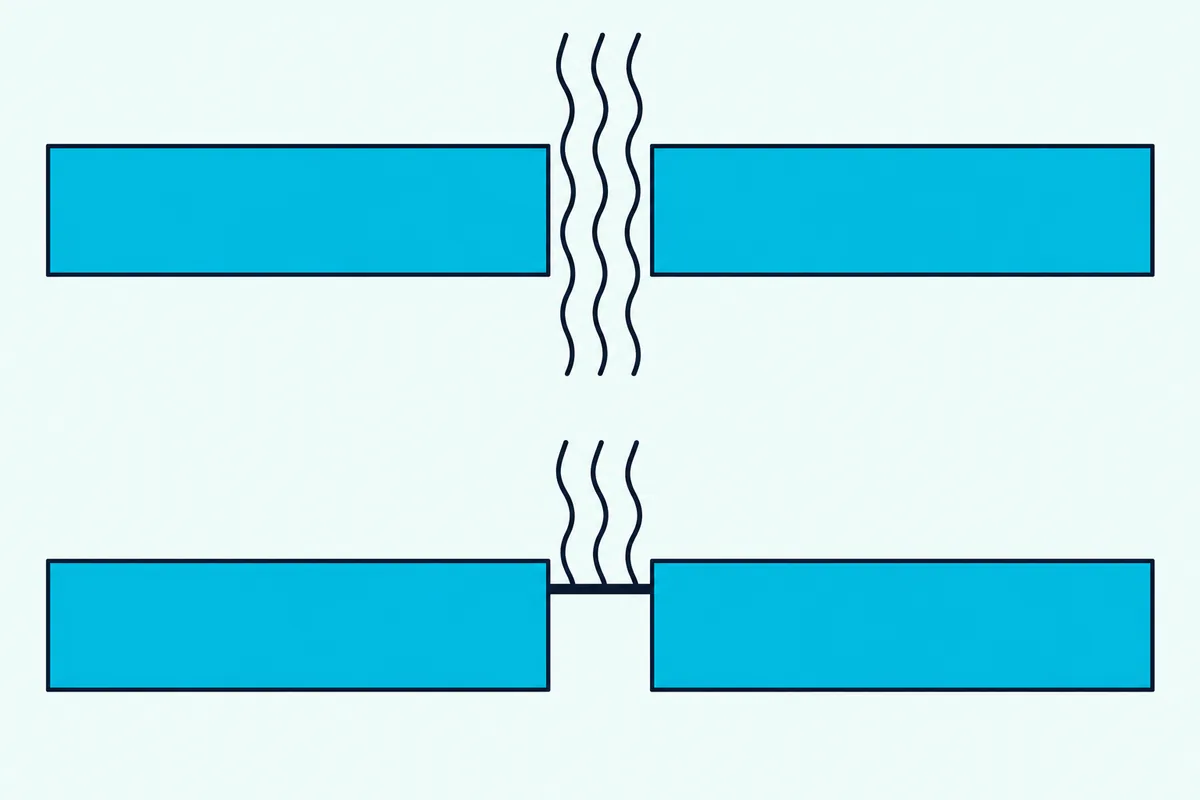
National Guard Products lists overlapping and adhesive astragals among its meeting-edge seals, and Second Skin Audio, which sells door seal kits, says the gap must be sealed if your doors don’t overlap in the center (Second Skin Audio).
If one door already has a vertical overlap strip, run compression foam along the edge it closes against, and if the doors meet edge to edge, fit a strip on one door for the foam to press against.
For the seam and the edges, Kikerike’s self-adhesive foam weatherstrip is a 1/2 in by 1/4 in high-density strip, and its listing sells it for door and window sound isolation.
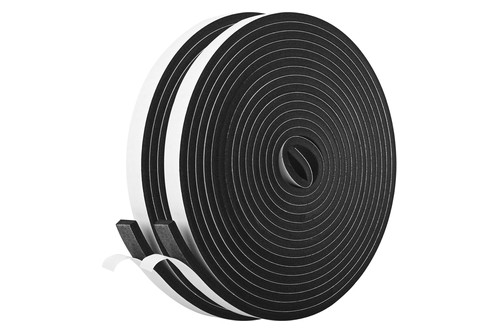
Kikerike’s self-adhesive foam weatherstrip
Close the doors after each strip and check that both still latch, because a seam that won’t close isn’t sealed.
TruStile says the seals around a door must be complete and uninterrupted, so run each strip in one piece past the corners (TruStile).
How Do You Seal the Edges and Bottom of French Doors?
That leaves the four edges of each door, which follow the same rules as any single door. You seal them with one continuous closed-cell foam strip on the top and sides of each opening and a sweep under each door.
GSA says a perimeter seal should be continuous closed-cell foam on three sides and that the undercut should be shielded by a sweep or drop seal (GSA).
TruStile adds that 1/8 in clearances around the edges can cut a 52 STC door to an effective 21, so closing gaps comes before any upgrade.
For a peel-and-stick bottom seal, the VITAM AMO silicone door sweep trims to length, and one sweep covers the width of a door up to 39 in.
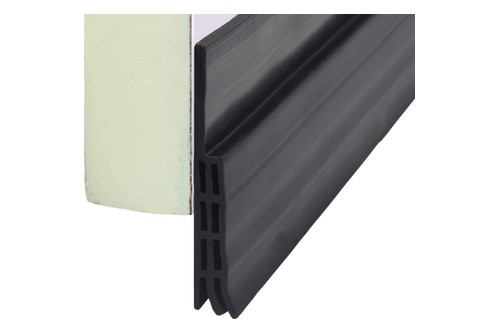
the VITAM AMO silicone door sweep
Our guide to what to do when the door leaves are hollow-core has the measuring steps and a one-hour seal job that apply here too.
Does Anything Make the Glass Quieter?
But sealed edges don’t change the glass, which is the next limit. Glass gets quieter with thickness, laminated layers and mismatched pane thicknesses, and curtains help only a little.
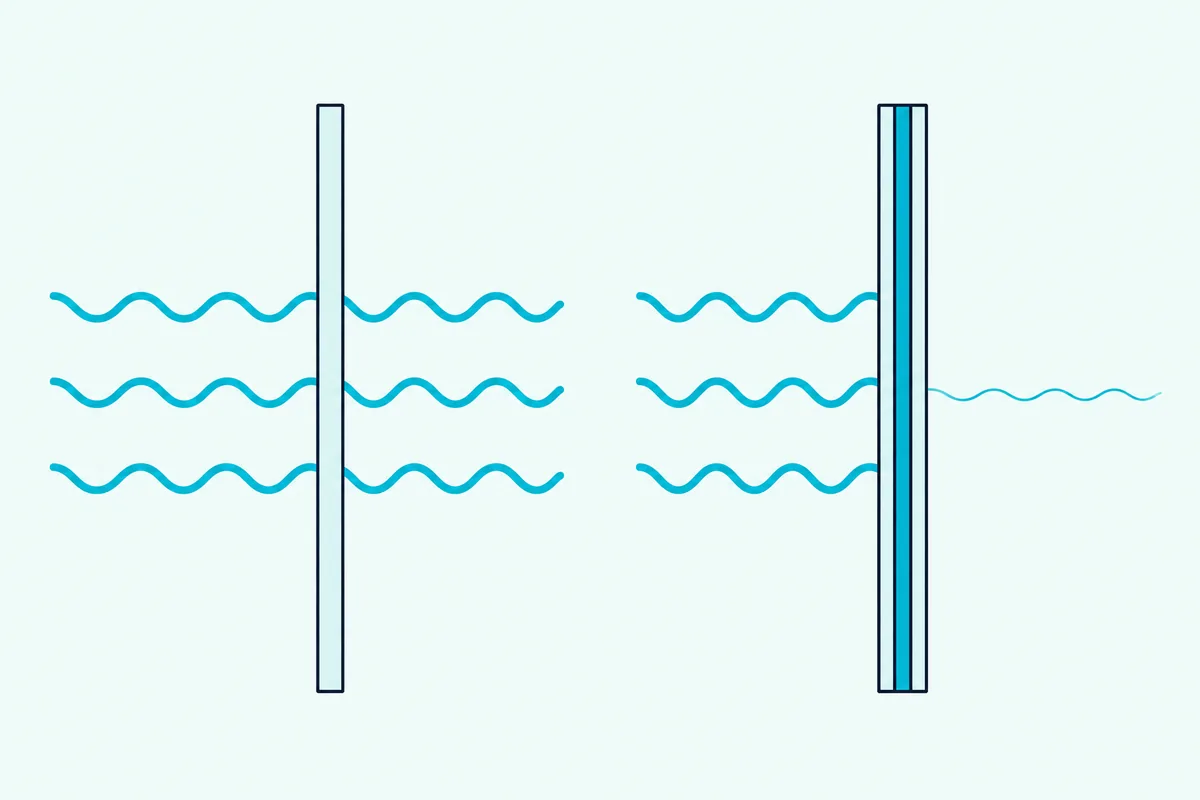
Andersen says the glass construction has the greatest influence on how a window dampens noise, and that thicker glass generally blocks more (Andersen).
Guardian’s center-of-glass estimates show the steps, and Guardian warns that a site-installed panel can lose about 6 dB against its lab specimen (Guardian).
Our guide to what laminated glass adds over plain glass compares it with tempered and double glazing.
| Glass (Guardian center-of-glass estimate) | STC |
|---|---|
| Single pane, 3 mm | 28 |
| Single pane, 6 mm | 30 |
| Single pane, 12 mm | 36 |
| Laminated, 6 mm and 6 mm with a standard interlayer | 36 |
| Laminated, 6 mm and 6 mm with an acoustic interlayer | 40 |
The options for a French door look like this.
| Option | What the sources say | The catch |
|---|---|---|
| A heavy curtain over the glass | Lab-tested curtain materials rate STC 13 to 21 (arXiv) | A bonus, since it leaves its edges open |
| A removable window insert | Indow says its inserts aren’t suited to French doors because the frames are usually not ideal and the weight makes egress hard (Indow) | Second Skin Audio, which sells door inserts, says each glass section needs about 1 in of flat mounting surface |
| Laminated replacement glass | Andersen says laminated glass cuts vibration through its rigidity | A glazier’s job, and the whole door still has its seams |
| New doors | Marvin lists STC 32 to 36 for tested builds | The biggest change and the biggest cost |
Are Sound-Rated French Doors Worth Buying?
If the seams are sealed and the glass is the limit, new doors are the next step. Sound-rated French doors are worth it when you own the doors, because Marvin’s tested builds reach STC 32 to 36 against 26 for HUD’s older wood French door.
Marvin’s best results come from builds with a laminated pane, such as its 7/32 in tempered pane, a 17/32 in air space and a 7/16 in laminated pane at STC 36, while two plain 5/32 in tempered panes around a 5/8 in air space rate 32 (Marvin).
Ask for the whole-door STC and its test report, not the glass rating alone, because Guardian’s table is for the center of the glass only.
Andersen’s scale helps you pick a target: STC 30 lets you understand a loud conversation, 30 to 35 lets you hear it without following, and 36 to 40 leaves even loud conversations hardly audible.
What About Interior French Doors Between Rooms?
Those numbers cover patio pairs, but interior French doors are often lighter and sometimes hollow-core. Interior French doors get the same seam and edge seals, and the leaf matters too: if it’s a hollow-core slab with glass lites, the hollow-door ratings apply to the solid parts.
Second Skin Audio says hollow-core double doors can’t be effectively upgraded and should be replaced, which is the seller’s view rather than a tested rating.
Our guide to sealing a door pair against sound compares sweeps for the bottom gap that every interior pair has.
If you’re renting, adhesive foam and a peel-and-stick sweep leave no screw holes, and a curtain across the pair adds a bonus layer.
How Much Quieter Will French Doors Get?
Those fixes add up unevenly, so it helps to know what each step sounds like. Sealing the seams should bring a pair close to what its glass allows, and the glass sets the ceiling: ordinary dual-pane glass rates STC 25 to 30, so expect speech to get harder to follow, not to disappear.
FHWA’s noise primer rates a 3 dBA change as barely perceptible, 5 dBA as readily perceptible and 10 dBA as half as loud (FHWA).
To check your result, play the same voice recording at the same volume outside the doors before and after, and read the level inside with the free NIOSH Sound Level Meter app, which CDC lists as accurate within 2 dBA and available only on iOS (CDC).
Which Fix Fits Which French Doors?
Those results depend on who owns the doors and which room they serve, so pick your route by situation. A rental pair gets removable seals and a curtain, an owned patio pair can take better glass or new doors, and an interior pair starts with the seam.
| Situation | Start with | Then |
|---|---|---|
| Rental pair | Adhesive foam, an adhesive sweep and a heavy curtain, with no screws | Ask the landlord about better glass |
| Owned patio pair | The seam, edges and bottom | Laminated glass or new doors with a published STC |
| Interior pair | The seam, edges and bottom | A solid-core pair if the leaves are hollow |
| Doors you’re already replacing | Choose laminated glass and ask for the whole-door STC | Seal the new doors the same way |
Our guide to soundproofing a sliding glass door instead covers the sliding version of the same problem.
The Bottom Line
Seal the center seam, the edges and the bottom first, because the glass can’t do its job until the gaps are closed, then treat the glass or replace the doors if you still hear too much.
Expect speech to get harder to follow, not to vanish, since even Marvin’s best tested door builds rate STC 36.
Frequently Asked Questions
Are French doors soundproof?
No. HUD rates an older wood French door at STC 26, and Marvin’s tested modern builds reach 32 to 36, which Andersen’s scale describes as a loud conversation you might hear but couldn’t follow, up to one that’s hardly audible.
How do you soundproof glass French doors?
Seal the gaps first, then add a heavy curtain, and replace the glass with a laminated pane or the doors with a rated pair if you still hear too much. Andersen says laminated glass works because its rigidity reduces vibration.
How do you soundproof double doors?
Seal the center seam with an astragal or foam, the edges with continuous foam and the bottom with a sweep on each door. National Guard Products says the meeting edge is the hard part of any pair.
Can you soundproof interior French doors?
Yes, with the same seam, edge and bottom seals. If the leaves are hollow-core, the hollow-door ratings apply to the solid parts and a solid-core pair rates higher.
What is the best soundproof French door?
The best are doors with a laminated pane and a published whole-door STC, such as Marvin’s 32 to 36 builds. Ask for the test report and check that the rating covers the door and frame, not just the glass.
Do curtains help soundproof French doors?
A little. Lab-tested curtain materials rate STC 13 to 21, and a curtain on a rod leaves its edges open, so treat one as a bonus over sealed doors.
Can you use window inserts on French doors?
Indow says its inserts aren’t suited to French doors because the frames are usually not ideal and the weight makes egress difficult. Second Skin Audio, which sells door inserts, says each glass section needs about 1 in of flat mounting surface around it.