How to Soundproof a Door: Close the Gaps, Then Add Mass

If you’re working out how to soundproof a door, start with the gaps around it, because without seals even a solid-core door tests at only STC 15 to 20.
That’s why voices and TV still come through a heavy door, and why foam panels or a blanket on its face change so little while the gap underneath stays open.
Seal that same door at the bottom and around the frame and it climbs to about STC 28 to 30, close to the point where normal speech stops being intelligible.
This guide works through that order: the bottom gap, the head and jambs, the frame, the slab and the rated door assemblies that studios use when nothing else is enough.
The six steps come first, then the numbers behind each one and the door types that need a fix of their own.
How to Soundproof a Door in Six Steps
The table below sums up that order for a bedroom, office or apartment door. To soundproof a door, find the leaks, seal the gap underneath, seal the head and both jambs, caulk the frame, then swap a hollow slab for a solid core, and move to a rated door assembly only when you need STC 40 or more.
| Step | What to do | What the numbers say |
|---|---|---|
| 1 | Find the leaks at the bottom, edges and frame | A 1/16-inch crack 16 inches long takes a 50 STC wall down to 40 (HUD) |
| 2 | Seal the gap under the door against a hard surface | Doors are commonly hung 1/2 to 3/4 inch off the floor for return air (NBS) |
| 3 | Fit a compression gasket on the head and jambs | Standard doors test at STC 15 to 20 without gaskets, solid-core wood about 28 to 30 with them (NGP) |
| 4 | Caulk the casing and frame joints | Sound gets through openings as small as 1/32 inch (Auralex) |
| 5 | Swap a hollow slab for a solid core | JELD-WEN rates its flush hollow-core door STC 24, its solid-core one 30 |
| 6 | Use a rated door assembly for STC 40 and up | Rated single openings run from STC 32 to 54 (Steel Door Institute) |
Steps 1 to 4 need no new door, step 5 replaces the slab and step 6 replaces the whole opening. The order matters because a heavier slab can’t help while sound walks around its edges.
Where Does Sound Get Through a Door?
Those steps start at the edges because of the way sound crosses a closed door. Sound gets through a door at the gap underneath, the clearance along the head and both jambs, the joint between the frame and the wall, any glass, louver or mail slot, and only then through the slab.

The gap underneath is usually the biggest, and it’s often there on purpose. The National Bureau of Standards’ Handbook 119 says doors are conventionally hung with a 1/2- to 3/4-inch space at the bottom so return air can circulate, which leaves no privacy even with the door shut (NBS Handbook 119).
The edges add up just as fast. NFPA 80 allows about 1/8 inch along the top and sides of a fire door, per a 2022 Fire Protection Research Foundation report, and by simple arithmetic that’s about 24 square inches of open air around a 32-by-80-inch door, the same as a 3/4-inch gap under it.
HUD’s Noise Guidebook shows what an opening like that costs: a 1-inch-square hole, or a 1/16-inch crack 16 inches long, drags a 50 STC wall down to 40 (HUD). Each of those door leaks is 24 times that hole.
The latch edge needs extra care once seals go on. The Steel Door Institute notes that seals tight enough to work make some hardware hard to operate, so a door that won’t latch against its gaskets isn’t sealing.
Openings in the door come next: SDI says a door’s rating drops as its glass gets bigger, HUD’s multifamily guide charts a louvered door at about 10 dB, and HUD’s Noise Guidebook rules out mail slots in exterior doors. A transfer grille above the door is the same kind of hole, and a sound-dampened transfer duct keeps the airflow while breaking the straight path.
Leave the grilles alone on a door into a room with a boiler or water heater, though, because they can be its combustion air, as Burton Acoustix’s boiler room guide explains.
Get Studio Tips Weekly
Join 5,000+ creators getting acoustic treatment advice every week.
No spam. Unsubscribe anytime.How Much Does Sealing a Door Actually Help?
Those leaks are why the seals are worth more than the slab on most doors. Sealing a door is worth roughly 8 to 15 STC points: National Guard Products, which makes door seals, says standard doors test at STC 15 to 20 without gasketing and solid-core wood doors at about 28 to 30 with it (NGP gasketing data).
On Handbook 119’s scale, normal speech is easily understood through STC 25 and audible but not intelligible at 30, so sealing moves a door across that line. Here’s what an STC number actually measures in more detail.
HUD’s older multifamily guide charts the same effect: a hollow-core door measured a few decibels lower at almost every frequency without its gaskets and drop closure and with a 1/4-inch sill gap. As NGP’s catalog puts it, “no matter what the STC door rating may be, it cannot perform without the proper STC gasketing.”
The door also caps the wall around it. In HUD’s Noise Guidebook, a common hollow-core door rated STC 17 takes up about 20% of a 48 STC wall and drags the whole wall down to 24, while a solid-core wood door with vinyl seals, over carpet, holds it at 33.
How Do You Seal the Gap Under a Door?
The gap underneath is the biggest of those leaks, so it’s the first to close. Seal the gap under a door with something that presses on a hard, level surface: an automatic door bottom or sweep over a threshold, or a slide-under stopper if you can’t drill.
The Steel Door Institute says carpet shouldn’t sit under an acoustical door, because the bottom seal has to compress against something solid, and ASSA ABLOY’s rated doors call for a level threshold, shimmed if need be.
An automatic door bottom is the version rated assemblies use. Pemko describes its model as an aluminum case around a drop bar seal that a plunger pushes down as the door closes, and NGP recommends a 1/4-inch drop for the best acoustic results from its own.
For a door you can modify, Pemko’s 411APKL36 automatic door bottom is the drop seal itself: it comes down as the door closes rather than dragging like a sweep.
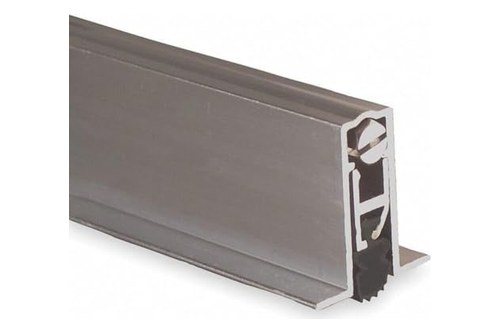
Pemko’s 411APKL36 automatic door bottom
A sweep is simpler but needs a smooth floor or threshold to seal on, and our guide to choosing a door sweep compares the types. If you rent or can’t drill, MAXTID’s under-door draft stopper slides under the door with a roll on each side.
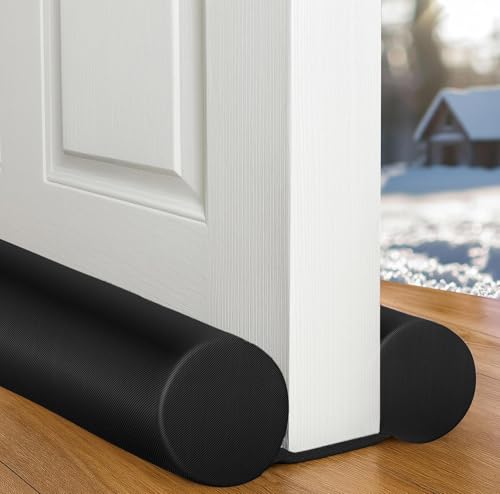
MAXTID’s under-door draft stopper
One check first: if the room has no return-air grille of its own, the undercut may be how air gets back to the central system. Handbook 119 calls such undercuts “extremely efficient flanking noise paths” and recommends a return duct in each room where possible, so give the air another way out before sealing one tight.
How Do You Seal the Top and Sides of a Door?
With the bottom closed, the clearance along the head and jambs is the next leak, and that 24 square inches is as big as the one you just sealed. Seal the top and sides with a continuous compression gasket on the door stop, so the closed door squeezes it along the head, the hinge jamb and the latch jamb.
Handbook 119 asks for soft rubber or plastic gaskets at the top, sides and bottom, and Auralex, which makes studio acoustics products, says the door should meet foam weatherstrip or a rubber gasket wherever it touches the jamb. Zero International, a maker of acoustic seals, adds that the seal must be complete and airtight at the head, jambs and sill, or it gives little or no sound control.
Watch the corners and the fit over time. NGP’s tested seal sets add corner pads where the jamb seals meet the door bottom, and Zero sells adjustable gaskets because alignment drifts as a house settles and doors swell with the seasons.
For a gasket from a door-hardware maker, Pemko’s S88 SiliconSeal gasket sticks to the stop in one run. Its 18-foot roll covers the head and both jambs of a 36-by-80-inch door, which take about 16 1/3 feet.
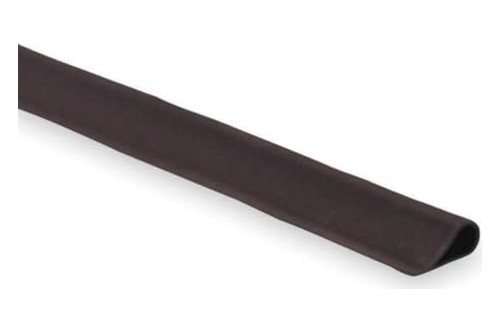
Pemko’s S88 SiliconSeal gasket
Should You Caulk Around the Door Frame?
Gaskets seal the door to its frame, but the frame also has to be sealed to the wall. Yes, caulk the joints where the casing meets the wall and where it meets the frame, because Auralex notes sound gets through openings as small as 1/32 inch and Handbook 119 calls for every crack between private rooms to be caulked or sealed.
Behind the trim sits the gap between the frame and the wall framing. Pull the casing, apply acoustical caulk or low-expansion foam to that gap, which works as a sealant rather than a sound layer, as what spray foam does for noise shows, then put the trim back.
Rated doors take this seriously: in ASSA ABLOY’s STC 53 door system, even the steel frame is grouted full to hold the rating. This 29-ounce tube of acoustical caulk is the sealant for those joints.
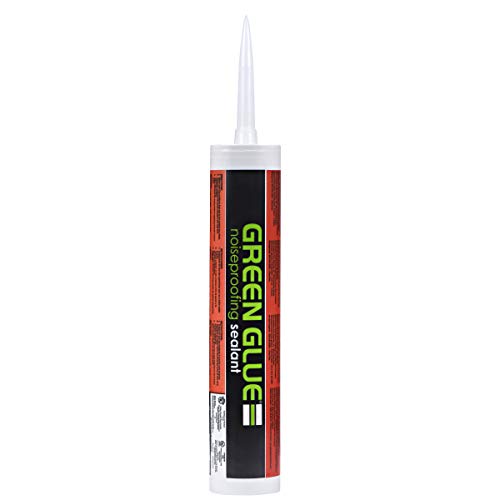
This 29-ounce tube of acoustical caulk
Once the door is tight, the nearby leaks take over. Handbook 119 lists back-to-back outlets among the common leaks in walls, and sound that can’t get through the door will find the thinnest point in the nearby wall.
Is a Solid-Core Door Worth the Swap?
Once every gap is sealed, the slab is finally the part you hear through. A solid-core door is worth 5 to 7 STC points on most of JELD-WEN’s designs: its flush hollow-core door rates STC 24 and its flush solid-core door 30, and most of its molded doors rate 25 hollow and 30 to 32 solid (JELD-WEN ratings).
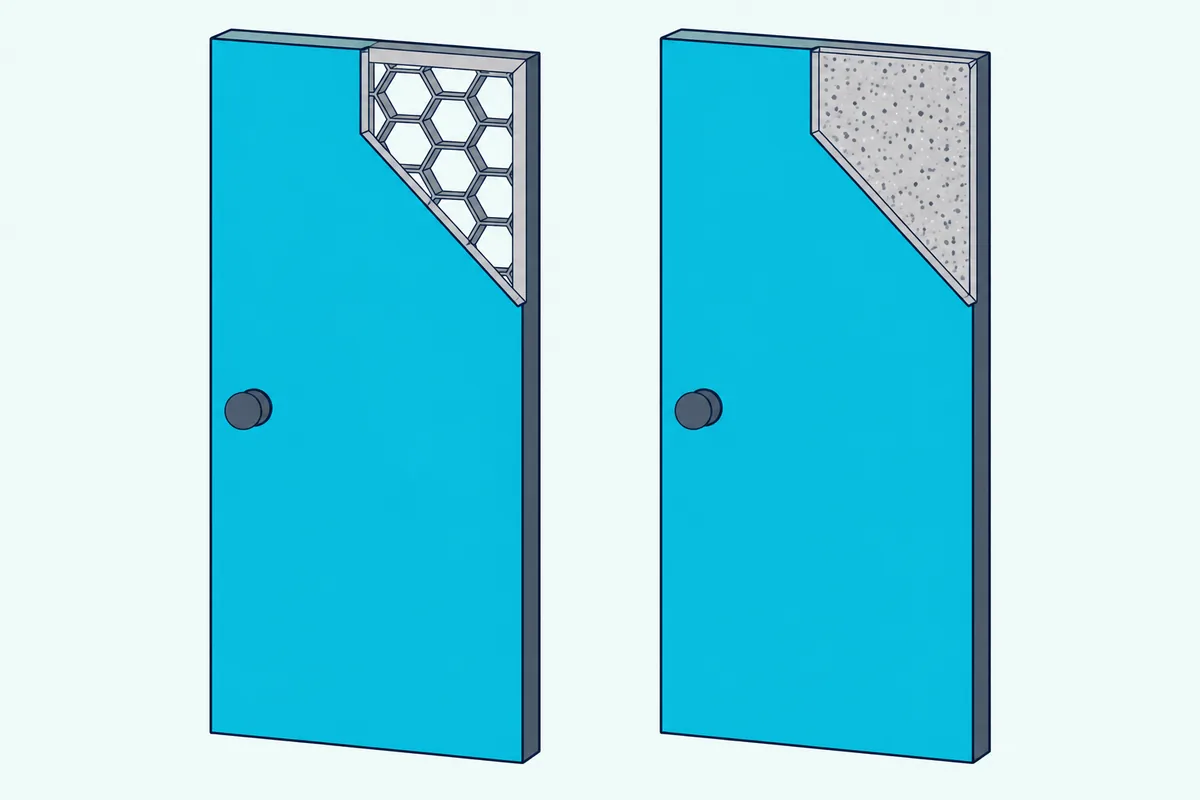
The gain is bigger for low sounds. JELD-WEN rates those hollow-core doors OITC 19 to 22, a scale the Steel Door Institute describes as reaching lower frequencies for traffic and rail noise, against 28 to 29 for the solid-core versions.
Don’t expect the slab alone to work miracles. Auralex puts even the best solid-core door at STC 30 to 32, about what Handbook 119 says most interior walls in homes manage (STC 30 to 35), so a sealed solid-core door roughly matches an ordinary wall.
For the spread by maker and model, see Burton Acoustix’s solid core door ratings. If you’re keeping your door, our guide on how to soundproof a hollow door ranks the seals, mass and swap by the makers’ ratings, and here’s how to pick a soundproof interior door.
Do Mass-Loaded Vinyl, Blankets or Foam on a Door Help?
If a new slab isn’t an option, the next idea is adding weight to the one you have. Mass-loaded vinyl adds real mass, a blanket adds a little and foam adds almost none, and none of them closes a gap: Johns Manville rates its 1-pound-per-square-foot vinyl at STC 26 on its own, about what a hollow-core door already rates.
Glued to a 32-by-80-inch door, that vinyl is a second layer of about the same rating plus roughly 18 pounds. Auralex suggests its vinyl on one or both faces of a solid-core door, and Zero says its barrier sheet can significantly raise a door’s rating, but neither gives a number for an existing door, so check when mass-loaded vinyl is worth using first.
A moving blanket mostly absorbs, which helps echo more than blocking. Acoustical Surfaces’ blocking blanket bonds a 2-inch quilt to 1-pound vinyl and rates STC 32 as a panel, and in a National University of Singapore study a polyester curtain blocked about 5 dB and a PVC-coated one 15 to 22 dB.
Any blanket over a door leaves the bottom and edges open, so it only adds to a sealed door. Our roundup of sound blankets covers the heavier ones, and here’s what a moving blanket really stops.
Acoustic foam is the weakest of the three: Auralex, which makes it, says foam won’t soundproof a room and adds only some high-frequency isolation, which is why soundproof foam doesn’t work on a door.
What Can Renters Do Without Damaging the Door?
Most of those fixes come off again, which matters if you rent. Renters can seal the bottom with a slide-under draft stopper, the head and jambs with self-adhesive weatherstrip, and hang a heavy blanket from removable hooks, then take all three down at move-out.
Check the door first. An apartment entry door may carry a fire label, and NFPA says fire doors must always open, close and latch, so ask the building before adding anything; soundproofing a fire door without breaking its listing starts with the closer, the latch and seals listed for fire doors.
For that hallway door, our step-by-step guide on how to soundproof an apartment door separates what a tenant may change from what to ask the landlord to fit.
A dorm door adds housing rules on top of that, which sealing a dorm door without drilling works through. Hotels have the same weak point at scale, and why hotel rooms let sound through covers their door undercuts and connecting doors.
For the rest of a rental, our guides to soundproofing an apartment and to soundproofing rental spaces cover the walls, windows and floors.
Which Doors Need a Different Fix?
Everything so far assumes a hinged door that presses into its stop when it latches. Double, sliding, folding and exterior doors either can’t seal that way or face different noise, so each has its own page.
Pairs are harder: NGP calls them intrinsically more difficult because the meeting edges need their own seals, and HUD lists a wood French door with weatherstripping at STC 26. Our guide on how to soundproof French doors covers the seam seals, the glass and rated doors.
A slider parks beside its opening instead of pressing into a stop. See soundproofing a sliding glass door for patio sliders, are barn doors soundproof for track-hung doors and Burton Acoustix’s bifold door guide for folding closet doors.
Front doors face traffic, which is lower-pitched, so the Steel Door Institute tells specifiers to list OITC as well as STC. In HUD’s table of NBS data, a solid-core wood entry door with weatherstripping rated STC 27 and the same type with an aluminum storm door 34, and Handbook 119’s advice for outside noise includes gasketed storm doors and covered mail slots.
When Is a Rated Door Assembly the Only Answer?
Those doors all top out in the 30s, which is where rated assemblies take over. A rated door assembly is the only answer when you need STC 40 or more, where loud speech stops being intelligible: the Steel Door Institute lists rated single openings from STC 32 to 54 and says 55 and up needs a door thickness of at least 2 1/4 inches (SDI).

Even with seals, NGP’s gasketed mineral-core doors test at 32 to 36 and JELD-WEN’s TRIA doors with seal sets at 34 to 37.
A rated assembly is a door, frame, seals, threshold and hardware tested together, and the weight shows it. ASSA ABLOY’s AW53C, rated STC 53 as a single wood door, weighs 13.7 pounds per square foot, close to 290 pounds for a 3-by-7-foot leaf by our arithmetic, and its installation calls for a frame tied to the structure, ideally with doubled studs.
Ask for the tested, working rating. SDI says the operable test, the one makers publish, typically runs 1 to 5 points below a sealed-shut test, ASSA ABLOY warns that construction tolerances can cost 3 to 5 dB in the field, and Zero’s STC 52 seal system reaches 52 only on doors rated 55 or more.
That’s the territory of studios, music rooms, home theater rooms and drum rooms. SDI 128 adds that the room around the door has to perform as well as the door, so the walls between you and the noise source count too.
How Can You Tell Whether the Fix Worked?
Rated or not, the proof is what you hear afterward. Play the same steady sound on one side before and after each step and listen, or measure, at the same spot on the other, since the FHWA counts a 3 dB change as barely perceptible and a 10 dB drop as half as loud.
Try this at night, too: light the far side, darken yours and look for light at the edges, though a dark edge doesn’t prove a seal. Our guide to measuring a door before and after sets up a fair test.
The Bottom Line
Soundproofing a door comes down to order: close the gap underneath, seal the head and jambs, caulk the frame, and only then pay for a heavier slab. Sealing is most of the gain, STC 15 to 20 becoming 28 to 30 in NGP’s figures, while a solid core adds 5 to 7 points and a rated assembly is a different class of project.
Treat the door first because it’s often the weakest link, then compare what’s left against how to soundproof a room, soundproofing a wall, soundproofing windows, soundproofing a ceiling and soundproofing a floor if the leak spreads through the rest of the room.
Frequently Asked Questions
What is the cheapest way to soundproof a door?
Seal it. A draft stopper or sweep for the gap underneath, self-adhesive weatherstrip for the head and jambs and a tube of acoustical caulk for the trim are the cheapest parts of the job and most of the gain: National Guard Products says standard doors test at STC 15 to 20 without gasketing, and solid-core wood doors at about 28 to 30 with it. Those are the same priorities as any budget-friendly approach to a noisy room.
Does a towel under the door block sound?
A towel fills part of the gap, so it takes some edge off voices and TV, but it doesn’t press against the floor like a seal and it leaves the head and jambs open. HUD’s figures show why leftovers matter: a crack 1/16 inch wide and 16 inches long drags a 50 STC wall down to 40. A draft stopper does the towel’s job more neatly, and an automatic door bottom with gaskets does it properly.
How do you soundproof a bedroom door?
Use the same order: seal the undercut once the room has another return-air path, gasket the head and jambs, caulk the trim, then swap a hollow slab for a solid core if voices still come through. Our guide to soundproofing bedroom doors and the rest of the room covers the walls and window, and the same steps suit a bathroom door or a home office.
Is it better to replace a door or seal it?
Seal it first. Sealing is worth more than the slab on most doors, and a new solid-core door needs the same seals anyway: in HUD’s example, the solid-core door that holds a 48 STC wall at 33 has vinyl seals. Replace the door if voices still come through once it’s sealed, or if it’s damaged or won’t latch against a gasket.
Can you completely soundproof a door?
Not completely, but rated assemblies come close. Handbook 119 puts STC 50 at “shouting barely audible” and 55 at “shouting not audible,” and the Steel Door Institute lists rated single door openings up to STC 54. Expect a few points less at home, since ASSA ABLOY says construction tolerances can cost 3 to 5 dB against the lab rating.