How to Soundproof a Pool Pump Without Overheating the Motor
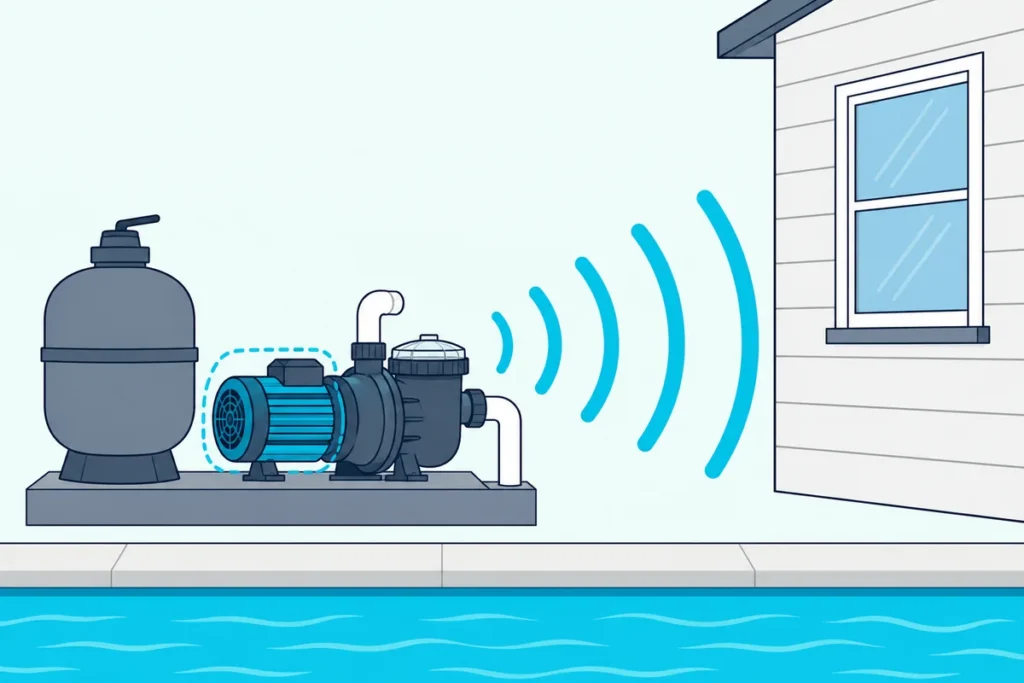
The pool pump hums on its pad all evening, loud enough to reach the bedroom or the neighbor’s patio, so you look up how to soundproof a pool pump.
The obvious fix, a snug box over the motor, is the one Pentair’s and Jandy’s manuals warn against, because the motor cools itself with outside air.
Done in the right order, the fixes the pump makers do allow can take the edge off the hum without starving the motor of that air.
The first step is free: rule out a worn bearing or a starved pump, since Hayward’s own help page lists both among the usual causes of a noisy pump.
The seven steps below run from cheapest to most involved, and the sections after them give each step’s numbers so you can tell when a wall or a cover is worth building.
How to Soundproof a Pool Pump in Seven Steps
These steps come from Hayward’s, Pentair’s and Jandy’s manuals and government noise guidance, quoted in the sections below.
| Step | What to do | Why it helps |
|---|---|---|
| 1 | Rule out a fault | Cavitation, debris and worn bearings are on Hayward’s and Pentair’s noisy-pump lists |
| 2 | Run the pump slower | Hayward lists quiet operation among the benefits of low speed |
| 3 | Bolt the pump down or set it on rubber | Jandy says either cuts the chance of vibration noise |
| 4 | Support and isolate the pipes | Hayward’s UK site suggests sleeves so vibration stays out of the pipes |
| 5 | Keep it away from bedrooms | Sound from one source falls about 6 dB per doubling of distance (FHWA) |
| 6 | Block the line of sight with a solid wall | Barriers work best on sources at or below ground level (HUD) |
| 7 | Enclose it only if the manual allows | Every manual here requires ventilation around the motor |
Steps 1 to 4 treat the pump itself, and steps 5 to 7 treat the path to the listener; step 7, the DIY box, is the one the manuals restrict.
How Loud Is a Pool Pump, and How Much Quieter Can It Get?
Those seven steps don’t buy the same amount of quiet, and the makers’ own figures show the range. Pentair says its now-discontinued IntelliFlo variable-speed pump runs as low as 45 decibels, about four times quieter than a typical 1.5 horsepower single-speed pump, but it doesn’t say how far away it measured.
The FHWA noise primer puts “1/4 as loud” at 20 dB down, so Pentair’s comparison describes a gap of about 20 dB by that rule of thumb. The same primer says a 3 dB change is barely perceptible, 5 dB is readily perceptible and 10 dB sounds half as loud.
Published guidance puts a rough size on each kind of noise reduction.
| Fix | Typical reduction in the source | Source |
|---|---|---|
| Doubling the distance | About 6 dB | FHWA, for a point source |
| A barrier or screen | About 5 to 7 dB, where that’s enough | WorkSafe Victoria |
| A partial enclosure | About 10 dB | WorkSafe Victoria |
| A full, relatively airtight enclosure | As much as 30 to 40 dB | WorkSafe Victoria |
| A barrier with 10% of its area open | About 4 dB at most | HUD |
The enclosure figures come from WorkSafe Victoria’s noise control guidance for industrial plant, and the 30 to 40 dB needs a relatively airtight box with a dense acoustic lining. A pool pump can’t run in an airtight box, so the barrier and partial-enclosure rows are the realistic range unless the vents are built as lined silencers.
Burton Acoustix’s distance table for generators works the same 6 dB rule out in feet for open ground.
Get Studio Tips Weekly
Join 5,000+ creators getting acoustic treatment advice every week.
No spam. Unsubscribe anytime.Is the Noise a Fault You Should Fix First?
Those reductions assume a healthy pump, and a pump with a fault needs a repair, not a wall. Yes, check first: Hayward’s Super Pump VS manual lists four causes of pump noise, which are air leaks and cavitation on the suction side, poor mounting, debris in the pump housing and worn motor bearings.
The table adds Pentair’s and Hayward’s other causes, each beside its maker’s fix.
| Cause on the makers’ lists | What the maker says to do | Source |
|---|---|---|
| A suction-side air leak or restriction, low pool water, unrestricted returns or a full strainer basket | Fix the suction side, clean the basket or throttle the returns | Hayward, Pentair |
| An undersized suction pipe, or a water feature with little back-pressure | A larger pipe, a smaller impeller or a back-pressure valve | Hayward |
| Debris hitting or clogging the impeller, or touching the cooling fan | Clean out the pump or the fan guard | Hayward, Pentair |
| Worn bearings, from wear, rust, overheating or a seal leak that lets chlorinated water in | Fix seal leaks at once, then replace the bearings or motor | Hayward |
| Poor mounting, a pump that isn’t level, or a speed set too high | Level and secure the pump, and reduce the speed | Hayward, Pentair |
Two sounds get a name in these sources: Hayward’s manual says bearings damaged by chlorinated water whine, and Hayward’s UK site says high-pitched whistling points to water in the bearings. Hayward’s US help page adds that the motor’s internal cooling fan can be heard, so some hum is simply the fan doing its job.
Switch the pump off at the circuit breaker before you touch it, as Pentair’s IntelliFlo3 VSF guide instructs, and leave the drive closed: Pentair warns that its capacitors hold a 230-volt charge even with the power off. Bearing and seal work goes to a dealer by Hayward’s own advice.
Does Running the Pump Slower Make It Quieter?
Once the faults are cleared, speed is the biggest lever left on the pump itself. Yes: Hayward’s Super Pump VS manual lists quiet operation among the benefits of running at low speed, and ENERGY STAR says variable-speed pumps are quieter.
ENERGY STAR adds that halving a pump’s speed lets it use one-eighth as much energy, and Pentair’s troubleshooting table lists a motor speed set too high as a cause of a loud pump.
Slower has limits, though. Hayward recommends filtering all the pool water at least once every 24 hours, says a lower speed may mean running longer, and notes that heaters, skimmers and chlorinators need minimum flows.
Its advice is to filter on a low speed, check that water still flows over the skimmer weirs, and save higher speeds for a heater or water feature. That pattern suits a quiet night, because the loud setting runs only when you choose.
A single-speed pump can’t slow down, and Hayward’s UK site calls a variable-speed pump the radical solution to pool pump noise, since water then circulates more slowly through the pipes.
Will a Rubber Pad Stop Pool Pump Vibration?
Slowing the motor quiets the airborne hum, but vibration takes a second path, through the base into the pad, the pipes and anything they touch. It can help: Jandy’s VS FloPro manual says to put the pump on a solid foundation that won’t vibrate and, to further cut the chance of vibration noise, to bolt it down or place it on a rubber mat.
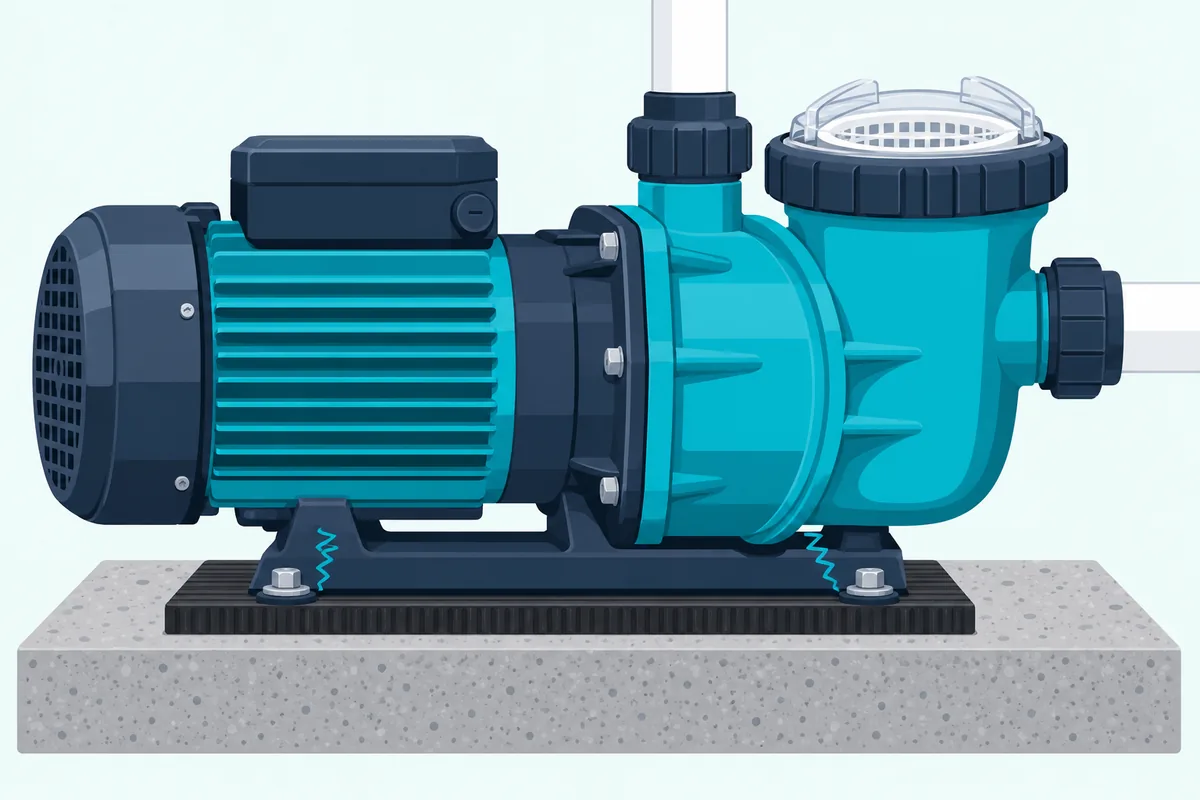
Jandy’s maker, Zodiac, recommends bolting the pump straight to the foundation, and Hayward’s manual says to secure it to a level, rigid base with screws or bolts to reduce vibration and stress on the pipe joints. Hayward’s help page also suggests a piece of old carpet or rubber between the pump’s base and the pad, and its UK site warns that a variable-speed pump standing on a concrete block will resonate.
The Spa Depot Silencer pump base is a ribbed rubber base with bolt grommets that its listing says fits 48 and 56 frame hot tub and pool motors, so the pump can still be bolted down. Measure your pump’s base first, since some motors need two bases or a trim.
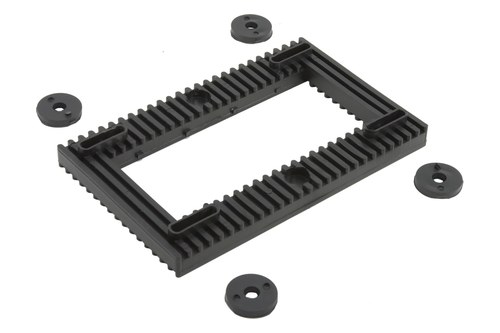
The Spa Depot Silencer pump base
This 4-pack of UPE Group rubber isolation pads gives you four ribbed pads, 4 by 4 inches and 3/8 inch thick, rated for up to 50 pounds per square inch by the listing. They suit the rubber-mat route in Jandy’s manual, while a manual that requires anchoring, as Pentair’s does, calls for the bolt-through base.
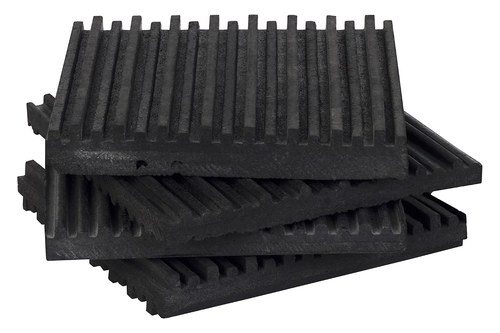
This 4-pack of UPE Group rubber isolation pads
The pipes are the other half of the job. Hayward’s UK site suggests sleeves at the pump’s inlet and outlet to stop vibration passing into the pipes, and Jandy’s manual says piping must be well supported and never forced together where it’s under constant stress.
Where Should a Pool Pump Sit to Be Quieter?
That plumbing also limits where the pad can go, and placement is the cheapest fix if you’re building or moving the pad anyway. Away from bedrooms: Hayward’s help page says the motor’s cooling fan can be heard and that the spot under a bedroom window may not be ideal.
Distance does real work outdoors, because the FHWA primer says sound from a point source drops about 6 dB each time the distance doubles. By that rule, moving a pump from 10 to 20 feet from a window cuts about 6 dB on open ground, a readily perceptible change.
The makers set limits on the move, though. Pentair’s guide puts the pump at least 5 feet from the pool’s inside wall (9.8 feet in Canada), at least 3 feet from a heater outlet and no more than 10 feet above the water.
Longer pipe runs cost flow, which is why Hayward wants the pump as close to the pool as practical and Pentair prefers short, direct lines. Wherever it goes, Hayward and Jandy both ask for a well-drained spot protected from the sun.
Does a Sound Barrier Wall Work for a Pool Pump?
When the pad can’t move, a wall between the pump and the listener is the next tool, and pool equipment is the kind of source barriers suit. Yes, if it blocks the line of sight: HUD’s Noise Guidebook says barriers are most effective for sources at or below ground level and that one which doesn’t break the line of sight between source and listener gives little or no reduction.
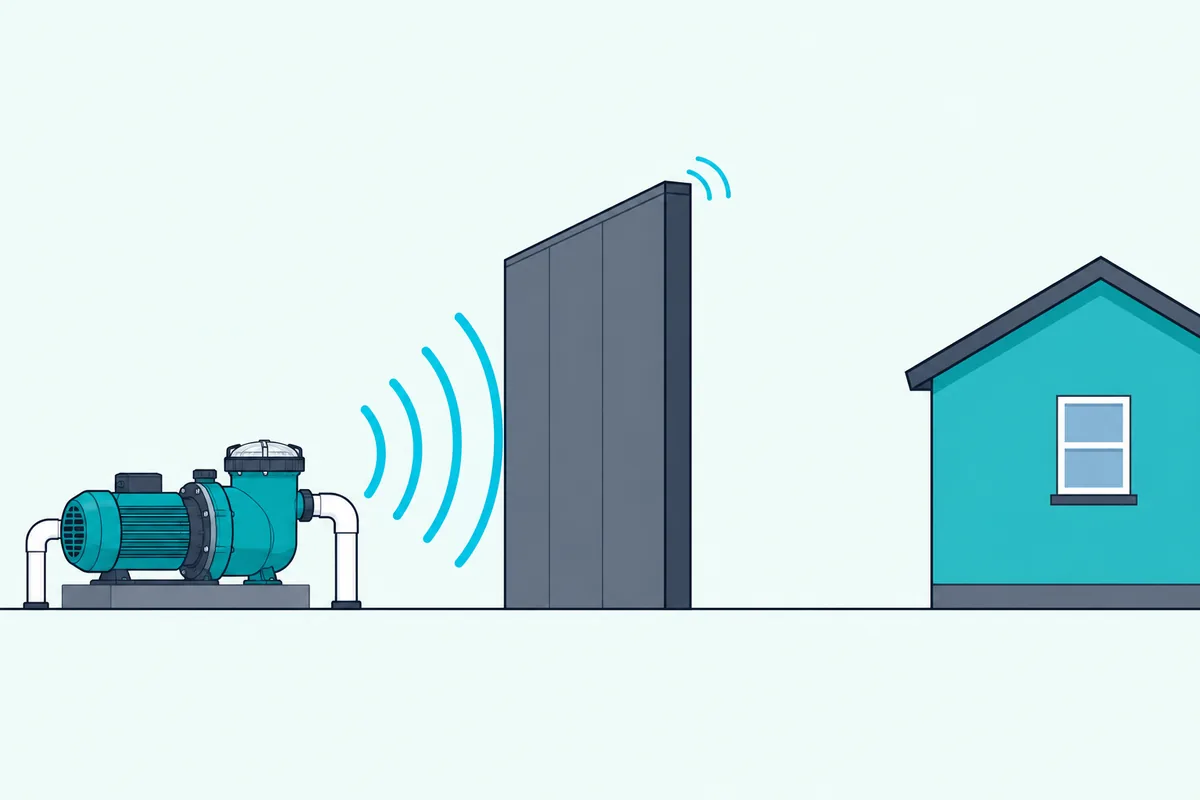
HUD’s other rules carry straight over: barriers work better the closer they are to the source, and one weighing more than 4 pounds per square foot with no openings usually lets through a negligible amount of sound.
Gaps undo it. HUD says openings totaling 10% of a barrier’s area cap it at about 4 dB however tall it is, 50% leaves no reduction at all, and intended openings should be no more than 1% with tightly sealed joints.
A spaced-board fence fails that test, while a solid wall, an earth berm or a building all count as barriers for HUD. WorkSafe Victoria suggests barriers and screens where a reduction of about 5 to 7 dB is enough, so expect a clear softening rather than silence.
Keep the wall clear of the pump, since Pentair asks for at least 3 inches beside and behind the motor and Jandy for plenty of space above the pump to lift out the lid and basket. Our reading is to leave the top open, because every manual here wants the motor ventilated.
The same rules decide whether you can soundproof a backyard against any outdoor noise, from traffic to a neighbor’s equipment.
Can You Put a Box or Cover Over a Pool Pump?
A wall leaves the pump in open air, and that’s exactly the line a box or pump cover crosses. Only if your pump’s manual allows it: Hayward’s Super Pump VS manual says an outer enclosure needs adequate ventilation and free circulation of air, Pentair’s IntelliFlo3 guide says not to install that pump within one unless it’s marked for it, and Jandy’s VS FloPro manual says not to at all.
Jandy gives the reason: the pump needs enough ventilation to keep the air around it below the maximum ambient temperature on the motor’s rating plate. Pentair adds that any enclosure must be well ventilated, with ample cross ventilation and at least 3 inches clear behind the motor fan for circulation and pump maintenance.
Pentair is blunt about wrapping: never cover the motor while it’s running or about to run, and don’t wrap it in plastic even for winter storage. Jandy says the same about plastic, because it traps condensation that damages the pump.
Hot tub makers draw the same line around their own cabinets, and Hot Spring says even its insulating kit must come out in warm weather, as Burton Acoustix’s hot tub motor guide explains.
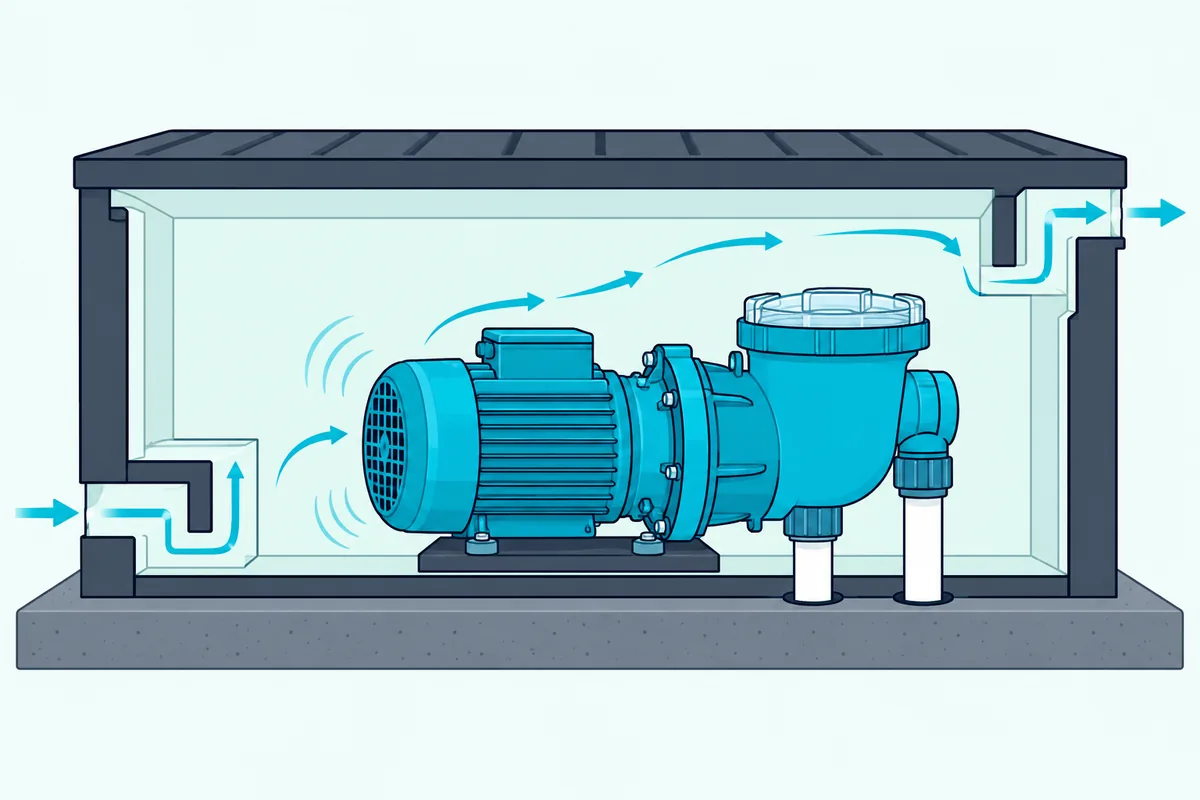
If your manual does allow an enclosure, WorkSafe Victoria shows why a vented box gives up so much: without absorbent lining, a 10% gap limits an enclosure to about 9 dB and a 5% gap to about 19 dB. Its answer is lined vents, and to reduce noise by 15 to 30 dB the lining in a vent should run at least 3 times, and preferably up to 6 times, its widest diameter.
WorkSafe’s own example is a pump motor enclosure with a silencer-style air vent, a cooling air vent, an absorbent lining, resilient seals and a resilient vibration mounting. It adds that close-fitting enclosures build up more noise, so build as large as the space allows, with panels that come off for service.
Our guide to how you build a soundproof box for a noisy machine covers the lining material and baffled vents, and the pump rules above decide whether to build one at all.
Air compressors raise the same question, and soundproofing an air compressor works through DeWalt’s, Makita’s and California Air Tools’ clearance rules the same way.
Does a Pump House or Shed Work Better Than a Box?
A pump house is the same idea as a box scaled up to hold the whole pad, so the same maker rules apply to it. It can beat a box on size, but only if every manual for the equipment inside allows it and the room is ventilated: Hayward’s rule is adequate ventilation and free circulation of air, and Pentair’s is ample cross ventilation with the motor shaded from the sun.
Jandy’s VS FloPro manual says not to install that pump within an outer enclosure, so ask Jandy or your installer before housing that model.
Size matters because WorkSafe says noise builds up more in close-fitting enclosures. Line the inside with at least 50 mm, about 2 inches, of dense absorbent over at least half the surface, as WorkSafe advises, and keep the door tightly sealed while the pump runs.
The other pool equipment on the pad adds its own noise, and the FHWA primer says two equal sources add 3 dB. By that rule, silencing only the pump beside an equally loud heat pump cuts just 3 dB, so Hayward’s UK site recommends full-inverter heat pumps that run without fits and starts.
What Can You Do About a Neighbor’s Loud Pool Pump?
Every fix so far, from the rubber base to the pump house, assumes the pump is yours, but plenty of these searches come from the other side of the fence. Start with a conversation, then the local rules: Brisbane City Council limits pool pumps to 5 dBA above background noise from 7 a.m. to 7 p.m., 3 dBA from 7 to 10 p.m., and no clearly audible noise inside an affected building from 10 p.m. to 7 a.m.
Los Angeles writes pool equipment into its noise code: Section 112.02 bars pool pumping, filtering or heating equipment from raising the noise on any other occupied property more than 5 decibels above the ambient level, in the 2016 text archived by the Noise Pollution Clearinghouse. The same code sets a residential ambient floor of 50 dB(A) by day and 40 at night.
Rules differ by city, so look up your own and keep records: Brisbane asks people to talk to their neighbors first and to keep a nuisance diary of dates, times and durations for 14 to 21 days.
On your side of the fence, the barrier rules above apply unchanged, and the rest is the room itself, where our guide to keeping that hum out of your bedroom starts with the weakest paths in: windows, doors and vents.
How Do You Check That a Fix Worked?
That 5 dB line is easier to judge with a reading than a hunch, whether the pump is yours or a neighbor’s. Measure before and after from the same spot: NIOSH’s free Sound Level Meter app is accurate within 2 dBA, though only on iOS, and meets the Type 2 requirements of IEC 61672 with a calibrated external microphone.
Keep the pump speed, time of day and listening spot the same. Then compare the change with the FHWA scale from earlier: 3 dB is barely perceptible, 5 dB readily so, and 10 dB halves the loudness.
The Bottom Line
Fix the faults, slow the pump, bolt or cushion it and support its pipes, and you’ve treated the source without touching its airflow.
Then block the line of sight with a solid, gap-free wall, and build a box or pump house only if your manual allows one, with lined vents and room for service.
Frequently Asked Questions
How do you muffle the sound of a pool pump?
Start at the pump: clear any fault, run it slower and isolate it from the pad with bolts or a rubber mat, as Jandy’s and Hayward’s manuals describe. Then add distance or a solid wall that breaks the line of sight, which HUD says suits ground-level sources.
Can I put a cover or box over my pool pump?
Only if your pump’s manual allows it. Hayward’s Super Pump VS manual permits an outer enclosure with adequate ventilation and free circulation of air, Pentair’s IntelliFlo3 VSF guide forbids one unless the pump is marked for it, and Jandy’s VS FloPro manual forbids it outright. Never cover a running motor, Pentair says.
Does a variable-speed pool pump make less noise?
Yes. ENERGY STAR says variable-speed pumps are quieter, and Hayward lists quiet operation among the benefits of low speeds. Lower speeds may need longer run times to filter the whole pool once a day, as Hayward’s manual recommends.
Is a loud pool pump always a sign of a problem?
No. Hayward says the motor’s internal cooling fan can be heard, which is why it advises against a spot under a bedroom window. A whine or a high-pitched whistle is different, because Hayward links both to the bearings, so switch off at the breaker and call a dealer.
What can I do if my neighbor’s pool pump is loud?
Talk to them first, then check your local noise rules. Brisbane limits pool pumps to 5 dBA above background by day and no clearly audible noise indoors overnight, and Los Angeles caps pool equipment at 5 decibels above the ambient level on a neighbor’s property. Keep a diary of dates, times and durations.