How to Soundproof a Generator Without Risking Carbon Monoxide
Your generator drones across the yard all evening and the neighbors have started to notice, so you’re searching for how to soundproof a generator.
Most quieting advice starts with a box, but the US Consumer Product Safety Commission says most of the portable generator incidents reported to it involve exhaust trapped indoors or in partly enclosed spaces.
This guide uses that agency’s alerts, Honda’s, Champion’s and Generac’s own sound figures, Rehlko’s enclosure measurements and the HUD and FHWA noise guides.
You’ll see how far to move it, how much a quieter model or a lighter load saves, what a screen or box can and can’t do and where the real limits sit.
Start with the safety rule, because it decides which fixes are allowed.
How to Soundproof a Generator Safely: What Are the Rules?
That rule comes from carbon monoxide, and the Commission says a generator’s exhaust contains it, a poison you can’t see or smell, and that using a generator indoors can kill you in minutes.
Its alert says never to run a generator inside a home, garage, crawlspace, shed or similar area, even with fans running or doors and windows open. Its 2026 news release adds that you should operate one outdoors only, at least 20 feet from homes and buildings, with the exhaust directed away from windows, doors and vents.
The Commission also says one generator produces as much carbon monoxide as hundreds of cars. That’s why the box in most quieting guides is the risky part: an enclosure that traps exhaust or starves the engine of air turns a noise problem into a safety one.
Two rules follow from that: you can add distance, a screen or a quieter machine freely, because none of them trap exhaust. Anything that surrounds the unit has to leave it in open air, and the Commission’s wet-weather advice is an open, canopy-like structure on dry ground, not a closed one.
Put a battery-operated carbon monoxide alarm in the house as well, and look for a generator with an automatic carbon monoxide shut-off, which the Commission says models certified to PGMA G300-2023 and UL 2201-2023 include.
For the alarm, Kidde’s battery-powered COB alarm matches the standard the Commission names, UL 2034, and runs on two AA batteries.
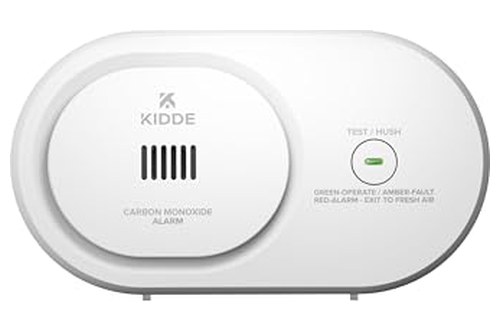
Kidde’s battery-powered COB alarm
How Loud Is a Generator, and Does a Few Decibels Matter?
That safety limit makes the sound level the next thing to read, and the makers publish it in dB(A), the decibel scale weighted for human hearing:
| Generator | Level the maker lists | Distance given |
|---|---|---|
| Honda EU2200i inverter, 2,200 W | 57 dB(A) at rated load, 48 at a quarter load | Not stated on its page |
| Champion 4500W dual fuel inverter | 64 dBA | 23 ft |
| Champion 3500W open frame | 68 dBA, which Champion compares to a vacuum cleaner | 23 ft |
| Generac Guardian 20, 22 and 24 kW standby | 67 dB(A) at normal load, 55 to 57 in its Quiet-Test mode | 23 ft (7 m), measured at the front |
Rehlko, a maker of standby and industrial generators, warns that a sound level depends heavily on how far away the microphone was, so only compare figures taken at the same distance. Honda’s page doesn’t give one, which is why its numbers shouldn’t be set directly against the others.
Rehlko describes how a maker measures an enclosed set: eight microphones spaced around it at 7 meters, 23 feet, and 1 meter high, with the readings averaged. That’s the convention behind the 23-foot figures above.
FHWA’s table explains what the gaps mean: 3 dBA is a barely perceptible change, 5 dBA a readily perceptible one and 10 dBA half as loud. The 4 dBA between Champion’s inverter and its open-frame model sits between the barely and the readily perceptible, and the 9 between Honda’s two load points is close to a halving.
For scale, the CDC list reproduced in Guardian Glass’s guide puts an air conditioner at 60 dB and a lawn mower at 80, so a generator at 68 dBA sits closer to the air conditioner.
Get Studio Tips Weekly
Join 5,000+ creators getting acoustic treatment advice every week.
No spam. Unsubscribe anytime.Does Moving the Generator Farther Away Help?
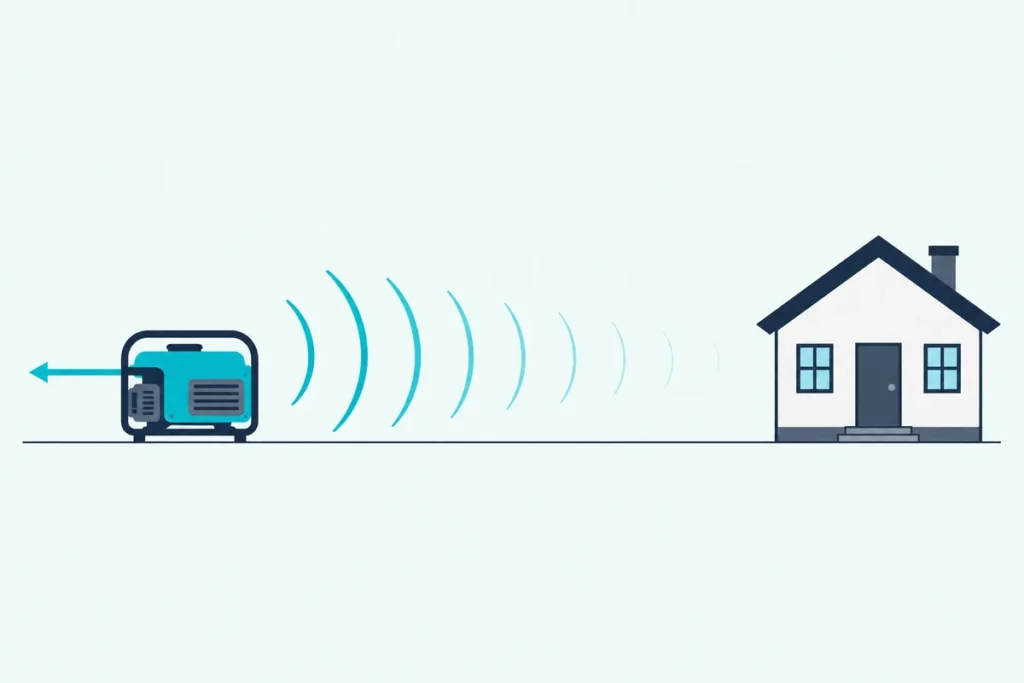
That is the free fix, and Rehlko says that in open space with no reflecting surfaces a generator’s sound level drops 6 dB each time the distance doubles. FHWA gives the same rule for any point source of sound.
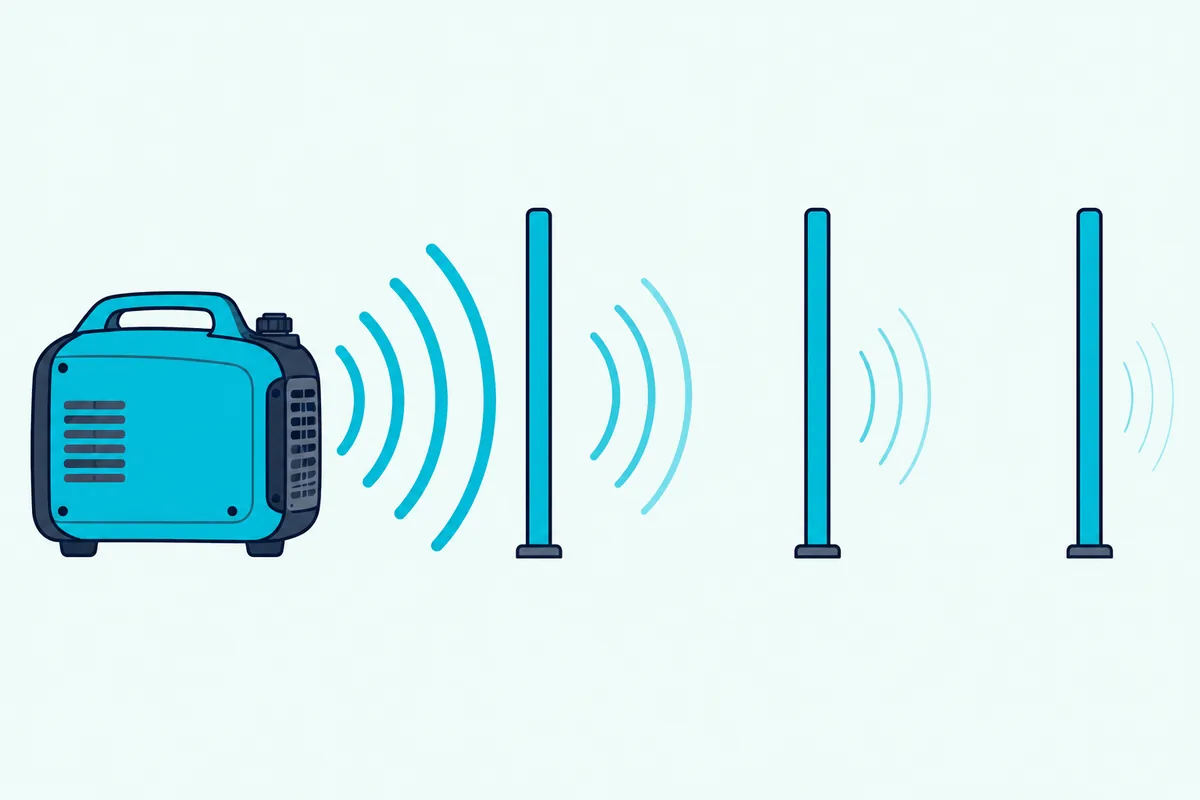
The makers’ figures are taken at 23 feet, which is close to the Commission’s 20-foot minimum, so a generator parked as close as is allowed will sound about as loud as its label at the nearest wall. This table starts from Champion’s 68 dBA and applies the 6 dB rule:
| Distance from the generator | Estimated level |
|---|---|
| 23 ft | 68 dBA (Champion’s figure) |
| 46 ft | About 62 dBA |
| 92 ft | About 56 dBA |
| 184 ft | About 50 dBA |
That’s arithmetic from a maker’s figure and the open-space rule, and it assumes nothing nearby reflects sound. Our guide to what works for noise outdoors covers the yard side of the problem.
Rehlko adds that many sites behave differently, because a building or other obstacle can reflect sound and amplify what reaches the ear, so check the real result at the spot that matters.
Direction counts too. In Rehlko’s own example the level around one enclosed set ran from 77.4 to 95.3 dB(A) depending on the side, and the engine side was the loudest, while Generac says its levels are taken from the front and the other sides may be higher.
The Commission wants the exhaust pointed away from buildings, so aim the loudest side away from your neighbor and your own bedroom windows.
Is a Quieter Generator the Best Fix?
Distance only goes so far, and the quietest option is often the machine itself. Inverter models can run the engine slower at light loads, and Champion says its inverters have an economy mode that monitors the load to reduce engine speed, noise and fuel use.
Load matters on its own. Honda lists the EU2200i at 57 dB(A) at rated load and 48 at a quarter load, a gap of 9 dB(A) that FHWA’s scale puts near a halving, so running only what you need is a real quieting step.
Honda’s page credits its Eco Throttle System with the fuel efficiency, listing 3.2 hours per tank at rated load and 8.1 at a quarter load, which fits the quieter quarter-load figure.
The model matters too. Champion lists its 4500-watt inverter at 64 dBA from 23 feet and its 3500-watt open-frame generator at 68.
Two small units are an alternative to one big one, because Honda says two EU2200i generators can be paralleled with an optional cable for up to 4,400 watts. FHWA’s rule for combining sounds adds 3 dB for two equal sources, so two at 57 dB(A) would read about 60, which is arithmetic and not a measured result, and Honda’s page doesn’t give its distance.
If you’re buying, the Honda EU2200i lists the lowest levels in the table, and its page says it has a carbon monoxide monitor that shuts the engine down.
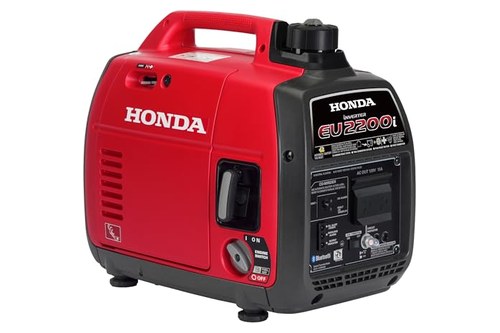
the Honda EU2200i
Can a Screen or Barrier Help?
That monitor and the 20-foot rule leave room for a barrier, and HUD’s Noise Guidebook explains the principle: a barrier works by breaking the line of sight between the source and the listener.
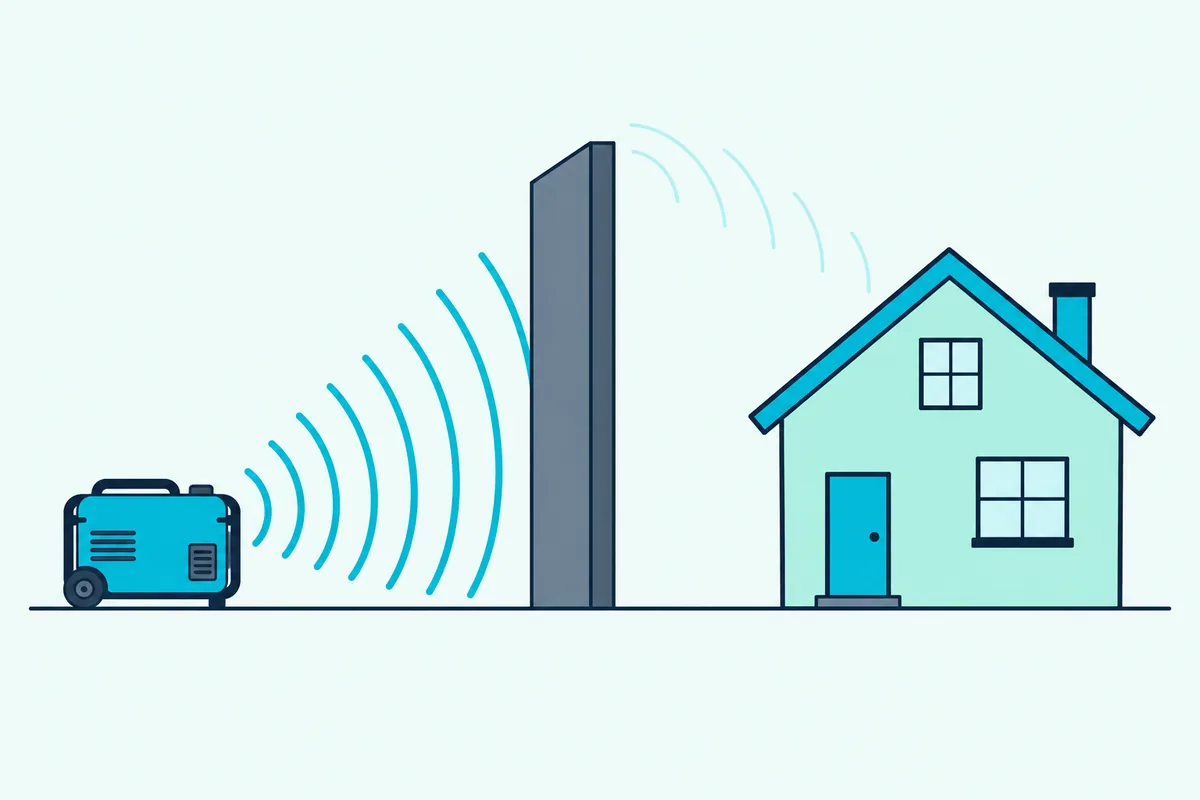
HUD says barriers are most effective for sources at or below ground level, which describes a generator, and that a barrier that isn’t high enough or long enough has its effectiveness greatly reduced. It adds that the effectiveness can fall by as much as 50 percent if the barrier isn’t long enough.
Gaps matter even more. HUD says a barrier with openings totaling 10 percent of its area can’t remove more than about 4 dB however high or thick it is, one with openings totaling 50 percent or more removes nothing, and the intended openings should be no more than 1 percent with every joint tightly sealed.
The material has to be solid too. HUD says a barrier’s transmission loss should be at least 10 dB above what the barrier gains from the sound bending over its top, and that lighter materials such as wood and metal may not be adequate when large reductions are needed.
So a screen should sit between the generator and the listener, stand taller than the unit, extend well past it and be solid and sealed. Walls, earth mounds and other buildings all count as barriers in HUD’s wording.
The same HUD rules suit a pool pump on its pad, which has no exhaust but still needs cooling air, as Burton Acoustix’s pool pump guide explains.
HUD also says a barrier gains from sitting closer to the source, and in its example, bending the top toward the source raised the reduction from 8 to 9.5 dB. Those two tricks make a screen more like a roof, so they collide with the open-air rule and are better left alone.
The one limit is the Commission’s: a screen has to leave the generator in open air. Keep it a free-standing wall on one or two sides and don’t close the top or the back, because the Commission’s warning is about exhaust that can’t escape, and that’s my reading of how to apply it.
What Can an Enclosure Really Do?
A full enclosure is the third step, and Rehlko’s paper gives the numbers makers work to. A weather-protective enclosure, usually sheet steel or aluminum, gives only limited noise reduction.
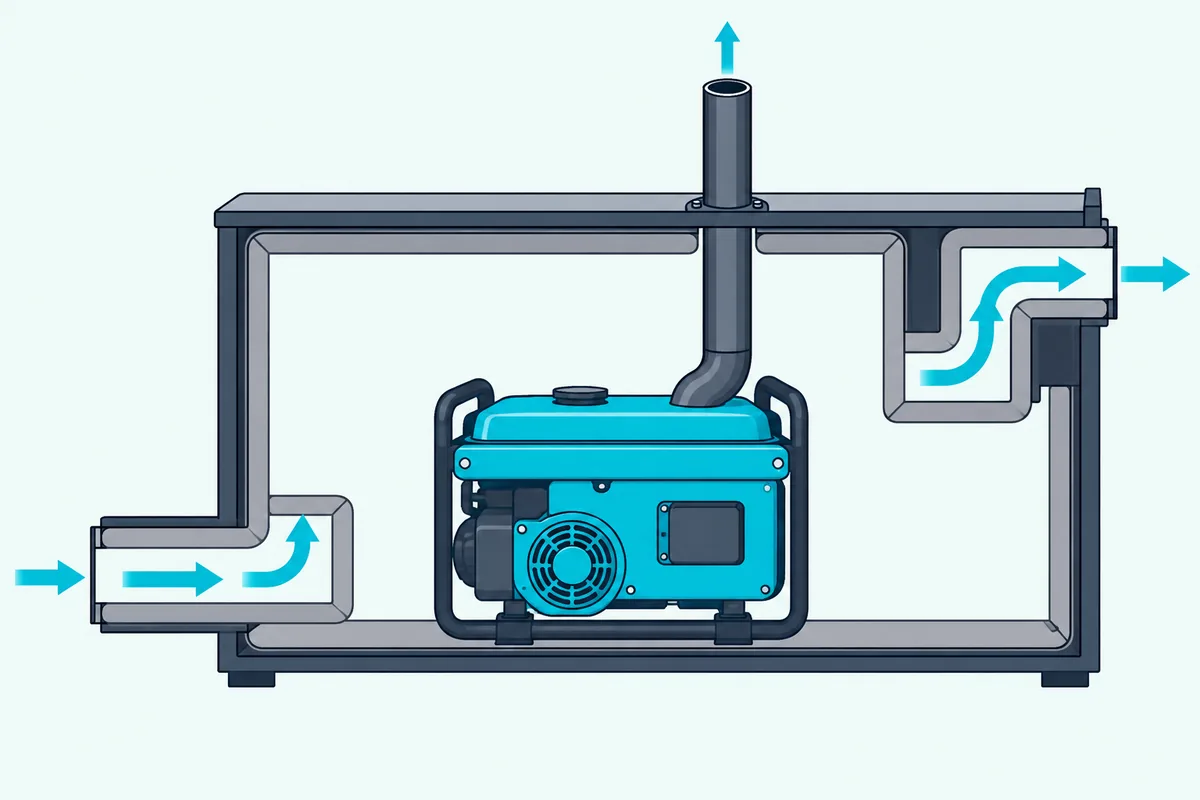
Lining the inside panels with sound-absorbing material makes a level 1 enclosure, which Rehlko says reduces noise in the order of 3 dB(A). Adding absorbing material over the louvers where air flows in and out makes a level 2 enclosure, around 10 dB(A), and custom level 3 enclosures reach at least 14 dB(A).
The limit is air. Rehlko says a generator uses air for combustion and cooling, so any redirecting has to avoid restriction or it overheats, and its level 3 design redirects the air through sound outlets lined with absorbent material instead of restricting it.
With better vibration isolation and a higher-grade silencer on top, Rehlko says a level 3 design can get quiet enough to hold a conversation next to a set at full load. That’s a factory-built enclosure for a large set, and it shows how much engineering sits behind the last few decibels.
Exhaust is the other limit. Rehlko measured 129.7 dB(A) at 1 meter from an engine’s raw exhaust at full load with no silencer, and it lists typical exhaust noise reductions of 12 to 18 dB(A) for an industrial silencer, 18 to 25 for a residential one and 25 to 35 for a critical-grade one.
For a portable generator, that means a box can’t do much more than the first two levels without a lot of ventilation engineering. Our guide to building a box for a noisy machine covers vents and materials, and its generator section repeats the carbon monoxide rule.
What About Standby and Diesel Generators?
Those numbers are why permanent units come with the work already done. Generac’s Guardian 20, 22 and 24 kW sheet lists a sound attenuated enclosure and an enclosed critical-grade muffler, 67 dB(A) at 23 feet at normal load and 55 to 57 in Quiet-Test mode, which is the low-speed exercise run.
The sheet also lists installation as close as 18 inches to a structure, as long as the unit is away from doors, windows and fresh air intakes and meets local codes. It says the sound levels are taken from the front and the other sides may be higher.
For a diesel set, ask the installer which enclosure level is fitted and for the measured level at your lot line, since Rehlko says local, state and federal ordinances often limit the noise measured there.
Do Noise Rules Apply to Your Generator?
Those lot-line limits are worth checking before you spend anything, because the rule that matters is local. Rehlko says zoning ordinances across North America limit the noise measured at a property line, and that the distance at which a level is measured has to be considered when you read an ordinance.
That means a generator that’s quiet at 23 feet can still fail at a fence 10 feet away, and the 6 dB rule shows why: halving the distance adds about 6 dB. Ask your city or county for the limit and the distance it applies at before you pick a fix.
Campgrounds have limits of their own: in National Park Service areas a generator can’t run louder than 60 dB(A) measured at 50 feet (eCFR), and our guide to quieting a tent at a campsite covers that rule from the camper’s side.
How Do You Check That a Fix Worked?
A reading beats a guess, and a phone can give you one. The CDC’s NIOSH Sound Level Meter app is free, accurate within 2 dBA, meets a Type 2 sound level meter standard when paired with a calibrated external microphone and runs only on iOS.
It’s built for workplace noise exposure, so use it to compare before and after and not to certify a result. Take each reading at the same spot, such as the neighbor’s fence, with the generator at the same load, before and after each change.
Then read the change on FHWA’s scale: under 3 dBA is barely perceptible, 5 dBA is readily perceptible and 10 dBA is half as loud. A fix that gains 2 dBA isn’t worth a weekend.
What Doesn’t Work, or Isn’t Safe?
Several popular fixes fail the safety test. A closed shed, garage or crawlspace is exactly what the Commission lists as a place never to run a generator, and fans or open doors don’t make it safe.
A tarp, tent, moving blanket or wrap of insulation tight around the unit restricts the air Rehlko says it needs for cooling and combustion, and a partly enclosed unit is exactly what the Commission’s incident reports describe. Covering the exhaust side or aiming it at a wall sends the gas toward the building the Commission wants it directed away from.
The muffler is part of the unit as well. The Commission tells owners to follow the instructions that come with the generator, so extending or swapping the exhaust is a question for the maker and not a quieting trick.
A box that’s quiet because it’s sealed is the dangerous kind, and the quiet it buys is only worth having if the exhaust and cooling air still get out.
Which Fix Should You Try First?
Those limits put the fixes in a clear order, and the table matches each to what the sources say:
| Fix | Safe? | What the sources say |
|---|---|---|
| Move it farther and aim the exhaust away | Yes | 6 dB less for each doubling of distance, 20 ft minimum |
| Run only the load you need | Yes | Honda lists 48 against 57 dB(A) at a quarter load |
| Buy an inverter model | Yes | Champion lists 64 against 68 dBA |
| Add a solid screen in the line of sight | Yes, in open air | HUD: it must break the line of sight and have no gaps |
| Wrap it in a tarp, tent or blanket | No | Rehlko: restricted air overheats the engine |
| Build an enclosure | Only outdoors with airflow | Rehlko: about 3, 10 and 14 dB(A) by level |
| Run it in a shed or garage | No | The Commission says never |
The Bottom Line
Soundproofing a generator starts with distance, the right machine and a lighter load, and a solid screen adds more in open air. An enclosure helps by about 3 to 10 dB(A) in a maker’s design, and it’s the one step that can create a carbon monoxide hazard.
Keep the unit outdoors at least 20 feet from buildings with the exhaust pointed away, keep a carbon monoxide alarm in the house and measure before and after.
Frequently Asked Questions
Can you soundproof a generator?
You can make one quieter, but not silent. Distance, a quieter model and a lighter load cost nothing in safety, and a screen helps if it breaks the line of sight.
How do you soundproof a portable generator?
Move it as far from the house as the cord allows, aim the exhaust away from buildings and run only the load you need. The Commission says to keep it outdoors at least 20 feet from homes and buildings.
How do you soundproof a generator enclosure?
Line the inside panels with sound-absorbing material for about 3 dB(A), then add absorbing material over the air louvers for around 10, according to Rehlko. Never restrict the cooling air, and never use an enclosure near a building.
How do you soundproof a diesel generator?
Diesel sets are usually quieted with sound attenuated enclosures and silencers, which Rehlko grades from industrial to hospital. Ask for the measured level at your lot line.
How far should a generator be from the house?
The Commission says at least 20 feet from homes and buildings, outdoors only, with the exhaust directed away from windows, doors and vents. Farther is quieter, at about 6 dB less for each doubling of distance in open space.
What is the quietest way to run a generator?
Run an inverter model at a light load, far from buildings, with the exhaust aimed away. Honda lists its EU2200i at 48 dB(A) at a quarter load.
Is an inverter generator really quieter?
Champion lists its 4500-watt inverter at 64 dBA from 23 feet and its 3500-watt open-frame model at 68. That 4 dBA gap is noticeable on FHWA’s scale, and the inverter’s economy mode lowers engine speed at light loads.
Can you put a generator in a shed?
No. The Commission lists sheds, garages and crawlspaces among the places never to run one, even with doors and windows open.