How to Soundproof an Air Compressor Without Overheating It
If you’re looking up how to soundproof an air compressor, the first idea is usually a sealed box, and that’s the fix the makers’ own manuals push back on.
DeWalt’s manual for its DWFP55126 pancake compressor says not to run it indoors or in any confined area, and California Air Tools’ manuals ask for 2 feet of clear space around and above the machine.
Work with that airflow instead of against it and you can still take a real bite out of the noise.
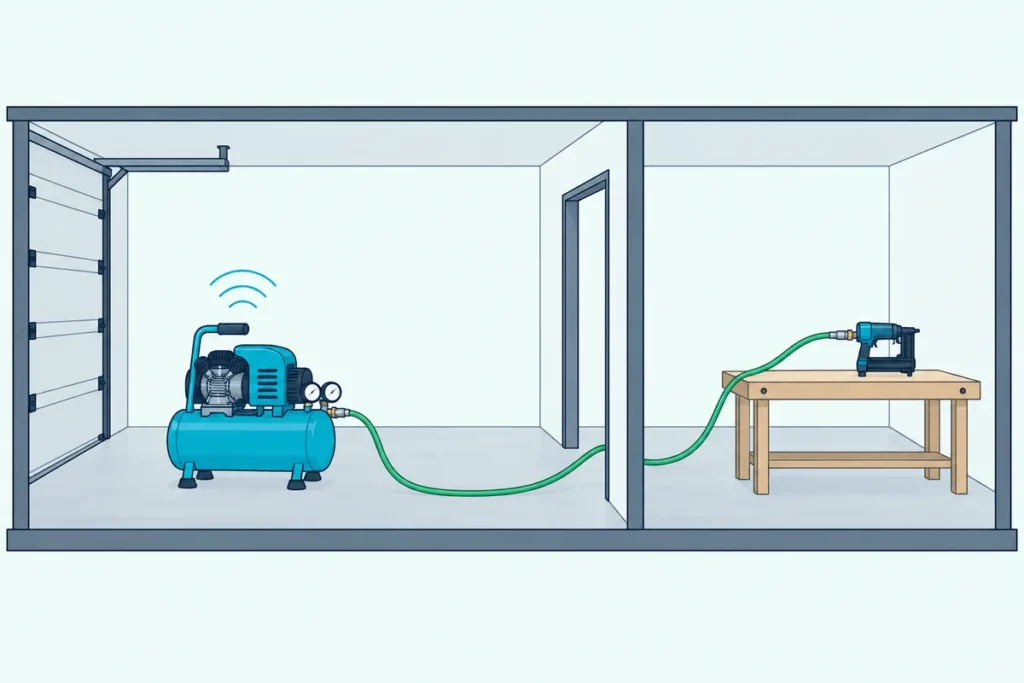
The first move costs nothing: put the compressor farther away and run more hose, which Makita and DeWalt both recommend over an extension cord anyway.
The steps below run from free to most involved, with the clearance, temperature and duty-cycle numbers that decide whether a box is safe for your model.
How to Soundproof an Air Compressor in Seven Steps
Those manual limits shape the whole plan, so the steps follow the order the makers and the noise-control agencies would have you try them. To soundproof an air compressor, move it away from where you work or sleep, decouple it from the floor, fix worn parts, then add a barrier or a ventilated, lined enclosure only if its manual allows one.
| Step | What to do | Why it helps |
|---|---|---|
| 1 | Read the manual’s location rules | Makita and DeWalt want 12 inches of open air; DeWalt rules out confined areas |
| 2 | Move it away and add hose | In open space, sound drops about 6 dB per doubling of distance (OSHA) |
| 3 | Pull it out of the corner | Atlas Copco’s formula makes a corner the loudest spot |
| 4 | Put rubber under it | Vibration passing into floors and pipes adds noise (Atlas Copco) |
| 5 | Fix worn parts | Maintenance alone cut one compressor’s noise by 6 dB (HSE) |
| 6 | Put a solid barrier in the way | OSHA puts the practical limit at 15 to 20 dB |
| 7 | Enclose it with lined, fan-driven ventilation | 20 to 40 dB at best, but heat buildup is a known problem (OSHA) |
Steps 1 to 5 cost little or nothing; steps 6 and 7 are building projects, and step 7 is the one most manuals limit.
How Loud Is an Air Compressor, and Why Don’t the Numbers Match?
Those seven steps need a starting point, and the makers’ own figures show why it’s slippery. DeWalt rates its DWFP55126 pancake compressor at 78.8 dBA, tested to ISO 3744, while California Air Tools lists its 10020HDCADC at 70 dB and the same compressor in its steel sound proof cabinet at 58 dB.
None of those pages says how far from the machine the reading was taken. Atlas Copco’s sound primer explains why that matters: the level you hear depends on your distance and on the room, so a sound pressure figure should always come with the distance it was measured at.
Atlas Copco’s guide to quieter compressors gives typical noise levels by type, again without a distance: 80 to 85 dB for piston compressors, 60 to 70 for oil-free models and 45 to 60 for scroll compressors. Use air compressor noise figures like these to compare one machine before and after a fix, not one brand against another.
The FHWA’s noise primer gives the scale for that comparison: a 3 dB change is barely perceptible, 5 dB is readily perceptible and 10 dB sounds half as loud. By that rule, the 12 dB between California Air Tools’ two listings would sound a little more than half as loud, if both were measured the same way.
Get Studio Tips Weekly
Join 5,000+ creators getting acoustic treatment advice every week.
No spam. Unsubscribe anytime.What Do Compressor Manuals Say About Boxing One In?
That cabinet is a factory design with fans built in, unlike a homemade box over a compressor never meant to be enclosed. The manuals all ask for open air: Makita’s MAC210Q manual wants the compressor at least 12 inches from walls or other obstructions, DeWalt wants an open area at least 12 inches from any wall, and California Air Tools wants 2 feet of obstacle-free space around and above it.
DeWalt’s manual goes furthest, warning that restricting the ventilation openings will cause serious overheating and could cause a fire. It also says never to place objects against or on top of the pump, and Eagle’s Silent Series manual adds that rags or other materials on top of the compressor obstruct cooling and can be a fire hazard.
Heat is the reason, and Makita puts a number on it: its MAC210Q is rated to run between 32°F and 104°F. Any box you build has to keep the air around the compressor under that ceiling, which is the same airflow-first rule behind the pool pump version of this problem.
Duty cycle tells you how much heat arrives and how often. DeWalt says its pancake compressor shouldn’t run more than 5 minutes in any 10, Makita calls running more than 50% of an hour misuse, and California Air Tools quotes a 70/30 duty cycle with no more than 60 minutes of continuous running.
The intake side matters too, because the compressor breathes the air around it. California Air Tools says its compressors shouldn’t run where dust or particulates are in the air, and Makita says the air filter must be kept clear of obstructions.
So read your own manual’s location section first. If it rules out confined areas, as DeWalt’s does, skip the box and use the other six steps.
Is Moving the Compressor the Cheapest Fix?
Since the manuals want open air anyway, distance is the first fix that doesn’t fight them. It usually is the cheapest: OSHA’s technical manual says a source measuring 90 dB at 1 meter in open space measures 84 at 2 meters and 78 at 4 meters.
Indoors the drop is smaller, because sound reflects off hard walls; OSHA says it falls by less than 6 dB per doubling in a room. Atlas Copco adds that far from a machine the reflected sound dominates, so another few feet in the same garage buys little; a wall or closed door between you and the machine, in a spot its manual still allows, does more.
That garage only protects the house if it keeps the noise in, and our guide on how to soundproof a garage covers its walls and door.
If the compressor shares the garage with a table saw and a dust collector, Burton Acoustix’s garage workshop guide ranks those machines and shows how to seal the door into the house.
Makita says to use extra air hose instead of an extension cord, to avoid voltage drop, power loss and an overheating motor. DeWalt says the same and suggests attaching another length of hose to the end of the one you have.
For a fixed run through a wall, Makita says to use metal pipe only, because plastic or PVC pipe can burst under air pressure whatever its rating.
Spraying adds a safety rule: Makita and DeWalt both say to keep the compressor at least 20 feet from the spray area when you spray flammable materials.
For that extra reach, the Flexzilla Pro air hose adds 50 feet of 3/8-inch hose with reusable aluminum fittings, according to its listing. Check its fittings against your couplers first.
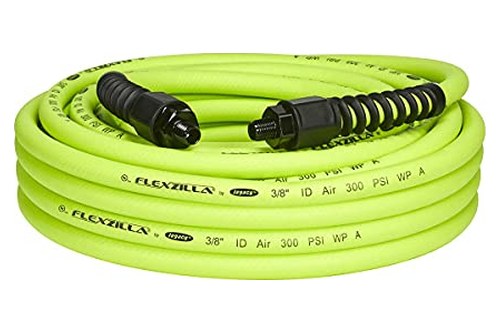
the Flexzilla Pro air hose
Why Does a Compressor Sound Louder in a Corner?
Distance isn’t the only thing that matters about where the compressor sits. Hard surfaces next to it add reflected sound, and Atlas Copco’s sound primer puts numbers on that with a direction factor: 1 for a source hanging in the middle of a large room, 2 near the center of one hard surface, 4 where two meet and 8 in a corner where three meet.
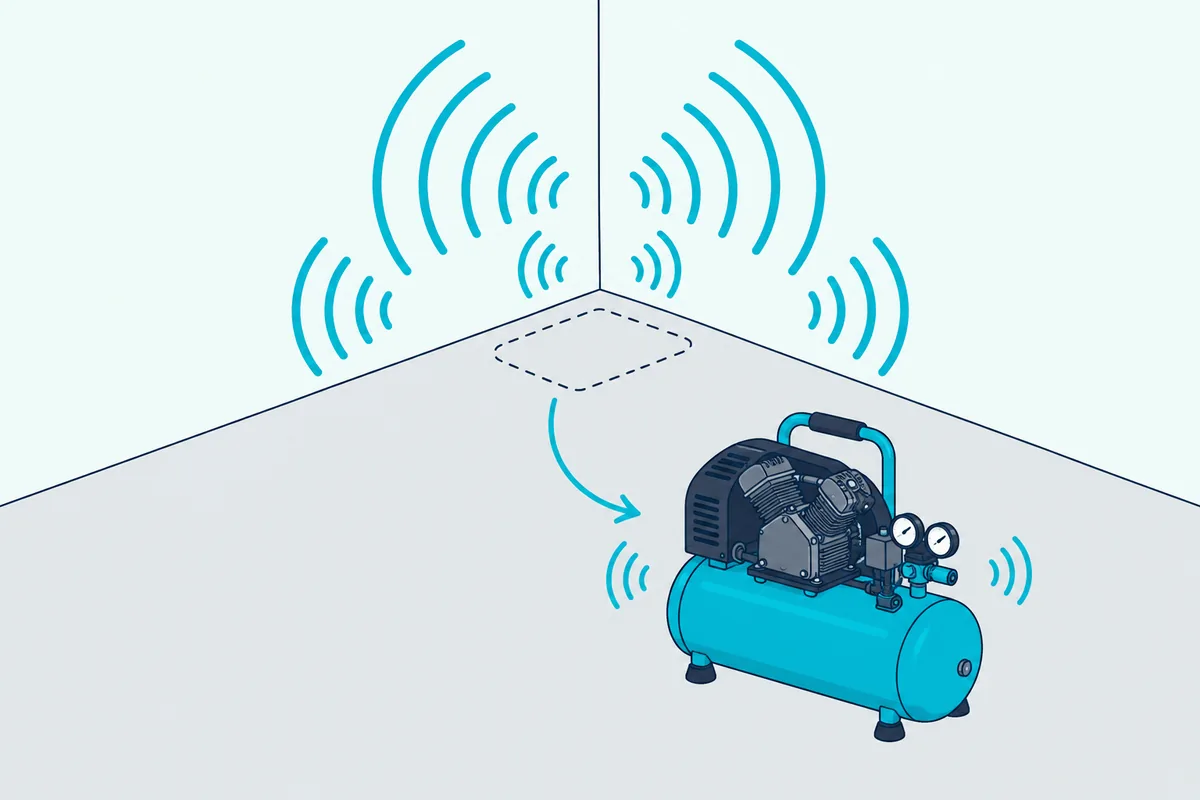
A compressor on a garage floor already has the floor as its first surface, so a wall behind it makes 4 and a corner makes 8. Close to the machine, where its direct sound dominates, moving it from open floor into a corner adds about 6 dB by our arithmetic on Atlas Copco’s formula, more than the FHWA’s “readily perceptible” 5 dB from earlier.
That’s a reason to use the manuals’ clearances generously. Try it: run the compressor in the corner, then 3 feet out from both walls, and listen from where you actually work.
Do Anti-Vibration Pads Help an Air Compressor?
Once the compressor sits in a better spot, the next path is through whatever it stands on. Pads help when the noise is vibration passing into a floor, bench or shelf, and Atlas Copco names the transfer of vibration from a machine down to the floor, or into an enclosure around it, as a common problem, listing rubber and cork among the materials used to stop it.
OSHA describes isolators as metal springs, elastomeric mounts and resilient pads that decouple a machine from what it sits on, and it lists compressor mounts among their common uses. It also warns that a badly chosen or badly installed isolator can make a noise and vibration problem worse.
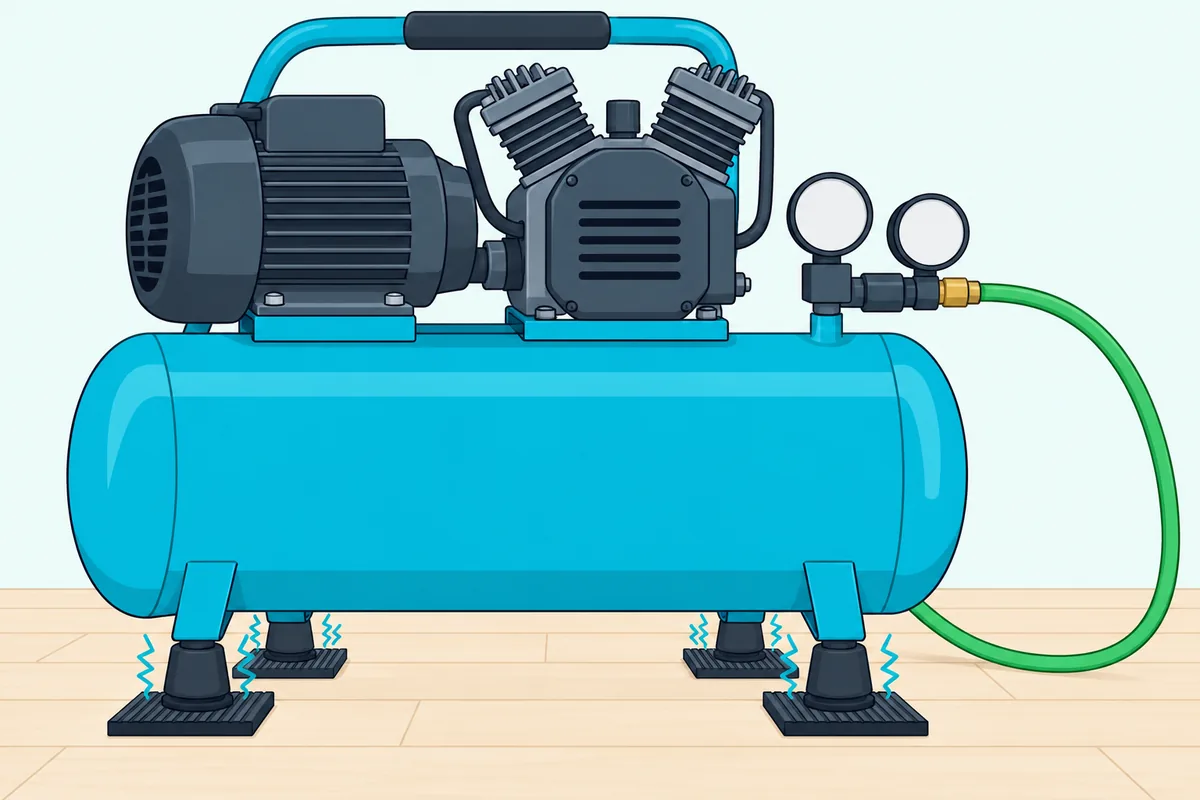
Compressors like Makita’s MAC210Q already stand on rubber feet, and its manual says to set it on a flat surface so it rests securely on them.
Pipes and hoses carry vibration too. Atlas Copco says sound radiating from compressed-air pipes is frequently a bigger problem than the compressor itself, and advises fitting vibration insulators on the pipework, so keep a flexible hose between the compressor and any hard piping.
To decouple the feet, this 4-pack of UPE Group rubber pads gives each foot a ribbed rubber pad 4 inches square and 3/8 inch thick, rated by the listing for up to 50 pounds per square inch. Eagle lists its 1-gallon EA-3000 at 40 pounds, which comes to well under 1 pound per square inch on four pads by our arithmetic.
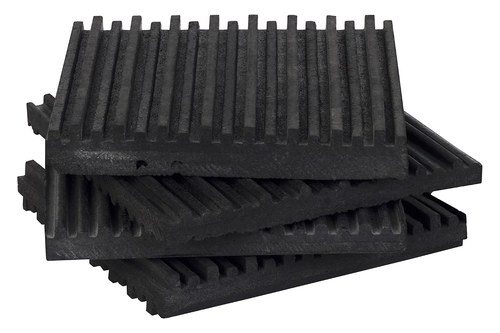
this 4-pack of UPE Group rubber pads
Can Maintenance Make a Compressor Quieter?
Pads stop noise that leaves through the floor, but worn parts make more noise in the first place. Yes, and by a measurable amount: in an HSE case study, a reciprocating compressor that measured 94 dB at 1 meter had its average reverberant noise level cut by 6 dB, to 87 dB, after its rough valves were polished and an additive went into its oil.
OSHA says regular maintenance should keep a machine within 2 dBA of its lowest potential operating noise, so loose or unlubricated parts don’t add to it.
For a home compressor, that starts with the intake filter. Makita says never to run its compressor with the filter removed and notes it won’t deliver full capacity with a dirty one, while Quincy suggests clearing inlet filters every 12 months or less, depending on conditions.
DeWalt says to stop the compressor immediately and have a trained service technician check it if you notice unusual noise or vibration. A new rattle is a repair job, not a soundproofing one.
Do Air Compressor Silencers Work?
That intake filter is also the opening the compressor breathes through, and on big piston machines it’s loud. Intake silencers can work: in another HSE case study, a combined reactive and absorptive silencer cut the noise 1 meter from a large reciprocating compressor’s intake from 88 to 71 dB(A), a drop of 17, with the biggest cuts at the lowest frequencies.
Those were industrial compressors turning at 370 rpm, with 200-millimeter intake pipes and silencer casings 3 meters long. The result doesn’t transfer to a pancake compressor’s small filter.
None of the four home-compressor manuals we read (California Air Tools, DeWalt, Makita and Eagle) mentions an intake silencer, so ask your compressor’s maker before replacing its filter, and never run it with the filter off.
Will a Wall or Barrier Block Compressor Noise?
If the compressor has to stay put and still breathe, the next option is to put something solid in the sound’s path instead of around the machine. A barrier helps most when it blocks the straight line from the compressor to you: OSHA puts the practical limit at 15 to 20 dB, and WorkSafe Victoria suggests barriers and screens where about 5 to 7 dB is enough.
OSHA’s design rules: put the barrier as close as practical to the compressor or the listener, make it at least twice as wide as it is tall on each side of the source, build it as tall as practical and leave no gaps.
The catch is the room. OSHA says a barrier does little if the listener sits in the reverberant field, and WorkSafe says barriers lose effect in reflective spaces with concrete floors or walls, which describes a bare garage.
WorkSafe’s answer is to line reflective walls and ceilings with sound-absorbing material and seal gaps at floor level. That absorption won’t stop sound traveling straight from the compressor to you, OSHA notes, so it helps the barrier rather than replacing it.
How Do You Build a Soundproof Box for an Air Compressor?
A barrier shields one direction, so the last step is a full enclosure, and it’s only for compressors whose manuals don’t rule it out. Build the box big enough to keep the manual’s clearance inside, line it, seal it everywhere except two lined air paths, and push air through it with a fan so the inside stays under the compressor’s maximum operating temperature.
Done well, it’s the most powerful step: OSHA says solid enclosures without acoustic leaks can provide 20 to 40 dB, and WorkSafe says a relatively airtight, lined enclosure can cut plant noise by as much as 30 to 40 dB. The same sources name the catch, since OSHA lists heat buildup as a problem and WorkSafe says partial enclosures generally manage about 10 dB.
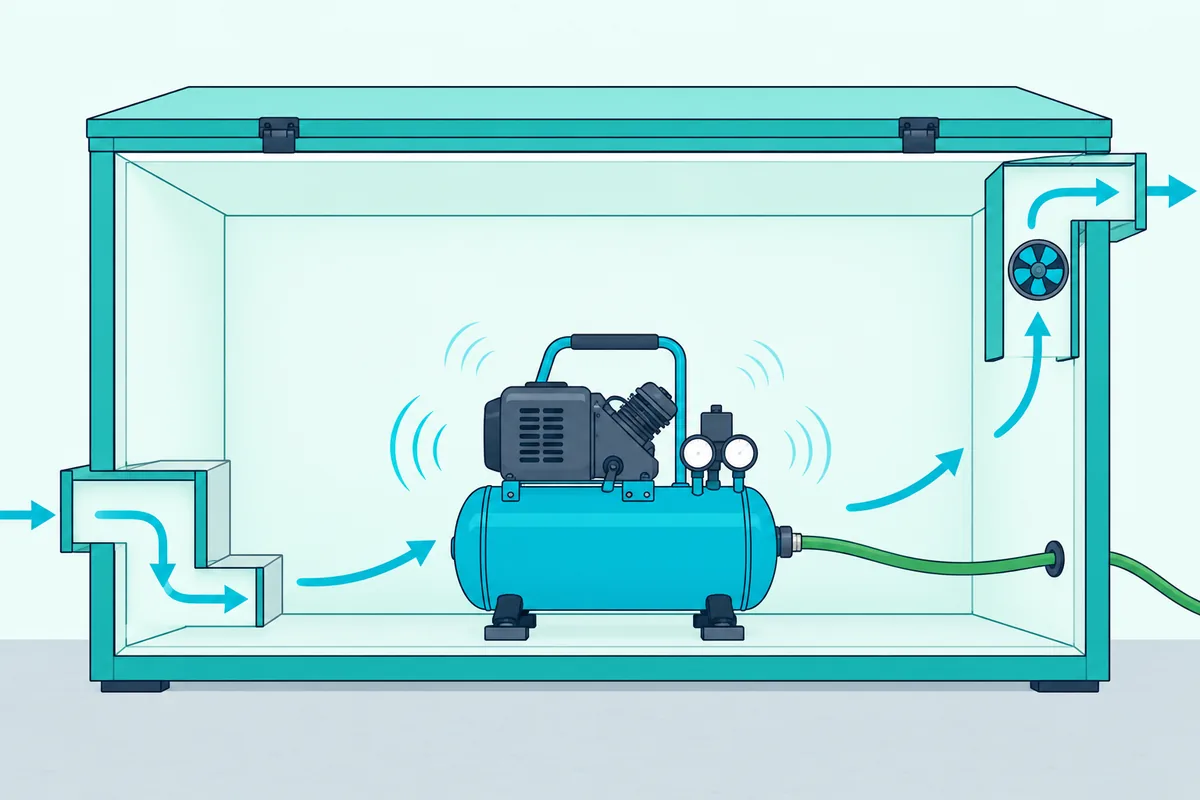
Openings cap the result, which is why the vents need care. WorkSafe says that without absorption, a 10% gap or opening limits an enclosure to about 9 dB, and a 5% gap to about 19 dB.
For the air paths, WorkSafe’s rule is an absorbent lining at least 3 times as long as the duct’s widest dimension, preferably up to 6 times, for 15 to 30 dB of reduction. It also says to line at least half of the inside with 50 millimeters (about 2 inches) of dense absorbent and to build the box as large as you can, because noise builds up in close-fitting enclosures.
Size comes out large anyway. Keeping Makita’s 12 inches on each side, a compressor 18 inches wide needs a box about 42 inches wide inside, and California Air Tools’ 2 feet makes that 66 inches.
Keep the compressor from touching the box, with resilient mounts under it and flexible sections where hoses and cables pass through, as WorkSafe’s design shows. An HSE case study of large ammonia compressors used the same recipe, a frame clear of the machines plus fans and lined ducts, and reduced noise by at least 24 dB.
Run the fan whenever the compressor runs, then check the air inside with a thermometer during your longest job against your manual’s limit, such as Makita’s 104°F.
Wall materials and lining choices are compared in Burton Acoustix’s soundproof box numbers. A machine with exhaust gases has extra rules, covered in the guide to a soundproof box for a generator.
Is a Quieter Compressor the Better Fix?
That much building raises a fair question about the machine itself. Often it is: Atlas Copco says the first step toward a quieter compressor room is choosing a quieter model, and WorkSafe’s hierarchy of control puts swapping noisy plant for quieter plant on the same rung as enclosures, above hearing protection.
Two makers here chase quiet with slower motors: California Air Tools says its 2.0 HP motor runs at 1,680 rpm, creating less noise and less wear, and Eagle credits the low-rpm motor in its Silent Series with less heat and less noise.
Compare published figures only when they state the measuring distance, which none of the compressor makers’ pages we read does. That’s why this guide doesn’t recommend a quiet compressor by its decibel number.
Can You Check Whether a Fix Worked?
Whichever of those steps you take, a before-and-after check keeps the effort honest. Yes: use the same sound level meter or phone app at the same spot, the same distance and the same point in the compressor’s cycle each time.
Atlas Copco’s point about distance applies here, because moving the meter changes the number. Measure where the noise matters, at the workbench, the bedroom or the property line, and judge the change on the FHWA’s scale, where a 3-decibel change is barely perceptible and a 10-decibel one sounds half as loud.
The Bottom Line
The quietest air compressor setup is the one the manual still approves: farther away, out of the corner, on rubber, well maintained and behind a solid wall. A full box can add the most, 20 to 40 dB in OSHA’s figures, but only with lined, fan-driven ventilation and only if your manual allows an enclosure at all.
Frequently Asked Questions
Can you put an air compressor in a cabinet?
Only if its manual allows an enclosure. DeWalt’s manual for the DWFP55126 says not to run it indoors or in any confined area, while Makita and California Air Tools set clearances of 12 inches and 2 feet that a cabinet has to keep inside. California Air Tools’ own 10020HDSPCADC cabinet has acoustic foam lining and two exhaust fans, and a homemade one needs the same: room around the machine, lined air paths and a fan that runs whenever the compressor does.
How much quieter does a soundproof box make an air compressor?
OSHA says solid enclosures without acoustic leaks can provide 20 to 40 dB of noise reduction, and WorkSafe Victoria gives 30 to 40 dB for a relatively airtight, lined enclosure. A box with open vents does worse: WorkSafe says a 10% opening without absorption limits an enclosure to about 9 dB, which is why the air paths need lined ducts. California Air Tools lists one compressor at 70 dB alone and 58 dB in its cabinet, without saying how far away either reading was taken.
Is it safe to run an air compressor in a closet?
Not unless the manual allows it and the closet is ventilated. DeWalt’s manual for its pancake compressor rules out indoor and confined areas and warns that restricting the ventilation openings can cause serious overheating and a fire. Makita wants 12 inches of clearance and air no hotter than 104°F, so a closet needs fan-driven, lined ventilation, and a thermometer check during your longest job, before you operate a compressor in it.
Do sound blankets work on an air compressor?
They work as a barrier, not as a cover. Hung as a screen between you and the compressor, a blanket blocks some of the direct sound, and WorkSafe Victoria suggests barriers and screens where about 5 to 7 dB is enough. Draped over the compressor, it covers the ventilation openings that DeWalt says must not be restricted. Keep the blanket clear of the machine and leave the airflow alone.
Can you put a muffler on an air compressor?
Large industrial compressors do get intake silencers, and in an HSE case study one cut the noise at the intake by 17 dB, but that machine’s silencer casing was 3 meters long. None of the California Air Tools, DeWalt, Makita or Eagle manuals we read mentions a silencer, and Makita says never to run its compressor without its air filter, so ask your compressor’s maker before fitting anything to the intake.