How to Soundproof a Window AC Unit and Make It Quieter
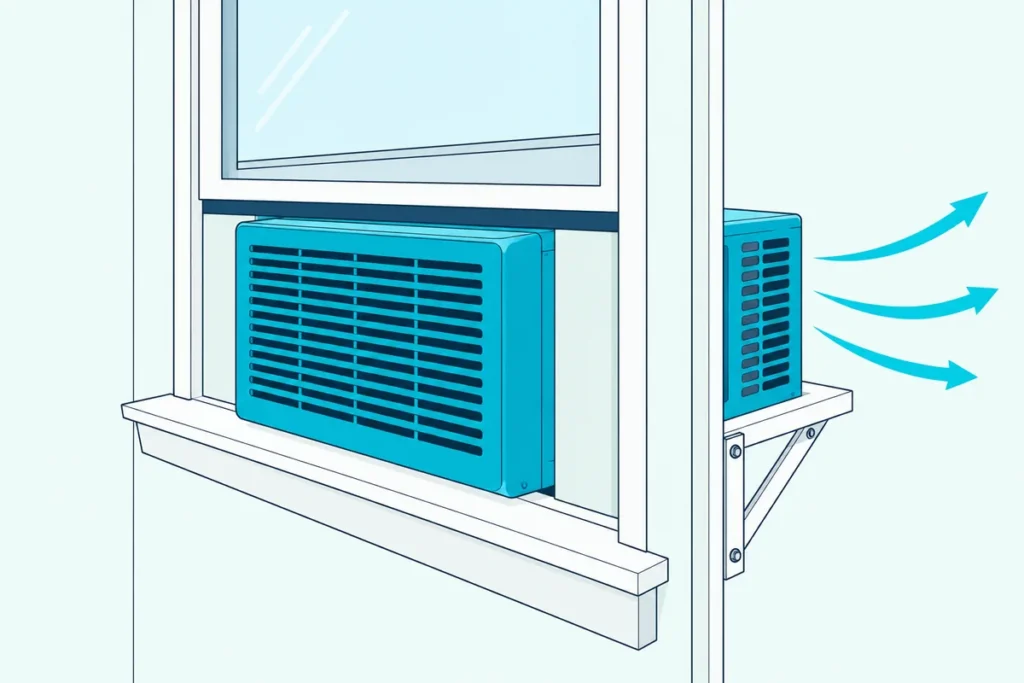
If you’re working out how to soundproof a window AC unit, start with how it sits in the window, not with a blanket that blocks the air it needs.
The drone comes from the compressor and fan inside the box, from a cabinet that shakes the window, and from gaps that let street noise in.
Fix the fit, seal the gaps and pick the quiet settings, and you cut the noise the install adds without putting the unit at risk.
The steps here come from Frigidaire’s, GE’s, LG’s and Midea’s manuals, ENERGY STAR and the National Bureau of Standards’ 1976 noise handbook.
The order of fixes comes first, then the normal sounds, what never to cover, and when a different kind of air conditioner is the honest answer.
How to Soundproof a Window AC Unit: Which Step Comes First?
That order matters, because each fix leans on the one before it. Tilt and support the cabinet the way its manual says, seal every gap around it, cushion the points where it touches the window, keep the filter clean and run the low fan at night.
| Step | What to do | Why, per the source |
|---|---|---|
| 1 | Tilt and support the cabinet | LG: a secure, firm install prevents vibration and noise |
| 2 | Seal the side panels, sashes and gaps | HUD: a 1/16-inch crack 16 inches long takes STC 50 to 40 |
| 3 | Put rubber at the contact points | NBS: a soft rubber gasket and resilient pads |
| 4 | Clean the filter on schedule | NBS: a clogged filter can whistle |
| 5 | Run Cool on the low fan at night | GE and LG: their quieter nighttime setting |
| 6 | Replace an old unit | ENERGY STAR: U-shaped units usually put the compressor outside |
Leave the blanket out of it, because every manual here says to keep the vents clear. If your unit stands on the floor with a hose to the window, it’s a portable, and making a portable air conditioner quieter is a different job.
Where Does a Window Air Conditioner’s Noise Come From?
Those six steps line up with three sources of sound. The compressor and fan make the steady drone, the cabinet passes their vibration into the window, and outside noise gets in around and through the unit.
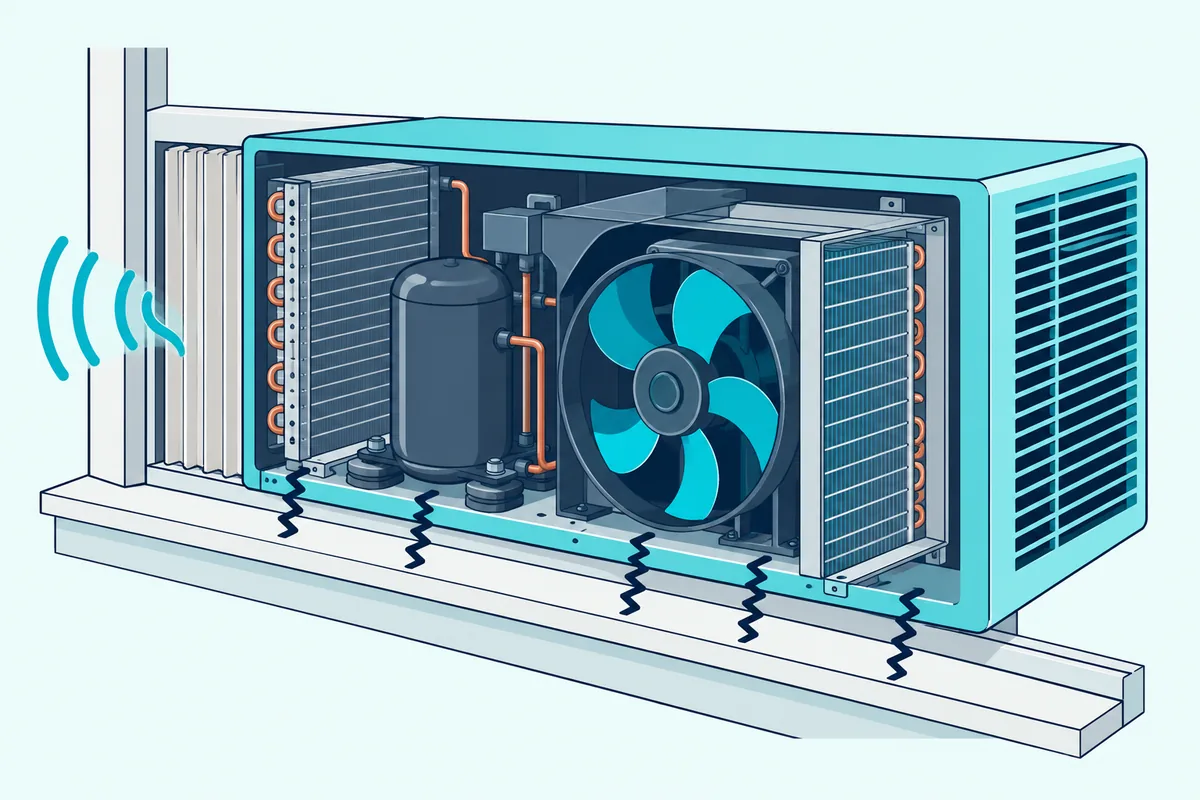
The National Bureau of Standards’ handbook says a window unit hanging in mid air would still be noisy, but mounted the usual way it gets louder, because it sets the window and wall vibrating (NBS). It adds that a window unit’s intake and exhaust openings act as noise leaks for outside sound.
Small gaps count, too. HUD’s Noise Guidebook says a 1/16-inch crack 16 inches long can drop a wall rated STC 50 to STC 40.
Get Studio Tips Weekly
Join 5,000+ creators getting acoustic treatment advice every week.
No spam. Unsubscribe anytime.Which Window AC Noises Are Normal?
Not every sound from the box needs fixing, though. Midea’s manual lists rushing air from the fan, gurgling or hissing from refrigerant, a high-pitched chatter from high-efficiency compressors, a trickle of water droplets hitting the condenser, and vibration from poor wall or window construction or incorrect installation.
GE adds a ping on rainy or humid days, when water is thrown against the condenser to help cool it, and says removing the subbase water plug reduces it at some cost in efficiency. It also says never to drill a hole in the base pan, LG says not to take the unit apart, and Midea says to disconnect the power if strange sounds, smells or smoke come from it.
Is It Safe to Soundproof a Window AC Unit?
That vibration line is the part soundproofing can reach, but only around the unit. Yes, it’s safe as long as nothing covers the grilles, the coils or the louvers on the sides of the cabinet.
LG wants no fence or wall within 20 inches of the cabinet’s back, because that stops the condenser shedding heat, and all side louvers open to the outside. Frigidaire says side louvers must never be blocked, and Midea says not to cover or obstruct the inlet or outlet grilles, which rules out a sound blanket on a running unit.
Vents follow the same rule, as Burton Acoustix’s vent soundproofing guide explains for openings that have to stay open.
Kitchen appliances follow it as well, and Burton Acoustix’s dishwasher quieting guide keeps a dishwasher’s drying vent and door springs clear.
How Should a Window AC Be Tilted and Supported?
With those vents and louvers clear, the install itself is the first real fix. Set the unit with a slight tilt down toward the outside, then make sure something solid carries its weight.
LG says a secure, firm install prevents vibration and noise, and puts the tilt at about 1/2 inch. Frigidaire’s sheet for its 15,000 to 28,500 BTU units asks for 7/8 to 1 1/4 inches, about 2 to 4 degrees, set with the support bracket that ships with them (Frigidaire).
Here’s a quick check from that sheet: once installed, condensate shouldn’t run from the overflow drain hole in normal use, and if it does, the slope needs correcting. GE and LG also say every supporting part must be fixed to firm wood, masonry or metal.
If your unit came without a bracket, the Ivation no-drill bracket carries the cabinet from outside the window. Frigidaire and Midea both call for two people to lift and set a unit.
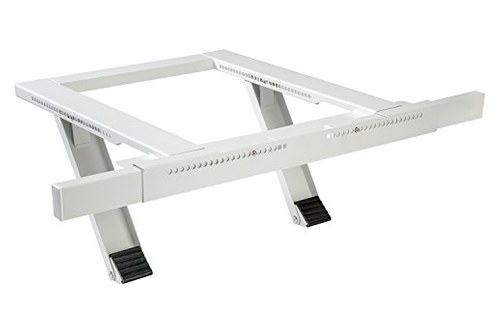
the Ivation no-drill bracket
How Do You Seal the Gaps Around a Window AC Unit?
Once the cabinet sits still, the next leak is the air around it. Use every seal in the box first, then close what’s left with weatherstripping.
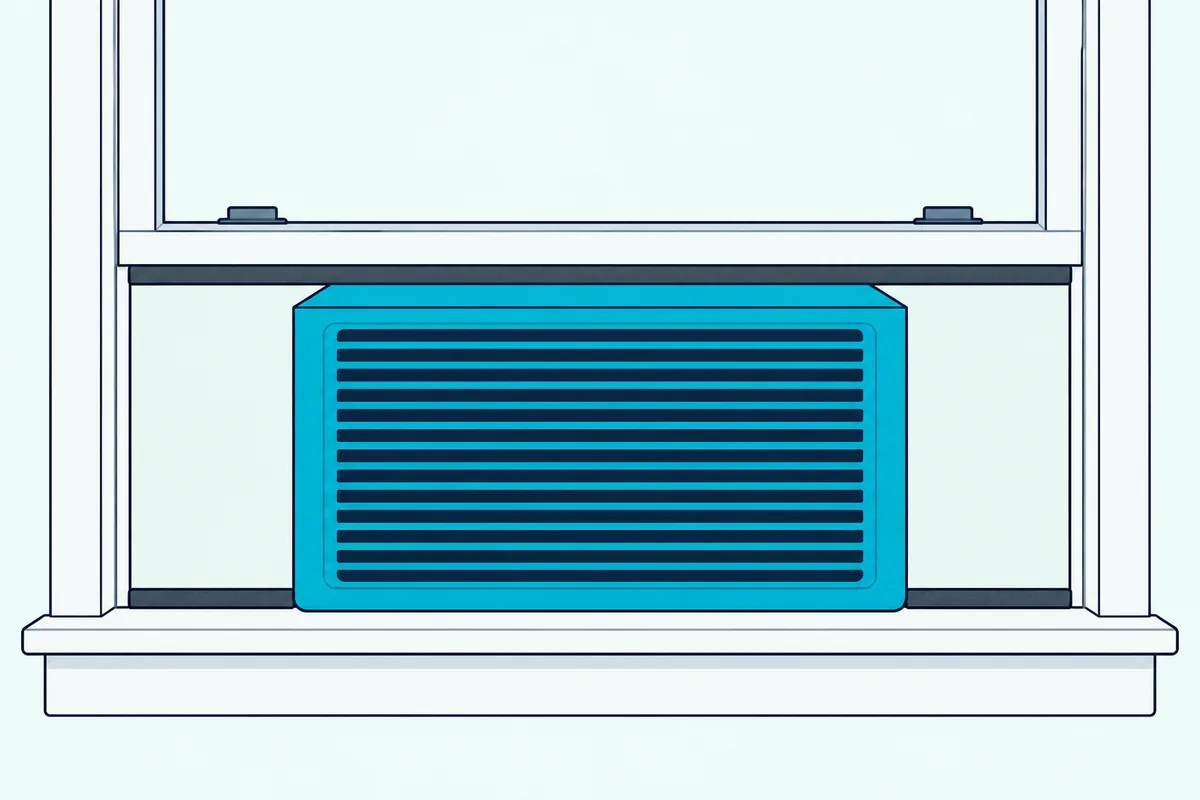
ENERGY STAR says an improperly installed room unit leaks as much air as a 6-square-inch hole, and tells you to use the insulation materials it came with (ENERGY STAR). In Frigidaire’s kit, that means panels that insulate the side curtains, a foam seal on the bottom rail and a sash seal pushed into the space between the upper and lower sashes.
GE has you stuff its foam gasket between the glass and the window, or buy suitable material locally if it doesn’t fit. Windmill, which makes window units, suggests running your fingers around the edges on a breezy day and marking each draft with tape.
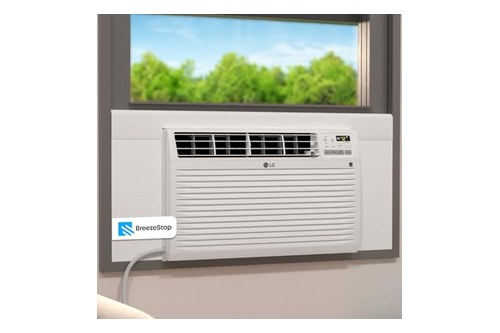
Frigidaire’s answer to any gap you find is trimmed weatherstripping, and Kikerike’s foam weatherstrip is that kind of strip. If drafts come through the accordion side panels themselves, Breeze Stop’s surround panels cover them from the room side.
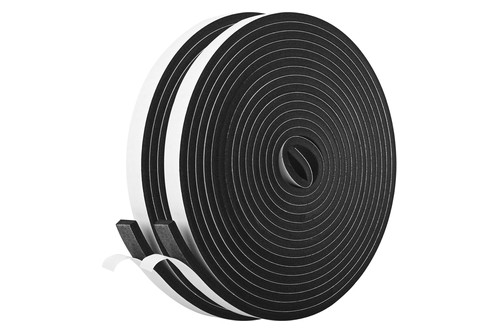
Kikerike’s foam weatherstrip
If the rest of the window leaks too, soundproofing the rest of the window covers inserts, seals and glass.
Do Vibration Pads Make a Window AC Quieter?
Seals stop the air, but they don’t stop the shaking NBS described. They can help: NBS’s entry for room and window units lists mounting on resilient pads and a soft rubber gasket to isolate the unit from the wall or window.
Keep the pads thin and check the tilt with a level afterward, since the manuals set that slope for drainage. These neoprene pads are thin enough, and our suggestion is to cut strips for where the cabinet rests on the bracket or the outer sill.
These neoprene pads
Does Cleaning a Window AC Make It Quieter?
Pads deal with the cabinet, and upkeep deals with what’s inside it. Yes, when the noise is a whistle: NBS says a clogged filter can let condensate freeze on the tubing and restrict the airflow further, which may whistle.
LG says to clean the filter at least every two weeks and GE at least every 30 days, and both say not to run the unit without one. GE adds that the outdoor coils should be checked regularly and, if clogged with dirt or soot, may be professionally cleaned.
Which Settings Make a Window AC Quietest?
Once it’s clean, the controls do the rest. Run Cool with the low fan and a middle temperature at night: GE calls that its quieter, nighttime setting, and LG’s dial units call it Low Cool.
NBS adds that starting and stopping can be more troublesome than steady running, so avoid a thermostat setting that cycles the compressor often. GE’s Eco setting cycles the fan with the compressor while Eco off keeps the fan running, so try both and keep the one you notice less.
When Is a Different Air Conditioner the Real Fix?
If all that still leaves a drone, the design is the limit. Replace the unit when it’s old or the compressor itself is the noise, and look at designs that put the compressor outside.
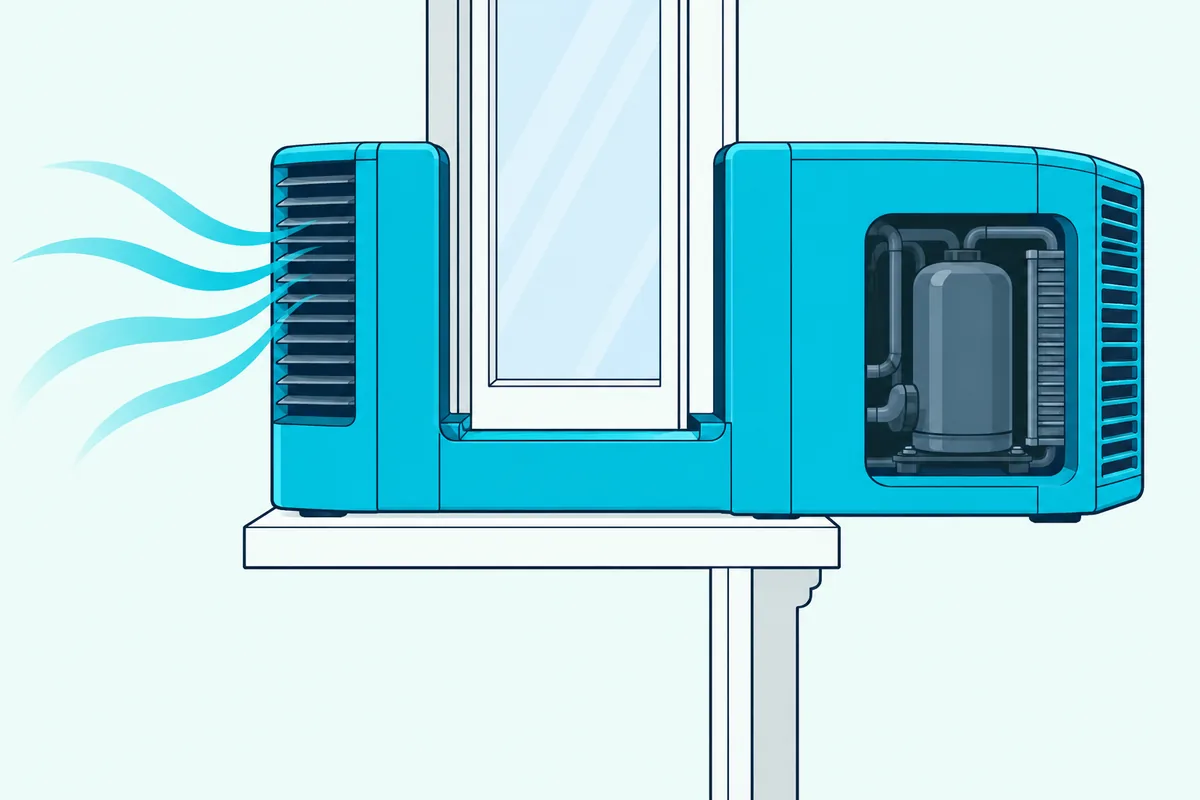
NBS called window and wall units relatively noisy, especially models five or more years old. ENERGY STAR says variable-speed models change the compressor’s speed instead of switching it fully on and off, which lets them cool quietly.
U-shaped and saddle units straddle the sill so the window closes between their halves, with the noise-producing compressor usually outside the room, and ENERGY STAR says they provide greater noise reduction. A ductless mini split pairs a head on the wall with a unit outside, and ENERGY STAR calls it a replacement for window units with quiet cooling (ENERGY STAR).
ENERGY STAR says to work with a professional installer, and LG’s split-system manual warns against placing the outdoor unit where its noise could disturb the neighbors. If street noise is the bigger problem, keeping street noise out of the room starts with its weakest opening.
The Bottom Line
So most of what you can change about a window AC’s noise is the install: the tilt, the support, the seals and the rubber at the contact points. Keep the vents clear, clean the filter, run the low fan at night, and if the drone stays, a U-shaped unit or a mini split puts the noisy part outside.
Frequently Asked Questions
What is the 3 minute rule for air conditioners?
It’s the wait before the compressor starts again. Midea’s window units delay a restart by 3 minutes if switched off and on quickly, to keep the compressor from overheating, and LG says to wait at least 3 minutes before switching back to cooling.
How do you stop outside noise coming through a window AC?
Seal around it first: the sash seal, the side panels and weatherstripping in any leftover gap. If your unit has a vent lever, keep it closed, which LG says gives maximum cooling; given NBS’s point about a unit’s openings, we’d expect that to shut one more path for outside sound. A U-shaped unit, with the window closed between its halves, is the bigger step.
Should you take a window AC out for winter?
ENERGY STAR says to remove it at the end of the cooling season if you can, to cut heat loss, or else use an appropriately sized cover. Midea’s manuals call the original carton the best way to store the unit.