Can Insulation Be Used for Soundproofing? Yes, With a Catch
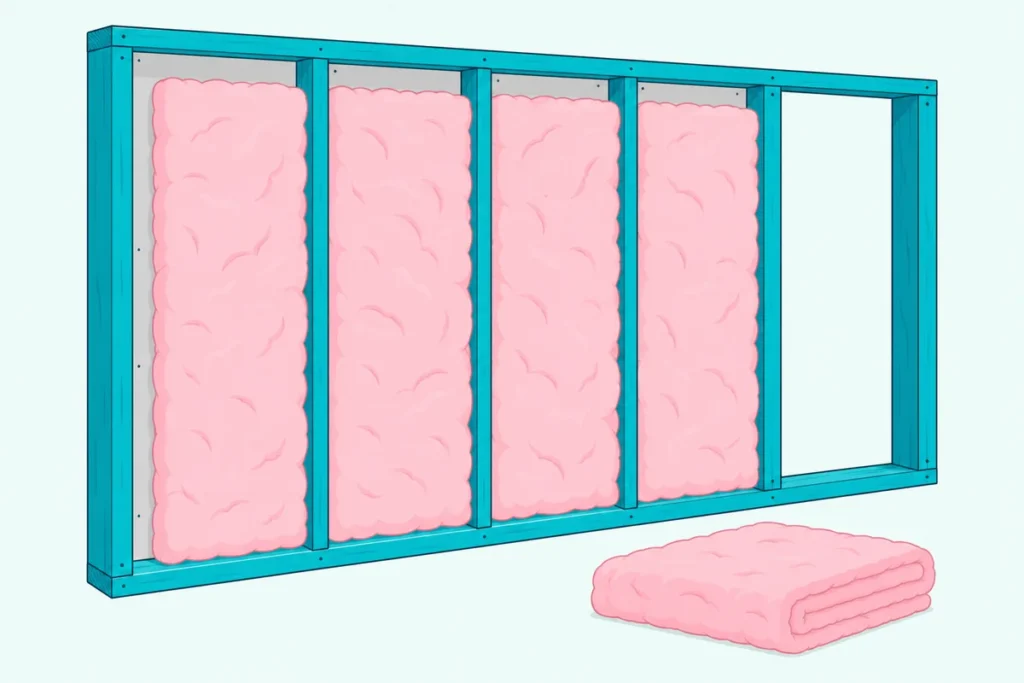
Can insulation be used for soundproofing? Yes, but in an ordinary stud wall it adds only about 3 STC points, close to the smallest change NRC Canada’s researchers say people can easily hear.
So if you filled a bedroom wall with batts and still hear the TV next door, the studs are carrying the sound past the insulation.
Put the same batts in a wall whose two faces don’t share studs, and NRC Canada’s lab tests credit them with 8 to 10 points instead.
Every figure below names its source, from NRC Canada’s lab reports to the makers’ own test listings and HUD’s guidebook.
Next comes why the same batt does little in one wall and a lot in another, then the bass, footsteps and leaks it can’t fix alone.
Can Insulation Be Used for Soundproofing a Wall?
That catch comes down to framing. Insulation can be used for soundproofing a wall, and NRC Canada’s Building Digest 239 puts the gain at about 3 STC points when the drywall on both faces is attached directly to the same studs, and about 8 when the faces are decoupled (NRC Canada).
Decoupled means each face has its own support: staggered studs, two rows of studs or resilient channels. The digest’s typical house partition rates about STC 33, and NBS Handbook 119 puts most interior walls in homes between 30 and 35.
Owens Corning, a fiberglass maker, says insulation performs a sound absorption job in the stud cavity but adds no significant mass compared with the drywall and studs (Owens Corning). The batt works on the air inside the wall, while the drywall does the blocking.
Why Do Batts Add So Little to an Ordinary Wall?
Those 3 points are small because of the studs. CBD 239 explains that when drywall is attached directly to both sides of the studs, sound crosses from one face to the other through them, so the insulation does much less.
The 1985 digest calls rigid connections the acoustical equivalent of an electrical short circuit, and NRC’s 1997 Construction Technology Update No. 1 goes further: absorbing material in a rigidly connected wall is “a waste of money.”
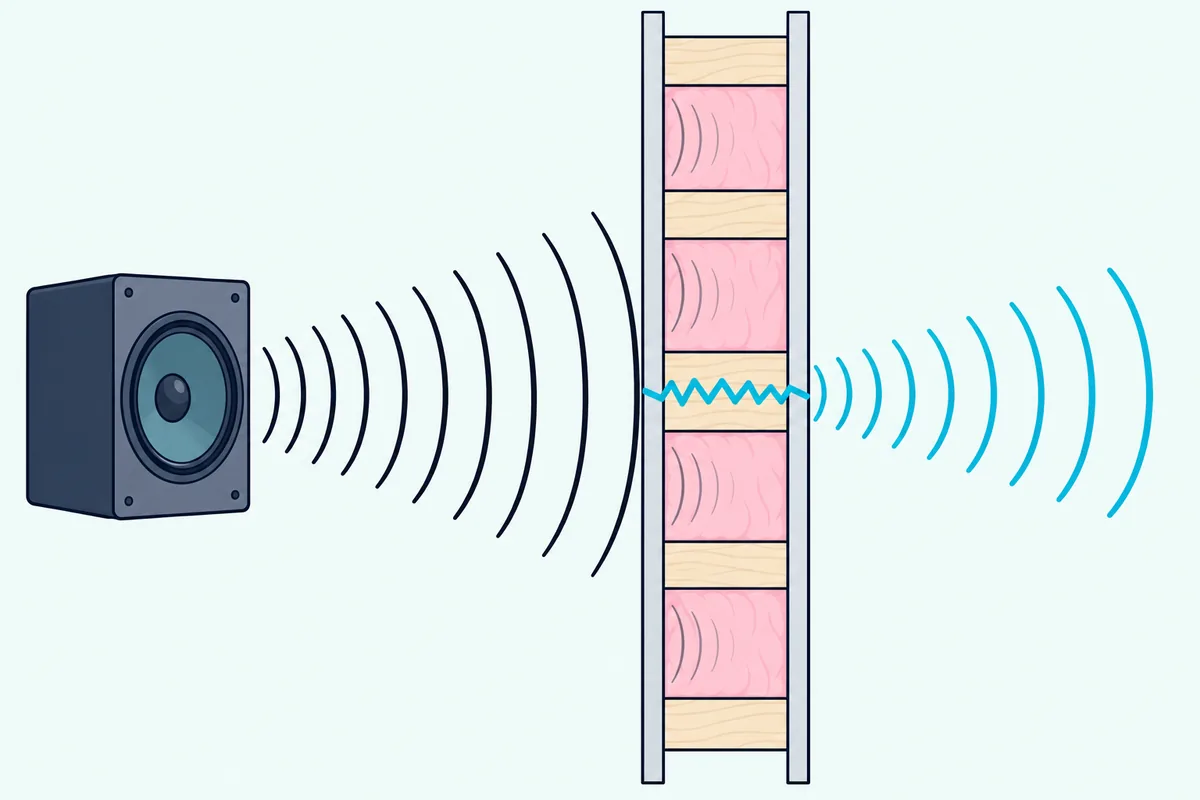
Think of each stud as a bridge between the rooms: packing the river below with sponges does nothing for the traffic on top.
To see which kind you have, measure the wall at a door frame. About 4-1/2 inches means one row of 2×4 studs (3-1/2 inches deep) with drywall on each side, while a double-stud wall on separate plates is roughly twice that.
If yours is ordinary and finished, Burton Acoustix’s guide to soundproofing a wall covers fixes that don’t rely on the cavity, from sealing gaps to channels and extra drywall.
Get Studio Tips Weekly
Join 5,000+ creators getting acoustic treatment advice every week.
No spam. Unsubscribe anytime.How Much Does Insulation Add in Lab Tests?
That split between rigid and decoupled walls shows up in lab pairs where the insulation is the only change. Filling the cavity added 4 to 6 STC points where both faces share the studs, and 4 to 10 where the faces are separated, most of them 8 or more.
| Wall tested | Empty | Insulated | Gain | Source |
|---|---|---|---|---|
| 2×4 studs, 1/2-inch Type X each side | 35 | 39 | +4 | Owens Corning W2169, W2069 |
| 2×4 studs, 5/8-inch Type X each side | 32 | 36 | +4 | Canada’s code tables (Owens Corning guide) |
| 2×4 studs at 16 inches, damped board one side | 36 | 40 | +4 | National Gypsum NGC 2012049, 2012050 |
| The same with studs at 24 inches | 39 | 45 | +6 | National Gypsum NGC 2012067, 2012066 |
| Staggered studs | 39 | 43 | +4 | HUD Noise Guidebook, Figure 16 |
| 2×4 studs, resilient channels one side | 40 | 48 | +8 | NRC Building Digest 239 |
| Staggered 2×4 studs | 41 | 50 | +9 | NRC Building Digest 239 |
| Double 2×4 studs, 5/8-inch Type X each side | 45 | 55 | +10 | NRC TL-93-261, TL-93-265 |
National Gypsum’s wall carried its damped retrofit board on one side and 3-1/2 inches of glass fiber when filled (National Gypsum). In the double-stud wall, a second batt added just 1 point more, to 56 (TL-93-266), so one full row does most of the work.
On NBS Handbook 119’s privacy scale, 10 points is the difference between STC 35, where loud speech is fairly understandable, and 45, where it’s barely audible.
Does It Matter Which Insulation You Use?
Most of those gains came from fiberglass, but the type of insulation matters far less than the framing. NRC’s gypsum wall study, using glass, rock and cellulose fiber, rated the type of absorber a relatively minor effect.
Owens Corning goes further: on average, glass fiber batts rate as well as or better than mineral wool batts of the same thickness that are about 265% denser. Warnock and Quirt, who measured about 400 walls in one NRC lab, found denser absorbers helped at higher frequencies but not at the low ones that decide STC.
For how these insulation materials compare by location, see which insulation is best for soundproofing.
Acoustic foam on a wall’s face is another job entirely. NBS Handbook 119 warns against putting light, porous absorbers on a room’s surface just to stop sound reaching the next room, and our page on how foam panels differ from cavity insulation explains the split.
Is Regular Thermal Insulation Good Enough?
That makes the everyday batt a fair choice. CBD 239 says the glass fiber or mineral wool normally used for thermal purposes absorbs sound well and is quite adequate inside a double-layer wall.
ROCKWOOL’s product guide says Safe’n’Sound, unlike thermal insulation, is for soundproofing, yet its catalog rates a 2×4 wall with 1/2-inch gypsum at STC 40 with its thermal Comfortbatt and 38 with 3-inch Safe’n’Sound (ROCKWOOL). Different labs and thicknesses make that a tie, not a win for the thermal batt.
Extra thickness adds little past about 75 millimeters (about 3 inches), says CBD 239, and ROCKWOOL rates one 2×6 wall at 48 with 3 inches of Safe’n’Sound and 48 with 5-1/2 inches of AFB. Filling the cavity edge to edge matters more, since Owens Corning reports a half-filled cavity about 5 dB worse than a full one, while NRC found that overfilling with dense, rigid material can carry sound through the insulation itself.
Why Won’t Insulation Stop Bass?
Those STC numbers also hide the bass problem. NBS Handbook 119 explains that STC comes from sixteen bands between 125 and 4,000 Hz, and that a passing truck’s low sounds get through a wall much more readily than chirping birds do.
NRC’s Warnock made the same point about apartments: low frequencies pass through walls much more easily, which is why bass guitar and drums from next door usually stand out.
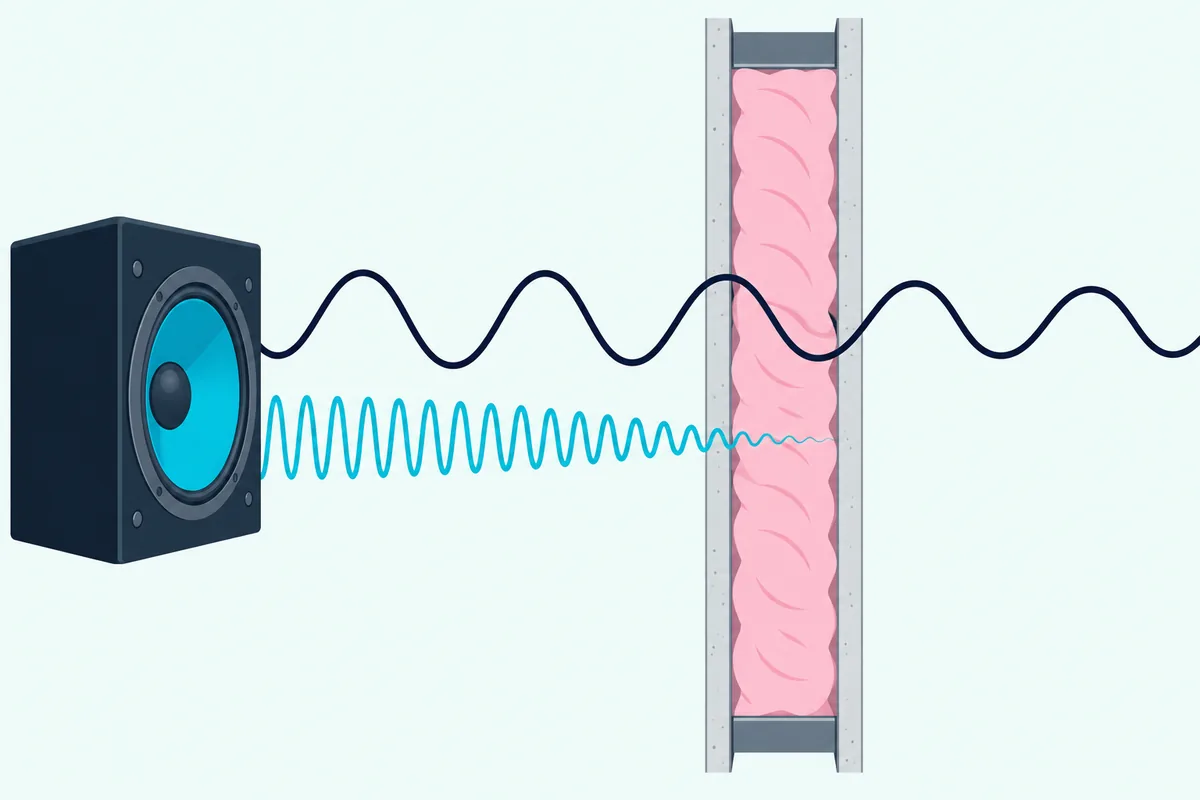
Insulation helps a little: Warnock found glass fiber made a 50-millimeter cavity respond as if it were about 40% larger, moving the wall’s resonance lower. CBD 239 says partitions should put that mass-air-mass resonance below 80 Hz, which takes weight and depth, and Owens Corning credits each doubling of a wall’s weight with 5 to 6 dB.
Will Insulation Soundproof a Whole Room?
Even a well-filled wall controls only one path, so insulation alone won’t soundproof a room. The ASTM E90 lab test is set up so the only significant path runs through the wall sample, and the standard calls its ratings an upper limit to what a field test in a building would measure.
NRC put a number on the other paths: with the subfloor running unbroken under a double-stud party wall, upgrading to two layers of drywall per face and batts in both rows raised the apparent rating only from FSTC 50 to 52, because sound kept traveling under the wall through the subfloor. A gap cut in the subfloor under the wall gave the study’s best case, FSTC 66.
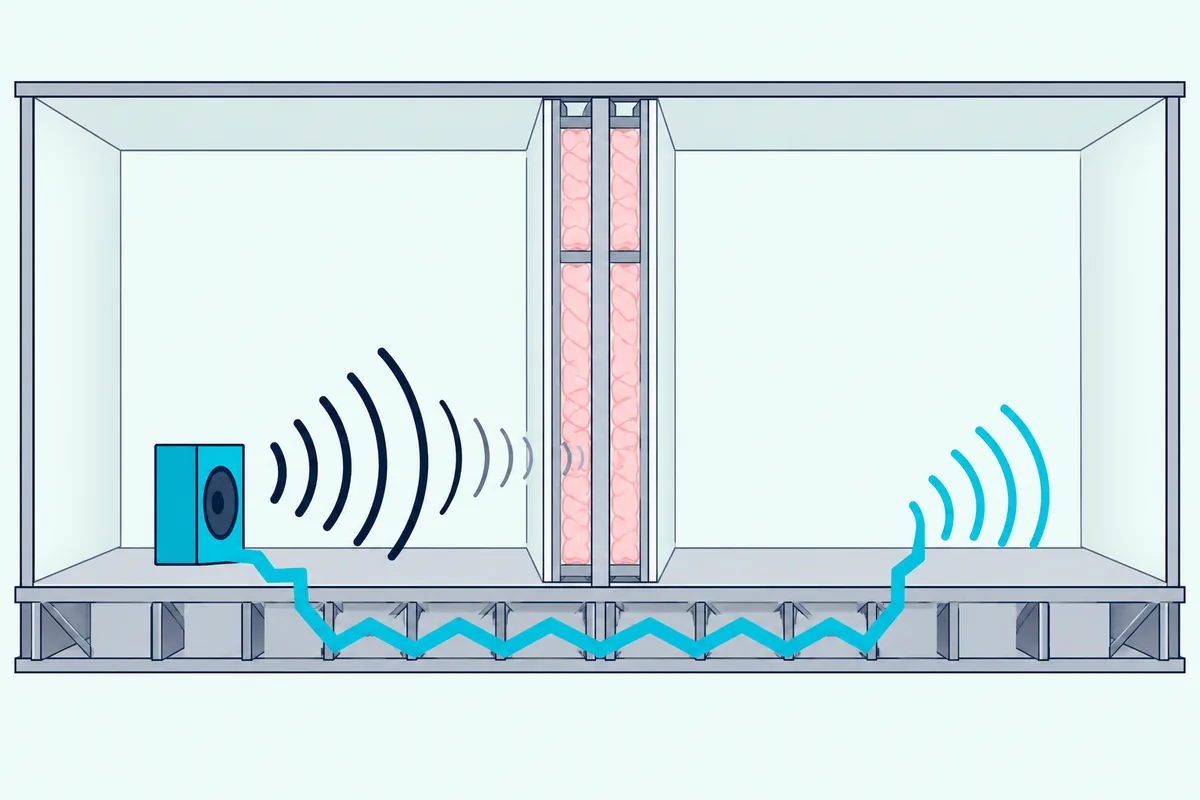
Leaks are the other bypass: HUD says a 1/16-inch crack 16 inches long will reduce an STC 50 wall to 40 (HUD). A quiet room needs its floor, ceiling, door and air paths treated too, which our guide to constructing a soundproof room covers.
Does Insulation Help With Footsteps From Upstairs?
Floors follow the same rule, for airborne sound and footsteps alike. In NRC Canada’s study of about 190 joist floors, absorbing material didn’t significantly help floors without resilient channels, which always rated below STC 50, but added about 8 points with them; impact ratings followed suit, and denser rock fiber gave small but definite gains over glass fiber.
National Gypsum’s SoundBook, which describes the IIC rating as covering impact sounds such as foot traffic, shows the payoff: a truss floor over a suspended drywall ceiling went from STC 52 and IIC 51 empty to 60 and 60 with 3-1/2 inches of glass fiber.
When Is Soundproof Insulation Worth It?
All of that adds up to a simple rule: insulate any wall or ceiling that’s open, and expect the most noise reduction when you also separate the faces. An ordinary 2×4 wall gained about 3 to 4 points from insulation alone, against 8 to 10 in NRC’s decoupled walls.
Opening a bedroom wall shared with a living room? Fill every bay, install resilient channels on one side and seal the edges, and the table puts you in the high 40s rather than the high 30s.
No mineral wool batt listing on Amazon met this guide’s buying standard on 17 October 2026, so none is linked here.
The Bottom Line
Insulation belongs in any open wall or ceiling, but on its own it buys about 3 points in an ordinary interior stud wall.
Pair it with separated faces, more drywall and sealed edges, and the same batts were worth 8 to 10 points in NRC Canada’s tests.
Frequently Asked Questions
What kind of insulation is best for soundproofing?
Fiberglass or mineral wool batts that fill the cavity completely, since their wall ratings differ little: Owens Corning reports glass fiber batts rating as well as or better than denser mineral wool batts of the same thickness. The framing matters more, at about 3 points where the faces share studs against 8 to 10 where they’re separated.
Does insulation in interior walls reduce noise between rooms?
A little, unless the wall lets it work. Most interior walls rate STC 30 to 35 in NBS Handbook 119, and CBD 239 credits insulation with about 3 points when both faces are attached to the same studs, so the bigger gains come from separating the faces and sealing every gap.
Can you add insulation to an existing wall for soundproofing?
Yes, by blowing loose fill such as cellulose into the closed bays, but expect a small gain, because both faces still sit on the same studs. NRC also found that walls with blown or sprayed cellulose varied more than walls with other insulation, which it put down to installation.