How to Soundproof a Dishwasher and Make It Quieter
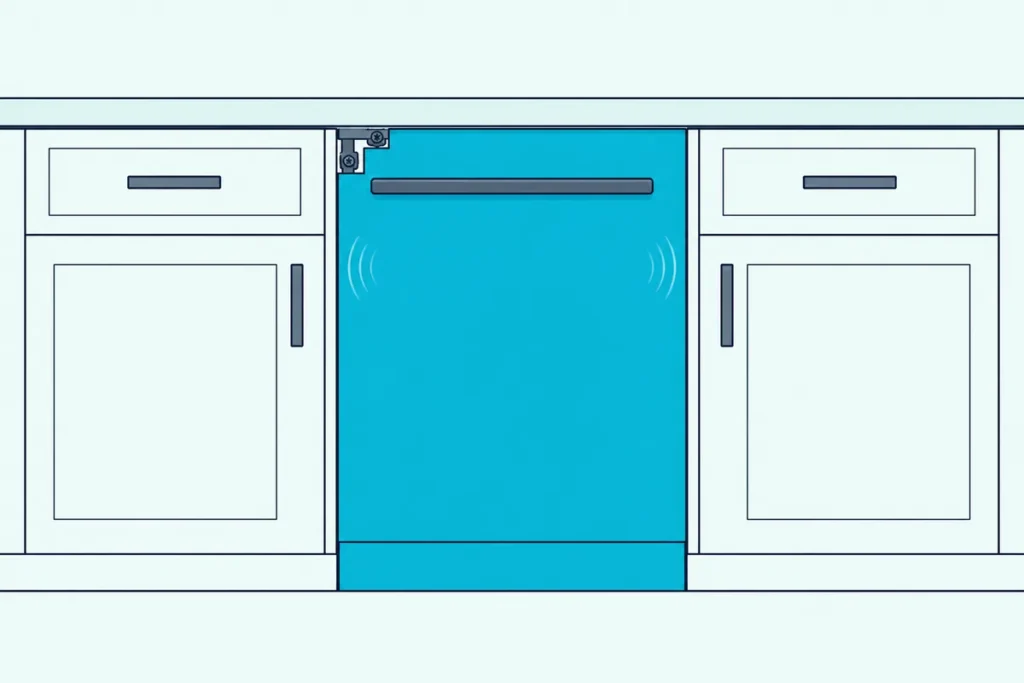
If you’re working out how to soundproof a dishwasher, start with the installation guide, because the sound parts its maker builds in only work when they’re fitted the way that guide shows.
You hear the pump hum through the cabinets, water drumming on the door and a rattle you can’t place, usually just when the kitchen should be quiet.
Fix the install first and the machine runs closer to the quiet its maker designed in, without risking the warranty or covering anything it needs to breathe.
This guide follows GE, Bosch and Samsung manuals through leveling, securing the unit, the sound blanket, the toe kick insulation, loading and what decibel ratings mean.
Start with the eight steps below, then use the sections after them to find the step your dishwasher skipped.
How to Soundproof a Dishwasher in Eight Steps
Those eight steps follow the order of an install, so each one builds on the step before it: a blanket can’t quiet a cabinet that rocks. Work down the list and stop when the noise does.
| Step | What to do | Whose guide says so |
|---|---|---|
| 1. Rule out a fault | Compare the sound with the maker’s list of normal noises | GE, Samsung |
| 2. Keep it breathing | Leave the vent, hot air outlet and door springs clear | GE, Samsung |
| 3. Level it | Level left to right and front to back, every leg on the floor | GE, Bosch, Samsung |
| 4. Secure it | Screw the brackets to the countertop or side cabinets | GE, Bosch |
| 5. Check the blanket | Smooth around the tub, off the door springs | GE |
| 6. Close the toe kick | Refit the sound pieces and set the toe kick on the floor | GE, Bosch |
| 7. Free the lines | Keep hoses and wiring off the frame, motor and springs | GE, Bosch |
| 8. Load for quiet | Nothing hanging below the racks or touching the spray arms | GE, Samsung, NBS |
Steps 3 to 7 are installation work, so read your own model’s guide before you pull the dishwasher out.
Is It Safe to Soundproof a Dishwasher?
That order puts safety ahead of padding for a reason. Yes, it’s safe as long as you stay inside the installation guide: nothing covers the vent, nothing touches the door springs, and covers come off only the way the manual shows.
GE’s owner’s manual says warm, moist air leaves through the vent during drying and pump-out, and that this is needed for drying (GE). Samsung’s manual says not to block the hot air outlet, and not to block or close the door when its Auto Release Dry feature pops it open at the end of a cycle.
The enclosure has rules too: GE’s installation instructions say the dishwasher must be fully enclosed on the top, sides and back, a rule its warnings tie to the risk of shock, fire or injury.
Bosch warns that removing a cover or pulling the dishwasher out can expose hot water connections, live power and sharp edges, so its guide has you shut off the water and power first (Bosch). Bosch also keeps the water and power lines apart in separate channels under the machine, so keep added material out of them.
The warranty is the other reason. GE says product failure due to improper installation isn’t covered, and Samsung says damage from repairs by anyone other than a Samsung-certified provider isn’t covered either.
The same rule runs through our window AC noise fixes: quiet the install and never smother the parts that move air.
It holds on the countertop too, and how to soundproof a blender keeps a blender’s vents and the space under its base clear.
Get Studio Tips Weekly
Join 5,000+ creators getting acoustic treatment advice every week.
No spam. Unsubscribe anytime.Where Does Dishwasher Noise Come From?
That sound starts inside the tub and leaves by more than one path. GE lists the motor, the spray arms, the drain pump, water coming in and the detergent cup opening among the sounds of a normal cycle.
NBS Handbook 119, the National Bureau of Standards’ 1976 guide to noise control, describes a dishwasher that sends noise through the air nearby and vibration along the plumbing to other rooms (NBS). It adds that built-in dishwashers should be quieter, because less of their surface is free to radiate sound.
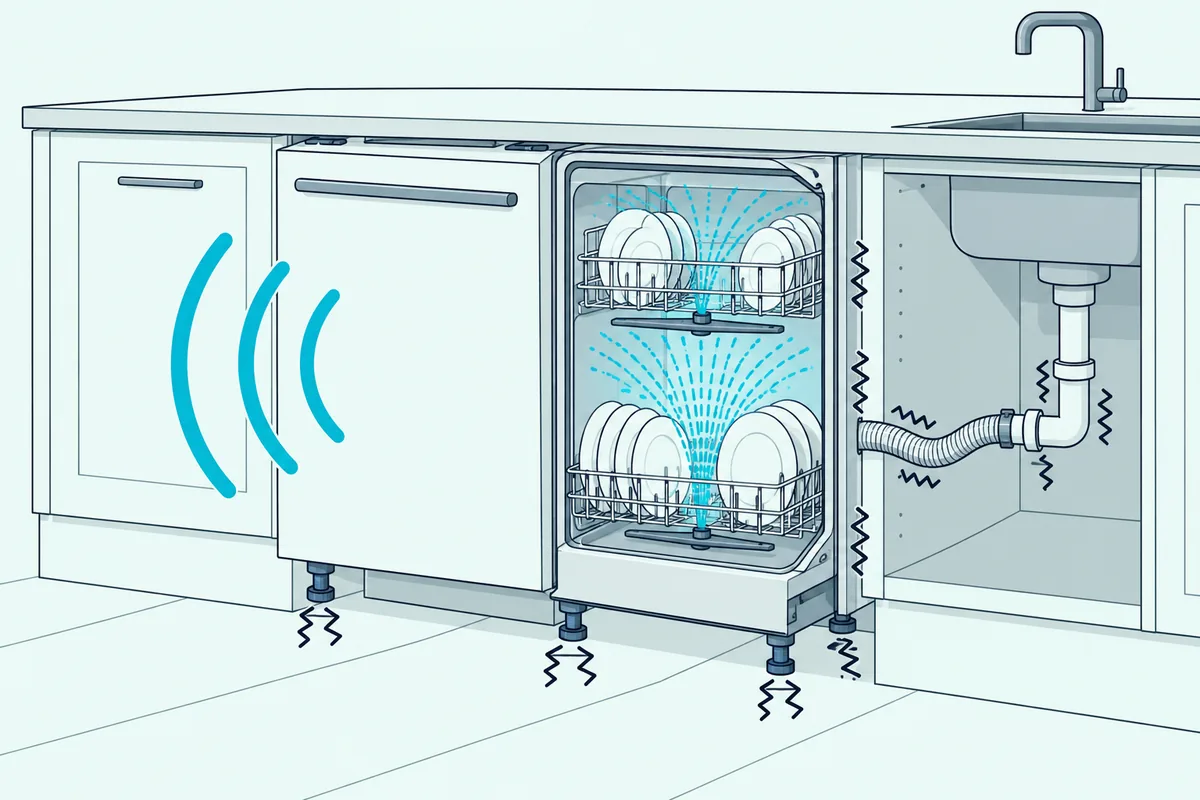
So there are three paths to close: the door and front, the base, and the cabinet and pipes the machine touches. GE’s installation tips point at the base in particular, with a reminder to keep the toe kick against the floor to reduce sound from under the dishwasher.
Which Dishwasher Noises Are Normal?
Some of those sounds are part of the job, and makers list them so you don’t chase them. GE’s normal list covers beeping at the end of a cycle, the detergent cup opening, water coming in, the motor and spray arms starting and stopping, and the drain pump running and pausing several times per drain.
Samsung’s troubleshooting table names the detergent compartment opening and the drain pump as normal too. It also lists two causes you can fix: a dishwasher that isn’t level, and a spray arm chopping against the dishes.
GE adds two rattles that need action rather than patience. Dishes rattling as the spray arm turns mean the load needs rearranging, and silverware rattling against the door means tall utensils belong in the upper rack.
Grinding, banging or a smell of burning aren’t on either list. If your noise isn’t on the maker’s list, book the manufacturer’s service or an authorized technician rather than opening panels yourself, because that’s repair work, not soundproofing.
How Do You Level a Dishwasher?
That unlevel cause from Samsung’s table is the cheapest fix on this page. Set the dishwasher level left to right and front to back with every leg on the floor, because GE says level is what keeps the racks still, the wash water flowing to the pump and the door clear of the tub.
GE’s method starts by removing the lower rack and setting a level on the open door and the lower rack track. On models with a rear leveling system, you adjust the two front legs first, then turn the bolt at the front, clockwise to raise the back and counterclockwise to lower it.
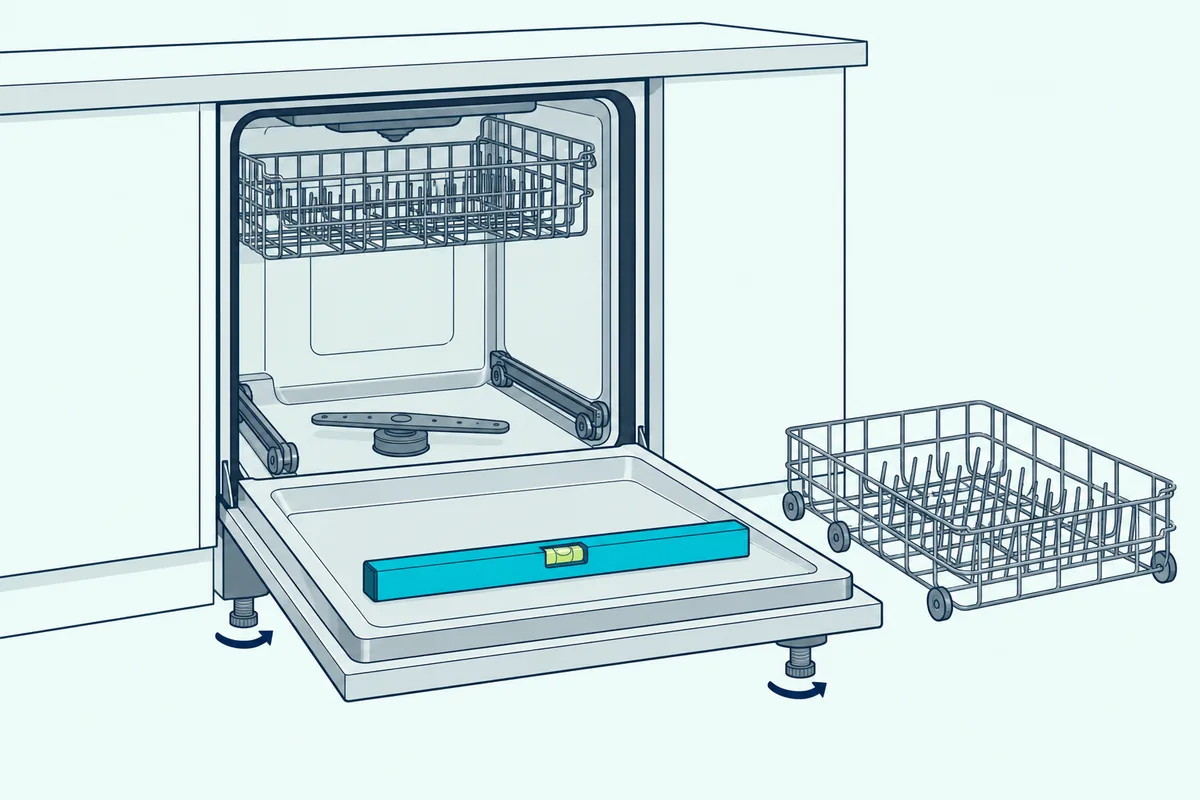
Bosch’s guide does the same with different hardware: turn the front feet clockwise to raise the front and the center screw to raise or lower the back. Its older 2006 instructions also have you lock the two front levelers with screws once the unit is leveled and secured.
Then run GE’s quick test. Pull both racks halfway out, and they should stay put; open and close the door, and it should fit the tub opening without touching the sides.
A short level that sits on the rack track is all the tool you need, and the CRAFTSMAN 9-inch magnetic torpedo level is a compact pick for it.
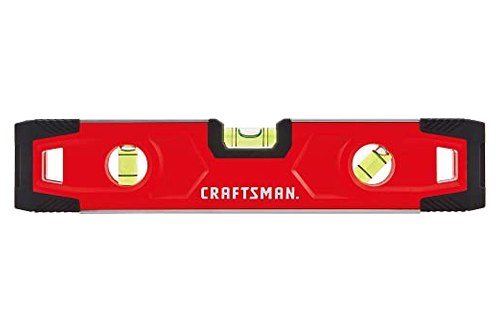
the CRAFTSMAN 9-inch magnetic torpedo level
Should a Dishwasher Be Screwed to the Counter?
Once it’s level, yes: GE’s guide says the dishwasher must be secured to the cabinet sides or countertop, and Bosch’s guide fastens it the same way. GE’s guide uses two screws, either into the side cabinets or into the underside of a wood countertop, driven straight and flush and never into the cabinet face frame.
Bosch picks the method by countertop: top mounting for wood or other materials that drill easily, and side mounting for marble, granite and other stone that doesn’t. Center the dishwasher in the opening first, and decide before the brackets go on, because Bosch says removing them later damages the brackets and the dishwasher.
After fastening, GE has you recheck that the tub and door are square and level, with no twisting. Its last check is that every leveling leg still touches the floor, to stop the dishwasher rocking and keep proper door and latch operation.
A leg that floats is the dishwasher version of a table with one short leg. That’s why the rack test from the leveling step is worth repeating once the screws are in.
What Does a Dishwasher Insulation Blanket Do?
Once the unit is level and fastened, the blanket can do its part. It’s insulation wrapped around the tub to cut the noise of the wash; Bosch lists multi-layer insulation among its noise-reducing technologies, and GE’s installation instructions treat the blanket as part of the install: smooth around the tub, not bunched up, and clear of the door springs (GE).
GE’s drawing shows the blanket pulled over the collar at the top front of the tub. If it’s bunched or touching the springs, GE says to straighten and re-center it before the dishwasher slides into its final position.
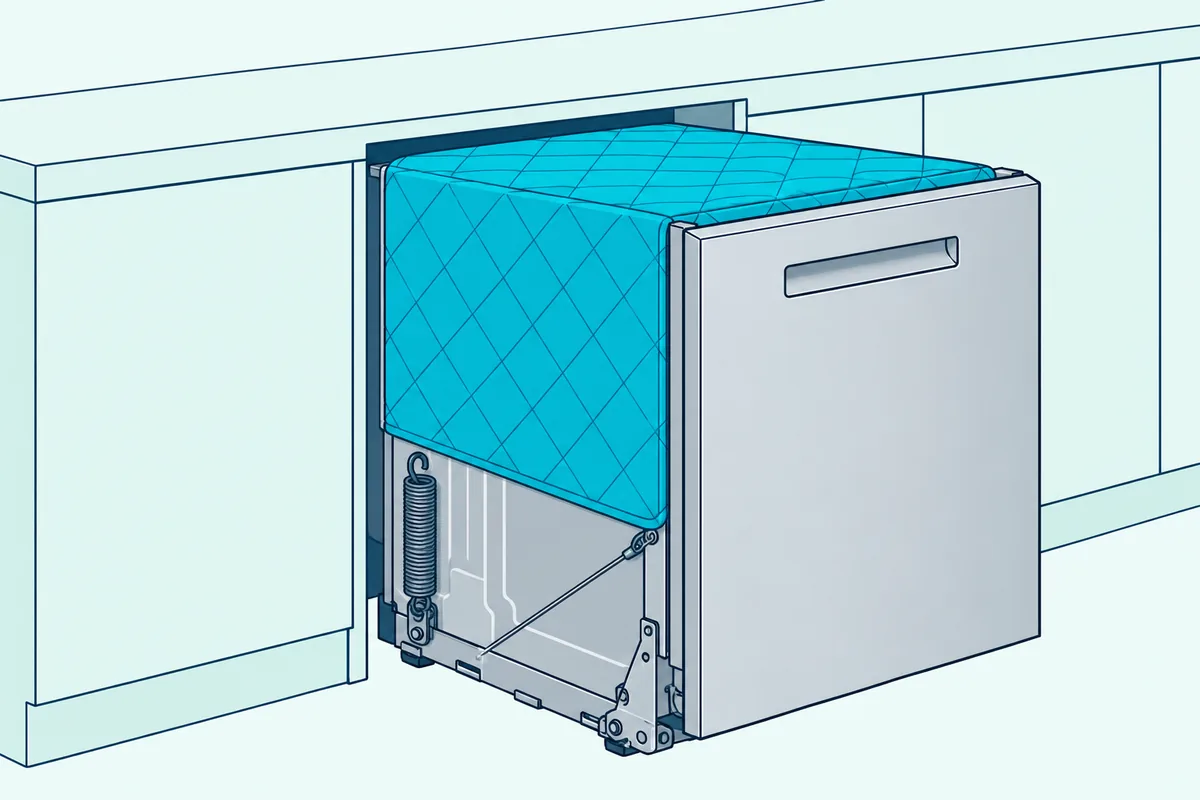
Makers build quiet in layers beyond the blanket: Bosch pairs its insulation with an EcoSilence motor and a sound-absorbing base, and GE’s PDT755, rated at 42 dBA, lists a quiet water valve, a sealed toe kick and tub collar trim as its quiet features.
GE’s guide says “if equipped,” so not every model ships with a blanket. If yours is torn or missing, look up the part listed for your model number first, because it’s made for that tub and a universal sheet isn’t.
For a dishwasher that has nothing listed, a universal sheet is the fallback, and the Frienda dishwasher insulation blanket comes in two cuttable sheets. Our suggestion is to trim it so it stays off the door springs, wiring and vent, then rerun the door test from the leveling step.
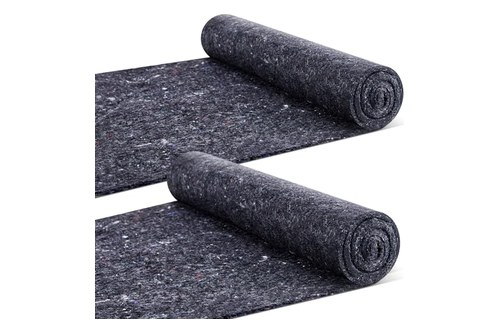
the Frienda dishwasher insulation blanket
Can You Put Insulation Under or Behind a Dishwasher?
That blanket has company down at the floor. Under the dishwasher, use the sound pieces your maker supplies, and leave the space behind it to the hoses and wiring; GE’s guide has a sound insulation piece on some models, a block pushed under the dishwasher beneath the control box with its front panel tucked behind the toe kick screw holes.
GE then sets the toe kick against the floor, and on models with a sound barrier the bottom edge sits flush with the floor and any extra material tucks up behind the outer door. Bosch’s 2006 guide describes a noise-reducing toe panel on select models, with a white cotton insulation strip laid under the unit between its base access panel and the floor.
GE once offered a toe kick Sound Upgrade Kit to cut noise from under three of its models made around 2010, which shows how much the base matters, though GE says the kit is no longer available.
Behind the dishwasher is a different story. GE says to make sure the utility lines aren’t trapped or crushed back there and don’t interfere with anything under or behind the machine, which is why we’d keep insulation out of that space.
Why Do Hoses and Cabinet Gaps Make Noise?
Those hoses and wires are also a noise path of their own. GE’s guide says water and drain lines touching the motor or the dishwasher frame could cause noise, and that a door spring rubbing the water line means the line needs rerouting.
NBS’s dishwasher entry explains why: rigid pipe and drain couplings carry the machine’s vibration into the house plumbing, so it recommends flexible connectors. If a gurgle or hum still travels through the walls, Burton Acoustix’s drain pipe guide covers the pipes themselves.
The cabinet opening is the other half. GE asks for a rough opening at least 24 inches wide and deep and about 34 1/2 inches high, and Bosch specifies a square enclosure 23 5/8 to 24 1/4 inches wide, with a different mounting method when the opening is exactly 23 5/8 inches.
NBS’s 1976 advice also suggested soft rubber gaskets between built-in appliances and their cabinets, but the current GE and Bosch guides don’t call for one. We’d leave the opening exactly as your guide sizes it.
If the next room still hears the kitchen once the dishwasher is quiet, the wall is the job, and alternative soundproofing materials for the wall are a separate project.
How Should You Load a Dishwasher to Stop Rattling?
Once the install is right, the load is what’s left to rattle. GE says items poking through the bottom of a rack or the silverware basket can block a spray arm and cause noise, and that large plates, pots or tall items shouldn’t hit the middle spray arm.
Samsung’s manual makes three more points. Food scraps and waste can make noise, a spray arm hitting the dishes makes a chopping sound, and running the dishwasher without its upper rack makes noise and stops it working properly.
Samsung also traces spray arms that don’t rotate smoothly to food clogging them, and its fix is cleaning the arms.
NBS put it simply decades earlier: load dishes so they aren’t free to flap in the water stream. It also suggests tightening loose fittings, especially door latches and shelf supports.
Try this on your next load: spin each spray arm by hand before you close the door. If it touches anything, the same rattle GE describes is waiting for the cycle to start.
How Many Decibels Is a Quiet Dishwasher?
Even a perfect install can’t make a loud machine quiet, so the rating matters when you buy. Bosch calls a dishwasher quiet at 48 dBA or lower, puts its quietest models at 38 to 48 dBA, and suggests shopping under 45 dBA (Bosch).
Those numbers are easier to compare with NBS’s table of how changes in level sound to most people:
| Difference between two ratings | How NBS says it sounds | Example pair |
|---|---|---|
| 1 dB | Takes close attention to notice | 43 and 44 dBA |
| 3 dB | Barely perceptible | 42 and 45 dBA |
| 5 dB | Quite noticeable | 40 and 45 dBA |
| 10 dB | Nearly twice or half as loud | 38 and 48 dBA |
So a 44 dBA model is barely louder than a 42 dBA one, while Bosch’s 38 to 48 dBA spread is close to a halving. Compare ratings from the makers’ own spec pages, and we’d treat a gap of 2 dB or less as a tie.
Our take: the rating is the ceiling, and the blanket, toe kick and level from earlier decide how close an installed unit gets to it.
The Bottom Line
So most of what you can do to quiet a dishwasher is the installation: level it, fasten it, keep the blanket smooth, close the toe kick and free the lines.
Leave the vent and door springs clear, add only what your maker supplies or what clears them, and let the decibel rating guide the next purchase.
Frequently Asked Questions
How do you make a dishwasher silent?
You can’t make one silent, but you can get it close to its rating. Even Bosch’s quietest models run at 38 to 48 dBA by Bosch’s own figures, and the pump, water and motor sounds GE and Samsung list as normal never disappear. Level and fasten it, keep the blanket smooth, close the toe kick and load so nothing touches the spray arms, then compare ratings with the table above if it’s still too loud.
Does the soundproofing on top of a dishwasher reduce sound?
It’s meant to: the tub blanket is insulation over the top and sides of the tub, and GE’s installation guide checks that it’s smoothly wrapped, not bunched up and clear of the door springs. No maker’s document cited here gives a noise reduction figure for the blanket alone, so the gain on your model is unknown, but GE treats a smooth, centered blanket as part of a correct install.
Why is my dishwasher so loud after installation?
GE’s installation tips name the usual suspects: a dishwasher that isn’t level, a toe kick that doesn’t reach the floor, and water or drain lines touching the motor or frame. Check that every leg touches the floor, the blanket isn’t bunched and the door spring doesn’t rub the water line. If all of that checks out, compare the sound with your manual’s list of normal noises.