Quiet Aquarium Air Pumps That Still Give Fish Enough Air

If you’re shopping for a quiet aquarium air pump, size it for the tank before you compare noise, because RSPCA Australia calls aeration critical both for the filter’s bacteria and for the fish to breathe.
A buzzing pump on a bedroom stand tempts you toward a box over it or a pinched airline, and either one can choke the pump’s airflow and leave it running hot.
Choose a pump its maker rates for your tank and set it up the way the manuals say, and you get the quiet without taking air away from the fish.
This guide compares pumps from Tetra, Aqueon and NICREW on the tank sizes, airflow and noise figures their makers publish.
The picks come first, then how much air a tank needs, how to read a decibel claim and where the pump should sit.
What Is the Quietest Aquarium Air Pump?
Those makers’ figures settle less than you’d hope, because only one of the three prints a decibel rating. On paper, the quietest aquarium air pump here is the NICREW Nano Silent, which NICREW’s manual rates at 33 dBA or less and describes as running on a thin ceramic element with no motor, but it’s built for small tanks only (NICREW).
For anything bigger, the choice comes down to how each maker builds its pump to stay quiet and which tank size it’s rated for:
| Pick | Tank size, per the maker | Airflow, per the maker | Drive | What the maker says about noise | Best for |
|---|---|---|---|---|---|
| Tetra Whisper 40 (non-UL) | 20 to 40 gallons | 1.3 liters a minute (UL-listed version) | Diaphragm, suspended motor | “Minimal noise” | Mid-size tanks |
| Aqueon QuietFlow 10 | 2 to 10 gallons | Not published | Diaphragm | “Virtual silence” | Small tanks, built-in check valve |
| NICREW Nano Silent | Up to 10 gallons | 18.6 liters an hour | Piezoelectric ceramic | 33 dBA or less | Nano and betta tanks |
Every pick met Burton Acoustix’s rating, review and stock checks on 28 October 2026. Nothing here was run or measured, and the descriptions come from the makers’ manuals, product pages and listings.
Air comes first and quiet second, the same priority Burton Acoustix sets for enclosures around anything alive. So every pick below is matched to a tank size its maker states, never stretched to a bigger tank to keep the noise down.
Which Quiet Aquarium Air Pump Should You Buy?
That table splits by tank size, since all three makers rate their pumps by the gallons they can serve.
Tetra Whisper 40 (Non-UL)
For a tank of 20 to 40 gallons, the Tetra Whisper 40 is the pick.
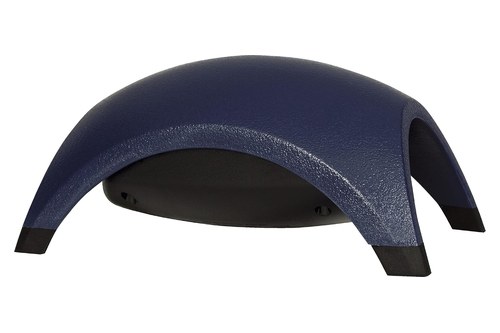
the Tetra Whisper 40
Tetra builds the Whisper around a dome-shaped housing with sound-dampening chambers designed for each model, and its product page says the rubber feet and suspended motor keep sound waves from reflecting off tables and shelves (Tetra). The same page sums the line up as minimal noise and maximum air flow.
That page, for Tetra’s UL-listed Whisper line, rates the Whisper 40 at 1.3 liters of air a minute, in a range from 0.5 for the Whisper 10 to 3.3 for the Whisper 100, while Tetra’s non-UL page lists the same sizes without airflow figures. The UL page also says Whisper pumps can work in tanks up to 8 feet deep and power long decorator air stones, multiple air stones in one or more tanks, or a protein skimmer.
The listing on this card is the non-UL Whisper 40, Tetra product 77853, which its description rates for tanks of 20 to 40 gallons. Tetra sells a separate UL-listed Whisper line, so check which version you’re buying if a UL mark matters to you.
The same description credits the pump’s thick walls with insulating motor noise and its wide footprint, rubber feet and suspended motor with eliminating sound-producing vibrations. It takes standard-size aquarium tubing.
Tetra’s Q&A page says its air pumps ship with a T connector, while the airline tubing, air stones and check valve are sold separately (Tetra). Budget for a check valve unless the pump will sit on a shelf above the water line, for reasons the check valve section below spells out.
Aqueon QuietFlow 10
For a tank of 2 to 10 gallons, the Aqueon QuietFlow 10 builds in the safety part Tetra sells separately.
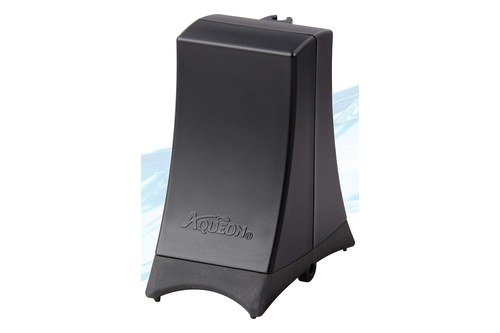
the Aqueon QuietFlow 10
Aqueon says the integrated check valve adds a level of security against back siphoning should the power be lost, and that the wide rubber base absorbs vibration to lessen the noise (Aqueon). Its product description goes further and promises virtual silence.
The outlet points straight up to keep the airline from kinking, and each pump carries a replaceable check valve, diaphragm and dust filter pad. Aqueon sells repair kits for those internal parts separately.
The QuietFlow instructions list the 10 at 1.5 watts for 2 to 10 gallons, then step up through the 20 for 11 to 20 gallons and the 40, 60 and 100 for tanks of up to 40, 60 and 100 gallons (Aqueon). The 60 and 100 take two separate airline tubes.
Aqueon prints no airflow figure for any QuietFlow size, so compare it by the tank sizes it lists rather than by output. Its limited warranty runs 90 days, against NICREW’s 12 months.
NICREW Nano Silent
For a nano or betta tank of up to 10 gallons, the NICREW Nano Silent is the quietest design on this list on paper.
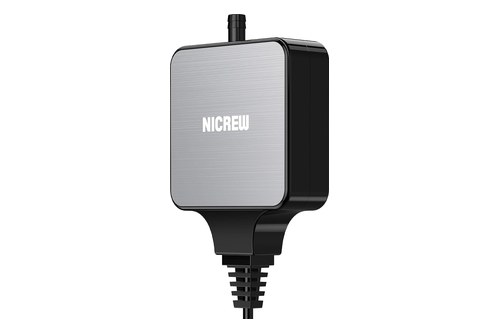
the NICREW Nano Silent
NICREW’s manual rates it at 1.5 watts, 18.6 liters of air an hour and 33 dBA or less, and describes a thin electric ceramic piece doing the work, with no motor and no shaft. Its listing calls the pump whisper-quiet and driven by piezoelectric ceramic.
That output is small. By our arithmetic, 18.6 liters an hour is about 0.31 liters a minute, roughly three-fifths of the 0.5 liters a minute Tetra gives for its Whisper 10.
NICREW packs a check valve, an air stone, tubing and a rubber suction cup with the pump. Its manual says to stick the pump to the tank’s outside wall above the water level, so water can’t run back into it.
The listing rates the Nano Silent for tanks of up to 10 gallons, and NICREW gives its products a 12-month limited warranty. For a betta, that low flow can be a feature rather than a flaw, as the sections below explain.
How Much Air Does a Fish Tank Need?
Each of those cards starts from a tank size, and that’s the number to shop by. Enough to keep the water well oxygenated, and RSPCA Australia says aeration is critical both for the aerobic bacteria in a healthy biological filter and for your fish to breathe (RSPCA Australia).
RSPCA Australia’s guides put no liters-per-minute figure on that. The makers do it for you, by rating each pump for a range of tank sizes:
| Model | Tank size, per the maker | Airflow, per the maker |
|---|---|---|
| Tetra Whisper 10, 20, 40, 60, 100 | 10, 20, 40, 60 and 100 gallons | 0.5, 1, 1.3, 2.6 and 3.3 liters a minute |
| Aqueon QuietFlow 10, 20, 40, 60, 100 | 2-10, 11-20, up to 40, up to 60 and up to 100 gallons | Not published |
| NICREW Nano Silent | Up to 10 gallons | 18.6 liters an hour |
Tetra’s airflow figures come from its page for the UL-listed line, and its non-UL page gives the tank sizes.
Tetra’s own sizing is worth a second look, since its non-UL page lists the Whisper 40 for 40 gallons while the Amazon description for the same pump rates it for 20 to 40. Either way, the pump named for your tank’s gallons is the one the maker rates for it.
So pick the size the maker names for your tank, and don’t step down a size to save noise. A pump working harder than its maker sized it for isn’t a quieter setup, just an underpowered one.
Load matters as much as size. Tetra’s Q&A says a diaphragm driving a one-inch air stone lasts much longer than one driving a twelve-inch bubble wand, and hygger warns that connecting too many bubble stones to one of its pumps can overload the motor until it overheats and burns.
Depth is the other load, and Tetra rates its Whisper pumps for tanks up to 8 feet deep. A deep tank with a long stone is the case for the bigger sizes in the next section.
Here’s a practical test from Tetra’s manual: if the bubbles thin out, try blowing through the air stone yourself. If that’s hard, the stone is clogged and should be replaced, because algae, floating debris and mineral deposits build up in its pores over time.
Which Quiet Pump Suits a Tank Over 40 Gallons?
That size table runs past the cards above, which stop at 40 gallons. The bigger size from the same lines, rated by its maker for your tank: Aqueon’s instructions rate the QuietFlow 60 and 100 for tanks of up to 60 and 100 gallons at 3.2 and 3.8 watts, and Tetra’s Whisper page lists the Whisper 60 and 100 at 2.6 and 3.3 liters of air a minute.
Tetra’s Amazon descriptions narrow the ranges further. They rate the non-UL Whisper 60 for tanks of 40 to 60 gallons and the Whisper 100 for 60 to 100 gallons, so by those ranges a 55-gallon tank lands on the 60.
Both larger QuietFlow models take two separate airline tubes, which suits a tank with two air stones. Tetra’s Q&A adds the rule for any pump with two ports: fit tubing to both, or join them with the T connector, because a two-port pump will be very loud if one port is left without tubing.
Above 100 gallons, Tetra points to its Whisper Deep Water line, the AP 150 and AP 300 for 150 and 300 gallons. Tetra calls them its most powerful air pumps and designs them for the greater back pressure of deep tanks, long decorator air stones, multiple stones and protein skimmers (Tetra).
None of those pages or manuals prints a decibel figure for the larger pumps. So the quiet comes from the same places as on the cards: rubber feet or a rubber base, a shelf of its own and distance from where you sit or sleep.
On a big stand, that usually means a shelf beside the tank rather than the cabinet under it, for the reasons the placement section below gives. The airline from that shelf needs a check valve if the pump sits below the water line.
Does Every Tank Need an Air Pump?
Whatever its size, the pump isn’t always the tank’s only source of oxygen. Not every tank needs one: RSPCA Australia’s care guides say that if the filter doesn’t create bubbles or stir the surface water, aeration with an air stone is needed to keep the water well oxygenated (RSPCA Australia).
A filter that splashes back into the tank does some of that work. Tetra’s Q&A says its Whisper Power Filter adds oxygen as the returning water breaks the surface, working like a waterfall, and that extra oxygen can only benefit the tank.
The test is simple: look at the surface while the filter runs. If it ripples, the pump is extra insurance, and if it lies flat and glassy, the RSPCA’s rule says an air stone is needed and the pump is doing a job the fish depend on.
Goldfish are the case where you shouldn’t skimp. RSPCA Australia calls them heavy feeders and high waste producers that need efficient filtration, with the same air stone rule when the filter doesn’t stir the surface.
Bettas sit at the other end. RSPCA Australia says Siamese fighting fish need occasional air from the surface even when the water holds plenty of oxygen, so there must be space between the water and the lid, and they prefer low flow (RSPCA Australia).
That’s where the NICREW’s small output earns its place. A gentle stream suits a fish that prefers low flow, while Tetra’s 1.3-liter rating for the Whisper 40 is about four times the NICREW’s output, by our arithmetic.
Why Is a Piezo Air Pump So Quiet?
Small tanks open the door to a second kind of pump, one with no motor at all. Because it has no motor: hygger says its HG811 Mini Air Pump is driven by a thin piezoelectric ceramic plate and has no motor or other mechanical equipment, which it says makes the pump very quiet (hygger).
NICREW’s manual describes its Nano Silent the same way, as a thin electric ceramic piece that’s completely different from traditional electromagnetic air pumps, with no motor and no shaft. hygger says the plate in its HG971 Fish Bowl Small Air Pump replaces traditional diaphragms and reduces noise dramatically.

The catch is output. hygger rates the HG971 at a maximum of 420 milliliters a minute for tanks of 0.5 to 15 gallons and calls it ideal for low-flow tanks such as planted, betta and shrimp tanks.
NICREW’s Nano Silent is lower again, at 18.6 liters an hour, or about 310 milliliters a minute by our arithmetic. Each comes with one small air stone and a single outlet, which tells you the size of job its maker has in mind.
A diaphragm pump uses a motor and a rubber diaphragm instead, and Tetra credits its powerful diaphragms with ample airflow for deep water. That motor is the noise Tetra’s design goes after: its description says the thick walls insulate motor noise, and the suspended motor and rubber feet eliminate sound-producing vibrations.
Aqueon takes the same approach with the QuietFlow’s wide rubber base, which it says absorbs vibration to lessen the noise. The quiet in a diaphragm pump is engineered around a motor, while a piezo pump simply doesn’t have one.
The diaphragm is also the part that wears. Tetra’s Q&A treats it as a wear-and-tear item, and Aqueon includes a replaceable diaphragm in each QuietFlow, with repair kits sold separately.
Can You Trust a Decibel Rating on an Air Pump?
That near-silence shows up in the makers’ numbers too, but only some of them print one. Only as the maker’s own claim, because none of the figures published for these pumps comes with the distance or method behind it.
Here’s what the makers publish. NICREW gives 33 dBA or less for the Nano Silent, hygger lists 25 to 35 dB for its HG971, under 30 dB for its HG215 Dual Max and 25 dB or less for its HG095 (hygger).
Tetra’s Whisper page and manual print no decibel figure at all, and neither do Aqueon’s QuietFlow page and instructions. Their quiet claims are about design: a dome, a suspended motor, rubber feet, a rubber base.
Distance changes the number a lot. The FHWA’s noise primer says sound from a single point source drops about 6 dBA each time the distance doubles, so by that rule a pump measured at one foot would read about 6 dBA lower at two (FHWA).
The same primer says a 10 dB change sounds twice as loud, or half as loud, to a listener. By that scale, the top of hygger’s 25 to 35 dB range for the HG971 sounds twice as loud as the bottom.
Small differences matter less. The FHWA calls a 3 dB change barely perceptible and a 5 dB change readily perceptible, so a pump quoted at 30 dB and one quoted at 33 dB may sound much the same in a bedroom, even before the missing distances come into it.
So treat a decibel figure as a claim to weigh, not a rating to rank by. Without matching distances, choose by the design and the rated tank size, the two things every maker on this page does publish.
Pool pump makers leave out the same details, which is why our quiet pool pump picks treat their figures the same cautious way. If you want numbers for your own room, take them the same way before and after a change, as Burton Acoustix’s guide to testing soundproofing describes.
Where Should a Quiet Air Pump Sit?
Even a well-built pump can be undone by where it sits. On a surface separate from the tank, either above the water line or lower with a check valve: Tetra’s manual says to place the pump on a surface separate from the tank, and on a shelf at least 12 inches higher than the water level if it goes above, but not directly above the aquarium (Tetra).
The same manual wants that shelf to have a raised edge, so the pump can’t slide off.
Feet matter as much as the shelf. Tetra says the Whisper’s rubber feet and suspended motor keep sound waves from reflecting off tables and shelves, and Aqueon says the QuietFlow’s wide rubber base absorbs vibration to lessen the noise.

So give a diaphragm pump a surface of its own, not the tank’s lid or the glass. That’s the arrangement Tetra’s manual draws, and it lets the rubber feet do the job Tetra designed them for.
Piezo pumps are the exception, by design. NICREW’s manual says to stick the Nano Silent to the tank’s outside wall with its suction cup, above the water level, and hygger’s HG971 page describes the same dual-suction-cup mounting.
Don’t tuck a pump directly under the tank either. Tetra’s setup guide for its Bubbling LED Kit says never to place the air pump directly below or directly above the aquarium, and Marina’s air pump manual gives the reason for the first: spilled water (Marina).
Distance is the free fix. By the FHWA’s 6 dBA rule, a pump moved from 3 feet to 6 feet from your pillow would read about 6 dBA lower there, though the FHWA’s primer deals with outdoor traffic noise, not rooms.
The workable compromise is a shelf or stand beside the tank, not under or over it, on soft feet, at the end of the tank farthest from where you sleep. If that spot is below the water line, the airline needs a check valve, as the next section explains.
Do You Need a Check Valve and a Drip Loop?
That airline is also the path water would take back toward the pump if the power cut out. Yes, unless the pump sits above the water line: Tetra’s manual says the pump should be used with a check valve or positioned higher than the water level to prevent possible electrical shock from water back-siphoning.
The manual explains the job in plain terms. A check valve between the pump and the aquarium helps stop water from siphoning into the air pump during a power failure or when you remove filters from the tank.

How you get one differs by maker. Aqueon builds a check valve into every QuietFlow, NICREW packs one with the Nano Silent, and Tetra sells it separately, while its manual marks the valve optional only for the above-tank setup.
Tetra’s manual adds a step for maintenance days. When you take out a filter, air stone or air-operated ornament, leave the pump running and stop back-siphoning by pulling the open end of the tubing off the pump nozzle and taping it to the top frame of the aquarium.
The power cord needs its own protection. Tetra and Aqueon both tell you to arrange a drip loop, the part of the cord that hangs below the level of the outlet, so water running along the cord drips off before it reaches the socket.
If the plug or outlet does get wet, both manuals say not to unplug the cord. Switch off the fuse or circuit breaker that feeds it first, then unplug it and check the outlet for water.
NICREW’s manual recommends a ground fault circuit interrupter and a surge protector for all electrical appliances. Tetra’s and NICREW’s manuals say the same about the pump itself: never immerse it, and if it falls into the water, unplug it before you reach for it.
That protection is part of the warranty math too. Tetra’s Q&A says water damage isn’t covered, so use a drip loop and an in-line check valve, or keep the pump higher than the aquarium if you can’t.
Should You Put an Air Pump in a Soundproof Box?
Every setup those manuals draw leaves the pump in open air, and that’s the catch with boxing it in. Not in a sealed one, because an air pump makes its bubbles from the air around it: Aqueon fits each QuietFlow with a dust filter pad, and hygger describes an air intake sponge under its Dual Max pump that traps particles and needs periodic replacement to keep the output up (hygger).
So an airtight box, or foam wrapped tight around the pump, cuts off the supply it pumps from, and the fish get less air. The pump suffers as well: NICREW’s manual says the pump will overheat and get damaged if it can’t discharge air adequately.
The same warning rules out pinching the airline to quiet it. NICREW says never to close the outlets and to make sure the tube isn’t clogged or bent, and Tetra’s way of trimming the flow is its own air-control valves, which regulate the air sent to each tank, filter or stone.
A box built for a noisy machine works on vents and absorbent linings, and the steps for making a soundproof box assume the machine still gets the air its manual asks for. For an aquarium pump, though, the quieter path is the one this page has followed: the right size, soft feet, a shelf of its own and distance.
None of the three manuals for the picks mentions enclosing the pump at all. If you’re set on a cover, ask the maker first, and keep the intake open to the room.
Is the Air Pump Really the Loud Part?
A box would only help if the pump were the noise, and that’s worth checking first. Not always: unplug the air pump for a moment and listen, and if the tank sounds about the same, the hum is coming from the filter or something else on the stand, so plug the pump straight back in for the fish.
The FHWA’s decibel-addition table explains why that test works. When two sources differ by 10 dB or more, it adds nothing to the louder one, so a pump far below a noisy filter is already lost under it and a quieter pump wouldn’t change what you hear.
If the two are about equal, the table adds 3 dB. By that table, silencing the pump completely would take only about 3 dB off the total, a change the FHWA calls barely perceptible.
Air stones can make the filter louder, too. Tetra’s Q&A says bubble walls and air stones shouldn’t sit directly under a filter’s intake tube, because bubbles going up the main tube cause a rattling sound and may stop the filter from working.
And check the ports. The two-port rule from the big-tank section applies to any pump: with one port left open, Tetra says the pump will be very loud, so the fix may be a T connector rather than a new pump.
Will a New Pump Fix a Loud One?
Once the pump is confirmed as the noise, the next question is whether it’s worn. Often you don’t need one: Tetra’s fix for an air pump that loses power or sounds very loud is a new rubber diaphragm, a wear part it sells in repair kits (Tetra).
The fix is short. Unplug the pump, open it by removing the screws at the bottom, and swap the round rubber disk, which is the diaphragm, for a new one.
Aqueon recommends replacing worn diaphragms, check valves and dirty filter pads on its QuietFlow pumps to keep them performing, and sells them in kits. Tetra’s manual adds that the pump mechanism never needs oil, so a squeak isn’t a lubrication job.
One other cause costs nothing. A clogged air stone cuts the airflow, as the blow-through test in the air section shows, so a new stone is the first thing to try.
Piezo pumps are different. NICREW’s troubleshooting table puts an abnormal noise or cracking sound down to a worn-out unit and says to unplug it and contact NICREW, so that one is a replacement rather than a repair.
Placement is the last check. A pump that sits below the water line without a check valve can take in water when the power fails, and hygger’s FAQ lists exactly that as a reason its pumps stop working.
What Should You Check Before You Buy?
Whichever tank you have, the same short list separates a quiet pump from a quiet claim. Start with the fish’s side of the deal:
- The tank size the maker names for your tank’s gallons, not the size below it.
- A drive that suits the job: piezo for a small, low-flow tank, a diaphragm pump for anything bigger or deeper.
- A check valve in the box, or one bought with it, unless the pump will sit above the water line.
- Spare parts for the long run: Tetra and Aqueon sell diaphragm repair kits.
Then check the quiet side, so the pump doesn’t arrive with a promise you can’t use:
- Rubber feet, a rubber base or a suction mount, whichever the maker designs for.
- Any decibel figure, treated as the maker’s claim without a distance.
- Enough outlets for your air stones, with tubing on every port.
- The warranty: 90 days for Aqueon, 12 months for NICREW, and the product label for Tetra.
Keep the box until the pump has run a few nights in its final spot. A return is easier than living with a hum.
The Bottom Line
Buy the Tetra Whisper 40 for a 20- to 40-gallon tank, because Tetra damps it with a dome, sound-dampening chambers, a suspended motor and rubber feet, and sizes it for exactly that range. Choose the Aqueon QuietFlow 10 for a small tank where a built-in check valve matters, and the NICREW Nano Silent for a nano or betta tank that wants low flow and the quietest design on paper.
Whichever you buy, the quiet comes from the right size, a shelf of its own on soft feet and a little distance, never from a sealed box or a pinched airline.
Frequently Asked Questions
Can you turn an aquarium air pump off at night?
Only if something else is moving the surface. RSPCA Australia says aeration is critical for the filter’s bacteria and for fish to breathe, and that an air stone is needed when the filter doesn’t create bubbles or stir the surface. If your filter’s outflow ripples the water, the pump is a backup; if the surface lies flat, switching the pump off takes away the aeration the fish rely on. A quieter pump or a better spot for it is the safer fix for a noisy night.
Can you put an air pump inside the aquarium stand?
Not directly under the tank. Tetra’s setup guide for its Bubbling LED Kit says never to place the air pump directly below the aquarium, and Marina’s air pump manual says the same to avoid damage from spilled water. A pump lower than the water line also needs a check valve in the airline, and Tetra’s manual wants the pump on a surface separate from the tank. A shelf beside the stand, with a check valve in the line, meets all three.
Is a quiet air pump safe for a betta?
Yes, if the flow stays gentle. RSPCA Australia says Siamese fighting fish prefer low flow and need occasional air from the surface, so leave space under the lid. A small piezo pump such as the NICREW Nano Silent, rated at 18.6 liters an hour, suits that better than a pump sized for a big tank.
Can one air pump run two air stones?
Yes, if it’s sized for the load. Tetra says its Whisper pumps can power multiple air stones in one or more tanks, and its manual uses air-control valves to route and regulate the air to each one. Aqueon’s QuietFlow 60 and 100 take two airline tubes. A two-port pump needs tubing on both ports, or a T connector, because Tetra says it will be very loud with one port open.
How long does an air pump diaphragm last?
It depends on the work it does. Tetra’s Q&A says a diaphragm running a one-inch air stone will last much longer than one running a twelve-inch bubble wand, and treats the rubber parts as wear-and-tear items its warranty doesn’t cover. When a pump loses airflow or gets very loud, Tetra says to check the diaphragm first, and both Tetra and Aqueon sell repair kits to replace it.