Quietest Pool Pump Picks and the Specs That Make One Quiet
If you’re shopping for the quietest pool pump, start with a variable-speed model you can run slowly, because Hayward’s own manuals list quiet operation among the benefits of low speeds.
Even a healthy pump makes noise, since Hayward says the motor’s internal cooling fan can be heard, and it warns that a spot under a bedroom window may not be ideal.
Choose by what the makers actually document, and you’ll know which pump can slow down for the long night shift and which one only promises quiet.
This guide compares variable-speed pumps from Hayward and Pentair on their speed ranges, motors, published noise figures and the warranty that comes with an online order.
The picks come first, followed by how to read a decibel figure, how to size the pump and where to put it so it stays quiet.
What Is the Quietest Pool Pump?
That low-speed rule settles most of the answer, because none of the US manuals and spec sheets for the pumps below prints a decibel rating. On paper, the quietest pool pump for most inground pools is the Hayward TriStar VS 1.85 HP: Hayward calls it exceptionally quiet compared to single-speed pumps, and its owner’s manual lets it turn as slowly as 600 RPM (Hayward).
The other picks cover the pools the TriStar doesn’t suit as well:
| Pick | Pool | Speed range, per the maker | Motor | What the maker says about noise | Best for |
|---|---|---|---|---|---|
| Hayward TriStar VS 1.85 HP | Inground | 600 to 3,450 RPM | Permanent magnet, totally enclosed fan-cooled | “Exceptionally quiet compared to single-speed pumps” | Medium to large pools |
| Pentair WhisperFlo VST | Inground | 450 to 3,450 RPM | Permanent magnet, totally enclosed fan-cooled | “Extremely quiet operation” | Pools that need more power |
| Pentair SuperFlo VS | Inground | 300 to 3,450 RPM | Permanent magnet, totally enclosed fan-cooled | “Extremely quiet operation” | Smaller pools and Super Pump swaps |
Every pick met Burton Acoustix’s rating, review and stock checks on 27 October 2026. Nothing here was run or measured, and the descriptions come from the makers’ manuals, spec sheets and product pages.
If the pump you already own is the problem, soundproofing an existing pool pump starts with its speed and mounting, and a new pump may not be needed at all.
Which Quiet Pool Pump Should You Buy?
Those rows split by the size of the pool and how hard its plumbing makes the pump work.
Hayward TriStar VS 1.85 HP
For most inground pools, the Hayward TriStar VS 1.85 HP is the pick.
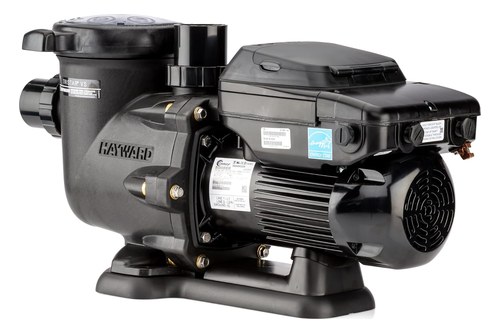
the Hayward TriStar VS 1.85 HP
Hayward builds it around a permanent magnet, totally enclosed fan-cooled motor and designs it for medium to large pools. Its owner’s manual allows any speed from 600 to 3,450 RPM, and the four preset speeds start at 1,150 RPM (Hayward).
Hayward’s TriStar VS sell sheet credits an upgraded dual-voltage motor drive with 30% quieter high-speed operation than other models, though it gives no decibel figure and doesn’t name the models. The same sheet sizes it to replace most high-performance pumps up to 1.5 full-rate or 2.0 max-rate horsepower.
The touch pad rotates to four positions or mounts on a wall, and the pump runs on its own, with Hayward automation or with other brands’ systems through relay control. As an Open Line model, it carries the warranty Hayward lists for that channel: one year of parts coverage and no labor.
Pentair WhisperFlo VST
For a pool that needs up to a 2.0 horsepower pump, a water feature or a higher-head system, the Pentair WhisperFlo VST is the stronger choice.
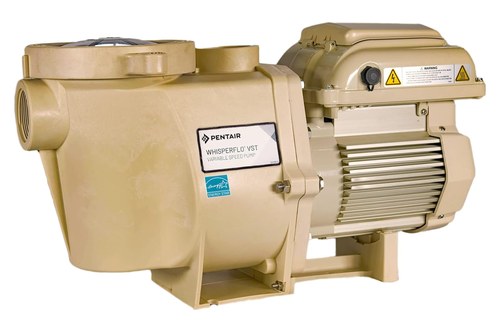
the Pentair WhisperFlo VST
Pentair’s installation guide lists extremely quiet operation and a high-efficiency permanent magnet motor, and it says the pump can run anywhere from 450 to 3,450 RPM. The same guide says the pump is intended to run at the lowest speeds needed to keep the pool sanitary (Pentair).
Pentair rates it at 2.6 total horsepower with an 8.4 weighted energy factor, and it takes 115 or 208-230 volts through 2-inch ports. Its sell sheet adds an improved mechanical seal and a totally enclosed fan-cooled motor built to withstand harsh temperatures and chemicals.
Programming is simpler than Hayward’s, with three speeds plus an override on a real-time, 24-hour clock, and an RS-485 connection links it to automation systems. The card links Pentair’s e-commerce version, EC-011533, which Pentair makes for online sales.
Pentair SuperFlo VS
For a smaller pool, or to replace a Hayward Super Pump without replumbing, the Pentair SuperFlo VS is the compact choice.
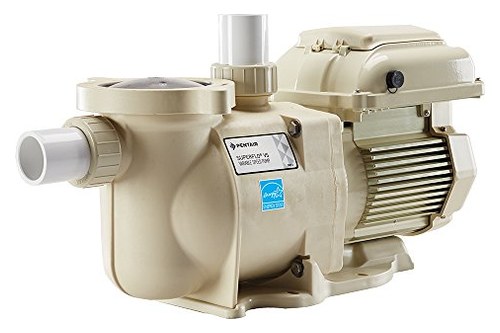
the Pentair SuperFlo VS
Its guide lists extremely quiet operation, a super-duty fan-cooled motor and an integral volute and pot that reduce hydraulic noise. It turns as slowly as 300 RPM, the lowest floor on this list, and Pentair’s default schedule spends 10 of its 14 running hours at 1,400 RPM (Pentair).
Pentair’s brochure calls the motor an ultra-quiet, totally enclosed fan-cooled permanent magnet design and the pump a drop-in replacement for the Hayward Super Pump. Its product page pitches it at standard pools that need up to a 1.5 horsepower pump, and the guide puts its controller in an IPX6-certified, UV- and rain-proof enclosure.
Pentair has since discontinued the SuperFlo VS and names the SuperFlo VST as its replacement, but the e-commerce version, EC-342001, is still sold online. Pentair’s guide for it says not to install the pump within an outer enclosure unless it’s marked for one, and to secure it mechanically to the equipment pad.
Why Is a Variable-Speed Pump Quieter?
All of these picks share the feature that put them on the list: each can slow down for the long hours of filtering. A variable-speed pump is quieter because it can turn its motor slowly for most of the day, and Hayward’s manuals list quiet operation among the benefits of low speeds, next to saving electricity, better filtration and less stress on the filter.
ENERGY STAR says the same of the whole category: variable-speed pumps are quieter, need less maintenance and last longer (ENERGY STAR). Its page adds that halving a pump’s speed lets it use just one-eighth as much energy.
That energy curve explains why makers push slow speeds so hard. Hayward’s Australian TriStar VS manual says a 50% cut in pump speed reduces power consumption by up to 75%, and it describes the same low-speed running as unlikely to be intrusive to your neighbors.
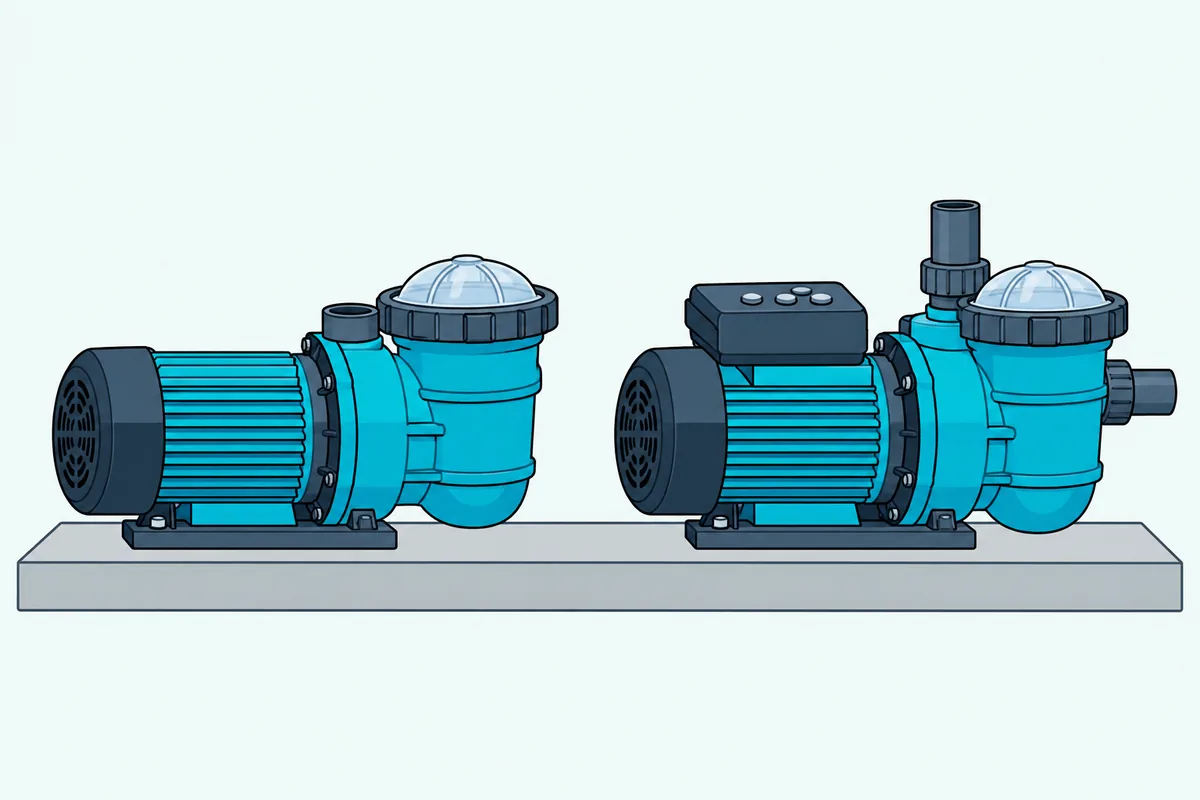
A single-speed pump can’t do any of that, since it runs at one speed whenever it’s on. Hayward’s UK site calls a variable-speed pump the radical solution to a noisy pool, because water then circulates more slowly through the pipes (Hayward UK).
The plumbing benefits as well. The same page says hydraulic noise is often down to poorly designed piping, that the only remedy then is a variable-speed pump, and that pairing it with a cartridge filter keeps head losses lower than a sand filter does.
The motor matters as much as the speed. Hayward’s TriStar VS and Pentair’s SuperFlo VS, WhisperFlo VST and IntelliFlo3 VSF all use permanent magnet, totally enclosed fan-cooled motors, and Pentair’s IntelliFlo3 guide lists low noise among that motor’s features.
Pentair once credited that design for the quiet of its now-discontinued IntelliFlo VS. Its product page says the fan-cooled design and a low average operating speed made the IntelliFlo the quietest variable-speed pool pump on earth, a maker’s claim with no test conditions attached.
Think of it like a ceiling fan on its lowest setting: the motor is the same, but the blades move less air and make far less whir. Same principle in a pump, except the slow setting also does the day’s filtering.
How Loud Is a Variable-Speed Pool Pump?
Those quiet claims would mean more with numbers attached, and only one set of maker documents in this guide prints them. Hayward’s Australian manuals list 46 dBA for the TriStar VS at 1,100 RPM and 52.7 dBA for the smaller MaxFlo VS at 1,450 RPM, both moving about 120 liters a minute, with no measuring distance given.
Hayward gives each figure at the speed it recommends as the minimum for filtration, the speed behind the pump’s Australian energy rating, and says each pump was independently tested to the Australian standard AS 5102. The EcoStar VS, another Hayward Australia variable-speed pump, sits level with the TriStar:
| Hayward Australia model | Speed | Flow | Noise, per Hayward |
|---|---|---|---|
| TriStar VS (TS540VS) | 1,100 RPM | 120.59 liters a minute | 46 dBA |
| EcoStar VS (1B-ESP2300HVS) | 1,190 RPM | 120 liters a minute | 46 dBA |
| MaxFlo VS (SP2300VS) | 1,450 RPM | 121.46 liters a minute | 52.7 dBA |
Those are Australian models, so read them as a sign of what a slower pump does rather than as ratings for the US pumps above. Hayward Australia rates the TriStar at 540 liters a minute against 8 meters of head at full speed, to the MaxFlo’s 320, so the bigger pump reached the same test flow 350 RPM slower, with a listed figure 6.7 dB lower.
The FHWA’s noise primer calls a 5 dB change readily perceptible and a 10 dB drop half as loud, so that gap is one you’d hear (FHWA). This difference, with Hayward’s own quiet claims for the US model, is why the TriStar leads the cards.
Pentair’s figure for the discontinued IntelliFlo VS reads “as low as 45 decibels,” about four times quieter than most traditional pumps, measured against a typical 1.5 horsepower single-speed pump. Pentair gives no distance or speed for it, and by the FHWA’s table a quarter as loud works out to a drop of about 20 dB.
The US documents are quieter still, in their own way. Hayward’s US manuals for the TriStar VS, MaxFlo VS and Super Pump VS print no decibel figure, and neither do Pentair’s guides for the SuperFlo VS and WhisperFlo VST.
Can You Compare Decibel Figures From Different Makers?
Those missing distances are the catch with any pump’s noise claim. Only when both figures give the same distance, speed and flow, because the FHWA says sound from a point source drops about 6 dBA each time the distance doubles.
By our reading, a single pump heard across a yard is close to that kind of source. So a pump quoted at 45 dB from 3 feet and another quoted at 45 dB from 10 feet aren’t equally quiet: by that rule, the second would read about 10 dB higher at 3 feet, which the FHWA’s scale hears as twice as loud.

Speed matters just as much, since a variable-speed pump’s figure only holds at the RPM it was taken at. Hayward’s Australian figures come from each pump’s recommended filtration speed, the one used for its energy rating, and those manuals give no noise figure for full speed.
Aquastrong, which sells a 220-volt variable-speed pump for above-ground and inground pools, is frank about the top end. Its product page says the pump is quieter than traditional pumps but may make slight noise at the highest speed, and it recommends placing the pump away from resting areas.
Flow and head belong with the figure too. Hayward’s table pins each reading to a flow and a total dynamic head, so a pump pushing through a long, narrow pipe run isn’t working at the test point.
So treat any figure without those conditions as a claim, not a rating, and ask a seller for the speed, distance and flow behind any number they quote. If you want numbers for your own yard, take them at the same spot and the same speed before and after a change, as Burton Acoustix’s soundproofing test guide explains.
Does a Bigger Pump Run Quieter?
The Hayward figures above hint at something about size. It can be, when the bigger pump moves the flow you need at a lower RPM, which is what Hayward’s Australian TriStar VS and MaxFlo VS figures show at about 120 liters a minute.
The catch is that the pump still has to meet the pool’s needs. Hayward’s manuals recommend filtering all the water at least once every 24 hours, and they warn that heaters, skimmers and chlorinators need minimum flows to work.
That makes the quiet setting the lowest speed that still does the job. Hayward’s check is simple: at a low filtration speed, verify that water is still flowing over the skimmer weirs.
Running slower can mean running longer, as Hayward’s manuals point out, so a long, slow schedule replaces a short, loud one. Hayward suggests saving the higher speeds for the shorter periods a heater or water feature needs them.
Pentair’s default schedule for the SuperFlo VS follows the same pattern. It runs 2 hours at 3,000 RPM, 10 hours at 1,400 RPM and 2 hours at 2,200 RPM, then pauses for 10 hours.
Match the pump to the job rather than buying the biggest one. Pentair pitches the SuperFlo VS at pools needing up to a 1.5 horsepower pump and the WhisperFlo VST at pools needing up to 2.0, while Hayward sizes the TriStar VS 1.85 HP for medium to large pools.
Hayward’s US default speeds for the TriStar VS show how low the everyday setting can sit. Its first preset is 1,150 RPM, a third of full speed, and the manual allows going down to 600 RPM if the pool’s equipment still gets its flow.
A practical test helps here. Set the pump to its lowest speed, check the skimmer weirs and the other equipment on the pad, and raise the speed in small steps until everything works, which Pentair’s guide calls some trial and error.
Why Does a Quiet Pump Get Loud for a Few Minutes?
That slow schedule has one loud exception built in, and it comes each time the pump starts. It’s priming: Pentair’s SuperFlo VS guide says priming runs automatically whenever the pump starts from a stopped state, at 3,450 RPM for 5 minutes by default.
The SuperFlo VS ships with priming switched on, so expect full speed the first time it starts as well. Pentair’s guide warns about exactly that in its start-up section.
The WhisperFlo VST lets you soften that burst. Its priming speed can be set anywhere from 1,700 to 3,450 RPM, and setting it below 1,700 RPM switches priming off, so the pump goes straight to its scheduled speed.
Hayward makes the priming time a setting in the TriStar VS’s configuration menu. Its manual says the first priming can take up to 10 minutes, depending on the suction lift and the length of the suction pipe.
On Pentair’s description, every start from a stop brings another priming run. So a schedule that starts once in the morning and stays at a low speed overnight keeps those loud minutes out of the hours you sleep.
Vacuuming is the other loud stretch. Hayward’s Quick Clean mode is meant for cleaning the pool with a suction-side vacuum, and the SuperFlo VS’s Quick Clean runs a temporary speed anywhere from 300 to 3,450 RPM before the pump returns to its schedule.
Run those cycles in the daytime, and the loud minutes land when the yard is already busy. Same principle as the low-speed rule: a quiet pump is mostly a quiet schedule.
Is a Single-Speed or Two-Speed Pump Ever Quiet Enough?
That same sizing logic explains why fixed-speed pumps rarely make a quiet list. A single-speed pump can’t slow down for the long filtration hours, so it makes its full-speed sound every hour it runs, and ENERGY STAR says certified pumps run much quieter than conventional single-speed models.
A two-speed pump sits in between, with a slower setting for filtering and a faster one for cleaning or heating. ENERGY STAR groups variable-speed and multi-speed pumps as the kinds that filter at slower rates and cut energy costs, but it singles out the variable-speed type as quieter.
Pentair’s pump family brochure sums up the split. It says variable-speed pumps run lower speeds for equipment longevity, energy savings and water quality, higher speeds for performance or flow, and adds whisper-quiet operation.
If an old single-speed pump is the noise you’re trying to escape, the swap itself is the biggest fix on this page. Pentair markets the SuperFlo VS as a direct replacement for its own SuperFlo single-speed pump, and Hayward’s TriStar VS 1.85 HP is sized to replace most high-performance pumps up to 1.5 full-rate horsepower.
Where Should a Quiet Pump Sit on the Pad?
Even a slow pump needs the right spot, because placement can undo what the motor saves. Put it away from bedrooms on a level, rigid base and bolt it down: Hayward’s help page warns that the motor’s internal cooling fan can be heard and that a spot under a bedroom window may not be ideal (Hayward).
Hayward’s manuals want the pump on a level concrete slab or other rigid base, secured with screws or bolts to reduce vibration and stress on the pipe joints. Pentair’s guide for the SuperFlo VS says the same in fewer words: make sure the pump is mechanically secured to the equipment pad.
If the base still hums, Hayward’s help page suggests a piece of old carpet or rubber between the pump’s base and the pad. Jandy’s VS FloPro manual allows a rubber mat to cut vibration noise, though Zodiac, which makes Jandy pumps, recommends bolting the pump directly to the foundation.
Hayward’s UK site adds a warning about the base itself: a variable-speed pump installed on a concrete block will resonate. A full slab is the better base.
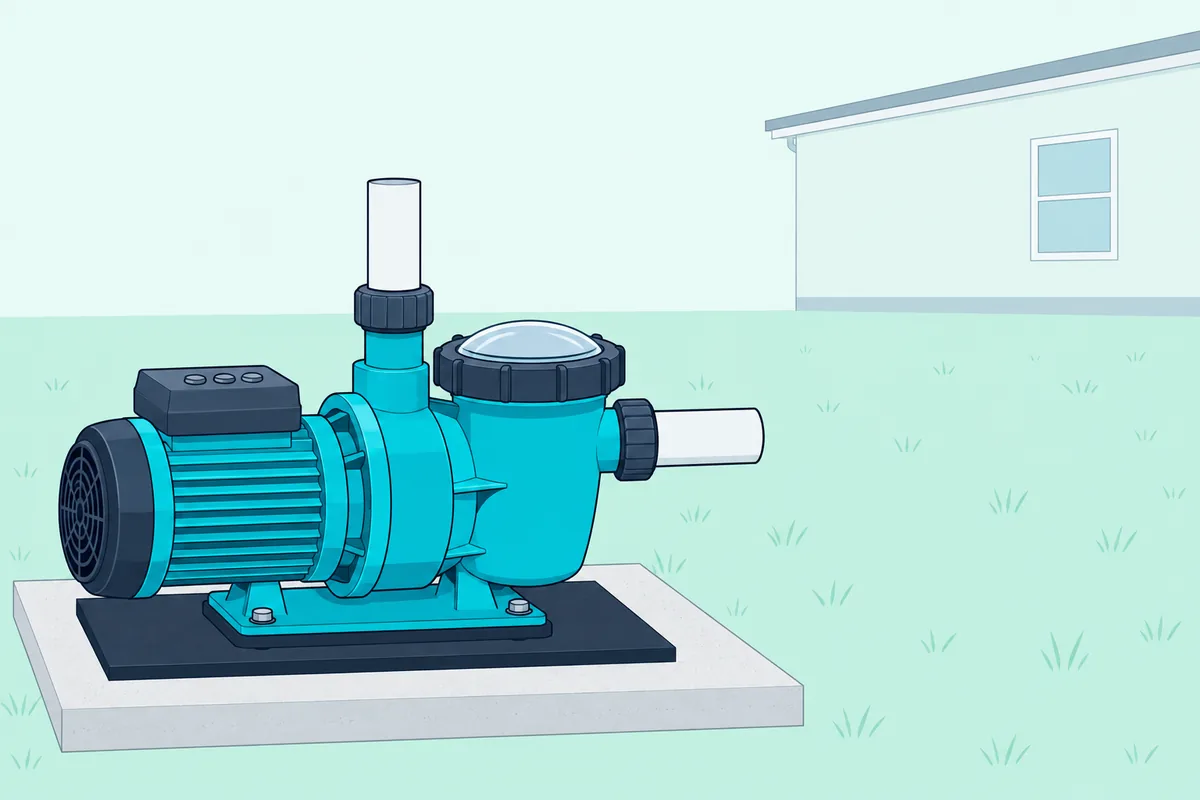
Distance is the free fix. By the FHWA’s 6 dBA rule, moving the pad from 10 feet to 20 feet from a window lowers the level at that window by about 6 dBA.
Plumbing pulls the other way, so the pad can’t go just anywhere. Hayward wants the pump as close to the pool as practical with a short, direct suction pipe, and Pentair’s SuperFlo VS guide sets a minimum of 5 feet from the pool’s inside wall.
The workable compromise is a pad near the pool and far from the house. That keeps the suction run short and puts the motor’s fan where nobody sleeps.
Other machines on the pad add their own noise, too. The FHWA’s primer says two equal sources add 3 dB, so silencing a pump that sits beside an equally loud heat pump lowers the total by only about 3 dB.
Hayward’s UK site points to full-inverter heat pumps for that half of the problem. It says they adapt to outdoor conditions without fits and starts, so their noise is reduced.
Don’t box the pump in to quiet it without checking its manual. Pentair’s SuperFlo VS and IntelliFlo3 guides say not to install the pump within an outer enclosure unless it’s marked accordingly, while Hayward allows one only with adequate ventilation and free circulation of air.
Will a New Pump Fix a Pump That’s Already Loud?
Placement covers a healthy pump, but a pad that has suddenly gotten loud may not need a new one at all. Not if the noise is a fault, because Hayward’s troubleshooting list puts noisy pumps down to air leaks and cavitation on the suction side, poor mounting, debris hitting the impeller and worn motor bearings.
A new pump inherits some of those causes. Hayward’s help page traces cavitation to an undersized suction pipe or too little back pressure, so a replacement on the same plumbing can cavitate just like the old one.
Our guide to why a pool pump gets loud matches each of those sounds to its fix. It’s worth reading before you order, since a loose mount or a clogged basket costs far less than a pump.
Pentair adds one cause that only a variable-speed pump can have. When its IntelliFlo3 is noisy, the guide’s troubleshooting table lists motor speed too high and says to consider reducing the speed if possible.
Worn bearings are the motor’s own noise. Hayward’s manuals list normal wear, rust and overheating among the causes, and describe chemicals damaging the seal, letting chlorinated water seep into the bearings and wipe out the grease until the bearing whines.
That whine points at the motor itself, and Hayward’s help page recommends replacing the bearings or the entire motor through an authorized dealer. So even then, new bearings or a new motor may do instead of a whole new pump.
What Warranty Comes With a Pump Bought Online?
Once a new pump is the answer, where you buy it changes what the maker covers. Usually one year, parts only: Pentair gives products bought on the internet, including from its authorized online resellers, a one-year parts-only warranty, and Hayward lists one year of parts and no labor for its Open Line TriStar VS (Pentair).
Pentair’s warranty page also leaves labor out for internet purchases. Its TradeGrade policy goes further, limiting a TradeGrade product sold online to a 60-day limited warranty.
That’s why the Pentair cards link the EC versions, the models Pentair makes for e-commerce sales. Pentair gives the SuperFlo VST its TradeGrade designation, and the WhisperFlo VST sell sheet places that pump in the Trade Grade family made for pool professionals.
Bought through a pool professional, the same makers offer more. Hayward’s sell sheets promise 3+ year parts and labor warranties when a Totally Hayward partner sells the pump, and Pentair’s three-year bundle covers parts and labor on qualifying equipment bought from a store, builder or service company.
Installation affects the warranty too. Pentair says a product that requires professional installation but isn’t professionally installed gets a one-year parts-only warranty, and Hayward’s manuals say the pump should be installed and serviced only by a qualified professional.
So the quiet pump with the best paper record can still be the wrong buy if no one local will install it. Price the installation alongside the pump, keep the receipt, and register a Pentair pump, since its warranty page says registration activates the coverage.
What About a Quiet Pump for an Above-Ground Pool?
Those inground warranties assume a hard-plumbed pad, and above-ground pools follow different rules. Look for a corded variable-speed pump made for above-ground use, such as Hayward’s PowerFlo VS 300, which Hayward says gives incredibly quiet operation, especially at lower, energy-saving speeds.
Hayward lists the PowerFlo VS 300 at 1.1 total horsepower on 115 volts with a cord, a built-in controller with an LED screen and keypad, and a 10.7 weighted energy factor. It sells the pump as an Expert Line product, which means buying it through a local pool professional or in a store, with a two-year parts warranty.
Aquastrong’s PSP150PM is the online alternative for pads with a 220-volt supply. It fits above-ground or inground plumbing with 1.5- or 2-inch connections, runs four programmable speeds from 1,200 to 4,000 RPM, and Aquastrong recommends professional installation because it needs manual wiring.
That 1,200 RPM floor sits higher than the inground pumps above, and Aquastrong’s own caution about the top speed applies here. Run it at the lowest speed that keeps the water moving over the skimmer, and save the fast settings for vacuuming.
Whatever you choose, the placement rules from the pad section apply just the same, rubber mat and distance included.
What Should You Check Before You Buy?
Whichever pool you have, the same short checklist sorts a quiet pump from a quiet claim. Start with the motor and the speed range, since those decide how slowly the pump can run.
- A variable-speed motor with a low floor: 300 RPM for the SuperFlo VS, 450 for the WhisperFlo VST and 600 for the TriStar VS.
- A totally enclosed fan-cooled motor, which Hayward and Pentair list for every pump here.
- Any decibel figure with its speed, flow and distance, or else treat it as a claim.
- The voltage at your pad: these Hayward and Pentair pumps take 115 or 230 volts, while Aquastrong’s PSP150PM needs 220.
Then check the fit, so the quiet pump doesn’t arrive needing a replumb.
- Port size: the WhisperFlo VST has 2-inch ports, and the TriStar VS uses 2-inch by 2.5-inch CPVC unions.
- Automation: the TriStar VS runs on its own, with Hayward automation or through relay control from other systems.
- The warranty from the seller you’re actually buying from, online or local.
- ENERGY STAR certification, since Hayward and ENERGY STAR both point to local utility rebates for certified pumps.
Keep the box until the pump runs quietly at your chosen speed. A return is easier than a replumb.
The Bottom Line
Buy the Hayward TriStar VS 1.85 HP for most inground pools, because it pairs a permanent magnet, fan-cooled motor with a 600 RPM floor, and Hayward’s Australian figures show the TriStar family reaching the same flow slower and quieter than the MaxFlo. Choose the Pentair WhisperFlo VST when the pool needs more power, and the Pentair SuperFlo VS for a smaller pool or a Super Pump swap.
Whichever you buy, the quiet comes from running it slowly, bolting it to a solid pad and keeping the motor’s fan away from the bedrooms.
Frequently Asked Questions
Are variable-speed pool pumps quieter?
Yes. ENERGY STAR says variable-speed pumps are quieter, need less maintenance and last longer, and Hayward’s manuals list quiet operation among the benefits of running at low speeds. The gain comes from the slow speeds, so a variable-speed pump set to run fast all day loses most of it.
How many decibels is a quiet pool pump?
Few makers say. Hayward’s Australian manuals list 46 dBA for the TriStar VS at 1,100 RPM and 52.7 dBA for the MaxFlo VS at 1,450 RPM, at about 120 liters a minute, without a measuring distance. Pentair’s discontinued IntelliFlo VS was quoted “as low as 45 decibels,” also without a distance. Compare any figure only with another taken at the same distance, speed and flow.
What makes a pool pump quiet?
A motor that can turn slowly, a totally enclosed fan-cooled design and a solid, level mounting. Hayward and Pentair both pair permanent magnet motors with variable-speed drives, and Pentair’s SuperFlo VS guide adds an integral volute and pot that reduce hydraulic noise. Placement finishes the job: Hayward warns that the motor’s cooling fan can be heard, so keep it away from bedroom windows.
How long should a variable-speed pool pump run each day?
Long enough to filter all the water at least once every 24 hours, which is Hayward’s recommendation, and longer at low speeds. Pentair’s default schedule for the SuperFlo VS runs 14 hours a day, 10 of them at 1,400 RPM. Check your local rules for the minimum turnover rate, as Hayward’s manuals advise, and confirm that water still flows over the skimmer weirs at your chosen speed.
Can you make an existing pool pump quieter?
Often, yes. Lowering the speed on a variable-speed pump, securing it to a level pad and adding a rubber mat are the makers’ own suggestions, and Hayward’s UK site warns against setting a variable-speed pump on a concrete block. Check for faults first, because air leaks, cavitation, debris and worn bearings make noise that no mat or barrier will stop.
Is the quietest pool pump also the most efficient?
Usually the two go together, because both come from running slowly. ENERGY STAR says halving a pump’s speed lets it use one-eighth as much energy, and Hayward’s TriStar VS product page cites ENERGY STAR test data to call the TriStar VS family the most energy efficient on the market. Efficiency ratings measure energy, though, not sound.