Best 4 Channel DJ Controller Picks for Laptop and Standalone DJs
Choosing the best 4 channel DJ controller starts with your software, because four faders only pay off when the program behind them plays four decks.
Buy on channel count alone and you can end up with a controller that unlocks the wrong program, or one with nowhere to plug in the turntables you already own.
Match the software, the inputs and the outputs to how you play, and the extra channels turn into layered blends, stems and outside decks that stay under your hands.
The picks below are compared on what their makers publish: the software each one unlocks, its phono and line inputs, its outputs, its jog wheel screens and its size.
The short list comes first, then the software, input, output, screen and size questions that decide which one fits your setup.
What Is the Best 4 Channel DJ Controller?
That depends on your software, but the Pioneer DJ DDJ-FLX10 is the best 4 channel DJ controller on paper for most laptop DJs. Pioneer DJ calls it a 4-channel performance controller for rekordbox and Serato DJ Pro with free plug-and-play use of both, STEMS controls for vocals, drums and other instruments, and LINE/PHONO inputs for turntables on channels 3 and 4 (Pioneer DJ).
Each of the others fits a narrower setup:
| Pick | Software it unlocks, per the maker | Turntable or player inputs | Main and booth outputs | Weight | Best for |
|---|---|---|---|---|---|
| Pioneer DJ DDJ-FLX10 | rekordbox, Serato DJ Pro | 2 LINE/PHONO, 2 LINE | XLR and RCA master, TRS booth | 6.7 kg (14.8 lb) | Laptop DJs on either program |
| Rane FOUR | Serato DJ Pro | 2 phono/line | XLR and RCA main, TRS booth/zone | 8.27 kg (18.25 lb) | Serato stems and turntables |
| Rane PERFORMER | Serato DJ Pro | 2 phono/line | XLR and RCA main, TRS booth/zone | 12.8 kg (28.2 lb) | Scratch DJs who want platters |
| AlphaTheta XDJ-AZ | rekordbox, Serato DJ Pro, or USB alone | 2 LINE/PHONO | XLR and RCA master, TRS booth | 13.5 kg (29.8 lb) | Club-style sets without a laptop |
| Denon DJ PRIME 4 G2 | Engine DJ, built in | 2 line/phono | XLR and RCA main, XLR booth and zone | 9.9 kg (21.83 lb) | Standalone sets with stems |
| Roland DJ-707M | Serato DJ Pro | 4 line, 2 phono | XLR and RCA master, TRS booth, RCA zone | 3.5 kg (7 lb 12 oz) | Mobile and event DJs |
The makers name their jacks in different ways, so read the input column against the gear you plan to plug in, not just the count.
Every pick met Burton Acoustix’s rating, review and stock checks on 29 October 2026. Nothing here was played or measured, and the descriptions come from the makers’ pages, manuals and support FAQs.
If you haven’t settled whether you need two channels or four, start there, because everything below assumes you’ve chosen four.
| Product | Link |
|---|---|
Best Overall 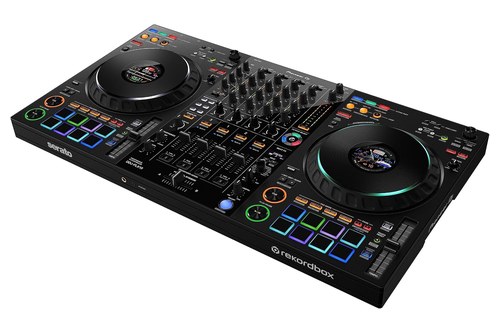 | See ratings |
Best for Serato Stems 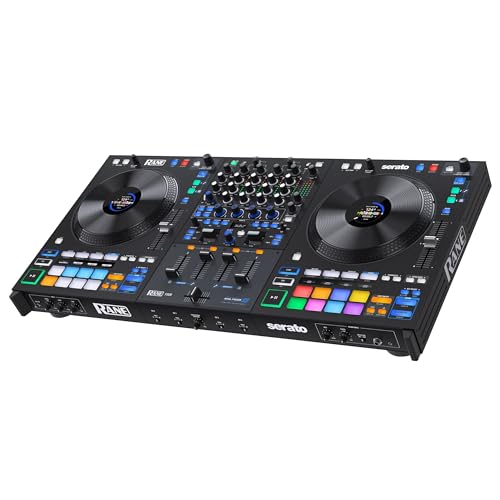 | See ratings |
Best Motorized Platters 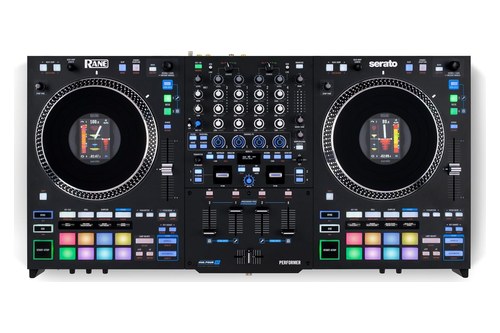 | See ratings |
Best Club-Style All-in-One 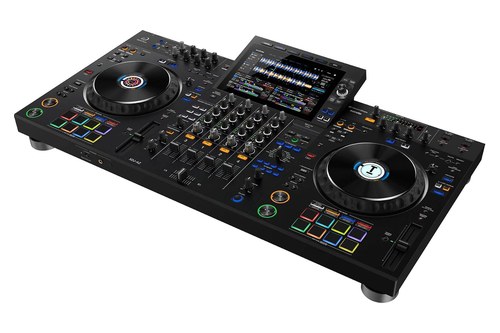 | See ratings |
Best Engine DJ Standalone 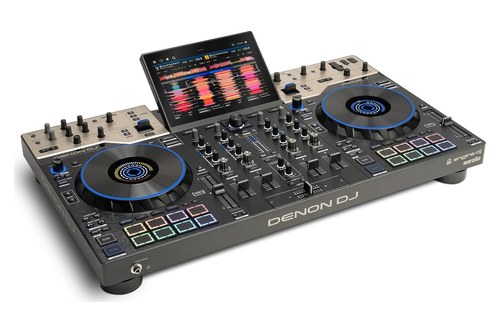 | See ratings |
Best for Mobile DJs 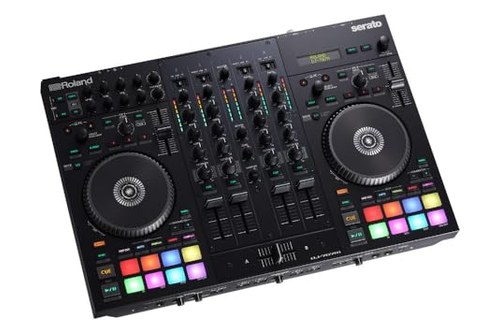 | See ratings |
Which 4-Channel DJ Controller Should You Buy?
The table sorts the picks by setup, and the notes below add what each maker’s documents say about software, inputs, screens and size. Buy by the program you use and the gear you’ll plug in: the FLX10 for rekordbox or Serato on a laptop, a Rane for Serato stems or platters, the XDJ-AZ or PRIME 4 G2 for playing without a laptop, and the DJ-707M for mobile gigs with microphones.
Pioneer DJ DDJ-FLX10
For laptop DJs who use rekordbox, Serato DJ Pro or both, the Pioneer DJ DDJ-FLX10 is the pick.
the Pioneer DJ DDJ-FLX10
Pioneer DJ says it offers free plug-and-play compatibility with both programs, and rekordbox’s Hardware Unlock list gives it Performance mode and lighting control without a subscription. It also works with djay Pro, though Pioneer DJ says that needs a paid djay Pro subscription.
Its manual lists two LINE/PHONO input pairs for channels 3 and 4, with a rear switch set to PHONO for a turntable or LINE for a multi player, plus two LINE pairs for more players. Each channel has its own source switch, so a channel can play a software deck or the gear plugged into it.
On the output side you get a balanced XLR master, an RCA master and a 1/4-inch TRS booth pair, and the two mic inputs are an XLR/TRS combo jack and a 1/4-inch TRS jack. A DMX output drives lighting from rekordbox without a separate interface (Pioneer DJ’s DDJ-FLX10 manual).
The STEMS controls split a regular track into vocals, drums and inst, which Pioneer DJ says covers the other instruments, including bass and synths. Part Instant Doubles moves one of those parts to another deck, which is exactly the kind of job the third and fourth channels exist for.
The jogs carry an On Jog Display with four modes, from deck information and zoomed waveforms to the track’s artwork or your own logo. At 716 by 400.3 millimeters and 6.7 kilograms (14.8 pounds), it’s a desk fixture rather than a backpack controller.
If your home setup runs rekordbox but the bar you play runs Serato, this is one of two picks, with the XDJ-AZ, that unlocks both programs without a subscription.
Rane FOUR
For Serato DJs who want stems under their fingers, the Rane FOUR is the pick.
the Rane FOUR
Serato calls it the first controller designed for control of Serato Stems: dedicated buttons pull the acapella or instrumental of a playing track, and Stem-Split doubles a track across two channels for separate FX and EQ. inMusic’s FAQ says the FOUR unlocks Serato DJ Pro without a license while it’s connected, and that stems come free with Serato DJ Pro from version 3.0.
Its rear panel has two stereo RCA inputs for decks 3 and 4, each switchable between phono and line for turntables, CD or media players (inMusic’s Rane FOUR FAQ). With Serato’s DVS plugin, sold separately, those two decks can also run Serato control vinyl or CDs.
Outputs cover XLR and RCA mains, a 1/4-inch TRS booth/zone pair and 1/4-inch and 1/8-inch headphone jacks. Both mic inputs are XLR/TRS combo jacks with their own gain and two-band EQ, and Mic 1 adds Talkover, which lowers the main mix automatically when you speak.
The 8.5-inch capacitive jog wheels are static, and their center color displays show the playhead, BPM, pitch, key, loop size, the deck in focus and an overview waveform with hot cue markers. Inside sit 22 built-in hardware FX alongside Serato’s own, with two battle-style FX paddles to throw them.
Its Mag 4 crossfader sits under a removable fader plate, so you can adjust its tension or replace it. The 16 RGB performance pads have Pad Mode screens that show what each pad does.
It measures 783.3 by 402.3 millimeters and weighs 8.27 kilograms (18.25 pounds). Outside Serato, inMusic lists VirtualDJ with a Pro license and djay Pro 5.2 or later on Mac and Windows.
Rane PERFORMER
For scratch DJs who want spinning platters on a four-channel mixer, the Rane PERFORMER is the pick.
the Rane PERFORMER
Serato describes it as a 4-channel controller with 7-inch high-torque motorized platters, 3.5-inch LCD wheel displays, a MAG FOUR crossfader and four PRECISION FEEL volume faders. Like the FOUR, it unlocks Serato DJ Pro when it’s plugged in (Serato’s RANE PERFORMER page).
inMusic’s FAQ adds LOW and HIGH torque settings and a set of plastic and felt slip rings to tune how the platter feels. The wheel screens switch between moving waveforms, a progress ring, album art and a library view for loading tracks without looking at the laptop.
Its stems tools go a step past the FOUR’s. Stem Split puts the acapella and the instrumental on two mixer channels, and Stem Level turns each channel’s three EQ knobs into vocal, melody and bass, and drum controls (inMusic’s Rane PERFORMER FAQ).
Two phono/line RCA inputs serve decks 3 and 4, and two USB B ports let two computers connect at once for back-to-back changeovers. Outputs match the FOUR’s: XLR and RCA mains, a balanced 1/4-inch TRS booth/zone pair and two headphone sizes.
Its PRECISION FEEL channel faders use the same dual-rail mechanism as the MAG FOUR crossfader, and a front-panel knob sets the crossfader’s tension.
The motors add weight, though: 12.8 kilograms (28.2 pounds) against the FOUR’s 8.27, on the same 783.3 by 402.3 millimeter footprint. VirtualDJ works too, with a Pro license bought separately.
AlphaTheta XDJ-AZ
For DJs who want a club-style booth in one box, the AlphaTheta XDJ-AZ is the pick.
the AlphaTheta XDJ-AZ
AlphaTheta says its layout and feel come from the flagship CDJ-3000 and DJM-A9, with full-size jog wheels, four channels and four-deck playback from USB storage or DJ software. Plug it into a PC or Mac and it runs rekordbox in Performance mode or Serato DJ Pro, with no paid subscription plan needed for either (AlphaTheta).
Without a computer, it plays from two top-loading USB ports and streams Apple Music, Beatport Streaming, Spotify and Tidal through StreamingDirectPlay, though each service needs its own subscription. A 10.1-inch touchscreen shows up to 13 tracks at once, with Playlist Bank, Touch Preview and Touch Cue for faster picking.
Its LINE/PHONO inputs feed decks 3 and 4, where a setting picks the unit’s own deck, a line-level player, a turntable or a Bluetooth device. Outputs are an XLR and an RCA master, a 1/4-inch TRS booth pair and two headphone jacks, and both mic inputs take XLR or 1/4-inch TRS plugs.
The jog display shows the loaded track’s artwork, the loop length and the pad mode, plus Slip, Sync and Vinyl indicators. A third USB port takes a laptop, so a second DJ can plug in while you play.
SonicLink pairs it with AlphaTheta’s HDJ-F10 headphones at the press of one button for wireless monitoring, and a 3-band master EQ tunes the output to the room.
At 895 by 504.1 millimeters and 13.5 kilograms (29.8 pounds), it’s the largest and heaviest pick here. AlphaTheta fits grab handles for carrying the single unit.
Denon DJ PRIME 4 G2
For DJs who want to leave the laptop at home and still use stems, the Denon DJ PRIME 4 G2 is the pick.
the Denon DJ PRIME 4 G2
Denon DJ calls it a 4-channel standalone DJ system with built-in FX, lighting output and stems, and it renders stems on the unit itself, with dedicated Instrumental and Acapella buttons, Stem FX and Stem Level EQ (Denon DJ). Its 16 MPCe pads sense velocity and pressure and pack several functions into each pad for hot cues, stems, rolls, FX and lighting.
It plays from USB drives, SD cards and an optional internal SATA drive, and its Wi-Fi streams Amazon Music Unlimited, Apple Music, Beatport, SoundCloud Go+ and TIDAL. Denon DJ’s FAQ says it also reads rekordbox-exported drives natively, with their playlists and hot cues.
Channels 3 and 4 take line or phono RCA pairs, and its outputs are the widest spread here: two XLR Main, an RCA Main pair, two XLR Booth and two XLR Zone, plus a 3-pin DMX output for lighting. Both mic inputs are XLR and 1/4-inch combo jacks, and Mic 2 doubles as an instrument input.
The 8-inch jog wheels carry LED displays, and its 10.1-inch HD touchscreen puts the performance tools front and center. Denon DJ lists 762 by 497.1 millimeters and 9.9 kilograms (21.83 pounds).
An 8-core ARM processor and 4 GB of RAM give it four times the processing power of the previous generation, Denon DJ says, for faster library browsing and onboard stems.
The catch is software. Denon DJ’s FAQ says Serato DJ Pro, djay and VirtualDJ support is anticipated in future updates, with no computer drivers at launch, so for now it’s an Engine DJ machine (Denon DJ’s PRIME 4 G2 FAQ).
Roland DJ-707M
For mobile and event DJs who also run the microphones, the Roland DJ-707M is the pick.
the Roland DJ-707M
Roland’s owner’s manual calls its mixer section a four-channel mixer, and Serato lists it as a 4-channel controller that unlocks Serato DJ Pro, with Serato DVS as a paid upgrade (Roland’s DJ-707M Owner’s Manual). Its INPUT jacks feed channels 1 to 4, and the channel 1 and 2 jacks take phono input from MM-type cartridges.
Roland built it for the whole gig. Master, booth and zone outputs each get loudspeaker management with four-band EQ, multiband compression and a limiter, and built-in feedback suppression listens for feedback and adjusts the output.
Switch the front aux inputs to MIC and you get up to four mic inputs. Each mic gets its own gain, low-cut and noise gate, three-band EQ and effects, from reverbs and delays to auto-pitch and auto-ducking (Roland).
Two USB ports take two computers, for a backup laptop or a smooth DJ changeover, and the zone output can carry a separate mix to another room or a videographer. Deck 3 hides a TR drum machine, and deck 4 an oscillator for sweepers and synth stabs.
Its 10 onboard scenes store routing, loudspeaker management and system settings, so the setup for a venue you play often comes back with one recall.
At 474 by 331 millimeters and 3.5 kilograms (7 pounds 12 ounces), it’s the smallest pick here. Roland lists one display, a backlit LCD with two lines of 16 characters.
Which Software Does Each Controller Unlock?
Those notes keep coming back to software, and that’s the first filter for any four-channel controller. Each pick unlocks its own set for free: the FLX10 and XDJ-AZ unlock rekordbox’s Performance mode and Serato DJ Pro, the FOUR, PERFORMER and DJ-707M unlock Serato DJ Pro, and the PRIME 4 G2 runs Engine DJ on its own.
rekordbox’s Hardware Unlock page says Performance mode gives you up to four decks, 16 samplers and the effects, and it lists the FLX10 for lighting control as well (rekordbox). The same table lists the XDJ-AZ for Performance mode.
Serato’s 4 Deck Mode plays up to four tracks at once on supported hardware, and its stems separate vocals, melody, bass or drums in real time (Serato DJ Pro). Serato DVS for control vinyl is a paid extra on the FOUR, PERFORMER, DJ-707M and FLX10, per Serato and the makers.
VirtualDJ works differently. Its license chart allows USB and MIDI controllers on the Pro and Business licenses, with entry-level controllers only on Home (VirtualDJ).
Its hardware manuals say the FLX10 and the PERFORMER need a Pro Infinity or Pro Subscription license to work fully, and that without one the controller runs for 10 minutes each time VirtualDJ restarts. inMusic says the FOUR needs a VirtualDJ Pro license too.
Engine DJ is the PRIME 4 G2’s own system. Denon DJ’s FAQ says the Engine DJ desktop app imports iTunes/Music, Serato DJ, rekordbox and Traktor libraries, then exports them to a drive for the unit.
djay Pro covers two of the picks. Pioneer DJ supports it on the FLX10 with a paid djay Pro subscription, and inMusic lists djay Pro 5.2 or later for the FOUR on Mac and Windows.
Here’s a real scenario. If your library already lives in rekordbox and you want to play from a USB stick, two standalones fit: the XDJ-AZ, and the PRIME 4 G2, which Denon DJ says reads rekordbox-exported drives natively.
If Serato is home base, the two Ranes and the DJ-707M all unlock Serato DJ Pro, and our Serato-first controller roundup covers two-channel options too.
Can You Plug Turntables or Media Players Into a 4-Channel Controller?
Software decides the virtual decks, but channels 3 and 4 are also where outside gear comes in. Yes, every pick here takes at least two outside sources: the FLX10, FOUR, PERFORMER, XDJ-AZ and PRIME 4 G2 put phono/line RCA inputs on channels or decks 3 and 4, and the DJ-707M takes phono on channels 1 and 2 and line on all four.
Set each input to phono for a turntable and to line for a CD or media player, because a turntable’s MM cartridge sends a much weaker signal. Pioneer DJ’s FLX10 specifications show the gap: a standard input level of -52 dBu for PHONO against -12 dBu for LINE.
Many turntables also have a ground wire, and the makers give it a place. The FLX10 has a SIGNAL GND terminal, the FOUR a GND screw, the XDJ-AZ a signal GND terminal and the DJ-707M a PHONO GROUND terminal.
With control vinyl, those same inputs run the software instead. inMusic says that with Serato’s DVS plugin, decks 3 and 4 on the FOUR and the PERFORMER can be controlled with Serato control vinyl or CDs.
Not every four-deck unit works this way. Denon DJ’s user guide lists one RCA aux input for the SC LIVE 4, set by a Mic 2/Aux switch and the Aux/Mic 2 level knob, and no phono input (Denon DJ’s Engine DJ user guide).
Count your outside gear before you choose. Two turntables fill channels 3 and 4 on most picks, which leaves channels 1 and 2 for software decks, while the FLX10 and DJ-707M can take line players on every channel.
That’s the difference between a four-deck mix and a hybrid booth: a laptop on two channels and records on the other two. The DJ-707M flips the usual layout, with its phono jacks on channels 1 and 2.
Do the Effects Live in the Hardware or the Software?
That split matters as soon as a turntable or player sits on a channel, because software effects can’t always reach it. Some can and some can’t: inMusic says Serato’s Channel FX work on software decks but have no effect on a channel set to Line, though the Filter still works, and the FOUR and PERFORMER carry their own FX engines with 22 and 29 built-in effects.
The PRIME 4 G2 draws a similar line. Denon DJ’s FAQ says its Sweep FX work on external line and phono sources and its BPM FX can be assigned to them, but beat-synced effects may need manual adjustment because outside sources carry no analyzed BPM, and Touch FX stay on the internal decks.
Roland puts hardware effects on every channel of the DJ-707M. Each channel’s Filter/FX knob can take Filter, Dub Echo, Jet, Noise, Reverb, Delay, Bit Crush, Phaser or Noise 2, and its stand-alone mode keeps those knobs working without Serato DJ Pro.
The FLX10 and XDJ-AZ come from the DJM side of the family. Serato lists 6 Sound Color FX and 14 Beat FX on the FLX10, and AlphaTheta lists the same counts on the XDJ-AZ, with DUB ECHO, NOISE, SWEEP, FILTER, SPACE and CRUSH as its Sound Color FX.
Here’s what that means at a party. If you’ll scratch a record on channel 3 and want an echo on it, make sure the effect you rely on runs in the hardware, or on a channel the software can process.
What Outputs and Mic Inputs Do Gigs Need?
Those effects shape the sound on its way through the mixer, but the outputs decide where it can go once you’re at a gig. A gig needs a balanced master for the PA and a booth output for your monitor, and every pick has an XLR master and a booth output, while the PRIME 4 G2 and DJ-707M add a separate zone output for a second room.
Pioneer DJ’s manual explains why the XLR master matters. It says to use the FLX10’s XLR MASTER 1 terminals as balanced outputs, because an XLR-to-RCA converter into an unbalanced input may lower the sound quality or add noise, and to use the RCA MASTER 2 terminals for RCA inputs instead.
Zone outputs earn their place at weddings and events. Denon DJ’s FAQ says the PRIME 4 G2’s zone output carries the master mix by default, or a separate playlist from deck 4 for another room.
Roland suggests the DJ-707M’s zone output for a videographer’s feed, a different area of the venue or a subwoofer. On the FOUR and the PERFORMER, the 1/4-inch output is a combined booth/zone pair.
Mic inputs split the field more. Most picks have two, on combo jacks that take XLR or 1/4-inch plugs, while the FLX10 pairs one combo jack with one 1/4-inch TRS jack and the DJ-707M reaches four once its aux inputs are switched to MIC.
The details matter for speeches. Talkover on Mic 1 of the FOUR and the PERFORMER lowers the main mix when you speak, and the DJ-707M adds auto-ducking and feedback suppression.
The PERFORMER’s Mic 1 also has its own echo knob. Denon DJ lets the PRIME 4 G2’s Mic 2 switch to an instrument mode.
Try this before a gig: list every cable the venue’s system needs, from the PA’s XLR inputs to the booth monitor and any second room. Then check that the controller has a separate output for each, so you’re not splitting one master with adapters.
For the hookup itself, our walkthrough on connecting a controller to PA or studio speakers goes through it step by step.
How Do Two DJs Share One 4-Channel Controller?
Gigs often come with a second DJ, and the USB ports decide how smooth the handover is. Three of the laptop picks take two computers at once: VirtualDJ’s manual for the FOUR says its two USB ports connect up to two computers, inMusic says the PERFORMER’s two USB B ports serve back-to-back transitions, and Roland says the DJ-707M takes two computers for a backup laptop or a seamless changeover.
On the FOUR, SOURCE switches on the top panel pick which USB port each channel plays. So the next DJ can plug in and cue on one channel while your last track plays out on another.
The two standalones do it with storage instead. AlphaTheta says the XDJ-AZ’s three USB inputs, two top-loading ports for drives and one for a laptop, let you perform back-to-back and hand over smoothly.
Denon DJ’s FAQ lists three USB media inputs on the PRIME 4 G2, plus an SD card slot. A guest DJ can bring a drive and load from it while you’re still playing from yours.
Serato lists dual USB Type-C ports on the FLX10 as well. Roland adds another use for the DJ-707M’s USB B port: it works as a standard audio interface with an iOS device, for streaming a set to social media or playing a mix from a phone.
Say the next DJ plays Serato on their own laptop. Plug it into the second port before your last track, switch their channels to it, and the dance floor never hears a gap.
Can a 4-Channel Controller Run Your Lights Too?
Bigger events can bring a light show as well, and two picks drive lights without an extra box. The FLX10 and PRIME 4 G2 both have a DMX output: Pioneer DJ says the FLX10’s works with rekordbox’s Lighting function with no external DMX interface, and Denon DJ gives the PRIME 4 G2 a 3-pin DMX output with Engine Lighting built in.
Pioneer DJ says rekordbox can build custom lighting effects or set the lights to follow the color and movement of the music automatically. rekordbox’s Hardware Unlock table lists lighting control for the FLX10, while for the XDJ-AZ it lists Performance mode only.
On the PRIME 4 G2, a Lighting pad mode puts SoundSwitch controls for color, position, strobe, intensity, Auto Loops and Static Looks on the MPCe pads. Denon DJ also lists onboard support for Philips Hue and Nanoleaf smart lights.
Count your fixtures’ DMX channels before you add more lights. Both the FLX10 and the PRIME 4 G2 list one DMX universe of 512 channels.
Denon DJ’s SC LIVE 4 runs Engine Lighting too, with Philips Hue, Nanoleaf and DMX lighting, though it isn’t one of the four-channel picks here.
Do Jog Wheel Displays Matter With Four Decks?
Lights follow the music, but your eyes follow the jog wheels, especially when each wheel controls two decks. They matter most when a wheel switches between decks, because the display tells you which deck you’re touching: the FOUR’s screens show the deck in focus, the PERFORMER’s Progress Ring view shows the deck number and the FLX10’s Deck Info mode shows information about the deck.
Here’s a real scenario. You’re riding a blend on decks 1 and 2 and switch the left side to deck 3 to cue an acapella; a wheel that shows the deck number tells you which track you’re about to move.
The two Ranes go furthest. inMusic lists the FOUR’s center color displays as showing the playhead position, track progress, BPM, beat jump length, pitch, key, time, loop size and an overview waveform with hot cue markers.
The PERFORMER puts a high-definition 3.5-inch LCD in the center of each motorized platter. It switches between moving waveforms, a progress ring, album art and a library view that appears when you turn the browse encoder.
Scratch DJs get one more touch there: an optional needle marker on the PERFORMER’s screens, switched on or off from the utility menu, with platter stickers in the box as well.
The FLX10’s On Jog Display has four modes. Deck Info shows the deck and its overall waveform, Waveform mode shows zoomed waveforms for two decks, and the other two show artwork or your own logo.
The XDJ-AZ’s jog display shows the loaded track’s artwork, the loop length or the pad mode, a playback point and Slip, Sync, Vinyl and Master indicators. The wheel itself measures 206 millimeters, which AlphaTheta says feels just like the CDJ-3000’s.
Denon DJ gives the PRIME 4 G2’s 8-inch wheels an RGB LED array of 60 LEDs per display. Its FAQ says the display gives feedback on the current play state of the track.
Screens on the wheels don’t replace the main screen, though. The XDJ-AZ and PRIME 4 G2 both add a 10.1-inch touchscreen, while the four laptop controllers leave the full waveforms and the library on your computer’s screen.
Should Your 4-Channel Controller Work Without a Laptop?
All that wheel information comes from software running somewhere, and two picks carry their own. Go laptop-free if you’ll play from USB drives or streaming: the XDJ-AZ and PRIME 4 G2 run four decks on their own, while the FLX10, FOUR and PERFORMER are built as controllers for DJ software on a computer.
The XDJ-AZ reads two USB drives from its top panel and streams through Wi-Fi. rekordbox CloudDirectPlay pulls your cloud library straight to the unit, and AlphaTheta says it lets you do all your preparation on the XDJ-AZ itself, though it needs a rekordbox Creative or Professional plan, or the Cloud Option.
The PRIME 4 G2 adds an SD card slot and a bay for an internal SATA drive. Denon DJ’s FAQ recommends a solid-state drive in that bay, especially for stems.
Bluetooth audio goes further on the Denon. Its FAQ says a phone or tablet streaming over Bluetooth can be assigned to any mixer channel and mixed with the fader, EQ and crossfader like any other input.
The PRIME 4 G2 still starts on a computer for prep. Denon DJ’s FAQ says to download the Engine DJ desktop software and import your music there to analyze it before exporting it to your drive.
The DJ-707M sits in between. Roland’s manual says its mixer section works when Serato DJ Pro isn’t running, which it calls stand-alone mode, so turntables or players on its inputs can still be mixed with the trim, EQ, faders and crossfader.
Denon DJ’s SC LIVE 4 is another laptop-free route. Denon calls it a 4-deck standalone controller with a 7-inch touchscreen and built-in speakers, and in Computer Mode it controls Serato DJ, with a Pro license included (Denon DJ).
For more units that skip the computer, including two-channel ones, see Burton Acoustix’s standalone DJ system picks.
Here’s the test. If you’ll prepare tracks on a laptop anyway and like seeing the library on a big screen, a laptop controller loses nothing; if you want to arrive with a USB stick and plug into the house PA, look at the XDJ-AZ and the PRIME 4 G2.
How Do Stems Change What Four Channels Can Do?
Standalone or not, stems are the newest reason to want the extra channels. Stems split one song into parts you can mix like separate tracks, and four channels give those parts their own faders: inMusic says Rane’s Stem-Split puts a track’s vocal stems on decks 1 and 2 and its instrumental on decks 3 and 4, each controlled by its own channel fader, EQ and FX.
Say you want the vocal from the track that’s playing over the beat of the next one. With Stem-Split, the acapella stays on its channel while you bring the instrumental down on the other, then blend in the new track on a third.
Pioneer DJ’s version on the FLX10 works by part. ACTIVE PART and PART ISO adjust or mute vocals, drums or inst, FX PART SELECT picks which parts the effects hit, and PART INSTANT DOUBLES sends one part to another deck.
The PERFORMER adds Stem Level, which turns a channel’s HIGH knob into vocal, MID into melody and bass, and LOW into drums. Hold SHIFT and that channel’s CUE button to switch it on or off.
Both Ranes also have a dedicated Stems pad mode, so the stems sit on pads without giving up another pad mode. inMusic adds dedicated buttons for an instant acapella or instrumental on each.
The PRIME 4 G2 renders stems on the unit, so a track doesn’t have to be prepared on a computer first. Denon DJ adds dedicated Instrumental and Acapella buttons, Stem FX and Stem Level EQ.
The software side matters here too. inMusic says stems come free with Serato DJ Pro from version 3.0 and separate any loaded song in real time, so no specially formatted stem files are needed.
That stems work is also the clearest case for four channels over two. One track can take up two channels, which leaves the other two for the track you’re mixing into.
Will a 4-Channel Controller Fit Your Desk and Your Car?
All those extra controls take up room, and the size gap between the picks is wide. Measure first, because the picks run from Roland’s 474-millimeter DJ-707M at 3.5 kilograms to AlphaTheta’s 895-millimeter XDJ-AZ at 13.5 kilograms.
In between, the FLX10 is 716 millimeters wide and 6.7 kilograms, the PRIME 4 G2 762 millimeters and 9.9 kilograms, and both Ranes 783.3 millimeters. The FOUR weighs 8.27 kilograms and the PERFORMER 12.8, which is the cost of its motors.
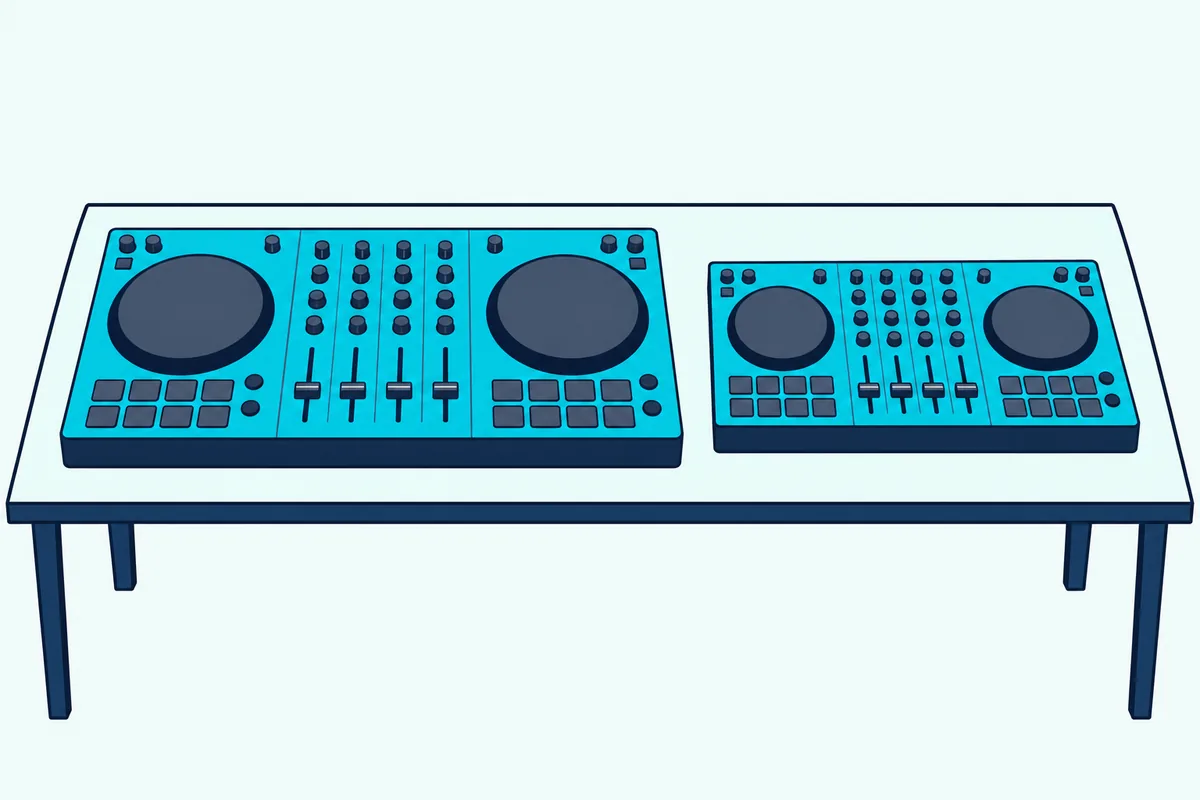
Depth matters as much as width on a desk. The XDJ-AZ runs 504.1 millimeters deep and the PRIME 4 G2 497.1, against 402.3 for the Ranes, 400.3 for the FLX10 and 331 for the DJ-707M.
Height decides the bag. The FLX10 and DJ-707M stand about 73 millimeters tall, the FOUR 103.6, the PRIME 4 G2 104.9 and the PERFORMER 109.7, while the XDJ-AZ reaches 133.4.
For scale, Pioneer DJ’s two-channel DDJ-FLX4 is 482 millimeters wide and 2.1 kilograms. So the FLX10 is about 23 centimeters wider and 4.6 kilograms heavier.
Try this before you order: mark the controller’s width and depth on your desk with tape, then add room for a laptop stand beside it if you’ll use one. A unit that hangs over the edge won’t sit flat, and jog wheels need a stable surface.
Then think about the trip. Roland pitches the 3.5-kilogram DJ-707M at tight DJ booths and gigs without an equipment van, while the XDJ-AZ and PERFORMER weigh 13.5 and 12.8 kilograms, and AlphaTheta fits the XDJ-AZ with grab handles to make carrying it easier.
Why Did Some Well-Known 4-Channel Controllers Miss the List?
Size narrows the field by setup, but the listings narrowed it further. Several well-known four-channel models missed it: AlphaTheta’s DDJ-GRV6 and Reloop’s Mixon 8 Pro fell short of the rating minimum, and Pioneer DJ’s OPUS-QUAD fell short of the review minimum.
Both of the Pioneer DJ and AlphaTheta models appear on rekordbox’s Hardware Unlock page for Performance mode, so they’re worth checking again later. Native Instruments’ Traktor Kontrol S4 MK3 and S3 listed a 10 to 11 day shipping wait on the day.
The SC LIVE 4 sits in the laptop-free section above rather than in the picks. Denon DJ calls it a 4-deck standalone controller with Layer buttons for its four decks, and the picks are units their makers or Serato describe as four-channel.
If one of the picks sells out, the same checks apply to whatever replaces it: the software it unlocks, its phono and line inputs, its outputs and its size.
The Bottom Line
The DDJ-FLX10 is the strongest all-rounder on paper for laptop DJs, because it unlocks both rekordbox and Serato DJ Pro and takes players on all four channels and turntables on two. The Rane FOUR and PERFORMER are the Serato stems and platter picks, the XDJ-AZ and PRIME 4 G2 drop the laptop, and the DJ-707M packs the most mic and output control into the smallest box; for what the extra channels do in the first place, see what a 4-channel controller actually adds.
Frequently Asked Questions
Is a 4-channel DJ controller worth the price?
It’s worth it when you’ll use the third and fourth channels, for turntables, stems or a third track. Every pick here takes at least two outside sources, and Rane’s Stem-Split puts one track’s vocal and instrumental on two channels; if you only blend two tracks, Pioneer DJ’s two-channel DDJ-FLX4 does that in 482 millimeters against the FLX10’s 716.
What’s the best 4-channel DJ controller for beginners?
The DDJ-FLX10 is the easiest start among these, because it unlocks both rekordbox’s Performance mode and Serato DJ Pro for free, so you can try both programs on one controller. Its LINE/PHONO inputs also leave room to add a turntable later.
Which 4-channel DJ controller works best with Serato?
The Rane FOUR, if stems are why you want four channels, since Serato calls it the first controller designed for Serato Stems. The Rane PERFORMER adds motorized platters, and the DDJ-FLX10 and Roland DJ-707M also unlock Serato DJ Pro when they’re plugged in.
Do these 4-channel controllers work with rekordbox?
The DDJ-FLX10 and XDJ-AZ do: rekordbox’s Hardware Unlock page lists both for Performance mode, and their makers say no paid plan is needed. The PRIME 4 G2 takes a different route: Denon DJ says it reads rekordbox-exported USB and SD drives natively, with their playlists and hot cues.
Can you plug CDJs into a 4-channel DJ controller?
Yes, into the line inputs, with the input switch set to line rather than phono. Pioneer DJ’s FLX10 manual says to set its LINE/PHONO switch to LINE for a multi player, and AlphaTheta says the XDJ-AZ works alongside CDJs over PRO DJ LINK, with beat and on-air information synced across the players.
Which 4-channel controller suits mobile and wedding DJs?
The Roland DJ-707M, for the microphones and outputs. It takes up to four mics, adds feedback suppression and auto-ducking, and gives its master, booth and zone outputs their own loudspeaker management; the PRIME 4 G2 is the laptop-free alternative, with XLR Main, Booth and Zone outputs and two combo mic inputs.
Can you use a 4-channel controller without a laptop?
Yes, with the XDJ-AZ or PRIME 4 G2, which play four decks from USB drives or streaming services on their own. The DJ-707M’s mixer section also keeps working when Serato DJ Pro isn’t running, which Roland calls stand-alone mode, so turntables or players plugged into it can still be mixed.