Is Acrylic Good for Soundproofing? What the Makers’ Tables Say
The honest answer to “is acrylic good for soundproofing” sits in the makers’ own tables: a single sheet rates STC 24 to 35 by thickness, below glass of the same thickness and nowhere near a wall.
Tape a thin sheet over a window and you still hear the low rumble of traffic, because a light panel barely slows the long waves that carry it.
Set that sheet a few inches in front of the glass with a sealed edge and the picture changes, since tested inserts lift a window from the mid-20s to STC 37 and beyond.
This guide puts Plaskolite’s numbers and the Plexiglas tables beside Guardian’s glass table, uses a Canadian building research digest to explain the mass rule, and marks where acrylic wins and where it fails.
Start with the rating ladder, because it decides whether a sheet on its own can ever be enough for your noise.
Is Acrylic Good for Soundproofing?
That ladder comes from the sheet makers themselves, and it starts low.
On its own, an acrylic sheet is a modest barrier: Plaskolite’s OPTIX acoustic sheet data sheet rates 6 mm at STC 24, 12 mm at STC 26 and 20 mm at STC 30, and the Plexiglas table on ePlastics’ sound transmission page runs from STC 25 at 0.118 inch to 35 at 0.944 inch.
Andersen’s sound abatement guide gives those numbers a meaning. At STC 30 you’d hear and understand a loud conversation outside, and only at 36 to 40 would loud conversations be hardly audible, so even the thickest sheet in either table leaves outside voices intelligible.
The same documents show where acrylic earns its keep. ePlastics’ table lists a 0.236-inch Plexiglas sheet at STC 29 alone and at 38 when it forms a double-glazed unit with a 0.177-inch sheet and an air space, and SoundTITE’s technical page says a dual-pane window improves from STC 28 to 41 when its acrylic panel is added.
So the useful question isn’t whether acrylic blocks sound, but what you’re comparing it with. Our ranking of window inserts by their published ratings shows what a finished acrylic insert scores, and this page explains why a bare sheet scores so much less.
One term to keep straight: soundproofing means blocking sound between spaces, and a clear sheet does that by reflecting it. ACRYLITE describes its Soundstop barrier sheets as sound-reflecting, so acrylic absorbs nothing and won’t tame echo inside a room.
Is Acrylic Better at Soundproofing Than Glass?
That comparison is the one most people mean, and the physics answers it before the tables do.

Thickness for thickness, glass wins. The National Research Council of Canada’s Canadian Building Digest 240 says typical transparent plastics give noise reduction similar to glass of the same mass, and that the transmission loss of 8 mm plastic resembles that of 4 mm glass, which weighs about the same.
The reason is the mass law. The digest explains that the transmission loss of a large thin panel would in theory rise 6 dB for each doubling of its mass, so a sheet that weighs half as much per square foot starts about 6 dB behind the glass it replaces.
The published ratings line up with that. Guardian Glass’s Expert Series table estimates a single 6 mm pane at STC 30 at the center of the glass, while Plaskolite rates 6 mm OPTIX at STC 24 and ePlastics’ Plexiglas table gives 0.236 inch, about 6 mm, STC 29.
Those two acrylic figures disagree by five points, and Plaskolite’s own dB(A) comparison even puts 6 mm OPTIX at 29 against 27 for 6 mm glass. Plaskolite claims sound loss equal to or better than glass, calls that table a guide to relative capability and offers its data without guarantee, so read the sheet tables as makers’ estimates rather than a lab verdict.
The insert makers who sell laminated glass take the other side. bQuiet says glass of the same thickness is denser and weighs more, so it blocks more, and CitiQuiet says plexiglass isn’t as dense as glass and can’t block sound as effectively; neither prints a figure.
Weight for weight, though, the digest calls it a draw, and acrylic brings something glass can’t. Plaskolite notes its sheet is more resistant to breakage, and SoundTITE says its acrylic windows are 17 times stronger than a single pane of glass, which is why acrylic is the usual second pane rather than the first.
A quick test makes the mass rule real: lift a 1/4-inch acrylic sheet and a 1/8-inch pane of glass the same size, and they weigh about the same, which is the pairing the digest says blocks about the same noise. What acoustic laminated glass scores, and why its interlayer beats plain thickness, has its own page.
How Much Noise Does an Acrylic Sheet Block?
The makers’ tables put numbers on a bare sheet, and the two documents are worth reading side by side.
| Sheet thickness | Plaskolite OPTIX, STC | Plexiglas per ePlastics, STC | Guardian single-pane glass, STC |
|---|---|---|---|
| 3 mm (0.118 in) | not listed | 25 | 28 |
| 6 mm (0.236 in) | 24 | 29 | 30 |
| 10 mm | 25 | not listed | 34 |
| 12 mm (0.472 in) | 26 | 33 | 36 |
| 15 mm | 29 | not listed | not listed |
| 20 mm | 30 | not listed | not listed |
| 24 mm (0.944 in) | not listed | 35 | not listed |
| Two sheets with an air space: OPTIX 6 mm and 3 mm; Plexiglas 0.236 in and 0.177 in | 38 | 38 | not listed |
Both acrylic columns climb slowly. Plaskolite adds 6 points between 6 mm and 20 mm, more than three times the thickness, and the Plexiglas table adds 10 points from 0.118 to 0.944 inch, eight times the thickness, while the two-sheet unit with an air space jumps 9 points in the Plexiglas table and 14 in Plaskolite’s.
The two acrylic documents also disagree with each other by five to seven points at the same thickness, which is another reason to treat them as estimates. Guardian’s glass column sits above both at every thickness it lists.
Plaskolite’s second table speaks in dB(A) instead: an approximate noise reduction of 25 for 3 mm, 29 for 6 mm, 32 for 12 mm and 34 for 20 mm, obtained in enclosures. It adds that the reduction an enclosure gets depends on how complete it is and how tight its joints are.
What an STC number means comes from ASTM. ASTM E413, ASTM’s classification for rating sound insulation, turns one-third-octave measurements into a single number, and the laboratory measurement behind it is ASTM E90, ASTM’s test method for airborne sound transmission loss of building partitions and elements.
E413 also says what the number is for: it correlates with impressions of speech, radio and television, and it is not appropriate for sources such as motor vehicles, aircraft and trains or many music systems. For traffic, that means the STC column flatters a sheet, and the low-frequency row we’ll meet below is the one to read.
What Thickness of Acrylic Blocks the Most Sound?
The slow climb in that table is the whole thickness story, and the makers’ figures and one university lab report show where the worthwhile steps are.
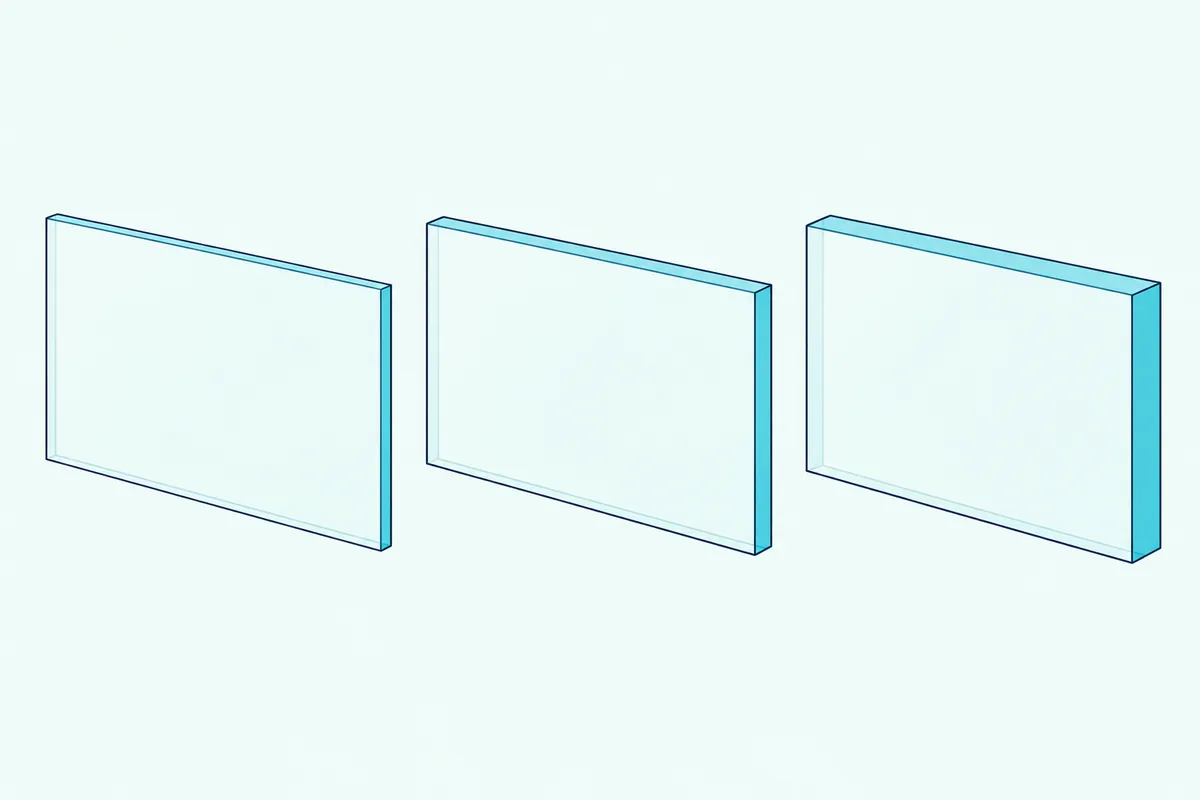
HUD’s Noise Guidebook says doubling the thickness of a partition can result in as much as a 6 dB reduction, and the Canadian digest adds that the stiffness of glass limits that improvement, with a coincidence dip in the transmission loss that moves to lower frequencies as the glass gets thicker. Plaskolite’s ladder shows the result: 6 mm to 20 mm buys 6 STC points.
Climate Seal, which makes acrylic inserts, gives practical steps on its acrylic window page. It says 1/4 inch is usually sufficient for traffic noise and recommends 3/8 to 1/2 inch for construction or airplane noise, and it calls any insert over 1/4 inch acoustic grade while claiming up to 70 percent of window noise blocked, a figure it doesn’t tie to a test.
Portland State University’s lab report on Indow inserts is the test that separates 1/8 inch from 1/4 inch. Over a single pane of 1/8-inch glass, with a gap of about 3/4 inch, the 1/8-inch acrylic samples cut the outdoor-indoor level by 6.8 to 14.1 dBA and the single 1/4-inch sample cut it by 18.9 dBA, measured to ASTM E966 with white noise.
The report says those results apply only under the conditions of that test, but the direction is plain: the step from 1/8 to 1/4 inch did more than any difference among the 1/8-inch samples. Past 1/4 inch, the makers’ tables promise a few points for a lot of material, and the air gap behind the sheet, which comes next but one, does more.
Are Plexiglass, Acrylite and Lexan the Same as Acrylic?
Those thickness figures carry brand names, and the names confuse more buyers than the physics does.
Plexiglass with a double s is the everyday word for acrylic sheet, which chemists call PMMA. ACRYLITE’s site explains that Röhm sells its PMMA sheet as PLEXIGLAS in Europe, Asia, Africa and Australia and as ACRYLITE in the Americas, and OPTIX is Plaskolite’s name for its acrylic, so a Plexiglas, Acrylite or Optix sheet of the same thickness is the same material for noise.
Lexan and Makrolon are not acrylic. Makrolon is filed under polycarbonates on Covestro’s site, and the Canadian digest groups impact-resistant polycarbonate with the other transparent plastics that block about as much as glass of the same mass.
Is polycarbonate better at soundproofing, then? By that mass rule, no, and nothing published says otherwise: Palram’s acoustic barrier page describes its polycarbonate sheets as lightweight, durable and transparent and prints no sound rating, so the two plastics are picked on toughness, which Palram calls virtually unbreakable, not on noise.
What the barrier makers do publish is a class rather than a decibel figure. ACRYLITE Soundstop GS is placed in the highest airborne sound reduction category, B3, of the European barrier standard EN 1793-2, and Röhm’s PLEXIGLAS Soundstop page lists the sheets as soundproof, impact-resistant and weather resistant without a rating, so for a home the sheet tables above are the numbers to use.
Why Does Acrylic Work Best as a Second Pane With an Air Gap?
Every gain above the sheet tables comes from that air gap, and the Canadian digest explains why it beats more thickness.

The digest says the STC of sealed double glazing increases by approximately 3 for each doubling of the air space, and that a small separation gives a rating only slightly higher, or even lower, than a single layer of the same glass. The trapped air acts like a spring, and the resonance it sets up falls at 200 to 400 Hz for factory-sealed units, the band where much road and aircraft noise sits.
That spring is why a sheet pressed against the glass disappoints. HUD’s Noise Guidebook puts the cure as a rule: the airspace between the panes should not be less than 2 to 4 inches if an STC above 40 is desired, and it calls proper sealing extremely important.
The tested inserts follow the rule exactly. Climate Seal’s ASTM E90 table takes a fixed window from STC 33 to 38 with a 2.5-inch airspace, 46 at 4.5 inches and 51 at 6.5 inches, and lifts a double-hung window from 24 to 37, while SoundTITE’s acrylic panel takes a dual-pane window from 28 to 41.
Those are acrylic panes doing what a bare sheet can’t, and the material suits the job. Climate Seal’s brochure says its inserts weigh half what its glass competitors do and uses acrylic up to 5/16 inch, Portland State’s samples sealed to the frame with a silicone bulb, and the breakage resistance noted earlier means a pane standing in a frame isn’t a hazard.
The digest’s other warning fits here too: triple glazing gives essentially the same reduction as double unless the spaces are very large, so a second acrylic pane with one deep gap beats stacking thin sheets. The double-glazing page explains why a narrow gap between panes does so little from the glass side.
Where Does Acrylic Fall Short?
That gap rule also explains most of acrylic’s failures, and the tables show the rest.
Low frequencies first. Plaskolite’s first table gives every thickness a lower figure when low frequencies of 100 to 400 Hz dominate than when high frequencies of 2,000 to 5,000 Hz do, the gap runs from 7 to 13 dB(A) across the table, and its lowest entry is 15 dB(A), for the thinnest sheet against bass-heavy noise.
ASTM E413 warns that STC is the wrong yardstick for motor vehicles, aircraft and trains, so a sheet’s STC overstates it against traffic, and Portland State’s dBA figures came from white noise under one set of test conditions. The bass of a bus is where a thin sheet does least.
Thin sheets second. At 1/8 inch or 6 mm the tables give STC 24 to 29, and Plaskolite itself says window STC ratings range from 18 to 38, so a thin sheet sits at the bottom of the window range before any gap or seal is counted.
The seal third. CitiQuiet says the seal around a plexiglass panel is rarely airtight and that this is where a lot of noise leaks through, Plaskolite says an enclosure’s reduction depends on the tightness of its joints, and HUD calls proper sealing extremely important, so a sheet held by a few clips has no seal at all.
Surface and use last. CitiQuiet says plexiglass can scratch, warp or discolor in direct sunlight, and SoundTITE’s FAQ page answers the yellowing worry with optical-grade acrylic, which it says contains no polystyrene, the ingredient it blames for low-cost plastic sheeting changing color in the sun.
CitiQuiet also notes that a fixed panel means you lose the ability to open and close the window normally, which matters for a bedroom’s only window. Burton Acoustix’s guide to soundproofing windows you already have covers the sealing work that comes before any pane.
How Does Acrylic Compare With Plywood, Steel and a Stud Wall?
Those limits make more sense against solid materials, and ePlastics’ third Plexiglas table puts acrylic on the same dB(A) scale as them.
| Material, per ePlastics’ Plexiglas table | Approximate noise reduction, dB(A) |
|---|---|
| Plexiglas sheet, 1/8 in | 25 |
| Glass, 1/8 in | 25 |
| Plywood, 1 in | 26 |
| Glass, 1/4 in | 27 |
| Plexiglas sheet, 1/4 in | 29 |
| Plexiglas sheet, 1/2 in | 33 |
| Plexiglas sheet, 1 in | 35 |
| Steel, 1/8 in | 37 |
| Double-glazed Plexiglas, 0.236 in, air space, 0.177 in | 38 |
| Sheet lead, 1/16 in | 38 |
| Wood stud partition | 38 |
An inch of plywood lands beside an eighth of an inch of acrylic, and an eighth of an inch of steel beats a full inch of acrylic. Plaskolite’s metric version of the table agrees, with 3 mm steel at 37, 25 mm plywood at 26 and 1.6 mm sheet lead at 38, so mass sets the order exactly as the digest says.
Drywall isn’t in either table, and the nearest entry is the wood stud partition at 38 dB(A). The double-glazed acrylic unit matches it and no single sheet reaches it, so a sheet screwed to a finished wall adds little to what the wall already does; the soundproofing materials ranked by what they block covers the wall side.
How Should You Use Acrylic to Cut Noise?
Put those comparisons together and the way to use acrylic writes itself: as a sealed second pane with a deep gap, never as a lone sheet.
For a window, that means a sheet of at least 1/4 inch, the thickness Climate Seal calls sufficient for traffic and the one Portland State’s test rewarded, set as deep in the opening as the frame allows and sealed on all four edges. HUD’s 2 to 4 inches is the target, and Climate Seal’s 2.5, 4.5 and 6.5-inch series shows what each extra inch buys.
The inserts page linked above compares the makers’ finished products and walks through a do-it-yourself build, so the materials live there. The job here is to get the order of priorities right: gap first, seal second, thickness third.
For an enclosure or a studio window, the same rule holds. Plaskolite’s dB(A) figures were obtained in complete enclosures, and the digest says double glazing with a sufficiently large airspace is the sensible choice where substantial reduction is required, so two acrylic panes with a wide gap beat one thick sheet.
When is a plain sheet enough? CitiQuiet’s own list is light noise rather than heavy traffic, a short-term fix, strict rental limits or a very tight budget, and for everyday honking, construction and buses it says plexiglass can’t offer the relief most people expect.
The Bottom Line
Acrylic is good for soundproofing in one role: a light, breakage-resistant second pane set 2 inches or more from the glass and sealed around its edge, where tested inserts reach STC 37 to 51. As a lone sheet it rates STC 24 to 35 in its makers’ tables, blocks less than glass of the same thickness, and does least against the low-frequency traffic noise people buy it for.
Frequently Asked Questions
Is acrylic soundproof?
No material is, and a single acrylic sheet rates STC 24 to 35 in Plaskolite’s and ePlastics’ tables, a range where Andersen says you’d still hear and understand a loud conversation outside. Used as a sealed second pane with an air gap, acrylic inserts have been tested at STC 37 to 51.
Is plexiglass good for soundproofing?
Plexiglass is acrylic under a brand name, so the same numbers apply: a 0.236-inch sheet rates STC 29 alone and 38 in a double-glazed unit with an air space in the Plexiglas table ePlastics reprints. It’s good as an insert pane and poor as a sheet taped flat to the glass.
Is laminated glass better than acrylic for soundproofing?
At the same thickness, yes. NRC Canada’s digest says plastics block like glass of the same mass, and acrylic weighs about half as much, while Guardian’s table rates two 6 mm panes laminated with acoustic PVB at STC 40 against 24 to 29 for a 6 mm acrylic sheet; acrylic’s advantages are weight and breakage resistance, which is why insert makers use it.
How thick should plexiglass be to block sound?
Climate Seal says 1/4 inch is usually enough for traffic noise and recommends 3/8 to 1/2 inch for construction or aircraft noise, and in Portland State University’s lab report the 1/4-inch insert cut 18.9 dBA where the 1/8-inch inserts managed 6.8 to 14.1. Past 1/4 inch, a deeper air gap buys more than a thicker sheet.
Can you soundproof a studio window with plexiglass?
Only as a double layer with a wide gap. NRC Canada’s digest says double glazing with a sufficiently large airspace is the sensible choice where substantial reduction is required, with about 3 STC points for each doubling of the gap, and a single sheet, however thick, tops out at STC 35 in the makers’ tables.
Is polycarbonate soundproof?
No more than acrylic. The Canadian digest groups impact-resistant polycarbonate with the other transparent plastics that block about as much as glass of the same mass, and Palram’s polycarbonate barrier page prints no sound rating, so polycarbonate’s edge is impact resistance rather than noise.