Best Soundproof Window Inserts for Renters, Bedrooms and Old Homes
The best soundproof window inserts publish a tested rating and leave a deep, sealed air gap, such as Climate Seal’s Acoustic Series at STC 51.
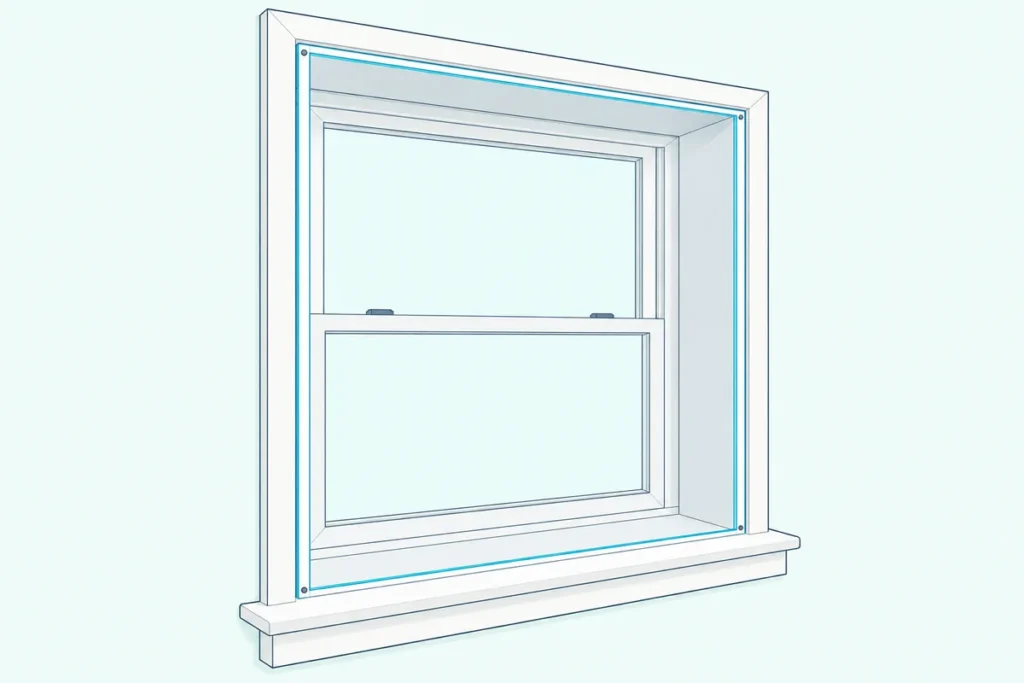
If you’re comparing the best soundproof window inserts, rank them by what a maker can show you: a tested sound rating and the depth of the air gap behind the pane.
Miss either one and a clear panel can look the part yet rate no better than the bare window, as HUD’s window table shows for a storm pane an eighth of an inch from the glass.
Get both right and the best published builds climb from the mid-20s on the STC scale into the high 40s, roughly two halvings of loudness.
This guide lines up the makers that publish numbers, from Soundproof Windows, Inc.’s laminated second windows to Climate Seal’s lab reports and Indow’s university test, plus a do-it-yourself build.
Start with the table, then use the sections after it to match one to your window, your noise and your lease.
What Are the Best Soundproof Window Inserts?
Those two tests, a published rating and a deep gap, sort the market quickly. On their makers’ own figures, the best soundproof window inserts are Soundproof Windows, Inc.’s second windows at STC 48 to 54, Climate Seal’s Acoustic Series at up to STC 51 in an accredited lab, CitiQuiet’s laminated interior windows at STC 45 to 48 or higher, SoundTITE’s acrylic panels at STC 41 and Indow’s press-in acrylic, up to 18.9 dBA quieter over single-pane glass in Portland State University’s lab.
Every row below gives the figure as its source states it, with the window it was measured over, since an insert’s number depends on the window behind it.
| Pick | What it is | Published sound figure | Air gap in that figure | Who publishes it |
|---|---|---|---|---|
| Highest published STC: Soundproof Windows, Inc. | Laminated-glass second window in its own frame, mounted behind your window | STC 48 to 54; 48 over a single-pane window in a standard wall | Not given as one number; the rating rises with air space | The maker’s STC page; no lab named, no OITC |
| Most complete lab data: Climate Seal Acoustic Series | Removable acrylic insert on a magnetic frame | STC 38, 46 and 51 over a fixed window rated STC 33 (OITC 26, 33 and 39); 37 over a double-hung rated 24 | 2.5, 4.5 and 6.5 inches on the fixed window | The maker’s table, with Orfield Laboratories’ ASTM E90 reports for the fixed window |
| CitiQuiet interior window | Laminated-glass interior window set on the sill | STC 45 to 48 or higher as a system | Often 4 to 5 inches | The maker’s pages; no lab named, no OITC |
| SoundTITE | Optical-grade acrylic on a magnetic seal | STC 41 over a double-pane window rated STC 28 | Not given | The maker’s technical page, citing an Acoustical Systems test |
| Indow, 1/4-inch acrylic | Custom acrylic insert held in the frame by a compression bulb | 18.9 dBA quieter over single-pane glass; 6.8 to 14.1 dBA for 1/8-inch samples | About 3/4 inch | Portland State University’s 2013 report |
| Do it yourself | 1/4-inch acrylic cut to fit and edged with foam | Up to 10 dB, the builder’s own estimate | Set by your frame depth | Soundproofist’s build notes |
Read the table as the best case for each build, not a promise for your room. Guardian Glass warns of a potential 6 dB loss between a lab specimen and a pane installed on site, and each maker measured over a different window, so small gaps between rows don’t settle much.
Every figure comes from the maker’s or the lab’s own document named in its row. Each insert is ordered from its maker and built to your window, so the picks are named without product cards; the do-it-yourself section links the two materials that build needs.
Do Soundproof Window Inserts Work?
Those figures answer the question most buyers start with. Yes, soundproof window inserts work when they seal at the edges and sit a few inches from the old glass: Soundproof Windows, Inc.’s STC ratings page puts a single-pane window at STC 26 to 28 and the same opening with its second window at STC 48.
Climate Seal’s lab reports tell the same story on one commercial fixed window. Alone it rated STC 33, and with the Acoustic Series insert 4.5 inches inside it, STC 46.
What does a jump like that sound like? Andersen’s guide to sound ratings says that at STC 30 you’d hear and understand a loud conversation outside, while at 36 to 40 even loud conversations would hardly be audible.
Guardian Glass adds that each 10 dB step feels roughly like doubling or halving the volume. So moving from the mid-20s to the high 40s is about two of those halvings, not a small upgrade.
Soundproof Windows, Inc. makes the same point from the other side. It says swapping an STC 27 single-pane window for a thick STC 35 double-pane one won’t reduce the sound much, and that the noise often stays a significant problem until the rating reaches the 40s.
On paper, the inserts at the top of the table also outrate most replacement windows: Andersen’s 400 Series report tops out at STC 37. If you’d still rather replace the window, our guide to the best soundproof windows for home ranks replacement units by the same published ratings.
The catch is low-pitched noise. NRC Canada’s Canadian Building Digest 240 warns that STC doesn’t properly rate insulation against sources with strong low-frequency content, such as aircraft and road traffic.
ASTM E1332 defines a separate rating for that, OITC, built around ground and air transportation noise. Of the documents behind the table, only Climate Seal’s reports give an OITC, and they show it rising from 28 on the bare window to 33 with a 4.5-inch gap and 39 with a 6.5-inch gap.
Soundproofist, a blogger who built acrylic inserts at home, puts the noise reduction at up to 10 decibels and says low-frequency truck and construction noise might only get slightly muted. The Soundproof Windows, a London acoustic window company, goes further and calls inserts limited by the windows they’re added to, though its article prints no test results to compare.
Which Inserts Leave the Deepest Air Gap?
That OITC climb with depth is the clearest sign of what matters most. Second windows mounted at the inner edge of the opening, like CitiQuiet’s and Soundproof Windows, Inc.’s, usually leave the deepest gaps, often 4 to 5 inches in CitiQuiet’s case, while a press-in insert that fits inside the window’s own frame sits closer to the glass.
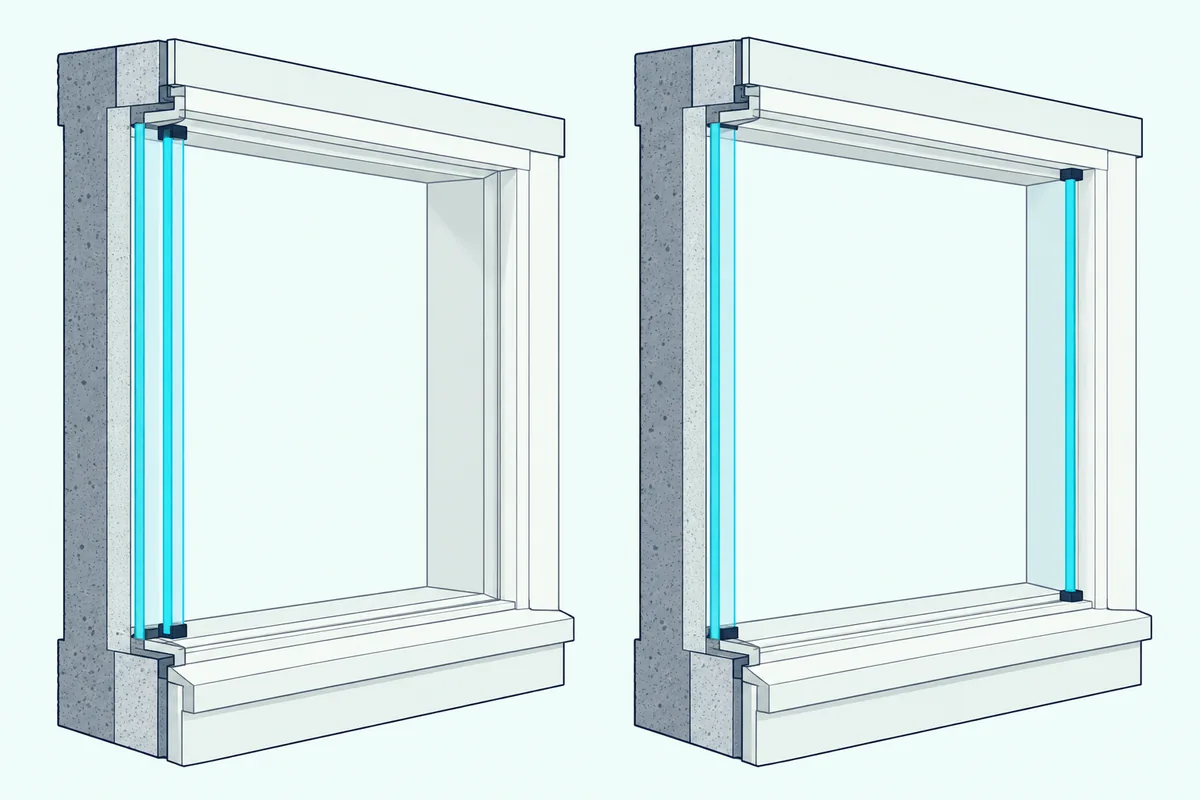
HUD’s Noise Guidebook gives the rule of thumb: the airspace between panes shouldn’t be less than 2 to 4 inches if you want an STC above 40. CitiQuiet’s own buying advice is blunter, saying anything under 2 inches is unlikely to deliver meaningful results for serious urban noise.
NRC Canada explains why. Two panes close together act like a spring that passes vibration from one to the other, and for typical factory-sealed double glazing that resonance falls between 200 and 400 Hz, where much of the sound energy from road traffic and aircraft sits.
Widen the gap and the resonance moves lower. NRC puts the gain at about 3 STC points for each doubling of the air space, so going from 1 inch to 4 inches is worth roughly 6 points on its own.
Climate Seal’s lab series shows that curve on one window. With the insert 2.5 inches away, the fixed window rose from STC 33 to 38 but its OITC fell from 28 to 26; at 4.5 inches it reached STC 46 and OITC 33, and at 6.5 inches STC 51 and OITC 39.
The two deeper builds also list a jamb absorber, and NRC says absorptive material around the perimeter of the cavity adds only slightly to STC but up to 10 dB at high frequencies, so not all of that climb is depth. Still, the shallow build’s lower OITC is the low-frequency side of the resonance NRC describes, and NRC adds that two panes set close together can rate only slightly higher than one, or even lower.
HUD’s window table, built from National Bureau of Standards tests, teaches the same lesson with older hardware. A wood double-hung window with a storm sash 2 1/8 inches out rated STC 35, while an aluminum slider with a storm pane just 1/8 inch out rated 22.
Measure your own window before you shop. The distance from the glass to the room-side face of the trim is roughly the deepest gap a surface-mounted insert can give you, and the depth of the frame itself is what a press-in panel gets.
Climate Seal offers both mounts, inside the jamb or on the face of the frame, and recommends the surface mount for its extra airspace. Indow’s inserts in Portland State’s test sat about 3/4 inch from a single pane, the shallowest stated gap in the table.
Should an Insert Be Acrylic or Laminated Glass?
Once the gap is set, the pane itself decides the rest. Heavier and damped panes rate higher: CitiQuiet’s table puts its interior units on their own at STC 29 with 1/8-inch glass, 31 with 1/4-inch glass and 35 with 1/4-inch laminated glass, up to 38 for its 1/2-inch laminated pane.
Acrylic follows the same rule, and our explainer on whether acrylic is good for soundproofing shows why a bare sheet rates so far below an insert. In Portland State’s lab, Indow’s 1/4-inch acrylic cut the sound level by 18.9 dBA over a single pane, against 6.8 to 14.1 dBA for its 1/8-inch samples.
Laminated glass adds damping on top of mass. NRC Canada credits the plastic interlayer with dissipating vibration, but notes the effect depends on temperature and may be drastically reduced at typical Canadian winter temperatures.
Soundproof Windows, Inc. builds its second windows with laminated glass and spring-loaded seals that keep a constant squeeze on the panes, and CitiQuiet uses laminated glass too. Acrylic inserts trade some mass for weight and safety: Climate Seal says its Acoustic Series is half the weight of glass competitors, and SoundTITE says its optical-grade acrylic is 17 times stronger than a single pane of glass.
Mismatched thicknesses help too. NRC rates panes in a thickness ratio of about 2 as most effective, and CitiQuiet says many acoustic systems pair 1/4-inch glass with 3/16-inch or 3/8-inch glass for the same reason.
If you’re choosing glass for a second window, see how laminated glass compares with tempered glass and double glazing in lab ratings. HUD’s guidebook puts the order plainly: thickness is important, but sealing and the width of the airspace do the most to decide a window’s noise resistance.
How Do Press-In, Magnetic and Second-Window Inserts Differ?
Those panes come in three mounting styles, and the style decides how the insert seals and how often you’ll take it down. Press-in inserts hold by compression, magnetic inserts snap to a metal strip around the opening, and second windows run in their own frames and open like the window behind them.
Indow is the press-in example. Portland State University’s 2013 report on the Indow Window describes acrylic sheets edged with a silicone spring bulb filled with urethane foam, made slightly oversized so the bulb compresses into the frame, with two safety straps hidden behind it.
Climate Seal and SoundTITE are magnetic. Climate Seal’s Acoustic Series page and brochure describe a vinyl magnetic frame that grips a metal strip fixed around the window opening and comes off for cleaning or storage, and SoundTITE’s FAQ says its panels attach with magnetic strips and lift off for access to the window.
CitiQuiet and Soundproof Windows, Inc. sell second windows. CitiQuiet’s units stand on the sill a few inches inside the existing window and slide on sealed-bearing rollers, and Soundproof Windows, Inc. mounts its frames to the inside edge of the opening so they slide or lift the same way your current windows do.
That makes a second window the more permanent fit, with a frame installed in the opening, while a magnetic panel like Climate Seal’s lifts off whole when you want the window back. If you’ll open the window often, a second window that slides is easier to live with; if it stays shut through the noisy season, a press-in or magnetic panel is lighter and quicker to fit.
Can You Make a Soundproof Window Insert Yourself?
If none of those makers serves your area, you can build a simpler version yourself. Soundproofist’s build uses 1/4-inch plexiglass cut about 1/4 inch smaller than the opening on each side, a thin foam or felt strip on the sill and foam padding at the edges, and it says the result should be up to 10 dB less window noise.
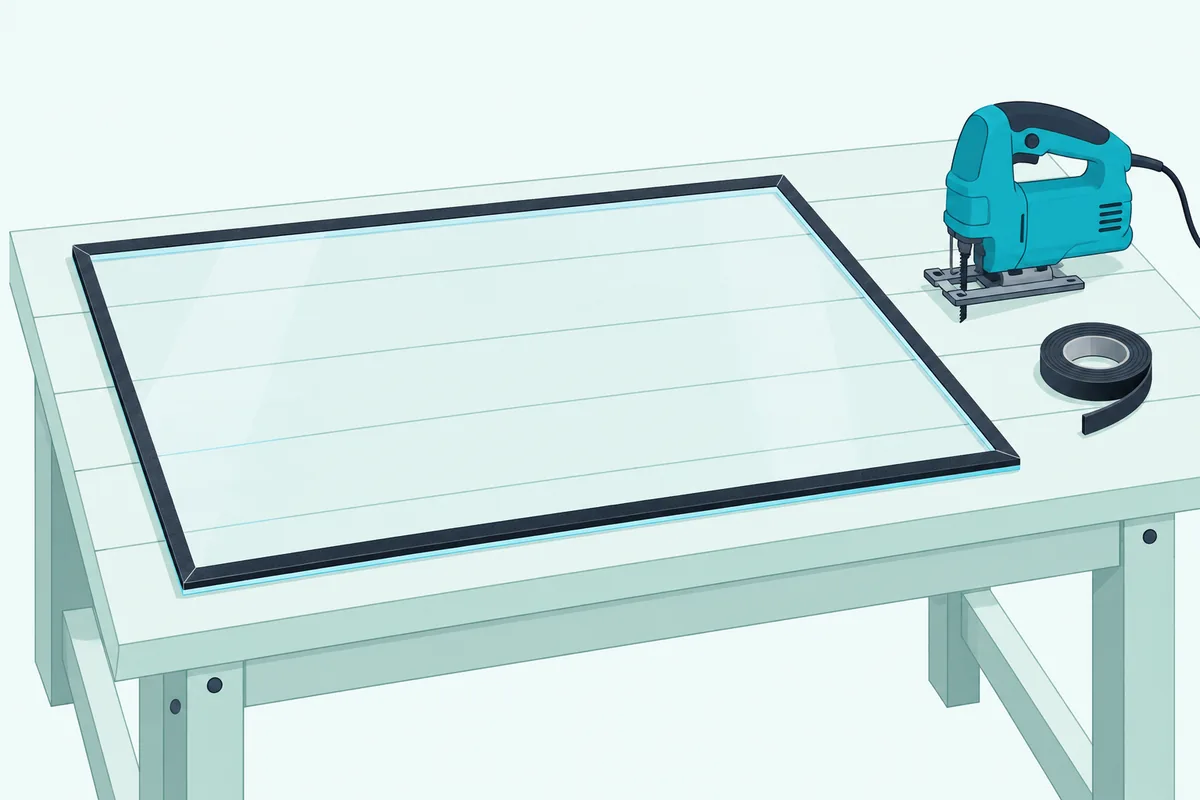
- Measure the opening at all four corners, since no window is perfectly square, and cut the sheet about 1/4 inch smaller on each side so the foam can fill the rest.
- Lay a thin foam or felt strip along the sill for the sheet to rest on, which keeps it from vibrating against the sill.
- Run foam tape around the sheet’s edges so it presses into the frame on every side, much as HUD says single windows can be mounted in resilient material such as rubber, cork or felt to prevent sound leaks.
- Join a wide window’s sheets with a two-sided joiner track instead of butting them together, because Soundproofist warns that any gap in the finished window will let some noise in.
Thickness matters here too. Portland State’s 1/4-inch acrylic did far better than its 1/8-inch samples, so skip the thin sheets.
For the pane, CALPALMY’s 1/4-inch acrylic sheets come two to a pack at 36 by 48 inches, and the listing sells them for windows among other uses. Its photos show saws and a drill for cutting and warn against a scoring knife, so plan on a saw or have a plastics shop cut it to size, as Soundproofist did.
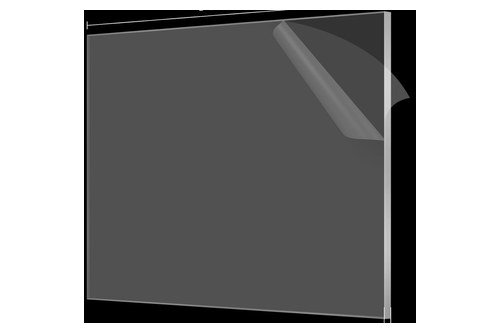
CALPALMY 1/4-Inch Clear Acrylic Sheets (2 Pack)
For the edges and the sill, three rolls of black closed-cell foam seal tape come 1/2 inch wide and 1/8 inch thick, the size Soundproofist’s recipe calls for, each one self-adhesive.
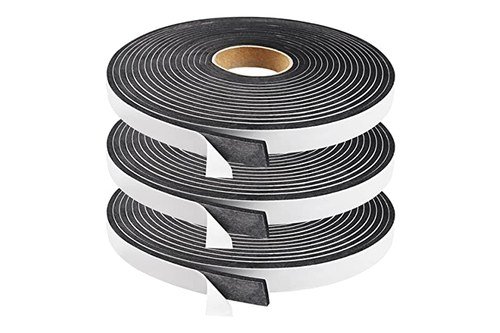
YIJUHOU Seal Foam Tape
The descriptions come from the makers’ manuals and spec pages.
Neither lists a sound rating, so a homemade insert is an unrated cousin of the products in the table, not a match for them. It’s still a reasonable test of whether the window is your main noise path before you pay for a made-to-measure insert or a professional installation.
Which Insert Suits a Renter, a Bedroom or an Old House?
Bought or built, an insert still has to suit its room. Renters need something that comes out cleanly, bedrooms need a way out in an emergency, and old houses need the original sash left alone.
For renters, the removable styles are the safer bet. CitiQuiet says its inserts need no alteration to the existing window and no building approval, and Soundproof Windows, Inc. says no homeowner association has ever rejected its interior units, but those are the makers’ claims, so check your lease first.
Our page on soundproofing a window in your apartment covers what to ask your landlord for and the cheaper seals to try first. CitiQuiet also lists inserts for air conditioning enclosure windows, which matters if the noisy window holds an air conditioner.
In a bedroom, think about escape before quiet. Climate Seal lists easy egress in emergency situations among its insert’s features, and the second windows from CitiQuiet and Soundproof Windows, Inc. open like ordinary windows, so don’t screw a fixed panel over a bedroom’s only window.
Old houses are where inserts make the clearest case. Soundproof Windows, Inc. says some historically preserved buildings install its units, and Climate Seal shows its Acoustic Series fitted over historic wooden windows at a cultural center in Ocean Springs, Mississippi.
An insert also leaves the outside of the house untouched, which is the point of keeping old windows. Soundproof Windows, Inc. says its interior units don’t change the outside appearance at all.
What Are the Downsides of Acoustic Window Inserts?
Every one of those choices has a cost beyond the quote. The main downsides of acoustic window inserts are a second pane to open and clean, condensation an insert may not cure, scratch-prone acrylic, and a rating that only holds while the window around it stays sealed.

Soundproof Windows, Inc. is frank about the cleaning: you have twice as much glass to clean, though its panes come out for the job. Climate Seal’s washing instructions call for an anti-static plastic cleaner and non-abrasive wipes used in straight lines so debris doesn’t scratch the acrylic.
Condensation is the hardest to predict. Climate Seal says its inserts stop damaging condensation, while Soundproof Windows, Inc. says its units will reduce it, maybe enough to stop all of it and maybe not, with the best chance when the old window doesn’t leak much air.
Moisture between panes is an old problem. HUD’s guidebook notes that permanently sealed double windows often need an air pressure control system to keep moisture in the airspace to a minimum, and the National Bureau of Standards’ 1976 handbook on quieting draws its double-window design with two small vent holes per sash, plugged with glass fiber.
Keeping the window shut is part of the deal too. HUD says that whether or not the sealing is permanent, keeping windows closed means installing mechanical ventilation.
Finally, an insert can’t fix a leaky frame around it. NRC Canada says even a window with good weatherstripping usually rates 3 to 5 STC points below the same window sealed, so seal the trim first; the full order is in our guide on how to soundproof windows you already have.
When Is an Insert Not Enough?
Even a perfect insert can only reduce noise that comes through the glass. HUD’s composite-wall example shows why: an STC 45 wall with an STC 26 window over 30 percent of it rates only 35 overall, so once the window improves, the wall, the door and any vent become the weak points.
Soundproof Windows, Inc. puts most walls at STC 43 to 48 and its own units at 48 to 54, which means a good insert can outrate the wall around it. If noise still gets in around a door, our pages on the best door sweep for soundproofing and the best soundproof interior doors cover that path.
For the walls themselves, the best soundproofing panels page covers panels that block noise rather than just echo. The soundproofing hub gathers the guides for the rest of the room.
Low rumble is the other limit. CitiQuiet says subway and rail noise carries significant low-frequency energy and that severe subway noise may need wall and floor treatment as well, and Soundproofist says truck engines and road construction might get only slightly muted by window inserts.
Soft layers don’t replace a second pane, but they can hang in front of one. Our guide to the best soundproof curtains covers curtains for bedrooms and street noise.
If the frame itself is rotten or the glass is cracked, replacing the window may make more sense than putting a pane in front of it. That’s a judgment for a window installer, not a rating, but it’s worth asking before you order an insert for a failing frame.
How Do You Measure and Order a Window Insert?
Those limits aside, ordering an insert is mostly measuring. Every maker in the table builds to your opening, so the first job is the depth and squareness of the window frame.
CitiQuiet sends a representative to assess the windows, quotes from the dimensions, type and size of each one, and leaves the installation to experienced professionals, in as little as 7 days from order to completion. Climate Seal publishes its own measuring instructions and an out-of-square form.
Price follows the same details. CitiQuiet names the type of glass, the size of the window and frame, the window’s style and the number of windows as the main factors, and our page on what soundproof window inserts cost has dated price ranges by method.
Ask each maker for the tested rating of the exact build you’re buying, as CitiQuiet itself advises, and ask what gap your frame allows. Then compare quotes against those ratings rather than against each other.
The Bottom Line
The best soundproof window inserts are the ones that publish a tested rating and leave a deep, sealed air gap. On their makers’ figures, Soundproof Windows, Inc.’s laminated second windows rate highest at STC 48 to 54, and Climate Seal’s Acoustic Series has the most complete lab data, STC 51 and OITC 39 at a 6.5-inch gap.
If you can only fit a press-in panel close to the glass, choose thick acrylic, seal the frame first and expect a smaller gain. Measure your window’s depth before you call anyone, because that number decides more than the brand.
Frequently Asked Questions
Are there any downsides to acoustic window inserts?
Yes. You get a second pane to open and clean, acrylic panes need gentle cleaning to avoid scratches, and condensation may not go away entirely: Soundproof Windows, Inc. says its units reduce it but may not stop all of it, especially if the old window leaks air. Keeping windows shut for quiet also means relying on mechanical ventilation, a point HUD’s Noise Guidebook makes. And an insert only helps as much as the frame around it is sealed, since NRC Canada puts the loss from ordinary weatherstripping at 3 to 5 STC points.
Is an acrylic window insert soundproof?
No insert is soundproof, but thick acrylic helps. In Portland State University’s lab, a 1/4-inch acrylic insert about 3/4 inch from a single pane cut the sound level by 18.9 dBA, and SoundTITE cites an accredited lab result of STC 41 for its acrylic panels over a double-pane window rated STC 28. Andersen’s sound guide makes the wider point: there’s no such thing as a soundproof window, only windows that reduce sound.
Do window inserts block low-frequency traffic noise?
Partly. Low-pitched rumble is the hardest part of traffic noise to stop, which is why OITC, the rating built around transportation noise, sits below STC in every row of Andersen’s window report. Climate Seal’s lab reports show what depth does to it: OITC 26 with the insert 2.5 inches from a fixed window, 33 at 4.5 inches and 39 at 6.5 inches, against 28 for the window alone. Soundproofist says truck engines might get only slightly muted by acrylic inserts. If traffic is your problem, ask for an OITC and choose the deepest gap your frame allows.
Can you open a window with an insert in place?
With some types. CitiQuiet’s and Soundproof Windows, Inc.’s second windows open and close like the windows behind them, so you can reach the old sash or let air in. Magnetic panels come off instead: Acoustical Surfaces, which makes Climate Seal, says its insert is easy to remove for cleaning or fresh air, and SoundTITE’s panels lift off their magnetic strips. A homemade acrylic panel needs handles or latches, which Soundproofist added to its large window.
Are Indow inserts worth it for noise?
They’re worth a quote if you want a press-in insert inside the frame. Portland State University’s lab measured Indow’s 1/4-inch acrylic insert at 18.9 dBA quieter over single-pane glass, the best of the samples it tested, and its 1/8-inch versions at 6.8 to 14.1 dBA. Because these inserts fit inside the window’s own frame, the gap is shallower than a sill-mounted second window gives, so ask what gap your frame allows.