Do Sound Diffusers Work In Small Rooms? (Only If You Pick The Right Type)
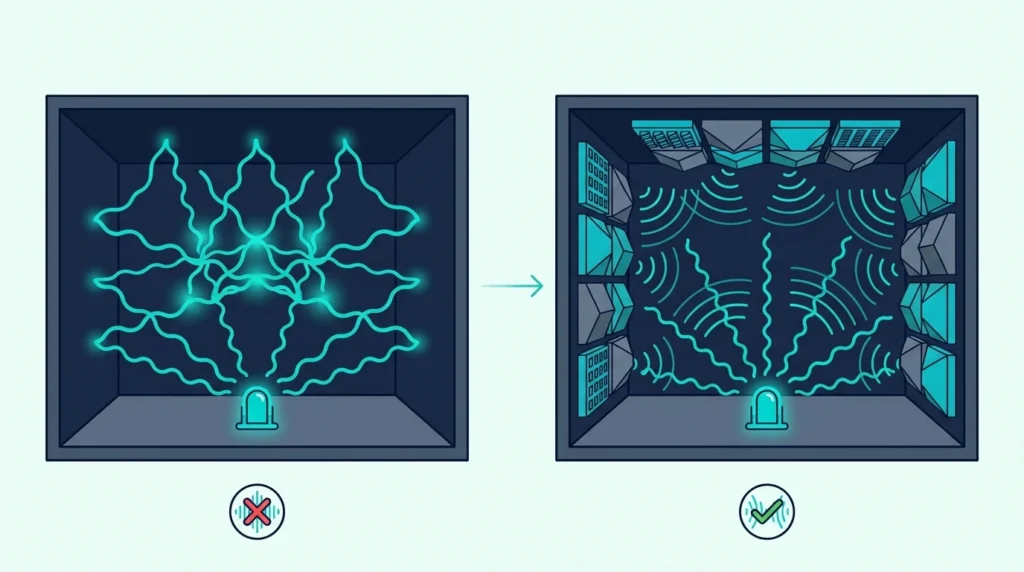
Do sound diffusers work in small rooms — or do they just waste wall space that should go to absorption? The honest answer is that most standard diffusers won’t perform as intended in rooms under 10×10 feet, but certain types still make a measurable difference if you understand why the physics changes at close range.
The core issue is distance. A diffuser scatters sound into multiple reflections that need physical space to separate before reaching your ears.
In a large studio, that separation happens naturally — in a bedroom or vocal booth, the walls are too close for it to develop.
Below, you’ll see which diffuser types still help in tight spaces, why experts recommend absorption first, and how to set up a small-room treatment plan that gets both clarity and liveliness without wasting money on panels that can’t do their job.
Standard QRD diffusers need at least 2 meters of clearance to scatter properly — a distance most small rooms can’t provide. In rooms under 100 square feet, prioritize absorption at first reflection points and bass traps in corners first. If you still want diffusion, use 2D skyline diffusers or shallow high-frequency panels on the rear wall or ceiling, where the scattering distance is longest.
Do Sound Diffusers Work In Small Rooms — Or Are They A Waste Of Money?
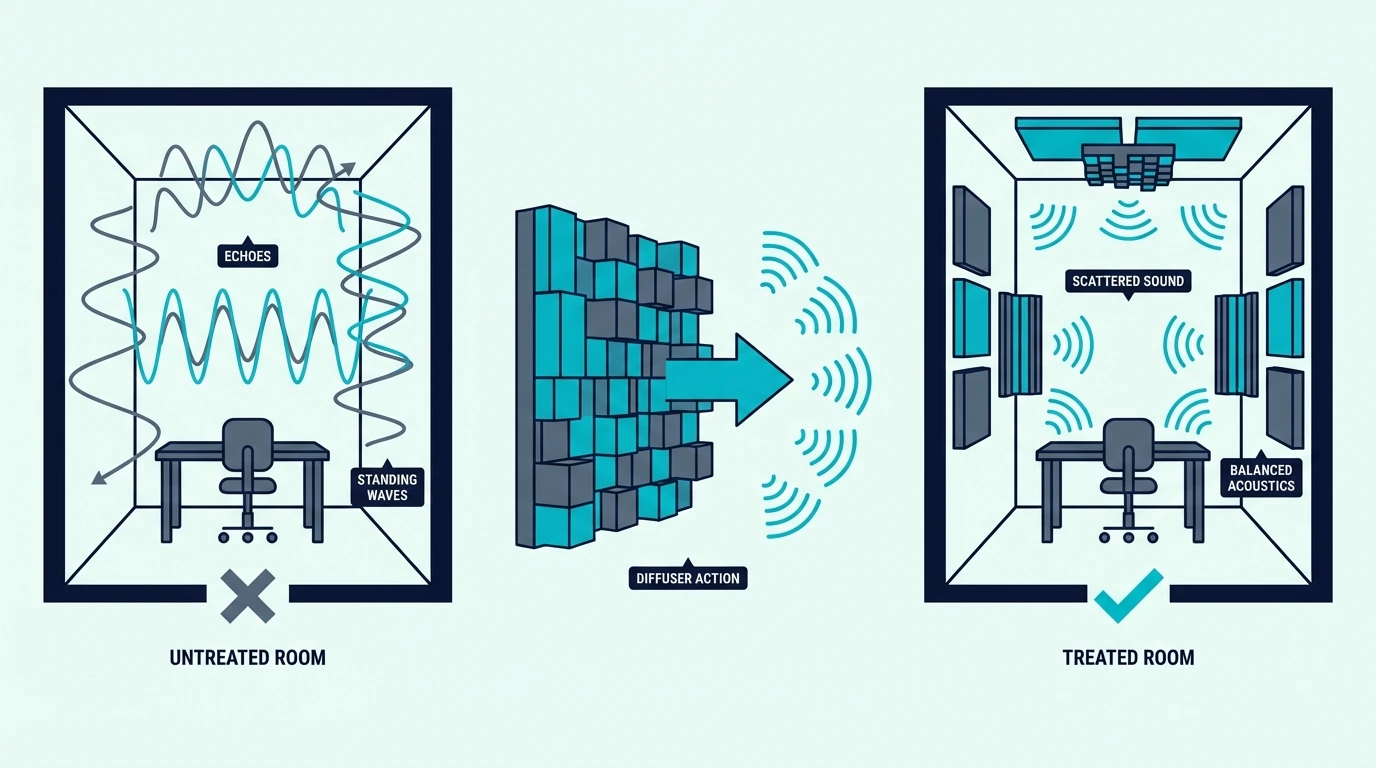
The short answer is: standard diffusers don’t work well in small rooms, and no amount of clever mounting changes that. The physics is non-negotiable — scattered reflections need travel distance to separate, and a room that’s 8 feet deep doesn’t have it.
A QRD diffuser designed for frequencies down to 500 Hz produces reflections that need roughly 3 wavelengths of travel distance to fully separate. At 500 Hz, that’s about 6.5 feet of clearance between the panel and your ears — already most of the room’s depth in a typical bedroom studio.
The result isn’t silence or a bad reflection. It’s worse — a comb-filtered version of the original sound that colors specific frequencies and makes your room’s response less even, not more.
That said, certain diffuser designs still work in compact spaces. The key is matching the diffuser type to the distances your room actually provides, rather than installing a full-range panel that needs more space than you have.
Why Do Most Experts Say Diffusers Don’t Work In Small Rooms?
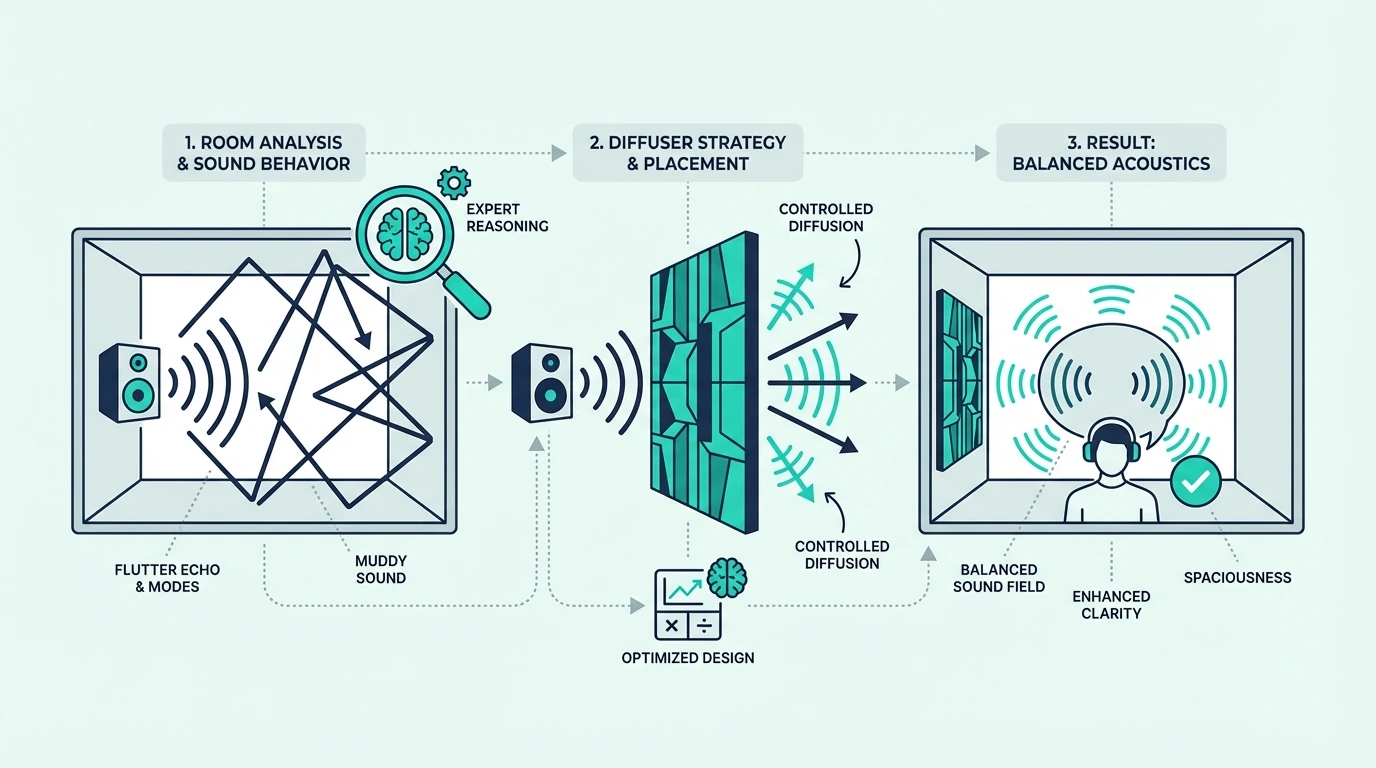
Every acoustician who advises against small-room diffusion is talking about the same problem: the gap between near-field and far-field scattering. Understanding this distinction explains why a panel that transforms a 20×15 control room sounds terrible in a 10×8 bedroom.
The Minimum Scattering Distance Problem
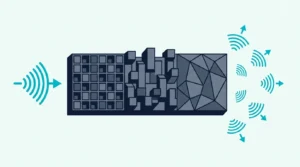
When sound hits a diffuser, each well or block redirects a portion of the wave at a different angle and timing. Close to the panel, these redirected waves overlap chaotically — they haven’t spread enough to create an even sound field.
Move far enough away and the individual reflections blend into a smooth, diffuse wash of sound energy. That transition point — where chaotic overlap becomes even diffusion — is the minimum scattering distance.
For most QRD diffusers targeting frequencies down to 500-1000 Hz, that distance is 2-3 meters (roughly 7-10 feet). In a room that’s 10 feet deep with your listening position 3 feet from the front wall, the rear wall is only 7 feet behind you.
Factor in the depth of the diffuser itself and you’re right at the threshold — or below it.
Far Field Vs Near Field Scattering
In the far field, the scattered reflections have spread enough that the sound energy arriving at your ears is roughly equal from all directions. Your brain perceives this as natural ambience — open, spacious, free of harsh reflections.
In the near field, you’re hearing individual scattered reflections before they’ve blended. The result is comb filtering — certain frequencies reinforce while others cancel, creating an uneven frequency response that changes depending on exactly where your head is.
Near-field scattering is actively worse than a flat wall reflection. A flat wall gives you one clean reflection your brain can process.
Near-field diffusion gives you dozens of partially-separated reflections that interfere with each other — muddying the sound rather than improving it.
For the full breakdown of how scattering works, what a sound diffuser does covers the physics in detail.
Get Studio Tips Weekly
Join 5,000+ creators getting acoustic treatment advice every week.
No spam. Unsubscribe anytime.Which Diffusers Can Still Help In A Small Room?
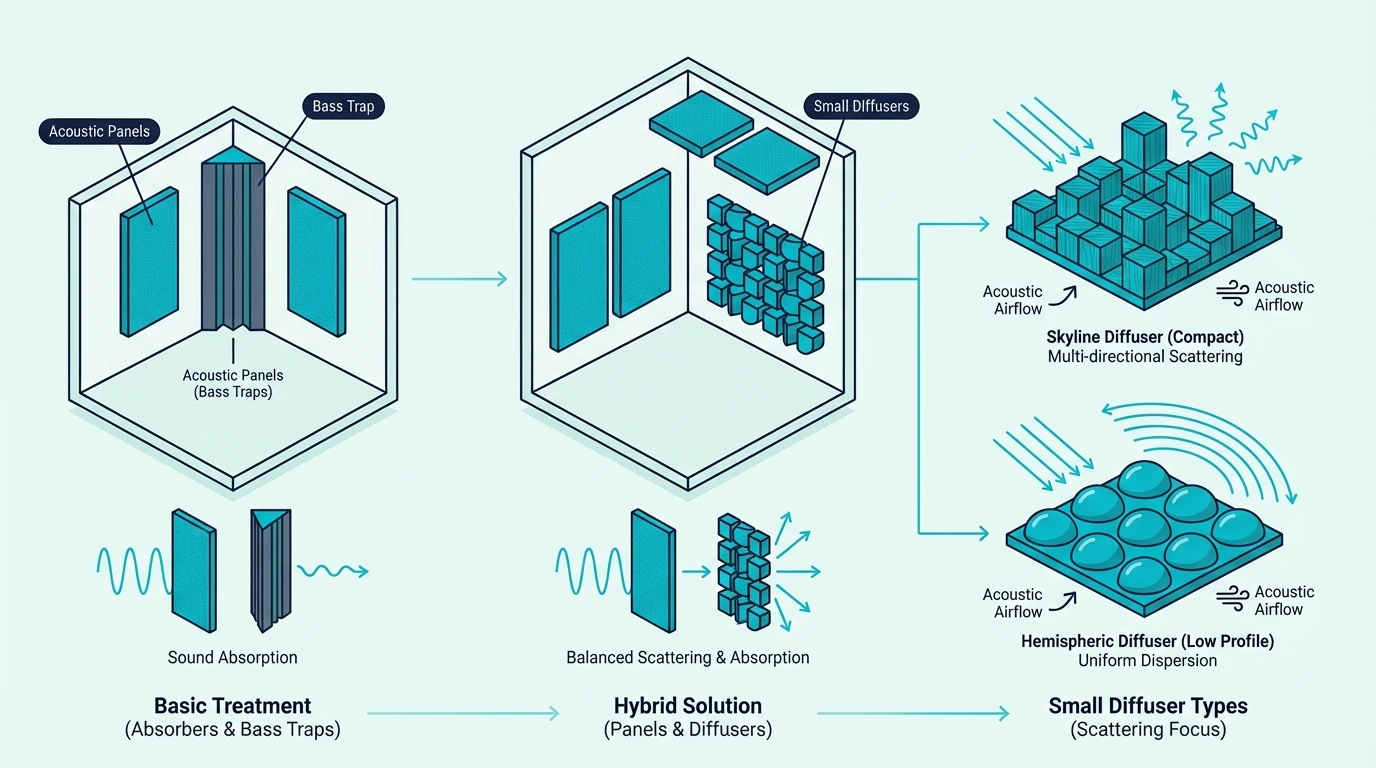
Not all diffusers need the same clearance distance. Two design features reduce the minimum scattering distance: scattering in multiple planes and targeting only high frequencies.
2D Skyline Diffusers
A 1D QRD diffuser scatters sound in one plane — typically horizontal. All the scattered energy spreads left-right but stays concentrated vertically, which means you need more distance for the reflections to separate in that single plane.
A 2D skyline diffuser scatters in both horizontal and vertical planes simultaneously. The energy spreads across a hemisphere instead of a single arc, which means less energy per angle and faster blending at shorter distances.
The EVA Acoustic Diffusers (4-Pack) use this approach — a waffle pattern that scatters sound across multiple angles within a compact 24×24-inch footprint. In a small room, mount them on the rear wall where you have the most distance from your listening position.
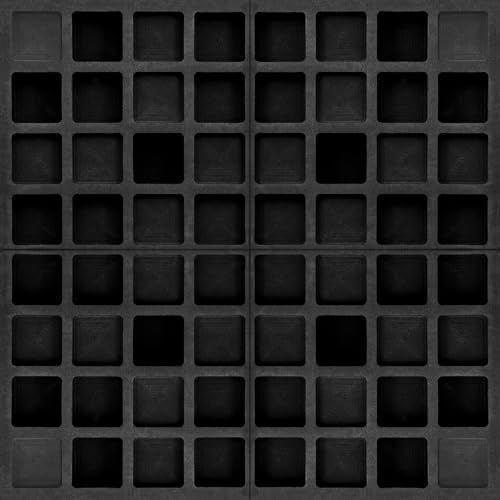
EVA Acoustic Diffusers (4-Pack)
Shallow High-Frequency Diffusers
High frequencies have shorter wavelengths, which means they need less travel distance to scatter properly. A shallow diffuser that only targets frequencies above 1-2 kHz can work in rooms where a full-range panel fails.
The tradeoff is obvious: you’re only diffusing the high end. Low-mid reflections still bounce back unscattered.
In practice, this still helps because high-frequency flutter echo — the metallic “zing” between parallel walls — is one of the most audible problems in small rooms.
The BXI Wood Sound Diffuser (2D Skyline) fits this role — the varying block heights scatter mid-high frequencies across both planes while fitting a compact 24×24-inch rear wall or ceiling spot.
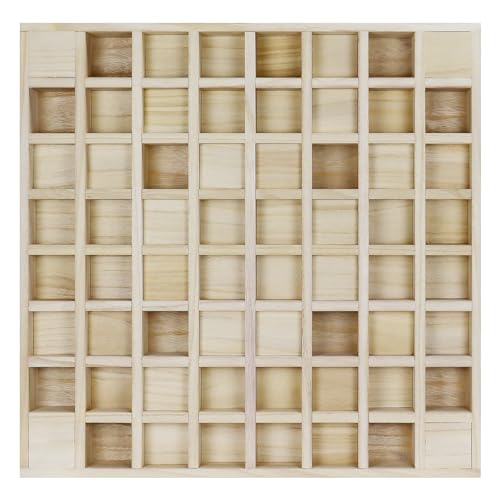
BXI Wood Sound Diffuser (2D Skyline)
When Should You Choose Absorption Over Diffusion In A Small Room?
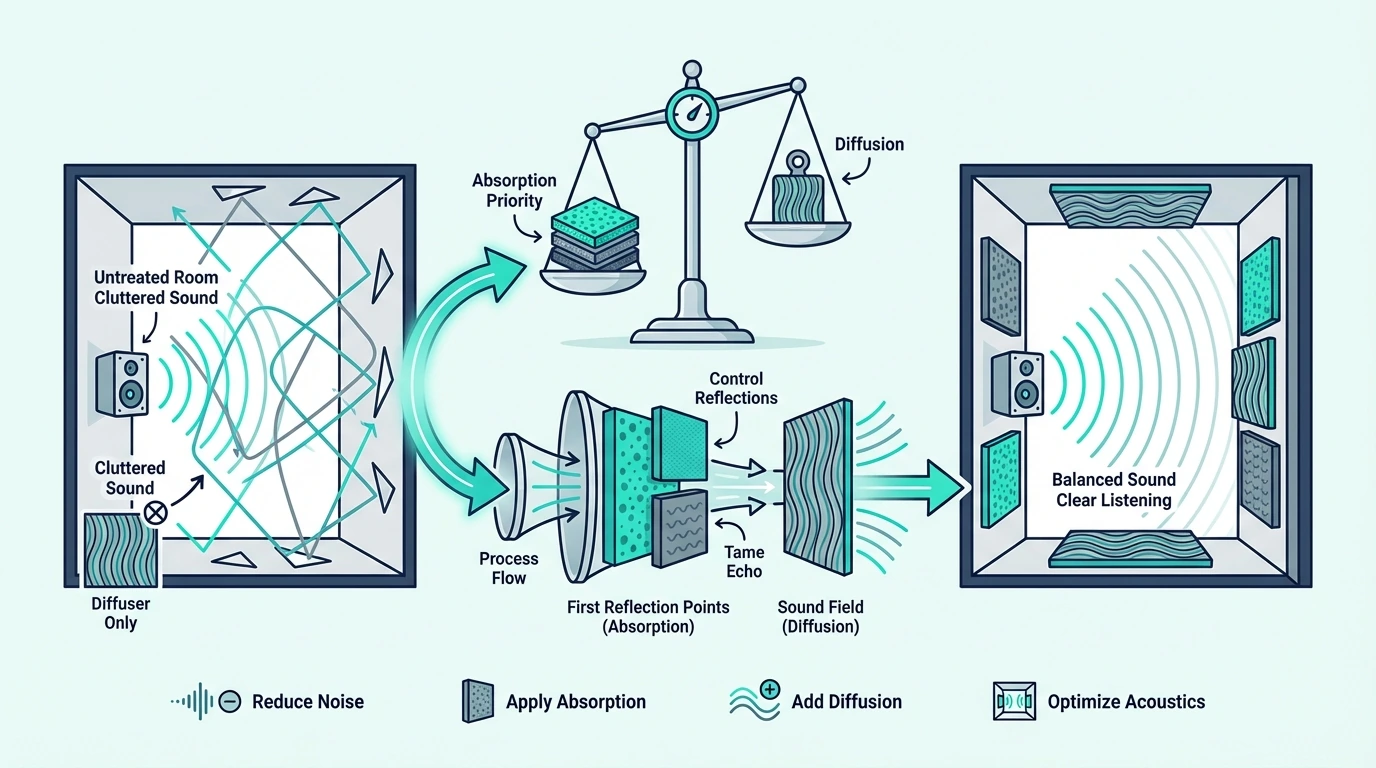
In most small rooms, absorption solves the biggest problems that diffusion can’t touch at close range. Bass buildup in corners, strong early reflections from nearby walls, and excessive reverb time all respond to absorption — and none of them improve with diffusion at short distances.
Absorption First, Diffusion Second
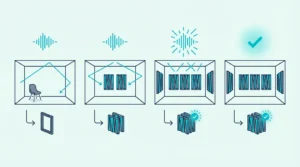
Bass traps in the corners handle the low-frequency buildup that makes small rooms sound boomy and undefined. Absorption panels at first reflection points on the side walls clean up the early reflections that smear your stereo image.
These two treatments alone transform a small room from echoey and muddy to controlled and clear. They’re also cheaper per square foot than wood diffusers, and they work regardless of the distance between the panel and your ears.
Once absorption handles the major problems, add diffusion where you have the most clearance — usually the rear wall or ceiling. The Art3d Wood Slat Acoustic Panels on the rear wall add diffusion without eating much depth — the slat pattern scatters mid-high frequencies while keeping the panel under an inch thick.
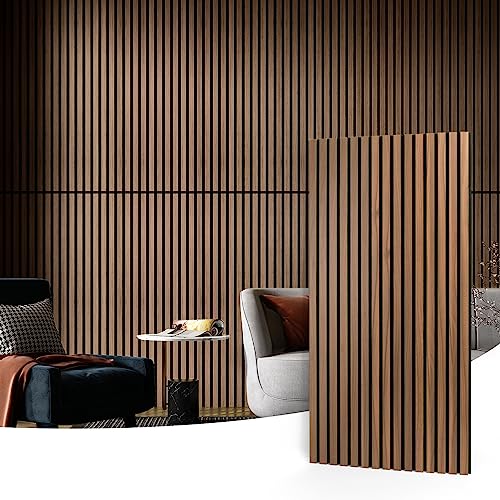
Art3d Wood Slat Acoustic Panels
The Small-Room LEDE Layout
The live-end/dead-end concept still applies in small rooms, just with adjusted proportions. The front half of the room — the “dead end” facing you — gets heavy absorption: panels at first reflection points, absorption behind the speakers, and bass traps in the front corners.
The rear half — the “live end” behind you — gets lighter treatment. If you have at least 1.5 meters between your listening position and the rear wall, a 2D diffuser works there.
If the distance is shorter, use absorption on the rear wall too and move diffusion to the ceiling.
Ceiling diffusion often works better in small rooms than rear-wall diffusion because the floor-to-ceiling distance is typically longer than the wall-to-listener distance. For detailed placement strategies, that guide covers every position.
If you’re weighing diffuser vs absorber tradeoffs, that comparison helps you decide what goes where. And for the underlying physics of why these treatments behave differently, absorption vs diffusion covers the science.
The Bottom Line
Standard diffusers need more space than most small rooms provide. In rooms under 10×10 feet, absorption handles the biggest problems — bass buildup, early reflections, and excessive reverb — without any distance requirements.
If you want diffusion in a small room, use 2D skyline diffusers or shallow high-frequency panels and mount them where you have the most clearance: rear wall first, ceiling second. Skip 1D QRD panels unless your rear wall is at least 2 meters from your listening position.
Start with absorption at first reflection points and bass traps in the corners. Add diffusion only after those fundamentals are covered — it’s a finishing touch, not a foundation.
For more on whether wood diffusers are worth it, that guide covers material performance. And for how many panels your room actually needs, check how many diffusers you need.
Frequently Asked Questions
Do diffusers work in small rooms?
Only certain types — 2D skyline diffusers and shallow high-frequency panels can help in rooms under 100 square feet. Standard QRD diffusers need at least 2 meters of clearance to scatter properly, which most small rooms can’t provide.
What is the minimum room size for a QRD diffuser?
Generally 10×12 feet or larger, so you have at least 2 meters between the diffuser and your listening position. Below that distance, the scattered reflections create comb filtering instead of smooth diffusion.
What is the 38% rule in room acoustics?
The 38% rule suggests placing your listening position at 38% of the room’s length from the front wall — roughly one-third of the way in. This position minimizes the impact of standing waves and room modes, giving you the most even bass response at your listening spot.