Do Wood Sound Diffusers Work? Yes — Here’s the Science
Do wood sound diffusers work — yes, but only if the build quality and placement are right.
Most people buy a diffuser expecting it to “fix” their room the way absorption panels do, and then wonder why the space still sounds off.
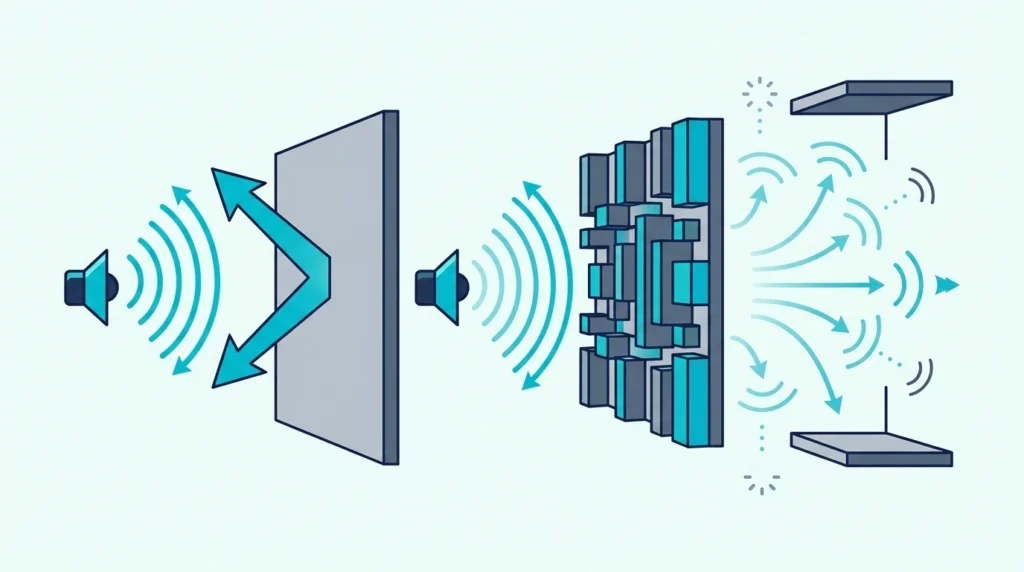
Wood diffusers don’t remove sound energy — they redistribute it, scattering reflections so your room sounds open and natural instead of echoey or dead.
The difference between a diffuser that transforms your room and one that just looks cool on the wall comes down to three things: the wood’s rigidity, the panel’s geometry, and where you put it.
Below, you’ll see exactly how wood diffusers work, how to tell if yours is actually doing its job, and when they’re the wrong tool for the problem.
To get real results from a wood sound diffuser, choose a panel with mathematically calculated well depths (QRD or skyline design), mount it on the rear wall at least 2-3 meters from your listening position, and make sure the wood is rigid enough to reflect — not flex. Thin decorative panels and foam “diffusers” won’t scatter sound properly.
Do Wood Sound Diffusers Actually Work?

Wood diffusers aren’t just studio decoration — they’re precision acoustic tools backed by physics that dates back to the 1970s. If you’re still unclear on what a sound diffuser actually does, start there.
Manfred Schroeder developed the mathematical sequences behind QRD (Quadratic Residue Diffuser) panels, and studios have relied on them ever since.
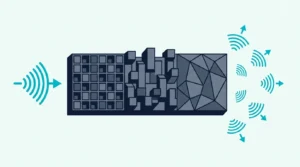
The principle is straightforward: sound waves hit the diffuser surface and encounter wells of varying depths. Each well delays the reflected wave by a different amount, and when those reflections recombine, they scatter in multiple directions instead of bouncing straight back as a single focused reflection.
Wood is ideal for this job because it’s rigid. When a sound wave hits a hard, dense surface like oak or maple, the energy reflects cleanly — the panel doesn’t absorb it or flex with it.
That rigidity is what separates a working diffuser from a decorative wall panel.
The geometry does the rest. A properly designed QRD diffuser has well depths calculated from a prime number sequence, with each depth targeting a specific wavelength.
A skyline diffuser achieves the same scattering effect through blocks of varying heights arranged in a 2D pattern. The BXI Wood Sound Diffuser (Natural) is a typical example of this design — solid wood blocks at calculated heights, mounted on a flat backing.
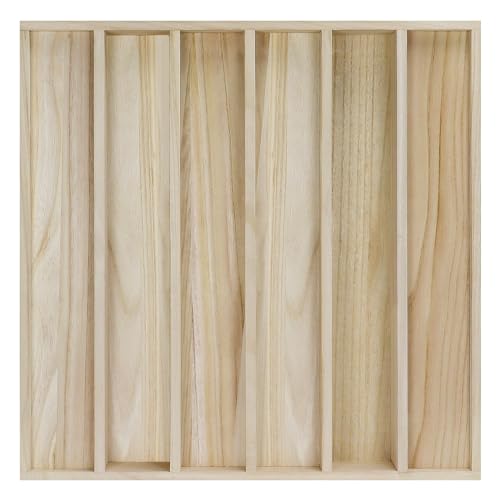
BXI Wood Sound Diffuser (Natural)
The result is a room that sounds spacious and natural. Reflections still exist — your brain needs them to perceive the size and character of a space — but they arrive from multiple angles instead of creating hot spots, comb filtering, or flutter echo.
The underlying principle is sound diffusion — redistributing energy rather than removing it.
The Clap Test Before And After
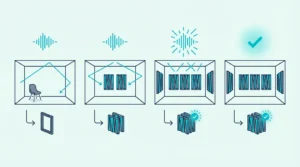
The fastest way to hear what a diffuser does is embarrassingly simple: clap your hands in the center of your room and listen.
In an untreated room with parallel walls, you’ll hear a metallic ringing that sustains for a second or more — that’s flutter echo, and it’s the sound of reflections bouncing back and forth between two flat surfaces like a ping-pong ball. The “zing” is unmistakable once you know what to listen for.
Mount a wood diffuser on the rear wall and clap again from the same spot. The flutter echo either disappears entirely or softens into a diffuse, even decay.
The room still sounds alive — it doesn’t go dead the way heavy absorption makes a space feel — but the harsh metallic ringing is gone.
If the ringing doesn’t change, either the diffuser is too close to your listening position (the scattering hasn’t had enough distance to spread) or the panel isn’t rigid enough to reflect properly. Both are fixable problems, not evidence that diffusers don’t work.
Measurement Tools (REW And Room EQ)
Your ears catch the obvious changes, but measurement software reveals what’s happening across the full frequency spectrum.
Room EQ Wizard (REW) is free and widely used. Run a sweep measurement before installing the diffuser, then run the same measurement after — same mic position, same speaker position.
The waterfall plot shows how energy decays over time at each frequency, and a working diffuser tightens the decay at mid and high frequencies without killing it entirely.
The RT60 measurement tells you how long sound takes to drop by 60dB. Absorption reduces RT60 by removing energy.
Diffusion reduces the peaks and valleys in the decay curve without necessarily lowering RT60 much — the room stays lively, but the decay becomes smoother and more even across frequencies.
Look at the early reflection window (the first 10-20 milliseconds after the direct sound). A bare wall produces a strong, discrete early reflection that smears your stereo image.
A diffuser breaks that single reflection into many smaller ones arriving from different angles — the energy is still there, but it’s spread across time and direction so your brain processes it as ambience rather than a distinct echo.
When Do Wood Diffusers NOT Work Well?
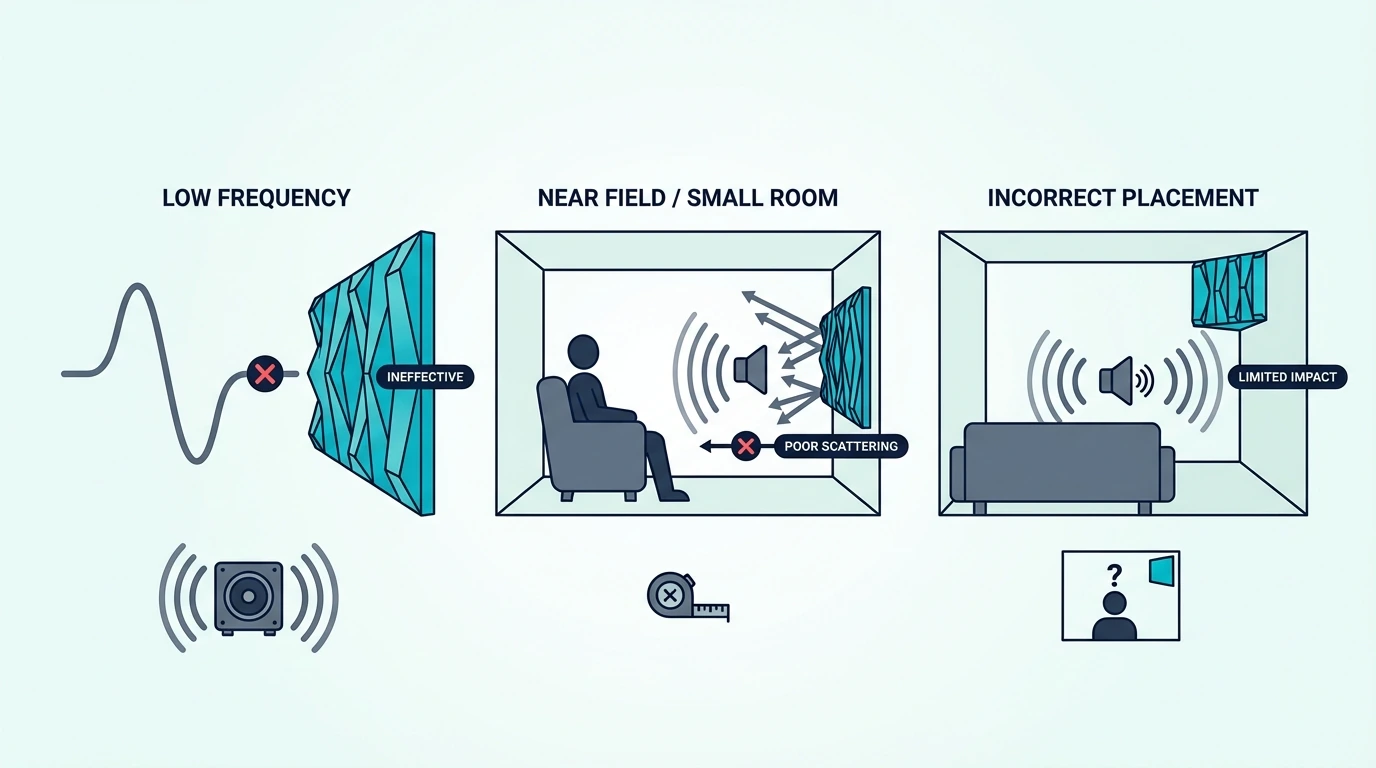
Knowing when diffusers fail matters as much as knowing when they succeed. The three most common scenarios where wood diffusers underperform have nothing to do with the physics — they’re all about context.
The honest answer is that wood diffusers are the wrong tool in specific situations, and recognizing those situations early saves you money and frustration. Every failed diffuser installation falls into one of these three categories.
Rooms That Are Too Small
Sound waves need physical distance to scatter after hitting a diffuser — without that distance, the scattered reflections haven’t separated enough to produce the intended effect.
The rule of thumb is that listeners should sit at least 2-3 meters (roughly 7-10 feet) from the diffuser surface. Below that distance, the reflections arrive too close together in time, and your ears perceive them as a single blurred reflection rather than smooth ambience.
In a room that’s 8 feet deep, a rear-wall diffuser puts the listener about 4-5 feet away — well inside the minimum distance for most diffuser designs. The scattering pattern collapses, and the panel behaves more like a flat reflective surface with texture.
Small rooms often benefit more from absorption at the rear wall. That doesn’t mean diffusers are useless in small spaces — it means the ceiling or side walls might be better locations where distance isn’t as constrained.
The physics don’t change; the geometry of your room determines where to put your diffusers so the physics can do their job.
Poor DIY Construction
A wood diffuser is only as good as its build quality, and the three most common DIY mistakes all undermine the acoustic performance.
Gaps between the wells let sound leak through instead of reflecting off the well bottoms. Even small gaps change the effective depth of each well, which shifts the frequency response away from the calculated design.
Tight joinery isn’t just aesthetics — it’s acoustics.
Thin wood that flexes under sound pressure absorbs low-mid energy instead of reflecting it. MDF or plywood thinner than 12mm will vibrate at certain frequencies, converting acoustic energy into heat rather than scattering it.
At that point, your “diffuser” is acting partly as a membrane absorber — the opposite of what you want.
Incorrect well depths throw off the entire scattering pattern. QRD diffusers rely on a specific mathematical sequence (based on a prime number), and eyeballing the depths or rounding them for convenience defeats the purpose.
Free online calculators generate the correct depths for any design frequency — there’s no reason to guess. If you’re planning a DIY wooden sound diffuser build, getting these depths right is the single most important step.
Get Studio Tips Weekly
Join 5,000+ creators getting acoustic treatment advice every week.
No spam. Unsubscribe anytime.How Do Wood Diffusers Compare To Plastic Or Foam Alternatives?
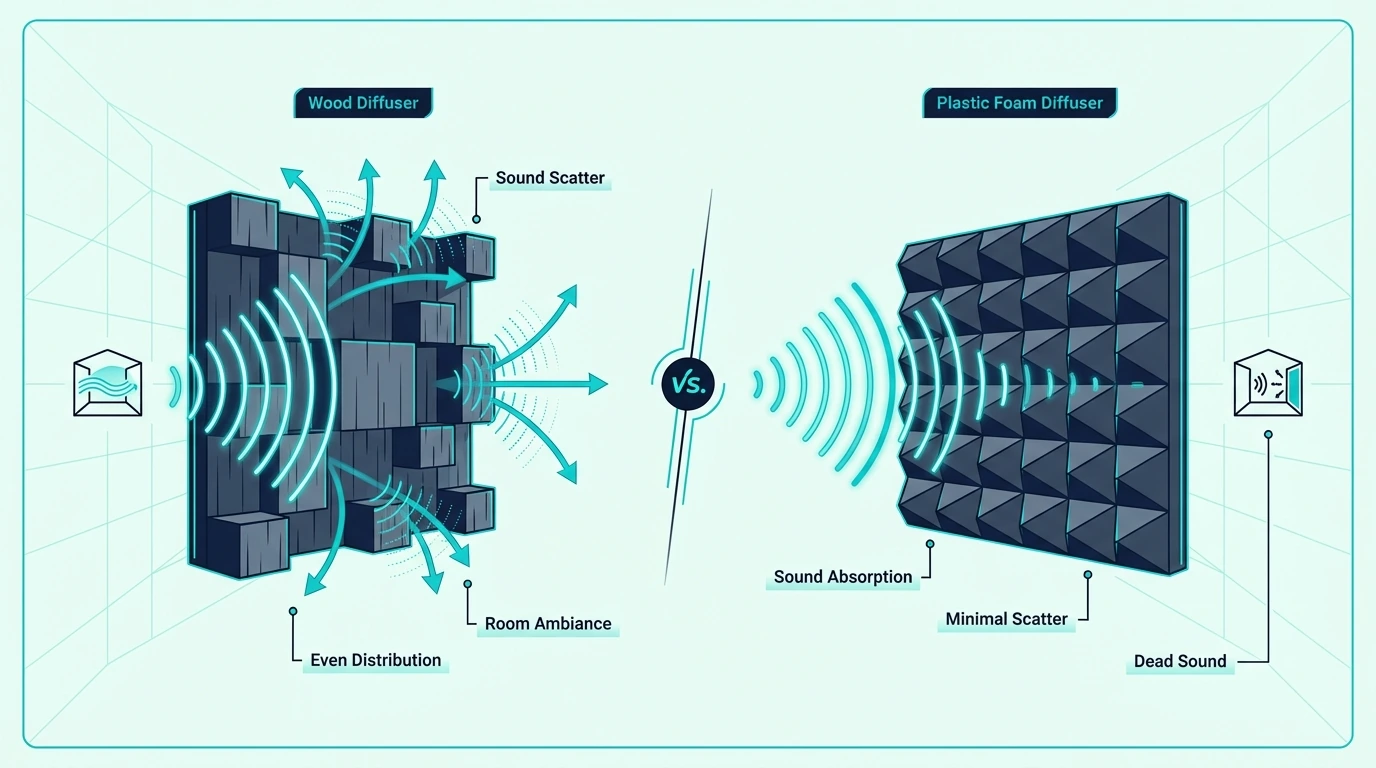
The material a diffuser is made from determines whether it actually scatters sound or just looks like it should.
Wood, plastic, and foam all interact with sound waves differently, and the differences aren’t subtle — they determine whether the panel works across a useful frequency range or only handles the easy high-frequency stuff that absorption could manage anyway.
Wood Vs Plastic Diffusers
Wood and plastic both reflect sound, but they don’t do it equally well across all frequencies.
Hardwood (oak, maple, birch ply) is dense and rigid enough to reflect frequencies from roughly 500Hz up through the highest audible range without flexing. The mass of the wood resists the pressure variations of low-mid sound waves, so the reflection stays clean and the scattering pattern holds.
Plastic and EPS (expanded polystyrene) diffusers work well at higher frequencies — 2kHz and above — where the wavelengths are short and the pressure variations are small. Below that range, lighter plastics can flex slightly on impact, absorbing some of the energy instead of reflecting it.
The scattering still happens, but it weakens as you move down the frequency scale.
The tradeoff is weight and cost. Wood diffusers are heavier (a 2×2 foot QRD panel can weigh 15+ pounds) and more expensive to manufacture.
Plastic diffusers are lighter, cheaper, and easier to mount — they just cover a narrower frequency range.
For a home studio or listening room where mid-frequency clarity matters, wood wins — the BXI Wood Sound Diffuser (2D Skyline) is the kind of panel studios reach for, with solid wood construction and calculated block heights.
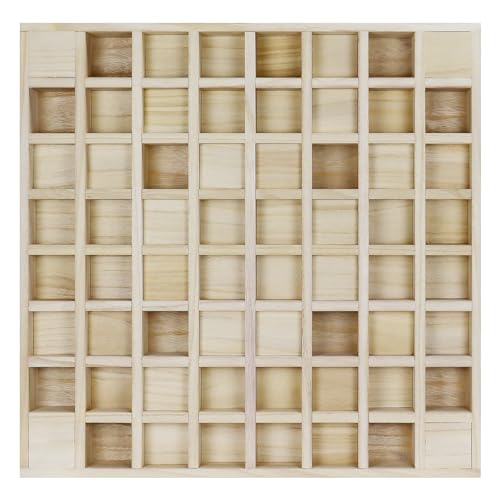
BXI Wood Sound Diffuser (2D Skyline)
The EVA Acoustic Diffusers (4-Pack) show the other end of the spectrum — lightweight EVA that’s easier to mount, covering high-frequency scatter without the weight or cost of wood. Our best wood sound diffuser roundup covers more options.
EVA Acoustic Diffusers (4-Pack)
For a large space where you’re mainly taming high-frequency flutter echo, plastic gets the job done at lower cost.
Why “Foam Diffusers” Are Misleading
Foam doesn’t scatter sound — it absorbs it. Any product marketed as a “foam diffuser” is fundamentally misnamed.
Open-cell foam (the same material in acoustic foam wedges and pyramids) converts sound energy into heat through friction as air moves through the porous structure. When sound hits foam, the energy doesn’t bounce back in a controlled pattern — it gets trapped and dissipated.
That’s absorption, not diffusion.
The shaped surfaces on foam products (pyramids, egg crate, wedges) break up the visual surface, which makes people assume they break up sound reflections the same way. They don’t.
The shapes add marginal surface area for absorption, but they lack the mass and rigidity to reflect anything. At 500Hz, the wavelength is over 2 feet long — a foam pyramid a few inches tall can’t redirect it.
If you need diffusion, you need a rigid surface. If you need absorption, foam works fine for high frequencies at a budget price.
Mixing up the two leads to rooms that are either too dead (all absorption, no diffusion) or still fluttery (foam “diffusers” where real diffusers were needed). The absorption vs diffusion comparison breaks down exactly when each approach fits.
The Bottom Line
Wood diffusers work — and they work exceptionally well when the three fundamentals are in place: rigid construction, calculated geometry, and enough distance between the panel and the listener.
The real question isn’t whether they work, but whether your specific room and situation call for diffusion instead of absorption. If the room sounds harsh and echoey, you likely need absorption first.
If the room sounds controlled but lifeless — or you’re hearing discrete reflections that smear your stereo image — that’s where diffusers earn their keep.
Start with the clap test, match the diffuser to your room’s dimensions, and don’t trust foam products that claim to “diffuse” sound.
The physics is settled. The only variable is the execution.
Frequently Asked Questions
Do wood diffusers actually work?
They do — wood diffusers have been the standard acoustic treatment in professional recording studios and concert halls since the 1970s. The key is that the panel must use a mathematically designed well pattern (QRD or skyline) and be built from rigid wood thick enough to reflect sound rather than flex.
How effective are sound diffusers?
Highly effective when sized and placed correctly. A properly designed wood diffuser scatters mid and high-frequency reflections across a wide angle, eliminating flutter echo and smoothing the room’s decay characteristics without removing energy the way absorption does.
The catch is distance — the listener needs to be at least 2-3 meters away for the scattering to fully develop.
What is the best wood for a sound diffuser?
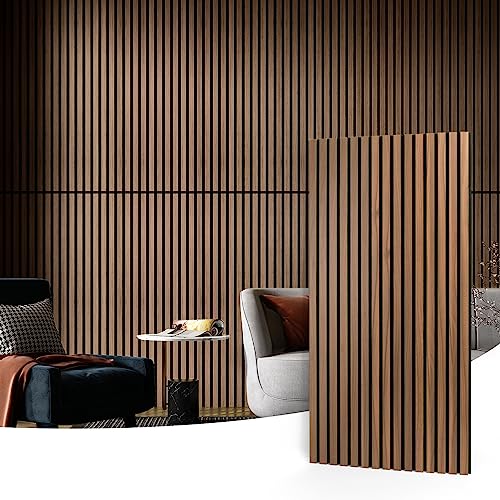
Dense hardwoods like oak, maple, and walnut reflect sound most cleanly because they resist flexing under acoustic pressure. The Art3d Wood Slat Acoustic Panels use this principle with a modern slat design — a good reference for what wood diffusion can look like when aesthetics and function merge.
Birch plywood and MDF (at 18mm+ thickness) are the most common choices for DIY builds — they’re rigid, affordable, and easy to machine.
Avoid softwoods thinner than 15mm; they’ll vibrate at low-mid frequencies and partially absorb instead of scatter.