Do Soundproof Curtains Work? What the Lab Numbers Say
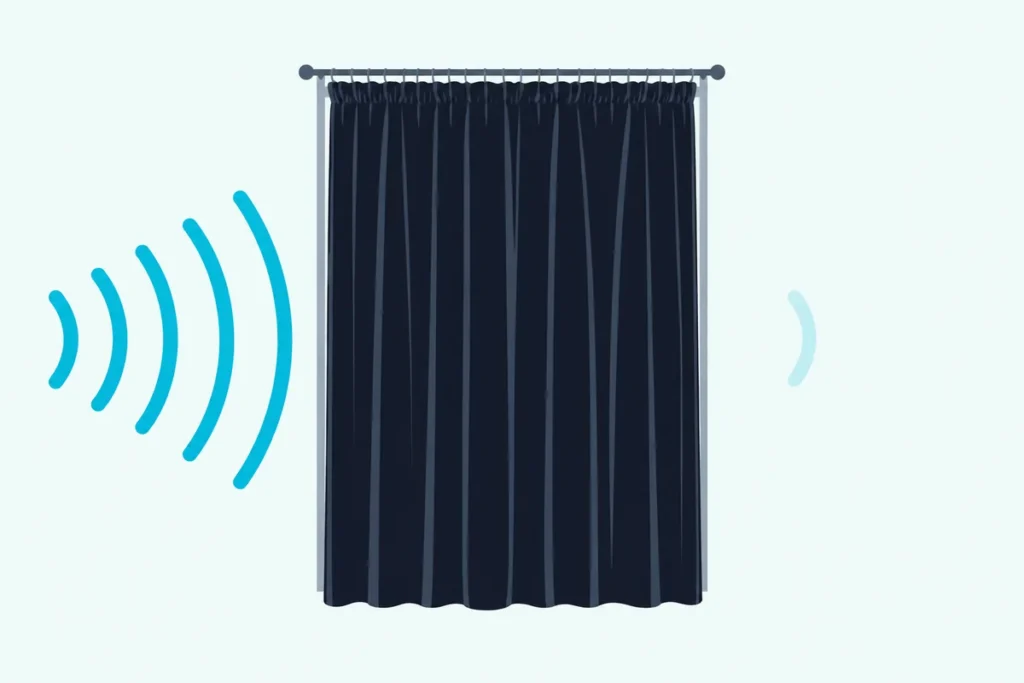
Do soundproof curtains work? A little, and mostly on mid and high sounds like voices, horns and tire hiss, while bass and rumble walk straight through.
Buy a pair expecting the street to vanish and you’ll be back at the window within a week, still hearing every passing truck and slamming car door.
Lab tests on curtain fabric paint a far more modest picture than the product pages do, and they show exactly which features change the result.
Below, you’ll see the measured numbers, why gaps and bass beat fabric, what weight and layers really add, and what to try when curtains aren’t enough.
Start with what the measurements found, because that sets every expectation that follows.
Do Soundproof Curtains Work?
Yes, in a limited way, and the measurements set the limit. A team at the National University of Singapore measured curtain materials in the lab and found a transmission loss of about 11 to 22 dB between 600 and 1,600 Hz for the best of them, a PVC-coated polyester fabric (NUS preprint).
Plain woven curtain fabric did much worse in the same team’s tube tests, averaging about 3 to 6 dB of loss from 150 to 1,600 Hz. The fabric’s weight and construction decide the result far more than the word “soundproof” on a label.
This table gathers the published results, and the notes after it explain the catches:
| Source | Material tested | Result |
|---|---|---|
| NUS preprint on hospital curtains | Commercial dual-layer drapery | STC 13 |
| NUS preprint on hospital curtains | Fire-rated curtain lining | STC 17 |
| NUS preprint on hospital curtains | Textile vinyl sheet | STC 20 |
| NUS preprint on hospital curtains | PVC-coated polyester and pure PVC sheet | STC 21 for both |
| NUS preprint on lightweight curtains | PVC-based curtains, 500 to 1,600 Hz | 8 to 15 dB insertion loss |
| University of Adelaide with a curtain maker | Interlined acoustic curtain as a room divider | 17 dB weighted improvement |
Each sample was sealed into a test opening or hung as a lab divider, so treat these numbers as best cases rather than what a curtain rod delivers. The Adelaide result came from a team that included the curtain’s maker, and the Acoustical Society’s own note says it may not have been peer reviewed yet (Acoustical Society of America).
That divider result matters most for open lofts, and Burton Acoustix’s loft soundproofing guide sets it beside the walls, doors and glass that close a loft off for good.
If you’d rather compare products than physics, our guide to which soundproof curtains to buy ranks them by weight and layers.
What Does an STC Rating Say About a Curtain?
The STC column in that table is a standard yardstick for barriers, so it helps to know what a number like 17 means. STC, or Sound Transmission Class, comes from a lab test to the ASTM E90 standard that compares sound levels in a source room and a receiving room at one-third-octave bands from 125 to 4,000 Hz (Acoustical Surfaces).
The result collapses to one number, and higher blocks more. Acoustical Surfaces’ chart translates it into what you’d hear on the other side:
| STC | What you’d hear through it |
|---|---|
| 25 | Soft speech can be heard and understood |
| 30 | Normal speech can be heard and understood |
| 35 | Loud speech can be heard and understood |
| 40 | Loud speech can be heard, but not understood |
| 45 | The threshold where privacy begins |
| 50 | Loud sounds can be heard, but are very faint |
Curtains at STC 13 to 21 sit below every row of that chart. The same source rates a standard interior wall of two half-inch drywall sheets on wood studs with no insulation at STC 33, and about 39 once fiberglass insulation goes in.
Windows land in between. Window makers put single-pane glass at roughly STC 20 to 28 and double-pane glass at about 26 to 35 (Infinity by Marvin, Indow, Giroux Glass).
A curtain’s lab rating is lower than the wall or window it hangs over, which is why it works as a modest add-on rather than a barrier. One more caution comes from Indow: STC is a single number, and it doesn’t show which frequencies get blocked.
Get Studio Tips Weekly
Join 5,000+ creators getting acoustic treatment advice every week.
No spam. Unsubscribe anytime.How Much Quieter Is a 5 or 10 dB Drop?
STC counts decibels of loss, and the Federal Highway Administration’s noise primer shows how those decibels sound (FHWA):
| Drop in level | How it sounds | Sound energy removed |
|---|---|---|
| 3 dBA | Barely perceptible | 50% |
| 5 dBA | Readily perceptible | 67% |
| 10 dBA | Half as loud | 90% |
| 20 dBA | One-quarter as loud | 99% |
The 8 to 15 dB of insertion loss the NUS team measured for PVC-based curtains would land somewhere between clearly quieter and well under half as loud, for mid and high frequencies only. A plain woven curtain averaging 3 to 6 dB sits at the other end, barely to readily noticeable.
That mapping is a rule of thumb, since the lab figures are per frequency band rather than A-weighted. It still shows why a heavy, sealed curtain is worth having and a light one isn’t.
What Does a 50 Percent Noise Reduction Claim Mean?
That table’s energy column explains a claim you’ll see on curtain listings: “reduces noise by 50 percent.” In the FHWA’s table, removing half the sound energy is a drop of just 3 dBA, which the same table calls barely perceptible.
Loudness claims run on a different scale, since a 10 dBA drop removes 90 percent of the energy but sounds only half as loud. So when a listing promises 50 percent less noise, ask whether it means energy, which you’d barely notice, or perceived loudness, which would be a 10 dB drop that only the best-built curtains in the tests approached.
Ask for the decibel figure, the frequency range it applies to and the test standard behind it. A percentage with none of those tells you very little.
What Do Transmission Loss and Insertion Loss Mean on a Listing?
Those decibel figures come from different tests, and listings tend to blur them together. Transmission loss is how much sound a material stops at each frequency, and the NUS team measured it two ways: in a small impedance tube with a round sample about 100 millimeters across, and in a reverberation chamber with a one-meter-square sample (NUS preprint).
The two methods gave different results for some materials, and the authors trust the chamber more because its diffuse sound field is closer to a real room. Insertion loss is the drop in level in the receiving room after the curtain goes into the opening, so it reflects the whole installed result rather than one frequency.
STC squeezes the transmission loss curve into a single number. The curtain maker involved in the Adelaide tests uses “level difference improvement” instead, which combines a curtain’s mass with its absorption (Acoustic Blinds and Curtains).
NRC is a different scale entirely. It summarizes absorption from 0 to 1 and says nothing about what passes through, so a tube number, a chamber number and an NRC aren’t interchangeable.
Why Do Curtains Struggle With Bass and Rumble?
Those numbers hold for the mid and high frequencies, and they fall apart lower down. The NUS team explains the trend with the mass law: transmission loss rises with frequency and with the fabric’s weight per square meter (NUS preprint).
Their formula is loss in dB = 20 log(frequency × weight) − 48, so doubling either one adds about 6 dB. Worked through for a sealed layer, it looks like this:
| Curtain weight | At 100 Hz | At 250 Hz | At 1,000 Hz |
|---|---|---|---|
| 0.5 kg/m² | None predicted | None predicted | 6 dB |
| 1 kg/m² | None predicted | None predicted | 12 dB |
| 2 kg/m² | None predicted | 6 dB | 18 dB |
| 4 kg/m² | 4 dB | 12 dB | 24 dB |
A 1 kg/m² sheet gives 12 dB at 1,000 Hz but nothing at 100 Hz, and matching that 12 dB down at 100 Hz would take about ten times the weight. These are best cases for an airtight layer, and a porous, leaky curtain does worse.
Absorption tells the same story. Published tables list a medium velour drape (14 ounces per square yard, draped to half area) at 0.07 at 125 Hz and 0.75 at 1,000 Hz, and Commercial Acoustics says furnishings add little absorption below 250 Hz (USEnclosure table, Commercial Acoustics).
Bass from music and the rumble of trucks live at those lower frequencies, so fabric hung at a window barely touches them. Tent walls hit the same limit, which is why no fabric soundproof tent can shut out a campground generator.
What Makes One Curtain Block More Than Another?
Weight per square meter drives those mass-law numbers, and it varies widely between fabrics. The NUS team’s woven acoustic curtain was 0.57 millimeters thick and weighed 0.224 kg/m², and two wool felts at 0.213 and 0.252 kg/m² averaged only up to 1 and 2.5 dB of loss (NUS preprint).

Woven textiles, including a hospital curtain and that acoustic curtain, averaged about 3 to 6 dB over 150 to 1,600 Hz. The authors blame the weave, since the threads leave porous gaps that let sound through.
Smooth, airtight materials did better. A light textured liner coated in PVC foam beat conventional woven curtain fabric by about 2 to 11 dB between 300 and 1,600 Hz, and pure PVC scored highest but was heavy and stiff for a curtain.
Layering helps too. Sliding a sheet of PVC-coated polyester or pure PVC into the woven curtain added about 1 to 2 dB and 2 to 5 dB of insertion loss, respectively, over the sheet alone.
The University of Adelaide design follows the same idea: a mass layer sandwiched between two sound-absorbing curtain fabrics, with demonstration recordings using interlinings of 800 and 1,500 grams per square meter (Acoustical Society of America). That’s roughly 3.5 to 7 times the 224 grams per square meter of the woven curtain above.
When you read a product listing, three details matter more than the word “soundproof”:
- A stated weight per area, since the mass law rewards weight.
- A dense, airtight layer between the fabrics rather than a porous weave alone.
- Lab numbers from a named test standard, such as STC from ASTM E90.
Do Gaps Around a Curtain Cancel Its Effect?
Even a good interlining fails where the fabric doesn’t meet the wall, which is why the labs went to such lengths. The NUS team fitted each sample tightly into the opening with frames, toggle clamps and gaskets to keep sound from leaking around it (NUS preprint).
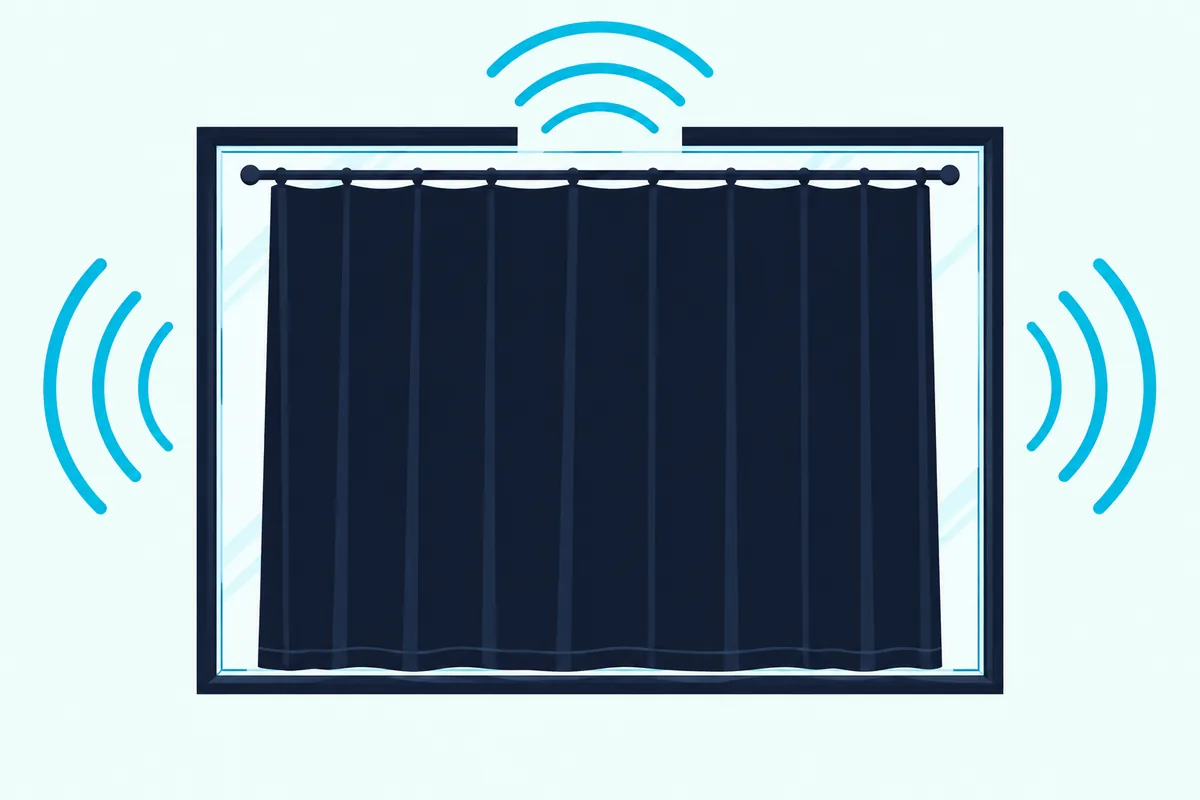
A curtain on a rod has open gaps at the sides, the top and the bottom instead. Indow notes that noise can enter anywhere air can, and Infinity by Marvin says a window’s rating depends partly on how airtight it is (Indow, Infinity by Marvin).
Giroux Glass adds that the effectiveness of a window’s seals and frames changes its overall STC. None of these sources gives a number for a specific gap size, so treat the advice as direction rather than a calculation.
The practical reading is that sealing leaks around the frame comes first and a curtain second. A curtain hung over an unsealed window is covering a hole with fabric that lets sound pass anyway.
Do Curtains Reduce Echo Inside a Room?
Blocking sound and controlling echo are different jobs, and curtains do the second one better than the first. Commercial Acoustics frames it as three outcomes when sound hits a surface: it reflects, it’s absorbed, or it passes through (Commercial Acoustics).
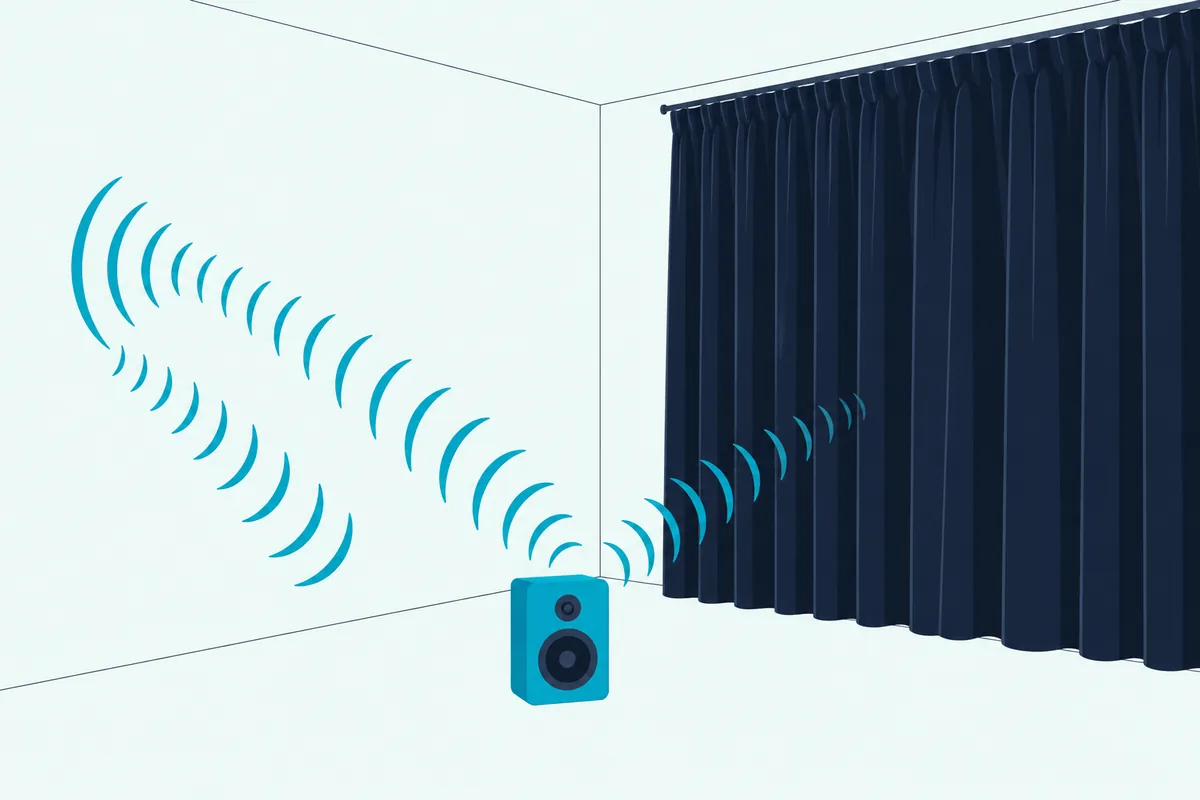
Absorption coefficients run from 0, which reflects everything, to 1, which absorbs everything. This published table shows how much drapery soaks up at each frequency (USEnclosure table):
| Fabric | 125 Hz | 250 Hz | 500 Hz | 1,000 Hz | 2,000 Hz | 4,000 Hz |
|---|---|---|---|---|---|---|
| Light velour (10 oz/yd²), hung flat against the wall | 0.03 | 0.04 | 0.11 | 0.17 | 0.24 | 0.35 |
| Medium velour (14 oz/yd²), draped to half area | 0.07 | 0.31 | 0.49 | 0.75 | 0.70 | 0.60 |
| Heavy velour (18 oz/yd²), draped to half area | 0.14 | 0.35 | 0.55 | 0.72 | 0.70 | 0.65 |
Fullness matters as much as fabric weight. Commercial Acoustics says a flat curtain barely absorbs more than the wall behind it, while the same fabric gathered to 50 to 75 percent fullness, with 1.5 to 2 times the rod length in fabric, can reach a noise reduction coefficient of 0.50 to 0.75.
For comparison, the Engineering ToolBox lists ordinary window glass at 0.1 to 0.2 and heavy plate glass at 0.03 to 0.05, so a bare window bounces almost all the sound back (Engineering ToolBox).
That calms a hard-walled room and clarifies speech inside it. It doesn’t stop sound at the wall, since the absorption number describes what a surface soaks up rather than what passes through, and our guide to acoustic curtains versus panels compares the two for echo.
Will Curtains Stop Traffic and Street Noise?
Echo is an inside problem, and street noise arrives from outside through the glass. The NUS authors say multi-layer curtains could serve as acoustic window curtains against road traffic while letting daylight in, and their measured gains were 8 to 15 dB in the 500 to 1,600 Hz band (NUS preprint).
That’s the mid-to-high slice of traffic noise, and the paper’s own title limits its claims to that band. Andersen’s help center notes that STC covers mid-to-high frequency sources like speech and television, while a separate rating, OITC, covers lower-frequency ones such as aircraft, trains and cars (Andersen).
Below that band, the mass law gives curtain-weight fabric almost nothing.
The Adelaide team notes that windows are where sound commonly enters a space, and a single-pane window is only about STC 20 to 28. A heavy curtain adds a few decibels at mid and high frequencies, while sealing gaps and upgrading the glass moves the whole spectrum, as our guide to soundproofing windows without replacing them explains.
Do Curtains Help When the Window Is Open?
The Adelaide tests included an open window among their four glazing conditions, alongside 4 mm, 6.38 mm and 10.38 mm glass. The team says the interlined curtains cut perceived noise by more than half for both open and closed windows, and reports similar results across the three glass thicknesses (Acoustical Society of America).
That claim comes from a test that included the curtain’s maker and hasn’t been peer reviewed, and the summary doesn’t publish the open-window decibel figure. It’s still the case where a curtain matters most, because with the glass out of the path its own weight and gaps decide the result.
Can Curtains Block Noise From Neighbors or a TV?
Windows are one path for noise, and walls are another. Sound from a neighbor or a television mostly reaches you through the wall, floor and ceiling, and a curtain over the window doesn’t sit in that path.
A curtain hung on the wall adds absorption rather than blocking, and its STC 13 to 21 range sits far below a plain wall’s 33. Acoustical Surfaces says the ways to improve a wall are more mass, insulation and air space, and our guide to ways to add mass and air space to a wall covers those fixes.
Do Blackout Curtains Reduce Noise?
Blackout curtains are the thing most people hang hoping for quiet, so it’s worth separating light from sound. Blackout describes how much light gets through, and nothing in the tests ties it to sound.
What the tests rewarded was weight per square meter and airtight layers. A plain woven blackout curtain would sit near the 3 to 6 dB the NUS team measured for woven fabric, while one with a heavy, dense layer could do better, and the label won’t tell you which you have.
How Should You Hang Curtains for the Best Result?
If you do hang curtains, the tests and makers point to a short list of choices that decide how much you get:
- Choose weight first. Look for a stated weight per area and a dense middle layer rather than a porous weave alone.
- Gather the fabric. Aim for 50 to 75 percent fullness so the fabric is 1.5 to 2 times the rod length, which means 90 to 120 inches of fabric on a 60-inch rod and is where Commercial Acoustics sees the best absorption.
- Cover the whole opening. Extend past the frame on every side and down to the floor, since noise gets in wherever air can.
- Seal the window first. Fix air leaks around the frame before you rely on fabric.
The sources don’t publish an exact overlap or gap size, so treat these as directions rather than specifications. Even done well, the result stays inside the mid-to-high band shown earlier.
What Works Better Than Curtains for Window Noise?
If the goal is blocking noise rather than softening it, other fixes have better published numbers. This table sets them side by side:
| Fix | Published figure | Source |
|---|---|---|
| Plain woven curtain | 3 to 6 dB average in tube tests | NUS preprint |
| Interlined acoustic curtain | 17 dB weighted improvement as a lab divider | University of Adelaide with a curtain maker |
| Acrylic window insert over a single-pane window | STC 39, against 25 bare | Indow |
| Insert over a double-pane window | STC 42 to 45, against 33 to 35 bare | Indow |
| Laminated glass with double glazing | About STC 40 | Giroux Glass |
Indow sells inserts, so treat its figures as a maker’s claims, and it says the gain is smaller over double-pane windows. Giroux Glass and Infinity by Marvin both say laminated glass raises a window’s STC.
These figures come from different tests and measures, so read them as a guide to the order of the fixes rather than an exact ranking.
Our comparison of window inserts that seal a window’s air gaps covers specific products. Curtains still win on light control, echo and flexibility, so many rooms end up using both.
Are Soundproof Curtains Worth Buying?
They’re worth it if you want light control, gentler echo and a few decibels off voices and hiss. They’re not worth it if the problem is bass, a neighbor through the wall or heavy traffic rumble, where the published numbers fall far short.
Before you buy, look for a stated weight, a heavy middle layer and a maker that publishes lab results from a named standard. A listing that offers only the word “soundproof” gives you nothing to compare.
Can You Make Curtains Quieter Yourself?
If you’d rather add to curtains you already own, the NUS results point to where the gain comes from. The NUS proof of concept slid a PVC sheet into a woven curtain’s pocket and measured 1 to 5 dB more insertion loss, though the authors note that pure PVC is heavy and stiff for a curtain (NUS preprint).
The Adelaide design layers a mass sheet between two absorbing fabrics. None of the sources describes a home-made version, so treat any DIY layer as an experiment and expect the weight and stiffness trade-off the NUS authors describe.
The Bottom Line
Soundproof curtains work modestly, mostly above a few hundred hertz, and the best-built ones need weight, a dense layer and no gaps to earn it. Plain woven curtains averaged 3 to 6 dB in the lab, while the best-built designs reached 10 dB or more.
Buy them for light control and echo, and reach for sealing, inserts or better glass when noise blocking is the goal.
Frequently Asked Questions
How many decibels do soundproof curtains reduce?
It depends on the build. The NUS team measured about 3 to 6 dB of average loss for plain woven fabric and 8 to 15 dB of insertion loss for PVC-based curtains in the 500 to 1,600 Hz range, and the Adelaide lab reported a 17 dB weighted improvement for a heavy interlined curtain used as a divider. Those are sealed lab results, so a curtain on a rod will do less.
Do soundproof curtains work for bass or music?
No. The mass law predicts almost no loss at 100 Hz for curtain-weight fabric, and published absorption for a medium velour drape is only 0.07 at 125 Hz. Commercial Acoustics says furnishings add little absorption below 250 Hz, so bass passes through.
Do thick curtains reduce noise?
Thickness on its own isn’t the measure. The NUS tests link performance to weight per square meter and airtightness, and a porous woven fabric let sound through even when it was a standard hospital curtain.
Are soundproof curtains better than window inserts?
For blocking noise, the published numbers favor inserts and better glass. Indow lists STC 39 for a single-pane window with its insert, against 25 without it, while lab curtains scored STC 13 to 21 on their own. The measures differ, so it’s a guide rather than a like-for-like test, and curtains do better for light control and echo.
Can curtains soundproof a room for music practice?
Not for keeping sound in. A gathered heavy curtain can reach an absorption coefficient of 0.50 to 0.75 and calm the room’s echo, but its STC 13 to 21 range is far below a plain wall’s 33, so most of the sound still gets out.