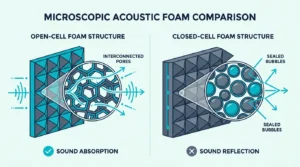
Acoustic Foam Pyramid vs Wedge: Which Shape Works Best?
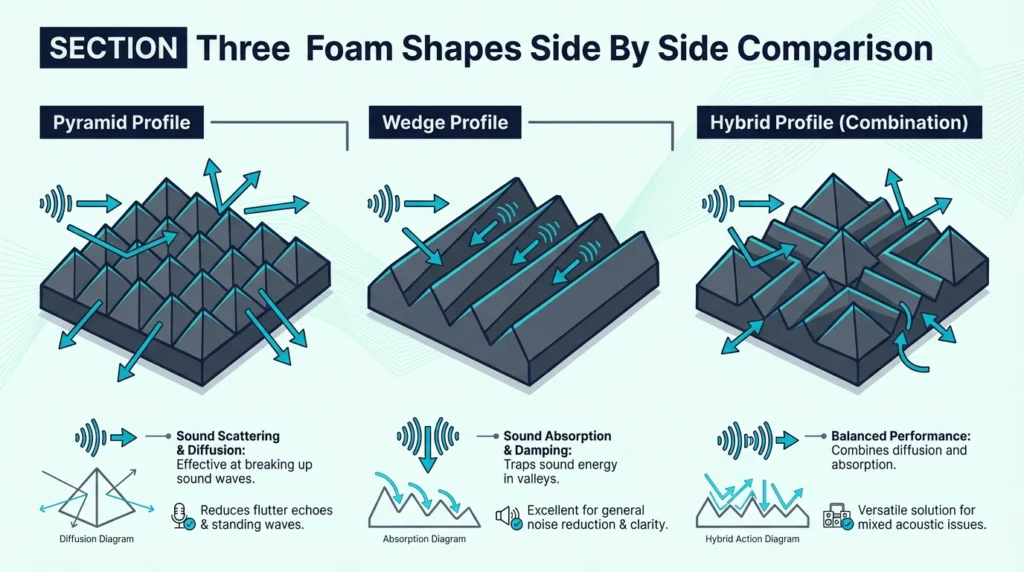
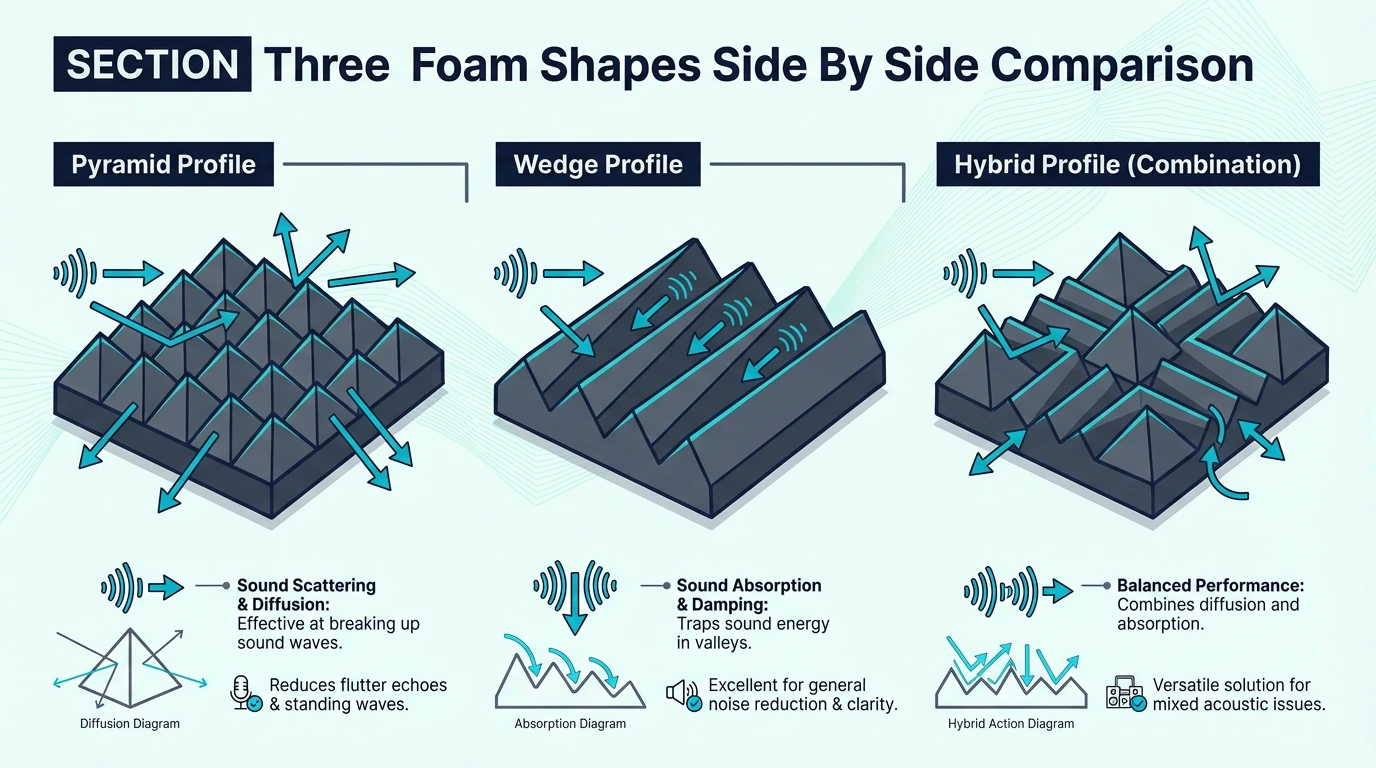
Acoustic foam pyramid vs wedge—the three shapes look different, but in most home studios the audible difference is minimal.
If the foam is the same thickness and density, pyramid, wedge, and egg crate all reduce mid/high reflections in similar ways. Placement and total coverage change your room far more than the surface pattern.
Shape isn’t completely irrelevant. It affects how the foam looks, how easy it is to cut, and how much coverage you can buy for the same money.
One important distinction before we start: acoustic foam reduces echo and reverb inside the room. It does not soundproof—your neighbors will still hear your music.
If you want the deeper physics, read our how acoustic foam works guide. Otherwise, start with the quick takeaway and then match a shape to your use case.
For most rooms, pyramid, wedge, and egg crate foam perform similarly when thickness and density match. The audible difference between shapes is usually tiny compared to placement and total coverage.
Pick pyramid if you like the look, wedge as an easy default, and egg crate if you need maximum coverage on a budget. If you can only optimize one thing, go thicker (2-inch) before you obsess over shape.
What’s the Difference Between Pyramid, Wedge, and Egg Crate Foam?
Let’s break down what makes each one tick. The three main acoustic foam shapes differ in their surface geometry, but they all work on the same principle: creating surface area for sound waves to enter and lose energy through friction.
Each shape creates peaks and valleys that increase the total surface area compared to a flat panel. More surface area means more opportunities for sound absorption.
The Short Answer: Does Shape Actually Matter?
I need to be direct about this: for most applications, shape makes less than a 10% difference in absorption performance. The marketing claims about pyramid being “superior” or wedge being “optimal” are largely overstated.
What matters more is thickness, density, and placement. A well-placed 2-inch wedge panel will outperform a poorly placed pyramid panel every time.
If you haven’t treated reflection points yet, start there first. Our foam placement guide shows exactly where to put panels for maximum effect.
That said, pyramid foam does have marginally more surface area due to its four-sided peak structure. In laboratory conditions, this translates to slightly better absorption — but in real rooms with real acoustic problems, the difference is barely measurable.
Quick Shape Comparison Table
| Feature | Pyramid | Wedge | Egg Crate |
|---|---|---|---|
| Surface Area | Highest | Medium | Lowest |
| Availability | Common | Most Common | Common |
| Price | Mid-range | Budget to Mid | Usually Cheapest |
| NRC Range | 0.3-0.5 | 0.3-0.5 | 0.25-0.45 |
| Best For | Aesthetics | General use | Budget setups |
| Diffusion | Some | Minimal | Minimal |
What Is Pyramid Acoustic Foam?
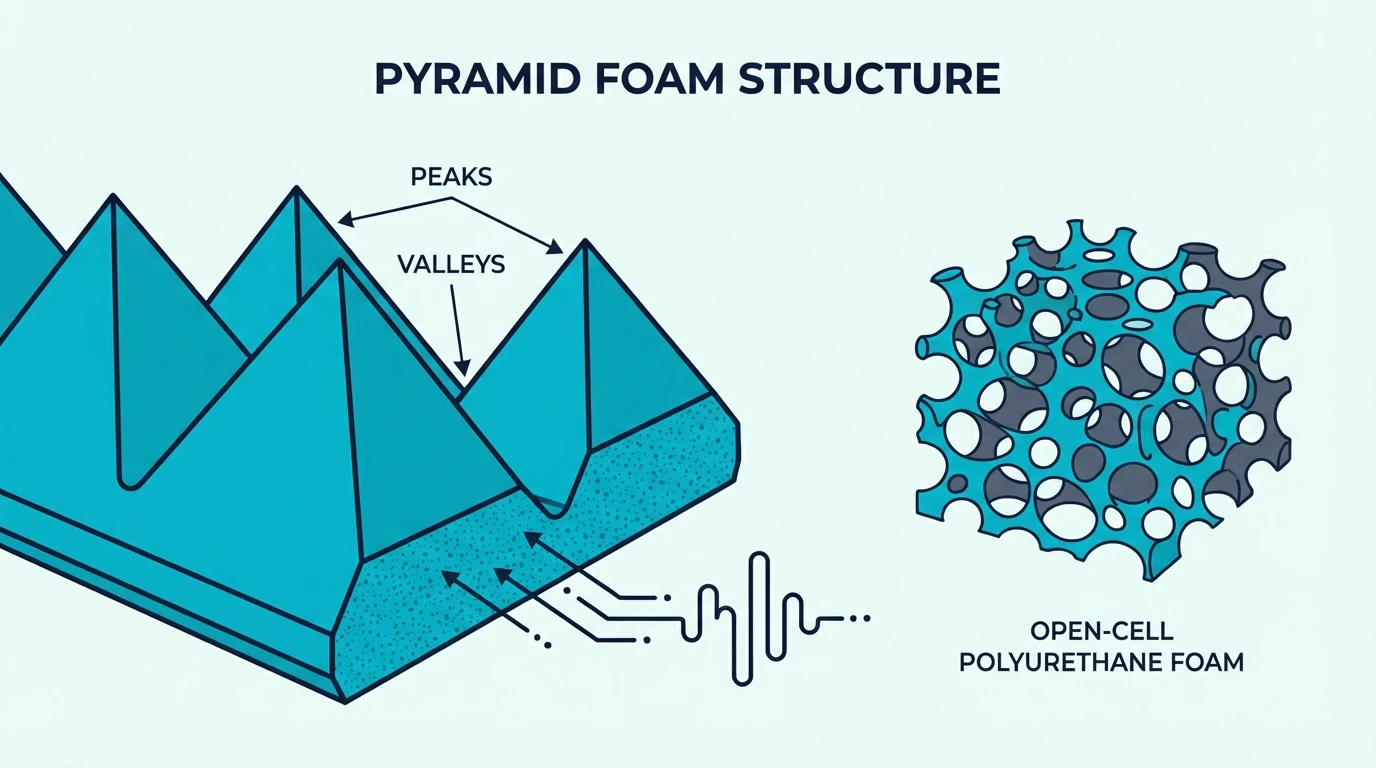
Now that you understand the basics, let’s look at each shape individually. Pyramid foam features four-sided pointed peaks arranged in a grid pattern, creating valleys between the pyramids where sound enters and gets absorbed.
The geometry resembles a field of small mountains. This distinctive look makes pyramid foam popular for visible studio installations where aesthetics matter.
How Pyramid Foam Works
Sound waves hit the angled surfaces of each pyramid and scatter in multiple directions. Some energy reflects at angles, while most enters the valleys between peaks.
Once inside the foam structure, sound bounces between pyramid walls, losing energy with each contact. The friction between air molecules and foam cell walls converts sound energy to heat.
The four-sided design means sound approaching from any horizontal angle encounters multiple surfaces. This provides slightly more consistent absorption across different sound arrival directions than wedge profiles.
Pyramid Foam Pros and Cons
Pyramid foam is popular because it looks like “studio treatment” and adds the most textured surface of the common shapes. Because the peaks face multiple directions, it’s less sensitive to orientation than wedge ridges.
The tradeoff is price and durability, not a night-and-day acoustic upgrade. The pointed peaks collect dust and can tear more easily, so you’re paying more mainly for the look.
Best Uses for Pyramid Foam
Pyramid foam makes sense when visual appearance matters alongside acoustic function. Recording studios with client-facing spaces often choose pyramid for its professional look.
Options like 12-pack 2-inch pyramid foam panels deliver the look with solid absorption. Check our best acoustic foam panels guide for more pyramid options.
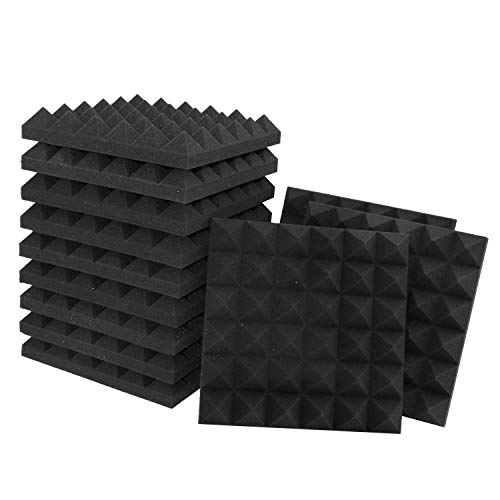
12 Pack 2-inch Pyramid Acoustic Foam Panels
For broadcast studios and podcast rooms where cameras capture the space, pyramid foam photographs well and looks intentional. The geometric pattern reads as “professional audio space” to viewers.
Get Studio Tips Weekly
Join 5,000+ creators getting acoustic treatment advice every week.
No spam. Unsubscribe anytime.What Is Wedge Acoustic Foam?
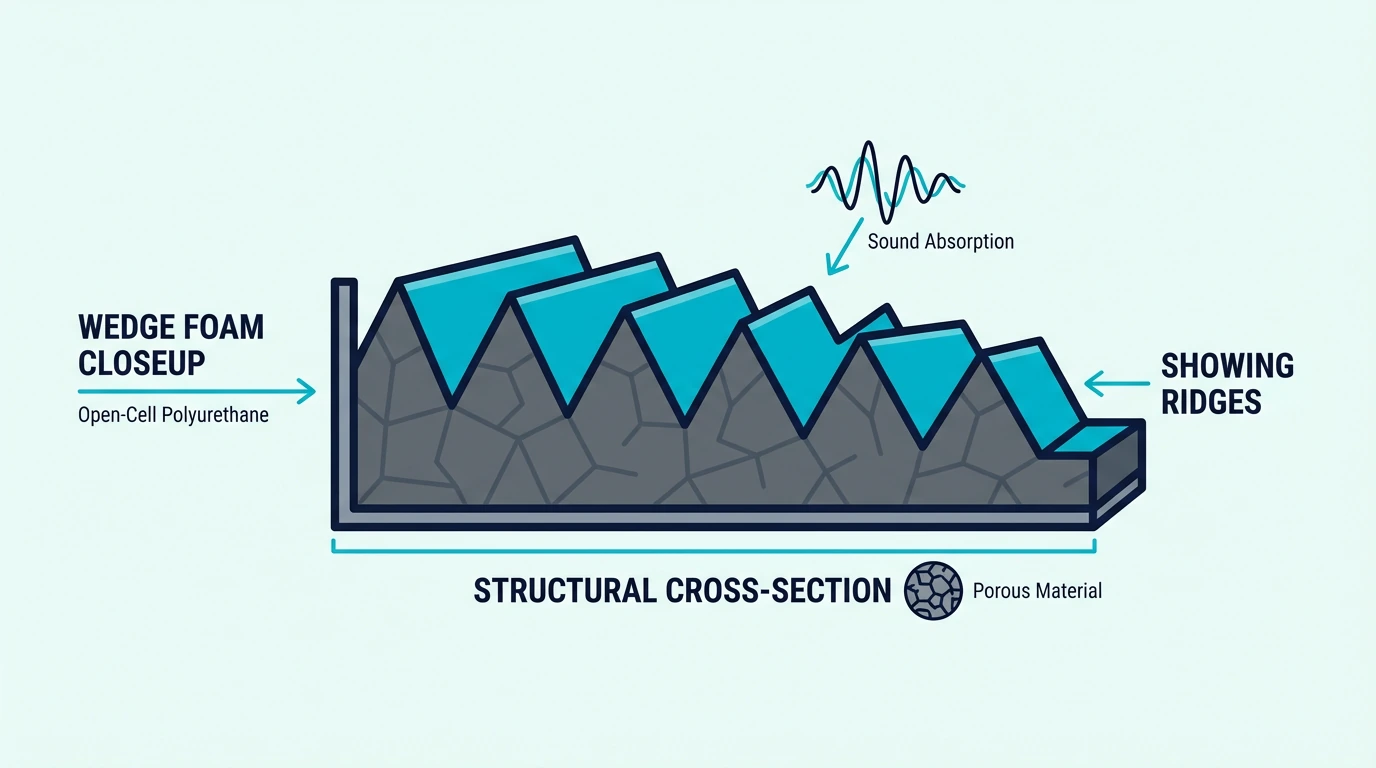
Wedge foam is the most common shape you’ll see, and it’s the default for a reason. The ridges run in one direction, creating a clean pattern that’s easy to align on a wall.
Because it’s so common, wedge foam is usually the most affordable and easiest to replace later. If you’re not sure what to buy, wedge is the safe pick.
How Wedge Foam Works
Sound waves entering at angles perpendicular to the ridges encounter maximum surface area. Waves parallel to the ridges encounter less surface but still get absorbed as they enter the valleys.
The angled surfaces scatter incoming sound while the valleys trap and absorb it. Like all acoustic foam, the open-cell structure converts sound energy to heat through friction.
Wedge foam’s directional pattern means optimal absorption depends somewhat on orientation. Mounting wedges perpendicular to your primary sound source maximizes their effectiveness.
Wedge Foam Pros and Cons
Wedge foam is easy to buy, match, and expand later, and it tends to look clean on a wall. The ridge structure also holds up well, so it’s a solid choice for bedrooms and practice rooms.
The main downside is that it’s directional: it absorbs best when sound hits across the ridges, not along them. In practice the difference is small, but you can orient the ridges toward your main reflection points if you want to be picky.
Best Uses for Wedge Foam
Wedge foam is the default choice for home studios, practice rooms, and anywhere budget matters. Budget-friendly options like Focusound 24-pack wedge foam panels offer excellent value for beginners.
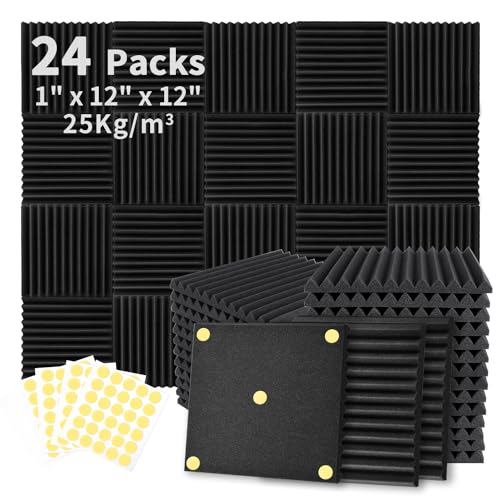
Focusound 24 Pack 1-inch Wedge Acoustic Foam Panels
The price-to-performance ratio is excellent, and availability means you can easily buy more. When ready to install, see our guide on how to put acoustic foam on walls for mounting methods.
For podcasting setups and vocal booths, wedge foam provides plenty of absorption for speech frequencies. The linear pattern also creates visual interest without being distracting on camera.
What Is Egg Crate Acoustic Foam?
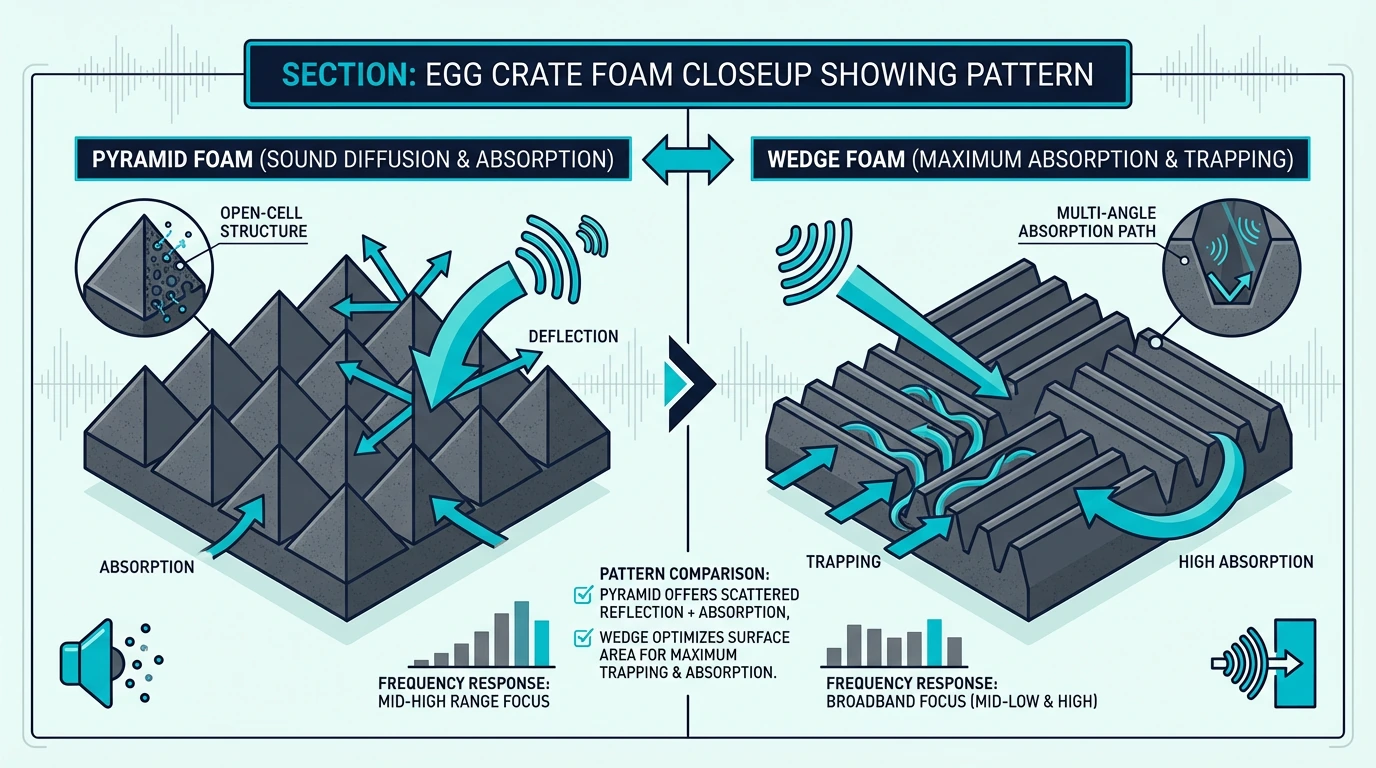
Egg crate foam has rounded bumps and deep valleys, similar to mattress toppers and packaging foam. The softer profile looks less “studio” than pyramid or wedge.
This shape originated in packaging and bedding applications before it became popular for acoustics. Its familiarity makes it blend in more, which some people prefer.
What Does “Convoluted Foam” Mean?
You’ll sometimes see “convoluted foam” in product descriptions and wonder if it’s something different from egg crate. It isn’t—“convoluted” is just the manufacturing term for the egg crate profile.
The convoluted shape comes from passing flat foam through a special cutting machine that creates the peaks and valleys. It’s the same process used for medical bed pads and mattress toppers — acoustic egg crate foam just uses denser, firmer material.
Some manufacturers use the fancy term because it sounds more technical. Others are simply using industry terminology.
Either way, don’t treat the label as a quality signal. Thickness and density matter more than whether a listing says “egg crate” or “convoluted.”
If you’re searching for products, try both terms. “Egg crate acoustic foam” returns more consumer-oriented results; “convoluted acoustic foam” sometimes surfaces industrial suppliers with bulk pricing.
How Egg Crate Foam Works
The rounded peaks and wide valleys create less total surface area than pointed pyramid or wedge profiles. Sound enters the valleys and gets absorbed, but there’s less surface contact overall.
The softer geometry means slightly less absorption efficiency compared to sharper profiles. However, the difference is small enough that egg crate remains effective for basic acoustic treatment.
Egg crate foam’s main advantage is price—the simpler manufacturing process typically makes it the cheapest acoustic foam option available. If you’re comparing foam to other treatments, our acoustic foam vs acoustic panels comparison breaks down the differences.
Egg Crate Foam Pros and Cons
Egg crate is usually the cheapest option, and the softer look can be a plus in bedrooms and casual spaces. It’s also less “pokey” if you bump into it.
The downside is that it looks more like packing material, and it has the lowest surface area of the three shapes. The absorption difference is small, but the aesthetic difference can be obvious.
Best Uses for Egg Crate Foam
Egg crate makes sense when budget is the primary concern and you need maximum coverage for minimum cost. Bedroom studios and practice spaces where appearance matters less benefit from the savings.
The surface area difference we covered earlier shows up here — egg crate’s rounded bumps create less friction than pointed peaks. But here’s the thing: if you’re covering a 10×10 room, that 15-30% price savings lets you buy 30% more panels.
More coverage beats marginally better per-panel absorption every time. A room with 20 egg crate panels will sound better than one with 12 pyramid panels.
For temporary setups or rental spaces where you might remove the foam later, egg crate’s lower cost reduces the investment at risk. The same principle applies to practice spaces where foam might get damaged.
How Do These Shapes Compare for Sound Absorption?
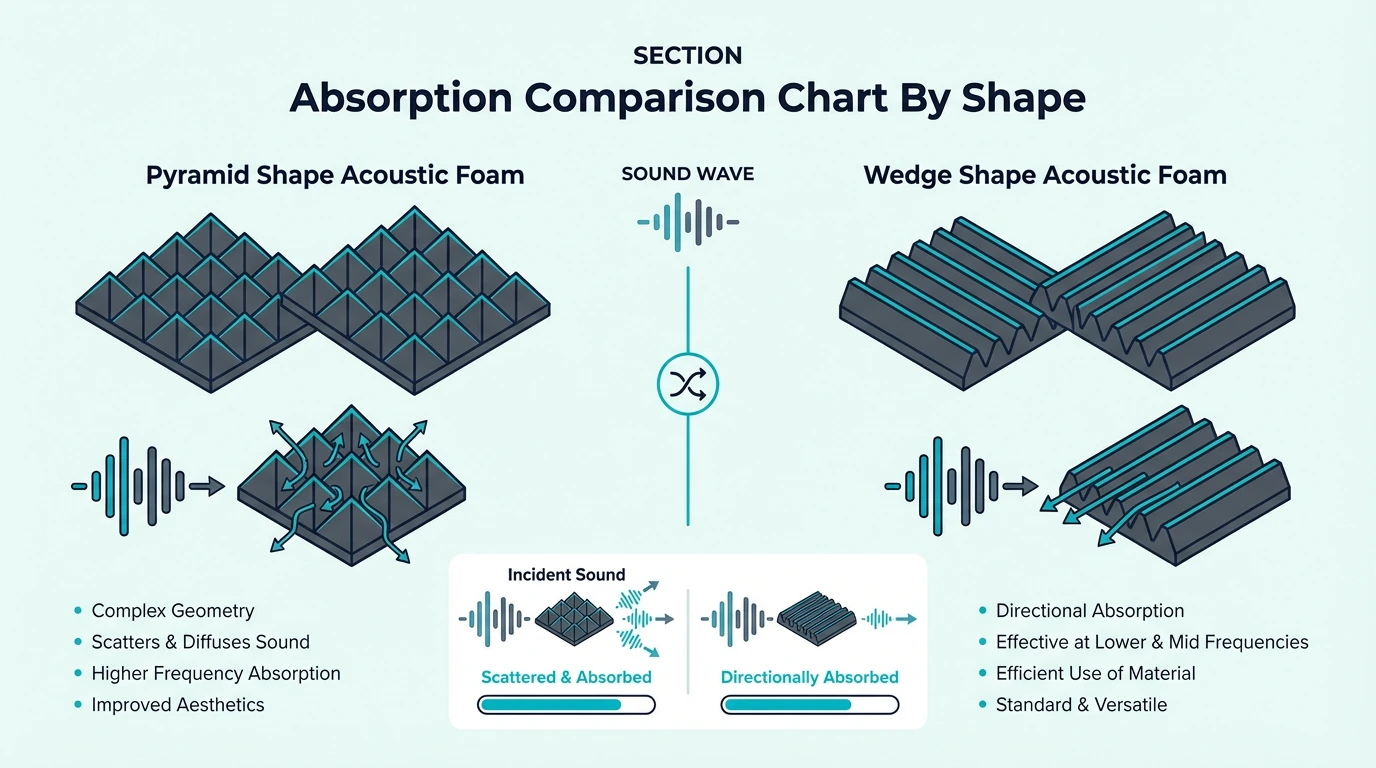
Here’s where it gets interesting: the numbers tell a different story than the marketing. Real-world absorption differences between shapes are smaller than sellers suggest.
When you control for thickness and density, shape alone accounts for roughly 5-10% variation in NRC ratings. For most rooms, that difference gets lost in the noise compared to placement and coverage.
That 5-10% matters in professional studios measuring for precise acoustic specifications. For home recording and content creation, it’s noise in the margin — other factors matter far more.
NRC Rating Comparison by Shape
NRC (Noise Reduction Coefficient) measures absorption from 0 (reflects all sound) to 1 (absorbs all sound). Most acoustic foam lands between 0.3-0.5 regardless of shape.
| Shape | 1” Thickness NRC | 2” Thickness NRC |
|---|---|---|
| Pyramid | 0.30-0.35 | 0.45-0.55 |
| Wedge | 0.28-0.33 | 0.43-0.52 |
| Egg Crate | 0.25-0.30 | 0.40-0.48 |
These numbers vary by manufacturer and foam density. A high-density wedge can outperform a low-density pyramid despite the theoretical surface-area advantage.
I’ve seen cheap pyramid foam underperform quality wedge foam many times. Density trumps shape.
Which Shape Absorbs Best?
Pyramid foam wins on pure surface area, giving it a slight edge in laboratory measurements. The four-sided peaks create approximately 5-10% more surface area than wedge of equal dimensions.
In practice, this advantage rarely translates to audible difference. Your ear can’t distinguish between 0.45 NRC and 0.48 NRC — both sound like “the echo went away.”
Try this: clap your hands in the center of your room and listen for the tail. That reverb tail is what foam reduces — and all three shapes shorten it about equally.
The factors that actually determine absorption are foam thickness (thicker reaches lower frequencies), placement (reflection points matter most), and total coverage (more panels = more absorption). Shape is a distant fourth.
If you want an upgrade you can actually hear, focus on thicker foam and better placement. Whether your peaks are pointed or rounded is the last thing to optimize.
Does Shape Affect Which Frequencies Are Absorbed?
Shape has minimal impact on frequency response. The primary frequency determinant is foam thickness — all shapes absorb high frequencies easily but struggle with bass regardless of profile.
A 2-inch pyramid and 2-inch wedge absorb essentially the same frequency range. Neither will help with bass below 250-300Hz; both will effectively absorb mid-high frequencies above 500Hz.
For bass problems, you need bass traps—absorbers with real depth. No amount of foam pyramids will fix corner bass buildup.
If bass is your main problem, start with bass traps vs acoustic foam. It’ll save you from buying foam for the wrong job.
Which Shape Should You Choose?
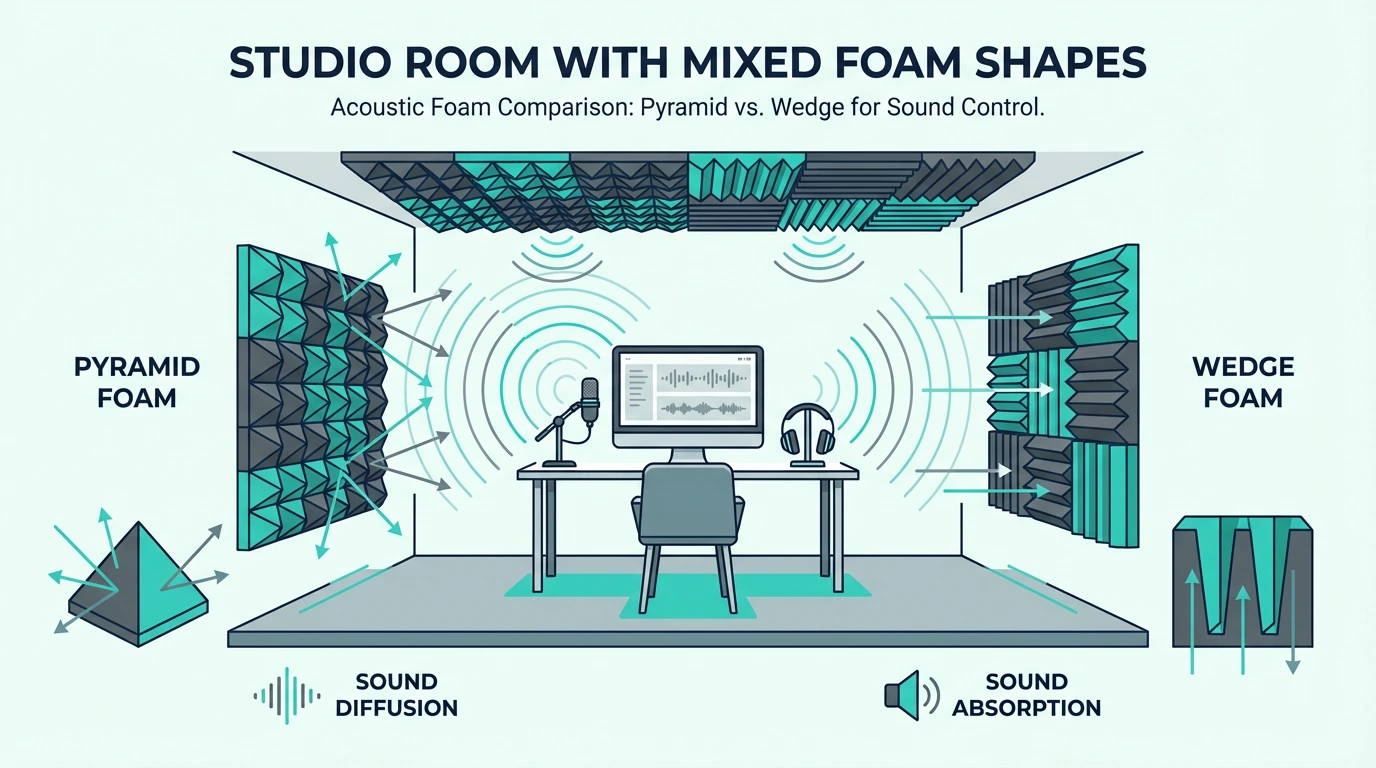
With those NRC numbers in mind, let’s get practical about your specific situation. The honest answer is to pick whichever looks best to you and fits your budget.
For most users, the performance differences between shapes don’t justify paying more or compromising on aesthetics. Use shape to solve a “fit and look” problem, not a “performance” problem.
Here’s how to match shape to specific use cases when it does matter.
Which Foam Shape Is Easiest to Cut for Custom Fits?
Installing around outlets, switches, and corners requires cutting foam to fit. Some shapes cooperate better than others with DIY trimming.
Wedge foam cuts the cleanest. The linear ridges give you natural cutting guides, so straight edges are easier to pull off.
Egg crate foam cuts reasonably well. The material is usually softer, so a sharp utility knife and a steady hand get acceptable results.
Pyramid foam is the hardest to trim cleanly. Those four-sided peaks force awkward cuts, so outlet cutouts tend to look jagged.
If you anticipate lots of custom cutting for an irregularly shaped room, wedge foam saves frustration. Save pyramid patterns for full-panel installations where cutting isn’t necessary.
Best Shape for Home Studios
Wedge foam hits the sweet spot for home studios — professional appearance, good availability, reasonable price. The linear pattern creates visual coherence when covering walls.
If you’re in a typical 10×12 bedroom studio with drywall and hardwood floors, here’s what to expect: twelve 12×12 wedge panels on the walls behind and beside your desk will cut flutter echo noticeably. You’ll hear the difference immediately when recording vocals or mixing.
Mount wedge panels with ridges running horizontally for a clean look, or mix horizontal and vertical orientations at reflection points. The pattern variation adds visual interest while maintaining function.
I’ve set up dozens of home studios, and wedge foam handles 90% of cases. The remaining 10% have specific aesthetic requirements that justify pyramid’s higher cost.
Best Shape for Podcasting
For podcasting and voice recording, any shape works equally well. Speech frequencies (roughly 100Hz-4000Hz) fall squarely in the range all acoustic foams handle effectively.
Those NRC numbers from earlier explain why: all shapes score 0.3-0.5 in the mid frequencies where voice lives. A budget wedge panel can absorb voice reflections just as well as a higher-priced pyramid option.
Choose based on what looks best on camera. Pyramid creates dramatic shadows under studio lighting, while wedge provides clean lines.
Egg crate reads as “budget” on camera — avoid it if appearance matters. Your audio quality won’t suffer, but your professional image might.
Best Shape on a Budget
Egg crate foam is often priced lower than pyramid or wedge of equal thickness. If you’re trying to cover more wall for the same money, that matters.
Budget packs like these 24-pack 1.2-inch egg crate foam panels give you a lot of treated area fast. When budget constrains your coverage area, cheaper foam means more panels.
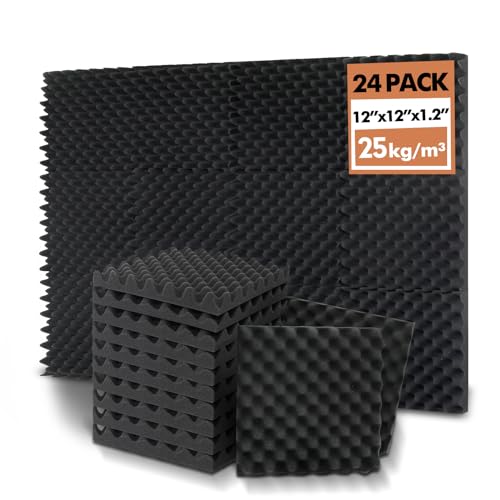
24 Pack 1.2-inch Egg Crate Acoustic Foam Panels
More coverage beats marginally better absorption. Sixteen egg crate panels will outperform eight pyramid panels even though pyramid is technically “better” per panel.
The Bottom Line: Which Shape Should You Buy?
Here’s the uncomfortable truth the foam sellers won’t tell you: shape differences are real but small. Pyramid has the most surface area, wedge is most available and affordable, egg crate is cheapest.
For home studios and recording spaces, pick based on aesthetics and budget. All three shapes work for basic echo reduction when properly placed at reflection points.
What actually matters is getting enough thickness for meaningful absorption, placing panels at first reflection points, and buying enough coverage for your room size. Our best foam panels guide helps you choose the right products.
Then make sure the install lasts. The right adhesive for acoustic foam prevents sagging panels and ruined walls.
Frequently Asked Questions
Does foam shape really matter for sound?
Shape accounts for roughly 5-10% variation in absorption performance. Thickness, density, and placement matter far more than whether you choose pyramid, wedge, or egg crate.
If you want a bigger win, see does acoustic foam work for what foam can (and can’t) realistically fix.
Is pyramid foam better than wedge?
Pyramid has slightly more surface area, giving it a marginal theoretical advantage. In real-world use, the difference is usually imperceptible.
Choose based on looks, price, and how easy it will be to install cleanly in your room.
Which shape is cheapest?
Egg crate is typically the cheapest acoustic foam shape, costing 15-30% less than pyramid or wedge. The simpler manufacturing process keeps costs down.
Can you mix different shapes?
Yes. Many studios combine shapes for visual interest or use different profiles in different areas.
There’s no acoustic downside to mixing — all shapes absorb similarly. Our placement guide covers multi-shape setups.
Which Shape Works Best for Corners?
None of the standard flat shapes — pyramid, wedge, or egg crate — work well in corners. Corners accumulate bass frequencies that flat panels can’t absorb regardless of surface pattern.
Dedicated corner bass traps are specifically designed with triangular profiles that fit corner geometry and provide the depth needed for low-frequency absorption. Standard foam panels mounted in corners waste money on an ineffective approach.
If you’re filling corner space for visual continuity rather than bass treatment, wedge foam usually looks most intentional. Mount panels with ridges running vertically to suggest purposeful design.
But understand you’re decorating, not treating bass. Real corner treatment requires purpose-built bass traps with enough depth to actually work.