Best 61 Key MIDI Controller — Five Octaves of Range Without the 88-Key Footprint
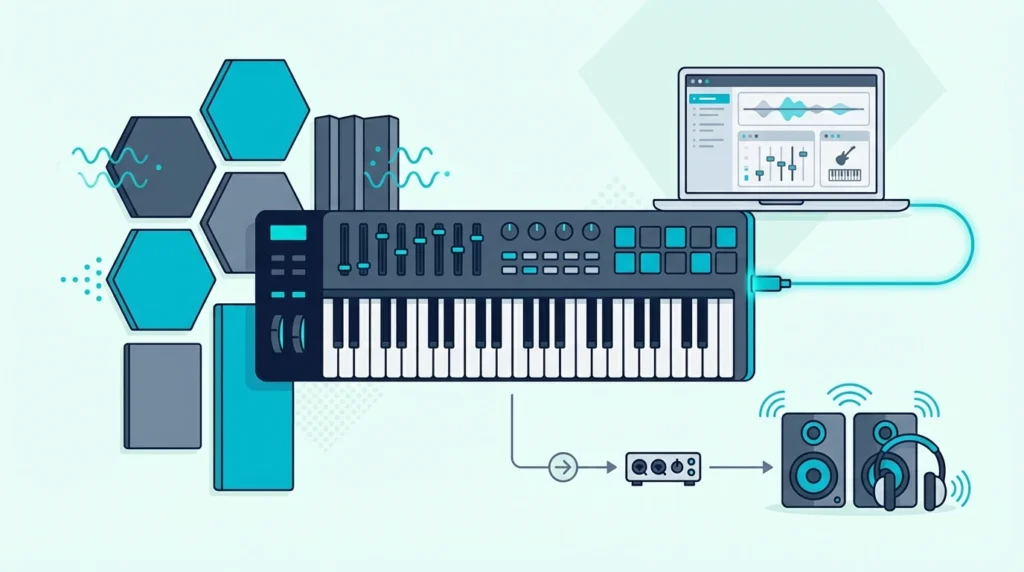
Best 61 key MIDI controller gives you five full octaves — enough range for serious piano work, orchestral keyswitches, and wide chord voicings — but most buyers overlook the feature that separates a good 61-key board from a great one: key action quality and what extras come alongside those keys.
The problem is caused by the 61-key market splitting into two very different product types. Some 61-key controllers are bare keyboards with nothing but keys and pitch/mod wheels. Others pack pads, faders, knobs, and deep DAW integration into the same five-octave form factor. Choosing the wrong type for your workflow wastes money on features you will never touch or leaves you missing controls you need daily.
We evaluated the 61-key controllers currently available and sorted them by what they actually deliver beyond key count. Every pick below was tested for key feel across the full five-octave range, extra control quality, and DAW integration depth.
Below you will find our top picks sorted by feature set, followed by a guide on when 61 keys makes more sense than 49 or 88.
The best 61 key MIDI controller for most producers is the Novation Launchkey 61 MK4 because it balances a solid semi-weighted keybed with 16 expressive pads, 9 faders, and excellent DAW integration. If you want a simpler keys-first board, the M-AUDIO Keystation 61 MK3 strips the format back to core playing essentials. Budget buyers should look at the Nektar Impact GX61, which keeps the full five-octave layout without pushing the price into premium territory.
Why Choose 61 Keys Over 49 Or 88
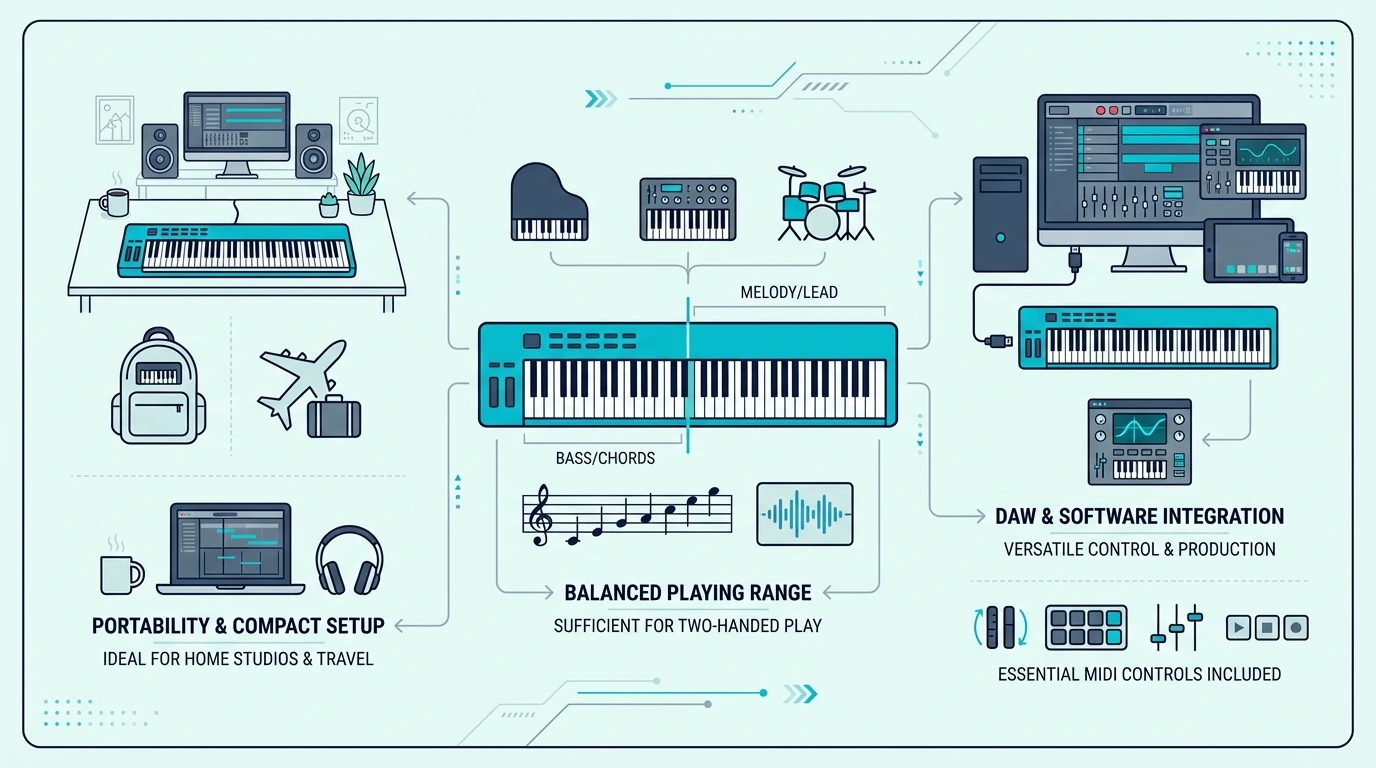
Sixty-one keys span five octaves — one more octave than a 49-key and two fewer than an 88-key. That extra octave over 49 keys sounds minor on paper, but it makes a meaningful difference in specific workflows.
Wide Chord Voicings And Split Zones
Jazz voicings that spread across two octaves in the left hand while the right hand plays melody three octaves higher require more range than 49 keys provide. Sixty-one keys handle these wide voicings without octave shifting, which interrupts the musical flow of a performance.
Split zones — where the left half of the keyboard plays bass and the right half plays piano — work better with 61 keys because each zone gets enough room for comfortable playing. On a 49-key controller, splitting the keyboard leaves each zone with barely two octaves of usable range.
Orchestral Keyswitches Plus Playing Range
Orchestral sample libraries use the bottom one to two octaves for keyswitches (articulation triggers like legato, staccato, and pizzicato). On a 49-key controller, dedicating two octaves to keyswitches leaves only two octaves for actual playing.
Sixty-one keys give you two keyswitch octaves plus three full playable octaves — enough for most orchestral writing. Only composers who need the absolute full piano range should step up to 88 keys.
The Desk Space Compromise
A 61-key controller measures roughly 40 inches wide — eight inches more than a 49-key but a full foot shorter than an 88-key. For producers with medium-sized desks, 61 keys fits comfortably alongside a monitor and speakers where an 88-key board would not.
That physical compromise is the core value proposition of 61 keys. You get meaningfully more range than 49 keys without the four-foot desk domination of 88 keys. For most producers, that middle ground hits the practical sweet spot.
What Are the Best 61 Key MIDI Controllers
Here are the controllers we recommend for five-octave playing, with every pick keeping the full 61-key layout intact.
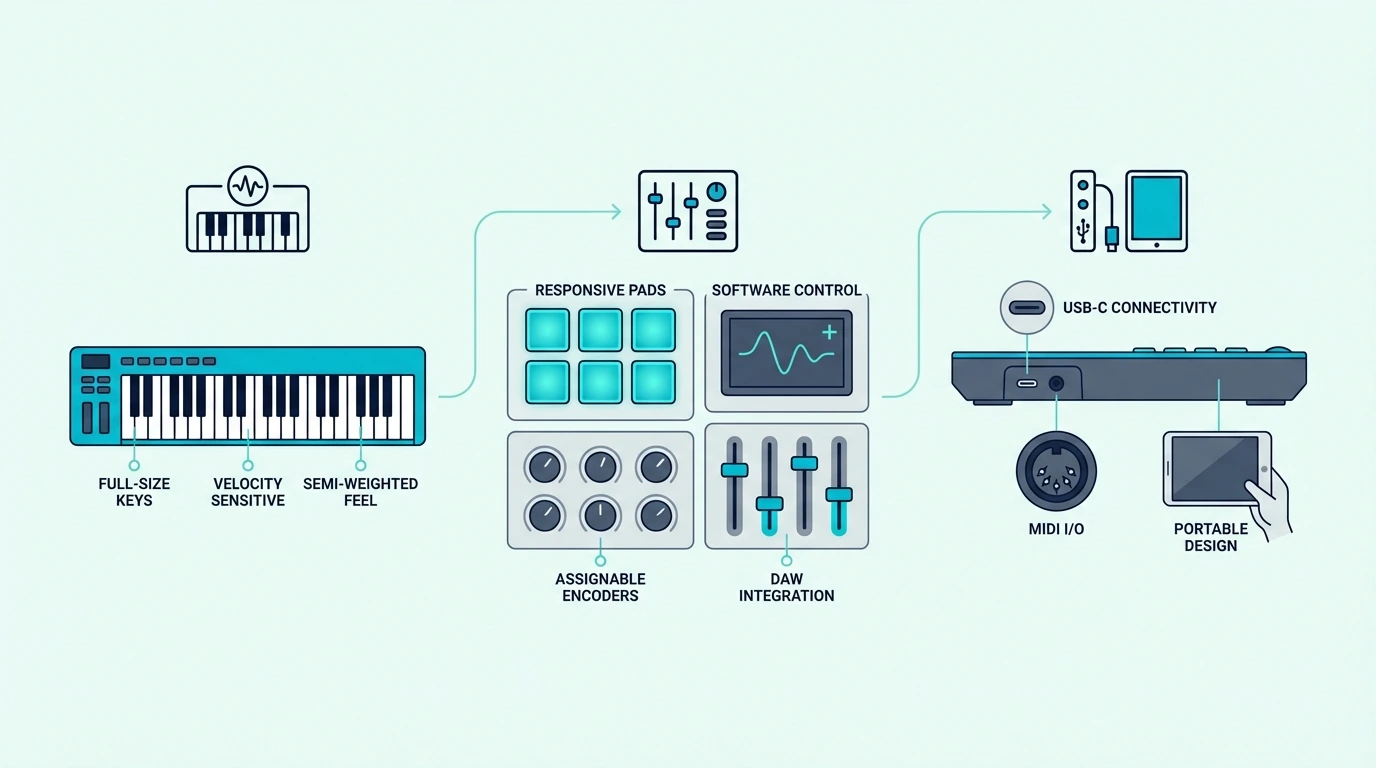
The Novation Launchkey 61 MK4 wins Best Overall because it gives you a better-than-entry-level keybed plus the extra controls most producers eventually want anyway. The 16 pads, 9 faders, and tight integration with Ableton and Logic Pro make it feel like a full production hub rather than just a keyboard.
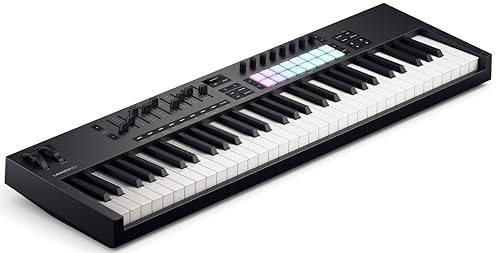
Novation Launchkey 61 MK4
The M-AUDIO Keystation 61 MK3 is the best 61-key option for players who care more about the keyboard than the control surface. It keeps the layout uncluttered, the transport buttons are useful, and the long review history makes it one of the safest keys-only buys in this size.
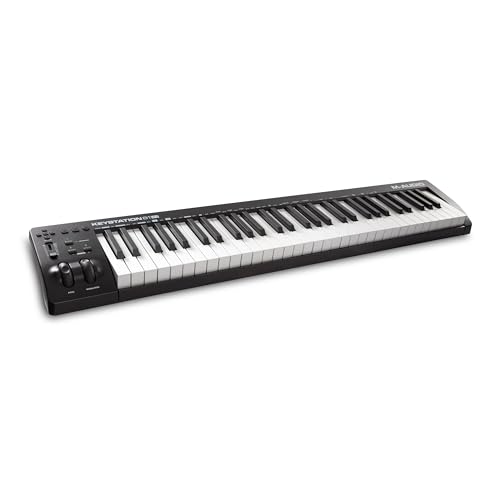
M-AUDIO Keystation 61 MK3
The M-AUDIO Oxygen Pro 61 is the best pick for producers who want their five-octave board to handle drums, mixer moves, and plugin control without extra hardware. It gives you more hands-on control than the Keystation line while keeping a serious playing range.
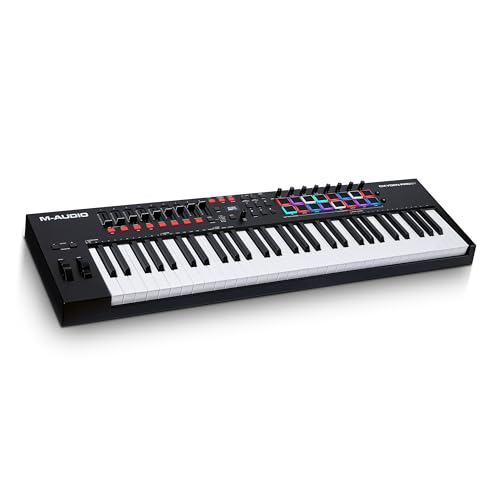
M-AUDIO Oxygen Pro 61
The Arturia KeyLab Essential mk3 61 is the smartest choice if bundled software matters to you. It pairs its five-octave keybed with a usable control surface and one of the better starter ecosystems for synth-heavy production.
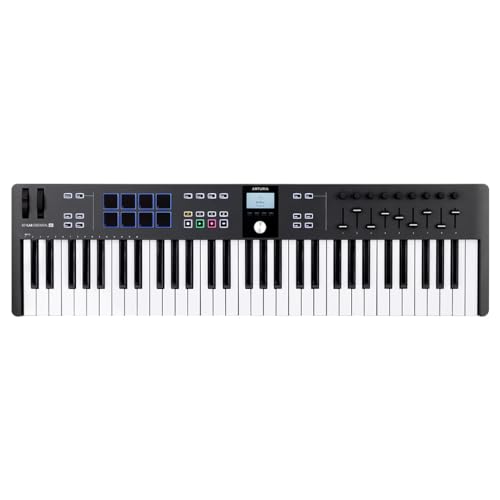
Arturia KeyLab Essential mk3 61
The Nektar Impact GX61 is the budget 61-key pick because it preserves the full five-octave range while staying much closer to entry-level pricing. If you want room for two-handed playing but do not need pads or faders, it is the best low-cost way into this format.
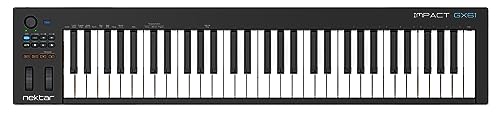
Nektar Impact GX61
And the Alesis V61 is the 61-key choice for beat makers who want pads without moving into the higher-priced control-surface tier. It keeps the full range for melodies and chords while still giving you enough pads to sketch rhythms quickly.
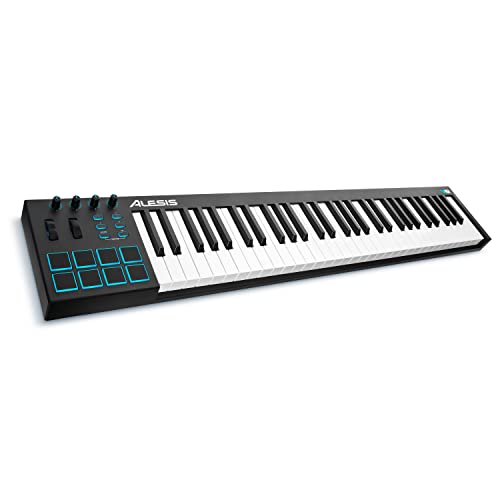
Alesis V61
Get Studio Tips Weekly
Join 5,000+ creators getting acoustic treatment advice every week.
No spam. Unsubscribe anytime.What Makes The Launchkey 61 MK4 Stand Out
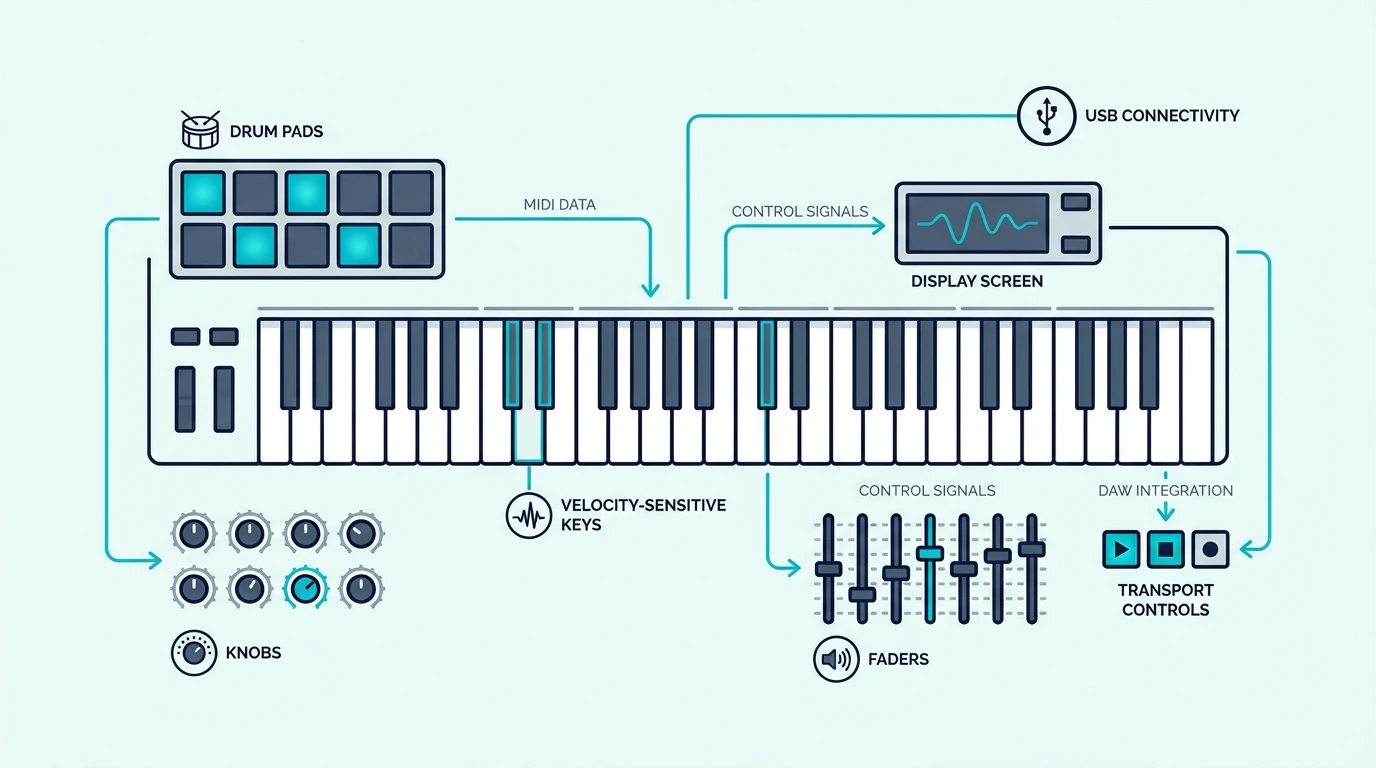
The Novation Launchkey 61 MK4 dominates the 61-key category because it treats the keyboard as one part of a complete production command center rather than a standalone key input device.
The Keybed Hits The Middle Ground
The Launchkey 61 MK4 uses a semi-weighted keybed that lands between lightweight synth keys and heavier piano-style action. That matters because five-octave boards attract players who need enough resistance for expressive parts but still want to move quickly through synth leads, organ parts, and repeated-note passages.
This middle-ground feel is exactly why 61 keys is such a practical format. You get more room for split zones and wide voicings than a 49-key board, but the keyboard still feels manageable on a desk and fast enough for everyday production. It is also easier to adapt across genres, because the same keybed can handle piano-style parts in the morning, synth programming in the afternoon, and live rehearsal duties at night without ever feeling like the wrong tool.
Faders And Pads Eliminate Extra Hardware
The 9 faders map to your DAW’s mixer channels, giving you physical volume control over eight tracks plus a master. The 16 pads handle clip launching in Ableton’s Session View, drum programming, and sample triggering, and they add polyphonic aftertouch for more expressive pad performance than most competitors offer.
Without these extras, a 61-key keyboard requires a separate pad controller for beats and a separate fader controller for mixing. The Launchkey consolidates everything into one unit, which saves desk space and simplifies your MIDI routing.
Native DAW Integration
The Launchkey 61 MK4 auto-maps to Ableton Live and Logic Pro the moment you plug in via USB-C. Pads mirror Session View clips, faders control the mixer, and knobs map to whichever instrument or plugin is selected. That zero-configuration integration saves hours of MIDI learn setup compared to generic controllers.
For FL Studio, Cubase, and other DAWs, the Launchkey works through standard MIDI mapping. The HUI protocol support also enables mixer control in DAWs that support it.
The Bottom Line
The Novation Launchkey 61 MK4 is the best 61-key MIDI controller for most producers because it combines a solid five-octave keybed with a serious control surface and low-friction DAW integration. If you want a simpler keyboard-first option, buy the M-AUDIO Keystation 61 MK3. If price matters more than extras, the Nektar Impact GX61 keeps the full five-octave range at a far lower cost.
If you keep hitting the range limits of four octaves, move up from 49 keys. If you need full piano range for classical practice or orchestral templates with large keyswitch layouts, step up again to 88 keys.
Frequently Asked Questions
Is 61 keys enough for piano?
Sixty-one keys cover five octaves, which handles most piano literature except pieces that use the extreme high and low registers simultaneously. Jazz, pop, and most classical pieces fit within five octaves. Only advanced classical repertoire (Liszt, Rachmaninoff) regularly requires the full 88-key range.
What is the difference between 49 and 61 keys?
A 49-key controller spans four octaves. A 61-key controller spans five. The extra octave helps with wide chord voicings, split keyboard zones, and orchestral keyswitch layouts. For basic production — beat making, synth programming, simple melodies — the difference is rarely noticeable.
Do I need 61 keys or is 49 enough?
If you play two-handed piano parts with wide voicings, use split keyboard zones, or work with orchestral sample libraries that require keyswitches, 61 keys provides meaningful extra range. For beat making, synth work, and basic chord progressions, 49 keys handles everything.
Are 61-key controllers heavier than 49-key?
Yes — a 61-key controller weighs roughly 50 percent more and measures 8-10 inches wider than a 49-key equivalent. The Novation Launchkey 61 MK4 weighs about 15 pounds versus 5-8 pounds for most 49-key controllers. Factor in desk space and portability when choosing between sizes.