Atmos Soundbar vs 5.1: Which System Sounds Better for Your Room?
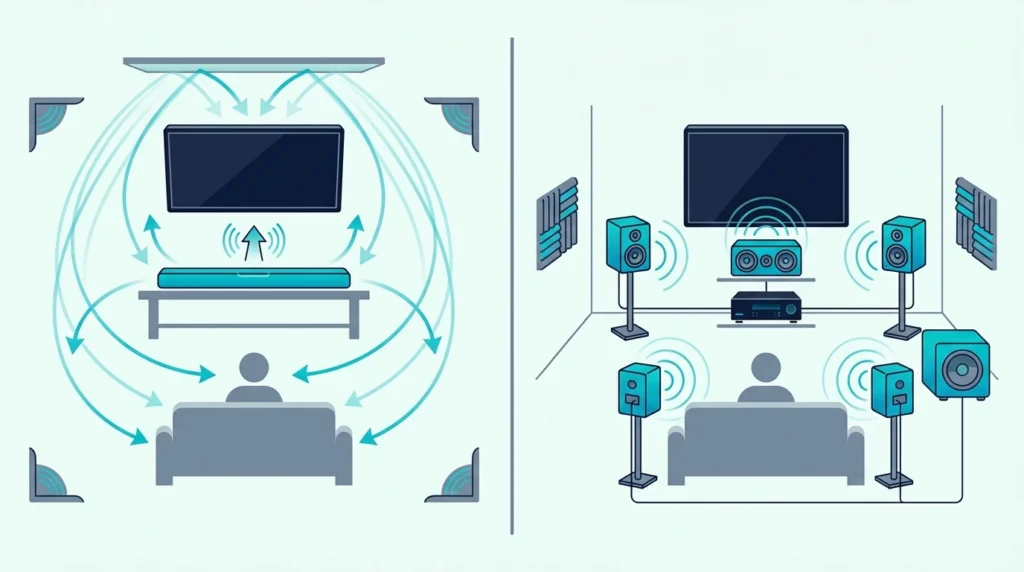
Atmos soundbar vs 5.1 sounds like a simple spec comparison, but these systems solve immersion in completely different ways.
Many buyers choose the Atmos badge or the 5.1 label first, then end up with the wrong kind of performance for their room — height effects that fade under a vaulted ceiling, or rear speakers that never get placed correctly because the seating layout cannot support them.
Once you separate overhead height from true horizontal surround, the decision gets easier. You can match the system to your room, your content habits, and the kind of immersion you will actually hear.
The first move is to check whether your room can support upfiring height effects or proper rear-speaker placement. That single reality check usually tells you whether an Atmos soundbar or a 5.1 system makes more sense.
An Atmos soundbar adds height effects from upfiring drivers or dedicated Atmos channels, which gives movies a vertical dimension a standard 5.1 system lacks unless it adds extra speakers. A traditional 5.1 system still wins on pure left-right and behind-you surround accuracy because its speakers are physically placed around the room.
Choose an Atmos soundbar if you want simpler setup and your ceiling can support the height effect. Choose 5.1 if rear-speaker placement is easy and precise horizontal surround matters more than Atmos height.
How Do Atmos Soundbars and 5.1 Systems Create Surround Sound?
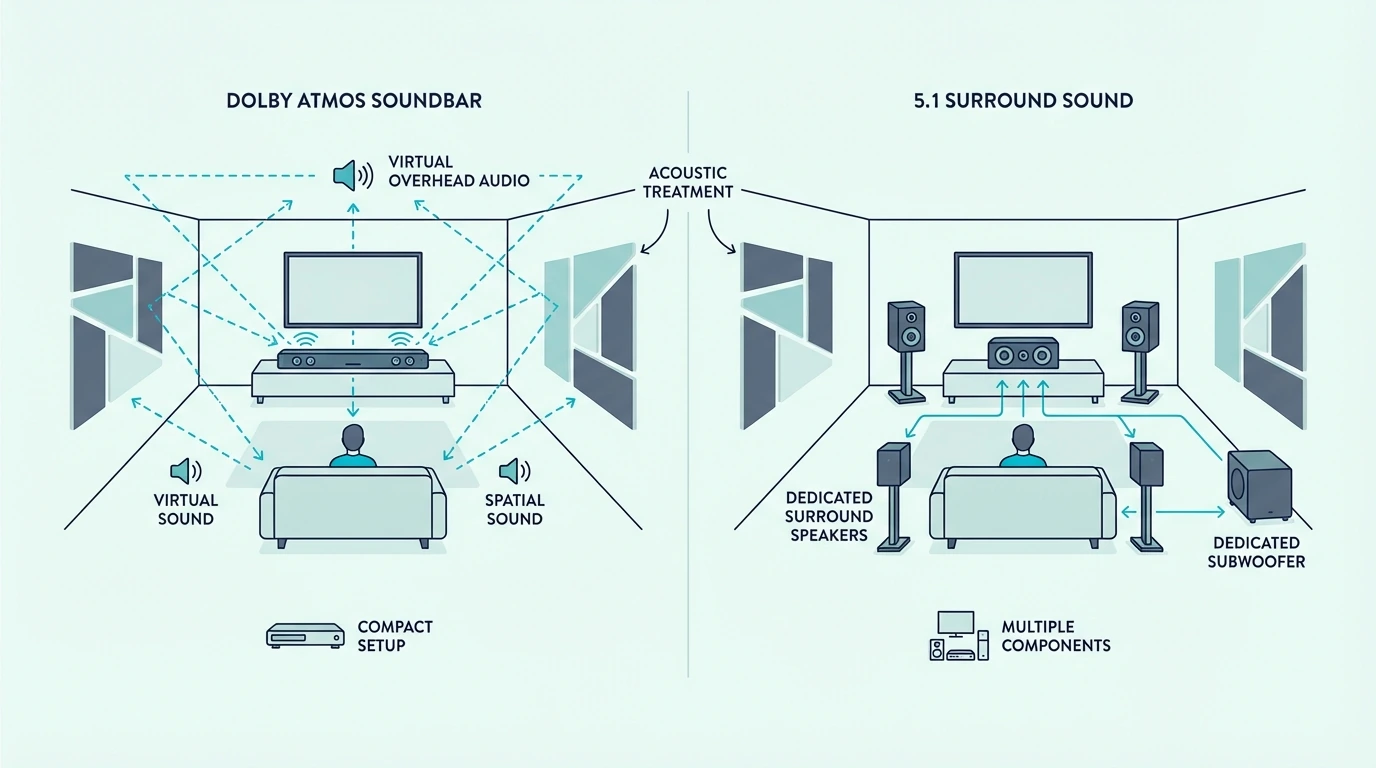
The core difference between these systems is how they create the spatial audio experience — one adds a vertical dimension, the other perfects the horizontal one.
Atmos Soundbar: Height Effects + Virtual Surround
A Dolby Atmos soundbar like the Samsung Q800F 5.1.2ch Q Series Soundbar + Subwoofer uses upfiring drivers that bounce sound off your ceiling to create the impression of audio coming from above — rain, helicopters, ambient atmosphere in the overhead space. That height dimension is something a standard 5.1 system simply cannot produce without adding dedicated ceiling or upfiring speakers.
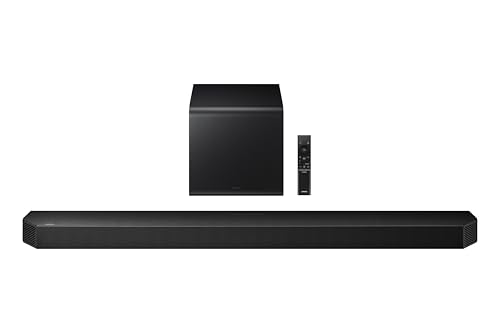
Samsung Q800F 5.1.2ch Q Series Soundbar + Subwoofer
For horizontal surround, an Atmos soundbar relies on psychoacoustic processing and side-firing drivers to simulate the effect. The simulation is convincing for casual viewing, but it cannot match the precision of speakers physically positioned behind your seating area.
Some premium Atmos soundbars include optional or bundled wireless rear speakers that shrink the gap between virtual and true surround. Even then, the height effect still depends on ceiling shape and room acoustics in a way discrete 5.1 surround does not.
Traditional 5.1: True Horizontal Surround
A 5.1 system places five speakers around your room — front left, center, front right, surround left, and surround right — plus a subwoofer. When a car drives past in a movie, the sound physically moves from your front speakers through your surround speakers because those speakers are actually in different positions around you.
This physical separation creates pinpoint directional accuracy that no soundbar processing can fully replicate. You hear exactly where sounds originate in the horizontal plane because the speakers are physically positioned at those locations, delivering a level of spatial precision that virtual surround algorithms cannot reproduce.
The tradeoff is that a 5.1 system has zero height capability out of the box — rain falls from ear level, helicopters fly past at ear level, and overhead ambient effects play from the same horizontal plane as everything else. Adding height requires upgrading to a 5.1.2 or 5.1.4 system with an Atmos-capable receiver and additional speakers.
Which Dimension Matters More?
For movies with Atmos soundtracks (available on Netflix, Disney+, Apple TV+, and Blu-ray), the height effects add genuine immersion. Overhead rain, spatial atmosphere, and objects moving in the vertical space are experiences a flat 5.1 system misses entirely.
For standard 5.1 content, which still represents the majority of TV shows, older movies, and a large share of streaming libraries, the traditional system’s precise horizontal surround wins.
That is why the best answer changes by content library. Atmos showcases vertical movement better, but 5.1 still handles the broadest mix of everyday TV and movie material with fewer assumptions about your ceiling.
Our soundbar vs receiver guide covers the broader comparison between soundbar convenience and discrete speaker systems.
Which Fits Better in Real Rooms: Atmos Soundbar or 5.1?
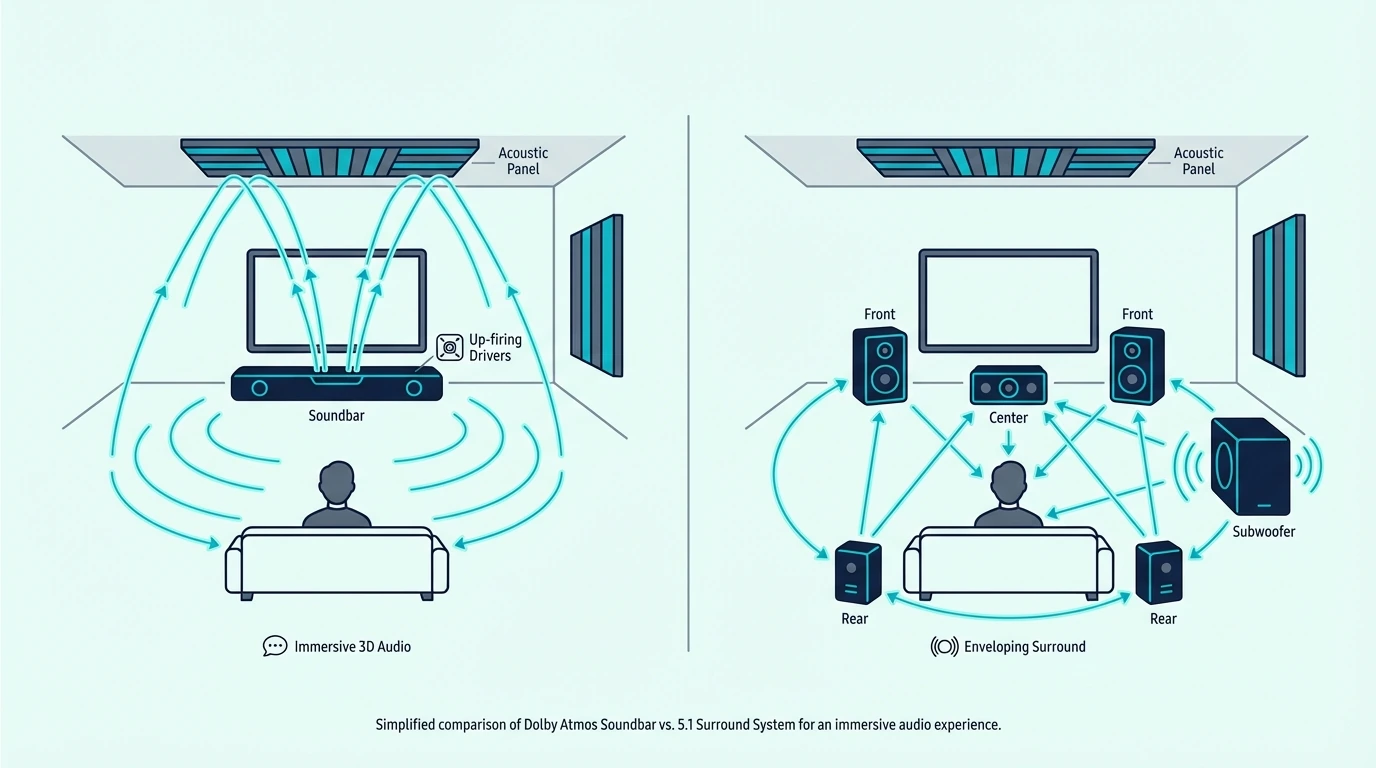
Beyond raw audio quality, the practical gap between these two systems is significant and often determines the final purchasing decision.
Setup and Complexity
An Atmos soundbar connects with one HDMI cable, powers on, and starts playing — the wireless subwoofer pairs automatically. Total setup is usually under 10 minutes with no speaker wire, no receiver, and very little calibration work.
A traditional 5.1 system requires an AV receiver, five speakers, a subwoofer, speaker wire runs to multiple locations, and a longer setup process that often includes calibration. If you want the simpler route, a good Atmos bar keeps the entire project far closer to plug-and-play.
For buyers who care more about keeping hardware minimal than maxing out low-end output, an all-in-one Atmos option like the Samsung S60D 5.0ch Soundbar with Wireless Dolby Atmos Audio shows why an Atmos bar can feel more realistic in everyday living rooms than a receiver project that never gets fully finished.

Samsung S60D 5.0ch Soundbar with Wireless Dolby Atmos Audio
If you are comparing Atmos channel layouts inside the soundbar category itself, the 5.1 vs 3.1.2 soundbar guide is the closer follow-up than another receiver discussion. Our soundbar vs receiver guide covers the receiver-specific tradeoffs in more detail.
Cost Comparison
A quality Atmos soundbar with a wireless subwoofer usually costs $250-600, though higher-output Atmos packages can stretch above that when you want stronger bass and bigger room coverage. That is still usually simpler than jumping straight into a receiver stack.
A comparable traditional 5.1 setup starts higher because you need the receiver and speakers separately. Adding Atmos to that 5.1 system later pushes the total up again because now you are paying for extra speakers and Atmos-capable electronics.
The cost gap is the primary reason many buyers choose an Atmos soundbar first. You get height effects and simplified setup in one purchase for less than the cost of many entry-level receiver-based builds.
That budget reality matters because cheap 5.1 does not automatically beat a competent Atmos soundbar. In ordinary living rooms, a better-tuned Atmos bar often makes more sense than stretching a receiver build so thin that speaker quality and placement both suffer.
Room Requirements
An Atmos soundbar needs a flat, hard ceiling between roughly 8 and 10 feet for the upfiring drivers to bounce sound effectively — vaulted ceilings, textured popcorn ceilings, and ceiling fans reduce or eliminate the height effect. The bar itself sits below the TV with no major placement burden beyond that ceiling requirement.
A traditional 5.1 system needs space for rear speakers behind the seating area, clear cable paths or power access, and enough distance for the surrounds to work properly. If a full receiver-based 5.1 build feels too complex, a wireless-rear package like the Sony BRAVIA Theater System 6 narrows the gap while staying simpler than a traditional component stack.
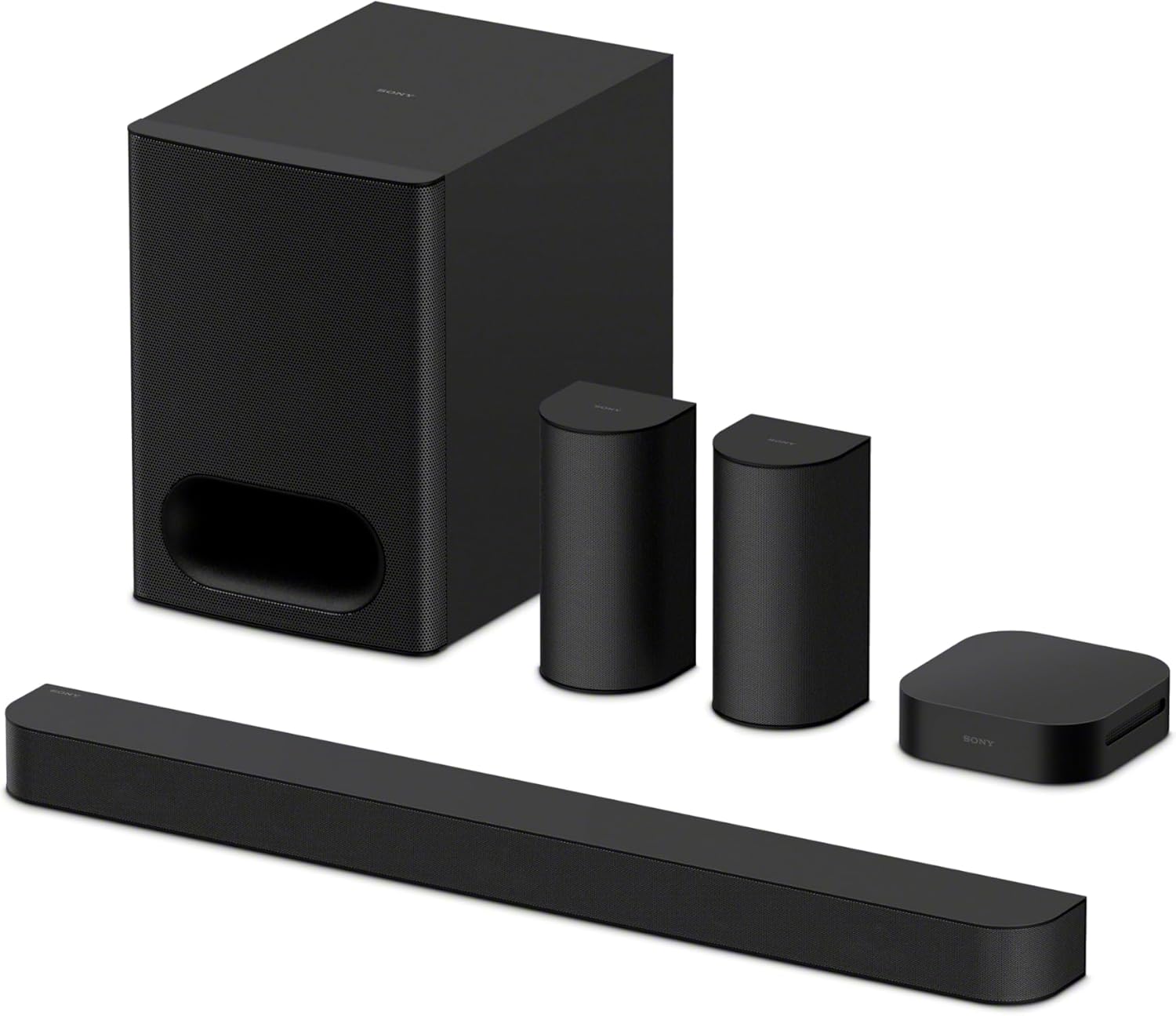
Sony BRAVIA Theater System 6
Room shape can break either option for a different reason. A vaulted ceiling hurts Atmos bounce, while a couch against the back wall makes proper 5.1 rear placement difficult.
Apartment living can tilt the decision too. A room may support Atmos bounce just fine, yet visible rear-speaker wire, speaker stands, or wall mounting can still make a traditional 5.1 setup unrealistic.
Our soundbar buying guide covers room-fit considerations in more detail.
Content Availability
Most streaming content is mixed in 5.1, which both systems handle well. Dolby Atmos content is growing on Netflix, Disney+, Apple TV+, and Amazon Prime, but it is still a fraction of the total catalog, so height channels often sit idle on everyday TV.
Streaming Atmos is also compressed, so the logo does not automatically mean a dramatic leap over good 5.1 playback. On Blu-ray or higher-quality Atmos tracks the height effect is easier to hear, but on casual streaming the practical difference can be smaller than buyers expect.
Sports, news, YouTube, and plenty of routine TV watching rarely exploit Atmos in a meaningful way. If that is most of your use, traditional surround accuracy or simple overall convenience may matter more than chasing height just because the logo is available.
If you want the soundbar-side breakdown of Atmos channel counts, the 5.1 vs 3.1.2 soundbar guide shows how height channels change the decision inside the soundbar category. And if you already know Atmos is the priority, the best Dolby Atmos soundbar roundup is the better buying next step.
Get Studio Tips Weekly
Join 5,000+ creators getting acoustic treatment advice every week.
No spam. Unsubscribe anytime.The Bottom Line
An Atmos soundbar adds a vertical dimension that a standard 5.1 system can’t match — overhead effects, spatial atmosphere, and height-based audio are exclusive to Atmos unless you add ceiling speakers to your 5.1. A traditional 5.1 system delivers more accurate horizontal surround from physically placed speakers that no soundbar processing can fully replicate.
Choose an Atmos soundbar if you want height effects, simple one-cable setup, and good virtual surround in one device under $600. Choose a 5.1 system if precise horizontal surround matters most and you have the room layout, budget ($800+ for speakers plus a receiver), and willingness to run speaker wire and calibrate the system properly.
For understanding how soundbars work fundamentally, start there, and the 5.1 vs 3.1.2 soundbar guide covers the most useful Atmos-versus-channel-count decision inside the soundbar category. For connection setup, our HDMI ARC guide covers the cleanest way to feed surround audio to any soundbar.
Frequently Asked Questions
Is Dolby Atmos worth it in a soundbar?
Yes, if you have a flat ceiling between 8-10 feet and watch Atmos content on streaming services or Blu-ray — the height effects add genuine immersion for movies mixed in Atmos. If your ceiling is vaulted or textured, the upfiring drivers won’t bounce effectively and the Atmos premium isn’t justified.
Why does Netflix show 5.1 instead of Atmos?
Netflix only outputs Atmos on its Premium plan ($22.99/month) and only on titles that have been mixed in Atmos. If your plan, device, or the specific title doesn’t support Atmos, Netflix falls back to 5.1 — which is still excellent surround audio that both Atmos soundbars and 5.1 systems handle well.
Is 5.1.2 enough for Atmos?
Yes — 5.1.2 is the entry point for a proper Dolby Atmos experience with five ear-level channels, one subwoofer, and two height channels reproducing the vertical dimension. A 5.1.4 adds more overhead coverage, but the improvement over 5.1.2 is subtle in most rooms.
Is a 5.1 or 2.1 soundbar better?
A 5.1 soundbar is better for surround effects and dialogue clarity because it has more discrete channels including a center channel and surround speakers. A 2.1 is better for budget-conscious buyers who want a major upgrade from TV speakers without building a bigger system — the best budget soundbar roundup is the more useful next step if cost matters most.