Are Townhomes Soundproof? What Codes and Wall Tests Say
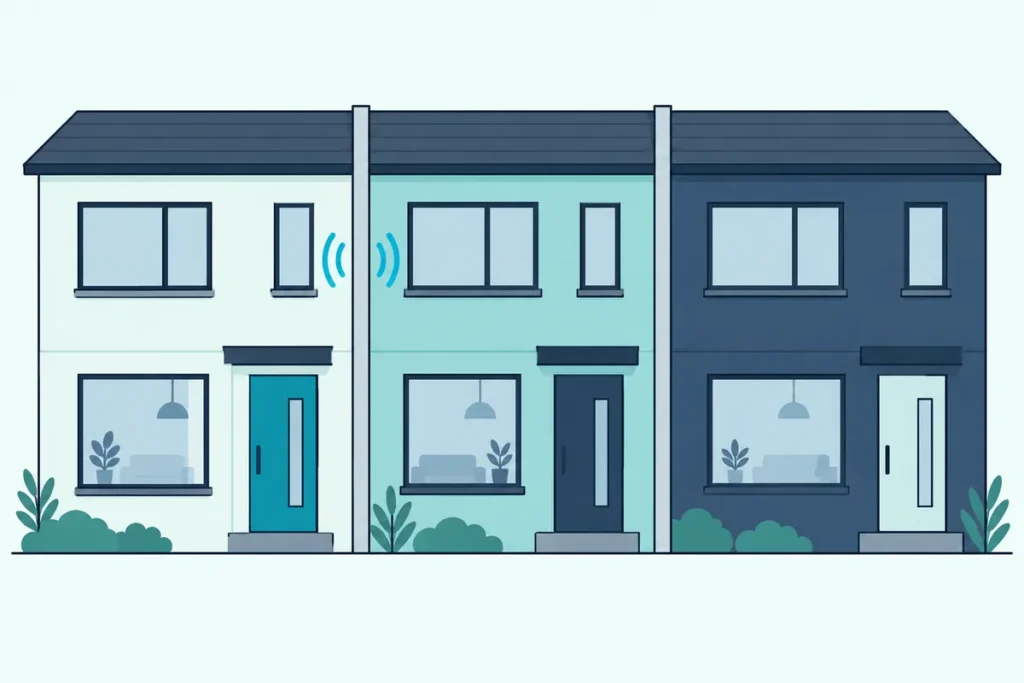
Are townhomes soundproof? Not by default, because the sound rules for the wall you share depend on which building code the builder followed.
Buy one expecting privacy and you can end up hearing a neighbor’s television through the wall every evening, in a home that passed every inspection.
The codes, the lab-tested wall assemblies and the STC scale show exactly how much quiet a shared wall can deliver, and what separates a good one from a weak one.
Below, you’ll see what the codes require, how common wall types score, where sound gets around the wall, and what to ask before you buy.
Start with what the rulebooks say.
Are Townhomes Soundproof?
Not automatically, and the reason is in the code. The International Residential Code covers townhouses up to three stories with separate exits, and its sound rules sit in an appendix that applies only where a jurisdiction lists that appendix in its adopting ordinance (ICC).
That appendix asks for STC 45 between units, while the International Building Code, which governs larger buildings, asks for STC 50, or 45 when tested in place. This table sets the two side by side:
| Rule | Where it applies | Airborne sound | Impact sound |
|---|---|---|---|
| IRC Appendix K | Townhouses and other dwellings under the residential code, only where adopted | STC 45 | IIC 45 |
| IBC Section 1206 | Dwelling units and sleeping units under the building code | STC 50, or NNIC 45 field tested | IIC 50, or NISR 45 field tested |
The figures come from the residential code’s Appendix K and the building code’s Section 1206 (Appendix K, Section 1206). Whether your townhouse has any sound requirement at all therefore depends on where it’s built and which code applied.
Our guide to what a wall needs to reach those STC numbers explains the mass, damping and decoupling behind them.
What Does STC 45 or 50 Sound Like?
Those two numbers only mean something next to the STC scale. Acoustical Surfaces’ chart says STC 40 lets loud speech be heard but not understood, 45 is where privacy begins, and 50 leaves loud sounds faint (Acoustical Surfaces).
The same source rates a basic interior wall of two half-inch drywall sheets on wood studs with no insulation at STC 33, and about 39 with fiberglass insulation. At STC 35 loud speech can be heard and understood, so a wall in the 30s leaves conversations audible next door.
The code targets of 45 and 50 sit 6 to 17 points above those two walls, which is a large gap in practice. Acoustical Surfaces notes the numbers only roughly track decibels, but it’s the gap between hearing words and hearing a murmur.
The same page is blunt about the stakes. It says STC 45 would be insufficient for townhouses and condos because of their shared walls, floors and ceilings, and that STC 50 is the point where survey respondents begin a drastic reduction in noise complaints.
It also cites National Research Council of Canada research recommending STC 55, with 60 or more ideal where music is involved. One limit applies to all of these numbers: Andersen’s help center notes that STC rates mid-to-high frequency sources like speech and television, so bass from a subwoofer or a home theater can pass a wall that scores well (Andersen).
Get Studio Tips Weekly
Join 5,000+ creators getting acoustic treatment advice every week.
No spam. Unsubscribe anytime.How Do Common Townhouse Wall Types Score?
Those code targets raise the question of what builders actually put in the wall. ROCKWOOL’s catalog of lab-tested interior wood-stud walls, measured to the ASTM E90 standard, shows how much the construction matters (ROCKWOOL).
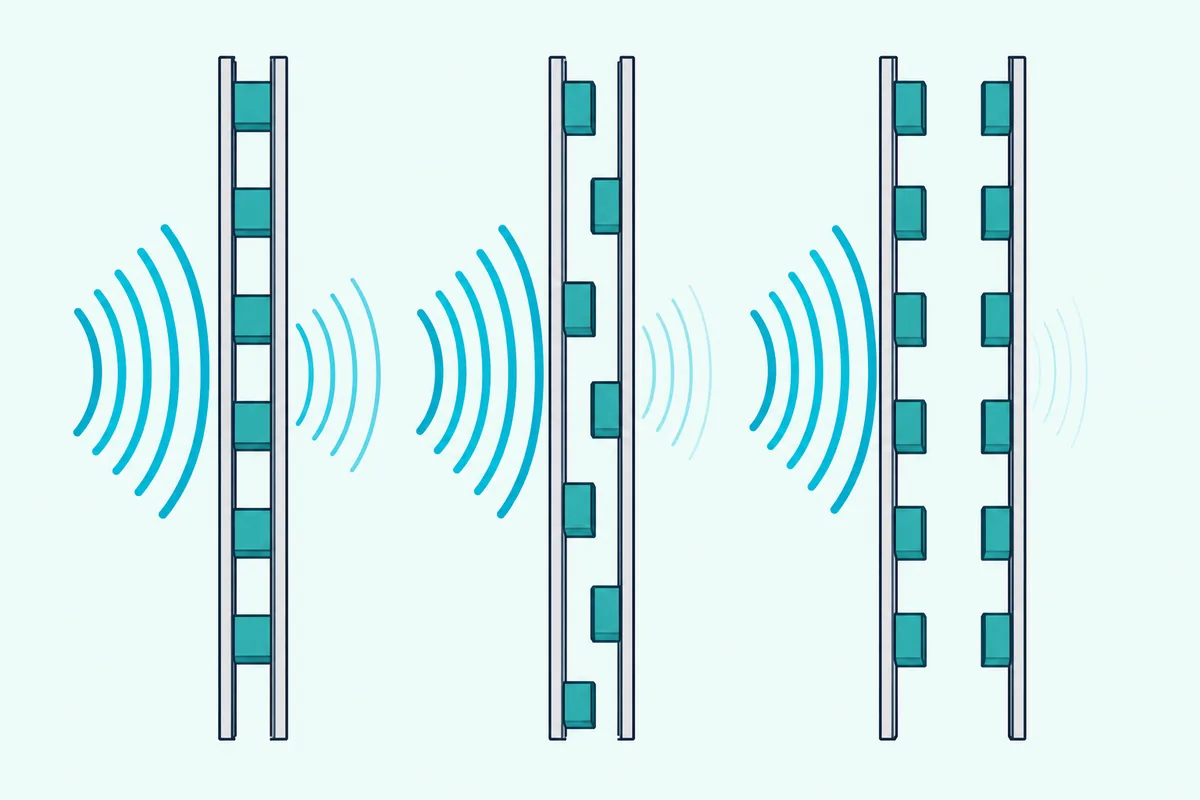
The table lists a few of its walls, all with mineral wool batts:
| Wall (all with mineral wool batts) | STC |
|---|---|
| Single 2×4 studs, 1/2-inch drywall | 38 |
| Single 2×6 studs, 5/8-inch Type X drywall | 38 |
| Same 2×6 wall, two layers of 5/8-inch Type X | 48 |
| Single 2×4 studs on resilient channels | 51 |
| Staggered 2×4 studs, 5/8-inch Type X | 50 |
| Double 2×4 studs with a 1-inch air gap, 5/8-inch Type X | 56 to 60 |
| Same double wall with two layers of 5/8-inch Type X | 66 |
The single-stud walls land in the high 30s, below the code numbers, while separating the two sides of the wall is what gets to 50 and beyond. Extra layers of drywall add about ten points to a single stud wall, and a gap between two rows of studs adds even more.
That ladder is why a double wall with an air gap is the classic choice for a common wall. Each entry above comes from a different lab report, so treat the table as a guide to the order of the options rather than a like-for-like ranking.
Do Fire Codes Also Make the Wall Quiet?
The wall types in that table aren’t chosen for sound alone, since fire rules shape townhouse walls too. The residential code requires the common wall to be a one-hour fire-resistance-rated assembly where the home has a sprinkler system and a two-hour assembly where it doesn’t (UpCodes, IRC R302.2.2).
Fire ratings come from a different test, ASTM E119, than STC’s ASTM E90. The Type X drywall board used in fire-rated walls shows up in ROCKWOOL’s lab data at STC 36 to 38 in a single-stud wall, so a fire-rated wall can still pass more sound than the codes ask for.
Some of the fire rules also help with sound. The same section requires the common wall to run tight against the exterior sheathing and up to the roof sheathing, and to have no plumbing, ducts or vents in its cavity, which closes a few paths sound would otherwise use.
Why Might a Lab-Rated Wall Sound Worse in a Real Townhouse?
Those closed paths matter because a lab test measures a wall alone, and a house has other ways for sound to travel. The building code itself allows for this, since it accepts a field-tested rating of 45 where a lab-tested wall needs 50 (UpCodes, IBC Section 1206).
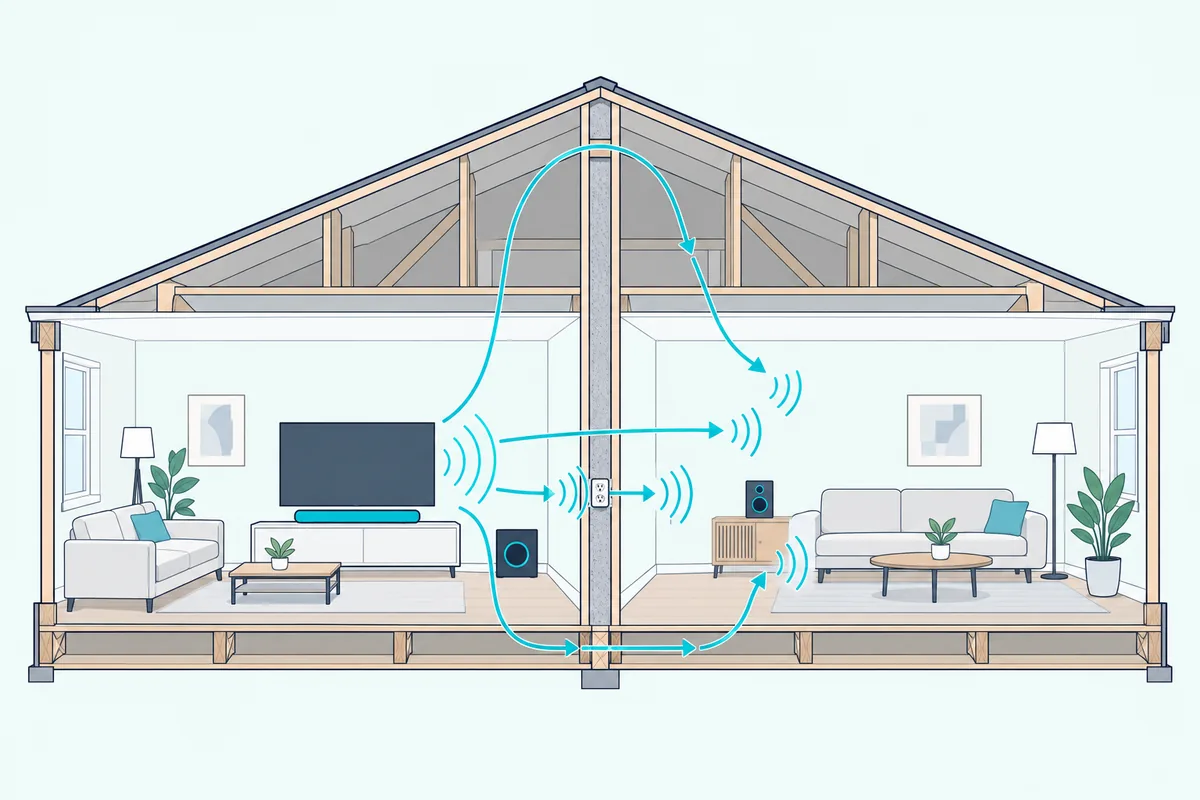
Both codes also require penetrations for pipes, electrical devices, recessed cabinets, soffits and ducts to be sealed, lined, insulated or otherwise treated to keep the rating. They add that shared entrance doors must fit tightly to the frame and sill.
The building code also lets a registered design professional establish a wall’s rating by engineering analysis, comparing it with assemblies tested to ASTM E90. A builder who says a wall “meets STC 50” may be relying on that analysis, so it’s fair to ask to see it.
A shared attic, a continuous floor joist or an unsealed outlet box can undo a good wall. The codes name those openings for a reason, and they’re the first places to check in a home you’re considering.
Do New Townhouses Have Good Soundproofing?
A newer home isn’t a guarantee of any of that, because the sound rules still depend on what the local jurisdiction adopted. A recent build in a place without the appendix can have a wall that scores in the 30s or 40s, while an older one with a double wall can do better.
The residential code covers three-story townhouses, and a builder working under it only has to meet what the adopted code says. That’s why the wall type and its test report tell you more than the year.
Hotels are covered by the building code’s stricter STC 50 rule, which is laid out in what the code requires between hotel rooms.
How Can You Check a Townhouse Before You Buy?
A few questions turn the code numbers into something you can check before you sign.
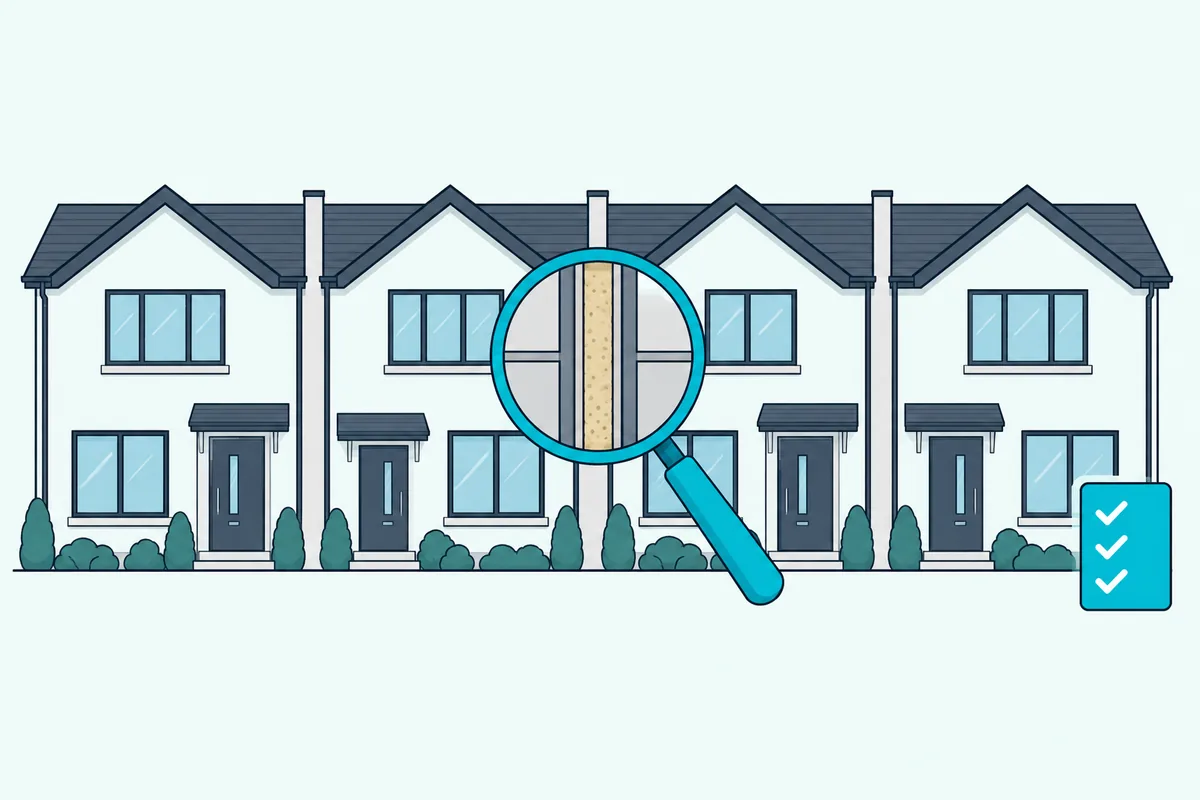
Ask the builder or seller for facts that map straight onto the codes:
- The wall assembly. Ask whether the common wall is a single stud wall, a staggered wall or a double wall with an air gap.
- The rating. Ask for the STC or field-test result and the test report number, not a description like “sound-rated.”
- The local rule. Ask whether the jurisdiction adopted the residential code’s sound appendix.
- The layout. Check which rooms sit against the shared wall, and whether the attic, ceiling or floor framing is shared.
- The openings. Look for outlet boxes and pipe gaps on the shared wall, since the codes require them to be sealed or treated.
Then visit at the hours neighbors are home, since a quiet afternoon tells you little. A wall in the 30s on the STC scale leaves speech understandable, and you’ll notice it in a single evening.
What Can You Do If the Shared Wall Is Loud?
If you already own one, the ROCKWOOL data points to where the gains are. Adding drywall layers and separating the two surfaces with resilient channels or a staggered or double frame moved lab walls from the high 30s into the 50s and beyond, and our guide to soundproofing a shared wall covers the practical versions.
Sealing outlet boxes and gaps comes first, since those are the leaks the codes warn about. Our comparison of soundproof drywall versus regular drywall shows what an extra layer changes.
The Bottom Line
Townhomes aren’t soundproof by default: the residential code’s sound rule is optional, and a basic single-stud common wall tests in the high 30s against a code target of 45.
Ask what the wall is made of and what its test rating is, since a double wall with an air gap can reach the 50s and 60s.
Frequently Asked Questions
Do townhouses have to be soundproof by law?
Not everywhere. The residential code asks for STC 45 between townhouse units, but only in places that adopted its sound appendix, while the building code asks for STC 50 in the buildings it governs.
What STC rating should a townhouse shared wall have?
The residential code’s appendix sets STC 45, and Acoustical Surfaces says 45 is where privacy begins. Higher is better, and 50 leaves loud sounds faint.
Can you hear neighbors through townhouse walls?
It depends on the wall. A basic single-stud wall scored STC 38 in ROCKWOOL’s lab data, and at that level loud speech can be heard and understood.
Is a double wall better than a single wall?
Yes. ROCKWOOL’s lab tests put double 2×4 walls with a one-inch air gap at STC 56 to 60, against 38 for a single stud wall.
Are fire-rated walls also soundproof?
Not necessarily. The fire rating and the sound rating come from different tests, and fire-rated Type X drywall shows up in single-stud walls at STC 36 to 38.