Does Soundproof Glass Work? Laminated vs Tempered vs Double Glazed
Every night the traffic comes through the window as if the glass weren’t there, and one question keeps coming back: does soundproof glass work?
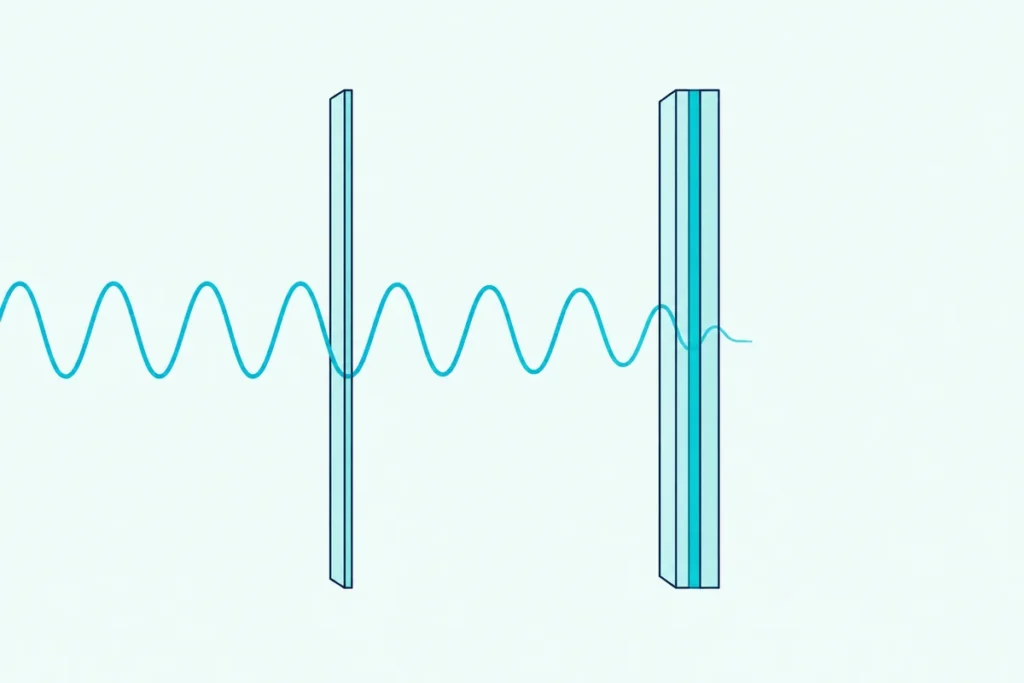
It does, but only some kinds: Guardian Glass lists a single 6 mm pane at STC 30 and two 6 mm panes laminated with an acoustic interlayer at STC 40.
This guide uses lab tables from Guardian Glass and Marvin, HUD’s Noise Guidebook, Andersen’s and Cardinal’s own sound pages, Indow’s insert data and a federal office guide.
You’ll see what tempered, laminated and double glazed glass score, how thick soundproof glass needs to be and why a good pane can still let sound in.
Start with the short answer, because it explains why the kind of glass matters so much.
Does Soundproof Glass Work?
That depends on the build, because glass is a thin barrier and only a few constructions make it a good one.
Guardian’s lab table lists a single 6 mm pane at STC 30, acoustic laminated glass at STC 40 and its best double-pane build at STC 48.
Andersen’s own guide says there’s no such thing as a soundproof window, only windows that reduce sound, and that the glass construction has the greatest influence.
It also gives a way to read the numbers: at STC 30 you’d hear and understand a loud conversation outside, at 30 to 35 you might hear it but couldn’t follow it, and at 36 to 40 even loud conversations would hardly be audible.
Guardian adds that each 10 dB of rating roughly halves the volume you perceive, so STC 40 glass should sound about half as loud as STC 30 glass. That makes soundproof glass a way to turn speech into muffled noise, not to get silence.
What Is Soundproof Glass Made Of?
Those higher numbers come from three changes to ordinary glass: a layered build, mismatched panes and more thickness.
Laminated glass bonds two panes with a plastic interlayer, and Cardinal says it attenuates sound thanks to that sturdy interlayer. Guardian adds that acoustic-grade polyvinyl butyral, PVB, does better than the standard kind.
Andersen explains the mismatch: panes of the same thickness vibrate at the same frequency, which makes it easier for sound to pass, so its STC upgrade pairs panes of different thicknesses. HUD says the same about double-glazed windows, where different thicknesses and weights keep the panes from coupling and resonating.
Makers don’t use one name for the result. Cardinal sells laminated glass for sound dampening, Guardian specifies acoustic PVB and Andersen offers an STC upgrade, so ask for the rating of the whole window.
Get Studio Tips Weekly
Join 5,000+ creators getting acoustic treatment advice every week.
No spam. Unsubscribe anytime.How Soundproof Is Ordinary Glass?
That layering matters because plain glass blocks less than most people expect, and it gains slowly with thickness.
Guardian lists a single pane at STC 28 for 3 mm, 30 for 6 mm, 32 for 8 mm, 34 for 10 mm and 36 for 12 mm. HUD gives 25 for ordinary 3/16-inch glass and 35 for half-inch glass, then says going from half an inch to three quarters of an inch raises the rating only to 37.
By Guardian’s table, doubling the glass from 6 mm to 12 mm adds 6 points, so thickness alone runs out of road. Andersen puts a typical dual-pane window at STC 25 to 30.
HUD’s older sample windows agree: most rate between 22 and 25, and the one that reaches 35 is a sealed double-hung window with 7/16-inch insulating glass and a storm sash.
Is Tempered Glass Soundproof?
That question matters because tempered glass is the safety glass in most doors and large windows, and it’s easy to assume it’s tougher on noise too.
It isn’t, according to Marvin’s listings for its Ultimate Sliding Patio Door. Tempered double glazing scores STC 29 to 31 there, and the combinations with a laminated pane score 31 to 32.
Guardian’s table explains why the gap is small. A single 12 mm pane lists at STC 36 and two 6 mm panes laminated with standard PVB list at the same 36, so lamination alone adds nothing at equal thickness.
What adds points is the acoustic interlayer: the same two 6 mm panes list at STC 40 with acoustic PVB. Nothing in these listings gives tempered glass a sound advantage, because its edge is safety: Marvin’s manual recommends tempered glass for frames taller than 71 1/8 inches and says units of 25.2 square feet or more may require it.
What Is the Best Glass for Soundproofing?
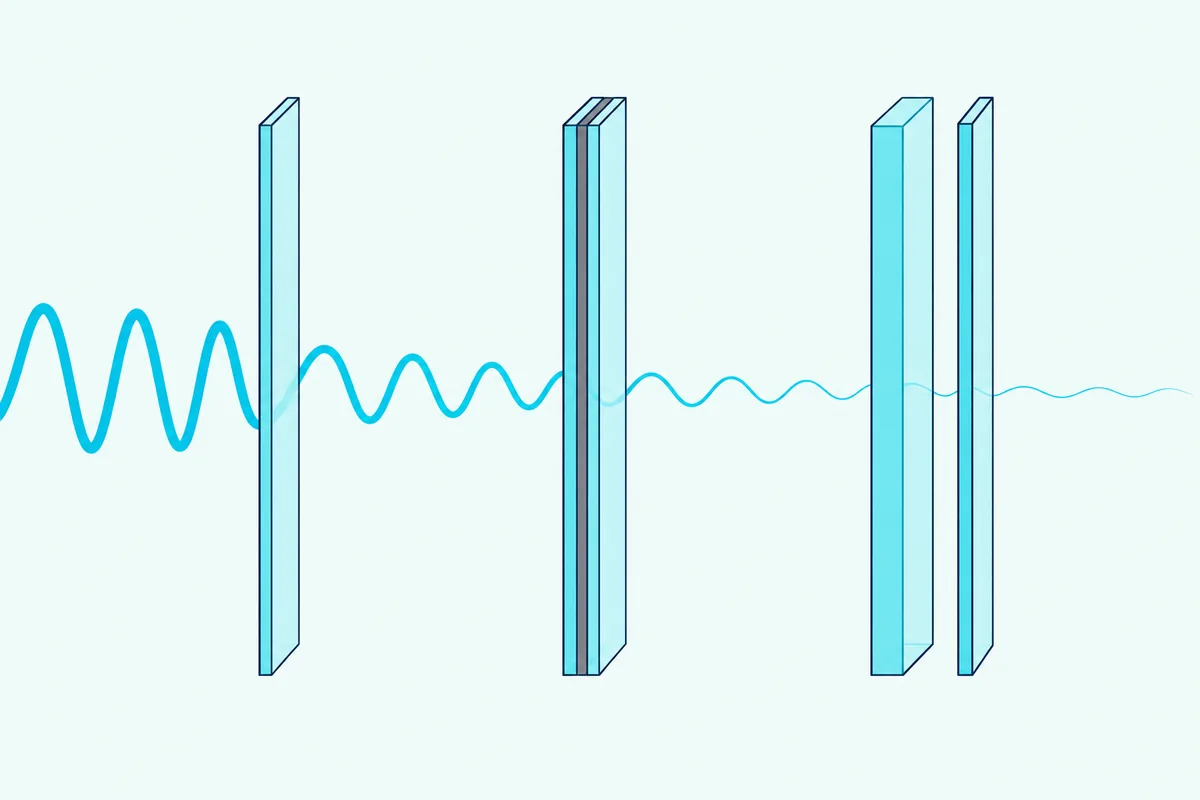
Those results point to one ladder from worst to best, and Guardian’s lab table puts a number on each rung:
| Glass build (Guardian, center of glass) | STC |
|---|---|
| Single 6 mm pane | 30 |
| Single 12 mm pane | 36 |
| Laminated, 6 mm + standard PVB + 6 mm | 36 |
| Laminated, 6 mm + acoustic PVB + 6 mm | 40 |
| Laminated, 12 mm + acoustic PVB + 12 mm | 44 |
| Double pane, 6 mm + 1/2 in air + 6 mm | 34 |
| Double pane, 12 mm + 1/2 in air + 6 mm | 38 |
| Double pane, one acoustic laminated pane (12 mm + air + 6 mm + PVB + 6 mm) | 44 |
| Double pane, both panes acoustic laminated (6 + 6 mm, air, 6 + 6 mm) | 48 |
| Triple pane, 6 mm + air + 6 mm + air + 6 mm | 37 |
The best single pane is acoustic laminated glass, and the best builds laminate with acoustic PVB and add an air gap with mismatched panes. Guardian notes that these are laboratory estimates for the center of the glass, so a finished window scores lower.
Andersen’s advice follows the same ladder: pick a dual-pane window with laminated or mismatched panes rather than going to triple pane. Our guide to which replacement windows are quietest covers the window side of that choice.
How Thick Does Soundproof Glass Need to Be?
That ladder shows thickness is only one lever, and it helps to know how thick the winning builds are.
Two 6 mm panes with an interlayer are about 12 mm of glass, close to half an inch, and two 12 mm panes are about 24 mm, close to an inch, before any air gap. That’s arithmetic from Guardian’s table, and it puts soundproof panes between about half an inch and an inch thick.
Past that, the gap does more than the glass. HUD says a double acoustical window of two 3/16-inch panes with an air space reaches STC 51, and that the air space should be at least 2 to 4 inches for anything above 40.
It adds that the factors which most determine a window’s noise resistance are the sealant and the width of the air space. Indow, which makes inserts that sit inside a window frame, cites British Columbia Institute of Technology results of STC 42 to 45 with its inserts 3 and 6 inches from double-pane glass.
Is Double Glazing Soundproof?
That air gap is where double glazing comes in, but the standard half-inch gap does less than people hope.
Guardian lists a single 6 mm pane at STC 30 and a double unit of two 6 mm panes with a half-inch gap at 34. Triple pane lists at 37, and its OITC stays at 29, the same as the double unit’s.
Marvin’s whole-window listings show what the glass in a frame adds up to, and they give two ratings. Andersen says STC covers indoor sounds such as speech and television while OITC covers outdoor sounds such as traffic and aircraft, and Guardian warns that the two scales aren’t linearly related:
| Marvin Ultimate Double Hung G2 and Sliding Patio Door | STC | OITC |
|---|---|---|
| Double hung, 1/8 in + 5/8 in air + 1/8 in annealed | 27 | 23 |
| Double hung, 1/4 in laminated + 3/8 in air + 1/4 in laminated | 31 | 27 |
| The same with a 1/8 in clad storm combination | 40 | 33 |
| Sliding patio door, 1/8 in + 1/2 in air + 1/8 in tempered | 29 | 24 |
| Sliding patio door, 1/4 in laminated + 9/32 in air + 1/4 in laminated | 32 | 29 |
The same window goes from 27 to 31 with thicker laminated glass and to 40 with a storm combination, which adds another layer of glass and air space. For doors, our guide to sliding glass doors goes through the same listings.
Are Glass Walls and Glass Doors Soundproof?
Those window numbers carry over to glass inside a building, though Guardian says STC may be the more appropriate scale there, with OITC for a building’s outer shell.
Its table puts acoustic laminated glass at STC 40 for 6 mm panes and 44 for 12 mm panes. The US General Services Administration sets office partitions at STC 40 for normal speech privacy and STC 45 for confidential conversations, so a well-built glass wall can reach the first line and come within a point of the second.
The glass is rarely the weak point, though. GSA’s sound-rated partitions run full height and are sealed airtight all around, and it calls hollow-core doors only good to poor, so the frame, the joints and the door decide a glass wall’s score.
Our guide to what a home office needs from its walls and door covers those targets.
Why Does Soundproof Glass Still Let Sound In?
That frame problem is the usual answer, because a lab number for the glass assumes the glass is the whole barrier.
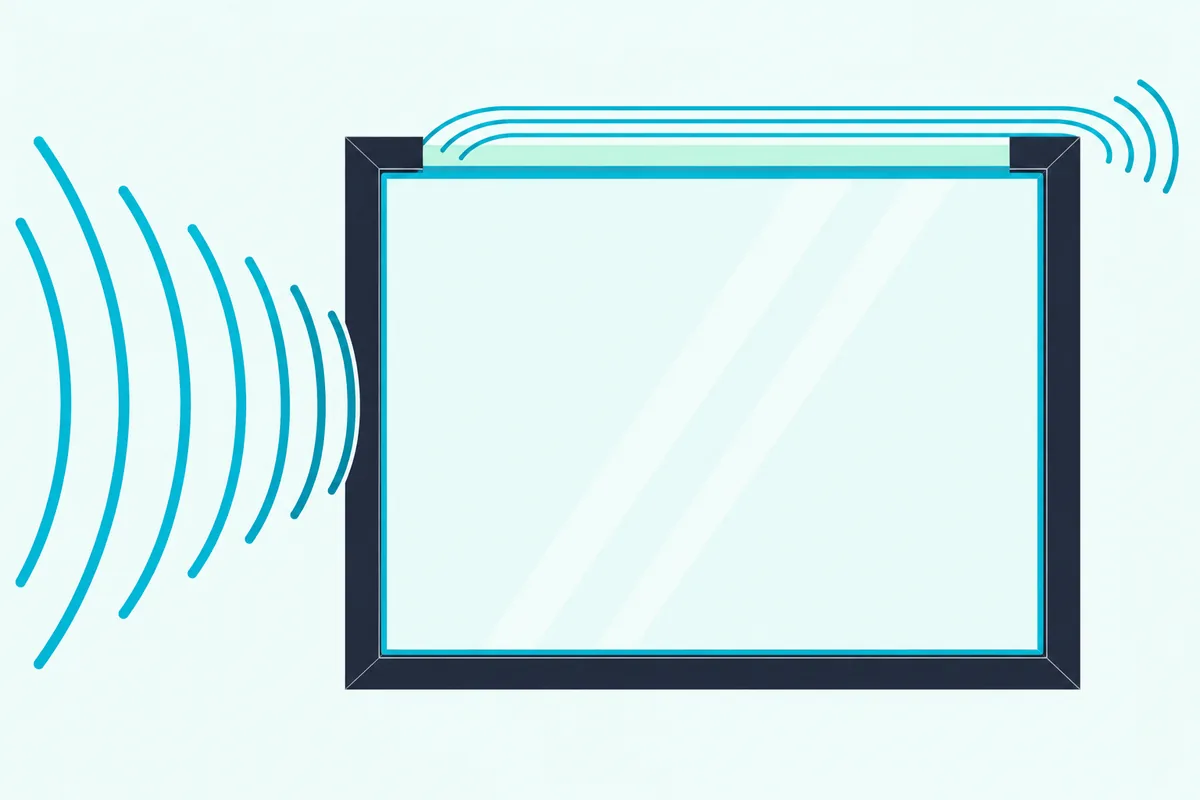
Guardian says its figures are estimates for the center of the glass, and that a site-installed panel can lose as much as 6 dB against its laboratory specimen, which it describes as a perceived loss of a third of the sound reduction.
HUD calls proper sealing extremely important. It says double-glazed windows need to be sealed permanently to go above STC 43, and that openable ones with special frames and seals top out at 43.
HUD’s window example shows how one weak element drags down a wall: a wall rated 45 with a window rated 26 covering 30 percent of it comes to 35 overall. The same arithmetic applies to a gap around a good pane.
So check the STC and OITC rating of the whole window or door, not the glass alone.
How Do You Soundproof Glass You Already Have?
That gap between the pane and the whole window is also why the cheapest upgrade is often a second layer of glass, not a new window.
Indow says its Acoustic Grade inserts cut noise by 18.9 dBA over single-pane windows in a Portland State University lab, against 10 to 12 dBA for its Standard Grade. It adds that the reduction is smaller over double-pane windows, and its FAQ says the inserts aren’t for sliding glass doors.
Those are the maker’s own figures, so treat them as a guide. Our guide to soundproofing windows you already have covers the cheaper steps too, such as sealing the frame, which HUD says is crucial.
If you’re replacing the glass, ask for acoustic laminated glass in a mismatched double unit and check the whole-window rating. That’s the combination the lab tables reward.
The Bottom Line
Soundproof glass works when it’s laminated with an acoustic interlayer, built from mismatched panes or backed by a wide air gap. Plain, tempered and standard double glazing give modest gains, and even the best lab build doesn’t make a window silent.
Judge any window by its whole-product STC and OITC, and seal the frame, because that’s where the lab number gets lost.
Frequently Asked Questions
What is soundproof glass called?
There’s no single name. Makers describe it as acoustic laminated glass, laminated glass for sound dampening or glass with acoustic PVB, and Andersen sells mismatched panes as an STC upgrade.
Can glass be soundproof?
Not completely. Andersen says there’s no such thing as a soundproof window, and the best double-pane build in Guardian’s lab table lists at STC 48, which is past the STC 36 to 40 band where Andersen says even loud conversations are hardly audible.
Is glass good for soundproofing?
Plain glass isn’t. A single 6 mm pane lists at STC 30 and a typical dual-pane window at 25 to 30, which Andersen says still lets you hear and understand a loud conversation outside.
How does soundproof glass work?
It adds mass with thicker panes, damping with an acoustic interlayer and isolation with mismatched panes and an air gap. HUD calls the first the mass principle, and Andersen explains that panes of equal thickness vibrate together.
Is laminated glass soundproof?
Standard laminated glass blocks about what a single pane of the same total thickness does, since both list at STC 36 in Guardian’s table. Laminated glass with acoustic PVB lists at STC 40, so the interlayer is what counts.
How thick is soundproof glass?
The acoustic laminated builds in Guardian’s table use two 6 mm or two 12 mm panes, which is about half an inch to an inch of glass. HUD says the air space should be at least 2 to 4 inches for ratings above 40, and that going from half an inch of glass to three quarters adds only 2 points.