Best Acoustic Slat Wall Panels: What the Makers’ Numbers Say
Your bare concrete basement wall throws every voice back across the room, so you’re searching for the best acoustic slat wall panels.
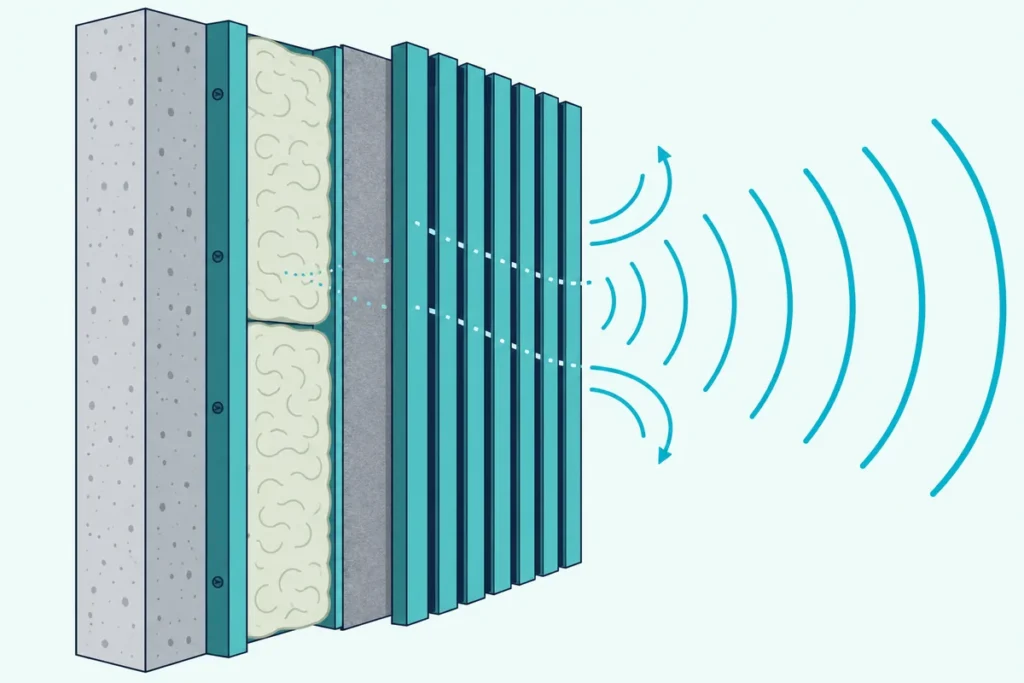
A slat panel looks like treatment, but the wood reflects sound, and it’s the felt behind the slats and the air around them that do the absorbing.
This guide uses ASI’s and Armstrong’s published NRC numbers, the test-report pages shown in two Amazon listings, a 2025 wood absorption study, WoodUpp’s installation guides and the EPA’s formaldehyde label rule.
You’ll see what slat panels really absorb, how to read a test report, how to mount them on concrete and which four earn a place on your wall.
Start with the picks, because the right one depends on your wall and your budget.
Which Are the Best Acoustic Slat Wall Panels?
That depends on your wall and your budget, but the evidence each listing shows sorts the four sets. The best acoustic slat wall panels here are the ones whose numbers you can inspect: TONOR’s, with a test-report page showing the full curve behind its NRC 0.70, and Art3d’s, with a report page that lists NRC 0.80 over 50 mm of fiberglass wool.
I picked the four from Amazon’s slat panel results on 3 October 2026, keeping sets that were in stock with at least 4.0 stars and 50 reviews, and chose different formats so each fits a different wall.
| Panel | Size and pack | Listed coverage | NRC the listing claims | Evidence in the listing’s images |
|---|---|---|---|---|
| TONOR 4-pack | 47.2 x 23.6 x 0.4 in, 4 panels | 31 sq ft | 0.70 | Page 4 of 6 of a test report dated 24 June 2025, with the 100 to 5,000 Hz table |
| AKUMAX 0.7 in 4-pack | 47.2 x 23.6 x 0.7 in, 4 panels | 30.94 sq ft | 0.8 | An “SGS lab-tested” banner, no report page for the absorption claim |
| NeatiEase 4-piece | 96 x 12.6 in, 4 panels | about 33 sq ft | 0.95 | None shown |
| Art3d 6-pack | 94.5 x 7.9 in, 6 panels | about 31.5 sq ft | 0.80 | Page 3 of 5 of a report dated 19 April 2023, for 600 by 1,200 mm panels over 50 mm of fiberglass wool |
| WoodUpp Akupanel, not on Amazon | 94.5 x 23.6 in, 1 panel | 15.5 sq ft | None, says Class A with the right setup | None on the page |
All four listings quote an NRC, from 0.70 to 0.95, and two show a page of a test report. Only Art3d’s report page says how its sample was mounted.
NeatiEase’s 0.95 is above ASI’s 0.90, the top of ASI’s published range, and no report backs it in the listing, so it’s the least supported of the four numbers.
AKUMAX’s images add that screwing the panels into 1.8 inch timber battens through the felt gives Class A sound absorption, which matches WoodUpp’s batten advice.
Our look at whether slat panels work at all covers the basics these picks build on.
| Product | Size | Link |
|---|---|---|
Best Documented Slat Set  | 0.4 inch | See ratings |
Best Narrow Slats 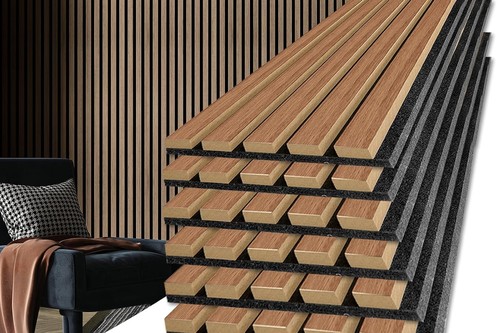 | 7.9 inch | See ratings |
Best Thick-Felt Set 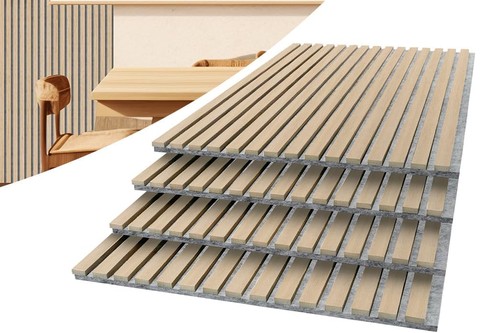 | 0.7 inch | See ratings |
Best Floor-to-Ceiling Slats 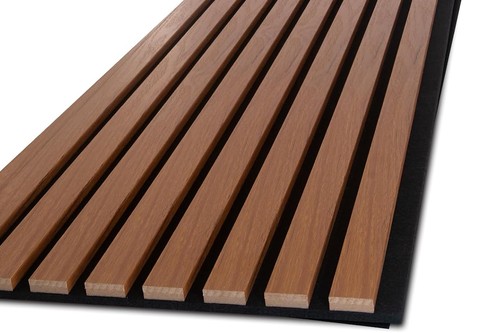 | 12.6 inch | See ratings |
How Much Sound Do Slat Panels Really Absorb?
Those claims need a yardstick, and the makers’ published numbers vary more than the packaging suggests. ASI, a commercial maker, lists its felt-backed Wood Slat Wall at NRC 0.54 to 0.90 and doesn’t say which mounting gives which.
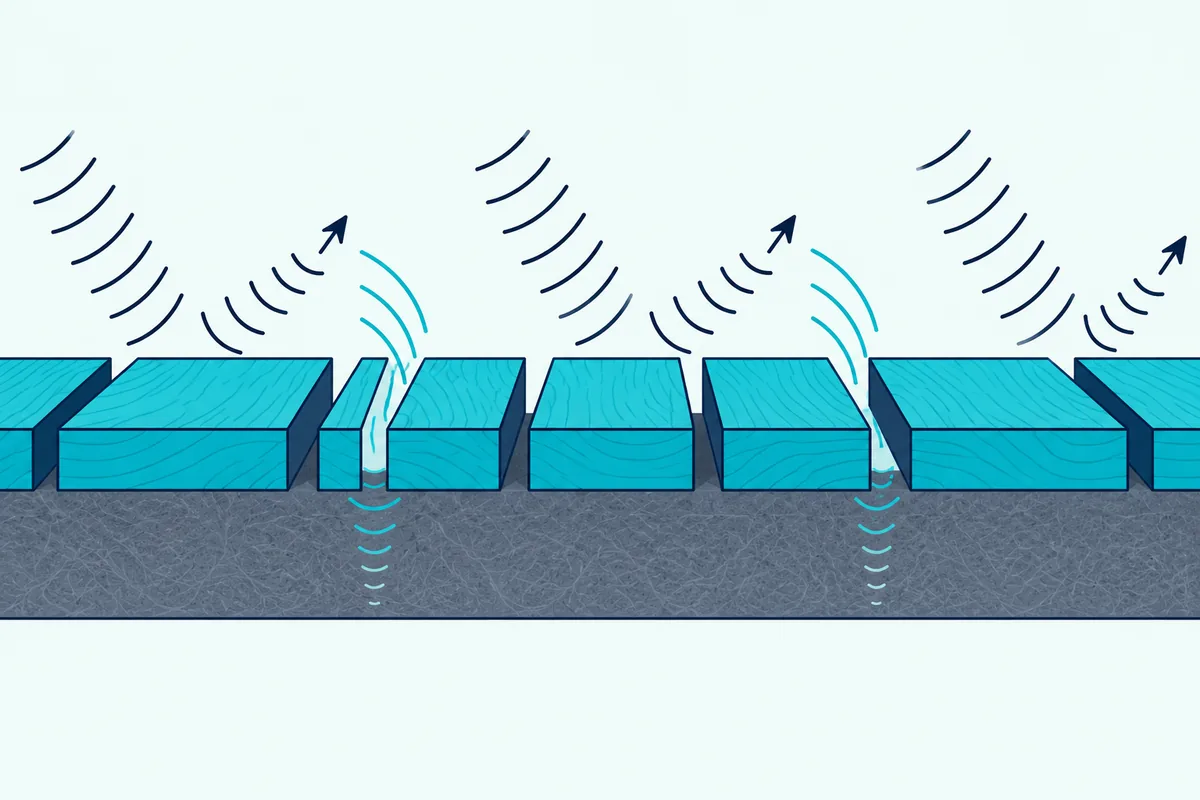
The ASI panel is 11.75 by 96 inches and 22 mm thick, built from a 0.5 mm veneer on 12 mm MDF with 9 mm of recycled fiber felt behind it.
NRC is the average sound absorption at 250, 500, 1,000 and 2,000 Hz under ASTM C423, and Armstrong says it runs from 0.00 for a concrete floor to 1.00 for the best absorbers.
| Product | Type | NRC listed | What changes the number |
|---|---|---|---|
| ASI Wood Slat Wall, Acoustical | Slat panel, 9 mm felt on 12 mm MDF | 0.54 to 0.90 | Not stated on the sheet |
| Armstrong WoodWorks Wall Panels | Perforated veneer panel | 0.35 to 0.65 | Perforation pattern and backing |
| Armstrong WoodWorks Linear, 3-1/4 in planks | Ceiling planks over infill | 0.60 to 0.70 | Infill panel |
| Armstrong WoodWorks Linear, 5-1/4 in planks | Ceiling planks over infill | 0.50 to 0.60 | Infill panel |
| The four Amazon sets above | Slat panel, polyester fiber or PET felt | 0.70 to 0.95, claimed | Stated only on Art3d’s report page |
Armstrong’s wall and ceiling lines show the same spread from the other side. Its perforated WoodWorks wall panels list NRC 0.35 to 0.65, and its WoodWorks Linear ceiling planks list 0.50 to 0.70.
A 2025 impedance tube study in the journal Materials tested fir, pine and oak panels 11, 18 and 25 mm thick against a rigid backing. Absorption stayed low at 250 Hz whatever the thickness or perforation, and above about 750 Hz the thicker and the perforated panels absorbed more.
That study didn’t test slats or felt, but it fits the picture: bare wood absorbs little, and the openings and what sits behind them do the work.
It also found that going from 10 to 20 percent perforation didn’t uniformly help, so more open area isn’t automatically better.
NRC also stops at 250 Hz, because it averages only those four bands, so it says nothing about the lowest notes in a boomy room.
GSA’s office table gives a yardstick: it asks for NRC 0.8 material in an enclosed office, a line that ASI’s range crosses and that Armstrong’s perforated wall panels don’t reach.
WoodUpp says its panels can reach Sound Absorption Class A, the top class of ISO 11654, which needs a weighted coefficient of 0.90 or more. Gustafs, an acoustic panel maker, equates classes A and B with an NRC above 0.75.
That Class A is an absorption class and has nothing to do with fire, because ASTM E84 Class A means a flame spread of 0 to 25.
Get Studio Tips Weekly
Join 5,000+ creators getting acoustic treatment advice every week.
No spam. Unsubscribe anytime.What Makes One Slat Panel Absorb More Than Another?
Those ranges come from three things you can check: what sits behind the slats, how wide the slats are and how deep the air space is. Backing comes first, and the makers’ own pairs show it.
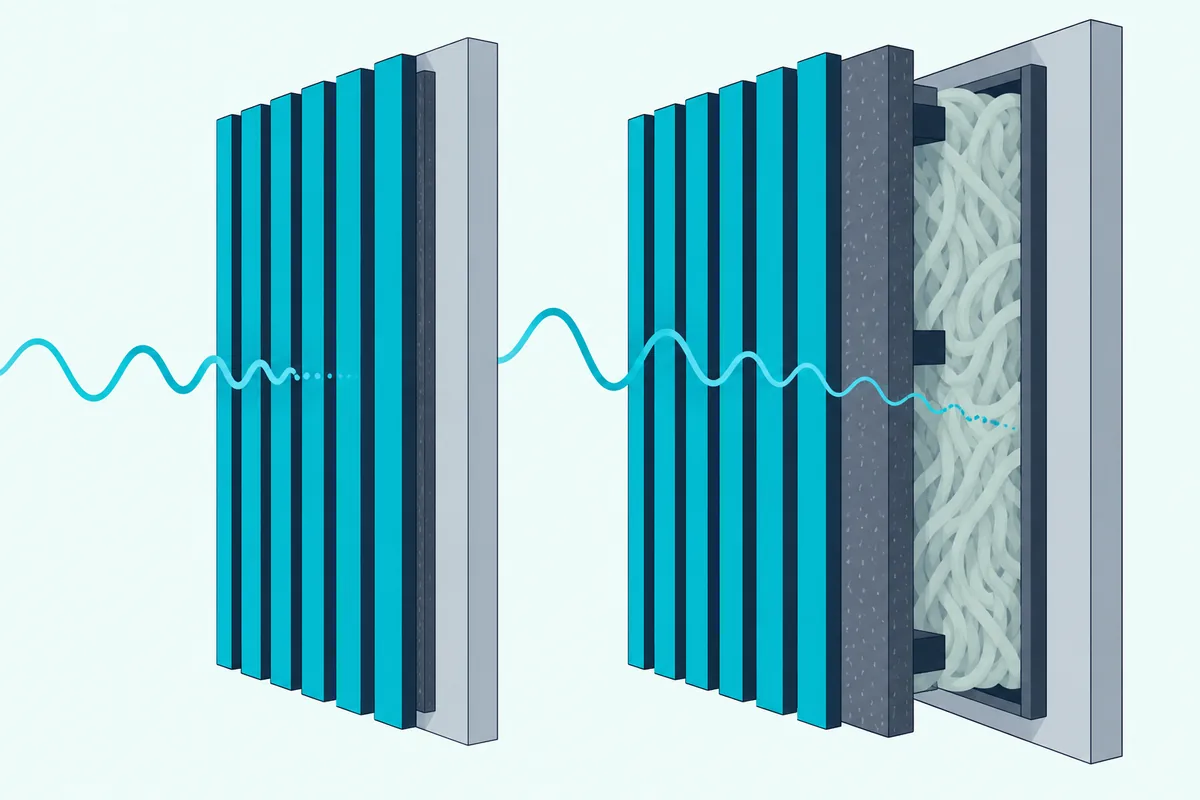
Armstrong’s W4 wall panel rates 0.55 on acoustical fleece and 0.65 over 1 inch of fiberglass infill. WoodUpp says a panel on battens needs mineral wool between them to reach sound class A.
Slat width is next. In Armstrong’s ceiling planks the narrower 3-1/4 inch plank rates 0.10 to 0.15 higher than the 5-1/4 inch plank over the same infill, from 0.70 against 0.60 up to 0.70 against 0.55.
Those are ceiling planks, so read them as an illustration of the pattern and not as wall-slat numbers.
Air depth is the third lever, and it explains why a rating needs its mounting. ISO 11654 says a test specimen mounted with an air space must have that depth stated, and a note recommends at least 400 mm in North America.
A number measured over a deep air space doesn’t describe a panel glued flat to concrete, which is my reading of the standard’s note and a reason to ask which mounting a seller’s number came from.
Felt thickness sits under all three. ASI’s panel uses 9 mm of recycled fiber felt, and the AKUMAX listing names 9 mm of PET felt, which makes the thickness a fair thing to compare when a listing gives no report.
What Should a Slat Panel’s Test Report Show?
Those three levers are why a single number needs context, and a real report supplies it. Look for the method, the mounting and the full curve, because a report that names the standard, the air space behind the specimen and the coefficient at each frequency lets you compare panels fairly.
TONOR’s listing shows what that looks like. Page 4 of 6 of a report issued by SGS and dated 24 June 2025 lists the absorption coefficient at every third-octave band from 100 to 5,000 Hz and ends in NRC 0.70.
Four of those bands make the NRC, and the page’s own numbers check out: 0.38 at 250 Hz, 0.82 at 500, 0.88 at 1,000 and 0.64 at 2,000 average to 0.68, which rounds to the printed 0.70.
The same table shows what an average hides, with 0.07 at 100 Hz and 0.15 at 125 Hz, so on that page the panel does little for deep bass.
That page doesn’t show the mounting or the specimen, which sit elsewhere in the report, so ask for the whole thing.
Art3d’s listing shows page 3 of 5 of an SGS report dated 19 April 2023. Its NRC of 0.80 and SAA of 0.86 belong to panels measuring 600 by 1,200 by 21 mm, 5.76 m² in all, laid on 50 mm of 48 kg/m³ fiberglass wool in a reverberation room.
Those panels aren’t the 94.5 by 7.9 inch set in the listing, and a panel laid on fiberglass wool isn’t a panel glued flat to concrete, which is my reading of the page and a clear case for asking about the mounting.
AKUMAX’s images say SGS lab-tested NRC 0.8 and an average absorption coefficient of 0.7 without a report page, and NeatiEase’s says 0.95 with none, so those two numbers stay claims until you see a report.
USG’s list of standards describes ASTM C423 as the reverberation room method for sound absorption, and ISO 11654 asks that a rating measured over an air space state its depth.
ISO 11654 also says that a single-number rating given with a shape indicator should be used with the complete coefficient curve, which can be obtained on request.
So ask a seller for the lab’s name, the date, the standard, the mounting and air space, and the coefficient at each frequency.
Do Slat Panels Soundproof a Room?
No, because absorbing sound in a room and stopping it crossing a wall are different jobs. USG’s guide says absorption reduces reverberation inside a space, while sound transmission has to be reduced to stop sound traveling between spaces.
Armstrong’s own wall panel sheet describes its perforated panel with backing as improving sound quality and reducing reverberation time within a space, which is an absorption claim and not a blocking one.
A slat set will soften the echo of your basement, but it won’t keep a movie from reaching the room above. Our explanation of why absorbing panels don’t block sound covers what does.
How Do You Mount Slat Panels on a Concrete Wall?
That wall decides the method, because WoodUpp shows two routes, glue straight to the wall or screws into battens, and ASI adds a stricter rule: its panels go on drywall or plywood only.
| Method | What the maker says |
|---|---|
| Glue | WoodUpp: wipe the wall, remove screws and nails so it’s completely even, use about half a tube per panel, and the panel grips in 20 to 30 seconds |
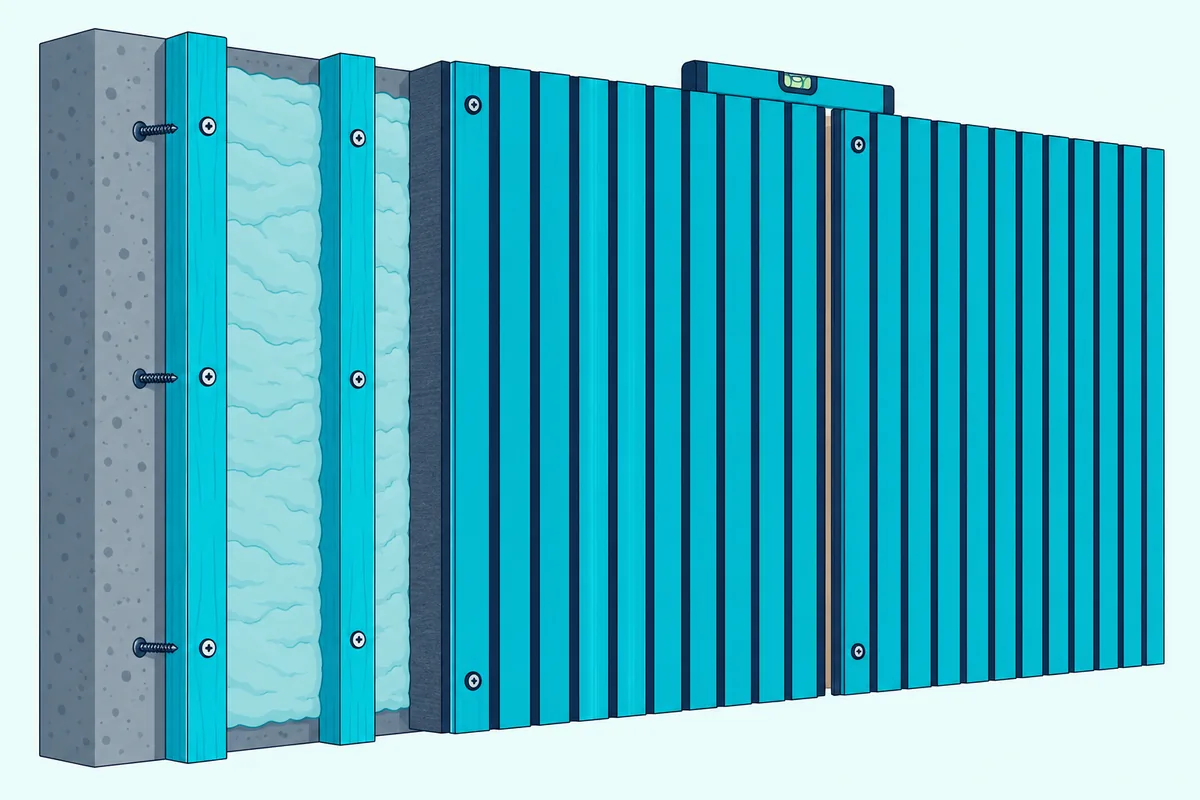
| Battens and screws | WoodUpp: 1-3/4 inch studs about 40 cm apart, fastened with screws and rawlplugs suited to the wall, then 15 screws per panel |
| Battens plus mineral wool | WoodUpp: mineral wool between the battens to reach sound class A |
| Glue and nails | ASI: drywall or plywood only, so concrete needs a layer first |
WoodUpp’s batten guide says to use screws, and possibly rawlplugs, suited to the type of wall, which on concrete means masonry fixings, and the battens also leave the air space that the numbers above reward.
WoodUpp tells you to leave a half inch gap between slats at each joint and not to push panels completely together, and to re-screw the slat ends through the felt with 9/16 inch screws after any cut.
Moisture is the risk to check first on a basement wall. ASI guarantees its panels only where humidity stays between 35 and 55 percent, says not to store them in a basement or garage, and doesn’t cover cupping or delamination from excess moisture.
The EPA says to keep indoor humidity below 60 percent, ideally 30 to 50 percent, with air conditioners or dehumidifiers when needed. Our guide to treating a bare concrete room covers the wall itself.
What Are the Steps for Hanging Slat Panels on Battens?
Once the method is settled, WoodUpp’s batten guide gives the order of work, and its numbers are worth following exactly. Fix 1-3/4 inch battens about 40 cm apart, press mineral wool between them if you want the higher rating, then screw each panel on with 15 screws and a half inch gap at every joint.
- Prepare the wall. Wipe it and remove screws, nails and other obstructions so it’s completely even, then measure and mark where the panels go.
- Cut the battens. Trim them to leave room for the end lamellas at each side.
- Fix the battens. Use screws, and possibly rawlplugs, suited to your wall, about 40 cm apart, and get a second person to hold each batten as you fasten it.
- Add mineral wool. Cut it to size and press it between the battens if you want sound class A.
- Cut the panels to height. Use a circular saw or jigsaw, then re-screw the slat ends through the felt with 9/16 inch screws so they don’t hang loose.
- Mount the panels. Drive black gypsum screws through the felt into the battens, 15 per panel, pushing panels together felt side against slat side until a half inch gap remains at each joint.
- Cut the last panel to width. Cut the felt with a knife and fix the narrower piece to the wall.
- Finish the edges. Add end lamellas with a thin layer of mounting glue, and cut off a final slat if the wall would otherwise end on the slat side, so the panel finishes on felt.
WoodUpp suggests using a slat from a color sample as the spacer for the joint gap, and checking the panels with a spirit level as you go. Its batten guide lists a jigsaw or handsaw, a screwdriver, a ruler and a pencil besides the studs and screws, which is a short kit.
What Can Go Wrong With Wood Slat Panels?
ASI’s data sheet names the conditions its warranty depends on, and they come down to moisture, heat and the install method. It’s a commercial product, but the Amazon sets list no such conditions in their bullet points, so its list is a careful guide for any of them.
ASI guarantees conformity only where ambient humidity stays between 35 and 55 percent before, during and after installation. It says solid wood and veneer can show gapping and cupping when humidity falls below 35 percent or rises above 55 percent.
It also says to leave the box flat on the floor in its original packaging in the room where it will be installed, and not to store it in a garage, basement or other place with uncontrolled humidity.
Installation method counts too. ASI calls its install a glue and nail job, warns that skipping the instructions voids the warranty, and limits it to drywall or plywood.
Heat is the next item, because the sheet calls the product flammable and recommends against using it near an important heating source.
Wood also varies from panel to panel and from lot to lot, so ASI recommends laying the panels out against your color preference and installing from the same lot.
Loose pieces are the last item. ASI’s warranty doesn’t cover individual wood pieces that come loose from vibration in transit, and WoodUpp tells you to re-screw cut slat ends so they don’t hang loosely.
What Should a Listing Show Before You Buy?
Those conditions point to what a listing should say before you pay. Five items cover most of it, and each comes from a maker or an agency rather than a rule of thumb.
An NRC that names its mounting and test method comes first. Armstrong’s wall sheet names its two mountings, D-20 with acoustical fleece and C-20 with 1 inch of fiberglass infill, which is the kind of detail a number needs.
A felt thickness comes second, because it’s the one part of the build you can read straight off a listing.
A fire class comes third. ASTM E84 rates surface burning from Class A at 0 to 25 flame spread, through B at 26 to 75, to C at 76 to 200, and ASI lists a Class A MDF core with a fire retardant on the veneer only.
A formaldehyde label comes fourth, since the panels above are built on MDF. The EPA says composite wood panels sold in the US must carry a TSCA Title VI compliance statement, and the MDF limit is 0.11 parts per million.
A warranty comes last. ASI’s sheet gives two years against structural defects and the AKUMAX listing gives three months, so the difference is worth a line in your decision.
This table shows what each listing’s text and images claim on 3 October 2026, so you can see which of the five items each one covers:
| Listing | Rating claimed | Formaldehyde claim shown | Warranty listed |
|---|---|---|---|
| TONOR 4-pack | NRC 0.70, with a report page | None seen | Not in the bullets |
| AKUMAX 0.7 in 4-pack | NRC 0.8, no report page | E0 grade, with a certificate thumbnail | 3 months |
| NeatiEase 4-piece | NRC 0.95, nothing shown | “Conform to E0 standard” | None listed |
| Art3d 6-pack | NRC 0.80, with a report page | 0.05 mg/m³ against an E1 limit of 0.124, with a report page | Not in the bullets |
Those formaldehyde claims use E0 and E1 grades, which aren’t the TSCA Title VI statement the EPA requires on composite wood sold in the US, so ask for the US label too.
None of the four listings states an ASTM E84 fire class. AKUMAX’s images call the panels fireproof, moisture-resistant and waterproof and its description quotes a fire-retardant certificate number without a class, which are claims to confirm with the seller.
Two of the listings say the panels have low TVOC levels, and that isn’t the same thing as the EPA’s label. TVOC counts volatile organic compounds in general, while the label rule covers formaldehyde from composite wood, so one doesn’t stand in for the other.
Samples are cheap insurance on color. The Art3d listing suggests ordering a sample pack first to pick the finish, and WoodUpp sells color samples on its product page.
For an office, a rental common area or any room where a code applies, pay for a panel whose maker documents the fire class, the NRC and the TSCA label. ASI’s sheet lists all three, and Armstrong’s WoodWorks wall sheet lists ASTM E84 Class A fire performance with an NRC for each mounting.
How Many Panels Does a Room Need, and How Do You Compare Cost?
That checklist assumes you know how much wall to cover, and the only published rule here is a government office guideline. GSA’s design table asks for NRC 0.8 material on 25 percent of two adjacent walls in an enclosed office, which isn’t a home rule but gives a worked example.
In a 12 by 10 foot room with 8 foot walls, two adjacent walls come to 176 square feet, and 25 percent of that is 44 square feet. A slat panel rated below 0.8 would need more area, which is my inference and not GSA’s.
Our guide to how many acoustic panels a room needs gives room-by-room counts for other sizes.
| Panel | Listed coverage per pack | Packs for 44 sq ft | Coverage bought |
|---|---|---|---|
| TONOR 4-pack | 31 sq ft | 2 | 62 sq ft |
| AKUMAX 0.7 in 4-pack | 30.94 sq ft | 2 | 61.9 sq ft |
| NeatiEase 4-piece | about 33 sq ft | 2 | 66 sq ft |
| Art3d 6-pack | about 31.5 sq ft | 2 | 63 sq ft |
| WoodUpp Akupanel | 15.5 sq ft | 3 | 46.5 sq ft |
Packs come in whole sets, so you pay for the cut waste. To compare cost, divide a listing’s price by its listed coverage on the day you buy, because Amazon prices change.
WoodUpp’s own shop priced its 94.5 by 23.6 inch Akupanel at $159 on 3 October 2026, which is $10.26 per square foot, and the panel ships as two pieces, one 11.025 inches wide and one 12.6 inches.
Fixings add to the bill. The same shop listed mounting glue at $16.95 a tube, black screws at $16.95 for 100 and end lamellas at $37.50 and $45.00.
With the glue method at half a tube per panel the glue adds about $8.48 a panel, and with the batten method at 15 screws per panel a 100-pack covers about 6.7 panels, which is arithmetic from WoodUpp’s guides and prices.
Which Slat Panel Should You Buy for Your Room?
Those counts sort the four sets into jobs, and the table matches each to the evidence its listing shows.
| Your goal | Pick | Why |
|---|---|---|
| A number you can inspect | TONOR | A report page with the full curve behind NRC 0.70 |
| The highest documented number | Art3d | NRC 0.80 and SAA 0.86, measured over 50 mm of fiberglass wool |
| Thick felt and a claimed 0.8 | AKUMAX | 9 mm PET felt and an SGS lab-tested claim, with no report page |
| Floor-to-ceiling slats | NeatiEase | 96 inch panels, with a claimed 0.95 and nothing shown |
For a number you can inspect, the TONOR 4-pack covers 31 square feet with 2 by 4 foot panels.
the TONOR 4-pack
For the highest documented number, the Art3d 6-pack covers about 31.5 square feet.
the Art3d 6-pack
For thick felt, the AKUMAX 0.7 inch set covers 30.94 square feet.
the AKUMAX 0.7 inch set
For long slats, the NeatiEase 4-piece set covers about 33 square feet.
the NeatiEase 4-piece set
The Bottom Line
The best acoustic slat wall panels are the ones whose numbers you can check, and of the four sets here that’s TONOR with its report curve at NRC 0.70, then Art3d at 0.80 over fiberglass wool.
On bare concrete, build battens first, add mineral wool for the higher rating, keep the room’s humidity under 60 percent and ask the seller for the whole test report, a fire class and a TSCA label.
Frequently Asked Questions
What are the best acoustic slat wall panels?
The ones whose numbers you can check. Of the four Amazon sets here, TONOR shows a report page with the full curve behind NRC 0.70, and Art3d’s shows NRC 0.80 measured over 50 mm of fiberglass wool.
Can you trust the NRC on a listing?
Only as far as you can see the report. Two of the four listings show a report page, and the sample on one of them was tested on fiberglass wool, so ask for the whole report with the mounting.
Do acoustic slat panels really work?
Yes, as absorbers, when felt sits behind the slats. ASI lists NRC 0.54 to 0.90 for its felt-backed panel, and TONOR’s report page shows 0.82 at 500 Hz but only 0.15 at 125 Hz.
Can you put slat panels on a concrete wall?
Yes, WoodUpp’s batten guide fixes 1-3/4 inch studs about 40 cm apart with screws and rawlplugs suited to the wall, then uses 15 screws per panel. ASI says its panels go on drywall or plywood only.
Are wood slat panels soundproof?
No. They absorb sound inside the room, and USG separates that from the transmission that has to be reduced to stop sound traveling between spaces.
What does Class A mean on a slat panel?
It can mean two unrelated things. Sound Absorption Class A needs a weighted coefficient of 0.90 or more, while ASTM E84 fire Class A means a flame spread of 0 to 25.
Do slat panels need mineral wool behind them?
Not always, but WoodUpp says mineral wool between the battens is what gets its panels to sound class A. Armstrong’s W4 wall panel rises from 0.55 to 0.65 with 1 inch of fiberglass behind it.
What NRC should slat panels have?
GSA’s office table asks for NRC 0.8 on 25 percent of two adjacent walls. ASI’s 0.54 to 0.90 range crosses that line, and Armstrong’s perforated wall panels top out at 0.65.
Can you cut slat panels?
Yes. WoodUpp cuts the panel with a circular saw or jigsaw and the felt with a knife, then re-screws the slat ends through the felt with 9/16 inch screws so they don’t hang loose.
How do you compare the cost of slat wall panels?
Divide the price by the listed coverage on the day you buy, because Amazon prices change. WoodUpp’s own shop priced its Akupanel at $10.26 per square foot on 3 October 2026.
Are slat panels safe on a basement wall?
Only if the room stays dry. ASI guarantees its panels at 35 to 55 percent humidity, and the EPA says to keep indoor humidity below 60 percent.