How to Stop Bass From Traveling Through Walls and Floors
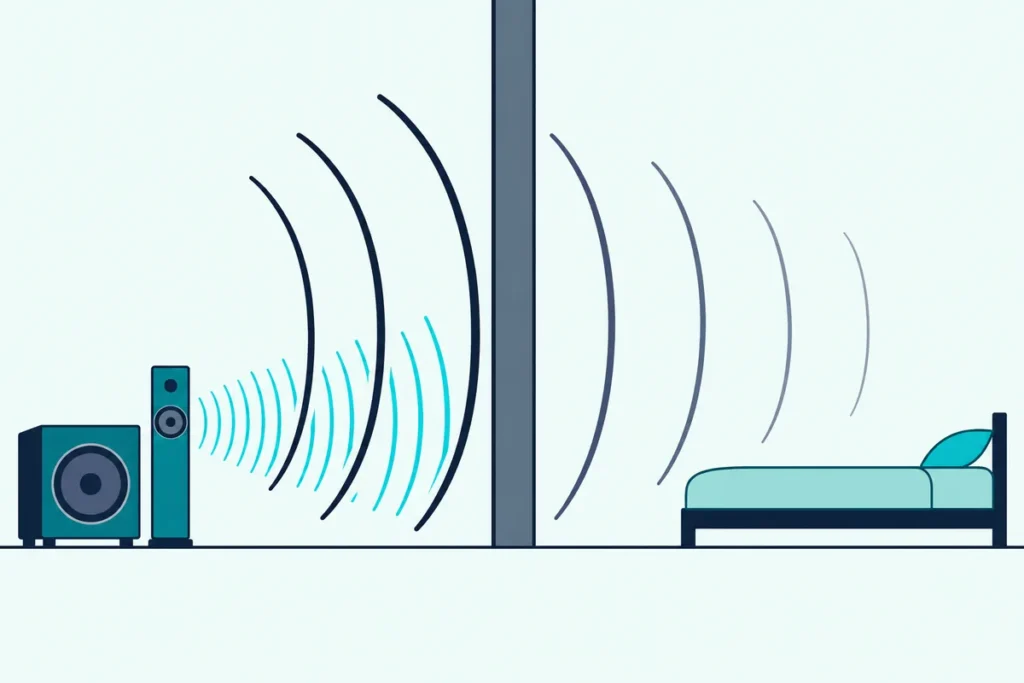
Learning how to stop bass from traveling through walls starts with an awkward fact: the wall that hides your neighbor’s voice lets the kick drum and the subwoofer through.
That isn’t your imagination or a flimsy wall, because walls block low notes far less than high ones, and the STC rating builders quote ignores everything below 125 Hz.
Pick the right path and the right fix, and you can take real decibels off the thump, sometimes without touching the wall at all.
The first move is usually at the subwoofer itself, then mass and a separated layer if you own the wall, with earplugs covering whatever’s left at night.
Below, you’ll see why bass gets through, what each fix is worth in lab numbers, and which ones suit a renter, an owner or the neighbor making the noise.
Why Does Bass Get Through Walls That Stop Voices?
That 125 Hz blind spot is only part of the story, so the physics comes first. Bass gets through because a wall stops sound mostly with its weight, and weight resists short, fast vibrations far better than long, slow ones.
Sound moves at about 344 meters per second in room-temperature air, and wave speed equals frequency times wavelength (HyperPhysics). By that arithmetic, a 50 Hz bass note is about 6.9 meters, or 23 feet, long, while a 1,000 Hz tone in a voice is about 13.5 inches.
One material’s lab numbers show the same slope. Johns Manville’s 1-pound-per-square-foot mass loaded vinyl stops 16 dB at 125 Hz but 36 dB at 4,000 Hz in its ASTM E90 test (JM), and JM lists the same 16 dB at 125 Hz for its 2-pound version.
Ordinary walls also have a weak spot inside the bass range. National Research Council Canada estimated that a single wood-stud wall with one layer of 5/8-inch gypsum board on each side has its mass-air-mass resonance around the 100 Hz band (NRC, Canadian Acoustics), where the two faces and the trapped air behave like weights on a spring and let more sound across.
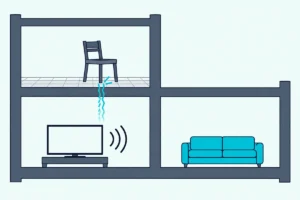
The building itself carries bass too. USG notes that airborne sound strong enough to impart energy into a structure travels through it, and impacts such as footsteps energize it directly (USG), which is how the bass produced by a subwoofer reaches other rooms through floors and framing as well as through the air.
Why Doesn’t a Wall That Meets Code Stop the Thump?
That 100 Hz resonance hides inside the most common wall rating, too. A wall can meet the building code and still pass bass, because STC, the rating the code uses, is calculated from 125 Hz up and is meant for sources like speech, radio and TV.
The 2021 International Building Code requires STC 50 for walls and floors between apartments and other dwelling units, or a field-tested NNIC of 45 (ICC). ASTM, which publishes the STC classification, says the method isn’t appropriate for sources such as musical instruments, many music systems and traffic, which need a frequency-band analysis instead (ASTM E413).
NRC Canada’s acousticians found the gap in the lab (NRC, 2024). In their tests, two double-stud walls with an extra layer of board inside the cavity rated STC 64 and 65, equal to or above the plain wall’s 64, while losing 14 to 17 dB of transmission loss in the bass.
The rating that does look lower is OITC. ASTM bases it on bands from 80 Hz up and on traffic and aircraft noise with strong low-frequency content, so a wall can’t score well on it without stopping low notes (ASTM E1332).
Rockwool’s tested-wall catalog shows how far apart the two numbers sit. A 2×6 wall with two layers of 5/8-inch Type X board on each side rates STC 48 but OITC 32 (Rockwool).
So when a landlord or builder says a wall is “STC 55,” that tells you about voices, not bass. Our guide to what an STC rating leaves out below 125 Hz shows how the number is built, and why OITC is the better question to ask.
Get Studio Tips Weekly
Join 5,000+ creators getting acoustic treatment advice every week.
No spam. Unsubscribe anytime.How to Stop Bass From Traveling Through Walls, Step by Step
Those OITC numbers line the fixes up in a clear order, with the cheapest way to reduce bass noise first. Start at the subwoofer, then seal the wall, add mass and finally separate its two faces, because each step down the list costs more.
| Fix | Who can do it | What the source says |
|---|---|---|
| Pull the subwoofer out of corners and off the shared wall | Whoever owns the subwoofer | Each nearby boundary reinforces a sub’s bass, and a corner has three (Axiom) |
| Set the subwoofer on an isolation platform | Whoever owns the subwoofer | Decouples the sub from the floor and cuts structural vibration (Auralex) |
| Seal outlets, penetrations and wall edges | Owners, or renters with permission | A 1-inch square hole takes an STC 50 wall to 40 (HUD) |
| Add a second layer of 5/8-inch board | Owners | A 2×6 wall rose from OITC 28 to 32 with the second layer and wider stud spacing (Rockwool) |
| Hang the boards on resilient channels | Owners | The same two-layer 2×6 wall rose from OITC 32 to 46 (Rockwool) |
| Build a double-stud wall with an air gap | Owners, as a major project | STC 66 and OITC 50 to 52 with two layers on each side (Rockwool) |
| Lay a heavy topping on a resilient layer upstairs | The owner of the floor above | More than 15 dB better above 50 Hz on a wood-joist floor (NRC) |
| Wear well-fitted foam earplugs at night | Anyone | Almost any protector fitted correctly cuts about 10 dB (CDC) |
For scale, FHWA treats a 10 dB drop as half as loud and 3 dB as barely perceptible (FHWA). OITC is itself a decibel difference, figured on a spectrum of road, rail and aircraft noise, so the 14-point gain from resilient channels clears that half-as-loud mark.
Sealing still comes before the bigger jobs, because it protects everything after it. HUD’s guidebook says a high-performance wall only reaches its rating when it’s well sealed at the perimeter (HUD), and the code itself requires openings for pipes, electrical boxes and ducts to be sealed or treated.
Renters can usually do the first two rows by asking, the last row on their own, and the rest only with the landlord. If you own your side of a shared wall, our steps for soundproofing a party wall cover one-sided builds and the code target in more detail.
Can the Bass Be Stopped at the Subwoofer?
The top two rows of that table cost the least, and they need only the cooperation of whoever owns the speakers. Yes, the subwoofer is the cheapest place to cut bass, because where it sits and what it stands on shape how much energy goes into the room and the structure in the first place.
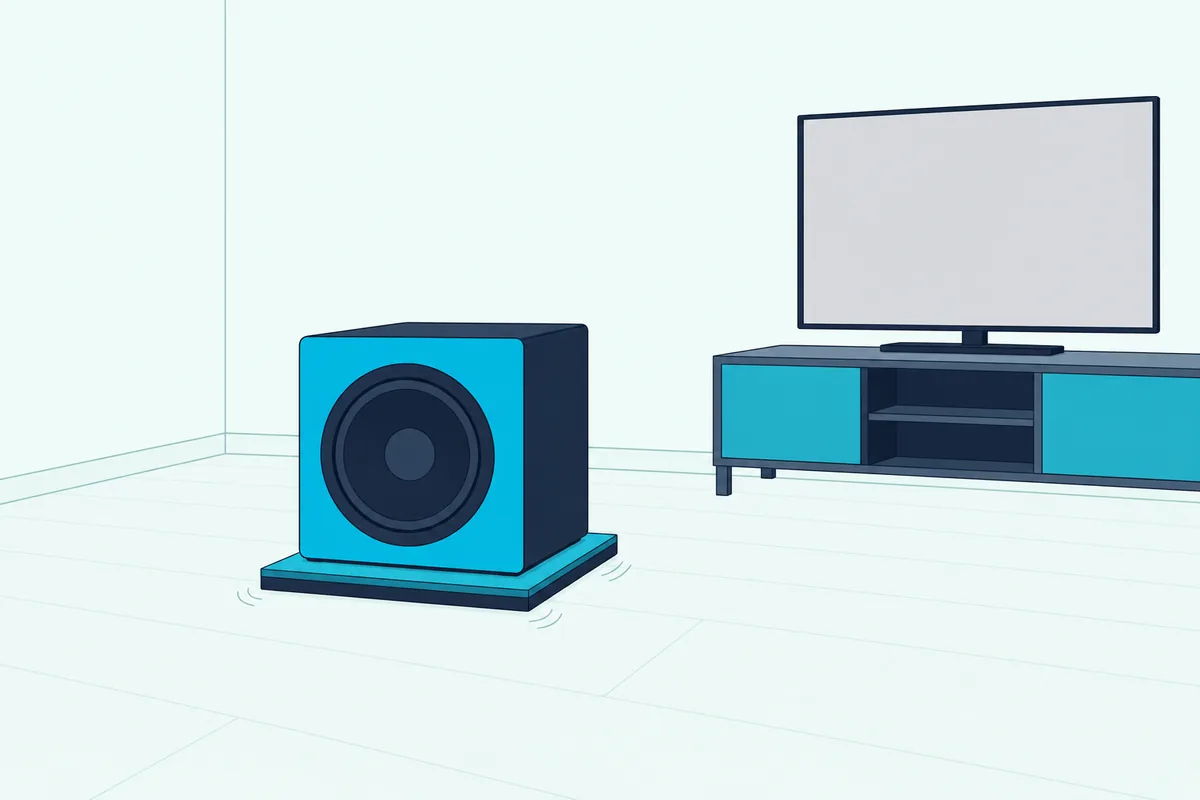
Axiom, a loudspeaker maker, explains that every large surface near a subwoofer reinforces its low-frequency output, so a sub in a corner has the floor and two walls all boosting it (Axiom). Axiom adds that the closer a sub sits to those boundaries, the stronger the effect, so moving it a few feet out of the corner and off a shared wall takes away part of the boost.
What the sub stands on matters next. Auralex says its Auralex SubDude-II decouples a subwoofer from the floor, diminishes structural vibration and reduces sound transmission to neighboring spaces (Auralex spec sheet).
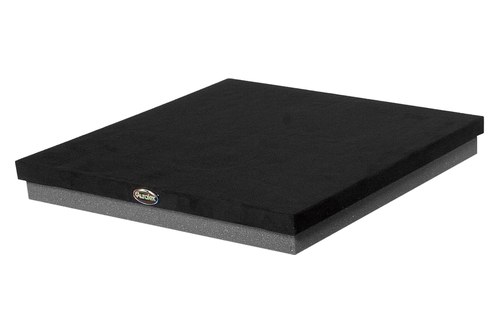
Auralex SubDude-II
The platform is a 3/4-inch MDF top on a 1-inch layer of Auralex’s Platfoam, 15 inches square and 1.75 inches high. Auralex gives no decibel figure for it, so treat it as a simple way to cut the floor path, not a fix for the bass that leaves the cabinet through the air.
If the subwoofer is yours, turning its level down and keeping the heaviest listening to daytime costs nothing and works on every path at once. If it’s your neighbor’s, a reasonable request that names specific changes, sub out of the corner, off the floor and down a notch after a set hour, tends to land better than “turn it down.”
If talking doesn’t work, take a written log of dates and times to the landlord or building manager.
Does Adding Mass to the Wall Stop Bass?
When the source won’t change, the wall is next, and the first instinct is to make it heavier. Mass helps, but slowly, because HUD’s noise guidebook puts the gain from doubling a partition’s thickness at no more than about 6 dB.
HUD also says denser materials reduce more noise, which is why concrete walls insulate better than wood walls of the same thickness. That 6 dB ceiling is the catch, and HUD adds that construction costs tend to limit large increases in wall mass.
Rockwool’s catalog shows how little extra board alone does for bass. A single-stud 2×6 wall with one layer of 5/8-inch Type X on each side rates STC 38 and OITC 28, and with two layers per side and studs 24 inches apart it rates STC 48 but only OITC 32.
That’s 10 STC points but just 4 OITC points, a reminder that a second layer helps voices far more than the low end. It also explains why mass loaded vinyl’s limits show up first on bass, as JM’s flat 16 dB at 125 Hz suggested earlier.
NRC’s work on about 400 walls points to what matters more. Once the two faces of a wall are isolated from each other, the mass of the gypsum board and the depth of the cavity are the factors that matter most (NRC, Canadian Acoustics).
Warnock and Quirt also report that denser insulation in the cavity helps at high frequencies but not at the low frequencies that decide the rating. Stuffing a wall with heavier batts won’t touch the bass the way people hope.
How Does Decoupling Stop Low Frequencies?
Those NRC findings hinge on one condition, isolated faces, and that is what decoupling means. Decoupling separates the two faces of a wall so vibration can’t cross through shared studs, and in Rockwool’s tests it did more for bass than doubling the board: resilient channels lifted a two-layer 2×6 wall from OITC 32 to 46.
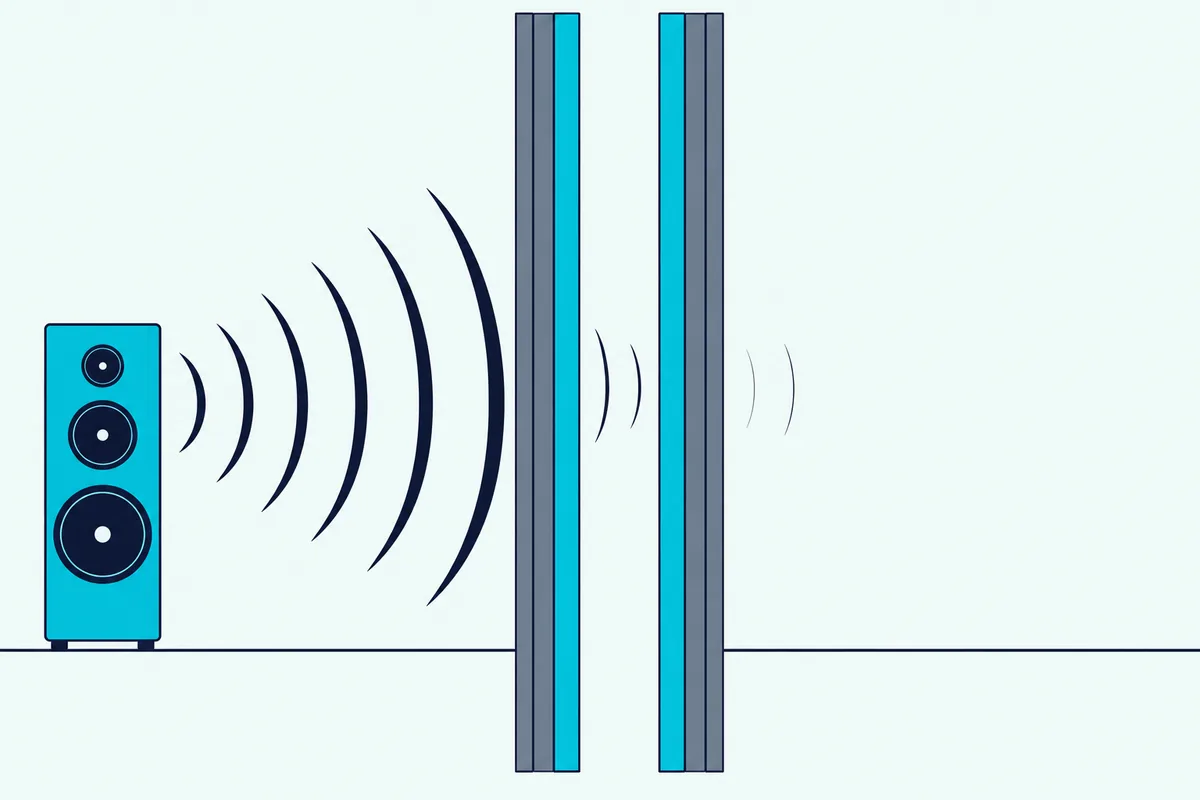
Three common construction techniques get there. Resilient channels hang the board on thin metal strips, staggered studs give each face its own row of studs on a shared plate, and a double-stud wall puts two separate rows of studs side by side with an air gap between them.
Rockwool’s numbers rise in that order for the low end. Its staggered-stud wall with two layers of board per side rates STC 54 and OITC 48, and its double 2×4 wall with a 1-inch gap and two layers per side rates STC 66 and OITC 50, or OITC 52 with studs 24 inches apart.
Spacing and depth help on top of that. NRC found that the farther apart the studs or channels are, the greater the transmission loss at low frequencies, and HUD says going from a 3-inch to a 6-inch airspace can cut another 5 dBA.
Heavier faces and a deeper cavity also move the wall’s own resonance lower. NRC estimated it around 100 Hz for a single wood-stud wall, but at about 36 Hz for a double steel-stud wall with two layers of board per side and a much deeper cavity.
Two mistakes undo all of this. HUD warns that nails severely reduce a wall’s ability to reduce noise, so the new board should touch only the channels or its own studs, never the old framing.
The second mistake is adding board inside the cavity. NRC’s 2024 tests found that a layer of gypsum between the rows of studs split the cavity, created two resonances around 80 Hz and cut the transmission loss below 200 Hz by 14 to 17 dB (NRC, Canadian Acoustics).
For the bigger picture of mass, damping and separation in any wall, Burton Acoustix’s primer on how walls block sound puts these pieces in one place.
Why Does Bass Come Through the Floor or Ceiling?
Even a perfectly decoupled wall leaves the floor and the ceiling, and those are the paths people forget. Bass comes through floors and ceilings because a subwoofer standing on a floor shakes the structure directly, and a continuous subfloor carries that vibration past the wall into the next unit.
NRC measured this flanking in a four-room test building. A party wall with two rows of studs and two layers of 5/8-inch board on each face reached only FSTC 52 with the OSB subfloor running continuously under it, and FSTC 66 once the subfloor was cut at the wall (NRC, Canadian Acoustics).
The detail matters for bass. In that test the floor path dominated above about 250 Hz, while below 250 Hz most of the sound still came through the wall itself, where the better wall added about 10 dB.
So in wood-framed buildings like the one NRC built, the shared wall is still the main path for deep bass, and the floor carries more of the higher sound. Adding a second layer of subfloor in each room raised that test from FSTC 52 to 60, and an engineered floating floor raised it to 67.
From above, the floor’s weight and what it rests on shape the thump. NRC’s Warnock wrote that a heavier floor vibrates less when walked on and so generates less low-frequency sound (NRC), and that a floor can earn a high impact rating with carpet and pad yet still draw complaints about “booming” or “thumping.”
In NRC’s lab, a heavy topping on a resilient layer improved a wood-joist floor by more than 15 dB above 50 Hz (NRC). That work happens in the unit above, though, so it’s the upstairs owner’s or the landlord’s project.
If what comes through your ceiling is walking rather than music, footsteps from the unit above have their own set of fixes.
Do Foam Panels or Bass Traps Block a Neighbor’s Bass?
Those paths explain why the products that guides to noisy neighbors recommend first so often disappoint. No, foam and bass traps don’t block a neighbor’s bass, because they absorb sound inside a room, and absorbing isn’t blocking.
USG separates the two jobs clearly: absorption reduces reverberation within a space, while transmission has to be reduced to keep sound from traveling between spaces. Porous materials such as glass fiber absorb well, while non-porous ones such as gypsum board tend to reflect.
Acoustic foam, the polyurethane wedges and pyramids, is porous and light, so by USG’s split it absorbs rather than blocks. Acoustic panels, the fabric-wrapped fiberglass or mineral wool kind, are porous too, so they also work on the sound inside the room, not on the wall’s ability to block it.
Bass traps are thick absorbers made to tame the low-frequency buildup inside the room where the music plays, which is why studios and home theaters use them. They help the person playing the music, not the person next door, as our look at whether bass traps work on outside noise explains.
How Do You Block Bass Noise From a Neighbor Without Construction?
Since most wall work belongs to owners, renters need options that don’t involve a drywall saw. Without construction, you block bass noise from a neighbor at your ears or cover it up: foam earplugs, noise-canceling headphones and a steady background sound, plus the request at the source described above.
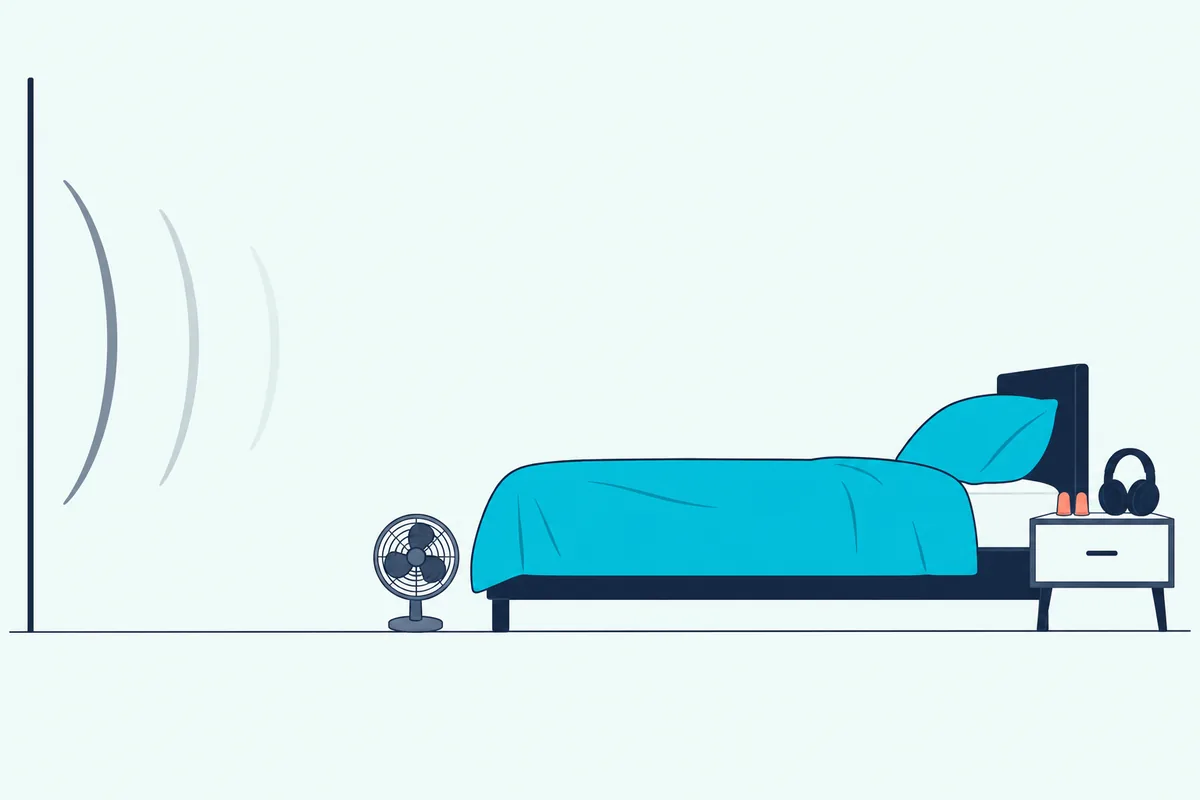
Earplugs are the most practical option for sleep. CDC says almost any hearing protector, fitted correctly, can reduce noise by 10 dB (CDC), and NIOSH’s derating counts an NRR 33 foam plug as about 16.5 dB (NIOSH).
For nights, Mack’s Ultra Soft Foam Earplugs carry the maker’s top rating of NRR 33, and Mack’s lists sleep among their uses. Roll each plug into a tight, crease-free cylinder, pull the outer ear up and back, and hold the plug in place until it expands (Mack’s).
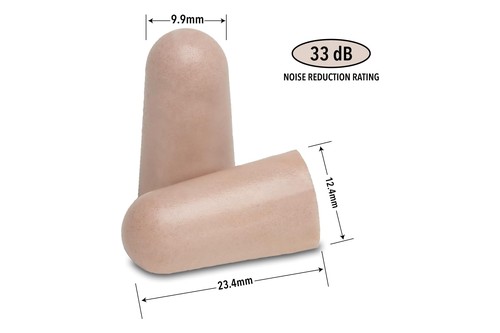
Mack’s Ultra Soft Foam Earplugs
CDC’s fit check is to count out loud while cupping and uncupping your hands over your ears, and a good fit sounds about the same either way. CDC also warns that too much sound reduction can make you less aware of your surroundings, so make sure you’d still hear a smoke alarm or your phone’s alarm.
Noise-canceling headphones suit bass during the day, when you need to concentrate. Sony’s help guides say their noise canceling works primarily on noise in the low frequency band and reduces it without canceling it completely (Sony).
CDC adds that active noise cancellation isn’t hearing protection unless the product carries an NRR, so treat it as a comfort tool.
A steady background sound from a fan, a white noise machine or a masking app covers some of what gets through. GSA’s guide to workplace acoustics calls this “cover,” the third step after absorbing and blocking (GSA), and its reasoning is that interruptions stand out most against near silence.
Where you sleep matters too. If one bedroom shares no wall or floor with the subwoofer’s room, it’s the one to use, and moving the bed off a shared wall is free to try.
What About Low-Frequency Noise That Isn’t Music?
Earplugs and noise canceling work on any low rumble, and the same physics covers noise that isn’t anyone’s stereo. Traffic, idling engines and air-conditioning hum are low-frequency noise too, and they’re blocked the same way, with mass, sealed openings and separated layers, rated by OITC rather than STC.
Windows are the usual weak point for noise coming from outside. HUD’s example is a wall rated STC 45 holding a window rated STC 26 over 30 percent of its area, which drops the whole wall to STC 35.
New glass helps less with rumble than you might hope. Marvin’s own table rates its standard double-pane double-hung window at STC 27 and OITC 23, its triple-pane version at STC 28 and OITC 24, and a version with laminated glass on both panes at STC 31 and OITC 27 (Marvin).
So the extra pane in that table bought one OITC point, and the laminated glass bought four. For a drone like a neighbor’s heat pump, start at the source here too.
The Bottom Line
Bass travels through walls because walls stop low notes poorly, and the STC rating doesn’t even look below 125 Hz. Ask for OITC instead, because that number tracks how a wall handles low, rumbling sound.
The cheapest fixes sit at the subwoofer: out of the corner, off the shared wall and onto an isolation platform. After that, owners can seal, add a layer and decouple, where Rockwool’s tested walls climb from OITC 28 to 52, while renters get the most from foam earplugs at night and noise canceling by day.
Frequently Asked Questions
Why can I hear the bass but not the vocals through the wall?
Because walls block high frequencies much better than low ones. Johns Manville’s mass loaded vinyl stops 36 dB at 4,000 Hz but only 16 dB at 125 Hz, and every wall in Rockwool’s catalog that carries both ratings scores lower on OITC, the low-frequency-weighted one, than on STC. By the time music reaches you, the vocals and cymbals have lost far more than the kick drum and bass line.
Does mass loaded vinyl block bass?
Only a little on its own. JM rates its 1-pound vinyl at 16 dB of loss at 125 Hz and lists the same 16 dB for its 2-pound version, against 36 to 40 dB at 4,000 Hz. Vinyl works better as one layer in a sealed, decoupled wall than as a sheet hung on the surface.
Does sound deadening help with bass?
Not if it means foam or panels. Those absorb echo inside a room, which USG separates from the transmission that carries sound between rooms, so they do little for a neighbor’s bass. Mass, a decoupled layer and the fixes at the subwoofer are what change the bass you hear.
Will new windows stop bass from next door?
Only if the bass is coming in through the windows, and even then the gain is small. Marvin’s table puts its triple-pane double-hung window just one OITC point above its double-pane version, while laminated glass on both panes adds four. Bass from a shared wall or floor won’t change with new windows at all.
Can you block out 100% of bass noise?
Not in a normal home. Rockwool’s best tested wood-stud walls reach about OITC 50 to 52, which is a large reduction but not silence, and flanking through floors and ceilings still has to be handled. The practical goal is to stack fixes, starting at the source, until what’s left no longer bothers you.