How to Soundproof an Apartment From Upstairs Neighbors: What Helps
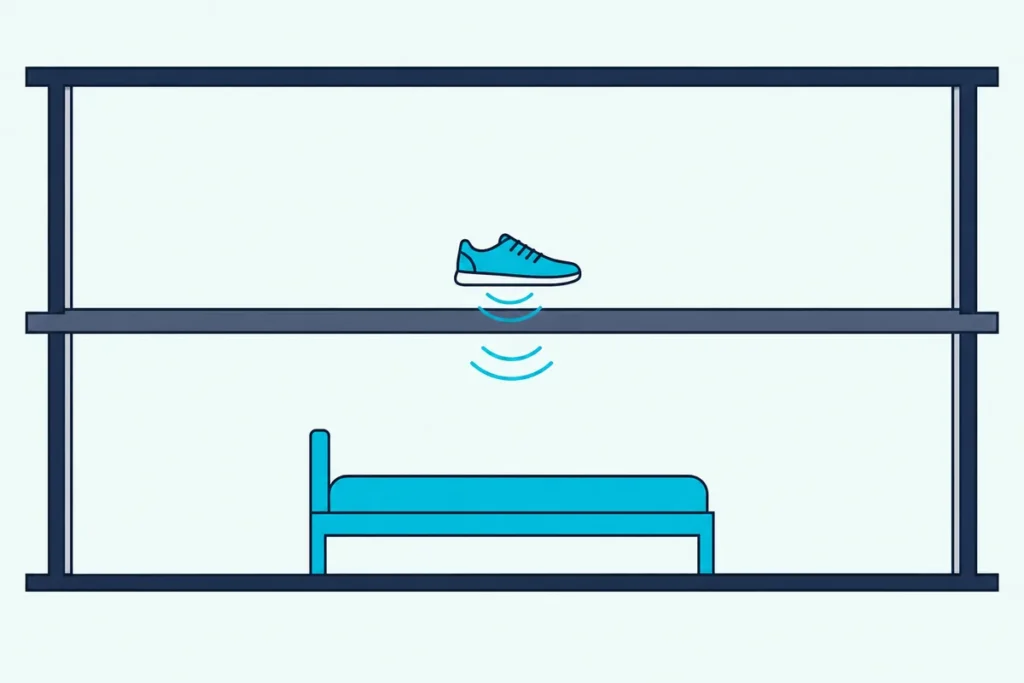
A heavy step lands on your ceiling late at night and the whole room seems to thud with it, which is when you start searching for how to soundproof an apartment from upstairs neighbors.
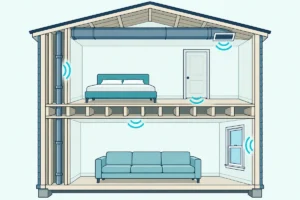
Most of that sound is low-frequency vibration traveling through the building’s frame, so panels and curtains inside your room can absorb echo but can’t block it.
This guide leans on the National Research Council of Canada’s floor tests, the building code’s impact rating, the carpet industry’s lab data and CDC’s earplug guidance to sort what helps from what doesn’t.
You’ll see what to ask the neighbor for, what a rebuilt ceiling can and can’t do, where white noise and earplugs fit, and when to take it to the landlord.
Start with the six steps, because the cheap ones come first.
How to Soundproof an Apartment From Upstairs Neighbors, Step by Step
That order puts the fixes you can start today first and the ceiling work last, because the ceiling is the part you rarely control. You soundproof an apartment from upstairs neighbors by fixing the source with the neighbor and the landlord, covering what’s left at night, and rebuilding the ceiling only with permission.
| Step | What you do | Who controls it | What it does |
|---|---|---|---|
| 1. Work out what you hear | Note whether it’s thuds, clicks or voices, and when | You | Tells you which fix to chase |
| 2. Ask the neighbor for rugs and pads | Rugs with pads on the walking paths, felt on furniture feet, soft-soled shoes | Neighbor | Cuts the sharp click, though the thump can remain |
| 3. Check the lease and tell management | Quiet hours, floor-covering rules, other complaints | Landlord | Puts a rule behind the request |
| 4. Cover the sound at night | A white noise machine, foam earplugs | You | Makes the thuds less noticeable without stopping them |
| 5. Rebuild the ceiling | Insulation, resilient channels or clips and heavier board, if permitted | Owner or landlord | Cuts what the ceiling passes down |
| 6. Weigh a move | A top floor or a building with heavier floors next time | You | Ends the problem if the structure is the limit |
The National Research Council of Canada says the floor covering has a major effect on how much impact sound gets through, which is why steps two and three come before any ceiling work (NRC).
Why Can You Hear Upstairs Footsteps So Clearly?
Because footsteps shake the structure itself, you hear them clearly even through a floor that blocks voices well. USG’s acoustics primer says sound can travel through solid structures when an impact, such as footsteps, energizes the structure directly (USG).

Engineers rate that path with the impact insulation class, or IIC, which USG describes as the rating for footsteps and other impacts in a floor-ceiling assembly. The test uses a tapping machine with five steel-faced hammers, and a higher IIC means less impact sound reaches the room below (NRC).
The 2021 International Building Code sets two minimums for floor-ceiling assemblies between dwelling units (ICC).
| Rating | What it covers | 2021 IBC minimum between units |
|---|---|---|
| STC | Voices, TV and other airborne sound | 50 in the lab, or NNIC 45 in the finished building |
| IIC | Footsteps and other impacts | 50 in the lab, or NISR 45 in the finished building |
NRC says experience shows an IIC of 50 is the least that satisfies the people living below.
But the tapping machine can’t reproduce the low-frequency thump of a person walking, so NRC warns that a floor with a good IIC can still produce thumping that annoys.
That gap is why ASTM published E3207 in 2021, a rating for the low-frequency “thudding” that footfall makes on lightweight structures (ASTM). The standard says its rating doesn’t replace IIC and should be reported alongside it, and ASTM’s announcement adds that it pairs with the high-frequency impact ratings in E3222 (ASTM).
Our explainer on what the IIC number measures shows how to read these ratings on a spec sheet.
Get Studio Tips Weekly
Join 5,000+ creators getting acoustic treatment advice every week.
No spam. Unsubscribe anytime.How Can You Tell Which Kind of Noise You Have?
That matters because each kind of noise takes a different path, and a fix aimed at the wrong one wastes money. You can tell the kind by what you notice: thuds you feel as much as hear are low-frequency impact, sharp clicks are higher-frequency impact, and voices or TV are airborne.
| What you notice | Likely path | Where to start |
|---|---|---|
| Heavy thuds with each step, felt as much as heard | Low-frequency impact through the floor structure | The structure itself: a ceiling rebuild or a different building, since rugs help less |
| Sharp clicks, scraping chairs, dropped objects | Higher-frequency impact from hard surfaces | The neighbor’s floor covering and furniture pads |
| Voices, TV and music | Airborne sound through the ceiling and its gaps | Sealing gaps, then mass and insulation in the ceiling |
NRC describes the sharp click of a hard object on a hard-topped floor and the low-frequency booming of walking on a lightweight floor as different problems that respond to different fixes.
Write the type in your log, because “steady heavy footsteps from 23:00 to 23:40, felt through the bedroom ceiling” tells management far more than “noise at night.”
Should You Talk to the Upstairs Neighbor First?
This is the cheapest first move, because a fix at the source works across the whole floor while anything you do below only treats your own ceiling. You should talk to the upstairs neighbor first, with a friendly note that names the sound and the hours.
| Ask for | Why it helps |
|---|---|
| A rug with a thick pad over the main walking paths | GSA’s office acoustics guide calls carpet especially effective at absorbing the sound of footfalls |
| Felt pads on chair and table legs | Softens the scrape and knock when furniture moves |
| Soft-soled house shoes | Cushions each step before it reaches the floor |
| Heavy activity away from the room over your bedroom | Moves the loudest source off your sleeping area |
A short note works better than a long one:
Hi, I’m in 2B right below you, and footsteps carry through my ceiling more than you’d guess in the evenings. Would you be open to a rug with a thick pad over the hallway and living room, and I’m happy to help pick one?
Read the lease before you write, because it may set quiet hours or a floor-covering rule that makes the request easier.
Keep a log of dates, times and what you heard, since that’s what you hand to management if the note doesn’t work.
| Date | Time | What you heard | Where | How long |
|---|---|---|---|---|
| Example: Tuesday | 23:10 | Steady heavy footsteps, felt through the bed | Bedroom ceiling | 40 minutes |
| Example: Thursday | 07:05 | Chair scraping and sharp clicks | Kitchen ceiling | 10 minutes |
Answering with noise of your own tends to turn a fixable problem into a feud.
How Much Do Rugs and Carpet Upstairs Really Help?
That depends on what’s under them, and the Carpet and Rug Institute measured a big gap between a bare floor and carpet with a cushion. On a wood-joist floor with a plywood subfloor, carpet with a cushion lifted the IIC from 32 to between 54 and 68 (CRI).

| Floor in CRI’s lab test | Bare floor IIC | Carpet, no cushion | Carpet with cushion |
|---|---|---|---|
| Concrete slab | 34 | 53 to 70 | 69 to 80 |
| Wood joists with 5/8 in plywood subfloor | 32 | Not tested | 54 to 68 |
NRC’s example joist floor scores about 40 with ceramic tile, 47 with vinyl or hardwood and 75 to 85 with carpet and underlay, and it notes that tile glued to the subfloor lowers the IIC.
Those tests carpeted the whole test floor, so a rug that covers part of a room will do less.
If the neighbor is open to new carpet, this pile-and-pad comparison shows which cushions added the most in the Carpet and Rug Institute’s slab and joist tests.
NRC also says a joist floor with carpet and pad can have a high IIC and still produce booming or thumping when people walk, and that no easy fix has been found. Our guide to floor coverings that cut impact noise lists the underlayments to suggest if the neighbor is replacing a hard floor.
Can You Soundproof a Ceiling From Upstairs Noise?
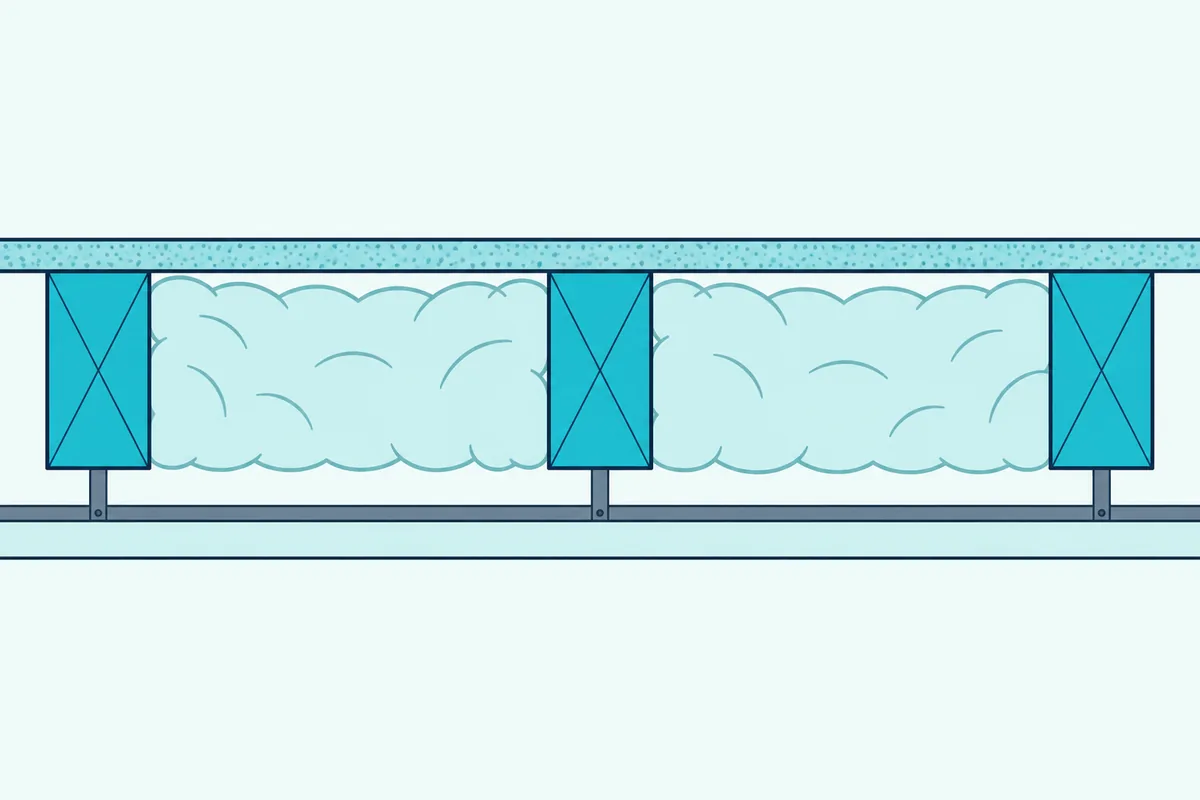
Once the source is handled, the ceiling is the next place the sound arrives, but the fixes that don’t open it up mostly absorb and don’t block. You can soundproof a ceiling from upstairs noise, but only a rebuild with insulation, decoupling and extra mass changes how much passes through.
Burton Acoustix’s no-construction ceiling guide puts numbers on those absorb-only fixes and on what a drop ceiling you already have can take.
| Ceiling option | What it does to footsteps | Who can do it |
|---|---|---|
| Acoustic panels or foam on the ceiling | Absorbs echo in your room and doesn’t block what comes through | Renter |
| Suspended ceiling with acoustic tiles | Tile ratings cover absorption and sound between rooms sharing the ceiling space, not impacts from above | Owner or landlord |
| Extra drywall fixed to the existing ceiling | Adds mass, but board fixed rigidly gave poor impact results in NRC’s tests | Owner |
| Clips or channels under the existing ceiling | The clip maker says this builds a three-layer ceiling that typically performs poorly | Not recommended |
| Tear out, insulate, decouple and rebuild | The route the lab data support for real gains | Owner or landlord |
NRC’s lab study of about 190 lightweight joist floors found the mass of the floor and ceiling layers, resilient metal channels and sound-absorbing material matter most (NRC).
In the floors NRC compared, the airborne rating never reached STC 50 without resilient channels and insulation didn’t help much, but once channels were in, insulation added about 8 points.
On floors with channels and batts, each doubling of the total mass raised the IIC by about 7 points, and moving the channels from 8 in (203 mm) to 24 in (610 mm) apart raised the IIC from 40 to 46 in NRC’s reference floor.
Gypsum board fixed straight to the joists gave poor impact results, NRC says, which is why a ceiling needs that resilient layer.
PAC International, which makes isolation clips, says clips fixed under an existing ceiling make a three-layer ceiling that typically performs poorly. Its advice is to tear off the old board, add insulation if needed and hang a new ceiling on clips, which it says can add up to 15 IIC points (PAC).
If you bring a contractor in, the lab findings turn into a short checklist:
| Ask the contractor to | Why | Source |
|---|---|---|
| Tear off the old ceiling board first | A second ceiling under the first performs poorly | PAC |
| Fill the joist cavity with batts | Sound insulation rose fairly steadily with the amount of absorber, and denser rock fiber beat glass fiber slightly | NRC |
| Hang the new board on resilient channels or clips | Board fixed straight to joists gave poor impact results | NRC |
| Space the channels as wide as the board maker allows | In NRC’s lab, channels 24 in apart beat channels 8 in apart, with the IIC rising from 40 to 46 | NRC |
| Add mass with two layers of board | Each doubling of total mass added about 7 IIC points, and two layers avoid the extra channel pieces a single layer needs, which lowered the rating | NRC |
| Leave a 1/4 in gap at the edge and fill it with acoustical caulk | The clip maker’s installation guide calls for it | PAC |
| Seal gaps around lights, vents and pipes | The code says openings in these assemblies must be sealed | ICC |
If you own the unit, the rebuild is your decision, though a condo association may have rules about ceilings and the units above you. Our guide to rebuilding a finished ceiling covers the build in order.
Armstrong rates ceiling tiles for absorption (NRC) and for blocking airborne sound between rooms that share a ceiling space (CAC), and neither rating measures footsteps from the floor above (Armstrong). Our look at what ceiling tile ratings actually measure goes through the numbers.
What About Voices, TV and Music From Upstairs?
Those ceiling details matter even more for voices, because airborne sound leaks through every gap a thud ignores. The 2021 International Building Code says openings for pipes, electrical devices, soffits and ducts in these assemblies must be sealed or treated to keep the required rating (ICC).
HUD’s noise guidebook gives a one-inch square hole as its example for a wall, saying it can drop a 50 STC wall to 40, and a ceiling with an unsealed light fixture or vent follows the same logic (HUD).
A renter can’t open the ceiling to seal those gaps, but management can, and it’s a fair thing to ask for.
Insulation and a rebuild help voices and TV too, since the airborne gains in NRC’s tests came from the same resilient channels and absorbing material.
Do White Noise Machines and Earplugs Help?
Both can help, because they work on what reaches your ears and not on the ceiling. White noise machines and earplugs help by covering or reducing the sound you hear, so the thuds stay but stand out less.
GSA’s workplace acoustics guide calls masking the “cover” step in absorb, block, cover, and says that when choices must be made, absorption comes first, blocking second and masking third (GSA). It lists a tabletop fountain among the simplest masking tools.
For a steady cover sound, the Yogasleep Dohm Classic makes its sound with a real fan and not a recording, so there’s no loop to notice. Yogasleep lists it at up to 57.4 dB at six feet on high, and for scale NIOSH’s workplace limit is 85 dBA over eight hours (NIOSH).
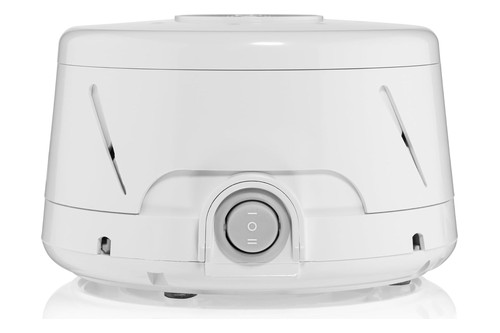
the Yogasleep Dohm Classic
GSA specifies masking sound at 40 to 42 dBA in private offices and 45 to 48 dBA in open-plan areas, so start the machine low and raise it only until the thuds fade.
Earplugs cut what reaches your ears, but the label overstates the result. CDC says the noise reduction rating on the package often doesn’t reflect the protection a person actually gets, and NIOSH recommends counting foam plugs at half their rating, so an NRR of 33 counts as about 16.5 dB (NIOSH).
That figure comes from workplace guidance, which makes it a cautious yardstick for bedtime use.
For foam plugs, Mack’s Ultra Soft Foam Earplugs carry an NRR of 33, and the maker’s steps are to roll the plug, pull the ear up and back, insert it and hold it until it expands.
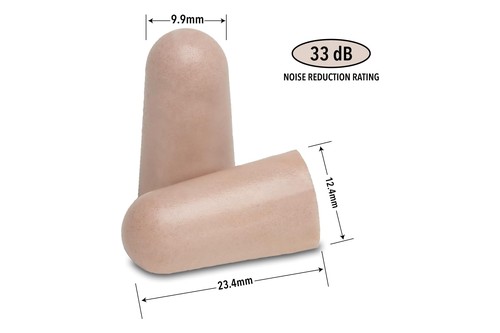
Mack’s Ultra Soft Foam Earplugs
Mack’s says to remove each plug slowly with a twisting motion and to discard the pair after several uses.
CDC’s fit check is to count out loud while cupping and uncupping your hands over your ears, and a good fit sounds about the same either way (CDC).
CDC also warns that too much sound reduction makes people less aware of their surroundings, so confirm you’d still hear a smoke alarm with the plugs in.
When Should You Bring In the Landlord or the Building Code?
If you’ve asked politely and the thumping goes on, it’s time, because the building’s rules and its construction now matter more than the neighbor’s habits. You should bring in the landlord or building manager once you have a dated log and the neighbor hasn’t changed anything.
The 2021 model code asks for an IIC of at least 50, or an NISR of at least 45 if the finished floor is field-tested, in floor-ceiling assemblies between dwelling units (ICC). It’s a model code, so what applies to your building depends on the local code in force when it was built.
A field rating comes from a formal test, so a phone app can document the problem but can’t settle a code question.
ASTM’s announcement notes that the World Health Organization has identified excessive noise in housing as harmful to health, which is a fair reason to put the request in writing.
Ask management whether the floor above has a carpet or rug rule, whether other units have complained and whether the building was built to a sound rating.
Even a floor built to IIC 50 can thump, NRC says, so a compliant building doesn’t guarantee quiet.
If the structure turns out to be the limit, NRC’s measurements point to what to look for in the next place. A heavier floor vibrates less when walked on and so makes less low-frequency sound, and in a separate NRC lab comparison a bare concrete slab beat a deep wood-joist floor up to 125 Hz while the bare wood floor did about 10 dB better in the mid frequencies (NRC).
If a concrete building is on your list, how soundproof concrete apartments really are depends as much on the floor finish upstairs and the entry door as on the slab itself.
That makes carpet over a heavy floor a strong pairing, since NRC puts carpet and underlay at an IIC of 75 to 85, and a top-floor unit has nobody walking overhead. Our guide to other renter-friendly fixes for noisy buildings covers the hallway, door and shared-wall noise that comes with apartment life.
What If You’re the One Upstairs?
Then the same data points at your own floor, because the fix that matters most is under your feet. If you’re the neighbor with a heavy step, wall-to-wall carpet with a cushion, or a thick pad under a large rug over the main walking paths, is the biggest change you can make.
NRC says hard toppings like tile lower the IIC, and thin vinyl, hardwood or a wood layer on thin resilient material add little on a joist floor.
Felt pads on furniture feet and soft-soled house shoes help too, as does moving a treadmill or a play area away from the room over a bedroom. Our guide to quieting your own floor for the unit below covers rubber mats for that play area, lease rules on rugs and an owner’s underlayment.
If the noise upstairs comes from a home gym, these drop-test numbers for gym flooring show how much thick tiles, a floating platform and treadmill isolation pads take off.
What Can Each Fix Realistically Deliver?
Those numbers come from different tests, so they don’t add up in a straight line. Each figure applies to the floor it was measured on, and the lab results are a ranking of effort more than a promise.
NRC’s own example is vinyl, which raised the IIC of a concrete floor by about 9 points and did little on a wood-joist floor, so a topping can only be compared with another on the same base floor.
| Fix | Result | Source |
|---|---|---|
| Carpet with cushion on a wood-joist floor | Bare IIC 32 became 54 to 68 | CRI |
| Doubling the total mass of the floor and ceiling layers | About 7 IIC points | NRC |
| Resilient channels 24 in apart instead of 8 in | IIC 40 became 46 on NRC’s reference floor | NRC |
| Insulation in the cavity once channels are in | About 8 STC points | NRC |
| Tear-off ceiling rebuilt on isolation clips | Up to 15 IIC points, the maker’s claim | PAC |
| White noise on high | Adds up to 57.4 dB at 6 ft, the maker’s figure, and doesn’t remove any sound | Yogasleep |
| Foam earplugs, NRR 33 | About 16.5 dB after NIOSH’s 50% derating | NIOSH |
The thud often stays audible even when the numbers improve, which is why the cover-and-earplug step belongs on the list.
Which Route Fits Your Situation?
That depends on who controls the floor and the ceiling, which is why the same six steps play out differently from one home to the next. Pick your route by whether you rent with a responsive landlord, rent with an unresponsive one, own the unit or are choosing your next place.
| Your situation | Start here | Then |
|---|---|---|
| Renting, landlord slow to act | The neighbor note, the log and a cover sound at night | Send the log to management in writing and weigh a move |
| Renting, landlord cooperative | The neighbor note, then ask management to check the floor rule and seal ceiling gaps | A ceiling rebuild at the landlord’s decision |
| Owning the unit | Ask the neighbor and the association about flooring rules | Tear off, insulate, decouple and rebuild the ceiling in two layers |
| Choosing your next place | Ask what the floors are built of and whether the unit above has carpet | Prefer a top floor, or a heavier floor with carpet over it |
The Bottom Line
Fix the source first by asking the neighbor for rugs with pads and checking the lease, cover what’s left with white noise or earplugs, and rebuild the ceiling only if the landlord agrees, since a rebuild is the one change the lab data back.
Expect less thud, not silence, because even a floor built to IIC 50 can thump.
Frequently Asked Questions
How do you soundproof an apartment from upstairs neighbors cheaply?
Ask for rugs with pads over the walking paths, add white noise or earplugs at night and keep a log. All three cost little, and the first one fixes the source.
Can I soundproof my ceiling from upstairs neighbors if I rent?
Only with the landlord’s agreement, because the fixes that change how much passes through mean rebuilding the ceiling. Panels you can hang yourself absorb echo in your room and don’t block the thud.
Do acoustic panels block upstairs noise?
No. USG says absorption reduces reverberation inside a room, and stopping sound from traveling between spaces is a separate job for the structure.
Does a drop ceiling stop footsteps?
Not by its ratings. Armstrong rates tiles for absorption and for sound between rooms that share a ceiling space, and neither measures footsteps from the floor above.
What IIC rating is good enough?
The 2021 code minimum between units is 50, and NRC says 50 is the least that satisfies occupants. CRI’s carpet-with-cushion tests on concrete reached 69 to 80, but a high IIC can still thump.
How do I find out whether my building meets the sound code?
Ask management when the building was built and whether its floors were rated, because the 2021 code asks for an IIC of 50 in the lab or an NISR of 45 in the finished building. Older buildings may have been built under earlier rules, and only a formal field test settles it.
Is there a rating for the thud itself?
Yes, ASTM E3207 rates the low-frequency “thudding” of footfall on lightweight structures. The standard says it doesn’t replace IIC and should be reported alongside it.
Why do I still hear footsteps through carpet?
Carpet softens the sharp click, but NRC says a lightweight joist floor with carpet and pad can still produce low-frequency booming or thumping that the IIC rating doesn’t capture. ASTM E3207 exists to rate that thud.
Why does a wood-frame building carry footsteps so well?
A lightweight floor vibrates more when walked on, and NRC says a heavier floor makes less low-frequency sound. A bare concrete slab did better than a bare wood-joist floor up to 125 Hz in NRC’s lab comparison.
What can I do about noisy kids upstairs?
Heavy running and jumping are the “heavy footsteps” ASTM says lightweight buildings turn into thudding, and NRC says carpet alone doesn’t cure that. Ask for thick pads over the play area, keep a log of the hours and use the cover-and-rebuild steps above if that isn’t enough.
How loud should a white noise machine be?
Just loud enough to cover the thumps. Yogasleep lists the Dohm Classic at up to 57.4 dB at six feet on high, against NIOSH’s 85 dBA workplace limit over eight hours.
Do foam earplugs work against upstairs noise?
They help if they fit, but NIOSH counts foam plugs at half their label, so an NRR of 33 counts as about 16.5 dB. Use CDC’s cupped-hands fit check and confirm you’d still hear a smoke alarm.
What should I do if the neighbor won’t cooperate?
Send management your dated log, ask whether the building was built to a sound rating and weigh a move. Heavier floors vibrate less, so ask what the next unit is built on.