STC and IIC Ratings: What the Numbers Actually Mean
You buy the door advertised as soundproof, hang it, close it, and can still make out every word from the next room.
The box said STC 32, which sounded impressive next to a hollow builder’s door at 20.
That gap between a number on a spec sheet and what you actually hear is what STC and IIC ratings are for — and what they routinely get blamed for.
They aren’t marketing inventions. They’re lab measurements with a defined method, and they work, as long as you know what each one is counting.
Below is what each number measures, what counts as good, why a high rating still lets bass through, what building codes require, and how far a lab result travels into a real room.
What do STC and IIC ratings actually measure?
That blame is usually misplaced, because the two ratings measure completely different kinds of noise and get read as if they were interchangeable.
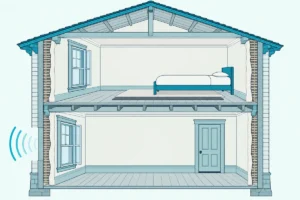
STC — Sound Transmission Class measures airborne sound passing through a partition. Voices, a television, a barking dog, music through a shared wall.
IIC — Impact Insulation Class measures structure-borne sound, generated by something striking a surface. Footsteps, a dropped fork, a chair dragged across the floor above you.
So STC belongs to walls, doors and windows. IIC belongs to floor-ceiling assemblies, and it is the number that matters if the problem is the apartment overhead.
Both are single numbers standing in for performance across a range of frequencies, and both are roughly decibel-shaped: higher is better, and a difference of 10 points is about half the perceived loudness.
What is a good STC rating?
That “roughly decibel-shaped” scale is why the honest answer is a range rather than a target.
- 25–30 — normal speech is understandable through the wall. This is a standard interior door or a single sheet of drywall each side.
- 35 — loud speech is audible but not intelligible. You know someone’s talking; you can’t follow it.
- 40 — loud speech is a faint murmur. This is the floor for anything you’d call privacy.
- 50 — loud speech is inaudible. Most residential building codes land here.
- 55–60 — good music isolation. Home theaters and practice rooms live in this band.
- 60+ — specialist construction, usually double-stud or fully decoupled.
The jump that matters most is 35 to 45. Below 45 you’re still hearing the shape of conversations, and above it you mostly aren’t.
An STC of 21 or 32 on a door, then, isn’t a soundproof product. It’s a door that’s marginally better than nothing.
Get Studio Tips Weekly
Join 5,000+ creators getting acoustic treatment advice every week.
No spam. Unsubscribe anytime.What is a good IIC rating?
IIC borrows the same numbering, so the bands below look deceptively similar to the STC ones even though the noise is nothing alike.
- 50 — the code minimum in most residential construction.
- 55–60 — footsteps audible but soft. Carpet with a decent pad usually gets here.
- 60–70 — most impact noise gone in normal use.
- 70+ — heavy floating floors and resilient underlayment assemblies.
Here’s the catch that surprises people. A concrete slab can post a fine STC and a dreadful IIC at the same time, because mass blocks airborne sound beautifully and does almost nothing about a heel strike transmitted directly into the structure.
That’s why an “IIC 68” underlayment and an “STC 55” wall are not competing claims. They’re solving unrelated problems.
The same split decides whether concrete apartments are soundproof: a bare slab under tile can sit near IIC 28 while its STC clears the code with room to spare.
Why does a high STC still let bass through?
That 55-to-60 band is exactly where the question gets asked, because it’s where people build carefully and are still unhappy. The answer is that the single number hides where the measurement stops.
STC is calculated from performance between 125 Hz and 4,000 Hz. Below 125 Hz — the kick drum, the bass line, the rumble of a subwoofer next door — the rating simply isn’t looking.
So a wall can measure STC 55, block conversation completely, and still pass the neighbor’s bass into your room all evening. Nothing about the number is wrong; it never claimed to cover that range.
This is the single most common reason someone builds to a spec, hits it, and is still unhappy. If the complaint is bass, an STC figure won’t predict the outcome, and OITC — which does extend down to 80 Hz — is the more honest number to ask for.
The fixes that actually raise those low-frequency numbers, from where the subwoofer sits to a double-stud wall, are laid out in Burton Acoustix’s guide to blocking a neighbor’s bass.
What do building codes actually require?
Most North American residential code sets a floor of STC 50 and IIC 50 for assemblies separating dwelling units — party walls between apartments, and the floor-ceiling between stacked units.
Field-tested equivalents, written FSTC and FIIC, are typically allowed to come in around five points lower, which is a tacit admission that lab numbers don’t survive installation intact.
Read that as the legal minimum, not a comfort standard. Code-compliant apartments generate noise complaints constantly, because STC 50 is the point where loud speech disappears and everything below 125 Hz is still arriving.
How are these numbers tested?
Codes cite these numbers as if they were properties of a wall. They’re properties of a wall in a laboratory, and the conditions are the reason field results disappoint.
For STC, a speaker generates sound in one chamber, microphones measure what arrives in the next, and transmission loss is recorded across sixteen frequency bands. The resulting curve is fitted against a standard contour, and the fit produces the single number.
IIC uses a tapping machine — five small hammers striking the floor at a fixed rate — with microphones in the room below.
Both chambers are built to eliminate flanking, meaning sound traveling around the assembly rather than through it. Your house has no such luxury, and flanking through shared joists, a common ceiling cavity or a poorly sealed outlet is why a lab-rated assembly underperforms once it’s installed.
Does the lab number survive into your room?
Rarely at full value, and the losses are boringly predictable.
An unsealed gap is the biggest one. A 1% open area in a partition can cost roughly 10 STC points — the same drop as removing half the assembly’s perceived performance, from one unsealed penetration.
Back-to-back electrical boxes, un-caulked perimeters, a door undercut, recessed lights punched through the ceiling: each is a hole in an otherwise-good number.
Treat a published rating as a ceiling, not a forecast. What you build determines how close to it you land, and soundproof a wall covers where the losses hide.
To see how close your own wall came, a before-and-after field test with a meter measures the drop between the two rooms, the same noise reduction a professional NIC rating starts from.
A worked example
Take a standard apartment party wall: single 2×4 studs at 16 inches, one layer of 1/2-inch drywall each side, fiberglass batts in the cavity. That assembly tests around STC 38 — below the code minimum, and squarely in the band where you follow conversations.
Add a second layer of 5/8-inch drywall to each side and it climbs to roughly STC 45. Doubling the mass bought seven points.
Now take the original wall and decouple it instead — resilient channel on one side, same single drywall layers — and it lands near STC 52. One change, fourteen points, and no extra sheets of board.
That contrast is the whole argument for the order of the four levers below.
How do you raise an STC rating?
Four levers, in descending order of how much they buy you.
Decoupling is the strongest. Separating the two faces of a wall so vibration can’t travel straight across — resilient channel, sound clips, or a double-stud wall — is worth more than any other single change.
Mass is next, and it’s the simplest. A second layer of drywall, or a denser material, raises transmission loss across the board.
Damping turns vibration into heat between two rigid layers, which is what viscoelastic compounds between drywall sheets do.
Absorption inside the cavity stops the wall behaving like a drum. Insulation matters here, though it does less alone than people expect — the insulation comparison puts numbers to it.
Sealing isn’t on that list because it isn’t an upgrade. It’s the prerequisite that decides whether any of the four are worth doing.
Delta IIC, and why underlayment claims mislead
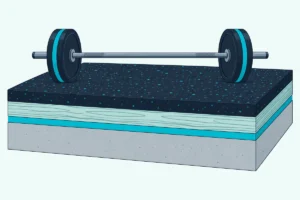
Underlayment products are usually sold on Delta IIC (ΔIIC) rather than IIC, and the two are not the same claim.
Delta IIC is the improvement a product adds to a reference concrete slab, so a “ΔIIC 21” underlayment raises whatever it’s laid on by about 21 points. It says nothing about the finished number.
Laid on a good slab that’s an excellent result. Laid on a bare wood-frame floor it will not deliver an IIC of 71, because the reference assembly in the test was concrete and yours isn’t.
Ask for the tested assembly IIC on a floor build resembling your own, not the delta in isolation.
What about NRC, and where does it fit?
NRC gets confused with STC constantly, and the two aren’t on the same axis at all.
NRC — Noise Reduction Coefficient measures how much sound a material absorbs when sound strikes it, on a 0 to 1 scale. It describes what happens to sound inside a room: echo, reverb, harshness.
STC and IIC describe what gets out of a room. A panel with an excellent acoustic panel NRC rating will make your room sound better and will not stop your neighbor hearing you.
If someone quotes NRC as evidence a product soundproofs, that’s the tell. They’re answering a different question.
What the numbers won’t tell you
Three things, and each one accounts for a share of the disappointment.
They won’t tell you about bass, since STC stops at 125 Hz and most complaints that survive good construction live below it.
They won’t tell you about flanking, because the lab eliminated it and your building didn’t.
And they won’t tell you about your room, which has a door, a window, an outlet and a ceiling the tested assembly didn’t have.
The weakest element sets the result, not the average, so a rated wall with an unrated door performs like the door. The full mechanism is in Burton Acoustix’s explainer on how sound gets through.
What to ask before you buy
Three questions cut through most product claims.
Is this a tested assembly rating or a component delta? A number for the product alone tells you far less than a number for a wall or floor built the way yours will be.
What was the test assembly? If it doesn’t resemble your construction, the figure won’t transfer.
Does the range cover my problem? For bass, STC is the wrong instrument and OITC is the right one.
Used properly, these ratings are the most useful shorthand the industry has. Used as a promise, they’re the reason people spend money and stay annoyed.
Frequently asked questions
What is the difference between STC and IIC?
STC measures airborne sound through a partition — voices, television, music through a wall. IIC measures impact sound through a floor-ceiling assembly — footsteps, dropped objects, dragged furniture. STC applies to walls, doors and windows; IIC applies to floors. An assembly can score well on one and badly on the other, because blocking a voice and blocking a heel strike are different physical problems.
Does an STC rating of 21 mean anything?
It means very little in practice. STC 21 is roughly a hollow-core interior door, where normal conversation passes through intelligibly. Privacy starts around STC 40 and loud speech only becomes inaudible around 50. A product marketed as soundproof at STC 21 is telling you it is slightly better than an open doorway.
Is IIC 68 a good rating?
Yes. IIC 68 is well above the code minimum of 50 and puts you in the band where normal footsteps are largely gone, typically achieved with a resilient underlayment or a floating floor. Bear in mind it is a laboratory figure — flanking through the structure and an imperfect installation both pull the delivered result down.
What STC rating do I need to not hear my neighbors?
For speech, aim for STC 50 and up, which is where loud conversation becomes inaudible. For music or home theater, 55 to 60. If the complaint is bass, no STC figure will answer it, because the rating stops at 125 Hz — ask for OITC instead and expect to decouple rather than simply add mass.