Are Fire Doors Soundproof? What the Label Doesn’t Tell You
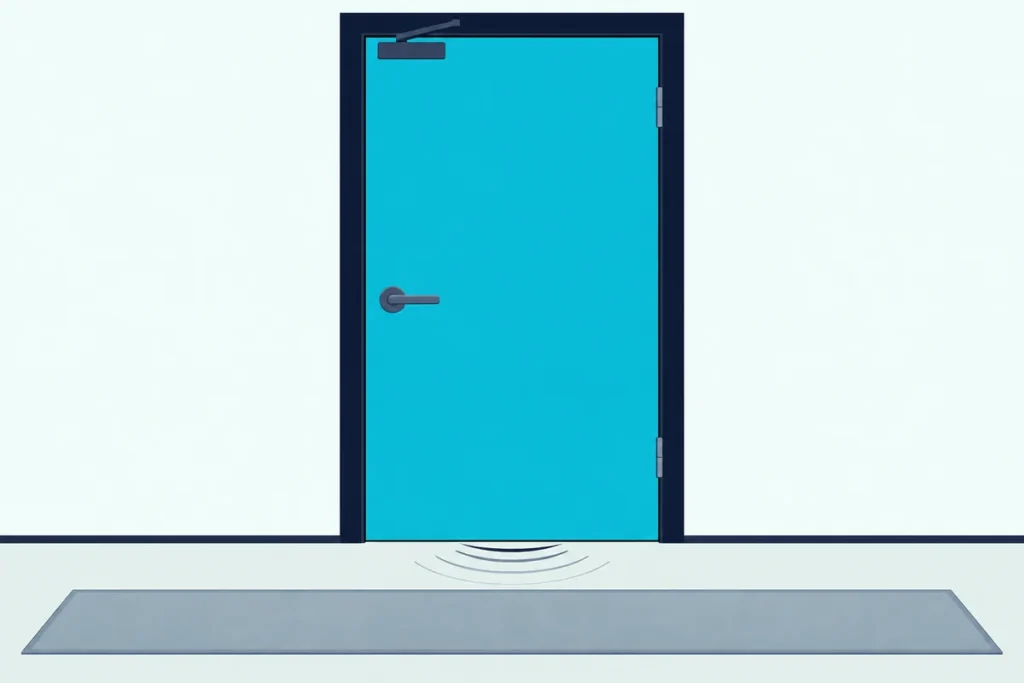
If a heavy apartment door still lets the hallway in, you’ve probably wondered: are fire doors soundproof, or do they only hold back flames?
The label on a fire door comes from a furnace test, and the US standard that governs it lets a gap of up to 3/4 in sit under the slab.
JELD-WEN’s own sound ratings put its fire-rated doors at STC 29 to 37, quieter than a hollow door but nowhere near soundproof.
This guide uses those ratings, NFPA’s fire door rules and the Steel Door Institute’s acoustic guidelines to show what a fire door blocks, where it leaks and what you may change.
Start with the numbers, because they show how little the fire rating itself predicts.
Are Fire Doors Soundproof?
Those numbers come from a sound lab, not from the fire label. Fire doors aren’t soundproof: JELD-WEN’s acoustic guide lists its fire-rated interior doors at STC 29 to 37, against 24 to 27 for its hollow-core doors (JELD-WEN).
On the Steel Door Institute’s scale, 25 to 29 means normal conversation is understood easily, and 35 to 39 means loud speech is still audible but not intelligible (SDI). Burton Acoustix’s STC explainer covers what a good rating is and how it’s tested.
| JELD-WEN door (2023 guide) | Hollow core | Solid core | Fire-rated versions |
|---|---|---|---|
| Molded: Caiman, Cambridge, Camden, Carrara, RockPort, Santa Fe | 25 | 30 | 30 at 20 min, 29 at 45 and 60 min |
| Molded: Birkdale, Conmore, Craftsman III, Madison, Monroe | 25 | 32 | 32 at 20 min |
| Molded: Colonist | 27 | 29 | 29 at 20, 45 and 60 min |
| Flush wood composite | 24 | 30 | 30 at 20 min, 34 at 60 min, 32 at 90 min |
Two patterns stand out: each 20-minute door rates exactly like its solid-core twin, and a longer rating doesn’t buy a higher number, since the 90-minute flush door rates 32 against 34 for the 60-minute one.
JELD-WEN adds that its figures are for new products and can vary with components and options.
Why Doesn’t a Fire Rating Tell You the STC?
That flat line makes sense once you see the two tests side by side. A fire rating records how long a door assembly survived a furnace, while STC comes from a separate sound test, so one number can’t stand in for the other.
In UL 10C, the door is mounted in a test wall, exposed to a furnace’s heat under positive pressure and then hit with a hose stream, and its pass conditions include limits on flaming, deflection and openings (Intertek).
| Fire test | Sound test | |
|---|---|---|
| What it measures | Fire resistance: UL 10C or NFPA 252 in the US, BS 476-22 or BS EN 1634-1 in the UK | Sound transmission loss at each frequency, in a lab (ASTM E90) |
| What you get | Minutes: 20 to 240 in the US, FD 30 or E 30 in the UK | One number: STC (ASTM E413) or Rw (BS EN ISO 717-1) |
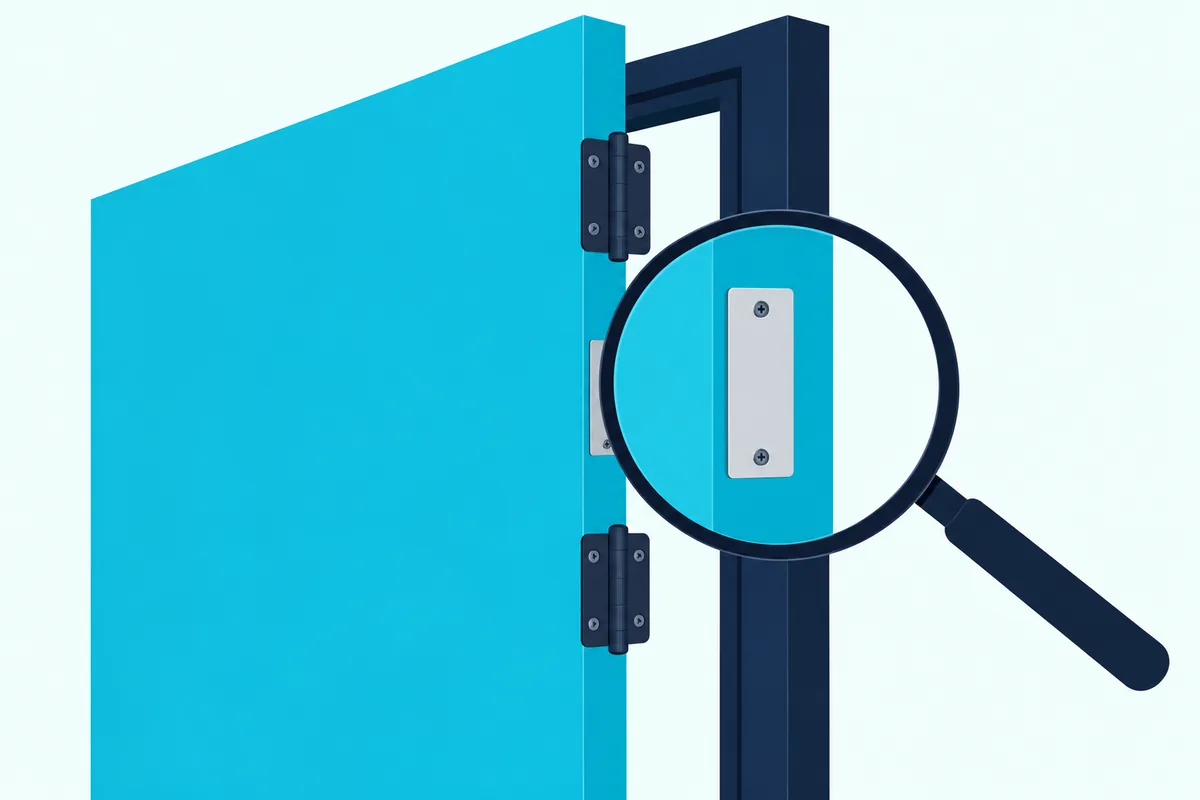
The label’s role, NFPA says, is proof that the door was tested and listed, and it carries the maker’s name, the certifier’s mark, the rating, the test standard and the temperature rise, none of them a sound figure (NFPA).
ASTM adds that a lab sound rating is an upper limit for a real building, which has other sound paths (ASTM).
Get Studio Tips Weekly
Join 5,000+ creators getting acoustic treatment advice every week.
No spam. Unsubscribe anytime.Do Fire Doors Block More Sound Than Regular Doors?
Separate tests don’t make a fire door useless against noise, because its core is built to survive a furnace. Compared with a hollow door, yes, and the construction explains that 29 to 37: JELD-WEN builds its 20-minute doors on a solid particleboard core and its 45-, 60- and 90-minute flush doors on a solid mineral core (JELD-WEN).
National Guard Products, a seal maker, puts gasketed solid-core wood doors at about STC 28 to 30, and gasketed mineral-core wood and honeycomb-core hollow metal doors at about 32 to 36 (NGP).
Steel doesn’t guarantee a quiet door either, since the Steel Door Institute says many commercial steel doors rate in the 25 to 35 range.
HUD’s noise guidebook shows what that difference does to a wall: a hollow-core door at STC 17 pulls a 48 STC wall down to 24, while a solid-core door with vinyl edge seals leaves it at 33 (HUD).
If your door turns out to be hollow, how to soundproof a hollow-core door covers its cheaper fixes.
Why Do Fire Doors Still Let Noise Through?
That core only helps if sound can’t simply go around it. The gaps are the leak: NFPA 80 allows 1/8 in at the top and sides of a swinging fire door and up to 3/4 in underneath it, according to the Fire Protection Research Foundation.
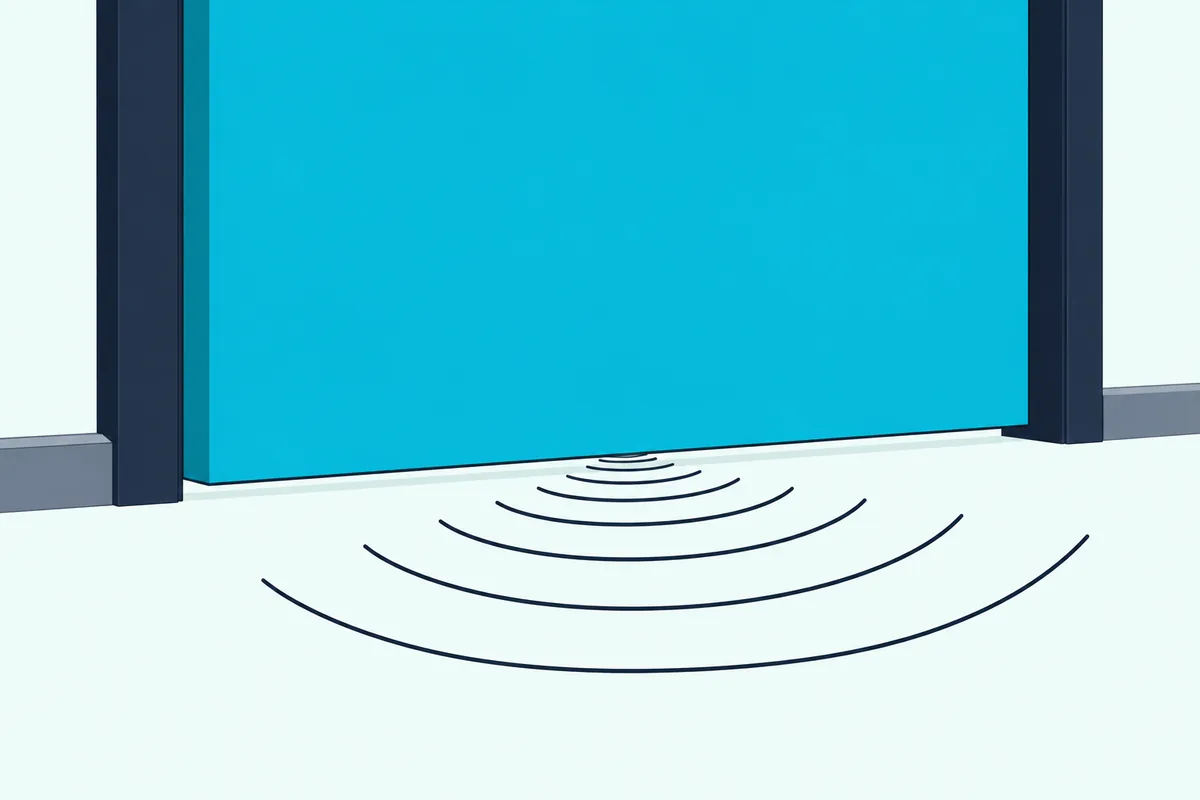
The fire test standards themselves allow only 3/8 in under a single door, that report adds.
A 3/4 in gap under a 36 in door is 27 square inches of open air, and NGP says doors without gasketing have no sound control, rating only STC 15 to 20.
The intumescent strips many fire doors carry don’t solve this, because the UK government’s fire safety guidance describes them as expanding to seal the gaps when exposed to fire (GOV.UK).
The smoke seals beside them look like ordinary draft seals, the guidance says, and it puts the industry limit for edge gaps at 4 mm.
NGP adds that US wood fire doors need edge sealing systems, built in during manufacturing or added later, to pass the positive-pressure fire test.
Try a light test tonight: switch the hall light on, close the door and look for light along the edges and under the slab from the dark side.
How Can You Soundproof a Fire Door Safely?
Those gaps are what you can work on, as long as the door’s fire listing survives. You soundproof a fire door by getting it to close and latch, then sealing it with parts listed for fire doors, while leaving the slab itself alone.
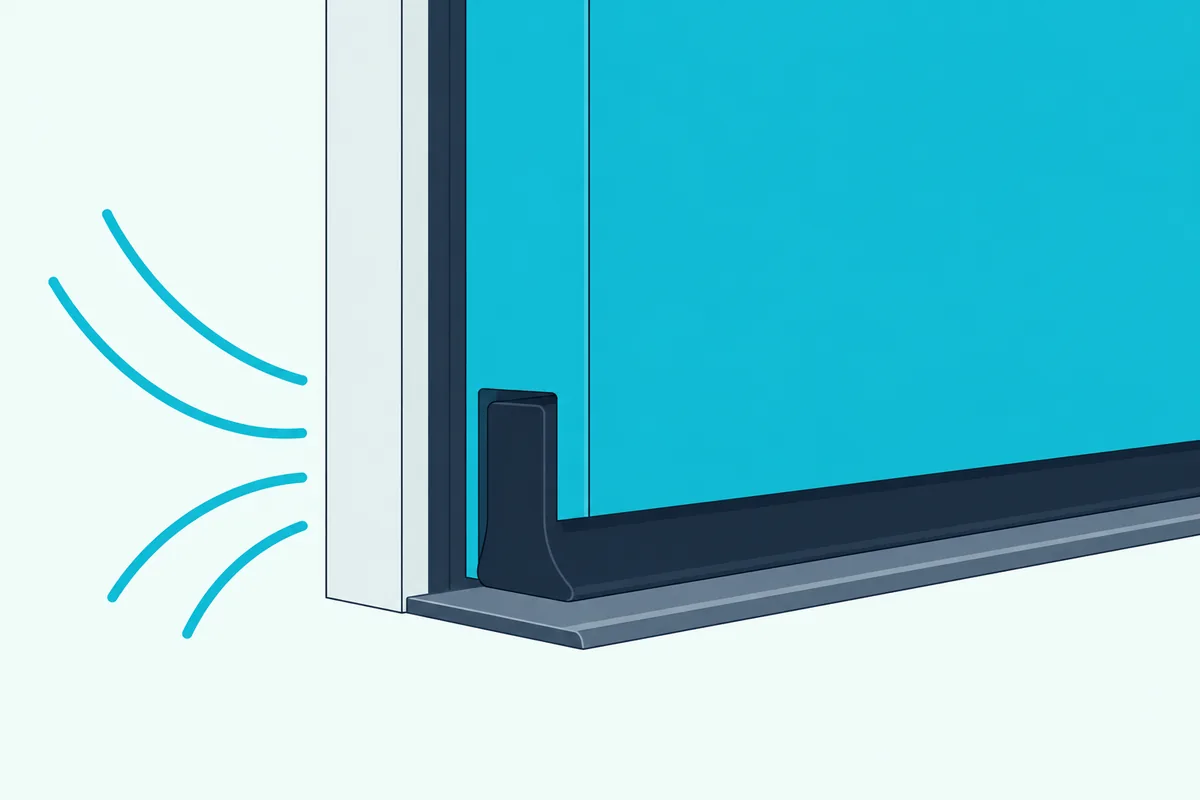
| Step | What you do | Why |
|---|---|---|
| 1. Ask first | Read the label on the hinge edge, then ask the landlord or building manager | UK guidance says changes to a flat’s front door need the responsible person’s agreement |
| 2. Close and latch | Open the door to about 15 degrees, let go and check it closes into the frame | NFPA says fire doors must always open, close and latch |
| 3. Seal the head and jambs | Fit gasketing listed for fire doors on the frame stop | NGP lists its fire-rated seals for steel doors up to 3 hours and wood doors up to 90 minutes, some ratings varying, and SDI calls seal installation critical |
| 4. Seal the bottom | Use a door bottom or threshold listed for fire doors over a hard floor | NFPA 80 wants thresholds noncombustible or listed, and SDI says bottom gaskets must press against a solid surface, not carpet |
NGP’s catalog also notes that smoke and draft control doors carry an S on the label, which holds only when listed or labeled gasketing is installed too (NGP).
For the frame, Pemko’s S88 SiliconSeal gasketing is a 1/2 in by 1/4 in silicone strip whose listing says Pemko gasketing is tested for sound, smoke and draft control, fire rating and positive pressure.
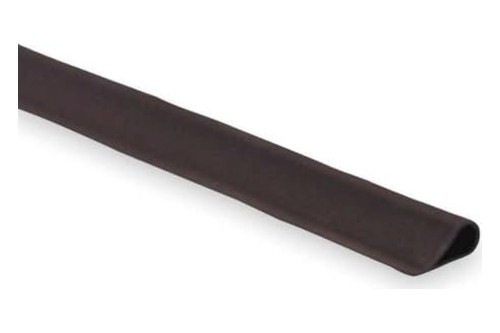
Pemko’s S88 SiliconSeal gasketing
Leave the slab alone, because the 2016 edition of NFPA 80 limits the holes it allows on site to 1 in across, lock cylinders aside, unless the door and hardware listings permit more (Intertek).
NFPA even limits a combustible sign to 5% of the door’s face, so added materials such as foam, vinyl sheets or blankets are a question for the building owner, not a weekend fix.
Can You Buy a Soundproof Fire Door?
Sealing an ordinary door tops out around NGP’s 32 to 36, and past that you need a door tested for both jobs. You can buy one as a tested assembly: Upstate Door says Intertek rated its “sealed-in-place” 90-minute fire door and jamb at STC 39 and OITC 36 (Upstate Door).
JELD-WEN lists its TRIA C Series 45-minute door with Seal Set D at STC 36 and its L Series 90-minute door with Seal Set E at 37.
The Steel Door Institute says single acoustic steel doors come in STC 32 to 54 and pairs up to 40 to 48, and that seal and threshold quality can move a rating by 1 to 5 points (SDI).
UK makers rate in Rw instead: Forza lists its FD30 acoustic doors at 32 to 35 dB and its FD60 ones at 35 to 44 dB, fitted with a drop-down seal (Forza).
For a room that doesn’t need a fire rating, our guide to the best soundproof doors compares solid-core models.
Is Your Apartment Door a Fire Door?
Those tested doors suit new openings, so the harder case is a door you can’t replace, between a flat and its hallway. In an English block of flats it usually is, since the government’s guidance lists flat entrance doors among the fire doors there, saying they prevent the spread of fire and smoke into the common parts, and in the US, NFPA says the rating a door needs depends on the wall it sits in.
Georgetown University’s safety office says to look for a metal identification tag on the hinge edge, and that door closers, panic hardware and keep-closed signs are other clues (Georgetown).
In England, Approved Document E asks that doors between corridors and flats have good perimeter sealing and a mass of at least 25 kg per square meter or a rating of 29 dB Rw (GOV.UK).
That’s a modest target built on sealing, so report a door that no longer closes onto its seals before blaming the slab for a neighbor’s TV.
Doors inside the flat that carry no fire label are ordinary doors, so you can soundproof an ordinary door there with any sweep or seal.
The Bottom Line
A fire door blocks about as much sound as a solid-core door, STC 29 to 37 in JELD-WEN’s ratings, because the fire rating was never a sound test.
Seal the gaps with parts listed for fire doors, keep the closer and label working, and buy a tested acoustic fire door if you need more.
Frequently Asked Questions
Can you soundproof a fire door?
Yes, within its listing. Get it to close and latch, then seal the frame and bottom with gasketing and door bottoms listed for fire doors, and ask the building owner first.
Are fire doors quieter than normal doors?
Than hollow doors, yes. JELD-WEN rates its fire-rated doors at STC 29 to 37 against 24 to 27 for hollow-core doors, but about the same as its solid-core ones.
Can you hear through a fire door?
Usually, yes. At STC 29 to 34 loud speech still comes through, and NGP says a door without gasketing rates only STC 15 to 20.
What are the disadvantages of a fire door for noise?
The gaps and the rules. NFPA 80 allows up to 3/4 in under the door, and you can’t drill, cover or rebuild a labeled door as freely as an ordinary one.
Do intumescent strips block sound?
They seal the gaps in a fire, not day to day. The UK guidance says they expand when exposed to fire, so the smoke seal or a listed gasket does the daily sealing.
Are steel fire doors soundproof?
No. The Steel Door Institute says many commercial steel doors rate STC 25 to 35, while acoustic steel door openings come in 32 to 54 with the right seals.
Are fire-rated doors sound rated?
Only when the maker tests them for sound as well. The fire label shows minutes, so look for an STC or Rw figure on the maker’s data sheet.