Best Small Soundbar: 7 Compact Bars Compared by Size
Picking the best small soundbar starts with a tape measure, because a bar that runs wider than your screen or taller than the gap beneath it looks wrong and can cover the bottom of the picture.
Shrinking a bar means trade-offs, and the seven here show them: one has no Bluetooth in its maker’s list, two lean on a separate subwoofer, and only four have Atmos on their makers’ pages.
Match the bar to your screen, your shelf and your TV’s ports, and you can still get a dialogue mode, Bluetooth music or even Atmos from a compact box.
This guide compares seven compact soundbars using only what their makers publish: width, height, drivers, connections and features.
The picks come first, then how to measure your space, when a subwoofer earns its floor space and which HDMI or optical port each bar needs.
What Is the Best Small Soundbar?
That depends on your screen and its ports, but the Sonos Beam (Gen 2) is the best small soundbar on paper for most setups. Sonos lists it at 25.63 inches wide and 2.68 tall, with five amplifiers, a center tweeter, four elliptical midwoofers and three passive radiators, and it connects through HDMI eARC with Dolby Atmos support (Sonos).
The other six each fit a narrower setup:
| Pick | Width, per the maker | Drivers, per the maker | Connection | Best for |
|---|---|---|---|---|
| Sonos Beam (Gen 2) | 25.63 in | 1 tweeter, 4 midwoofers, 3 passive radiators | HDMI eARC, optical adapter included | Most setups |
| Polk MagniFi Mini AX | 14.4 in, plus a subwoofer | 2 tweeters, 3 mids; 5 x 7 in woofer in the sub | HDMI eARC, optical, 3.5 mm | The narrowest space |
| Bose Smart Soundbar | 27.34 in | 5 speakers and a center tweeter, with upward-firing transducers | HDMI, optical | Atmos and voice control |
| Denon Home Sound Bar 550 | 25.95 in | 2 tweeters, 4 full-range drivers, 3 passive radiators | HDMI eARC plus an HDMI input, optical, 3.5 mm | Adding an HDMI source |
| Bose TV Speaker (2nd Gen) | 23.47 in | Angled left and right speakers, center tweeter | HDMI ARC, optical | Clear speech |
| Yamaha SR-C30A | 23-5/8 in, plus a subwoofer | 2 x 1.8 in cones; 5-1/8 in driver in the sub | HDMI ARC, 2 optical, analog | Bass for an older set |
| Amazon Fire TV Soundbar | 24 in | 2 speakers | HDMI eARC or ARC | Fire TV homes |
Each pick had at least 4.0 stars and 50 reviews on Amazon and was in stock on 14 October 2026, and no prices appear because they change often.
Width is the number to check against your set first, and our breakdown of how much soundbar size matters runs the same math for bigger screens.
| Product | Size | Link |
|---|---|---|
Best Overall 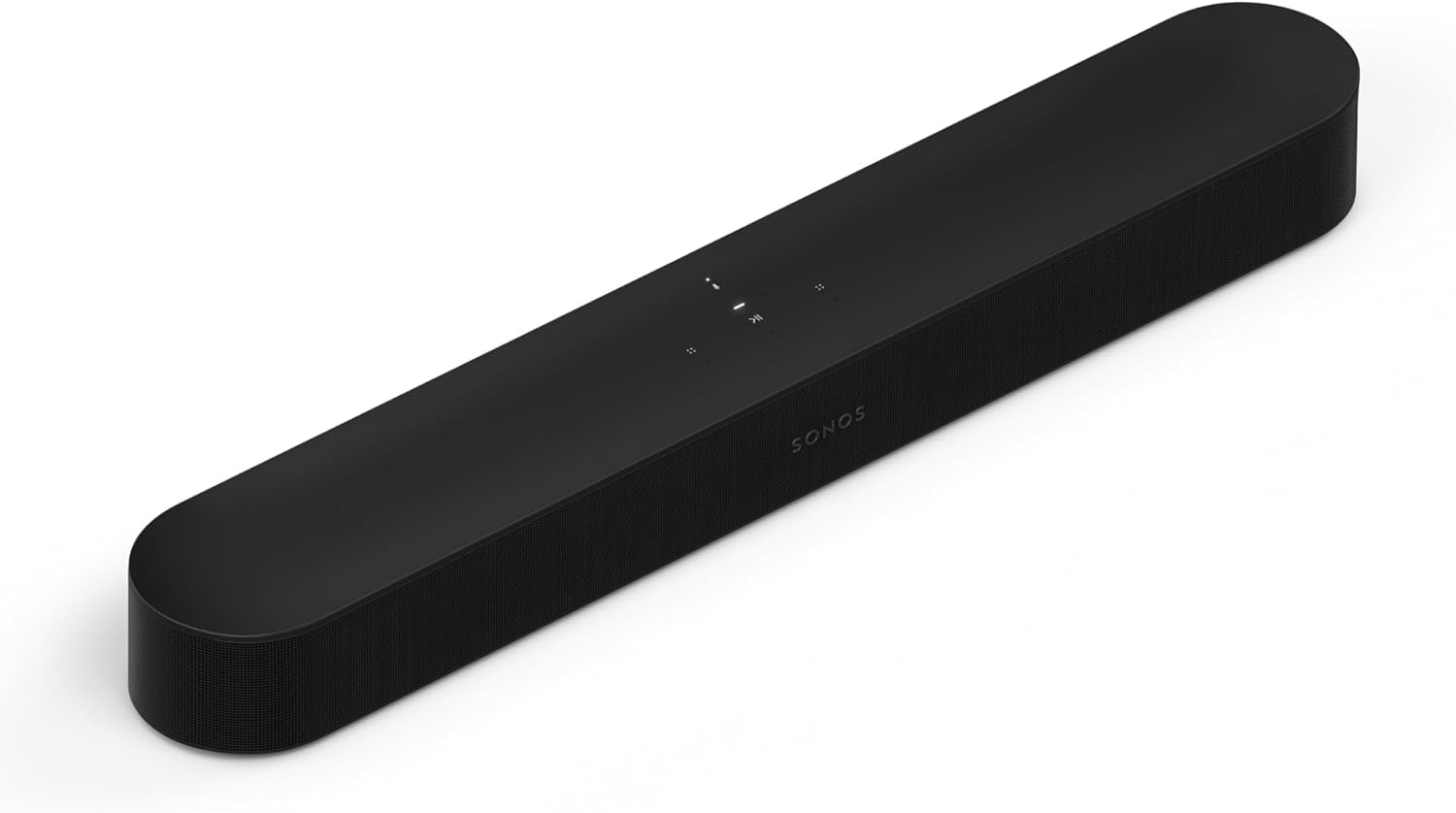 | 25.63 inch | See ratings |
Best for Tight Spaces 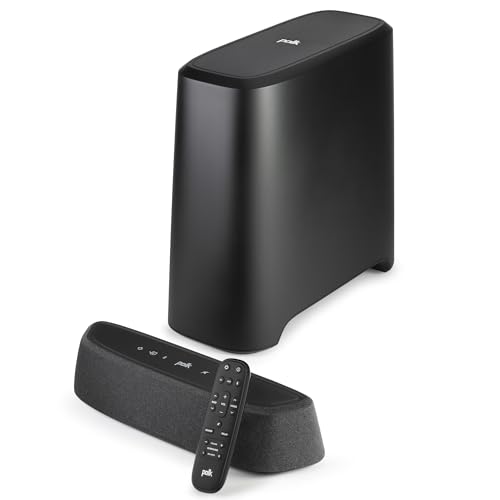 | 14.4 inch | See ratings |
Best for Atmos and Voice Control 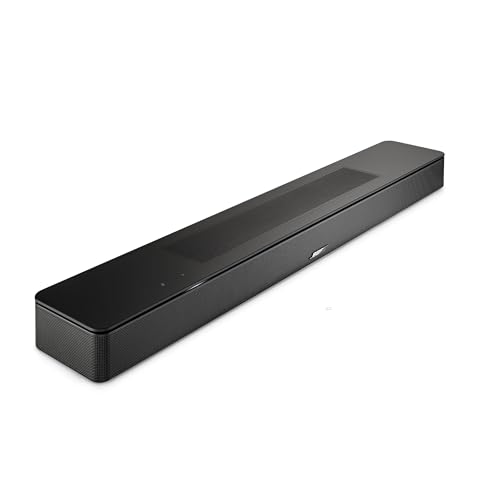 | 27.34 inch | See ratings |
Best With an HDMI Input 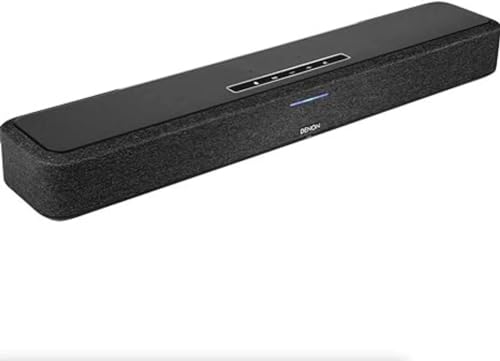 | 25.95 inch | See ratings |
Best for Dialogue 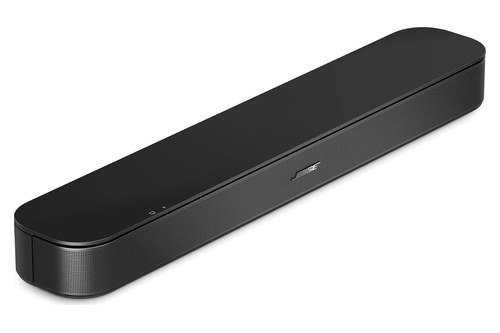 | 23.47 inch | See ratings |
Best for Older TVs 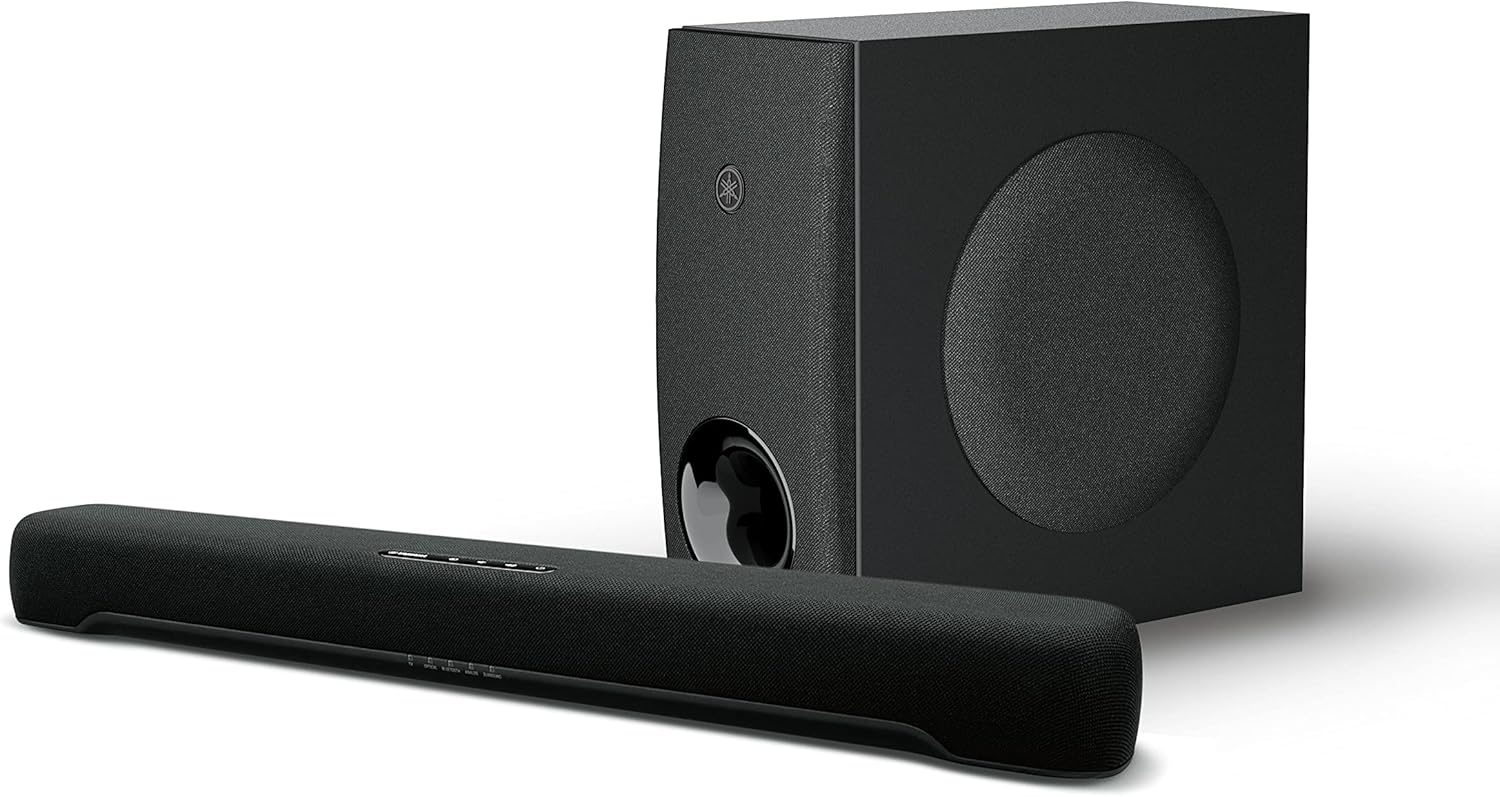 | 8 inch | See ratings |
Best for Fire TV 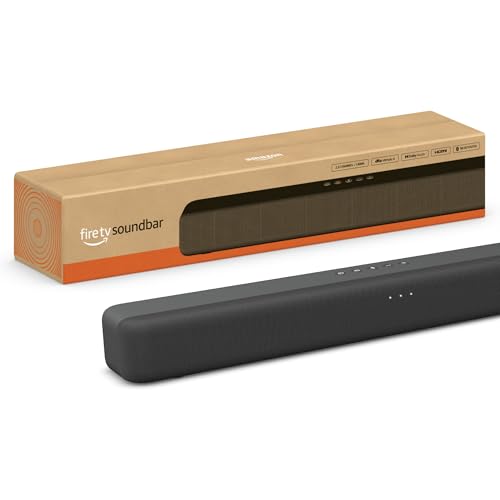 | 24 inch | See ratings |
Which Compact Soundbar Should You Buy?
Those seven split by what your setup needs: the Sonos for most rooms, the Polk for the narrowest space, the Bose Smart Soundbar or the Denon for Atmos with extras, Bose’s 2nd Gen speaker for speech, the Yamaha for bass and the Amazon bar for Fire TV households. Every card lists only what the maker publishes, and two of them flag a spec the maker leaves out.
Sonos Beam (Gen 2)
For most small and midsize screens, the Sonos Beam (Gen 2) is the pick.
the Sonos Beam (Gen 2)
Sonos says its processing creates phantom height channels for Atmos, and it marks Dolby TrueHD and Atmos through TrueHD as needing an HDMI eARC connection. A set with only an optical output still works through the Sonos Optical Audio Adapter in the box.
For music, Sonos lists Wi-Fi, AirPlay 2 and an Ethernet port rather than Bluetooth, and its far-field microphones work with Sonos Voice Control, Amazon Alexa and Google Assistant. The 6.35-pound bar has a threaded socket for a wall mount.
Polk MagniFi Mini AX
For the narrowest space, the Polk MagniFi Mini AX puts a 14.4-inch bar under the screen and moves the bass into a wireless subwoofer.
the Polk MagniFi Mini AX
Polk lists two 19 mm tweeters and three 51 mm mids in the bar, and a 127 x 178 mm woofer in a subwoofer that can sit up to nine meters away. It decodes Dolby Atmos and DTS:X and connects through HDMI eARC, optical or a 3.5 mm analog input (Polk).
Music streams over Wi-Fi with Chromecast, AirPlay 2 and Spotify Connect, or over Bluetooth 5.0. The cost is floor space, since Polk lists the subwoofer at 7.2 inches wide, 15.6 deep and 14.6 tall.
Bose Smart Soundbar
For Atmos and a built-in voice assistant, the Bose Smart Soundbar fits five speakers into a bar 27.34 inches wide.
the Bose Smart Soundbar
Bose lists a center tweeter and upward-firing transducers for Atmos, with Dolby Atmos decoding and its TrueSpace processing for programs that aren’t Atmos-encoded. Its dialogue mode uses AI to sense speech and balance it against surround effects, and you can switch it off in the Bose app (Bose).
Alexa is built in, and music streams over Wi-Fi, Bluetooth 5.0, AirPlay 2, Chromecast built-in or Spotify Connect. Bose sells an optional wireless bass module and surround speakers if you want to grow the system later.
Denon Home Sound Bar 550
For a set that’s short on HDMI ports, the Denon Home Sound Bar 550 gives you one more.
the Denon Home Sound Bar 550
Denon lists a 4K HDMI input with pass-through beside the eARC output, so a streaming stick or console can plug into the bar instead of the television. Inside the 25.95-inch body are two 19 mm tweeters, four 55 mm full-range drivers and three passive radiators on a 4-channel amplifier, with Dolby Atmos and DTS:X decoding.
Optical, a 3.5 mm AUX input, USB and a wired network port round out the connections, and Wi-Fi, Bluetooth, AirPlay 2 and built-in HEOS handle music. A wall-mount template comes in the box.
Bose TV Speaker (2nd Gen)
For clearer speech with one cable, the Bose TV Speaker (2nd Gen) keeps things simple.
the Bose TV Speaker (2nd Gen)
Bose angles the left and right speakers for a wider soundstage and gives the center tweeter to speech, with a Dialogue Mode that separates voices from background sound. The HDMI cable is in the box, ARC and CEC let your existing remote run the volume, and optical works with a cable you buy separately.
Bose calls it the successor to its original model and says it works best centered under the screen on a flat, level surface, not mounted above it. Bluetooth covers music from a phone, and Bose says this model has no voice assistant.
Yamaha SR-C30A
For more bass from an older set, the Yamaha SR-C30A pairs a 23-5/8-inch bar with a wireless subwoofer.
the Yamaha SR-C30A
Yamaha lists two 1.8-inch cones in the bar and a 5-1/8-inch driver in the subwoofer, with 90 watts in all: 20 per side and 50 for the sub. HDMI ARC, two optical inputs and an analog input give an older set more ways in, and no other pick here lists two optical inputs (Yamaha).
It decodes Dolby Digital and offers Dolby Audio surround modes, including 3D Movie, but Yamaha lists no DTS decoding and no Wi-Fi. Bluetooth 5.0 handles music, with SBC and AAC support.
Amazon Fire TV Soundbar
For a home built around Fire TV, the Amazon Fire TV Soundbar keeps to one box and one cable.
the Amazon Fire TV Soundbar
Amazon lists dual speakers, DTS Virtual:X for virtual surround and Dolby Audio in a bar 24 inches long and 2.5 tall. The included HDMI cable goes into the eARC or ARC port on your set, and Bluetooth streams music from a phone or tablet.
Amazon says it’s designed and tested to work with Fire TV, so one remote runs the picture and the sound, and that it also works with other smart televisions and with sets fed by streaming players. Its listing doesn’t mention an optical input, so check for HDMI ARC on your set first.
Get Studio Tips Weekly
Join 5,000+ creators getting acoustic treatment advice every week.
No spam. Unsubscribe anytime.How Small Is a Small Soundbar?
Those seven run from 14.4 to 27.34 inches wide, and that range only means something next to your screen. No standard defines a small soundbar, but every pick here is narrower than a 32-inch screen, which works out to about 27.9 inches across.

The math is simple: a 16:9 screen is about 0.87 times its diagonal in width. The table runs it for three common sizes.
| Screen size | Screen width, about | Picks narrower than the screen |
|---|---|---|
| 24 in | 20.9 in | Polk MagniFi Mini AX only |
| 32 in | 27.9 in | All seven |
| 43 in | 37.5 in | All seven |
The smallest set is where the list thins out, since only the Polk’s bar sits inside its width. Bose’s 2nd Gen speaker, at 23.47 inches, would overhang a 24-inch screen by about 1.3 on each side.
Measure the frame as well as the screen, because the frame adds width. A bar narrower than the frame reads as part of the set, while a wider one looks like an afterthought.
Will a Small Soundbar Block the Screen?
Width is only half of that fit, because height decides whether the bar sits below the picture or in front of it. It won’t block anything if it’s shorter than the gap between your stand and the bottom of the screen, and the picks here run from 2.21 inches tall (the Bose Smart Soundbar) to 3.1 (the Polk).
Try this with a ruler: stand it on the front edge of your stand and read where the screen’s bottom edge crosses it. A reading over 3.1 clears every bar on this list, and one under 2.5 leaves only the two Bose bars, at 2.21 and 2.24.
Depth matters on a shallow shelf too: the Yamaha bar is 3-3/4 inches deep, the Sonos 3.94, the Polk bar and the two Bose bars 4.1 to 4.2, and the Denon 4.72. Amazon’s listing gives no depth for its bar.
Bose’s placement advice for its 2nd Gen speaker is a sensible default for any of them: centered under the screen, near the front edge of the stand. Wall mounting is the other route, and the FAQ below lists which makers provide for it.
Do Small Soundbars Need a Subwoofer?
The Polk, the tallest bar here, is also the clearest example of where small soundbars put their bass. Not every one needs a subwoofer: five of these seven keep everything in one box, while Polk and Yamaha move the low end into a separate wireless sub.
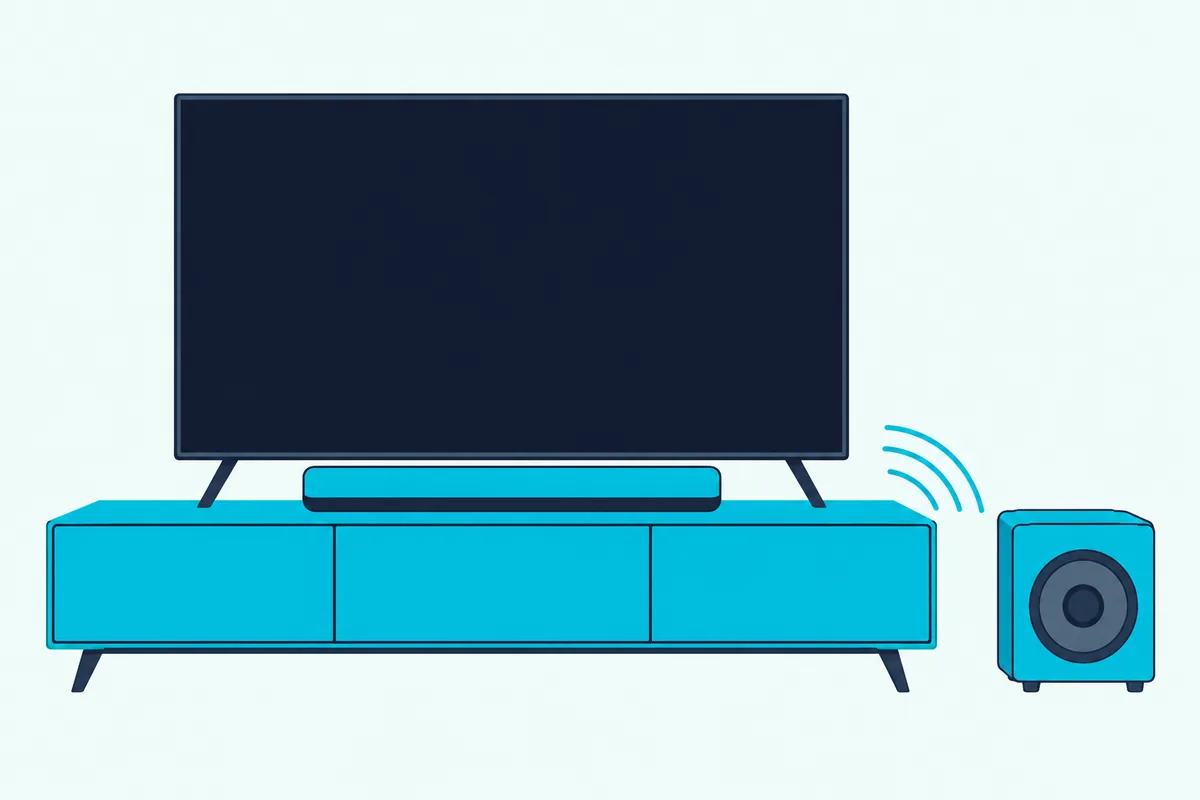
Two of the one-box bars list passive radiators, which Sonos says enhance low frequencies: the Sonos and the Denon have three each. The Polk’s sub carries a 127 x 178 mm woofer and the Yamaha’s a 5-1/8-inch driver, both far larger than the drivers in their bars.
The cost is floor space, and a spot for the sub near an outlet. Yamaha lists its subwoofer at 13-1/4 by 6-1/4 by 14-3/8 inches, and Polk’s stands 14.6 tall.
Three of the one-box picks can add a subwoofer later: Sonos and Bose sell wireless ones for the Beam and the Smart Soundbar, and Denon makes a matching Denon Home Subwoofer. If you’re still deciding whether you need a subwoofer at all, start with one box and add the sub only if the bass feels thin.
Can a Small Soundbar Play Dolby Atmos?
Bass is one trade-off of a small box, and height effects are the other. Four of these seven can: Sonos, Polk, Bose and Denon each list Dolby Atmos for the Beam (Gen 2), the MagniFi Mini AX, the Smart Soundbar and the Home Sound Bar 550.
They get there differently: Bose uses upward-firing transducers, while Sonos says its processing creates phantom height channels. Polk and Denon also decode DTS:X, which Polk describes as immersive audio that places sound where it would naturally occur.
The connection decides how much of it reaches the bar. The HDMI Licensing Administrator says eARC carries uncompressed 5.1 and 7.1 audio and formats including Dolby TrueHD, Dolby Atmos and DTS:X over one cable (HDMI LA), and Sonos lists TrueHD and Atmos through TrueHD as needing eARC.
The other three stop short on their makers’ pages: Amazon lists DTS Virtual:X for its bar and Yamaha a 3D Movie surround mode. Bose’s page names no Atmos or surround format for its 2nd Gen speaker, though the Amazon listing’s title includes Dolby Atmos, so treat that as unconfirmed.
Which Ports Does Your TV Need?
That eARC requirement is the clearest case of a port deciding what you hear. An HDMI port labeled ARC or eARC is the one to find first: six of these bars name it, and Bose packs an HDMI cable with the seventh, the Smart Soundbar.
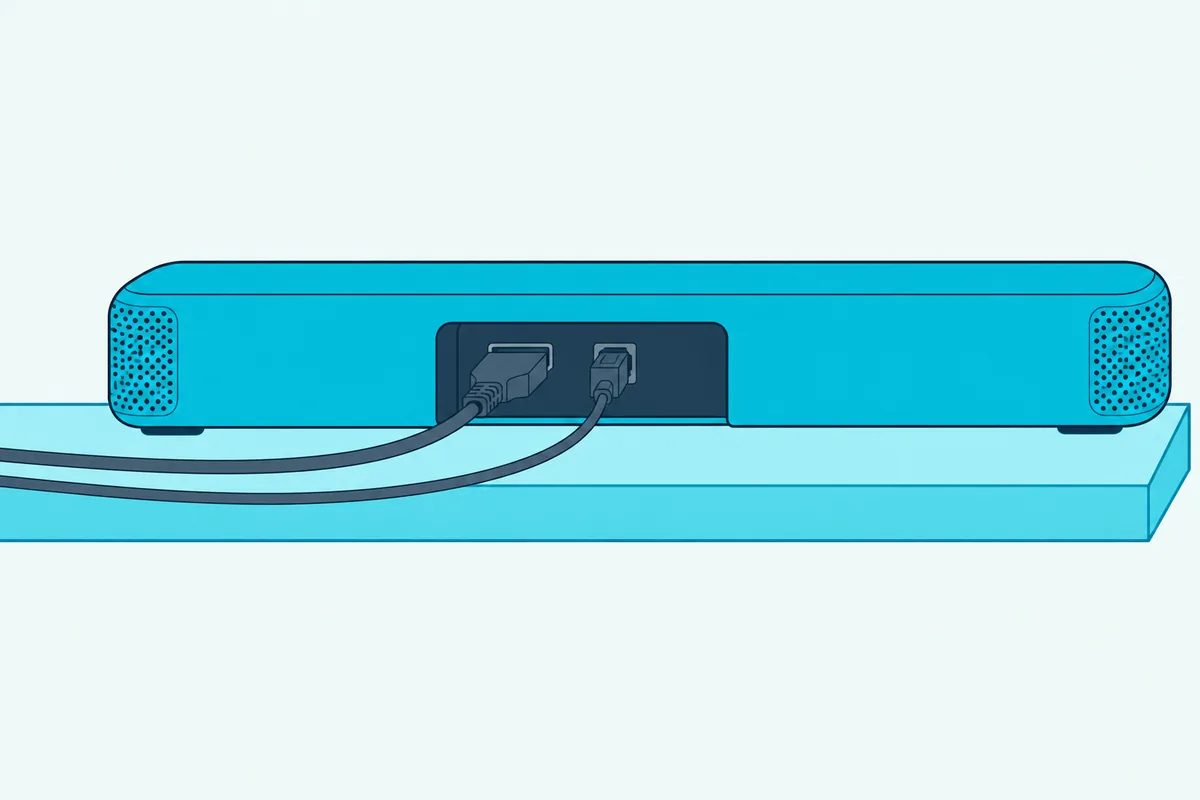
Bose adds that HDMI-CEC lets your existing remote run its 2nd Gen speaker’s volume and power. Optical is the fallback for older sets: the Polk, Denon, Yamaha and Bose’s 2nd Gen speaker list an optical input, Bose packs an optical cable with the Smart Soundbar, and Sonos includes an adapter for the Beam.
Analog is rarer: the Polk and Denon list a 3.5 mm input and the Yamaha an analog input. The Denon is the only pick with an HDMI input as well, which matters when a console or streaming stick needs a port your set doesn’t have free.
So check the back of your set before you check the bar. Burton Acoustix’s HDMI and optical comparison explains what each cable carries if your set offers both.
Are Small Soundbars Good for Small Rooms?
The room is the last part of that fit, and small soundbars suit small rooms well. Bose puts a number on it, suggesting a room of about 10 by 12 feet for the Bose Smart Soundbar.
The Sonos also adjusts to the room. Its Trueplay uses the microphones in an iOS device to measure the room and tune the bar, and its Night Sound setting lowers loud effects and lifts quiet sounds for late viewing.
In a bedroom or a small apartment, the one-box bars from the subwoofer section are the simpler fit, since nothing sits on the floor. If you’re choosing for the room rather than the screen, our soundbar picks for small rooms start from the space instead.
Can You Use a Small Soundbar With a PC?
A desk is the smallest room of all, and a compact bar can work there too. It needs a connection your computer has: the Polk and Denon list a 3.5 mm input, the Yamaha an analog input, and six of the seven list Bluetooth.
Picture the width on a desk: the screen of a 27-inch widescreen monitor is about as wide as Bose’s 2nd Gen speaker. The Polk’s bar is the only pick much narrower than that screen.
Most of these bars are built around a television’s HDMI port, so Bluetooth or the analog input is the simpler route on a desk. Our walkthrough covers the PC side of the setup, including why HDMI often stays silent between a computer and a soundbar.
What Didn’t Make the List?
Those desk options round out the picks, while a few well-known compact bars missed the cut on stock, reviews or detail. Sonos’s own site still sells the Ray, but Amazon’s listing showed no price, seller or stock on 14 October, and Yamaha’s SR-C20A was listed as currently unavailable.
Bose’s original TV Speaker is still listed, but Bose calls the 2nd Gen its successor, so the newer model gets the slot. Creative’s Stage SE, an under-monitor bar with USB and Bluetooth only, had too few reviews to qualify.
The Samsung S60D, Roku Streambar SE, JBL Bar 2.0 All-in-One MK2 and Zvox AV120 stay out because their makers’ spec pages couldn’t be read for this comparison. A pick has to be checkable against its maker, or the card would be guessing.
How Should You Check a Bar Before You Buy?
Those exclusions came down to fit, stock and missing detail, and your own checks come down to the same things. Four take a few minutes each:
- Measure the set’s frame and the gap under its screen, and compare both with the bar’s width and height.
- Find the HDMI ARC or eARC port, or the optical output on an older set.
- Decide between one box and a subwoofer, and where the sub would sit.
- List the features you’ll use: Atmos, Bluetooth, Wi-Fi or a voice assistant.
Keep the box until the bar has run a full movie and an evening of shows in your room.
The Bottom Line
So buy the Sonos Beam (Gen 2) for most small and midsize screens, or the Polk MagniFi Mini AX when the space under the screen is narrower than 23 inches.
Choose the Bose Smart Soundbar or the Denon for Atmos with extras, Bose’s 2nd Gen speaker for speech, the Yamaha for bass from an older set, and the Amazon bar for Fire TV.
Frequently Asked Questions
What is the best all-in-one compact soundbar?
On paper, the Sonos Beam (Gen 2): it keeps everything in a 25.63-inch bar with Dolby Atmos over HDMI eARC, Wi-Fi and AirPlay 2. “All-in-one” means no separate subwoofer, which rules out the Polk and the Yamaha here. The Bose Smart Soundbar is the pick if you want upward-firing speakers and Alexa built in, and the Denon if you need an HDMI input.
What size soundbar is best for a 24-inch TV?
Look for a bar under about 21 inches, since a 24-inch 16:9 screen is about 20.9 wide. Of these seven, only the Polk MagniFi Mini AX’s bar fits inside that width. The bars from Bose, Yamaha and Amazon, at 23.47 to 24 inches, overhang it by 1.3 to 1.5 a side, which can still look tidy on a wider stand.
What is the best sounding small soundbar for the money?
Sound quality takes a listening test, and we haven’t run one, so this guide doesn’t rank these bars by sound. What the makers’ specs show is hardware: the Polk and Yamaha add subwoofers, the Sonos and Denon each list three passive radiators, and the Bose Smart Soundbar lists upward-firing speakers. Prices change too often to judge value here, so compare the features you’ll use.
Can a small soundbar be wall mounted?
Four of these seven have a maker-backed way. Sonos builds a threaded mounting socket into the Beam, Denon puts a wall-mount template in the box, and Bose sells a Soundbar Wall Bracket for its soundbars, though it recommends against mounting its 2nd Gen speaker above the screen. Polk, Yamaha and Amazon don’t cover wall mounting on the pages read for this guide, so check their manuals first.
Do small soundbars have Bluetooth?
Six of these seven list it: the Polk, both Bose bars, the Denon, the Yamaha and the Amazon bar. Sonos lists Wi-Fi, AirPlay 2 and an Ethernet port for the Beam instead, so it streams over your home network rather than from a phone’s Bluetooth.