What DJ Controller Does Skrillex Use? His Gear on Record
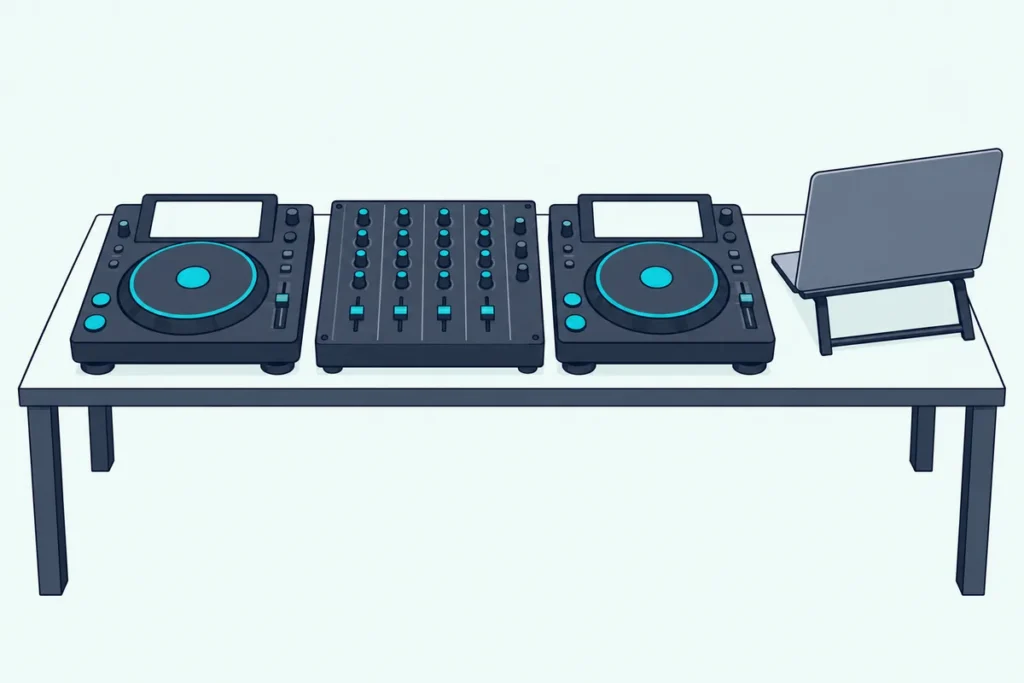
Pause the clip Skrillex posted from a Shanghai show in December 2019 and you’ll catch him standing on the CDJs, a hint that “what DJ controller does Skrillex use” has no tidy answer.
Gear lists online fill that gap anyway, pinning exact monitor and keyboard models on him that none of his interviews we found actually name.
The record is more useful, and it’s dated: Ableton Live in 2011, a MacBook Pro road studio in 2012, then Pioneer decks in the booth of his 2014 tour.
This guide matches each piece of gear to the year it was named and the outlet that printed it, so you can tell documented gear from guesswork.
It starts with the controller question, then works through his decks, software, synths and vocals before ending on what you can still buy.
What DJ Controller Does Skrillex Use?
That Shanghai clip sums up the record better than any gear list does. We found no interview, maker page or post where Skrillex names a DJ controller, and the DJ gear that is documented is club equipment: Pioneer CDJ-2000 decks and a Pioneer “900” mixer in Wired’s 2014 tour feature, then CDJs again in his own 2019 clip.
A controller and a pair of CDJs do different jobs, which is why the difference matters if you’re trying to copy him. A typical DJ controller is a control surface for software on a laptop, while the CDJ-2000 is a club player that, by Pioneer’s description, plays music from CDs, DVDs, USB storage and SD cards by itself.
If you’d rather learn on a controller anyway, our picks for the best DJ controller at each level and setup include models laid out like a club booth. None of them is on that list because of Skrillex, and none needs to be.
You’ll also see an M-Audio Trigger Finger tied to his 2011 shows, including in the title of a performance video that ranks for this question. We couldn’t find him saying so, an M-Audio page about it, or an outlet quoting him on it, so this page treats it as unconfirmed rather than repeating it.
The closest he came to describing his DJ setup was a 2012 Future Music interview, reprinted by MusicRadar in 2023. Asked whether his gear had changed since his Kill Everybody days, he said “Not really, no,” explained that he’d never had time to rethink it, and added that he “was never really a DJ” until touring pushed him into it.
Skrillex’s Gear on Record, Year by Year
Those two clues, the club decks and the “never really a DJ” line, sit inside a longer paper trail. Every row below comes from his own words in a named, dated outlet, a maker’s page, a magazine’s tour feature, or his own post as a news outlet described it.
| Year | Gear named | Who named it | Where it ran |
|---|---|---|---|
| 2011 | Ableton Live, Massive, FM8, Sylenth1, Tone2 Gladiator, Operator, iZotope Trash, Ohmicide, Melodyne, iZotope Maximizer | Skrillex | Computer Music Specials interview, on MusicRadar, 3 November 2011 |
| 2011 | Ableton Live, “his DAW of choice” | Ableton | Ableton’s blog, 10 November 2011 |
| 2012 | MacBook Pro, Ableton Live, two KRK monitors, Focusrite Saffire Pro 14, a two-octave Alesis controller, a guitar, a Shure SM58, Massive, Reaktor, FM8 | Skrillex | Future Music interview, reprinted on MusicRadar, 21 February 2023 |
| 2014 | Pioneer CDJ-2000 decks and a Pioneer “900” mixer in the Mothership booth | Wired’s tour feature | Wired, November 2014 issue |
| 2015 | Ableton Live, used on “Where Are Ü Now” | Ableton | Ableton’s blog, 26 August 2015, pointing to a New York Times video |
| 2019 | CDJs and a mixer in his Instagram story from Shanghai | His own post | YourEDM, 19 December 2019, with Pioneer DJ’s reply |
Nothing in that table comes from a gear database or a forum thread. The gaps tell you as much as the rows: no entry names a DJ controller, a headphone model, or the exact KRK and Alesis models he used.
Get Studio Tips Weekly
Join 5,000+ creators getting acoustic treatment advice every week.
No spam. Unsubscribe anytime.Which Decks and Mixer Has Skrillex Played On?
The 2014 row is the most specific DJ entry in that table. For the Mothership Tour 2014, Wired’s feature labeled the booth inside his spaceship stage: “In the DJ booth, Skrillex performs using Pioneer CDJ-2000 decks and a Pioneer 900 mixer.”
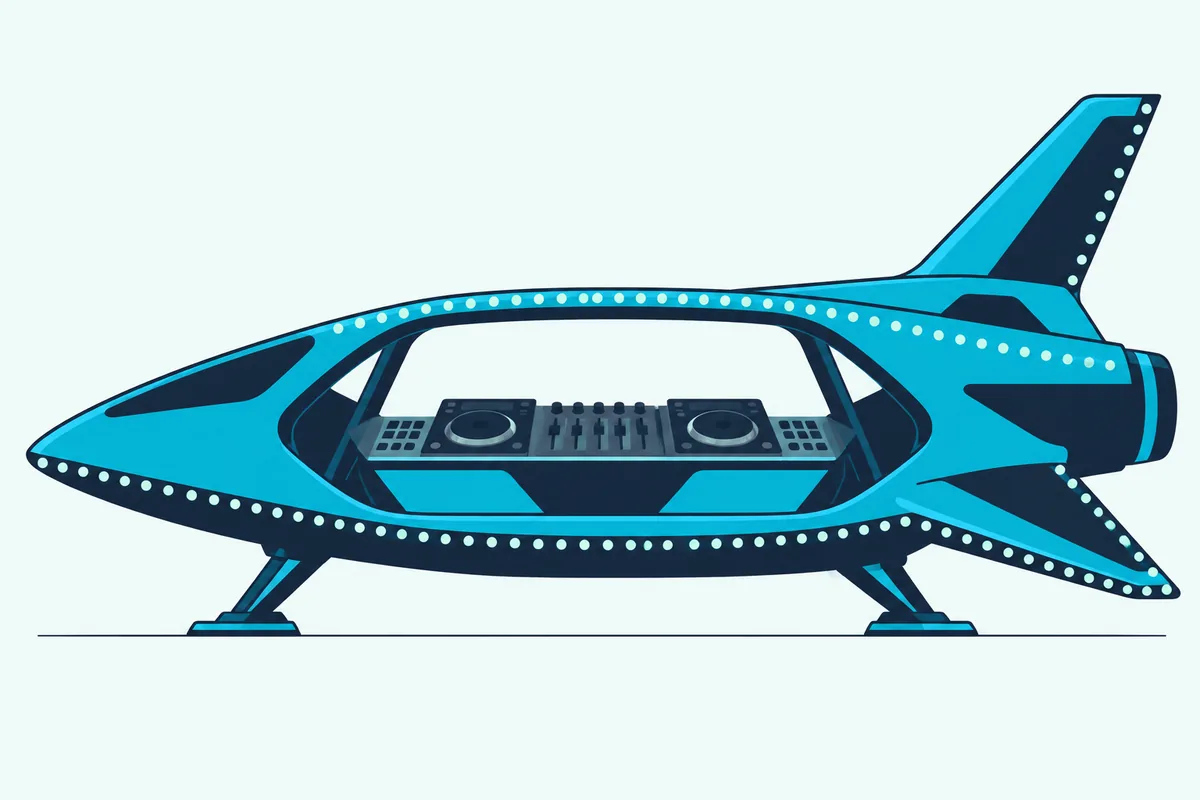
Wired opened that feature by calling stadium-filling EDM “a precision affair” built on painstaking studio production, then explained that he wanted his 2014 tour to be more flexible. He told the magazine the set changed nightly: “If I record something new on the road, I’ll incorporate it into the set that day.”
Wired says Pennsylvania stage company Tait Towers built the ship, and that the rig needed six trucks to move between venues. That’s a touring production built around club decks, a long way from a controller on a bedroom desk.
Pioneer’s own page calls the CDJ-2000 its “professional player for the digital age” and shows what those decks do on their own. It says the player reads music from CDs, DVDs, USB storage and SD cards, comes with its rekordbox library software, and lets up to four players share one USB or SD device over Pro DJ Link.
Pioneer also lists what it calls advanced HID and MIDI capabilities for running digital vinyl software over USB, so the same decks can steer software on a laptop. Wired doesn’t say which way he used them, so whether his tracks came off a USB drive or a computer isn’t on record.
Five years later, the Shanghai clip showed the same kind of booth. YourEDM reported on December 19, 2019 that the video, from his own Instagram story, showed him hopping up onto the decks and standing on the CDJs and mixer, and Pioneer DJ’s account replied, “Don’t try this at home (or in the club, really).”
That reply is the closest thing to a maker’s comment on his DJ gear that we found, and it names no model. The players in that Shanghai booth, and in his booths since, haven’t been listed anywhere we could read.
If the line between decks, a mixer and a controller is still fuzzy, Burton Acoustix’s guide to controllers versus club mixers walks through what each one connects to. The short version is that a CDJ booth splits playback and mixing into separate boxes, which a controller folds into one.
Does Skrillex DJ With rekordbox, Serato or Ableton?
That missing detail about the Shanghai booth is the same gap behind most searches for his DJ software. He hasn’t said which DJ program he uses: rekordbox, Serato and Traktor don’t appear in any interview of his we read, and the program he keeps naming is Ableton Live, which he talks about as the place he makes tracks.
Gear lists that answer “rekordbox” or “Serato Scratch Live” are filling that gap with a guess. Pioneer’s CDJ-2000 comes with rekordbox and reads USB drives prepared in it, so seeing CDJs in his booth still doesn’t settle which program, if any, he prepares tracks in.
What he did describe is how new songs reach his sets. In 2012 he said he was “always trying new tracks out live before they’re released,” and in 2014 he told Wired he’d fold anything recorded on the road into that day’s set.
Both habits lead back to the road studio covered further down, since that’s where he said those tracks were being made. If you want to compare the DJ programs themselves, here’s how rekordbox, Serato and Virtual DJ stack up on pricing tiers and the hardware each one supports.
Why Did Skrillex Choose Ableton Live?
That road laptop ran one program above all others. Skrillex settled on Ableton Live after working through Fruity Loops, Reason and Pro Tools, and in 2011 he told Computer Music Specials that “for laptop producers especially, it’s just so intuitive in the box.”
His reason was practical. In Live, he said, you don’t have to go searching for things like automation or plugin parameters, and he called it “very fluid and quick,” which fits a producer who gave that interview from a tour bus that doubled as his studio.
The route there started early. He told NPR in 2014 that between the ages of 15 and 16 he was making records on Fruity Loops and Reason for fun, and in 2012 he said he learned Pro Tools and “kinda hated it” before landing on Live, which he called “so incredibly intuitive.”
He also explained why he didn’t go back to Fruity Loops, the program now sold as FL Studio. He had moved to a Mac, and at the time that meant he couldn’t run it, though he said he’d “love to be able to jam with FL Studio.”
Ableton picked up on all this. Its own blog introduced him as a dubstep producer and called Live his “DAW of choice” in November 2011, and in August 2015 it pointed readers to a New York Times video showing how Live was used on “Where Are Ü Now,” the track he made with Diplo and Justin Bieber.
Live’s built-in FM synth, Operator, was part of the appeal. In 2011 he said he used it a lot and that its routing matrix differs from FM8’s, so the two give him different kinds of sounds.
By 2013 he was turning an 11,000-square-foot building in downtown Los Angeles into a base. Sonicstate’s May 2013 report said the studio was meant for “in-the-box producers” like himself, the laptop-first way of working he’d talked about two years earlier.
Which Synths and Plugins Built Skrillex’s Sound?
Operator was only one of the instruments he named in that 2011 interview. His two favorites were Native Instruments’ Massive and FM8, and he said his best “monster bass sounds” came from FM8, even though fans online kept trying to recreate them in Massive.
| Plugin | What he said about it | Year |
|---|---|---|
| FM8 (Native Instruments) | His best “monster bass sounds” came from it | 2011 |
| Massive (Native Instruments) | One of his two favorites; more “plug-and-play” than FM | 2011, 2012 |
| Reaktor (Native Instruments) | “Massive, Reaktor and FM8 are all amazing” | 2012 |
| Sylenth1, Tone2 Gladiator | Named alongside “some other granular soft synths” | 2011 |
| Operator (Ableton) | Used a lot; a different FM matrix from FM8 | 2011 |
| iZotope Trash | “A great plug-in for distortion” | 2011 |
| Ohmicide | Multiband distortion, compression, EQ and filter in one | 2011 |
| Melodyne | Formants and basic pitch; DNA for notes inside a chord | 2011, 2012 |
| iZotope Maximizer | The core of his mastering, with a little EQ | 2011 |
That list is short on purpose, by his account. He said he hadn’t strayed far from FM8 and Massive because he knew them so well he could “pretty much make any sound” he wanted with them.
The FM8 habit came by word of mouth. He said in 2012 that he tried FM8 because Noisia were using it, and that FM synthesis built from scratch was “so elemental and fun” next to Massive’s more plug-and-play wavetables.
Native Instruments still sells both as downloads, and its pages explain the split he described. NI says FM8 builds sounds from the interaction of operators, a modulator and a carrier at minimum, while Massive runs on wavetable oscillators and comes with 85 wavetables.
His mastering advice was refreshingly simple. He said mastering is “given too much credit,” and that his consisted of an iZotope Maximizer, “maybe with a little bit of EQ and harmonic excitement.”
He did share one mix trick with a number attached. Whatever drum sample you use, he said, make sure “it’s hitting at 200Hz,” so the hit dominates the whole spectrum for an instant and becomes the loudest element in the mix.
He called programming a joy, with two exceptions: project files left messy because he worked too fast, and a spiking CPU that forces you to “bounce all your MIDI to audio,” which he counted among the real evils. That second one is a fair warning for anyone stacking those synths on a laptop.
What Was in Skrillex’s Road Studio?
All of those plugins ran on a setup that traveled with him. In 2012 he listed it for Future Music as a MacBook Pro running Ableton Live, two little KRK monitors, a Focusrite Saffire Pro 14 interface, a two-octave Alesis controller and a guitar.
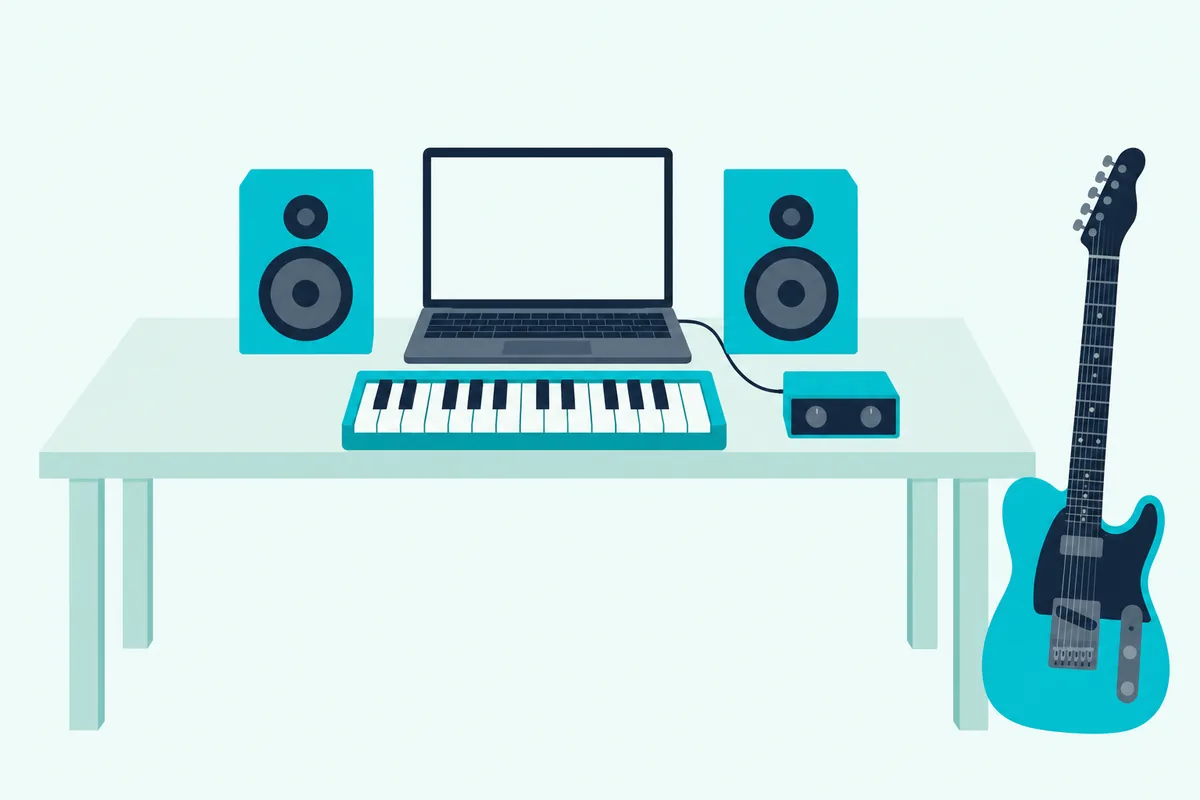
He barely touched the keyboard, by his own account. He said he never seemed to use the Alesis because he ended up drawing everything in with the mouse, then said later in the same interview that he skips the mouse for the trackpad, which “feels a bit like Minority Report.”
He didn’t give model numbers for the KRK speakers or the Alesis keyboard, and no maker page we found fills them in. The Saffire Pro 14 is the one interface he named, and his vocals went through it too, which the next section covers.
The setup was built for life in transit. He estimated he spent “a minimum of eight hours a day in transit,” and said he’d been home for about four days in the second half of the previous year.
Those KRKs took a beating as well. He said he finished the More Monsters and Sprites EP “with the right speaker blown,” and that he was “pretty happy” with the sound anyway.
On some tracks he said everything was audio by the end of the mixdown, while on others he had “live synths MIDI-triggering” his soft synths with automation running wild. That’s the same in-the-box approach the plugin table reflects, done on one laptop.
The rig’s weak point was that everything lived on it. When two of his laptops and several hard drives were stolen from his Milan hotel room in March 2011, he said he lost an unreleased album and “four years’ worth of all my other work.”
How Did Skrillex Record His Vocals?
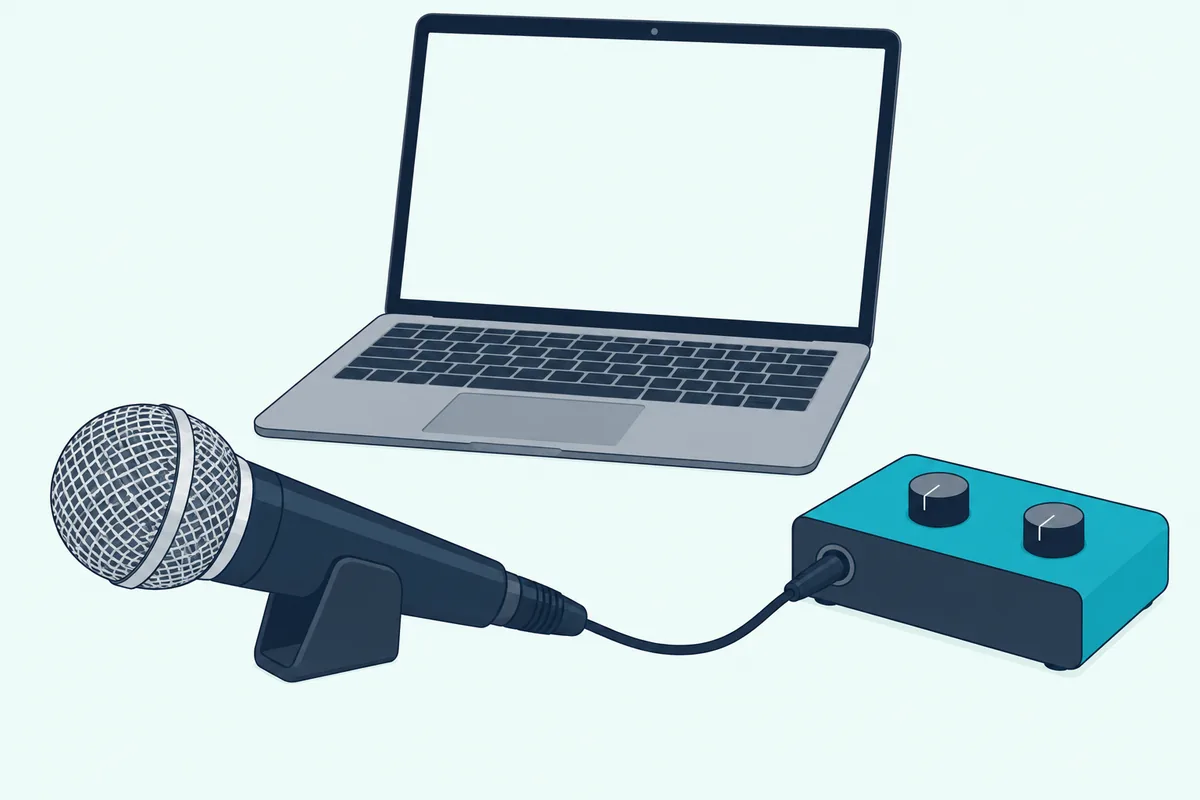
The Saffire interface from that road list also handled his voice. He recorded his own vocals with a Shure SM58 into the Saffire, then processed them with Melodyne and “a ton of other plug-ins to make it sound weird,” he said in 2012.
Vocoders mostly stayed out of it. “I don’t do much vocoding to be honest,” he said, though he’d run vocoders on guitar notes and mangled the formants, just not on his vocals.
Melodyne did the heavy lifting. In 2011 he said he used it for “formant stuff and basic pitch,” then sliced and transposed the audio in Live for the stylistic treatments, and he singled out Melodyne’s DNA for isolating “the individual sounds in a chord.”
Celemony’s own description matches what he was doing. Melodyne shows each note as a “blob” you can edit for pitch, timing and formants, even in polyphonic instruments like piano and guitar.
The edition matters if you want the chord trick. Celemony lists the DNA algorithm for polyphonic audio with Melodyne 5 editor, while its essential and assistant editions are aimed at vocals.
The SM58 is the part of that chain that’s easiest to copy exactly. It’s also the only product on this page, because it’s the only item he named with an Amazon listing that met our rating, review-count and stock rules on October 15, 2026.
For his vocal setup, the Shure SM58 is the exact model he named.
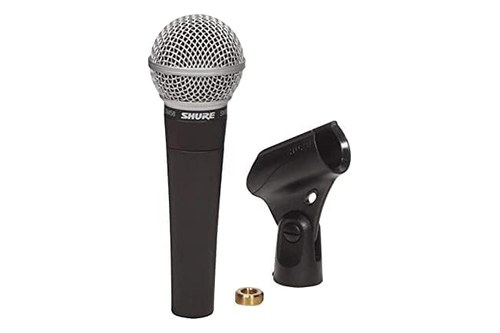
the Shure SM58
Shure describes it as a cardioid dynamic mic designed for professional vocal use, with a 50 to 15,000 Hz response and a pneumatic shock mount that cuts handling noise. The version linked here comes without a cable, so you’ll need an XLR lead to reach an interface like the Saffire he used.
Is Skrillex’s Current Setup Public?
That 2012 vocal chain is also close to where the paper trail ends. His current setup isn’t public in any detail: the newest gear details we could source are Ableton’s 2015 post about “Where Are Ü Now” and his 2019 Shanghai clip, and neither names a model.
Even the 2012 list was a snapshot of a setup he said he’d never had time to rethink. His laptop, software versions and speakers have had more than a decade to change since then.
We also left out gear we couldn’t trace to him, such as exact KRK models, an Akai MPK49 keyboard and headphones from three brands. Those appear on gear lists that rank for this question, with no quote or maker page behind them.
How Can You Build a Setup Like Skrillex’s Today?
Those gaps still leave a setup you can copy honestly, as long as you stick to the pieces he named. Start with Ableton Live, the center of his music production in both of his gear interviews, then add the synths he named, a vocal mic, and for DJing either club-style decks or a controller to learn on.
| What he named | What the maker lists now | Notes |
|---|---|---|
| Ableton Live | Live 12 in Intro, Standard and Suite | Operator ships with Suite only |
| Massive and FM8 | Both sold as downloads by Native Instruments | No Amazon listing met our rules |
| Melodyne | Melodyne 5 in essential, assistant, editor and studio | DNA for chords is listed with editor |
| Shure SM58 | Still in Shure’s range | The card above |
| Focusrite Saffire Pro 14 | Couldn’t confirm | Focusrite’s page didn’t load for us |
| KRK monitors, Alesis keyboard | Models not named | Any compact KRK pair and two-octave Alesis board fits his description |
| Pioneer CDJ-2000, “900” mixer | Pioneer still hosts the CDJ-2000 page | Pioneer calls the CDJ series the club standard |
Ableton sells Live 12 in three editions, Intro, Standard and Suite, and its comparison table puts Operator, the FM synth he praised in 2011, in Suite only. That matters if you’re copying his sound, because Intro and Standard skip the very synth he said he used a lot.
We’d learn on a controller before buying club decks to copy him, since Wired’s booth was a touring rig rather than a starter one. A controller covers the same mixing basics on a laptop, and a CDJ booth will still make sense when you get to play one.
If you’d rather perform from Live itself, the best Ableton DJ controller options for Session View sets are pad grids, small keyboards and one DJ controller. None of them is a Skrillex endorsement, so pick on what you need rather than on what he might use.
The most useful part of his method isn’t a purchase at all. Drawing parts in with the mouse or trackpad and editing audio inside Live is the workflow he described across his 2011 and 2012 interviews, and you can practice it on any laptop that runs Live.
Frequently Asked Questions
What laptop does Skrillex use?
In his 2012 Future Music interview he named a MacBook Pro running Ableton Live as the center of his road studio, and he said he was “a Mac guy now” after starting on a PC he got for Christmas. He didn’t give the model or year, and no later interview we found updates it. The 2011 Computer Music interview talks about “laptop producers” without naming a machine, so the MacBook Pro is the only laptop on record, as of 2012.
Does Skrillex use FL Studio?
He started on it, back when it was called Fruity Loops, and told NPR in 2014 he was making records on it and Reason at 15 and 16. In 2012 he called Fruity Loops “an amazing bit of software” but said he couldn’t run it because he was Mac-based. He added that he’d love to be able to jam with FL Studio, so he clearly still rated it, but nothing we found says he went back to it.
What headphones does Skrillex use?
None of his interviews we found names a pair, so there’s no model we can point to. Gear lists online name headphones from Beats, Audio-Technica and Sennheiser, but without a quote from him or a maker’s artist page. A DJ TechTools roundup first published in 2014, and updated in 2017, listed him among DJs using Beats Mixr headphones, a list it said it pieced together from YouTube, interviews and gig photos, without quoting him.
Does Skrillex play any instruments?
He has a guitar in his 2012 road studio, and in a 2014 NPR interview he said he comes “from singing and playing guitar and instruments.” NPR noted he got his start fronting the emo band From First to Last, and he said that after leaving it, “the computer was just the way I could express myself,” calling it “just another instrument.” The keyboard in his 2012 setup was the small Alesis he said he rarely used.
Is Skrillex a DJ or a producer?
By his own account he was a producer first. In 2012 he said he “was never really a DJ” and only started DJing as he toured more, and he admitted he was “still trying to figure out what being a producer/DJ really means.” He also told NPR in 2014 that he mixes and masters everything himself.
What technology did Skrillex use in his live shows?
Wired’s November 2014 feature describes two tour setups. His 2011 tour had him wearing an Xsens motion-capture suit to interact with animated characters in real time, and the Mothership Tour 2014 put his DJ booth inside a spaceship stage with an LED-lined frame, hydraulics, a scissor lift, lasers and flame systems. The booth itself held Pioneer CDJ-2000 decks and a Pioneer “900” mixer.