Best DJ Mixer for Club, Home, Scratch and Vinyl Setups
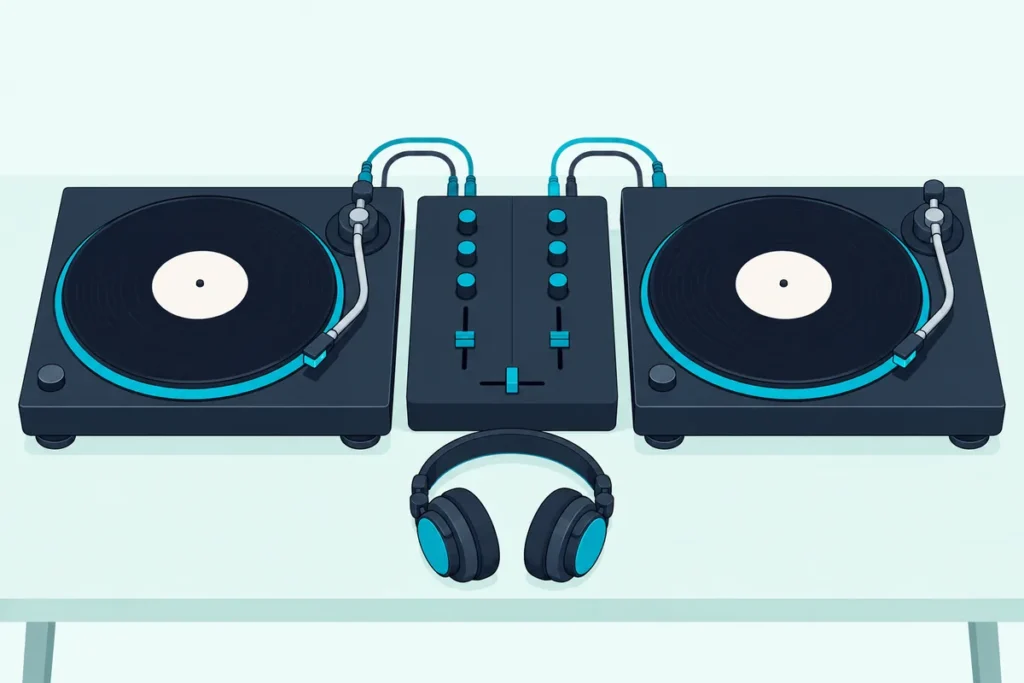
Plug a turntable with a built-in phono preamp into the phono input of even the best DJ mixer and the music distorts, a fault Pioneer DJ’s own troubleshooting table fixes with a line input.
Mixers that look alike from the front split hard around the back, from two channels and no USB port to four turntable inputs and two laptop ports.
Match those sockets to your decks, your software and your room, and one mixer can carry you from a bedroom setup to a club booth.
This guide compares eight mixers from Pioneer DJ, Rane and Numark using only what their makers publish about channels, connections, sound cards, effects and software.
The short list and a side-by-side table come first, then one pick for each setup and the checks that decide which one belongs on your desk.
What Is the Best DJ Mixer Right Now?
That depends on what you plug in, but on paper the Pioneer DJ DJM-750MK2 is the best DJ mixer for most DJs who want a four-channel club layout at home. Each of its four channels takes a turntable on phono or a player on line, and it adds a send/return for outboard effects, a balanced booth output and the EQ curves and Magvel crossfader it inherits from the DJM-900NXS2 (Pioneer DJ).
If this is your first mixer, our best beginner DJ mixer guide narrows the field to four starter picks, and if you don’t own decks yet, the best DJ controller list may suit you better.
The other seven picks each fit a narrower setup, from a club booth with two laptops to a two-channel box with no USB port at all:
| Pick | Channels | Inputs, per the maker | Computer connection | Best for |
|---|---|---|---|---|
| Pioneer DJ DJM-750MK2 | 4 | 4 phono, 4 line, mic, effects return | USB sound card | Best overall |
| Pioneer DJ DJM-900NXS2 | 4 | 4 phono, 4 line, 4 digital, 2 mics | 2 USB sound card ports, LAN | Club booths |
| Rane Seventy | 2 | 2 phono/CD, 2 aux, 2 mics, session in | 2 USB-B, 2 controller ports | Pro scratching |
| Pioneer DJ DJM-450 | 2 | 2 phono, 2 line, aux, mic | USB sound card, phone and tablet port | Home use |
| Pioneer DJ DJM-250MK2 | 2 | 2 phono, 2 line, aux, mic | USB sound card | Compact club layout |
| Numark Scratch | 2 | 2 line/phono, mic | USB, with Serato DJ Pro | Affordable scratching |
| Numark M6 USB | 4 | Phono, line, 2 mics | USB audio on channel 3 | Budget four-channel |
| Numark M2 | 2 | 2 phono/line, 2 line, mic | None | Budget vinyl |
Each pick had at least 4.0 stars from 50 or more Amazon reviews and was in stock on 15 October 2026, but ratings, review counts and prices are left off because they change daily. None of these mixers was tested for this guide, so every verdict rests on the makers’ spec pages, quick start guides and manuals.
| Product | Link |
|---|---|
Best Overall 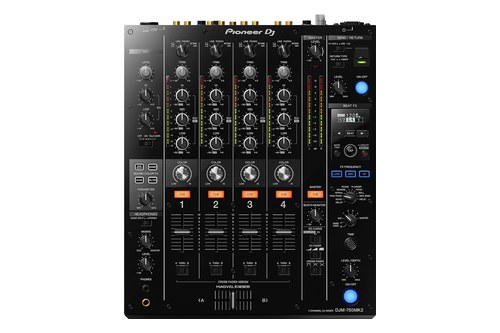 | See ratings |
Best for Club Booths 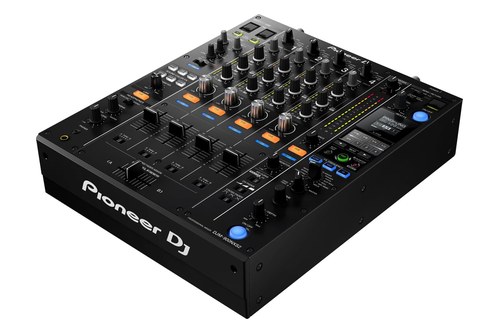 | See ratings |
Best for Pro Scratching 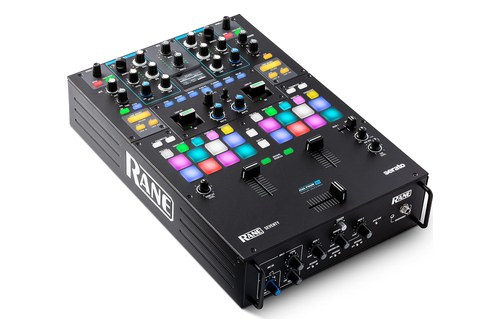 | See ratings |
Best for Home Use 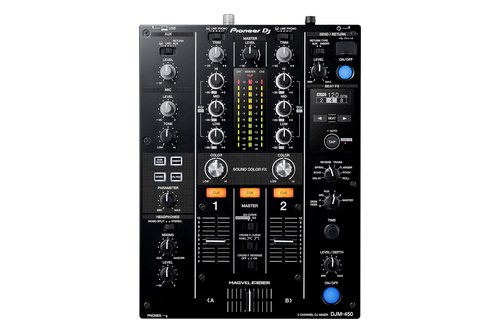 | See ratings |
Best Compact Club Layout 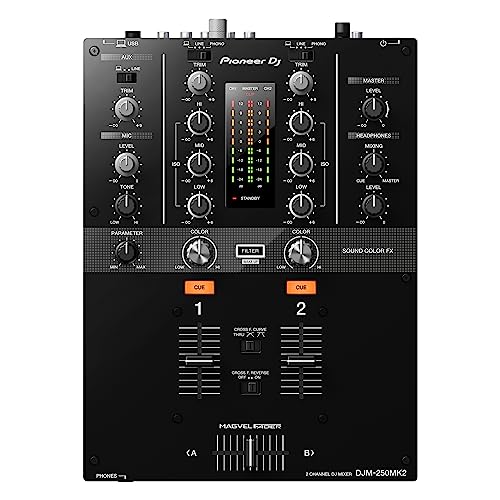 | See ratings |
Best Affordable Scratch Mixer 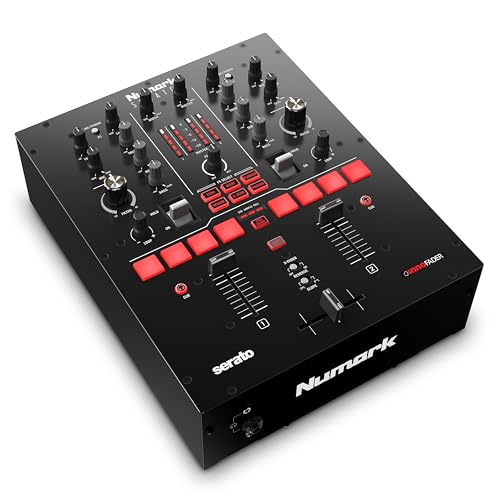 | See ratings |
Best Budget Four-Channel 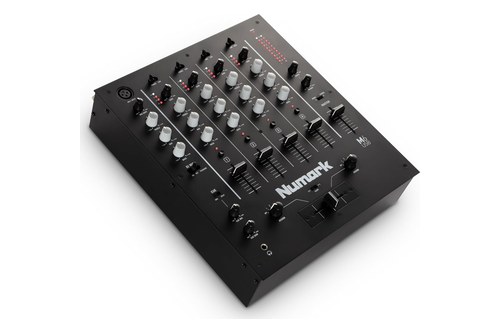 | See ratings |
Best Budget for Vinyl 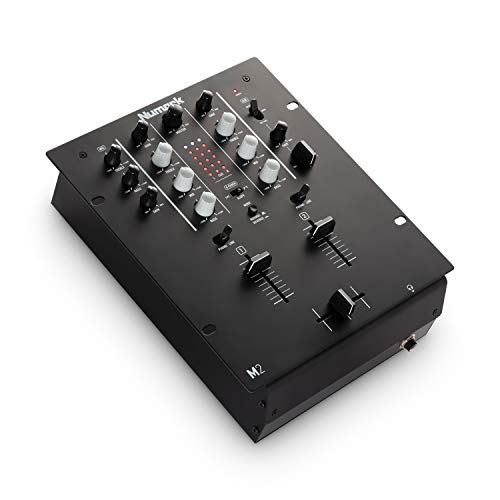 | See ratings |
Which DJ Mixers Are Best for Each Setup?
Those eight picks run from a mixer with a network jack for club players down to one with no computer connection, and each wins a different setup. The DJM-750MK2 is best overall, the DJM-900NXS2 best for club booths and the Rane Seventy best for pro scratching, while the rest cover home desks, compact club layouts, affordable scratching and budget four- and two-channel mixing.
Pioneer DJ DJM-750MK2
For most DJs who want a four-channel club layout at home, the Pioneer DJ DJM-750MK2 is the pick.
the Pioneer DJ DJM-750MK2
Pioneer DJ pitches it as a step toward the DJ booth: a 4-channel mixer that inherits key features and design from the DJM-900NXS2 and builds a club-style setup with Pioneer’s CDJ or XDJ players. Its EQ and channel fader curves match the 900NXS2’s, and Pioneer rates the Magvel crossfader for more than 10 million movements.
Two effects units pair Sound Color FX with Beat FX, and the send/return switches between Aux and Insert types, so a hardware effects unit or an FX app on an iPhone or iPad can join the built-in effects.
Around the back, its quick start lists four phono and four line inputs, a combo mic jack without phantom power, XLR and RCA master outputs, a balanced booth output, and USB-A and USB-B ports (Pioneer DJ). Connect a PC or Mac and it unlocks rekordbox’s performance features, with DVS control in rekordbox and in Native Instruments’ Traktor Pro 3.
At 320 mm wide and 6.6 kg, it’s 13 mm narrower and 1.4 kg lighter than the DJM-900NXS2, which matters on a home desk.
Pioneer DJ DJM-900NXS2
For a booth where club players, two laptops and a microphone all meet, the Pioneer DJ DJM-900NXS2 is the most complete mixer here.
the Pioneer DJ DJM-900NXS2
Pioneer DJ built it around a 96 kHz, 64-bit mixing processor, with six Sound Color FX on every channel and 14 Beat FX whose parameters you adjust with one finger on the X-Pad (Pioneer DJ). FX Frequency picks the frequency range an effect hits, so you can add echo to a vocal or double a hi-hat rhythm at the touch of a button.
Its built-in sound card passes 4 stereo inputs and 5 outputs to a computer at 96 kHz/24-bit, and two USB ports with an A/B switch on top let two laptops share the mixer for seamless changeovers.
Pro DJ Link connects up to four players through the LAN terminal to share one music source, and the quick start adds four coaxial digital inputs, a digital master out, a rec out and a second mic input (Pioneer DJ). Four phono inputs mean a turntable can sit on every channel.
Pioneer DJ’s DJM-A9 page calls this mixer its predecessor, so the 900NXS2 is the established layout rather than the newest one, and the A9 appears with the left-out mixers below.
Rane Seventy
For battle-style scratching with Serato DJ Pro, the Rane Seventy is the pro pick.
the Rane Seventy
Rane’s user guide, in the copy hosted by inMusic, the company that owns the Rane brand, lists three tension-adjustable MAG FOUR faders, 16 multi-color pads with 10 modes each and a 1.6-inch OLED display (inMusic). Its effects toggles latch when you push them away and spring back for momentary hits when you pull them toward you.
Each deck’s source knob picks USB A or B, the phono/CD input or an aux input, and two USB-A ports take Rane’s Twelve or another USB MIDI controller. The rear panel adds XLR main outputs, TRS booth outputs, a session in and out for another mixer, and two combo mic inputs that switch to line level.
Mic 1 has a ducking mode that drops every other input by 10 dB, every EQ is full-kill, and each deck has a low-pass and high-pass filter knob. The box adds two NoiseMap control records, two control CDs and a Pitch ‘n Time download card, so DVS needs no extra purchase of control media.
Rane’s guide marks its Control Panel drivers as a Windows-only setup step.
Pioneer DJ DJM-450
For a two-channel mixer designed around a home setup, the Pioneer DJ DJM-450 is the pick.
the Pioneer DJ DJM-450
Pioneer DJ’s quick start calls it a home mixer for DJs, and its product page says it inherits features and design from the DJM-900NXS2, pairing the Magvel fader with smooth EQ and channel fader curves (Pioneer DJ). Its eight Beat FX (Delay, Echo, Spiral, Reverb, Trans, Flanger, Pitch and Roll) run in sync with the BPM, and four Sound Color FX (Dub Echo, Sweep, Noise and Filter) take a parameter knob for finer control.
A phone or tablet plugs in over USB so FX and instrument apps can run beside the built-in effects, while a computer connects for rekordbox’s performance features and its DVS mode.
The quick start lists two phono and two line inputs, an aux input, a 1/4-inch mic jack, XLR and RCA master outputs and two headphone jacks, but no booth output (Pioneer DJ). In a bedroom the master can feed powered speakers directly, so that gap matters only in rooms that need a separate monitor.
Its 230 x 319.5 mm footprint is a little bigger than a sheet of letter paper, and it weighs 3.2 kg.
Pioneer DJ DJM-250MK2
For the lightest Pioneer DJ mixer here, with a filter on every channel, the Pioneer DJ DJM-250MK2 is the pick.
the Pioneer DJ DJM-250MK2
It inherits the Magvel crossfader and the Sound Color FX filter from the DJM-900NXS2, and Pioneer DJ keeps the lower half of the panel clear so you have room for scratch techniques (Pioneer DJ). Turn an isolator all the way left and that band disappears, which the quick start specifies as minus infinity to +6 dB on all three bands.
The sound card records your mixes to a computer over one USB cable, and with rekordbox you can play from CDJs or scratch digital files on turntables with Pioneer DJ’s control vinyl.
It shares the DJM-450’s 230 x 319.5 mm footprint at 3.0 kg and the same two phono, two line and aux inputs, with a 1/4-inch TS mic jack and one USB-B port (Pioneer DJ). Pioneer DJ lists Beat FX for the DJM-450 but only the channel filter here, so effects are the real difference between the two.
Numark Scratch
For affordable scratching with Serato DJ Pro, the Numark Scratch is the pick.
the Numark Scratch
Numark describes a 24-bit two-channel mixer with an all-metal build, an Innofader crossfader, performance pads, an instant loop encoder and toggle paddles that fire software effects (Numark). It comes with Serato DJ Pro and unlocks Serato DVS, though Numark’s user guide says the control records or CDs that DVS needs are sold separately.
The paddles trigger six software effects (Echo, Delay, Flanger, Reverb, Version Echo and Phaser), and each deck’s four pads switch between cue, sample and roll modes. Two switches above the crossfader reverse the channels or change the slope from a smooth fade for mixing to a sharp cut for scratching.
Each deck’s RCA input switches between line and phono, the mic input takes an XLR or 1/4-inch plug, and the master leaves on XLR and RCA beside an RCA booth output (Numark). Macs need no extra driver, while Windows uses Numark’s own driver.
Numark M6 USB
For four channels on a budget, the Numark M6 USB is the pick.
the Numark M6 USB
Numark pitches it as a step up to four channels, a club-style design for turntables and CD players with a USB connection that plays music software through the mixer and records your sets (Numark). Each channel gets three-band EQ and LED metering, any channel can go to either side of the crossfader, and the crossfader is replaceable with a slope control.
The quick start routes computer audio into channel 3 and sends the record mix back over the same class-compliant USB link, so there’s no driver to install (Numark). A dedicated XLR mic channel sits beside a second 1/4-inch mic input that takes over channel 4 when you flip its input switch.
The master leaves on balanced XLR or RCA, with RCA booth and record outputs, and the mic switch’s talkover setting lowers channels 1 to 4 while you speak. US buyers should set the rear voltage switch to 100-120V.
Numark M2
For the simplest two-channel mixer for turntables, the Numark M2 is the budget pick.
the Numark M2
Numark calls it a two-channel scratch mixer for any setting from weddings to clubs and practice setups, with switchable phono/line inputs for turntables, CD players and other line sources (Numark). Its quick start counts two phono inputs that switch to aux line, two line inputs, a 1/4-inch mic input with gain, bass and treble, and RCA master and record outputs (Numark).
Each channel gets gain and three-band EQ, a cue slider blends the two channels in your headphones, and the replaceable crossfader has a reverse button and a slope switch for a sharp cut.
With no USB port, a laptop joins through an audio interface on a line input, which Numark lists among the line-level devices those inputs take. At 241 x 290 mm, it has the smallest footprint here, and its 3.0 kg ties the DJM-250MK2 for the lightest.
Get Studio Tips Weekly
Join 5,000+ creators getting acoustic treatment advice every week.
No spam. Unsubscribe anytime.Should You Buy a 2-Channel or 4-Channel DJ Mixer?
Five of those eight picks have two channels and three have four, and that split is usually the first decision. Buy two channels if you play two turntables or players, and four if you want a deck on every channel or room for extra sources such as a sampler or drum machine.
Pioneer DJ’s range page ties the channel count to how much hardware you can connect, naming CDJs, turntables, samplers, synths and drum machines (Pioneer DJ). Each channel plays one source at a time, picked with its input selector, so the number tells you how many things can be live in the mix at once.
Picture two turntables, a laptop and a sampler: a two-channel DJM-450 can take the sampler on its separate aux input, while a four-channel DJM-750MK2 gives it a full channel with EQ and a fader.
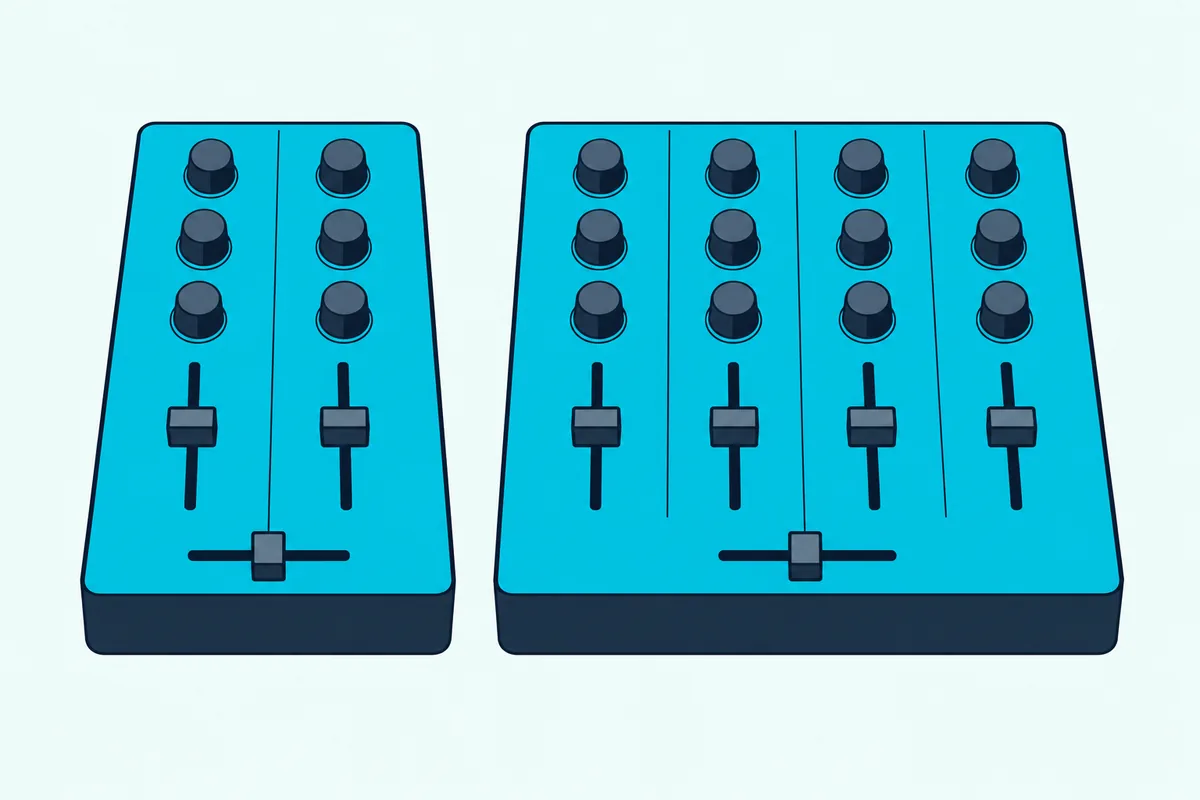
Two channels suit scratch and battle setups, where every scratch mixer in this guide has two, and they keep a home desk clear. Four suit club setups with four players, and the DJM-750MK2 is 90 mm wider than the DJM-450 to fit them.
Watch for mixers that borrow a channel: the Numark M6 USB’s second mic input takes over channel 4 when you switch it in, and its computer audio arrives on channel 3. A simple rule: count the sources you want playing at the same time, then add one for a guest DJ or a sampler.
If the parts of a channel strip are new to you, our walk-through of how each control on a DJ mixer works covers the controls and headphone cueing.
What Makes a DJ Mixer Good for Vinyl and Turntables?
Those channel counts only help if each channel can take a turntable, and that comes down to the phono inputs. A good mixer for vinyl has a phono input for every turntable, a ground terminal for their ground wires and a line input for any turntable with its own preamp.
Pioneer DJ’s quick starts say the phono terminals are for phono-level (MM cartridge) devices and warn against feeding them line-level signals. The Numark Scratch, Numark M2 and Rane Seventy put a phono/line switch on their inputs instead, set to phono for the extra amplification a phono-level turntable needs or to line for a CD player.
That’s why the turntable from the opening distorts: for an analog player with a built-in phono equalizer, Pioneer DJ’s fix is to connect it to the line terminals, or to set the player’s own phono/line switch to phono if it has one (Pioneer DJ).
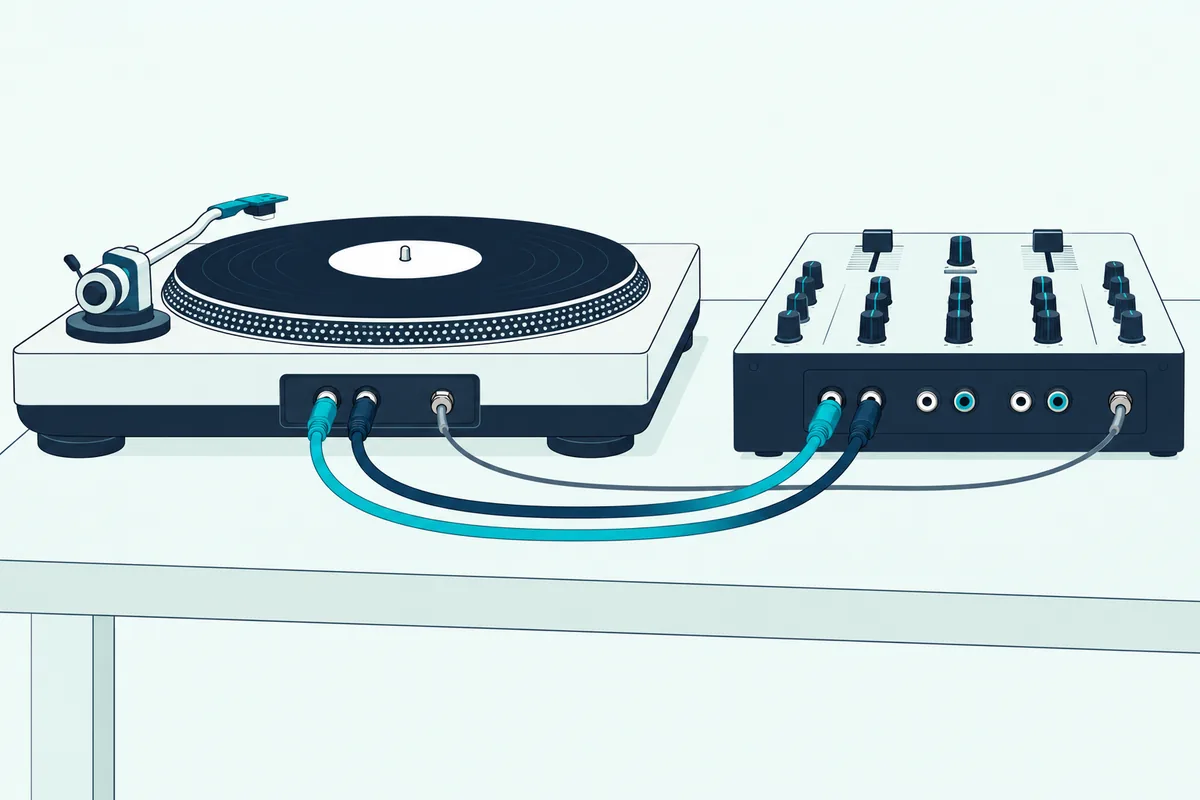
Then count the phono inputs: the DJM-750MK2 and DJM-900NXS2 have four, enough for a turntable on every channel, while the DJM-450, DJM-250MK2 and Numark M2 have two. The Rane Seventy and Numark Scratch switch each deck’s input between phono and line, so two turntables fill them.
Hum is the other vinyl problem, and every pick here has a ground terminal for it. Numark’s and Rane’s guides both say a low hum or buzz can mean the turntables aren’t grounded, and that some turntables carry the ground inside the RCA cable, so nothing goes on the terminal.
Turntables can also play digital files through DVS, where control vinyl steers the music in your DJ software. The Rane Seventy includes two NoiseMap control records, while Pioneer DJ’s DJM-450 page and Numark’s Scratch guide list control vinyl as sold separately.
Which DJ Mixer Has the Best Sound Quality?
Those phono stages are one part of what makers mean by sound quality, and the spec sheets put numbers on the rest. On paper, the DJM-900NXS2 has the highest-resolution audio path of the eight cards, with 96 kHz processing and a 32-bit master converter where the other Pioneer DJ, Rane and Numark Scratch sheets list 48 kHz.
| Mixer | Sampling rate | Line or CD signal-to-noise | Phono signal-to-noise |
|---|---|---|---|
| Pioneer DJ DJM-900NXS2 | 96 kHz | 105 dB | 88 dB |
| Pioneer DJ DJM-750MK2 | 48 kHz | 105 dB | 87 dB |
| Pioneer DJ DJM-450 | 48 kHz | 94 dB | 80 dB |
| Pioneer DJ DJM-250MK2 | 48 kHz | 94 dB | 80 dB |
| Rane Seventy | 48 kHz | 111 dB dynamic range | Not listed |
| Numark Scratch | 48 kHz | 102 dB | 99 dB |
| Numark M6 USB | Not listed | Over 96 dB | Over 79 dB |
| Numark M2 | Not listed | Not listed | Not listed |
Read those as each maker’s own measurements rather than a league table: Pioneer DJ quotes signal-to-noise at rated output, Numark’s Scratch guide at maximum input with A-weighting, and Rane gives dynamic range from CD input to analog output instead. Phono figures run lower than line figures on every sheet that lists both.
Two setup habits from Pioneer DJ’s manuals protect whatever quality the specs promise: set each channel’s TRIM so its level indicator peaks around 0 dB, and send the balanced XLR master to balanced inputs, since Pioneer DJ warns that an XLR-to-RCA converter may lower sound quality or add noise. For an RCA input, its quick starts point you to the separate RCA master instead.
Above these cards, makers chase sound in different ways. AlphaTheta’s euphonia runs every output through a transformer co-designed with Rupert Neve Designs, the DJM-A9 puts 32-bit ESS Technology converters on its channel inputs and its master and booth outputs, and Allen & Heath’s Xone:92 keeps 100% analog circuitry and mix bus summing.
None of that can be judged from a spec sheet, and this guide didn’t listen to these mixers, so treat words like warm and glossy as the makers’ descriptions.
Should You Pick an Analog or Digital DJ Mixer?
That all-analog Xone:92 is the clearest example of the other path, because six of the eight cards here are digital inside. Pick digital if you want built-in beat effects and deep software ties in one box, and analog if a fully analog signal path matters most, though none of the analog mixers documented here passed this guide’s Amazon checks on 15 October.
Pioneer DJ’s four cards run a 64-bit digital signal processor with dithering for both analog and digital sources. The Rane Seventy lists 32-bit floating-point processing, and the Numark Scratch a 32-bit fixed-point DSP with 24-bit converters.
Allen & Heath builds the Xone:92 with 100% analog circuitry and mix bus summing, a 4-band EQ with total kill on the high and low bands, and dual analog filters with silent switching (Allen & Heath). Its phono preamp uses an RIAA curve that Allen & Heath tailors for techno and house.
The Xone:96 is still an analog mixer but adds a dual 32-bit USB soundcard with 24 channels at 96 kHz and Traktor Scratch certification, so the line between the two types is blurrier than the labels (Allen & Heath). The euphonia blurs it from the other side, digital inside with an analog transformer on everything it outputs.
Neither Xone made the cards: on 15 October the Xone:96 listing had too few Amazon reviews and the Xone:92 MK2 listing showed no rating, both short of this guide’s bar. If an analog path is the point, those two listings are worth checking again later.
What Is a Scratch Mixer, and Who Needs One?
Analog or digital, a mixer built for scratching is judged by its crossfader first, and that’s what sets a scratch mixer apart. A scratch mixer, also called a battle mixer, is a two-channel mixer laid out for cutting between decks, and Pioneer DJ defines its scratch style as built for scratching and pad performances.
Pioneer DJ recommends its MAGVEL FADER PRO for precise scratching, describing a low-latency crossfader whose weight you change with a Feeling Adjust dial (Pioneer DJ). Rane’s three MAG FOUR faders are tension-adjustable, and Numark builds its Scratch around an Innofader.
Curve switches shape that fader: Numark’s slope switches go from a smooth fade for mixing to a sharp cut for scratching, and its reverse controls flip which deck sits on which side of the crossfader.
Pads turn the mixer into a controller for Serato DJ Pro. The Seventy’s 16 pads have 10 modes each, and the Scratch’s four pads per deck cover cues, samples and loop rolls.
If you blend long tracks rather than cut them, Pioneer DJ’s standard style, which it calls suitable for DJing a wide range of genres, fits better. The DJM-750MK2’s Magvel crossfader still handles the occasional cut, since Pioneer DJ describes it as precise during even complicated scratch techniques.
The DJM-250MK2 covers both, since Pioneer DJ says its simple controls, clear layout and isolators suit scratching and mixing alike.
What Is a Rotary DJ Mixer?
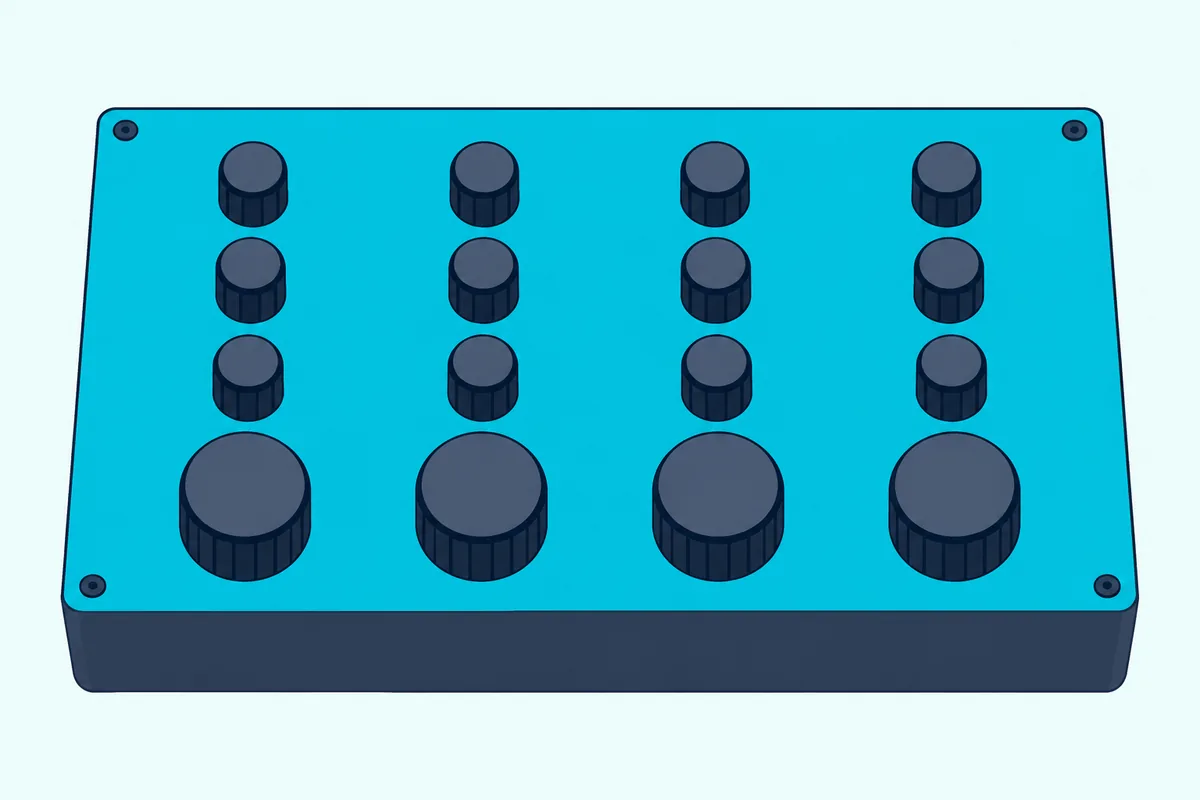
Scratch mixers push everything onto the crossfader, and rotary mixers go the other way, swapping each channel’s slider for a large knob. A rotary mixer sets each channel’s volume with a rotary fader, and Pioneer DJ’s mixer range lists a single rotary-style model, AlphaTheta’s 4-channel euphonia.
AlphaTheta’s manual has you turn each channel’s rotary fader clockwise to raise its volume, and its page says the fader curves were tuned with feedback from numerous DJs for smooth, natural mixing without leaning on the EQ (AlphaTheta). Alongside 3-band channel EQs, it adds a 3-band master isolator with Boost Send buttons that push a built-in or external effect onto the low, mid or high band.
Its send effects are Delay, Tape Echo, Echo Verb, Reverb and Shimmer plus a high-pass filter, and a send/return and master insert take outboard units. The back panel carries four phono, four line and four digital inputs, a mic input, an XLR master, a TRS booth output and a USB-C port, and it weighs 9.5 kg.
No Amazon listing for the euphonia turned up on 15 October, so it has no card here, and Ecler’s WARM4 rotary listing had too few reviews.
What’s the Best DJ Mixer for Home Use?
A 9.5 kg rotary is booth gear, and a home desk usually wants the opposite: a small footprint and a straight run to powered speakers. For home use, the Pioneer DJ DJM-450 is the best DJ mixer here, because Pioneer DJ designed it as a home mixer for DJs and it fits Beat FX, a sound card and a phone and tablet USB port into a 230 mm-wide body.
| Mixer | Width x depth, per the maker | Weight, per the maker |
|---|---|---|
| Numark M2 | 241 x 290 mm | 3.0 kg |
| Pioneer DJ DJM-250MK2 | 230 x 319.5 mm | 3.0 kg |
| Pioneer DJ DJM-450 | 230 x 319.5 mm | 3.2 kg |
| Numark Scratch | 9.61 x 12.05 in | Not listed |
| Rane Seventy | 285 x 445 mm | 5.6 kg |
| Pioneer DJ DJM-750MK2 | 320 x 387.9 mm | 6.6 kg |
| Numark M6 USB | 12.625 x 14.25 in | 9.6 lb |
| Pioneer DJ DJM-900NXS2 | 333 x 414.2 mm | 8.0 kg |
Pioneer DJ quotes maximum external dimensions, so leave room behind the mixer for cables.
Speaker cables come next: Pioneer DJ’s quick starts send the XLR master to balanced inputs and the RCA master to unbalanced ones, so check which your powered speakers have. Recording is the other home job, and the DJM-750MK2, DJM-450 and DJM-900NXS2 work with Pioneer DJ’s DJM-REC app, which records mixes on an iPhone or iPad and can live-stream them.
In a bedroom with a laptop and two powered speakers, the DJM-450’s master covers the speakers, its two headphone jacks cover cueing, and the booth output it lacks never comes up.
What Connections Should a Club DJ Mixer Have?
That booth output is the first thing a club mixer needs, because the DJ’s own monitor runs from it. A club mixer should have a booth output, an XLR master, two mic inputs, a send/return for effects, two USB ports for changeovers and, in Pioneer DJ booths, a LAN terminal for Pro DJ Link.
The DJM-900NXS2 has all of those, and the DJM-750MK2 misses only the second USB port, the second mic and the LAN terminal. The Rane Seventy covers a battle booth with XLR mains, TRS booth outputs, two mic inputs and two USB-B ports, plus a session in and out for linking another mixer.
Pioneer DJ’s range page explains the USB part: with two USB-B ports, two PCs or Macs can connect at once, so DJs can switch over without interrupting the music. Pro DJ Link lets players share one source such as a USB drive and adds features including Quantize, per the same page.
Two headphone jacks help at changeovers too, and Pioneer DJ says the DJM-750MK2 takes two pairs of headphones for back-to-back sets. Its quick start adds a caveat: using both jacks at once may lower sound quality and volume.
The DJM-A9 goes further, with dual independent headphone outputs, a 2-band booth EQ and two USB-B plus two USB-C ports, but it missed this guide’s review bar (Pioneer DJ).
What Effects Do DJ Mixers Have?
Those club mixers also carry the most effects, and Pioneer DJ splits them into two families. DJ mixers have channel effects such as filters, which Pioneer DJ calls Sound Color FX, and beat-synced effects such as echo and delay, which it calls Beat FX, while some add sends for external units.
The DJM-900NXS2 has six Sound Color FX and 14 Beat FX, the DJM-450 four and eight, and the DJM-750MK2 two effects units that combine both families. Pioneer DJ lists only a Sound Color FX filter on each channel of the DJM-250MK2, and Numark’s M6 USB and M2 list no effects at all.
Software effects need the laptop connected: the Numark Scratch’s six effects come from Serato DJ Pro, while Pioneer DJ’s Beat FX are built into the mixer. The Seventy does both, with an FX Mode button that switches between its internal Flex FX and Serato’s effects and a Mix Flex FX setting that combines them.
A send/return adds hardware you already own. The DJM-750MK2’s switches between Aux and Insert types, the euphonia pairs a send/return with a master insert, and the Xone:96 has two stereo sends, four stereo returns and a master insert, with Send 1 switching to Hi-Z for guitar pedals.
A quick way to decide: if your transitions lean on echo-outs and filter sweeps, the DJM-450’s Beat FX and Sound Color FX keep them on the mixer, and if you already live in Serato’s effects, the Scratch’s paddles put them under your fingers.
Which DJ Software Works With Each Mixer?
Software effects are only one tie between a mixer and a laptop, and the bigger one is which DJ software it works with. Pioneer DJ’s mixers here work with rekordbox and Traktor Pro 3, the Rane Seventy and Numark Scratch with Serato DJ Pro, the DJM-900NXS2 with all three, and the Numark M6 USB with any recording app that supports USB audio.
| Mixer | rekordbox | Serato DJ Pro | Traktor Pro 3 |
|---|---|---|---|
| Pioneer DJ DJM-900NXS2 | DVS with a paid pack | DVS with paid Serato software | DVS |
| Pioneer DJ DJM-750MK2 | Performance features and DVS | Not listed | DVS |
| Pioneer DJ DJM-450 | Performance features and DVS | Not listed | DVS |
| Pioneer DJ DJM-250MK2 | Performance features and DVS | Not listed | DVS |
| Rane Seventy | Not listed | Yes, control media included | Not listed |
| Numark Scratch | Not listed | Included, DVS unlocked | Not listed |
“Not listed” means the maker’s page and guide don’t name that software, not that it can’t work, so check the software maker’s own hardware list before you buy.
DVS costs differ too: the Seventy’s box has control records and CDs, the Scratch’s control media are sold separately, and Pioneer DJ’s DJM-900NXS2 page says Serato DVS needs Serato DJ Pro plus Serato’s DVS Expansion Pack.
On the Pioneer DJ side, connecting a DJM-750MK2, DJM-450 or DJM-250MK2 to a PC or Mac unlocks rekordbox’s performance features, and the pages point to a Creative plan subscription for extras such as Cloud Library Sync. Rane’s guide has you download Serato DJ Pro from serato.com before plugging in the Seventy, and the Scratch ships with a software download card.
Can You Add a DJ Mixer to a Controller Setup?
Those software ties come up again if a controller already sits on your desk. Yes: a controller’s master output can feed a mixer’s line input like any other line-level source, and the Rane Seventy goes further with two USB-A ports that host Rane’s Twelve or other USB MIDI controllers.
Pioneer DJ’s DJM-S7 and DJM-S11, both left off the cards below, also have dual USB-A ports for DJ controllers and other devices, including selected units from other brands.
Whether you need a mixer at all depends on what your controller lacks, and our guide to whether you need a mixer with your DJ controller works through turntables, guest DJs, extra mics and booth monitors. If you’re still choosing between the two kinds of gear, Burton Acoustix’s DJ controller vs mixer guide compares their inputs, outputs and software side by side.
Which DJ Mixers Didn’t Make the List?
Those DJM-S7 and DJM-S11 mentions are a reminder that some well-known mixers aren’t on the cards, and the reason is the Amazon bar rather than their specs. Pioneer DJ’s DJM-A9, DJM-S7 and DJM-S11, AlphaTheta’s euphonia, Allen & Heath’s Xone:96 and Xone:92 and Denon DJ’s X1850 Prime all missed the 4.0-star, 50-review and in-stock checks on 15 October.
The DJM-A9, which Pioneer DJ introduced as a next-generation professional mixer, adds ESS 32-bit converters, a phantom-powered mic input for condenser mics and a Bluetooth input you can route to any channel, but its Amazon listing had too few reviews. The DJM-S7, a scratch-style mixer that unlocks Serato DJ Pro for free, works as a rekordbox Hardware Unlock device and takes Bluetooth audio from a phone, showed no price, seller or stock on two lookups.
The DJM-S11 adds a 4.3-inch touch screen and 22 Beat FX but, like the DJM-S5 and AlphaTheta’s DJM-V5, had too few reviews, and no listing turned up for the DJM-V10 or the euphonia. Allen & Heath’s Xone:96, Xone:43, Xone:PX5 and Xone:24C listings also had too few reviews, and the Xone:92 MK2 listing showed no rating.
Reloop’s Elite, RMX-95 and RMX-30 BT had too few reviews, and the RMX-22i fell short of the rating bar. Denon DJ’s X1850 Prime, a 4-channel club mixer with a LAN hub for up to four SC media players, had no Amazon listing with reviews beyond accessories (Denon DJ).
What Should You Check Before You Buy?
Those listings were this guide’s last filter, but your own checks start at the back panel. Four take a minute each:
- A phono input for every turntable, and a line input for any turntable with a built-in preamp.
- Enough channels for the sources you’ll play at once, plus one for a guest or a sampler.
- Your DJ software on the mixer’s list, and DVS control media in the box if you need them.
- The outputs your room needs: an XLR or RCA master for your speakers and a booth output for loud rooms.
Then measure your desk against the footprint table, because the deepest pick here needs 445 mm before the cables go in.
The Bottom Line
Put those checks together and the Pioneer DJ DJM-750MK2 is the one to buy for a four-channel club layout at home, the DJM-900NXS2 for a full club booth and the Rane Seventy for pro scratching with Serato DJ Pro.
For smaller desks, the DJM-450 is the home mixer, the DJM-250MK2 the compact club layout and the Numark Scratch the affordable scratch mixer, while the Numark M6 USB and M2 cover four and two channels with the fewest extras.
Frequently Asked Questions
What mixer do most DJs use?
This guide found no independent count of the mixers DJs use, so the honest answer comes from the makers themselves. Pioneer DJ’s quick starts call its DJM line the world standard for discos and clubs, and its DJM-A9 page says the A9 keeps the functions and layout that clubs treat as standard. Allen & Heath points to respected names and rising artists who choose its Xone mixers. If you play clubs, check which mixer the venue has before you practice, since that’s the layout your hands need to know.
What do most professional DJs use?
In clubs, Pioneer DJ’s own picture of a club-style setup is a four-channel mixer combined with its professional CDJ or XDJ players, which the DJM-750MK2 recreates at home and the DJM-900NXS2 links over Pro DJ Link. Scratch DJs work on two-channel battle mixers such as the Rane Seventy or Pioneer DJ’s DJM-S11, built around scratch crossfaders and performance pads. Club mixers like the DJM-900NXS2 and DJM-A9 also have two USB ports, so a DJ playing from a laptop can take over without stopping the music.
What is the best DJ mixer in the world?
No mixer wins every setup, but on paper the most complete one in this guide is the Pioneer DJ DJM-900NXS2, with four phono, four line and four digital inputs, two USB ports, Pro DJ Link and 96 kHz processing. Its successor, the DJM-A9, adds 32-bit ESS converters, a Bluetooth input and a phantom-powered mic input, but missed this guide’s Amazon review bar. For scratching, the Rane Seventy is the strongest card here, and for an analog signal path, Allen & Heath’s Xone:92 and Xone:96 are the best-documented options.
What is DVS on a DJ mixer?
DVS, a digital vinyl system, lets a turntable or CD player control music files in DJ software through the mixer’s sound card. You play control vinyl or CDs pressed with an audible tone that the software reads, and Numark’s guide has you calibrate Serato DJ Pro for each deck until the readable signal sits close to 85%. Switch off a CD player’s keylock first, Numark adds. In ABS mode the needle position moves the track, while REL mode follows the record’s motion but keeps hot cues and loops working. The Rane Seventy includes control media, while the Scratch needs it bought separately.
Do you need a booth output on a DJ mixer?
You need one when the DJ needs a separate monitor, since Pioneer DJ describes its booth terminals as outputs for a booth monitor. At home, a mixer without one, such as the DJM-450, DJM-250MK2 or Numark M2, runs your speakers from the master instead. The DJM-750MK2’s booth output is balanced TRS, and Pioneer DJ warns that converting it to an unbalanced RCA or TS input may lower sound quality or add noise. The DJM-900NXS2, Rane Seventy, Numark Scratch and Numark M6 USB have booth outputs too.
Can a DJ mixer record your mix?
Yes, in two ways. A mixer with a USB sound card, such as the DJM-250MK2 or Numark M6 USB, sends the mix to recording software on a computer, and the M6 USB’s class-compliant connection needs no driver. Mixers with a record output, such as the Numark M2, Numark M6 USB and DJM-900NXS2, send the mix to a separate recorder over RCA. Pioneer DJ’s DJM-REC app also records, and can live-stream, from a DJM-750MK2, DJM-450 or DJM-900NXS2 on an iPhone or iPad.