How to Soundproof an Apartment Floor as a Renter or Owner
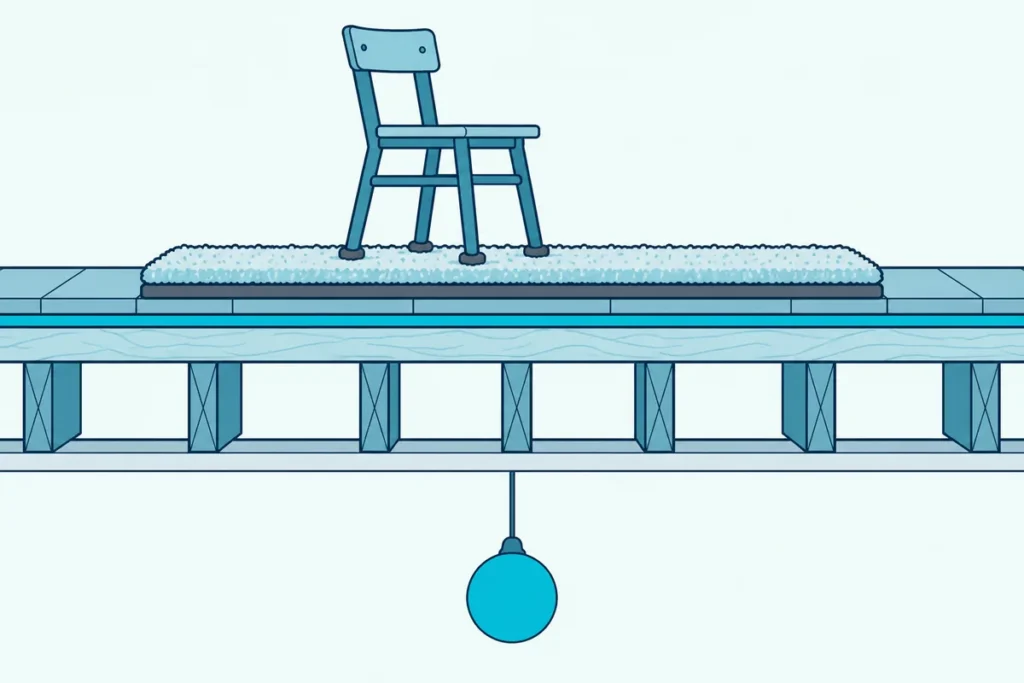
If you’re working out how to soundproof an apartment floor, the lab work says this first: soft layers cut sharp clicks, but the thump of footsteps travels through the structure.
That’s why the neighbor below can still hear you after you’ve laid rugs, and why a lease or a condo board may decide what else you’re allowed to change.
Match the fix to your floor, concrete slab or wood joists, and the gains are real: carpet and underlay took NRC Canada’s concrete test floor from IIC 28 to between 75 and 85.
Renters can start with rugs on dense pads, rubber mats and felt furniture pads, and owners can put a tested underlayment under new flooring or float the floor.
Below, you’ll see what each step is worth on each floor type, what a rating on the box describes and what to ask first.
How to Soundproof an Apartment Floor, Step by Step
These five steps run from free to full building work, and each one names who gets to decide.
| Step | What it does | Who decides |
|---|---|---|
| 1. Find out whether the floor is a concrete slab or wood joists | Tells you which fixes can work, since the same topping rates differently on each | You, by asking the building manager |
| 2. Cover the walking paths with rugs on dense pads | Cushions impacts; carpet and underlay rated IIC 75 to 85 on both of NRC Canada’s floor types | You, within the lease |
| 3. Put rubber mats where things drop and felt pads under furniture legs | Softens drops and scraping at the spots that take the hits | You |
| 4. Lay an underlayment rated on a floor like yours under new flooring | Lifts the footstep rating of the whole floor | The owner, under the building’s rules |
| 5. Float the floor on a resilient layer | The most practical route to a high rating under hardwood or tile, per NRC Canada | The owner, with a contractor |
Steps 1 to 3 are DIY and leave with you when you move. Steps 4 and 5 are building work, so in a rental they’re the landlord’s call.
That split matters because the walls, door and windows need different fixes again, and soundproofing the rest of an apartment covers them in a renter-friendly order. The floor has one limit of its own that no layer gets around, and the next section explains it.
Why Does Floor Noise Reach the Apartment Below So Easily?
That limit starts the moment a heel or a dropped pan hits the floor, because the blow sets the floor vibrating and the structure transmits the sound, not the air. A HUD guide to noise control in multifamily dwellings, prepared by the National Bureau of Standards, describes the whole floor-ceiling moving and radiating sound from the ceiling into the room below, much like the soundboard of a piano.
The same guide judged that structure-borne noise from the apartment above is usually more disturbing than airborne noise from the apartment next door. It also noted that these vibrations travel through a building’s structure over long distances with very little loss.
Those impacts don’t all sound alike. NRC Canada’s Construction Technology Update No. 35 describes impacts on a concrete slab with a hard finish as a click or a sharp tap below, and on lightweight wood joists as a thump, boom or thud.
The two sit at opposite ends of the frequency range, which is why one fix rarely handles both. HUD’s multifamily guide says resilient coverings such as carpet, cork or rubber tile attenuate the high-frequency part quite easily, while the low-frequency thump needs the structural floor itself changed.
Get Studio Tips Weekly
Join 5,000+ creators getting acoustic treatment advice every week.
No spam. Unsubscribe anytime.Is Your Floor a Concrete Slab or Wood Joists?
That split between clicks and thumps makes your floor’s structure the first thing to find out. Ask the building manager whether the floors between units are concrete slabs or wood joists, or ask the neighbor below whether your steps sound like taps or like thuds.
The answer changes what any covering is worth. In NRC Canada’s tables, ceramic tile on a 150-mm (about 6-inch) concrete slab rated IIC 28 and 9-mm hardwood on a 6-mm resilient layer 45 to 50, while that same resilient-backed hardwood on a basic wood-joist floor rated 47, no better than plain vinyl or hardwood on that floor.
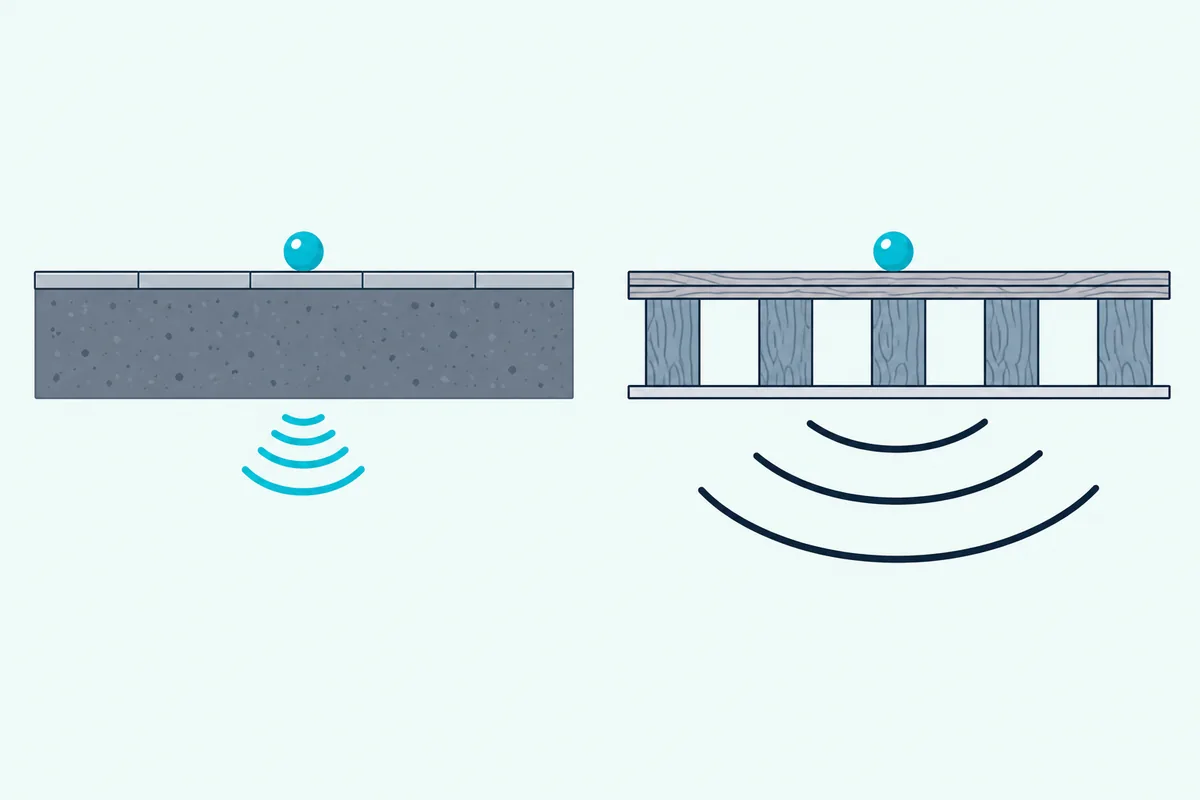
NRC sums it up plainly in Construction Technology Update No. 35 (the AIVC library’s copy): the rating of a complete floor “tells us nothing about the floor topping itself.” Vinyl attached to concrete improved the IIC by 8 points in its study, but on a basic wood-joist floor it offered no improvement.
On concrete, the hard finish is the problem: NRC says slabs finished with tile, marble or hardwood are “invariably judged as unacceptable” until a resilient surface or a floating floor cushions the impact. On joists, most of the sound that sets the IIC sits in the bands below 250 Hz, so a soft covering can quiet the clicks without moving the rating much.
What Can a Renter Put Down Without Changing the Floor?
Those tables point a renter toward soft layers on top, because they’re the part of the floor you control. That means rugs on dense pads over the walking paths, rubber mats where things get dropped and felt pads under furniture legs.
Rugs on dense pads come first. NRC Canada’s tables put carpet and underlay at IIC 75 to 85 on both of its test floors, because impacts are well cushioned, and its experience on concrete is that most occupants won’t be disturbed by footstep noise over that combination.
Those ratings come from carpeted test floors, not area rugs, so a rug that covers part of a room will do less. None of the sources here rates an area rug on its own.
Rubber or foam floor mats belong where a toy, a dumbbell or a pot lands, since rubber is one of the resilient coverings HUD’s multifamily guide names. Felt pads under chair and table legs apply the same idea where furniture scrapes, and the same guide says soft floor surfaces also cut the noise of sliding furniture, vacuuming and scuffling feet.
Even the best of these adds little against airborne sound waves, though. That guide found “no appreciable gain in airborne sound insulation” from carpets, pads or other resilient floor surfaces, so they won’t block much of your TV or voices.
A rug’s sound absorption still trims echo inside your own room, which is acoustic treatment rather than soundproofing.
How Much Does a Rug Pad Add Under a Rug?
That cushioning is the pad’s job, and the Carpet and Rug Institute, a carpet industry group, measured how much it adds. On a concrete slab floor-ceiling, a 44-ounce woven wool loop carpet rated IIC 68 on its own and 73 to 80 over five different cushions, with sponge rubber and foam rubber at the top.
On a wood-joist floor with a 5/8-inch plywood subfloor, the same carpet over the same cushions rated 61 to 68, against 32 for the bare floor. So on concrete the cushion added 5 to 12 points on top of the carpet, and the floor underneath decided the rest.
The Institute adds a caution about every number here. Footfalls make low-frequency sounds that are hard to measure in a test room, so a rating can miss part of what a heavy step sends below.
For a rug on a bare hard floor, the RUGPADUSA Dual Surface pad is a 1/4-inch felt-and-rubber pad. Its listing claims no sound rating, so treat it as the cushion layer from the tests above, not a rated product.
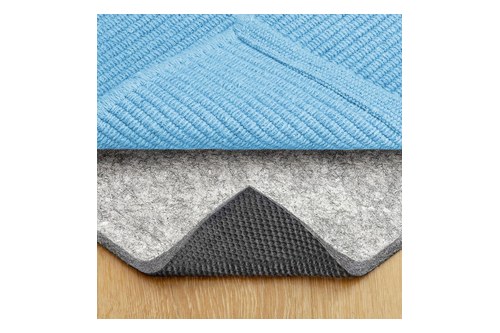
RUGPADUSA Dual Surface pad
Do Rubber or Foam Floor Mats Help?
Those carpet results come from soft, thick layers, and mats help for the same reason at the spots that take the hardest hits. On concrete, NRC Canada found that the softer and thicker a covering is, the better its IIC, while vinyl, though soft, is usually thin and adds only a little.
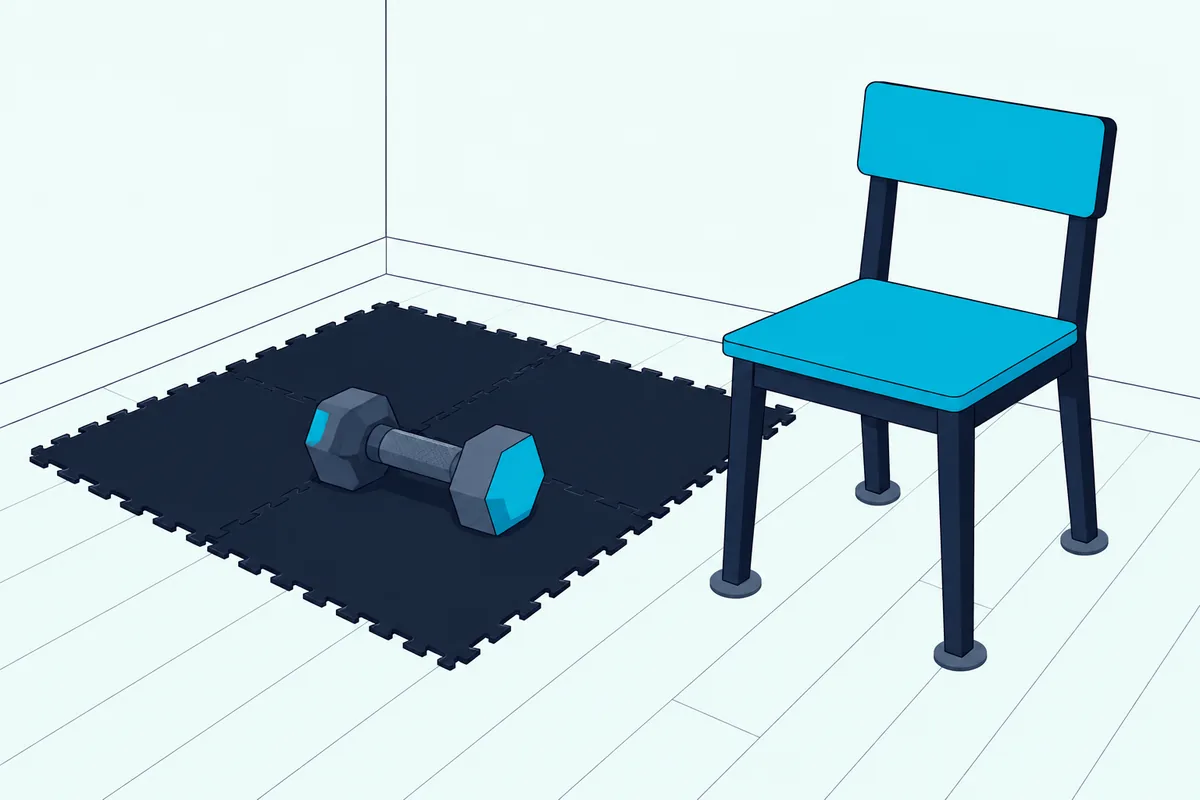
None of the mats checked for this guide publishes an impact rating, so what they add hasn’t been measured.
Where weights, toys or a play area take the hits, American Floor Mats Fit-Lock tiles lock together into one rubber floor mat. The listing describes commercial-grade recycled rubber tiles that lay flat, with no sound rating.
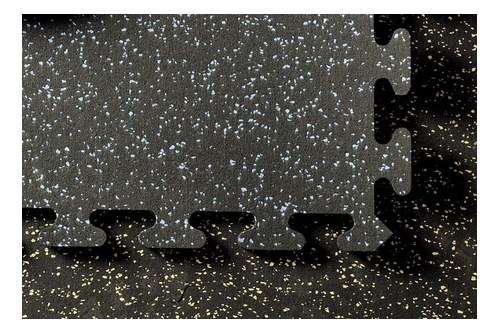
American Floor Mats Fit-Lock tiles
The same caution goes for foam puzzle mats. A soft layer helps with the sharp part of an impact, not the low thump that reaches through a joist floor.
What Does Your Lease or Building Allow?
Even the removable fixes can be required rather than optional in some buildings. In a New York co-op case, Fraken Builders versus Ciccone, the house rules required rugs or carpeting over at least 80 percent of the floor area of each room except kitchens, pantries, bathrooms and hallways, as Habitat magazine reported.
The occupant had laid small rugs along the paths she walked, and the court held that 80 percent meant 80 percent of the total floor area. It found her still in violation of a material term of her lease and granted a judgment for possession.
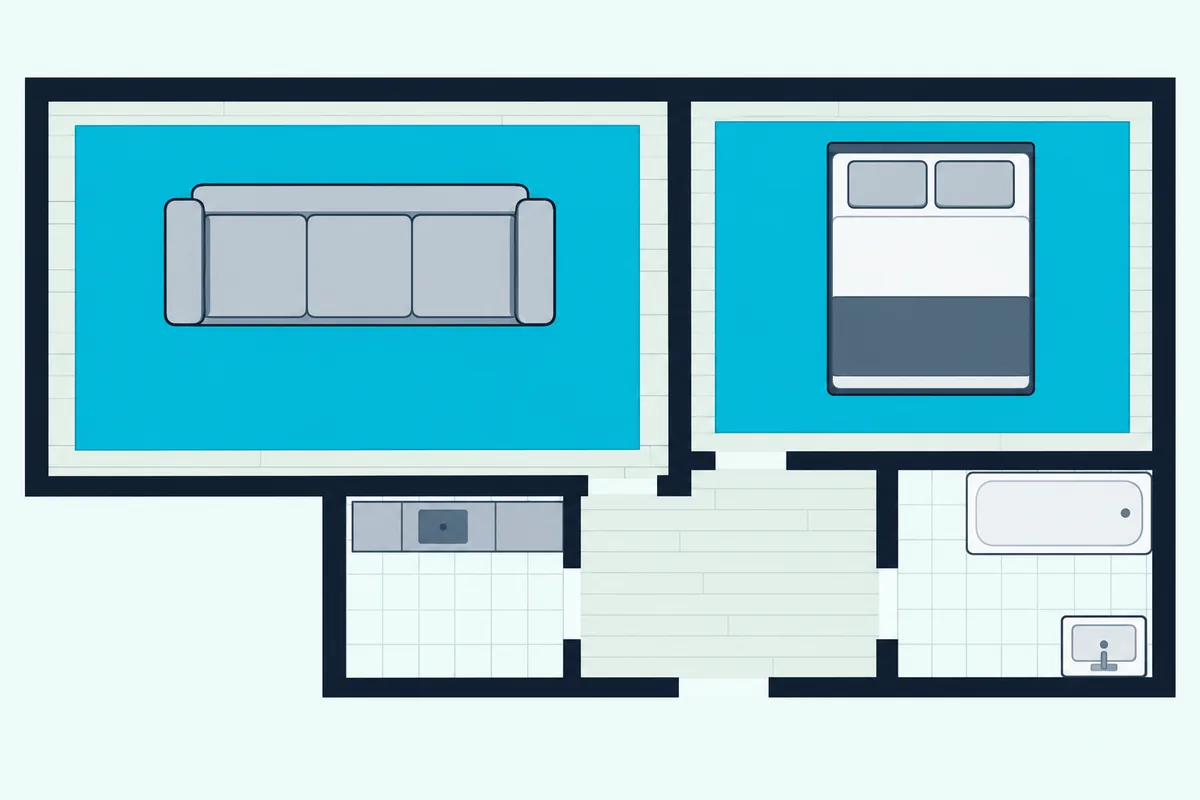
So read your lease and house rules for a floor-covering clause before you shop. The percentage, the rooms that count and any padding rule are written there, and that case’s house rules covered padding too.
Anything past rugs and mats means taking up the existing floor, which is work on the owner’s property. Ask the landlord in writing, and if the floor is being replaced anyway, ask for an underlayment with a published test on a floor like yours.
Codes set a minimum for the whole floor, not for your rug. The International Building Code asks for IIC 50 in a lab test, or NISR 45 when the finished floor is tested in place, between dwelling units (Section 1206.3, in UpCodes’ copy), so ask which version applied when your building went up.
What Do IIC and STC Ratings Actually Measure?
That code number, IIC, comes from a machine, not a person walking. ASTM’s E492 test uses a tapping machine with five steel-faced hammers that strike the floor a combined ten times a second, and the levels measured in the room below from 100 to 3,150 Hz become one number under ASTM E989.
| Rating | What it describes | Test |
|---|---|---|
| IIC | Impact sound through a whole floor and ceiling, in a lab | ASTM E492, rated by E989 |
| NISR | Impact sound through a finished floor, tested in the building | ASTM E1007 |
| Delta IIC | How much a floor covering improves a standard concrete floor | ASTM E2179, lab only |
| LIIC | Low-frequency “thudding” from footfall on lightweight floors | ASTM E3207 |
| STC | Airborne sound such as voices and TV through a wall or floor | ASTM E90 |
The table’s first row carries the catch. ASTM says the tapping machine doesn’t simulate a walker’s weight, so the creaks and booms of real footsteps aren’t in the rating, and E989 leaves out sounds below 100 Hz, where a joist floor thumps when it’s walked on.
ASTM E3207 rates that low-frequency thudding separately, as LIIC. ASTM says it doesn’t replace IIC and can’t be used to show compliance with an IIC requirement.
Delta IIC is the number many underlayment makers quote. ASTM E2179 measures it on a standard concrete floor in the lab, and ASTM says the method doesn’t apply to a floor covering in the field.
STC is the airborne rating, and the same code section asks for STC 50 between units, or NNIC 45 when tested in place. As a yardstick for impact, NRC Canada calls IIC 50 the usual minimum for occupant satisfaction.
Why Does the Same Underlayment Show Several IIC Ratings?
Because IIC rates the whole assembly, one underlayment can carry very different numbers. MP Global’s QuietWalk spec sheet lists these impact ratings, among others, for its 3-mm underlayment, each on a different floor and ceiling:
| Floor and ceiling in the test | IIC |
|---|---|
| Laminate, with a ceiling assembly | 71 |
| Laminate, with a suspended gypsum board ceiling | 68 |
| Laminate, no ceiling (field test) | 60 |
| Floating engineered wood, with a ceiling assembly | 57 |
| Laminate on a 6-inch concrete slab, no ceiling | 55 |
That’s a 16-point spread for one product, and the sheet’s headline figures are 71 with a ceiling assembly and 60 without one. MP Global’s SoundStep LV sheet shows the same swing, IIC 70 with a suspended ceiling under a 6-inch slab and 50 with none, and its headline “IIC 70” carries the note “With ceiling assembly.”
A California condominium community puts it bluntly in its flooring standard: manufacturers’ IIC ratings “are only valid if the factory assemblies match the assembly conditions as found in the field.” The same standard notes that field results can run 3 to 5 dB lower than lab results.
NRC Canada’s advice for comparing them is plain: toppings must be tested on the same basic floor. Ask for the report behind any number, since NRC notes that manufacturers can usually provide test data for their products.
Which Underlayment Should Go Under New Flooring?
Once the old flooring is coming up anyway, the layer under the new one is the owner’s main lever. NRC Canada found that wood flooring laid on a resilient layer can give acceptable impact ratings, with shredded or foamed rubber, foamed plastic and cork mats all common and effective, while tile stuck straight to a slab doesn’t improve on bare concrete and plain wood flooring barely does.
Match the underlayment to the finish. MP Global lists QuietWalk for floating laminate and hardwood and says it isn’t for ceramic tile, glued-down flooring or carpet, while QEP rates its natural cork under ceramic tile.
For a floating laminate or engineered wood floor, QuietWalk’s 3-mm underlayment is the one with a full table of test floors behind its numbers. Its sheet puts the delta IIC at 24 under laminate, and the roll has an attached vapor barrier.
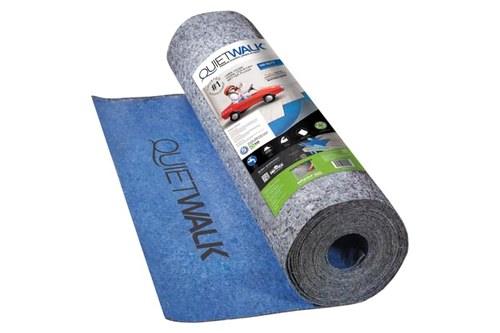
QuietWalk’s 3-mm underlayment
Under ceramic tile on concrete, QEP’s natural cork underlayment lists IIC 74 and STC 70 on a 6-inch slab with a suspended ceiling. For comparison, Amorim’s 1/2-inch AcoustiCORK S130 rated IIC 50 under tile on a slab with no suspended ceiling.
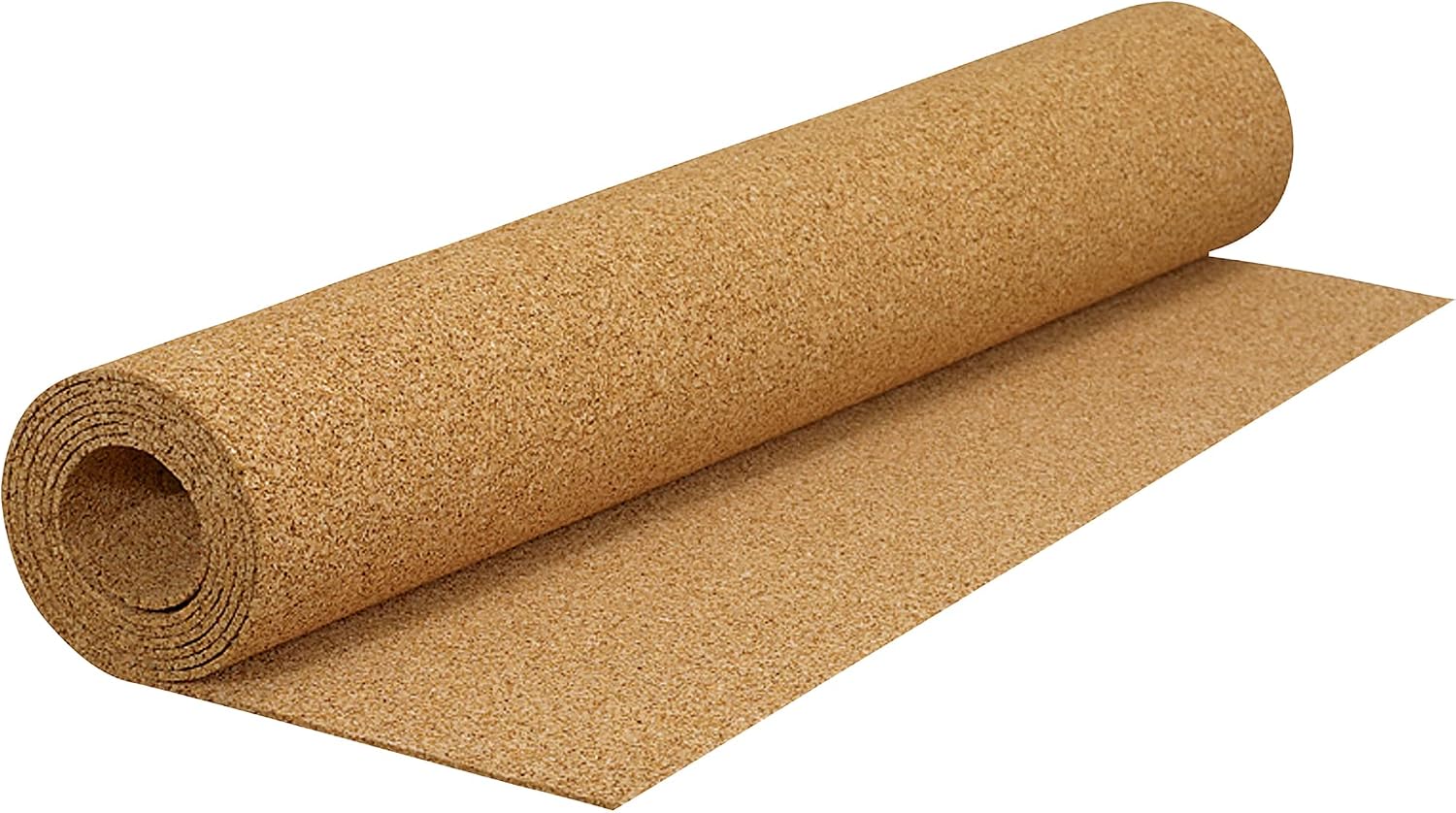
QEP’s natural cork underlayment
Whatever goes down, keep it from touching the walls. Amorim tells installers to keep the finished floor off the perimeter walls with an isolation strip, and MP Global says to set baseboards slightly off the floor to avoid a flanking path.
In a condo, the board may set the number for you. Laguna Woods Village’s Standard 11A, for one, requires a registration form before installation starts and an underlayment rated at least delta IIC 20, and if a grievance test finds new flooring under a field AIIC of 57, the owner who installed it pays for the test, the fix and every retest.
Burton Acoustix’s floor soundproofing picks compare more underlayments by their delta IIC. Ask your board for its written flooring rule before you choose one.
When Is a Floating Floor Worth the Trouble?
If an underlayment isn’t enough, the next step up is a floating floor: a rigid layer that rests on a resilient mat or pads instead of being fixed to the structure. NRC Canada calls it the most practical way to get high impact ratings where a hard finish such as hardwood or ceramic tile is required.
On its concrete test slab, plywood on wood strapping over mineral fiber board rated IIC 50 to 55, and a 35-mm concrete topping on fiber board 60 to 65. On a wood-joist floor the same two approaches rated 55 to 58 and 55 to 65.
HUD’s Noise Guidebook says a floating floor “gives the greatest amount of sound and vibration insulation” but is “extremely expensive.” HUD’s multifamily guide adds that it works best with a soft resilient layer, a heavy floating layer and a joint at the walls that’s flexible and airtight, so the floor’s added airborne insulation isn’t wasted.
Details decide whether it works. NRC’s drawings run a resilient edge strip around the room so vibration can’t bypass the floating layer through the walls, and the multifamily guide says each apartment should have its own floating floor rather than one running through the building.
For the thump on joists, NRC’s common practical approach is mass: a layer of concrete or gypsum concrete on top, with a resilient layer above or below it so the hard surface doesn’t bring the clicks back. A 35-mm topping also raises the floor and adds weight, so this is an owner’s build with a contractor, under the building’s flooring rules.
What If the Noise Comes Up From the Unit Below?
All of that is about noise you make. Noise coming up from the apartment below, like a TV or voices, is airborne, and that’s the part floor coverings barely touch.
In Veneklasen Associates’ lab tests for MiTek, the same truss floor rated STC 54 with engineered wood and STC 53 with carpet and a pad, while its IIC jumped from 51 to 72. NRC lists heavier gypsum board, a deeper cavity and more sound-absorbing material in a resiliently hung ceiling as the factors that help both impact and airborne control, and that ceiling is on the neighbor’s side.
On your side, a floating floor is the owner’s fix that adds airborne insulation, per HUD’s multifamily guide. Short of that, the honest step is a conversation with the neighbor below.
If you’re the one hearing a noisy neighbor’s footsteps from upstairs, what the neighbor below can do about footsteps walks through talking to the neighbor, bringing in the landlord and the ceiling work. Soundproofing between floors from either side covers the floor-side layers and the ceiling-side retrofits.
How Much Quieter Will the Floor Get?
Those limits shape what to expect, and NRC Canada’s two tables show where the gains are largest.
| Topping | On a 150-mm concrete slab | On a basic wood-joist floor (IIC 45) |
|---|---|---|
| Ceramic or marble tile | 28 | 40 |
| Vinyl | 35 to 40 | 47 |
| 9-mm hardwood on a 6-mm resilient layer | 45 to 50 | 47 |
| Plywood on strapping over fiber board (floating) | 50 to 55 | 55 to 58 |
| Carpet and underlay | 75 to 85 | 75 to 85 |
On concrete, moving from a hard finish to carpet and underlay is the biggest change in the table. On joists, the ratings climb too, but NRC warns that people still complain of booming or thumping when the IIC is above 50, because much of that sound sits below the frequencies the IIC covers.
The MiTek truss floor shows that gap in numbers: carpet and a pad lifted its IIC from 51 to 72 but its low-frequency LIIC only from 35 to 47. So on a joist floor, expect soft layers to quiet the clicks and soften the thump, not remove it.
The Bottom Line
That leaves a short order of work for anyone soundproofing an apartment floor. Find out whether it’s concrete or wood joists, cover the walking paths with rugs on dense pads, put rubber where things drop and felt under furniture legs, and read the floor-covering rule in your lease.
If you own the floor, choose an underlayment by its test on a floor and ceiling like yours, keep the new floor off the walls, and float it if hard flooring has to go down. And be honest with the neighbor below: on a wood-joist floor, a heavy step’s thump rides the structure, and no rug takes it away completely.
Frequently Asked Questions
Is there something I can put on my floor to reduce noise?
Yes: a thick rug on a dense pad over the areas you walk is the most effective thing you can lay down without changing the floor. In NRC Canada’s tests, carpet and underlay rated IIC 75 to 85 on both a concrete slab and a wood-joist floor, far above any hard finish, though those were carpeted test floors, not rugs. Rubber mats help where things get dropped, and felt pads under chair legs cut scraping. None of these does much against voices or TV from below, which travel as airborne sound.
How do I stop my footsteps from bothering the neighbor downstairs?
Cover the paths you walk most with rugs on dense pads, starting with the rooms you use most. On a wood-joist floor, expect the clicks to fade sooner than the thumps: NRC Canada notes that people below can still hear booming or thumping even when a floor rates above IIC 50. If you own the unit, a resilient underlayment or a floating floor under the next flooring change is the structural fix.
Can a renter add an underlayment or replace the flooring?
Not on their own, because it means taking up the existing floor, which belongs to the owner. Ask the landlord in writing, and if the floor is being replaced anyway, suggest an underlayment with a published test on a floor like yours. Check the lease while you’re at it: some house rules go the other way and require rugs over most of the floor.
What IIC rating should an apartment floor have?
The International Building Code asks for at least IIC 50 between dwelling units in a lab test, or NISR 45 when the finished floor is tested in place, and NRC Canada calls IIC 50 the usual minimum for occupant satisfaction. Some associations ask for more: Laguna Woods Village’s standard expects new flooring to reach a field AIIC of 57 if a test is requested. The rating belongs to the whole floor and ceiling, not to the underlayment alone.