Best Soundbar for 75 Inch TV: 6 Bars Wide Enough to Match

Picking the best soundbar for 75 inch TV setups starts with a tape measure, because the screen above the soundbar is about 65 inches wide.
Bose’s own largest bar is just over 41 inches wide, so a soundbar that looks generous under a 55-inch set can look like a stripe under a 75-inch one, and big screens often sit in rooms that swallow small speakers.
Get the width, the channel count and the connection right, and the sound spreads as wide as the picture instead of coming from a short strip in the middle.
Below are six picks from 41 to 51 inches wide, checked on Amazon on 24 October 2026 and described from each maker’s own guide or spec page.
The short answer comes first, then the width math, a card per pick, and the mounting, room and Atmos details that decide between them.
What Is the Best Soundbar for a 75-Inch TV?
The best soundbar for a 75-inch TV is one between about 45 and 52 inches wide with HDMI eARC, Dolby Atmos and a path to a subwoofer and rear speakers. On that rule, the Samsung HW-Q990F is the most complete package here: a 48.5-inch bar with the subwoofer, two rear speakers and a wall-mount kit in the box, per the box list in its Amazon listing photos.
If you’d rather start with one soundbar and add pieces later, the 46.4-inch Sonos Arc Ultra is the pick, and the 51.2-inch Sony BRAVIA Theater Bar 9 is the widest on the list. LG’s S95TR brings the most channels, the Bose Smart Ultra is the slim all-in-one, and the Polk MagniFi Max AX puts a 10-inch subwoofer and three HDMI inputs in the box.
| Pick | Bar width | Share of a 75-inch screen’s width | Channels (maker or listing) | Subwoofer in the box | Best for |
|---|---|---|---|---|---|
| Samsung HW-Q990F | 48.5 in | 74% | 11.1.4 | Yes, plus two rears | The full surround package |
| Sonos Arc Ultra | 46.4 in | 71% | 9.1.4 | No | One bar now, more later |
| Sony BRAVIA Theater Bar 9 | 51.2 in | 78% | 13 speakers (listing) | No | The widest bar |
| LG S95TR | 49.2 in | 75% | 9.1.5 | Yes, plus two rears | The most channels |
| Bose Smart Ultra | 41.1 in | 63% | 5.0.2 | No | A slim all-in-one |
| Polk MagniFi Max AX | 45 in | 69% | 5.1.2 | Yes | HDMI inputs and a subwoofer |
The share column divides each bar’s width by 65.4 inches, the width of a 75-inch 16:9 screen. None of the six reaches full width; even the widest, Sony’s 51.2-inch bar, leaves about 7 inches of screen on each side, so the table is about how close each one gets.
| Product | Size | Link |
|---|---|---|
The Full Surround Package 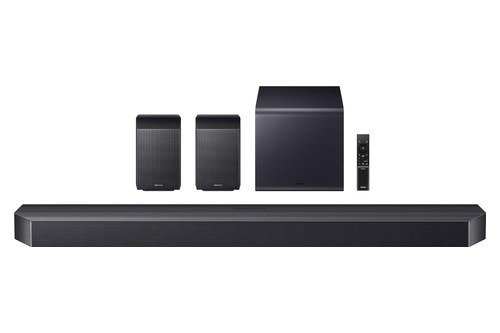 | 48.5 inch | See ratings |
One Bar Now, More Later 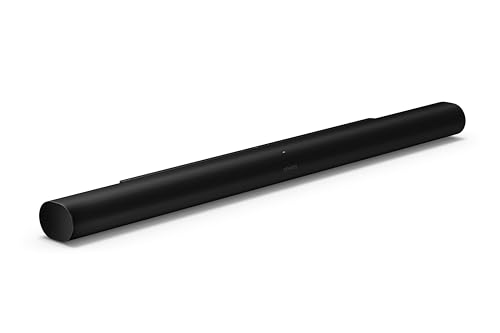 | 46.38 inch | See ratings |
The Widest Bar 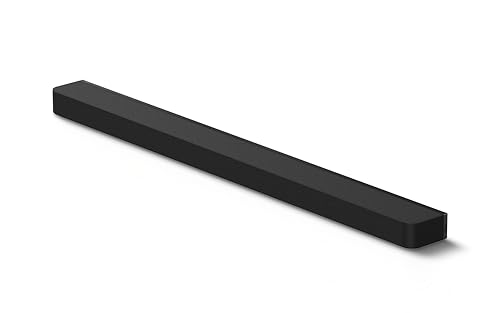 | 51.2 inch | See ratings |
The Most Channels 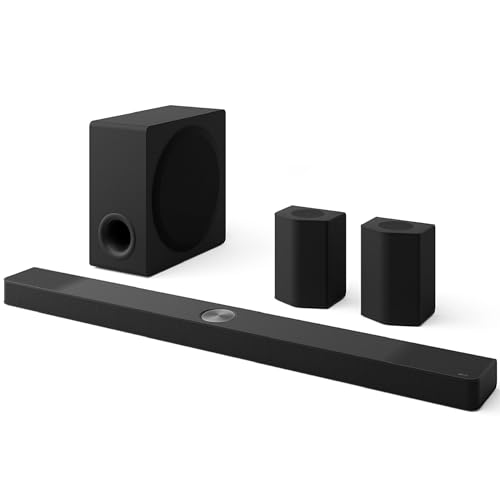 | 49.2 inch | See ratings |
A Slim All-in-One 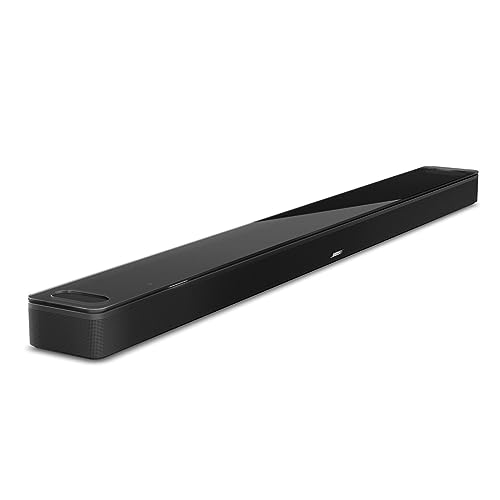 | 41.14 inch | See ratings |
HDMI Inputs and a Subwoofer 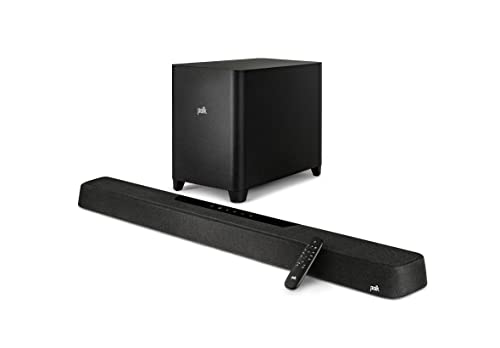 | 45 inch | See ratings |
How Wide Should a Soundbar Be for a 75-Inch TV?
A soundbar for a 75-inch TV should be as wide as you can get, ideally 45 inches or more, because the screen itself is about 65.4 inches across. That figure comes from the screen’s shape: a 16:9 screen is about 0.87 times its diagonal wide, so 75 inches of diagonal gives roughly 65 inches of glass, and the TV’s frame adds a little more.

Bose warns against sizing on width alone. Its buying guide says many guides tell you to pick a soundbar by the TV’s width, and that room size, reflective surfaces, the number of speakers and channels, and the supported formats matter as much (Bose, How to choose a soundbar).
Bose’s own numbers show how far short most bars fall. It describes its largest bar, the Smart Ultra, as just over 41 inches wide and roughly the width of a 50-inch TV, so under a 75-inch screen it covers about 63% of the glass.
Here’s a practical test before you buy. Stretch a tape measure across the bottom of your screen, then mark the soundbar’s width from the center out with two pieces of painter’s tape, and look at it from the couch.
Do 70, 77, 80 and 85-inch TVs change the answer?
Not much, because every size from 70 to 85 inches is already wider than the widest pick here. The same 0.87 rule gives about 61 inches of screen for a 70-inch TV, 67.1 inches for a 77-inch, 69.7 inches for an 80-inch and 74.1 inches for an 85-inch.
So the picks stay the same, and the bigger the TV, the more the wide bars (the Sony, the LG and the Samsung) earn their place. For the general rule at every size, from 32 inches up, our soundbar size guide by TV width has the full chart.
Get Studio Tips Weekly
Join 5,000+ creators getting acoustic treatment advice every week.
No spam. Unsubscribe anytime.Which Soundbars Are the Best Picks for a 75-Inch TV?
Those widths set the order below: the two complete systems and the expandable single bar first, then the widest bar, then the narrower all-in-ones. Every card was checked on Amazon on 24 October 2026 for a 4.0-star or better average, 50 or more reviews and stock; the ratings themselves aren’t shown here.
Samsung HW-Q990F
The Q990F is the pick for a 75-inch TV if you want the whole system in one box. Samsung’s user guide shows Dolby Atmos and DTS:X input played as 11.1.4 channels when the subwoofer and surround speakers are connected together.
For the full surround package, the Samsung HW-Q990F is the pick.
the Samsung HW-Q990F
At 48.5 inches, the bar covers about 74% of a 75-inch screen, and it stands 2.79 inches tall, per the dimension drawing in its listing photos. The same photos list an HDMI 2.1 cable among the box contents, so the eARC hookup needs nothing extra.
The listing’s footnotes are worth reading if your TV isn’t a Samsung. Wireless Dolby Atmos needs a 2022 to 2025 Samsung TV, and Q-Symphony, which plays the TV’s speakers with the bar, needs a 2020 to 2025 Samsung TV; on any other brand the bar still connects over HDMI eARC.
Sonos Arc Ultra
The Arc Ultra is the single bar to start with if you plan to grow the system later. Sonos’s guide lists 14 drivers, seven tweeters (two firing upward), six midwoofers and its Sound Motion woofer, run by fifteen amplifiers, and describes a 9.1.4 Dolby Atmos experience from the one bar (Sonos Arc Ultra guide).
For one bar now and more later, the Sonos Arc Ultra is the pick.
the Sonos Arc Ultra
Sonos gives the bar’s width as 46.38 inches and its height as 2.95 inches, which makes it about 71% as wide as a 75-inch screen. The guide also says Dolby TrueHD and Dolby Atmos in TrueHD need an HDMI eARC connection.
The format gap is DTS:X. Sonos lists DTS Digital Surround but not DTS:X, so a DTS:X disc plays in its older core format here.
Sony BRAVIA Theater Bar 9
The Theater Bar 9 is the widest pick on this list and the closest to a 75-inch screen’s width. Its listing photo draws it at 51.2 inches wide with 13 speakers, against 43.3 inches and 11 speakers for the Theater Bar 8, so it covers about 78% of the glass.
For the widest bar, the Sony BRAVIA Theater Bar 9 is the pick.
the Sony BRAVIA Theater Bar 9
Sony’s help guide for the Theatre Bar 9 and 8 shows Dolby TrueHD and DTS:X supported on the HDMI input and the TV eARC input, but not over plain ARC, where Atmos arrives only inside Dolby Digital Plus (Sony supported audio formats). The same guide covers an optional subwoofer and Sony’s SA-RS5 rear speakers.
The guide adds one setup step after the soundbar is placed. It recommends running Sound Field Optimization in Sony’s app whenever you move the soundbar, the optional speakers or the seating.
LG S95TR
The S95TR is the pick for the most channels in a large room. LG’s listing calls it a 9.1.5-channel system, and LG’s specification sheet lists amplifiers for the bar’s front, center, side and overhead speakers plus wireless rears with their own top speakers and a 220-watt RMS subwoofer (LG S95TR specifications).
For the most channels, the LG S95TR is the pick.
the LG S95TR
LG gives the bar’s size as about 1,250 mm wide and 63 mm tall including its base, which is 49.2 by 2.5 inches. That makes it about 75% as wide as a 75-inch screen.
LG’s manual draws the full layout: front, center, top and side speakers in the bar, the subwoofer, and rear, rear-side and rear-top speakers in the two rear units. Its format list includes Dolby TrueHD, Dolby Atmos, DTS-HD Master Audio and DTS:X.
Bose Smart Ultra Soundbar
The Smart Ultra is the slim all-in-one for a 75-inch TV in a room that can’t take a subwoofer yet. Bose calls it a 5.0.2-channel Dolby Atmos bar with two upward-firing dipole transducers, and its product page lists it at 41.14 inches wide and 2.29 inches tall (Bose Smart Ultra Soundbar).
For a slim all-in-one, the Bose Smart Ultra Soundbar is the pick.
the Bose Smart Ultra Soundbar
Bose’s own guide is honest about the trade. It calls the Smart Ultra roughly the width of a 50-inch TV and says a big room needs a big soundbar, ideally paired with other speakers.
That’s where the add-ons come in. Bose’s owner’s guide lists the Bass Module 500 and 700 and both Bose surround speaker sets as accessories that connect to this bar.
Polk MagniFi Max AX
The MagniFi Max AX is the pick if your sources plug into the bar, not the TV. Polk’s page lists 3-in/1-out 4K HDMI switching with eARC, a 10-inch wireless subwoofer in the box and Dolby Atmos and DTS:X from an 11-driver, 5.1.2-channel bar (Polk MagniFi Max AX).
For HDMI inputs and a subwoofer in one box, the Polk MagniFi Max AX is the pick.
the Polk MagniFi Max AX
Polk lists the bar at 45 inches wide, about 69% of a 75-inch screen. For streaming music, the page lists Apple AirPlay 2, Google Chromecast and Spotify Connect over Wi-Fi, plus Bluetooth 5.0.
Polk sells the same bar with its SR2 wireless rear speakers as the MagniFi Max AX SR. That version failed today’s stock check, so the card is the soundbar and subwoofer, and the SR2 pair can be added later.
Will the Soundbar Fit Under a Wall-Mounted 75-Inch TV?
Those six cards hide one practical difference: a soundbar fits under a wall-mounted 75-inch TV only with the gap its maker asks for, about 2 to 5.5 inches for the picks here. Big TVs often go on the wall, so this is where the six differ more than in the table.
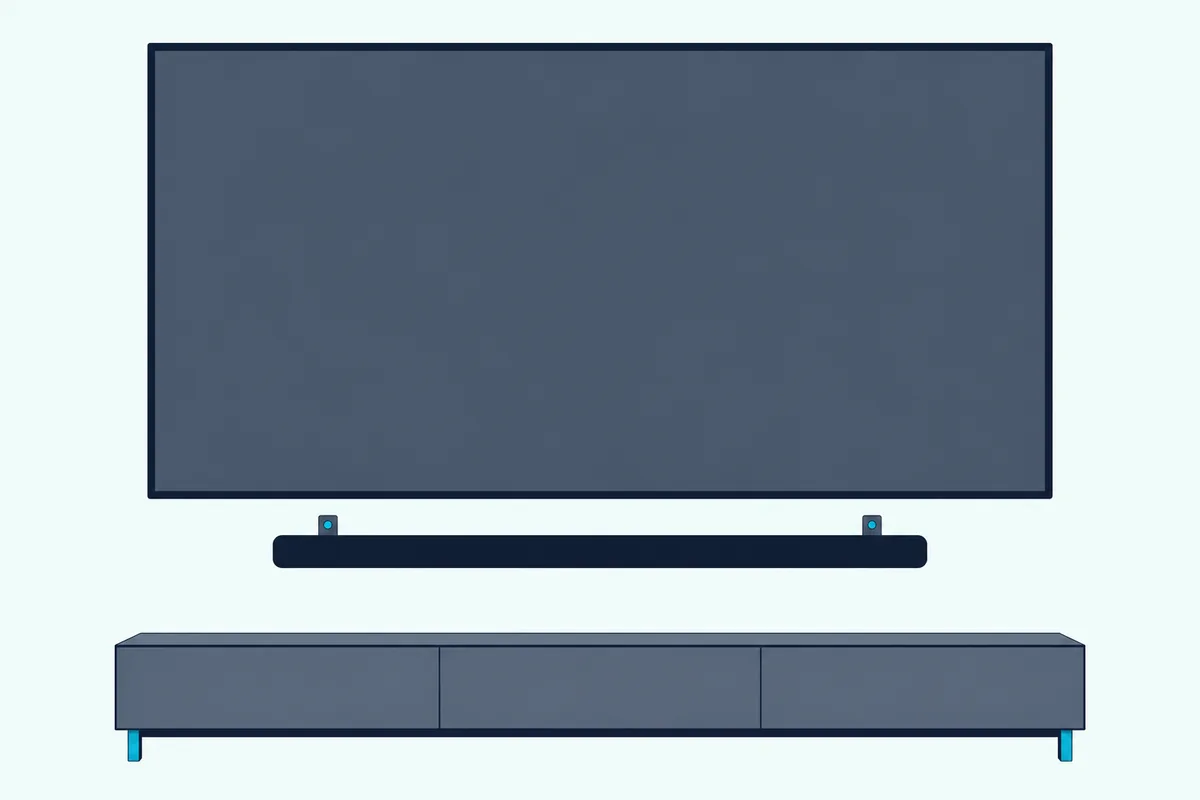
Samsung’s user guide says to install the Q990F at least 5 cm, about 2 inches, below the bottom of a wall-mounted TV, and to line up the wall-mounting guide’s center line with the TV’s center. The wall-mount kit is in the Q990F’s box.
Sonos asks for more room. Its guide says to keep at least 4 inches between the Arc Ultra and the TV, and to mount the bracket with 5.5 inches between its top edge and the TV.
Sony’s help guide says to mount the Theater Bar 9 under a wall-mounted TV with the supplied brackets only, never directly on the wall, because heat can build up inside the bar. It also asks for at least 10 mm, about 13/32 inch, between the bar’s rear vents and the TV or wall.
What if the TV stands on a console?
Then the bar’s height matters, because it sits between the TV’s feet or pedestal and has to clear the bottom of the screen. The published heights here run from 2.29 inches for the Bose to 2.95 inches for the Sonos; Polk’s page gives two different figures, so measure that one.
Sony’s help guide adds one warning for console setups: don’t cover the TV’s remote sensor with the bar, and check afterward that the TV remote still turns the TV on and off. Measure the gap under your own screen first, since that figure is in your TV’s manual, not the bar’s.
How Much Power and How Many Channels Does a Big Room Need?
A big room needs more speakers and channels rather than a single wattage figure, and Bose draws the line at about 500 square feet. Its buying guide says sound waves get lost in rooms of that size, especially with a soundbar that has only a few speakers, and that large windows, bare walls and uncovered floors make clear sound harder.
For comparison, Bose puts the average US living room at around 340 square feet with 9-foot ceilings and says a midsize soundbar can do well there. A 75-inch TV can sit in either room, so measure yours: a 20 by 25-foot open-plan space is 500 square feet, right at Bose’s line.
None of the six makers publishes a room size or a loudness rating for these bars in the pages read here, so there’s no maker figure to compare. Channel counts are the next best guide, and that’s where the Samsung (11.1.4) and LG (9.1.5) systems stand out.
Think of it like lighting a room. One bright lamp in the middle leaves the corners dim, while several smaller lamps spread the same light more evenly, which is what rear and height speakers do for sound.
Is a 2.1 or 5.1 soundbar better for a big screen?
A 5.1 system is better for a big screen in a big room, because it adds a center channel for dialogue and two surround channels. A 2.1 bar has left, right and a subwoofer, so effects stay in front of you, which matters more as the room and screen grow.
The Samsung, LG and Polk picks are 5.1 or more out of the box; the Bose is 5.0.2 until you add a Bass Module, and the Sonos and Sony reach full surround with their makers’ add-ons. If a subwoofer is your priority, soundbar systems with a separate sub in the box covers that question across more budgets.
Do You Need Dolby Atmos and HDMI eARC for a 75-Inch TV?
Channel counts only pay off if the formats reach the soundbar, so the connection comes next: you need HDMI eARC for the lossless Dolby TrueHD and DTS:X tracks, and every pick here supports Dolby Atmos. The difference matters most on a big screen, where discs and premium streams are the reason many people bought the TV.
The difference shows up in the makers’ format tables. Sony’s table plays Atmos over plain ARC only inside Dolby Digital Plus, and Sonos marks Dolby TrueHD and Atmos in TrueHD as eARC-only, so the eARC port on your TV is the one to use.
Sonos’s TV requirements page sets the floor: its Atmos bars must be connected to HDMI ARC or eARC to play any Dolby Atmos content (Sonos TV requirements). Sonos’s optical adapter works as a fallback, but Sonos notes you lose CEC and voice control of the TV that way.
DTS:X is the format that splits the list. The Samsung, Sony, LG and Polk bars list it, Sonos lists only DTS Digital Surround, and Bose doesn’t list DTS:X for the Smart Ultra.
Which TV brand changes the pick?
A Samsung TV changes it most, because the Q990F’s Wireless Dolby Atmos and Q-Symphony features only work with recent Samsung TVs, per its listing. Owners of a 75-inch Samsung will find more Samsung-specific detail in our Samsung TV soundbar picks.
Sony’s listing photos describe Acoustic Center Sync with BRAVIA TVs too, but every pick on this page works with any TV brand over HDMI eARC. If your set is a 77-inch LG C3, the LG C3 soundbar shortlist goes through LG’s own output chart.
Should You Add a Subwoofer or Rear Speakers Later?
You should plan for them with a 75-inch TV, because a single soundbar can only spread sound so far across a big room. The two LG and Samsung systems include them, and the other four bars each have a maker’s path to add them.

Sonos’s Sub 4 page names the Arc Ultra as a partner for richer bass, and the Arc Ultra guide names Era 300 speakers as its rear option. Bose lists its Bass Modules and surround speakers, Sony lists an optional subwoofer and the SA-RS5 rears, and Polk lists its SR2 rears for the MagniFi Max AX.
Here’s a real scenario. If you buy the Arc Ultra for a 75-inch TV in a 340-square-foot living room and later knock through to an open-plan kitchen, adding a Sub 4 and two Era 300s turns the same bar into a full system without replacing it.
The width math from earlier still applies. Rear speakers don’t make a narrow bar look wider under the screen, so the bar’s own width is still the first choice to make.
How Were These Soundbars Checked?
Each bar’s width, channels, formats and connections come from its maker’s guide, manual or spec page, except where a card says the figure comes from the Amazon listing or its photos. Samsung’s and Sony’s own product sites refused Burton’s scripts earlier this month, so Samsung’s figures come from a user guide saved on 8 October and the listing photos, and Sony’s from its help guide and listing photo.
No bar was tested or listened to for this page, and none of the descriptions above is a listening verdict. Every pick was checked on Amazon on 24 October 2026 for a 4.0-star or better average, at least 50 reviews and stock, and the Klipsch Flexus Core 300, Nakamichi Dragon and Shockwafe, Vizio Elevate and Polk MagniFi Max AX SR were left out because their listings couldn’t ship or were unavailable that day.
The Bottom Line
For a 75-inch TV, buy the widest soundbar your room and budget allow, then plan for a subwoofer and rear speakers. The Samsung HW-Q990F and LG S95TR arrive complete, the Sonos Arc Ultra grows into a system, and the Sony Theater Bar 9 gets closest to the screen’s 65-inch width.
The Bose Smart Ultra and Polk MagniFi Max AX are the narrower options, and they make most sense in a mid-sized room or where a console or wall bracket limits the width. Whichever you choose, connect it to the TV’s HDMI eARC port.
Frequently Asked Questions
How big of a soundbar do I need for a 75-inch TV?
Aim for 45 inches or wider. A 75-inch 16:9 screen is about 65.4 inches across, and the widest bars sold for TVs run a little over 50 inches, so no common soundbar matches it fully.
Among the picks here, the Sony BRAVIA Theater Bar 9 (51.2 inches), LG S95TR (49.2 inches) and Samsung HW-Q990F (48.5 inches) come closest. Bose’s guide adds that room size and speaker count matter as much as width.
What is the best soundbar for a 75-inch Samsung TV?
The Samsung HW-Q990F, because its Wireless Dolby Atmos and Q-Symphony features need a recent Samsung TV, per its listing: 2022 to 2025 models for Wireless Dolby Atmos and 2020 to 2025 models for Q-Symphony.
It’s 48.5 inches wide and comes with a subwoofer, two rear speakers and a wall-mount kit. Any other pick here also works with a Samsung TV over HDMI eARC.
Is a soundbar with a subwoofer better for a 75-inch TV?
For a large room, a subwoofer is worth having, because the bars with a single published height here are only 2.29 to 2.95 inches tall and Bose says big rooms need more than a few speakers. The Samsung, LG and Polk picks include one.
The Sonos, Sony and Bose bars work alone and take their maker’s subwoofer later. Bose’s guide calls its biggest soundbar best paired with other speakers in a large room.
Can I mount a soundbar under a wall-mounted 75-inch TV?
Yes, with the gap the maker asks for. Samsung says at least 5 cm (about 2 inches) below the TV for the Q990F, Sonos asks for at least 4 inches for the Arc Ultra, and Sony says to use the Theater Bar 9’s supplied brackets.
The Samsung and Sony bars come with their wall-mounting hardware, per the listing photos and Sony’s help guide.
Do I need eARC for a soundbar on a 75-inch TV?
You need eARC for Dolby TrueHD and DTS:X, the lossless formats from players and some apps. Over plain ARC, Sony’s table and Sonos’s guide show Atmos arriving only inside Dolby Digital Plus.
Every pick here connects over HDMI eARC, and Samsung and Bose include the HDMI cable in the box.