Best Wattage for Sound Bar Shoppers, and Why Box Watts Mislead

If you’re hunting for the best wattage for sound bar shopping, the biggest number on the box is the wrong place to start.
One maker prints 240W max and 120W RMS for the same bar, another prints only a 240W max figure, and a third prints no power rating at all.
Once you know what each number measures, you can stop paying for a figure and start comparing what actually changes the volume in your room.
The first step is checking whether a rating is amplifier output, peak output or simply the electricity the bar draws from the wall.
From there, this guide walks through the one US test rule, the decibel math, the specs that matter more, and the figures popular makers really list.
What Is the Best Wattage for a Sound Bar?
There’s no single best wattage for a sound bar, because makers measure power in different ways and most don’t say how. Comparing two boxes is only fair when both figures are the same kind of rating, and even then a big gap in watts is a small gap in volume.
The decibel scale shows why. HyperPhysics, Georgia State University’s physics reference, notes that it takes about 10 times the sound intensity to sound twice as loud, and that about 1 decibel is the smallest change most ears notice (HyperPhysics).
Doubling the power adds only about 3 dB by the same formula. So the “300W vs 160W” question that shoppers type comes out to under 3 dB on paper, if both numbers were measured the same way, which is well short of twice as loud.
Here’s the plain answer for most TV rooms. Pick the bar by its channels, its subwoofer and your room, then treat the power rating as a tiebreaker between two bars from the same maker, rated the same way, alongside a wider checklist for picking a soundbar.
Which Watts Does a Soundbar Spec Sheet Actually Show?
That tiebreaker only works if you know which rating you’re looking at. A spec sheet can list two very different power figures: the amplifier’s output to the speakers, and the power the bar consumes from the outlet.
Output is what most shoppers mean. Yamaha’s spec page for the SR-B40A lists “Output Power” of 200 W, split into 50 W for each front channel and 100 W for the subwoofer (Yamaha).
Consumption is a different line on the same kind of page. Yamaha lists the SR-B40A’s power consumption separately, at 25 W for the bar and 20 W for the subwoofer.
Some makers list only the consumption line. Polk’s Signa S4 manual gives power consumption of 40 W for the bar, and Sony’s BRAVIA Theatre Bar 5 help guide gives 30 W when it’s on, with no output rating in either specification list.
Bose goes further. The owner’s guides for the Smart Soundbar 900 and the Smart Ultra Soundbar list an input rating of 100 to 240 volts and 65 W, which is what the bar draws, not what it delivers to its drivers.
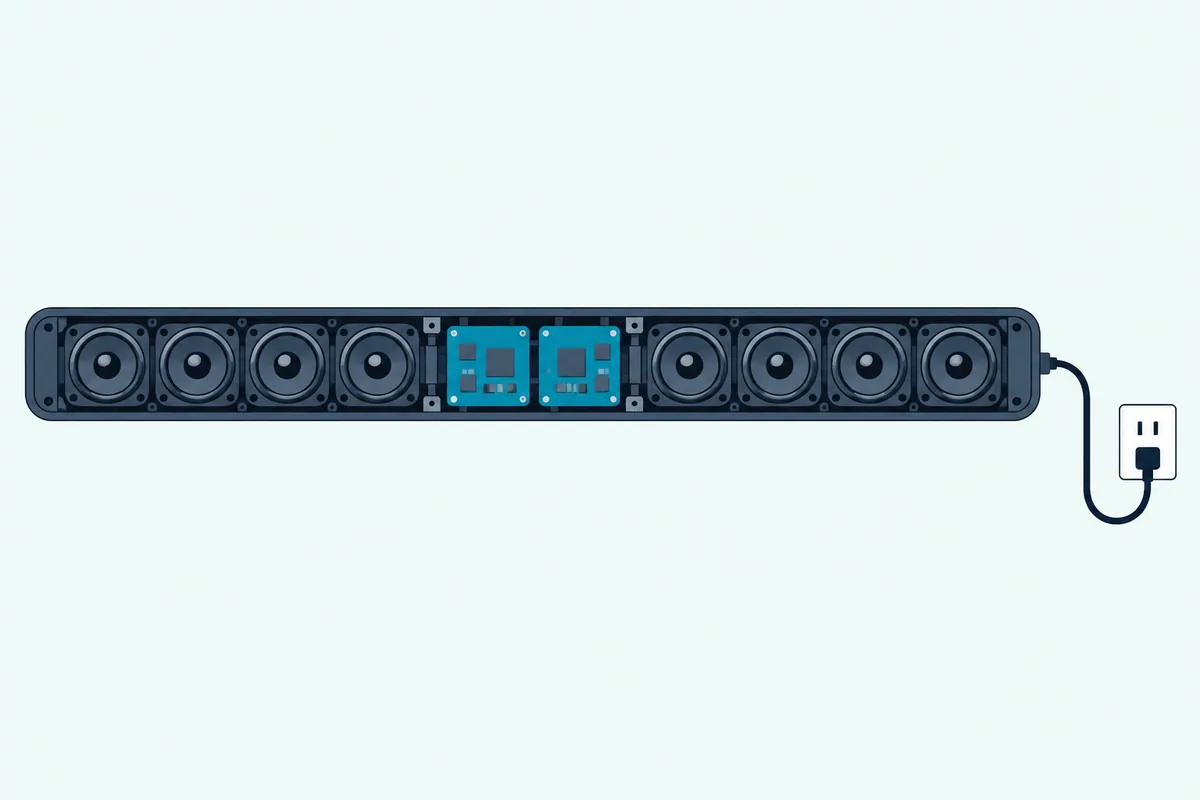
So the first test is simple. If the line says “consumption”, “input rating” or “power supply”, it’s an electricity figure, and it tells you nothing about how loud the bar plays.
Get Studio Tips Weekly
Join 5,000+ creators getting acoustic treatment advice every week.
No spam. Unsubscribe anytime.Is Peak, RMS or Total System Power the Number to Compare?
Once you’ve found an output figure, the next trap is the kind of output it is. Peak or “max” power is a maker’s top figure with no stated duration, RMS is meant as a continuous figure, and total system power adds every channel together.
Philips prints two of these side by side for its TAB5309. The specs list “240W max / 120W RMS”, so the bigger number is exactly double the continuous one on the same bar.
Other makers print only one kind. Hisense’s HS2100 spec sheet advertises 240W “Max Audio Power”, while Klipsch’s Flexus Core 200 spec sheet lists “System Power 185W RMS”.
Those two bars can’t be ranked by their numbers alone. Philips shows that a max figure can be twice an RMS figure, so a 240 W max rating and a 185 W RMS rating may describe similar amplifiers, or not.
Total system power hides a second wrinkle. LG’s manual for the S40T lists a total of 300 W RMS, made of 50 W for each front channel and 200 W for the subwoofer.
That’s two thirds of the headline in the subwoofer alone. Samsung’s HW-B550F user guide splits it the same way: 80 W of max output for the bar (40 W x 2) and 220 W for the subwoofer.
Think of total system power like a car’s combined horsepower across two engines. It’s a real sum, but it doesn’t tell you how much is driving the part you care about, which for dialogue is the bar itself.
Who Sets the Rules for Amplifier Watt Ratings?
Those mixed labels persist even though one federal rule in the US says how home amplifier power must be measured. The Federal Trade Commission’s amplifier rule, 16 CFR Part 432, applies whenever a power output claim is made for sound amplification equipment sold for home entertainment (eCFR).
The rule’s scope names radios, component amplifiers and “self-powered speakers for computers, multimedia systems and sound systems, and the like”. It doesn’t name soundbars, and claims for products rated at 2 watts or less are exempt.
Its test is strict. The amplifier is preconditioned for an hour at one eighth of its rated power, then must hold its rated power across 20 Hz to 20 kHz at no more than 1% total harmonic distortion plus noise into 8 ohms, with all associated channels driven.
The rated figure must be labeled “FTC Power Output Rating” and shown more prominently than any other power claim. Any other rating must carry the words “This rating was not tested under the FTC standard”, under amendments published in the Federal Register on June 12, 2024.
None of the soundbar spec sheets read for this guide carries the FTC label. LG comes closest to stating its terms, listing each channel’s impedance and “THD 10 %”, which is ten times the distortion limit in the FTC test.
Vizio takes a different route entirely. Its manuals for the SV510M, SV510X and SV210D list no output power at all, and instead give a system sound pressure level of 96 dB SPL, measured with pink noise at 1 meter, C-weighted (Vizio).
That’s a loudness figure with its method attached. It’s closer to what you actually want to know than a power rating with no conditions, although other makers’ bars publish no SPL to compare it against.
Do More Watts Make a Soundbar Louder?
That 96 dB figure is a good bridge to the real question, because loudness is measured in decibels, not watts. Extra power makes a soundbar louder only slowly: each doubling of amplifier power adds about 3 dB, and it takes about ten times the power to sound twice as loud.
Run the numbers on two bars from the same maker. Yamaha rates the SR-B30A at 120 W and the SR-B40A at 200 W on the same spec page, a power ratio of 1.67, which works out to about 2.2 dB.
That’s a real step, roughly twice the 1 dB change HyperPhysics describes as just noticeable. It’s nowhere near the doubling the extra 80 W seems to promise on the box.
The 300W vs 160W comparison lands in the same place. If both were measured the same way, the gap is about 2.7 dB, and a bar would need roughly 1,600 W to sound twice as loud as a true 160 W one.
Try this at home with the bar you own. Note the volume step you normally use for films, then check how many steps remain before the maximum, since that remaining room is the headroom extra power would add to.
Why Do Sensitivity, Drivers and the Subwoofer Matter More?
If power moves volume that slowly, the parts that turn power into sound deserve more attention. Sensitivity, the driver layout and the subwoofer decide how much sound each unit of power produces and where it goes.
Sensitivity is the clearest of the three, and passive speakers publish it. Polk lists its Monitor XT30 center speaker at 89 dB SPL from 1 watt at 1 meter, with a recommended amplifier power of 30 to 200 W per channel.
A speaker rated 3 dB less sensitive would need twice the power to match that level. That’s the same 3 dB as doubling the amplifier, which is why a sensitive speaker can make a modest amplifier look big.
None of the powered bars read for this guide publishes sensitivity, which fits a product whose amplifier and drivers are sold as one unit. That’s part of why Vizio’s system SPL figure is useful: it already folds the amplifier, the drivers and the cabinet into one number.
Driver count belongs in the same picture. Vizio’s SV510M manual lists three small full-range drivers in the bar, two in the surrounds and one 5-inch subwoofer, and its 96 dB rating is for that whole system.
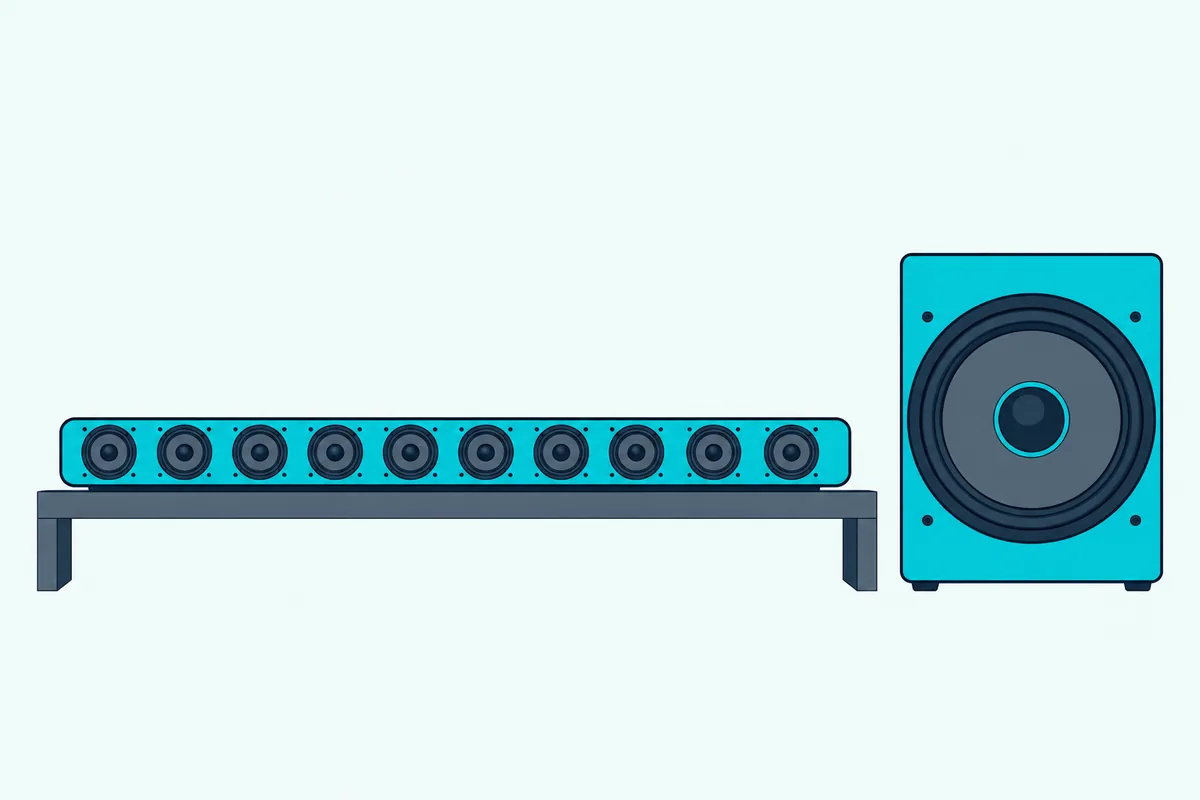
The subwoofer is where the biggest share of the advertised power goes. LG gives its S40T subwoofer 200 of 300 W, Yamaha gives the SR-B40A’s 100 of 200, and Samsung gives the HW-B550F’s subwoofer 220 W against 80 W for the bar.
So a big total often means a big subwoofer amplifier. That share goes to bass, and it’s why deciding whether you need a subwoofer with a soundbar changes the headline figure more than any other choice.
How Does Room Size Change the Watts You Need?
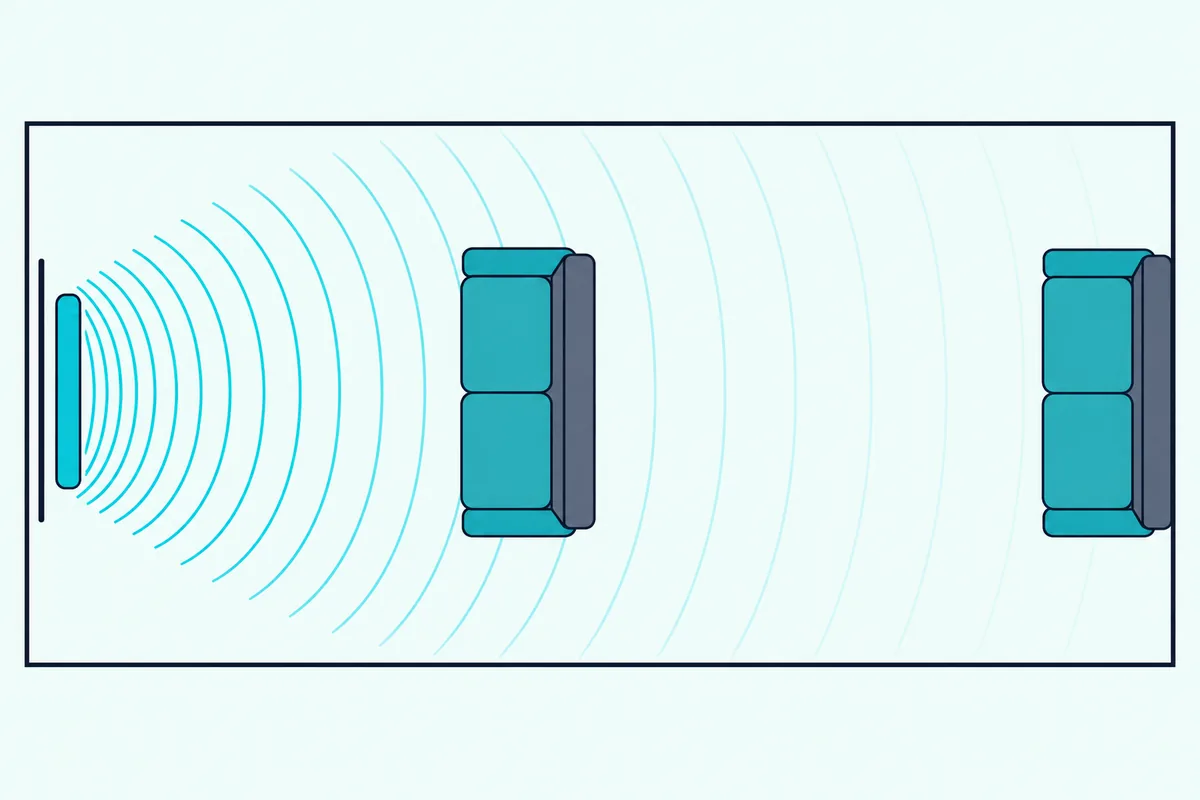
Those bass and sensitivity numbers all assume you’re sitting 1 meter away, which nobody does. Room size changes the power you need because sound weakens with distance: in open space, each doubling of distance drops the level by about 6 dB.
HyperPhysics shows the inverse square law this way: doubling the distance drops intensity by about 6 dB, and 10 times the distance drops it by 20 dB (HyperPhysics). The same page notes that reverberation partly makes up the loss indoors.
Put that next to the 3 dB rule from earlier. Making up 6 dB takes four times the power, so a couch twice as far from the bar asks for roughly four times the power to hear the same level, before the room’s reflections help.
THX’s room guidance talks about volume and seating distance, not power ratings. THX, which certifies home theater electronics, sizes its classes by room: up to 1,000 cubic feet at about 8 feet from the screen, up to 2,000 at about 10 feet, and up to 3,000 at about 12 feet.
THX tests power output against a loudness target, its Reference Level, and the page read for this guide prints no power minimum for any class. That’s the honest framing for soundbars too: the room sets how loud the bar must play at your seat, and amplifier power is only one input to that.
Here’s a real scenario. A 12 by 15 foot room with an 8 foot ceiling is 1,440 cubic feet, between THX’s two smaller classes, and a couch 10 feet back sits about 10 dB further down than a seat at 1 meter (about 3.3 feet), by the 6 dB rule.
Smaller rooms put the seats closer, so distance costs fewer decibels, and Burton’s picks for compact soundbars in small rooms start there. In bigger rooms the same math shows why an extra 50 watts on a 200 W bar adds only about 1 dB.
How Many Watts Do Popular Soundbars List?
With the room math in hand, the makers’ own figures are easier to read. Popular bars list anything from 80 W to 810 W, and several list no output figure at all.
The table gives each figure exactly as the maker prints it, with its type. Read across a row before comparing down a column, since a “max” figure, an RMS figure and an SPL figure aren’t the same measurement.
| Soundbar | Power figure the maker lists | What kind of figure |
|---|---|---|
| Yamaha SR-B30A | 120 W (30 W x 2 front, 60 W built-in subwoofer) | Output power, no test terms given |
| Yamaha SR-B40A | 200 W (50 W x 2 front, 100 W subwoofer) | Output power, no test terms given |
| Klipsch Flexus Core 200 | 185W RMS system power | RMS total, no test terms given |
| Philips TAB5309 | 240W max / 120W RMS | Both, THD up to 10% |
| Hisense HS2100 | 240W max audio power | Peak total |
| Samsung HW-B550F | 80W bar (40W x 2) plus 220W subwoofer | Max output, per box |
| LG S40T | 300 W RMS total (subwoofer 200 W) | RMS at 4 and 3 ohms, THD 10% |
| LG S95TR | 810 W RMS total | RMS at 6, 4 and 3 ohms, THD 10% |
| Vizio SV510M, SV510X, SV210D | Not published | 96 dB SPL at 1 m instead |
| Bose Smart Soundbar 900, Smart Ultra | Not published | 65 W input rating (power draw) |
| Sonos Arc Ultra | Not published | Fifteen Class-D amplifiers, no power figure |
| Sony BRAVIA Theatre Bar 5 | Not published in the help guide | 30 W power consumption |
| Polk Signa S4 | Not published in the manual | 40 W power consumption |
Two patterns stand out. The bars with the largest totals split them across many channels and a subwoofer, and the makers that list no output power include Sonos, Bose and Vizio, which leaves loudness to be judged some other way.
None of these rows can be ranked against each other by the power column alone. The only fair pairs on the table are the two Yamaha bars, rated on one page by one maker, and the two LG bars, rated with the same terms.
How Many Watts Does a Vizio, Bose or Sonos Soundbar Have?
Those blank rows include two brands people search for by name. Vizio, Bose and Sonos don’t publish output power for the bars read here, so any wattage you see quoted for them didn’t come from the maker documents behind this table.
Vizio’s current pages for the 5.1 Soundbar (SV510M-0806), the 5.1 SE (SV510X-0806) and the All-in-One 2.1 (SV210D-0806) list speaker counts, frequency response and connections in their key specs, with no watt line. Their manuals add the 96 dB SPL rating, and the older V-Series 2.1 page (V214x-K6), now marked no longer available, lists no watts either.
Bose’s owner’s guide for the Smart Soundbar 900 gives only its 65 W input rating. Bose’s online specifications page for the 900 loaded no figures when it was saved for this guide, so the owner’s guide is the only Bose number here.
Sonos describes the Arc Ultra’s amplification by count, not power. Its guide lists “Fifteen Class-D digital amplifiers” tuned to the bar, with no wattage per amplifier or in total.
So the short answer to “how many watts is a Bose 900” or “how many watts is a Vizio 5.1” is that the maker doesn’t say. For Vizio you get an SPL figure instead, and for Bose the 65 W on the label is what it draws from the wall.
Is a 60W, 120W or 300W Soundbar Good Enough?
Bars that do print a power figure invite a different question: whether a given number is enough. A 60 W, 120 W or 300 W soundbar can each be enough for a TV room, because the right figure depends on how it was measured, how the watts are split and how far away you sit.
Start with the split. Samsung’s HW-B550F lists 80 W for the bar and 220 W for its subwoofer, so a “300W” Samsung box gives the speakers that carry dialogue about a quarter of the headline.
Then check the measurement. A 120 W RMS figure and a 240 W max figure are the same bar on Philips’ TAB5309 spec page, so a 120W soundbar rated RMS may match a 240W one rated max.
A 60 W bar is a smaller step down than it looks. Against a 120 W bar rated the same way, it’s 3 dB quieter at full power, the same gap as moving from a couch at 7 feet to one at about 10.
In a small room with seats within about 10 feet, that 3 dB equals moving the couch from 7 to 10 feet. Size and placement are worth settling first, and how big a soundbar should be for your TV and room is the better first filter.
What Should You Compare Instead of Watts?
That filter leaves a short list of specs that predict more than the power line. Compare the channel layout, whether there’s a separate subwoofer, any published SPL figure, and the inputs your TV needs, then use power ratings only between same-maker bars rated the same way.
A dedicated subwoofer is the biggest single change in the table above, since makers give it the largest share of their power. A center channel, as in a 3.1 bar, gives dialogue a driver of its own, which a power figure can’t describe.
An SPL figure, when a maker gives one, already includes the drivers and cabinet. Vizio’s 96 dB at 1 meter, for example, works out to roughly 87 dB at about 9 feet by the 6 dB rule, in open space and before the room adds reflections.
Once the bar is home, its settings shape how that power is spent. Dialogue modes, night mode and the subwoofer level all change the balance, and the step-by-step soundbar settings walkthrough covers each one.
The Bottom Line
The best wattage for a sound bar is the one that’s measured clearly enough to compare, and on most of the spec sheets read here, it isn’t. Figures on a “consumption” or “input rating” line are electricity, “max” can be double “RMS”, and totals often belong mostly to the subwoofer.
The one US test standard found for this guide, the FTC’s amplifier rule, asks for 1% distortion into 8 ohms with every channel driven, and none of the bars read here print that label. Vizio’s SPL figure and LG’s stated test terms are the most useful numbers on the table.
When you shop, compare channels and the subwoofer first, then power ratings only within one maker. And remember the math: double the power is about 3 dB, and twice as loud takes about ten times the power.
Frequently Asked Questions
What is a good wattage for a soundbar?
A good wattage for a soundbar is one stated as RMS or tested output, compared only against bars rated the same way. No source read for this guide publishes a minimum for a TV room; the FTC rule sets how US home amplifier watts are tested, not how many you need.
In practice, the split matters more than the total. LG’s S40T puts 200 of its 300 W RMS in the subwoofer, so check the front-channel figure if dialogue is your priority.
Does higher watts mean better sound?
Higher watts don’t mean better sound, only more potential volume, and even that grows slowly. Each doubling of power adds about 3 dB, and it takes about ten times the power to sound twice as loud, according to HyperPhysics.
Sound quality depends on the drivers, the cabinet, the channel layout and the processing, none of which a power rating describes. It also says nothing about distortion unless the maker states it, as LG does with its 10% figure.
Is a 200W speaker loud?
A 200W speaker can be loud, but the rating alone can’t tell you how loud. Loudness depends on the speaker’s sensitivity, the distance to your seat and how the 200 watts are measured and split.
Yamaha’s 200 W SR-B40A, for example, sends 100 W of that to its subwoofer. A passive speaker rated 3 dB more sensitive than another needs half the power to play at the same level.
Is a 300W soundbar good?
A 300W soundbar is good if the figure is measured clearly and split sensibly. LG’s S40T lists 300 W RMS with its test terms, while Samsung’s HW-B550F adds up to 300 W only by counting an 80 W bar and a 220 W subwoofer together.
Against a 160W bar rated the same way, 300 W is about 2.7 dB louder at full power, a noticeable but modest step. Check where the power goes before treating the bigger box as the louder bar.
Does a soundbar’s wattage affect your electricity use?
The output figure on the box doesn’t tell you the electricity use; the consumption line does. Yamaha lists 25 W for the SR-B40A bar and 20 W for its subwoofer, Polk lists 40 W for the Signa S4 bar, and Sony lists 30 W for the BRAVIA Theatre Bar 5 when it’s on.
Bose’s 65 W input rating for the Smart Soundbar 900 is the same kind of figure. Those numbers are far below the output totals printed on many boxes.