Best Outdoor Soundbar: 5 Weatherproof Bars for a Patio TV

Choosing the best outdoor soundbar starts with the fine print, because the soundbar in your living room was never meant to see weather.
Sonos and Bose both tell owners not to expose their indoor bars to rain or moisture, and a patio adds dust, insects, salt air, summer heat and winter cold on top of that.
Pick a bar built for it, with an IP rating, a published temperature range and a weatherproof hookup, and the TV out back gets clear sound that lasts through the seasons.
Below are five outdoor soundbars from Neptune, Furrion, SunBrite and Sylvox, compared only on what each maker publishes, plus the GFCI outlet, brackets and cables they ask for.
The short answer and the comparison table come first, then what each rating number means and how to mount and connect a bar outside.
What Is the Best Outdoor Soundbar?
The answer depends on how exposed your spot is, but on paper the best outdoor soundbar for most open patios is the Neptune All-Weather Outdoor Soundbar. Neptune rates it IP55 and specifies it for -22°F to 122°F, the widest cold-weather range of the five here, with HDMI ARC, optical, analog and Bluetooth 5.3 inputs (Neptune).
The other four each solve a narrower problem. Furrion’s Aurora 2.1 bars come with brackets for Furrion’s own outdoor TVs, SunBrite’s passive bar is the one built from rust-proof aluminum for permanent installs, and Sylvox’s Elf S2 carries the highest dust rating of the group.
| Outdoor soundbar | Maker’s weather rating | Maker’s operating range | Width | Power | TV connections | Best for |
|---|---|---|---|---|---|---|
| Neptune All-Weather Outdoor Soundbar | IP55 | -22°F to 122°F | 45 in | Powered, 150 W peak | HDMI ARC, optical, 3.5 mm analog, Bluetooth 5.3 | Open patios and cold winters |
| Furrion Aurora 2.1, built-in subwoofer (FSBNN30MST) | IP45 | -4°F to 113°F | 39.5 in | Powered, 70 W | HDMI ARC, optical, aux, Bluetooth 5.0 | Furrion Aurora TVs |
| Furrion Aurora 2.1, wireless subwoofer (FSBNN30MX) | IP45 | Not on the page read | Not on the page read | Powered, 130 W, 8-inch subwoofer | HDMI ARC, optical, Bluetooth 5.0 | More bass outdoors |
| SunBrite PREMIUM All-Weather Passive Soundbar (Small) | Water resistant (no IP number given) | -4°F to 140°F | 39 in | Passive, up to 90 W RMS | Speaker wire or SunBrite’s 5-pin cable | SunBrite Signature and Pro TVs |
| Sylvox Elf S2 | IP65 | Not on the page read | 38.38 in | Powered, 2.0 channel | HDMI ARC with CEC, Bluetooth | The highest dust rating |
Every figure in the table comes from the maker’s own product page or manual, and “Not on the page read” means the maker didn’t publish it where we looked. None of the five had a 4.0-star or better average from 50 or more reviews while in stock on Amazon on 24 October 2026, the bar a product needs for a card on this site, so this page has no buy buttons; each maker sells its bar through its own store.
What Makes a Soundbar Fit for Outdoor Use?
That table’s first two columns are the whole difference between an outdoor soundbar and an indoor one. A soundbar is fit for outdoor use when its maker rates the enclosure against water and dust, publishes the temperatures it runs in, and builds it to stand up to sun, salt and corrosion, and an indoor bar’s maker promises none of those.
Indoor makers say so plainly. Sonos’s Arc Ultra guide warns against exposing the bar to rain or moisture, dripping or splashing, and Bose’s Smart Ultra owner’s guide adds that the bar shouldn’t be used in vehicles or boats.
What do the two digits in an IP rating mean?
The first digit of an IP rating, from 0 to 6, rates protection against dust and solid objects, and the second, from 0 to 9, rates protection against water. NEMA’s bulletin on the two systems names IEC 60529 as the standard that defines them (NEMA Bulletin 123).
Sonos explains the first digit in its outdoor speaker guide: a 5 means dust-protected and a 6 means dust-tight. For water, Sonos says a 7 or higher means the speaker can be dropped in water (Sonos guide to outdoor speakers).
Intertek, a testing lab, fills in two rules that trip people up. An X in place of a digit means that requirement wasn’t defined, and up to a water digit of 6 a rating includes the lower ones, while 7, 8 and 9 are separate tests that don’t automatically cover lower numbers (Intertek IP code FAQ).
Read the rated bars that way and they sort cleanly. Sylvox’s IP65 Elf S2 is dust-tight, Neptune’s IP55 bar is dust-protected, and Furrion’s IP45 bars sit one step below dust-protected; none reaches 7, so none is rated for immersion.
NEMA’s own enclosure types make a useful cross-check. Its Type 4 enclosures, tested against rain, snow, sleet and splashing water, meet IP65 and IP66, though NEMA notes the conversion only runs one way, so an IP65 product isn’t automatically a Type 4 one.
Here’s a quick test before you buy any bar for a yard. Find the IP number on the maker’s spec sheet, and if the page only says “water resistant,” as SunBrite’s does, ask the maker which rating that means.
Bars built to clamp onto a roll cage use the same code, and our golf cart soundbars rated up to IP67 show how high those ratings go when a bar has to ride through rain.
How hot and cold can an outdoor soundbar run?
That depends on the bar, and the makers’ ranges run from -22°F to 140°F. Neptune specifies -22°F to 122°F, Furrion -4°F to 113°F for operation, and SunBrite -4°F to 140°F, which it credits to a built-in temperature dispersion system.
Storage ranges matter for a bar left up all winter. Furrion’s manual allows -27.4°F to 136.4°F in storage and adds a frank line, “This is not a commercial outdoor Soundbar,” while SunBrite lists -24°F to 140°F.
Picture a -10°F January night. That’s inside Neptune’s operating range but below the -4°F floor of the Furrion and SunBrite bars, so in a cold climate the spec, not the IP number, decides which bar can play that night.
Do sun, salt air and rust matter?
They matter most near the coast, and SunBrite is the soundbar maker here that addresses them directly. Its page describes a single piece of extruded aluminum with a rust-proof cabinet and grille that shields the internals from rain, snow, dust, insects, humidity and salt air (SunBrite).
Furrion’s manual handles salt as a cleaning job. It says to unplug the bar and wipe dirt and salt deposits off with a damp microfiber, cotton or flannel cloth, rinsing the cloth often and avoiding harsh chemicals, abrasives or solvents.
None of the five soundbar makers publishes a sunlight or UV test in the pages we read. Polk does for its Atrium outdoor speakers, which it says exceed ASTM D5894 UV and salt fog, MIL-STD-810 immersion and MIL-STD-883 salt and corrosion tests.
Get Studio Tips Weekly
Join 5,000+ creators getting acoustic treatment advice every week.
No spam. Unsubscribe anytime.Can You Use a Regular Soundbar on a Covered Patio?
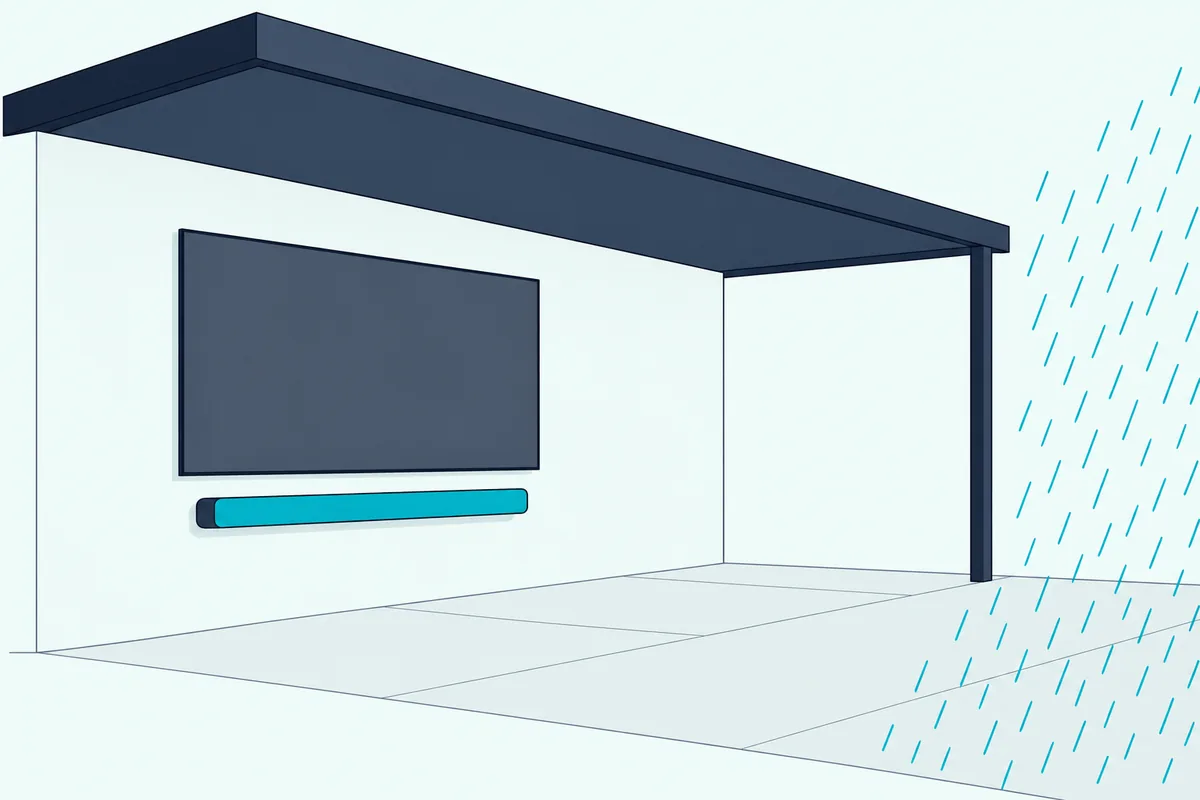
Those ratings explain why a roof alone doesn’t settle it. A regular soundbar on a covered patio is outside its makers’ instructions, because Sonos and Bose tell owners not to expose their bars to rain, moisture, dripping or splashing, and a roof doesn’t stop humidity or wind-blown rain.
No indoor-soundbar maker we read publishes separate guidance for a covered porch, so treat the warning as covering it. Think of a patio roof like a carport: it keeps the worst off, but the air under it is still outdoor air.
The outdoor makers draw their own lines too. Furrion’s manual says its bar shouldn’t be within 6 feet of a pool, spa or tub, submerged, pressure-washed, hit with high-pressure jets or exposed to hurricane-type weather.
At the other end, Neptune describes its bar as engineered for year-round outdoor use, and SunBrite says its passive bar is made for permanent outdoor installation. If your TV wall takes direct rain, those two statements are the ones to look for.
Which Outdoor Soundbar Fits Your Setup?
The covered-or-open question narrows the field, and the rest comes down to your TV and how you power the bar. Each section below sticks to what the maker documents.
Neptune All-Weather Outdoor Soundbar
The Neptune is the pick for an open patio in a cold climate. Its IP55 enclosure, the -22°F floor and a 45-inch width make it the widest and most cold-tolerant bar here.
Neptune lists a built-in Class D amplifier rated at 150 W peak and three channels. The inputs are HDMI ARC, digital optical, a 3.5 mm analog jack and Bluetooth 5.3, with a USB port for service only.
HDMI ARC also lets the TV’s remote run the bar through CEC, Neptune says. The included IR remote is rated IP65, and the bar comes with outdoor-rated mounting hardware for Neptune’s outdoor TVs.
Furrion Aurora 2.1 Outdoor Soundbar
The Aurora 2.1 is the pick if your outdoor TV is a Furrion Aurora, because its brackets bolt straight to the back of that TV. Furrion sells it two ways: FSBNN30MST with a built-in subwoofer at 70 W, and FSBNN30MX with an 8-inch wireless subwoofer at 130 W (Furrion outdoor soundbars).
Both carry Furrion’s IP45 rating against rain, snow, dust, insects and humidity, and both come with a weatherproof remote, an HDMI ARC cable and the brackets. The MST’s manual lists HDMI, optical and 3.5 mm aux inputs plus Bluetooth 5.0 and a 39.5-inch by 4.75-inch body.
The MST’s speakers are rated at 2 x 20 W plus 2 x 15 W RMS, with a frequency response of 80 Hz to 20 kHz. Furrion’s page gives the MX’s wireless subwoofer a 40 Hz to 250 Hz range, which is the reason to pick that version if bass matters.
SunBrite PREMIUM All-Weather Passive Soundbar
SunBrite’s bar is the pick for a SunBrite Signature or Pro TV, because those TVs have the 20-watt amplifier and five-pin connector that power it. It’s a passive two-channel bar, so on any other TV it needs a separate amplifier.
The small version is 39 inches wide, weighs 11.52 pounds and handles up to 90 W RMS, with four 3-inch woofers, two 1-inch titanium tweeters and four passive radiators. SunBrite’s installation manual pairs the larger SB-AW-SNDBR-M-B with the 55 to 75-inch TVs in its table.
SunBrite backs it with a lifetime limited warranty. Its rated -4°F to 140°F range has the highest upper limit of the bars with a published range, which suits a wall that bakes in afternoon sun.
Sylvox Elf S2
The Elf S2 is the pick if dust is your main enemy, since Sylvox rates it IP65, the dust-tight digit. Sylvox says the waterproof design works indoors and out and suits its own outdoor TVs (Sylvox Elf S2).
The 2.0-channel bar measures 38.38 by 3.62 by 2.44 inches and connects over HDMI ARC with CEC or Bluetooth. Integrated mounting slots let it hang on a wall, and Sylvox sells separate brackets to hang it under its TVs.
Sylvox’s page doesn’t publish an operating temperature in the sections we read. That’s the one gap to ask about before it goes up somewhere with hard winters.
What about Samsung’s Terrace soundbar?
Samsung makes one for its Terrace outdoor TVs, the HW-LST70T, which its own product address lists as a 3.0-channel Terrace soundbar. Samsung’s site refuses Burton’s research scripts, so we couldn’t read its rating or temperature range, and it had no Amazon.com listing in our 24 October search.
How Do You Mount an Outdoor Soundbar Safely?
Whichever of those bars you choose, mount it with the maker’s bracket, connect every cable before it goes up, and plug it into a GFCI-protected outlet. Furrion’s manual spells out all three steps, and its wording is a good checklist for any outdoor bar.
Furrion says to connect the power cord to a GFCI-protected outlet with an “in-use” waterproof cover, ideally a dedicated one, and it doesn’t recommend extension cords. Keep the 6-foot rule from earlier in mind too, since Furrion wants the bar itself at least that far from a pool, spa or tub.
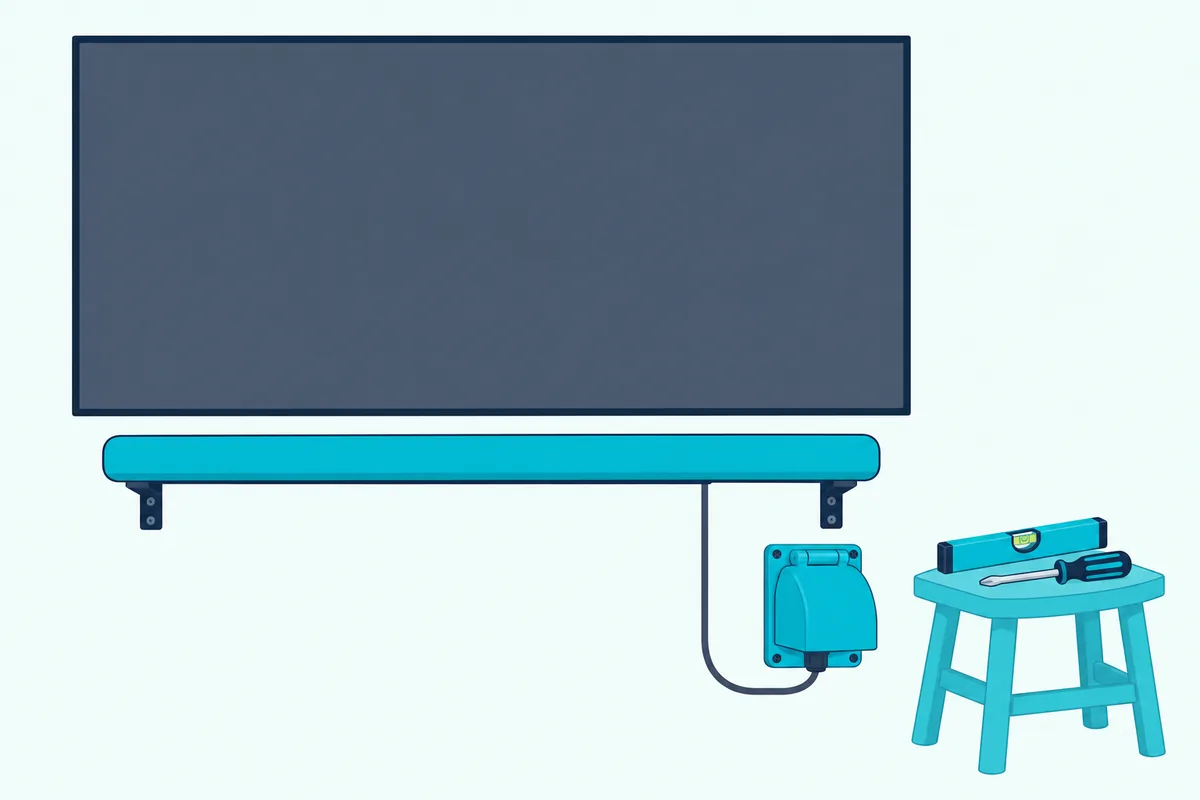
Furrion gives two ways to hang its bar. You can bolt the brackets to the back of a Furrion Aurora TV before the TV goes on its mount, or screw the bar to a wall with anchors that suit the wall, in which case all cables go in first because the rear connection compartment is blocked once it’s up.
That compartment is part of the weatherproofing. Furrion has you remove the screws to open the protective cover, connect, then close it and tighten the screws “for the best waterproof effect.”
SunBrite’s bracket bolts to SunBrite TVs using the TV’s own display screws and spacers. For any other display, SunBrite says to use its Strong universal bracket, SM-SBAR-BKT-UNIV, sold separately.
Furrion also recommends two people for the lift and a professional installer. Check that the wall can hold the TV, the bar and the mount together before you drill.
How Do You Connect an Outdoor Soundbar to an Outdoor TV?
Once it’s mounted, an outdoor soundbar connects to an outdoor TV the same way an indoor one does: HDMI ARC first, optical if the TV lacks ARC, and Bluetooth for phones. The difference is the passive bar, which needs an amplifier instead of a signal cable.
Furrion’s manual shows all three routes and puts Bluetooth’s reach at 33 feet, or 10 meters. It also notes the bar defaults to the optical input, and its fix for distorted sound is to make sure the TV is muted.
For a deeper look at the cables themselves, our guide to which cable suits a soundbar best compares HDMI ARC, eARC and optical. On a powered outdoor bar like the Neptune, ARC also lets the TV remote control the volume.
SunBrite’s passive bar works differently. Its manual recommends an amplifier or receiver rated 20 to 90 W RMS per channel and two runs of 14 to 16-gauge stranded speaker wire, or the included DIN cable on a SunBrite TV.
The manual adds a polarity check you can do by ear. Play music in mono from your seat, then swap the wires on one speaker: the setting with the fuller bass and centered vocals is the correct one.
Are Outdoor Speakers a Better Fit Than a Soundbar?
For music across a whole yard, often yes, and the outdoor-speaker makers explain why. Sonos says its surface-mount Outdoor Speakers by Sonos and Sonance are sold in pairs, rated IP66 and aimed at the listening area, and that you’ll likely need at least two for most outdoor spaces.
Those speakers are passive, so Sonos pairs them with its Amp, which it says can power up to three pairs. Sonos also says most people have them professionally installed, while a soundbar hangs on the TV with one audio cable.
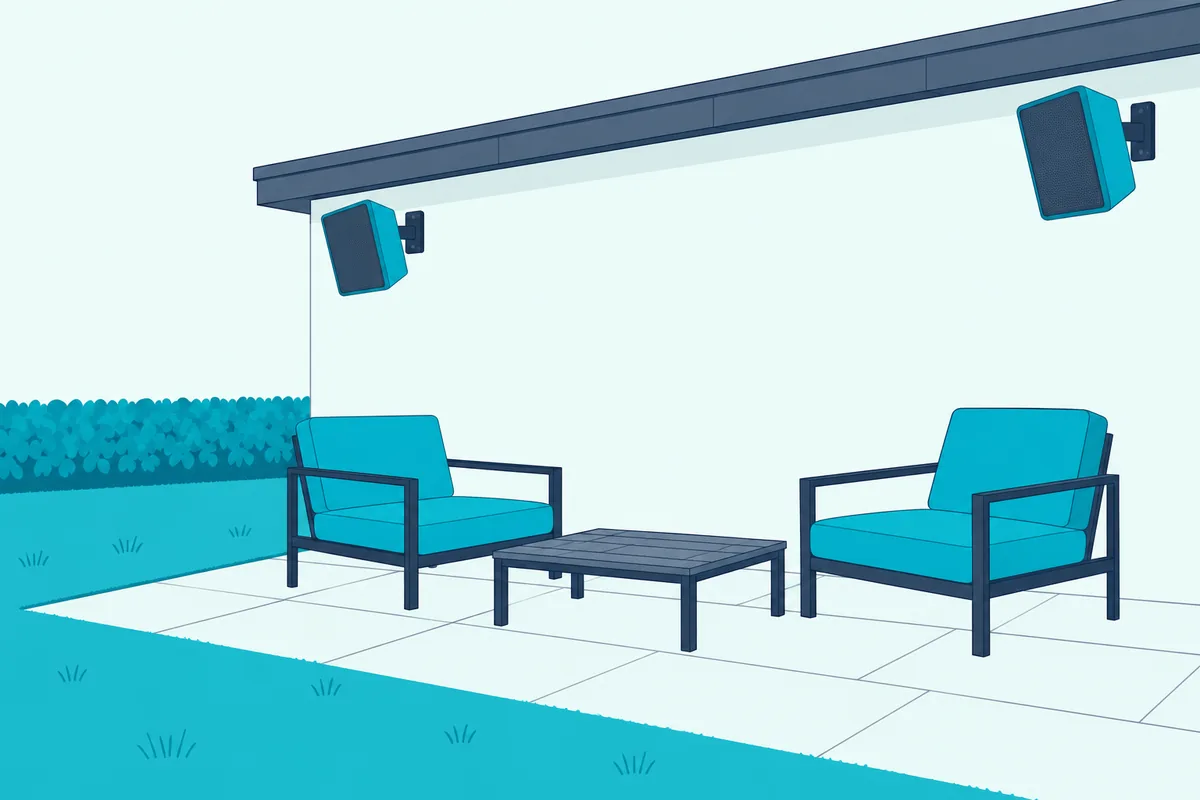
Polk’s Atrium line is the same idea. The Atrium 6 is a speaker, not a bar, with 5.25-inch woofers and a Speed-Lock mount, and Polk sells Atrium bundles with an AV receiver to drive them (Polk Atrium 6).
So the split is simple. A soundbar keeps TV dialogue at the screen with one box, while a pair of outdoor speakers spreads music over a bigger area, and a portable like Sonos’s IP67 Play covers poolside listening without any install.
How Were These Outdoor Soundbars Compared?
They were compared on makers’ documents, not listening sessions. Every rating, temperature, size and connection above comes from the maker’s product page or manual, read from copies saved between 7 and 24 October 2026, plus Sonos’s outdoor speaker guide, Intertek’s IP code FAQ and NEMA’s bulletin for the rating rules.
Each outdoor soundbar’s Amazon listing was also looked up that day for a 4.0-star or better average, 50 or more reviews and stock. None qualified, so none gets a card, and Samsung’s Terrace soundbar is named without specs because Samsung’s site refused our scripts.
Which Outdoor Soundbar Should You Buy?
Start with your weather, then your TV. For an open patio with real winters, the Neptune’s IP55 rating and -22°F floor lead the five; for a Furrion Aurora or SunBrite TV, the matching bar bolts straight on.
If dust is the issue, the IP65 Sylvox is the one rated dust-tight. And whichever you pick, put it on a GFCI outlet with an in-use cover, keep it 6 feet from the pool, and never pressure-wash it.
Frequently Asked Questions
Is an outdoor soundbar waterproof?
Not in the sense of surviving a dunk. The bars here are rated IP45 to IP65, and per Sonos’s guide only a water digit of 7 or higher means a speaker can go into water.
Furrion’s manual is explicit that its bar must not be submerged, pressure-washed or hit with high-pressure jets. “Weatherproof” here means rain, snow and humidity, not a pool.
Can an outdoor soundbar stay outside all winter?
Yes, if your lows stay inside its maker’s range. Neptune rates its bar down to -22°F in operation, while Furrion and SunBrite stop at -4°F for operation and allow -27.4°F and -24°F in storage.
Check those figures against your area’s coldest nights before you leave a bar up year-round.
Does an outdoor soundbar need a GFCI outlet?
Furrion says yes: its manual asks for a GFCI-protected outlet with an “in-use” waterproof cover, ideally dedicated, and no extension cord. The other makers’ pages we read don’t mention outlets, so follow your outdoor TV’s and electrician’s requirements for the circuit.
Will Bluetooth reach from the house to an outdoor soundbar?
Furrion puts its bar’s Bluetooth range at 33 feet, or 10 meters. For poor Bluetooth sound, its troubleshooting advice is to move the device closer or remove any obstacle between it and the bar.
Can an outdoor soundbar work with a projector for movie nights?
Yes, as long as the projector has an audio output the bar accepts, such as HDMI ARC, optical or analog, or the bar’s Bluetooth. For portable setups that pack away after the film, our soundbar choices for a projector screen cover bars that set up fast.