Best Golf Cart Soundbar Picks for 2026, Plus Safe Wiring
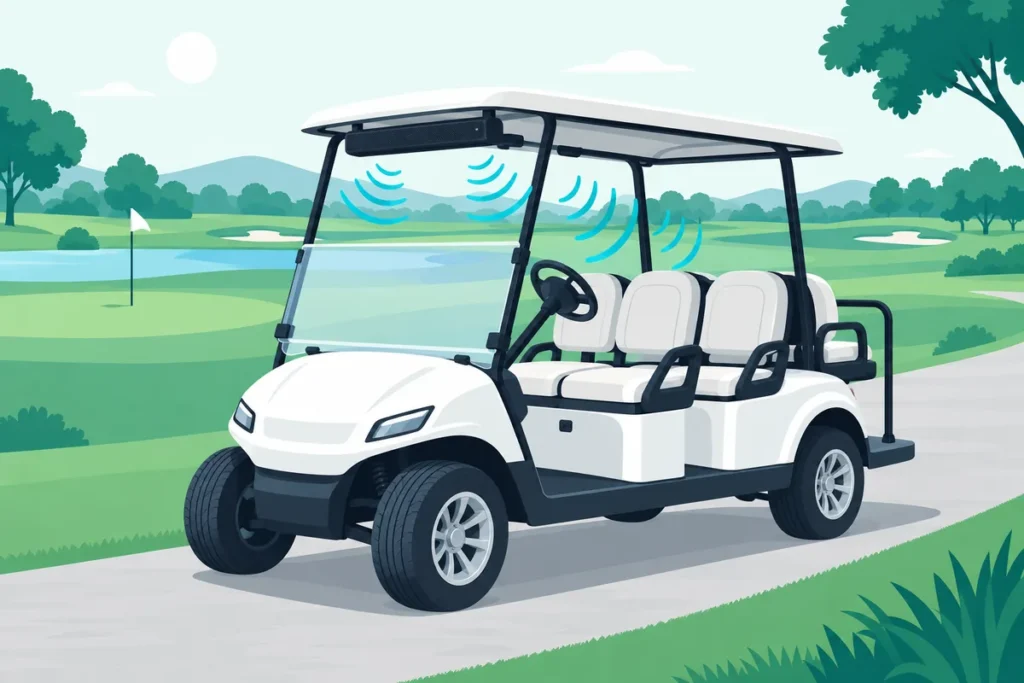
A Bluetooth speaker sliding off the seat on the back nine is usually what starts the hunt for the best golf cart soundbar.
The next surprise is that many golf cart bars are really UTV bars, with clamps sized for round roll cages and a plug meant for a 12-volt socket.
An electric cart’s battery pack runs far higher, and E-Z-GO’s owner’s guide says accessories on its 48-volt carts need a DC-to-DC converter.
Get the fit and the power right first, and choosing the bar itself gets a lot simpler.
Below are six bars worth buying, what their makers say about each, what the water ratings mean, and how to mount and wire one safely.
What Is the Best Golf Cart Soundbar?
Those six bars split neatly by the cart they suit, so start with the quick picks and the table, then read the detail on the ones that fit your roof:
- Best overall: BOSS Audio BRT26RGB, a 26-inch bar with four 4-inch speakers, two tweeters and an aluminum case.
- Best value: Ehaho MT4200, a 25-inch bar with six drivers, including two passive radiators for bass.
- Best compact bar: Ehaho MT4100, a 17-inch bar for carts with a short span between roof supports.
- Best for bass: Ehaho MT4300, a 34-inch bar with two 4-inch subwoofers among its eight drivers.
- Best for thicker roof bars: KEMIMOTO 28-inch, whose clamps fit bars from 1.56 to 2.25 inches.
- Best for wet weather: Wet Sounds Stealth Ultra HD-6, rated IP67 for dust and immersion.
| Soundbar | Size | Drivers | Water rating | Clamp fit |
|---|---|---|---|---|
| BOSS Audio BRT26RGB | 26.4 in wide | 4 × 4-inch speakers, 2 × 1-inch tweeters | IPX5 | 1.75 or 2 in bars |
| Ehaho MT4200 | 25 in | 2 × 4-inch woofers, 2 × 1-inch tweeters, 2 × 4-inch passive radiators | IP65 | 1.75 to 2 in |
| Ehaho MT4100 | 17 in | 2 × 4-inch woofers, 2 × 1-inch tweeters | IP65 | 1.75 to 2 in |
| Ehaho MT4300 | 34 in | 2 × 4-inch subwoofers, 2 × 3-inch woofers, 2 × 1-inch tweeters, 2 × 4-inch passive radiators | IP66 | 1 to 2 in |
| KEMIMOTO 28-inch | 28 in | 4 drivers KEMIMOTO calls subwoofers, 2 tweeters | Not listed | 1.56 to 2.25 in |
| Wet Sounds Stealth Ultra HD-6 | Compact | 4 × 3-inch drivers, 2 × 1-inch tweeters | IP67 | L-brackets and top mounts |
Prices are what each maker charged on its own US store on 29 September 2026, and the ratings and fits are the makers’ own figures. The clamp column matters most on a golf cart, for reasons the fitting section below explains.
| Product | Size | Link |
|---|---|---|
Best Golf Cart Soundbar Overall 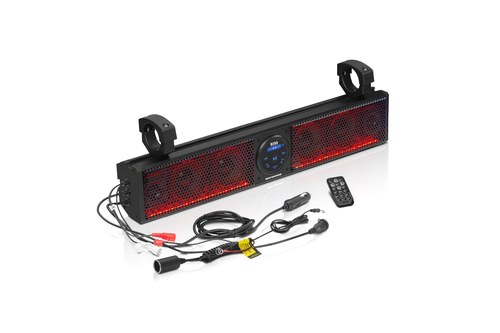 | 26.4 inch | See ratings |
Best Value Golf Cart Soundbar 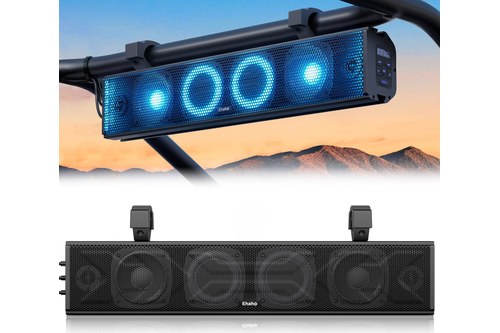 | 25 inch | See ratings |
Best Compact Golf Cart Soundbar 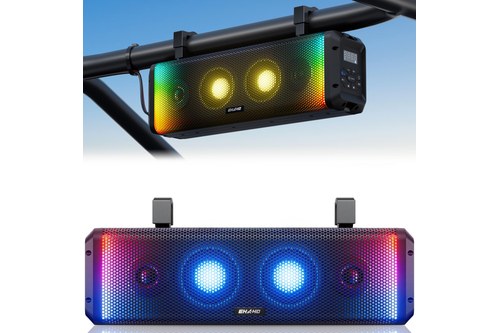 | 17 inch | See ratings |
Best Golf Cart Soundbar for Bass 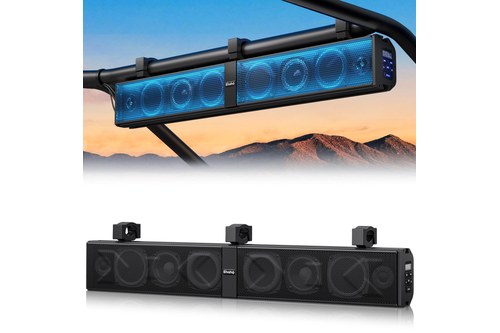 | 34 inch | See ratings |
Best Golf Cart Soundbar for Thick Roof Bars 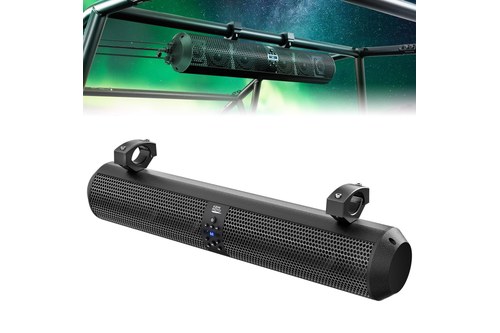 | 28 inch | See ratings |
Best Golf Cart Soundbar for Wet Weather 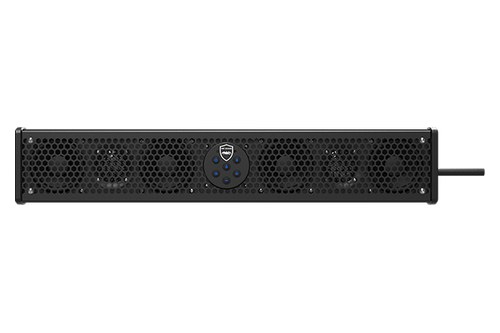 | — | See ratings |
Which Golf Cart Soundbar Should You Buy?
That table narrows it down, but the details decide it: how the bar is powered, what it mounts to, and how much weather it can take. Here’s what each maker says about its bar.
1. BOSS Audio BRT26RGB: Best Overall
The BOSS Audio BRT26RGB is the bar we’d start with for most carts. BOSS lists it as golf cart compatible, and it packs four 4-inch speakers and two 1-inch soft-dome tweeters into a 26-inch aluminum case with its own heat-dissipation system (BOSS Audio).
BOSS Audio BRT26RGB
Its Class A/B amplifier and built-in DSP presets handle the tuning, and BOSS gives the frequency response as 45 Hz to 22 kHz. For sources, it streams over Bluetooth 5.0 with a range of 33 feet, and it also takes a 3.5 mm aux cable or a USB stick with MP3 or WMA files.
The USB port charges a phone at 1 amp, and RCA outputs let you add an amplifier later. The bar comes with two remotes: one for the music, aimed at a receiver window on the bar, and a radio-frequency one for the color lights, with a range of up to 25 feet in line of sight (BOSS Audio manual).
That light remote changes the color, brightness, speed and pattern, and has an auto demo mode. It runs on a CR2025 coin battery, and BOSS warns not to block its signal with metal.
Power is where the details matter. BOSS rates the bar for 12 volts DC, with 10 to 16 volts allowed and a maximum draw of 8 amps, and puts a 10-amp AGC fuse inside the plug.
Its adjustable clamps fit bars with an outside diameter of 1.75 or 2 inches, so measure your cart’s roof supports first. BOSS also recommends professional installation, and warns that other mounting methods may void the warranty.
The one real limit is weather. Its IPX5 rating covers water only, since the X means no dust rating was given, even though BOSS describes the bar as dustproof; BOSS also says it should never be submerged.
2. Ehaho MT4200 25-Inch: Best Value
The Ehaho MT4200 gets you most of the BOSS’s features for about half the maker’s price. Ehaho pairs two 1-inch tweeters and two 4-inch woofers with two 4-inch passive radiators, which fill out the low end without extra amplifier channels (Ehaho).
Ehaho MT4200
Ehaho quotes up to 500 watts from its Class D amplifier. It streams over Bluetooth 5.0, plays USB and 3.5 mm aux sources, and comes with both a control panel and a wireless remote.
For mounting, the kit has three brackets that fit roll bars from 1.75 to 2 inches, and Ehaho says no drilling is needed. It also includes a cigarette lighter receptacle and two fuses, which helps if your cart has no 12-volt socket yet.
Ehaho’s own product page rates the MT4200 IP65 for water and dust, while its Amazon listing says IP66. The listing also notes an aux audio output for connecting a subwoofer amplifier, so the bar can grow with your setup.
Its 7-color lights sync to the music or hold a steady color. Ehaho backs the bar with lifetime technical support from the date of purchase.
3. Ehaho MT4100 17-Inch: Best Compact Bar
The Ehaho MT4100 is the one for carts where a 25-inch bar simply won’t fit. At 17 inches, it carries two 4-inch woofers and two 1-inch tweeters, driven by a Class D amplifier that Ehaho rates at 300 to 400 watts (Ehaho).
Ehaho MT4100
It uses the same clamp range as the MT4200, 1.75 to 2 inches, with two brackets instead of three. Ehaho rates it IP65 and packs two remotes, two fuses, an extendable cable and a storage bag in the box.
Fewer drivers means less bass than the larger bars, so the MT4100 suits a two-seat cart and background music rather than a party on wheels.
4. Ehaho MT4300 34-Inch: Best for Bass
The Ehaho MT4300 is the bar for music you can feel from the back seat. Ehaho builds it with eight drivers: two 4-inch subwoofers, two 3-inch mid-woofers, two 1-inch tweeters and two 4-inch passive radiators, powered by a Class D amplifier rated at up to 600 watts peak (Ehaho).
Ehaho MT4300
Its IP66 rating is the highest of the Ehaho bars here. Ehaho says the clamps fit most roll cages from 1 to 2 inches, the widest range among these picks, which helps on carts with slimmer roof supports.
The catch is size. At 34 inches, it needs a wide, clear span between supports, so measure before you order.
It streams over Bluetooth 5.0, plays USB and aux sources, and comes with a remote, three brackets, a cigarette lighter receptacle and two fuses. Its Amazon listing notes an RCA output for a subwoofer amplifier.
5. KEMIMOTO 28-Inch 6-Speaker: Best for Thicker Roof Bars
The KEMIMOTO 28-inch soundbar has the widest clamp range here, which makes it the one to check if your roof supports are thicker than 2 inches. KEMIMOTO says its multi-angle clamps fit roll bars from 1.56 to 2.25 inches, with sliders to set the spacing (KEMIMOTO).
KEMIMOTO 28-inch soundbar
Inside are four drivers, which KEMIMOTO calls subwoofers, and two tweeters, with a maximum power of 500 watts. It runs on 10 to 16 volts through its cigarette lighter cord, and connects by Bluetooth or a 3.5 mm aux input, with a USB charging port.
KEMIMOTO’s installation tip is worth following on a cart: take the roof or windshield off before you fit the bar. It also notes the bar doesn’t fit a Pro-Fit cage.
The page for this model doesn’t list an IP rating, so ask KEMIMOTO before you wash it with a hose.
6. Wet Sounds Stealth Ultra HD-6: Best for Wet Weather
The Wet Sounds Stealth Ultra HD-6 is the pick if your cart lives outside or near water. Wet Sounds designs it for marine and powersports use and rates it IP67, which it describes as protection against dust and water immersion (Wet Sounds).
Wet Sounds Stealth Ultra HD-6
It uses four 3-inch full-range drivers and two 1-inch titanium tweeters, with a 200-watt DSP amplifier and Wet Sounds’ D-Bass tuning. A powder-coated case adds resistance to UV and wear, which matters for a bar that spends summers in the sun.
Wet Sounds calls the design plug-and-play, and the RF remote comes with a steering wheel cradle, a handy touch on a cart. Wet Sounds includes a complete wiring harness, L-brackets and top-mount brackets, so it can mount in more ways than the clamp-only bars.
It’s the premium pick here. You’re paying for the build and the rating rather than for more speakers.
Get Studio Tips Weekly
Join 5,000+ creators getting acoustic treatment advice every week.
No spam. Unsubscribe anytime.What to Look For in a Golf Cart Soundbar
Those six bars differ in ways that matter more on a cart than in a car or a UTV, so here’s the checklist we’d work through before buying any of them:
- Clamp range. Each bar’s clamps fit a set range of tube sizes, from 1.75 or 2 inches on the BOSS to 1.56 to 2.25 inches on the KEMIMOTO, and your cart’s roof supports decide which ones will grip.
- Width. Bars run from 17 to 34 inches here, and the bar has to fit the clear span between the supports it clamps to.
- Power. Check the voltage the maker gives: BOSS and KEMIMOTO both allow 10 to 16 volts, which means a converter on a 48-volt cart.
- Water and dust rating. IPX5 rates water only, IP65 and IP66 add dust-tight protection, and IP67 adds immersion, as the rating section below explains.
- Drivers. More drivers usually come with a wider bar: four on Ehaho’s 17-inch model, six on its 25-inch and eight on its 34-inch.
- Controls. A remote you can reach from the seat matters when you’re driving; Wet Sounds adds a steering wheel cradle for its remote.
- Inputs and outputs. All six stream over Bluetooth, most add USB and aux, and the BOSS and the bigger Ehaho bars have an output for a subwoofer amplifier.
- Support. Ehaho offers lifetime technical support from the date of purchase, and BOSS lists a technical support line in its manual.
- Lights. Multicolor lights are standard on the UTV-style bars, but they draw power too, and KEMIMOTO suggests switching its lights off when you don’t need them.
If a bar misses on the first three, skip it, however good it sounds. The rest are trade-offs you can make for your budget.
Will a UTV Soundbar Fit Your Golf Cart?
All six of those bars are sold for UTVs as well as golf carts, and that’s where fit problems start. Their clamps wrap around round tubes: BOSS’s fit 1.75 or 2-inch bars, Ehaho’s 17 and 25-inch models take 1.75 to 2 inches, the 34-inch takes 1 to 2 inches, and KEMIMOTO’s take 1.56 to 2.25 inches.
If the machine is a side-by-side rather than a cart, our pick of the best sound bar for UTV cages matches MTX’s overhead and clamp-on bars to inside cage widths from 32.25 to 56 inches.

Golf cart roof supports vary, so measure two things before you buy:
- The diameter of the supports where the clamps will go. If it’s outside the bar’s clamp range, the clamps won’t grip, and you’ll need a bracket made for golf carts.
- The clear span between the front supports. A 34-inch bar needs a wide opening, while the 17-inch MT4100 fits almost anywhere.
Most people mount the bar up front, just under the roof, so it faces the seats. BOSS’s installation guide shows the bar secured to the front rails with its adjustable brackets, and tells you to recheck the brackets before every ride (BOSS Audio manual).
A bar that comes loose on a bumpy path is a hazard as well as a lost speaker, so take that check seriously. If you’re unsure about the roof, KEMIMOTO’s advice to remove it or the windshield before fitting gives you room to work.
How Do You Power a Soundbar on an Electric Golf Cart?
Bars like these are built for 12-volt vehicle power: BOSS rates the BRT26RGB for 10 to 16 volts, and KEMIMOTO says the same range for its bar. An electric cart’s battery pack runs far higher, which is the part product listings tend to skip.
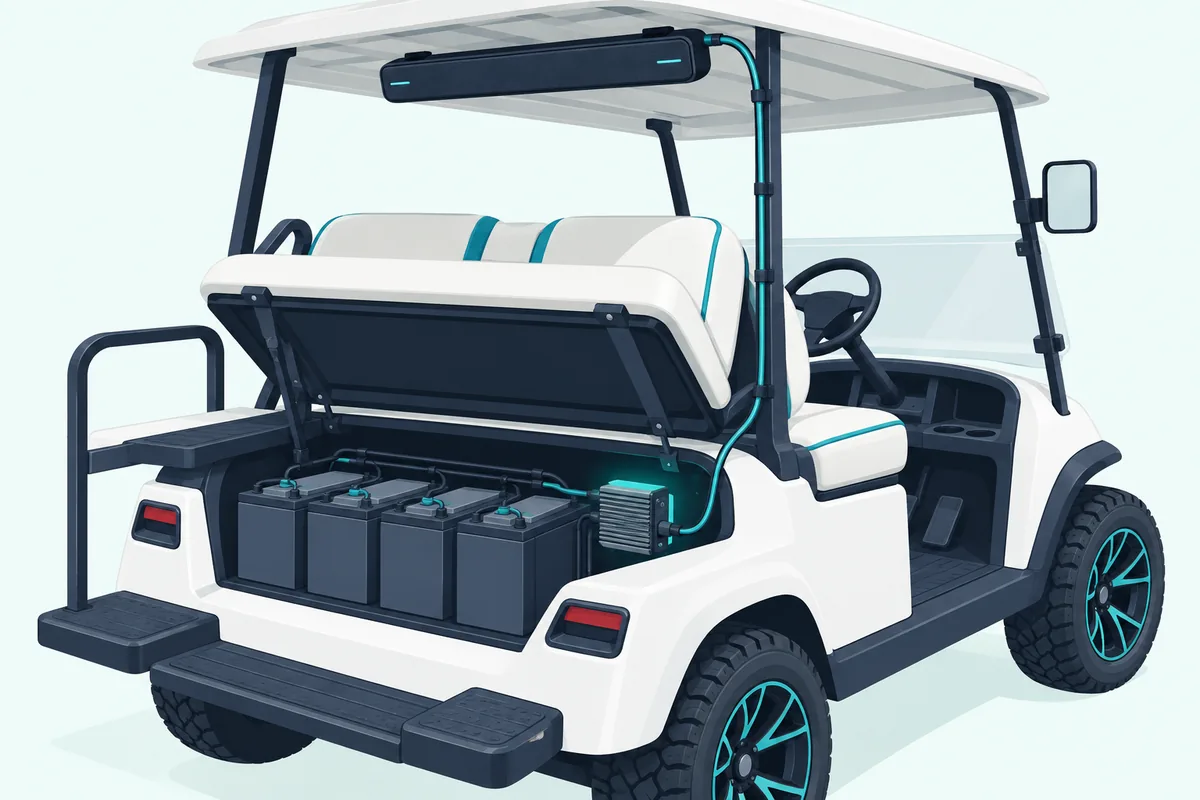
E-Z-GO’s owner’s guide for its TXT 48-volt cart lists the electrical system as 48 volts DC from six 8-volt batteries (E-Z-GO). It says any accessory that doesn’t use the cart’s accessory wiring harness must draw from the entire 48-volt pack, and that a DC-to-DC converter is required for accessories that need a different voltage.
So on an electric cart like this one, the soundbar needs a 48-to-12-volt converter, often sold as a voltage reducer, wired across the whole pack. Tapping 12 volts from one or two of the batteries isn’t what E-Z-GO describes.
Grounding is the other rule. E-Z-GO says that on electric vehicles, all electrical accessories must be grounded directly to the battery’s negative post, and never to the chassis or body.
That differs from BOSS’s own wiring diagram, which grounds the bar to a vehicle’s metal frame, as you would on an ATV. On an electric golf cart, follow the cart maker.
From the converter’s 12-volt output, BOSS’s direct-wiring advice still applies:
- Disconnect the battery’s negative terminal before you start.
- Fit an inline fuse and fuse holder on the positive feed; BOSS specifies a rating of at least 15 amps for its bar.
- Use 12 to 14-gauge wire, which BOSS recommends for the power run.
- Add a switch, so the bar can’t stay powered when the cart is parked.
Size the converter for the bar. BOSS lists a maximum draw of 8 amps for the BRT26RGB, so a converter rated comfortably above 8 amps at 12 volts leaves headroom.
If wiring isn’t something you’re comfortable with, this is the step to hand to a golf cart shop. BOSS recommends professional installation, and a wiring mistake on a 48-volt pack costs more than the bar.
Can You Use the Cigarette Lighter Plug Instead?
That plug on the end of the power cord is the easy option, and most of these bars include one. BOSS’s manual powers the bar from a cigarette lighter or auxiliary socket, and its plug hides a 10-amp fuse you reach by twisting the tip counterclockwise.
On a golf cart, though, the plug only works if the cart has a 12-volt socket. On an electric cart like E-Z-GO’s TXT, that socket has to be fed by a converter too, since the pack itself is 48 volts.
That’s why Ehaho puts a cigarette lighter receptacle in the MT4200 and MT4300 kits: you can wire the socket to the converter once, then plug the bar in and out. It’s also handy if you take the bar off the cart between seasons.
Gas carts are different again, so check your owner’s manual for how the cart supplies 12-volt accessories before you wire anything. BOSS’s direct-wiring diagram is drawn for a vehicle with a 12-volt battery.
How to Install a Golf Cart Soundbar, Step by Step
With the fit measured and the power plan settled, the install itself follows the same order for most clamp-on bars. Here’s that order, using the makers’ own instructions:
- Check the fit on the bench. Hold the bar against the roof supports and confirm the clamp size and the span before you remove anything.
- Make room. KEMIMOTO suggests taking the roof or windshield off first, which gives you space to tighten the clamps evenly.
- Mount the bar. Use the brackets that came with it; BOSS says to secure the bar to the rails with its supplied adjustable brackets, and warns that other mounting methods may void the warranty.
- Run the power. On an electric cart, go through the converter and fuse as described above, grounding to the battery’s negative post as E-Z-GO requires.
- Add the switch. A switch on the 12-volt feed lets you cut power when the cart is parked, since the bar may not follow the key.
- Tidy the cables. Route them along the roof support and away from moving parts, so nothing snags when people climb in and out.
- Test before you ride. Power up, pair a phone, check the volume and the remote, then shake the bar gently to confirm the clamps hold.
After that, BOSS’s rule for every ride applies: recheck the brackets before you set off. Clamps can loosen on rough paths, and a quick check takes seconds.
Will a Soundbar Drain Your Golf Cart Battery?
It can, if it’s left on. BOSS’s manual tells users to run the vehicle’s engine occasionally when playing the bar, since using it without the engine running can drain the battery.
On an electric cart, the numbers are reassuring as long as you switch the bar off. At its 8-amp maximum, the BRT26RGB draws about 96 watts at 12 volts, which works out to roughly 2 amps from a 48-volt pack before the converter’s losses.
E-Z-GO rates the TXT’s batteries at 170 amp-hours over a 20-hour discharge. So a bar playing flat out is a small load next to that, but it adds up over a weekend if nothing turns it off.
That’s the case for the switch in the wiring above. E-Z-GO notes that some factory accessories stay on with the key switch off, so don’t assume the key cuts power to anything you add.
The lights draw power too. KEMIMOTO suggests turning its RGB lights off with the remote when you don’t need them, to save battery (KEMIMOTO).
What Do IP65, IP66 and IP67 Mean on a Soundbar?
Those weather ratings in the table come from a standard, not from marketing. The International Electrotechnical Commission created the IP code, and each rating has two digits: the first grades protection against solids, up to 6 for no ingress of dust, and the second grades protection against liquids on a scale of 0 to 9 (IEC).

An X in place of a digit means that part wasn’t rated. Intertek, a testing lab, explains that the letter X means the requirements aren’t defined, so the BOSS’s IPX5 tells you about water and nothing about dust (Intertek).
Intertek adds a useful detail about the water digit. Up to 6, a rating includes the lower ones, but 7 means immersion, which is a separate test, so an IP67 bar isn’t automatically rated for water jets.
NEMA, the US electrical manufacturers’ association, maps its enclosure types to IP ratings in a way that helps here. Its Type 4 enclosures, tested for rain, snow, sleet and splashing water, meet IP65 and IP66, and its Type 6 adds occasional submersion and meets IP67 (NEMA).
For a golf cart, that sorts the picks like this:
- IPX5 (BOSS BRT26RGB): rated for water, dust not rated; BOSS says never submerge it.
- IP65 (Ehaho MT4100 and MT4200, on Ehaho’s site): dust-tight and rated for water.
- IP66 (Ehaho MT4300): dust-tight, one step higher for water.
- IP67 (Wet Sounds Stealth Ultra HD-6): dust-tight and rated for immersion.
Can You Take a Golf Cart Soundbar Off Between Rides?
With clamp-on bars, yes, and it’s worth planning for if your cart sits outside or in a shared storage area. None of the clamp-on bars here needs drilling, so taking one off is a matter of loosening the clamps and unplugging it.
BOSS’s wiring diagram shows a quick-release power adaptor on the bar’s cable, and Ehaho packs a storage bag with its 17 and 25-inch bars. Taking the bar indoors also keeps it out of the heat and storms that shorten any electronics’ life.
If you wired the bar directly, leave the fused feed and switch in place and add a plug where the bar’s cable meets it. That way the cart’s wiring stays put and only the bar comes off.
How Should You Clean a Golf Cart Soundbar?
Whatever its rating, a gentle wash keeps a bar working longer. BOSS’s manual says to use mild soap or detergent with lukewarm water and a clean sponge or soft cloth, then rinse with clean water.
Its list of what not to do is just as specific:
- Don’t clean the bar in hot sun or on very hot days.
- Don’t use abrasive or highly alkaline cleaners.
- Don’t scrape the case with razor blades or other sharp tools.
- Never use gasoline, acetone or carbon tetrachloride.
Heat and storms matter for any soundbar, not just one on a cart. Our guide to what shortens a soundbar’s working life covers what the makers say about both.
What Comes in the Box With Each Bar?
Before you order, check what’s in each box, since it decides how much extra shopping you’ll do before the first ride. Here’s what each maker says it includes:
| Soundbar | In the box |
|---|---|
| BOSS Audio BRT26RGB | Mounting kit, power accessory extension adaptor, two remotes, user manual, warranty card |
| Ehaho MT4200 | Mounting kit, three brackets, two remotes, two fuses, extendable cable, connectors, storage bag, cigarette lighter receptacle, user guide |
| Ehaho MT4100 | Mounting kit, two brackets, two remotes, two fuses, extendable cable, connectors, storage bag, user guide |
| Ehaho MT4300 | Remote, three brackets, mounting kit, connectors, extendable cable, cigarette lighter receptacle, two fuses, user guide |
| KEMIMOTO 28-inch | Adjustable brackets and mounting hardware, aux input, USB jack, wireless remote, power extension adaptor, cigarette lighter, user manual, installation tool |
| Wet Sounds Stealth Ultra HD-6 | Wiring harness, L-brackets, top-mount brackets, RF remote with steering wheel cradle |
None of them includes the voltage converter an electric cart needs, so budget for one separately. The fuse and switch for a direct-wired install aren’t in the BOSS box either; its manual lists both as not included.
Which Size Golf Cart Soundbar Do You Need?
After fit, size is mostly about how many drivers you want. Ehaho’s lineup shows the trade clearly: its 17-inch bar has four drivers, the 25-inch has six, and the 34-inch has eight, including two subwoofers.
A rough guide, based on those bars:
- 17 inches: a compact two-seat cart, or a roof with supports close together.
- 25 to 28 inches: the middle size, shared by the BOSS, the Ehaho MT4200 and the KEMIMOTO.
- 34 inches: a wide roof span and passengers who want bass they can feel.
Measure the span you have first, then pick the biggest bar that fits it with room for the clamps.
How Loud Can a Golf Cart Soundbar Get?
That depends partly on the drivers and partly on how each maker counts power, and they don’t count it the same way. Ehaho quotes up to 300 to 400 watts for its 17-inch bar, up to 500 for the 25-inch and up to 600 watts peak for the 34-inch.
KEMIMOTO gives a maximum power of 500 watts for its 28-inch bar, while Wet Sounds rates the Stealth Ultra HD-6’s amplifier at 200 watts. BOSS’s spec sheet lists no wattage at all, only a maximum current draw of 8 amps at 12 volts.
Because those figures aren’t measured the same way, don’t pick a bar by its watts. The driver count and size in the table are a steadier guide, along with the maker’s own claims about bass, like Ehaho’s subwoofers and passive radiators or Wet Sounds’ D-Bass tuning.
On a course, loud rarely needs to mean maximum. A bar a few feet from your ears only has to fill the cart, and the section on playing music on the course covers courtesy.
Should You Use Bluetooth, USB or the Aux Cable?
Once the bar is loud enough, the next choice is how to feed it music, and on a golf cart that’s a practical question. Bluetooth is the easy default: BOSS gives the BRT26RGB’s range as 33 feet, and its specs list Bluetooth 5.0 with EDR and the A2DP profile for music.
The aux input is the fallback when Bluetooth misbehaves. BOSS says the bar plays audio from any device with a 3.5 mm headphone jack, and its steps end with a practical tip: route the cable back to the bar and secure your device, so a bump doesn’t pull it loose.
USB suits a playlist you don’t want to manage. On the BRT26RGB, a flash drive with MP3 or WMA files starts playing automatically once you insert it, and the next and previous buttons skip tracks.
Wet Sounds’ Bluetooth adds source control, so you can change tracks from the bar’s remote rather than your phone. Its remote sits in a steering wheel cradle, which keeps your phone in a pocket while the cart is moving.
How Do You Pair a Golf Cart Soundbar With Your Phone?
Once the bar has power, pairing takes a minute. BOSS’s steps for the BRT26RGB work much the same way on most bars:
- Power the bar on, then press its MODE button; the BRT26RGB goes into pairing mode on its own.
- On your phone, open the Bluetooth settings, turn Bluetooth on and scan.
- Choose “Boss Audio BRT26RGB” from the list, and enter 0000 if you’re asked for a passcode.
BOSS notes you have 2 minutes before you need to start again. Once paired, the bar reconnects to the last device automatically, including when you come back within range.
For the best sound, BOSS suggests setting your phone’s volume to at least 75% and using the bar’s volume for the rest. Our general Bluetooth pairing walkthrough covers the phone side if a bar won’t show up.
Can You Add a Subwoofer to a Golf Cart Soundbar?
Some of these bars are built for it. The BRT26RGB has RCA outputs, and Ehaho’s listings note an aux audio output on the MT4200 and an RCA output on the MT4300 for connecting a subwoofer amplifier.
That adds another powered box to the cart, so plan the wiring and the space before you buy one. If you’re not sure the extra bass is worth it, our look at what a subwoofer adds to a soundbar setup explains the difference, though it’s written for home setups.
For most carts, a bar with passive radiators or built-in subwoofers, like the Ehaho MT4200 or MT4300, is the simpler route to fuller bass.
What If Your Golf Cart Soundbar Stops Working?
Most failures on a cart come down to power or pairing, and BOSS’s troubleshooting table covers the common ones:
- It won’t turn on. BOSS points to a blown fuse or a main accessory switch that isn’t on; check the fuse in the plug and the switch in your wiring.
- No sound. The phone’s volume may be low or muted, or the music paused.
- It won’t pair. Make sure Bluetooth is turned on in the phone’s settings, then start the pairing steps again.
- The sound breaks up. Weak Bluetooth reception is the usual cause, so move the phone closer to the bar or clear anything between them.
- It stops responding. BOSS’s fix for a glitch is to disconnect the power for 10 seconds, which resets the bar.
If the bar still won’t power up with a good fuse, check the converter’s output before you blame the bar. A bar that cuts out only over bumps points to a loose connection along the cable run.
Can You Play Music on the Golf Course?
That depends on the course, not the bar. Courses set their own rules, so ask at the pro shop before you play music during a round.
Where it’s allowed, keep the volume down near greens, tee boxes and other groups. A bar that fills a cart with sound is plenty loud enough to carry across a fairway.
Frequently Asked Questions
Do I need a voltage reducer for a golf cart soundbar?
On a 48-volt electric cart, yes. E-Z-GO says accessories that need a voltage other than 48 volts require a DC-to-DC converter, and these bars run on 10 to 16 volts.
What size soundbar fits a golf cart?
The bars here run from 17 to 34 inches, and the right one is the widest that fits your roof span with clamps that fit the supports. Clamp ranges run from 1 to 2 inches on the Ehaho MT4300 to 1.56 to 2.25 inches on the KEMIMOTO.
Is an IPX5 soundbar waterproof?
Not fully. The 5 rates it against water, the X means dust wasn’t rated, and BOSS says its IPX5 bar should never be submerged.
How far does a golf cart soundbar’s Bluetooth reach?
BOSS lists 33 feet for the BRT26RGB’s Bluetooth. Its separate remote for the lights reaches up to 25 feet in line of sight.
Can I mount a golf cart soundbar without drilling?
Usually, yes. Ehaho says its bars need no drilling, and the clamp-on bars here all attach to round roof supports within their clamp range.
What voltage does a golf cart soundbar need?
The bars here are built for 12-volt vehicle power; BOSS and KEMIMOTO both allow 10 to 16 volts. On a 48-volt electric cart, that means a DC-to-DC converter.
Can a golf cart soundbar charge my phone?
Some can. BOSS says the BRT26RGB’s USB port charges at 1 amp, and KEMIMOTO’s 28-inch bar has a USB charging port.
Do golf cart soundbars have lights?
Most of these do. BOSS’s bar has multicolor lights with a separate remote for them, and Ehaho’s lights can hold a steady color or blink with the music.
Is a soundbar better than a Bluetooth speaker in a golf cart?
For regular use, usually. A soundbar clamps to the roof, runs from the cart’s power instead of its own battery, and comes with a remote, while a loose speaker can slide or fall on a bumpy path.
Can I take my golf cart soundbar off when I’m not using it?
Yes, the clamp-on bars here come off without tools beyond the clamp fittings. BOSS’s cable has a quick-release power adaptor, and Ehaho includes a storage bag with its smaller bars.
Where should a soundbar go on a golf cart?
Up front, just under the roof and facing the seats. BOSS’s installation guide shows its bar clamped to the front rails with the supplied brackets.
What gauge wire should I use for a golf cart soundbar?
For a direct-wired BOSS BRT26RGB, BOSS recommends 12 to 14-gauge wire, with an inline fuse of at least 15 amps on the positive side. On an electric cart, that run starts at the converter’s 12-volt output.
How do I reset a golf cart soundbar?
BOSS’s fix for an unresponsive BRT26RGB is to disconnect the power for 10 seconds. For other bars, check the maker’s manual, since reset steps vary.
Will rain damage a golf cart soundbar?
That depends on its rating. An IPX5 bar like the BOSS is rated for water but shouldn’t be submerged, Ehaho’s IP65 and IP66 bars are also dust-tight, and the Wet Sounds IP67 bar is rated for immersion.
Which golf cart soundbar has the best water rating?
The Wet Sounds Stealth Ultra HD-6, which Wet Sounds rates IP67 for dust and water immersion.