Soundproof Dog Crate? What Quiets One Without Risking Your Dog
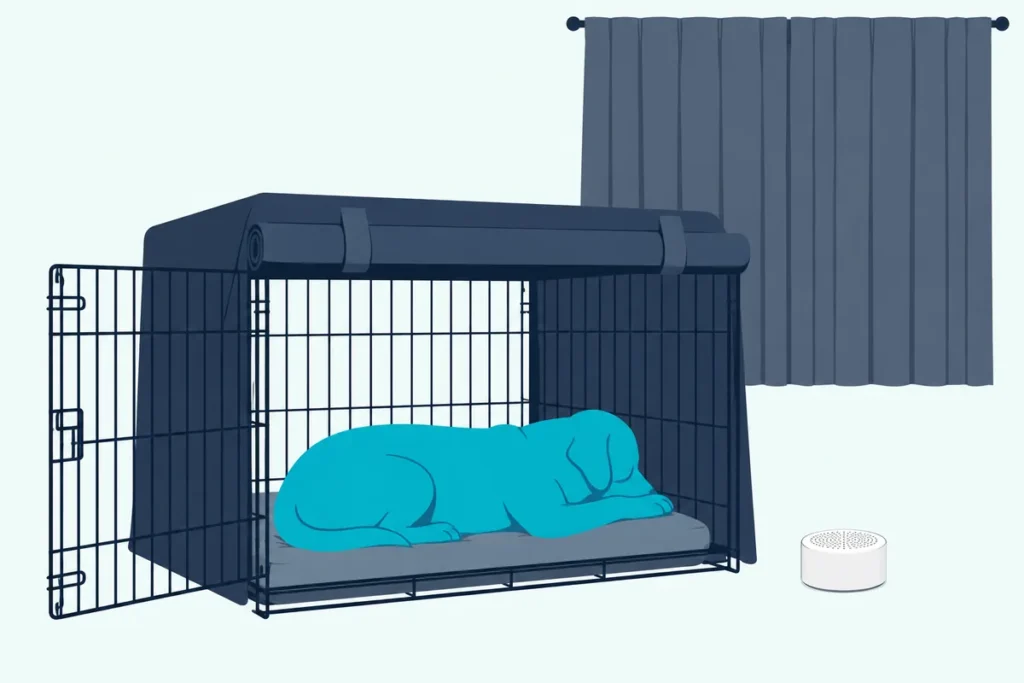
Shopping for a soundproof dog crate usually starts on a night of fireworks, thunder or barking, but a crate quiet enough to matter would have to be close to airtight.
Your dog pants and paces while the sky booms, or a neighbor mentions barking you never hear because you’re out, and a box that shuts the world out starts to look kind.
What actually helps keeps the air moving: a den with solid walls or a cover, steady sound outside it, the right room, and a vet when the fear runs deep.
The first move is the room, since the ASPCA and Cornell’s veterinarians both recommend an inside space away from windows, then the cover and the sound machine.
Below, you’ll see how much any crate can block, what to buy instead, and how to tell fear from barking before you spend anything.
Can a Dog Crate Really Be Soundproof?
That airtight catch is where every soundproof crate claim meets physics. No crate a dog can safely breathe in comes close to soundproof, because OSHA’s noise manual credits 20 to 40 dB of reduction to solid enclosures with no acoustic leaks, while the federal rules for shipping a dog require vents across at least 14 percent of its crate’s walls (9 CFR 3.15).
WorkSafe Victoria, the Australian state’s workplace safety regulator, puts a number on the leak: without absorbent material, a 10 percent gap or opening can limit an acoustic enclosure to about 9 dB, and a 5 percent gap to about 19 dB (WorkSafe Victoria). A crate vented to the federal shipping rule has more open area than that 10 percent case.
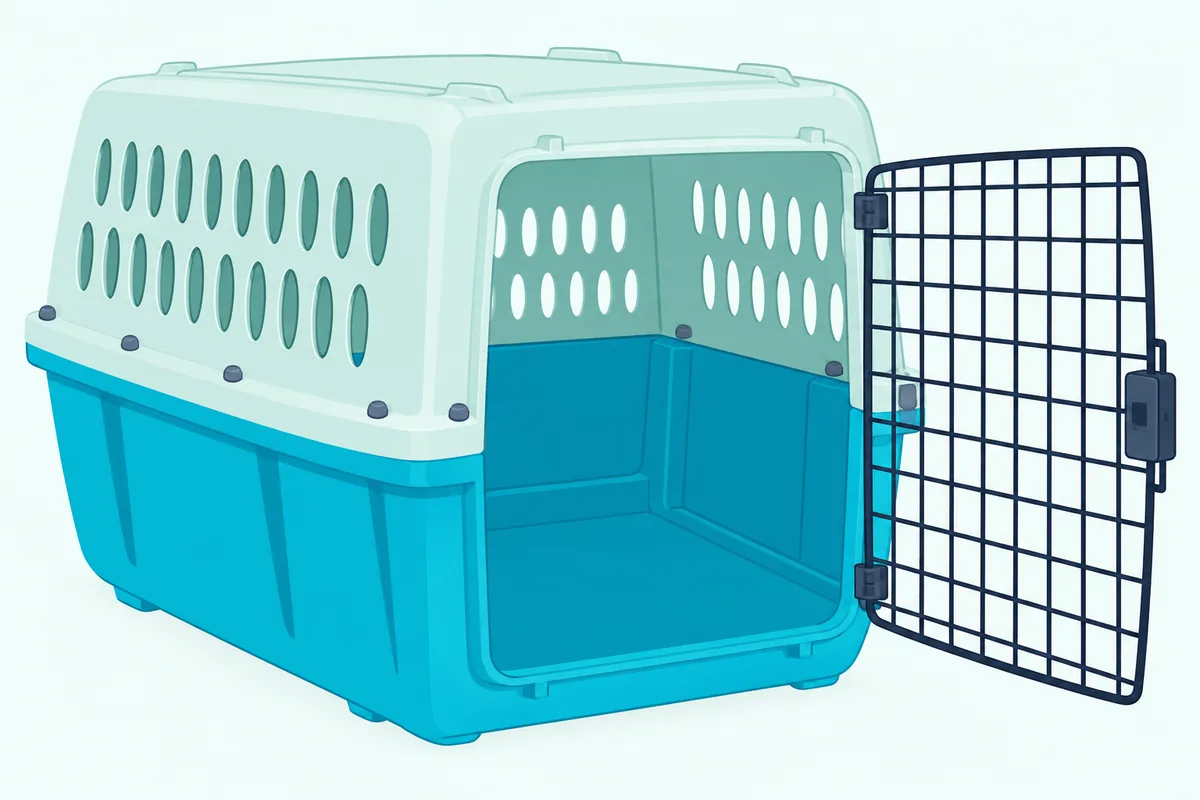
OSHA’s manual also says that doubling the sound power raises the noise level by 3 dB, so a 9 dB cut leaves roughly an eighth of the sound energy. That’s a real drop, but it isn’t the silence a fireworks night calls for.
OSHA adds that low frequencies travel around corners and through holes more easily than high ones, so the deepest booms are the hardest part to stop. Here’s how the three figures line up for a crate:
| Source | What it says | What it means for a crate |
|---|---|---|
| OSHA Technical Manual, noise chapter | A solid enclosure with no acoustic leaks can give 20 to 40 dB | Only a sealed box gets near those numbers |
| WorkSafe Victoria | A 10% gap or opening can limit an enclosure to about 9 dB; a 5% gap to about 19 dB | Every vent caps the quiet |
| Federal rules for shipping dogs (9 CFR 3.15) | Vents on at least 14% of the total wall area, at least a third of it in the upper half | A crate built to breathe can’t be sealed |
The quieter a crate gets, the more it has to close up, and closing up is exactly what a dog’s crate can’t do. Burton Acoustix’s guide to building a soundproof box draws the same line for any enclosure with an animal inside: it needs continuous fresh air, light and space, and none of that can be traded for quiet.
What Should You Buy Instead of a Soundproof Dog Crate?
Since sealing is off the table, the useful purchases work on sight, sound masking and heat rather than trying to block every decibel. Buy a solid-walled kennel or a cover for the wire crate you already own, a white noise machine to mask the booms, and a room thermometer to keep an eye on the heat.
| Pick | What it is | What it does about noise | Best for |
|---|---|---|---|
| Petmate Vari Kennel, 36 in | Plastic kennel with a wire door | Its plastic walls block the view; Petmate makes no sound claim | A dog that wants a den |
| MidWest QuietTime Crate Cover, 42 in | Polyester cover for a wire crate | Dims light and hides the room; its sides lift for air | A wire crate you already own |
| LectroFan EVO | Electronic fan and white noise machine | Masks outside noise with steady sound | Storms and fireworks |
| TempPro TP50 | Room thermometer and hygrometer | Nothing; it shows heat and humidity | Checking a covered crate |
Every pick met Burton Acoustix’s rating, review and stock checks on 28 October 2026, and no prices appear because they change often. Nothing on this page was tried out or measured by Burton Acoustix, and the descriptions come from the makers’ own pages, manuals and listings.
Petmate Vari Kennel
For a dog that hides when the sky rumbles, the Petmate Vari Kennel is a ready-made den with solid walls.
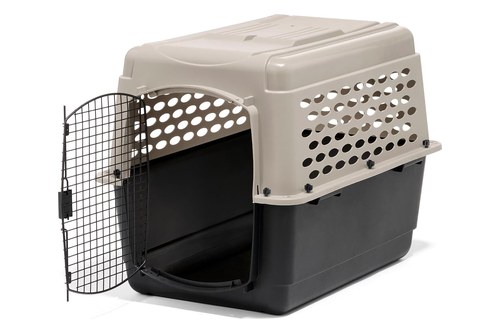
the Petmate Vari Kennel
Petmate describes 360-degree airflow, with vents in the back and side walls and a wire front door, so the plastic shell blocks the view without closing off the air. That matters because the ASPCA counts bright light, as well as noise, among the things that can set off a storm-phobic dog.
The 36-inch size is listed for dogs of 50 to 70 pounds and measures 36 by 25 by 27 inches. Humane World for Animals says a crate should be large enough for your dog to stand up and turn around in, so measure before you pick a size.
Petmate lists an interior moat to keep your dog dry and says the kennel is made in the USA from recycled plastic. For air travel, it says the wing nuts and bolts are required and that the kennel meets most air travel requirements, but it still tells owners to check with their airline.
If you fly often, Petmate’s Sky Kennel is the travel model, listed with four-way ventilation and as compliant with the 51st edition (2025) of the IATA Live Animals Regulations. Both kennels put their vents where a sealed soundproof box would have walls.
Keep its vents clear of walls and furniture. The federal shipping rule even requires rims that hold a crate’s vents three-quarters of an inch off anything it’s placed against, so the openings can’t be blocked.
MidWest QuietTime Crate Cover
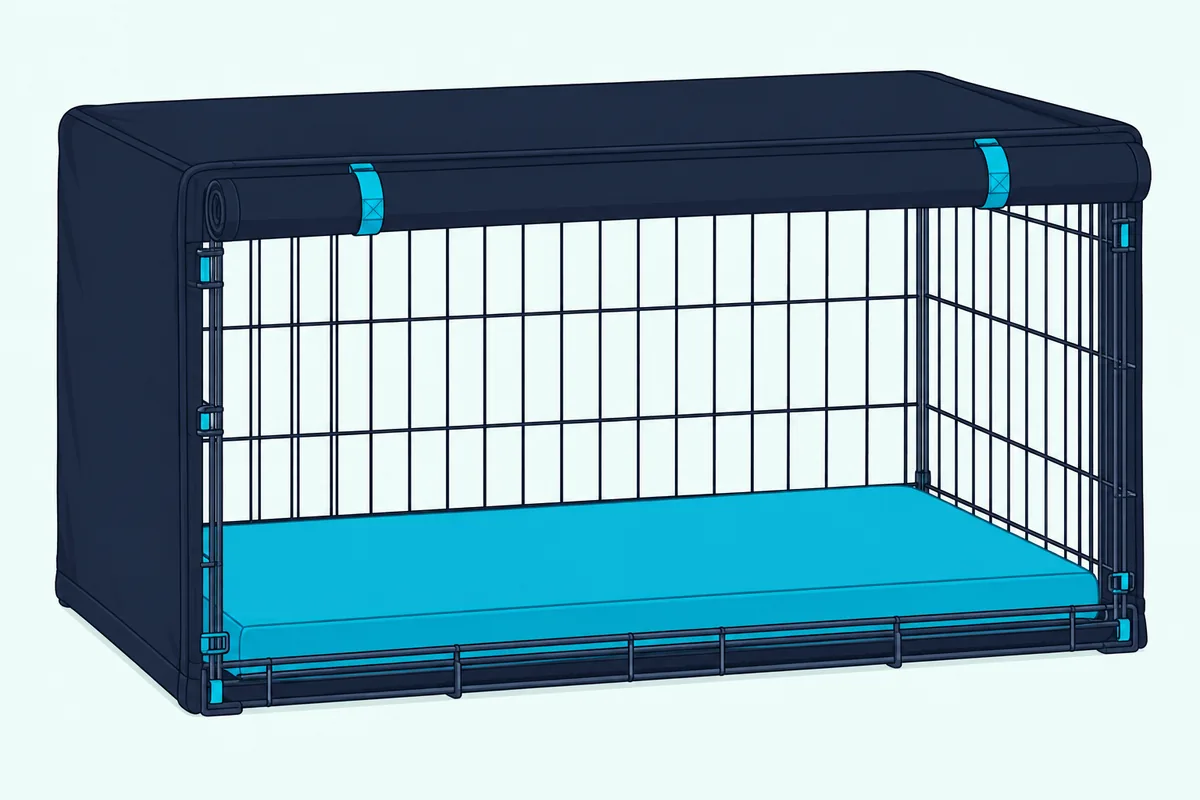
If your dog already likes a wire crate, the MidWest QuietTime Crate Cover turns it into a darker den without wrapping it shut.
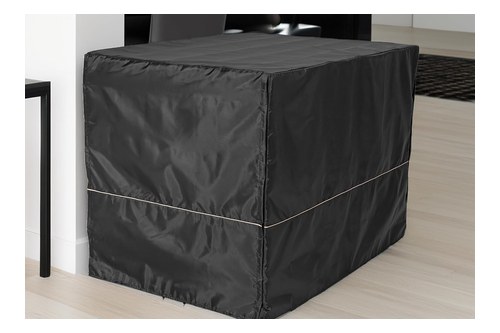
the MidWest QuietTime Crate Cover
MidWest, which makes the iCrate, says the cover slips over the top of the crate, offers proper ventilation, and lets each side be lifted and hooked in place if your dog prefers a little light. Its listing gives the 42-inch cover as 42 by 27.25 by 30 inches, made of polyester to fit MidWest’s 42-inch iCrate and Life Stages crates with one, two or three doors.
AKC says covering a crate with a blanket can have a calming effect much like tucking a dog into one. The same AKC page says to remove fabric a teething puppy or a chewer is munching on, because swallowed chunks can cause choking or an intestinal blockage.
MidWest’s iCrate manual adds a step worth copying for any crate: remove your dog’s collar, tags and leash before putting it inside, to prevent entanglement.
LectroFan EVO
For masking thunder and fireworks, the LectroFan EVO plays a steady fan or noise sound from outside the crate.
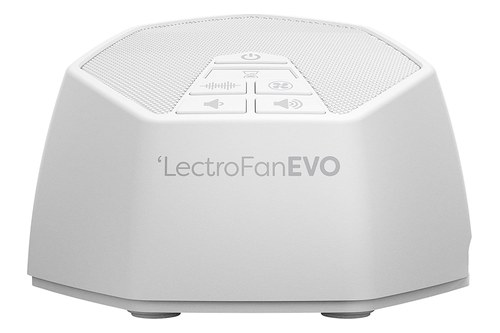
the LectroFan EVO
Adaptive Sound Technologies lists 10 fan sounds, 10 noise variations and 2 ocean surf sounds, all made electronically with no motor or other internal moving parts. Its noise settings run from brown through pink to pure white noise, so you can pick a deeper or brighter hiss.
Its owner’s guide says it plays continuously unless you tap the timer, which adds an hour per tap up to eight. It runs from the included USB cable and AC adapter, and by default it turns on by itself when it’s plugged in.
Cornell’s Riney Canine Health Center suggests layering two different types of sound to help drown out noise, so the machine can run alongside soft music. Its 3.5 mm audio jack switches the built-in speaker off when you plug in another speaker.
TempPro TP50
For checking the room around a covered crate, the TempPro TP50 shows temperature and humidity at a glance.
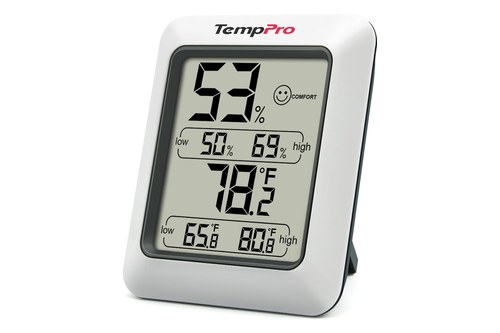
the TempPro TP50
Its listing photos give a 10-second refresh, ±1°F temperature accuracy and ±2 to 3 percent humidity accuracy, with highs and lows on the screen. It runs on one AAA battery, which the listing says is included, and it stands on a fold-away stand or sticks to metal with a magnet.
Set it beside the crate rather than across the room, so it reads the air your dog is actually in. The next section explains why humidity belongs on that screen as much as temperature does.
Why Can’t You Seal a Dog Crate?
That thermometer made the list because heat, not noise, is what a closed crate gets wrong first. You can’t seal one because a dog cools itself by panting, and veterinarian Barbara Hodges of the Humane Society Veterinary Medical Association, quoted by Humane World for Animals, says high humidity hampers that cooling (Humane World for Animals).
The same page says a doghouse doesn’t provide relief from heat and in fact makes it worse, and that fans don’t cool pets as effectively as they cool people. A sealed crate is a doghouse with the door shut.
The federal rules for dogs in transit put the limits in writing. Dogs must have adequate air for breathing at all times, a cargo space needs fans or air conditioning once it reaches 85°F, and the temperature may not stay above 85°F for more than four hours.
Those are shipping rules, not a home standard, but they show how seriously regulators treat air and heat for a dog in a box. Animal holding areas at terminal facilities get the same 85°F, four-hour ceiling, plus a 45°F floor.
Humane World’s hot-car figures show how little a small opening does once heat builds. On an 85-degree day, it says, a car with its windows opened slightly can reach 102 degrees within 10 minutes and 120 degrees after 30.
The ASPCA lists the signs of overheating as excessive panting or difficulty breathing, a faster heart and breathing rate, drooling, mild weakness, stupor or collapse. In bad cases it adds seizures, bloody diarrhea, vomiting and a body temperature over 104°F.
Flat-faced breeds such as Pugs are more susceptible to heat stroke because they can’t pant as effectively, the ASPCA says. Humane World for Animals adds boxers and shih tzus to that short-muzzled group, so their crates need more air, not less.
Even machines run hot in a box. OSHA lists heat buildup among the drawbacks of solid enclosures, and WorkSafe Victoria says a machine in an enclosure may need ventilation to prevent overheating, so a dog shut in a sealed crate faces the same buildup with no off switch.
Do Sealed Crates With Fans Solve the Heat Problem?
Some makers answer that heat problem with seals and fans, which moves the risk rather than removing it. They solve it only while the airflow keeps working: Zalebot, for example, says its bark-proof cage reaches 50 dB of noise reduction in its own factory test, with rubber door seals it calls airtight and fan-driven air ducts.
Its FAQ says passive ventilation ports keep air moving if the power fails, and that the built-in fan boosts the airflow when it’s on. Zalebot’s page also claims 40 to 50 dB less barking from a meter away and 60 to 70 dB through walls, in its own tests.
Zalebot’s page gives those figures but not the test report behind them. Ask for it, and for the temperature inside the cage on a warm day, before trusting a closed box with your dog.
ZenCrate takes a different route. Its page describes an open den with an automatic fan for ventilation and white noise, motion-activated music, a battery backup, sound dampening and vibration-dampening feet, with a door insert sold separately.
ZenCrate gives no decibel figure, so the honest description is a calming den, not a soundproof crate. Humane World’s fan warning applies here too: fans don’t cool pets as effectively as they cool people, so moving air isn’t the same as a cool dog.
Whatever crate you choose, Cornell’s veterinarians say to use one during fireworks or storms only if your dog is already used to it and treats it as a safe spot. A frightened dog that feels stuck can panic, and the ASPCA notes that some pets injure themselves trying to escape.
Is Your Dog Barking or Afraid?
Cornell’s point about a safe spot depends on knowing why your dog is loud in the first place. Fear and barking need different fixes: Cornell lists trembling, vocalizing, panting, pacing, drooling, hiding, digging at doors and escape attempts as signs of noise fear, while the ASPCA sorts barking into types such as territorial, alarm, attention-seeking, compulsive and separation-related.
The ASPCA says a storm’s trigger may be the sudden loud noise, the bright light or the change in barometric pressure (ASPCA). No crate wall touches the last one, and the Santa Fe Humane Society says dogs can even sense a drop in barometric pressure.
The same handout points out that statically charged air during a storm affects a dog covered in hair, and that the smell of the air changes too. A crate can’t filter either of those, which is one more reason fear needs more than walls.
Separation-related barking happens only when the dog’s person is gone or the dog is left alone, and the ASPCA says it usually comes with at least one other sign, such as pacing, destruction or accidents. If the barking starts when your car leaves the driveway and stops when you’re home, that’s the pattern to watch for.
Humane World for Animals warns that a crate won’t solve separation anxiety, and that a dog may get injured trying to escape one. Muffling that barking would only hide a dog in distress.
Cornell traces noise fear to causes such as a bad experience with a particular sound, too little socialization as a puppy, an underlying illness, or anxieties that worsen with age. The ASPCA describes the reaction to fireworks as a real fight-or-flight response that raises blood pressure and heart rate, and says some pets panic, run away or react with aggression.
The ASPCA also asks for a vet visit before you tackle any barking problem, because dogs sometimes bark in response to pain or a painful condition.
Where Should the Crate Go During Storms and Fireworks?
Once you know the noise itself is the trigger, the room does more than any crate can. Put the crate in the room farthest from the noise, with few or no windows, as Cornell’s veterinarians advise, or in an interior room with less noise and fewer flashes of light, as the ASPCA puts it.
For fireworks, the ASPCA’s poison control team suggests a small, windowless room with soft music or white noise. Its storm advice also says to let a scared dog stay under a bed or in a closet or bathroom if that’s where it chooses to hide.
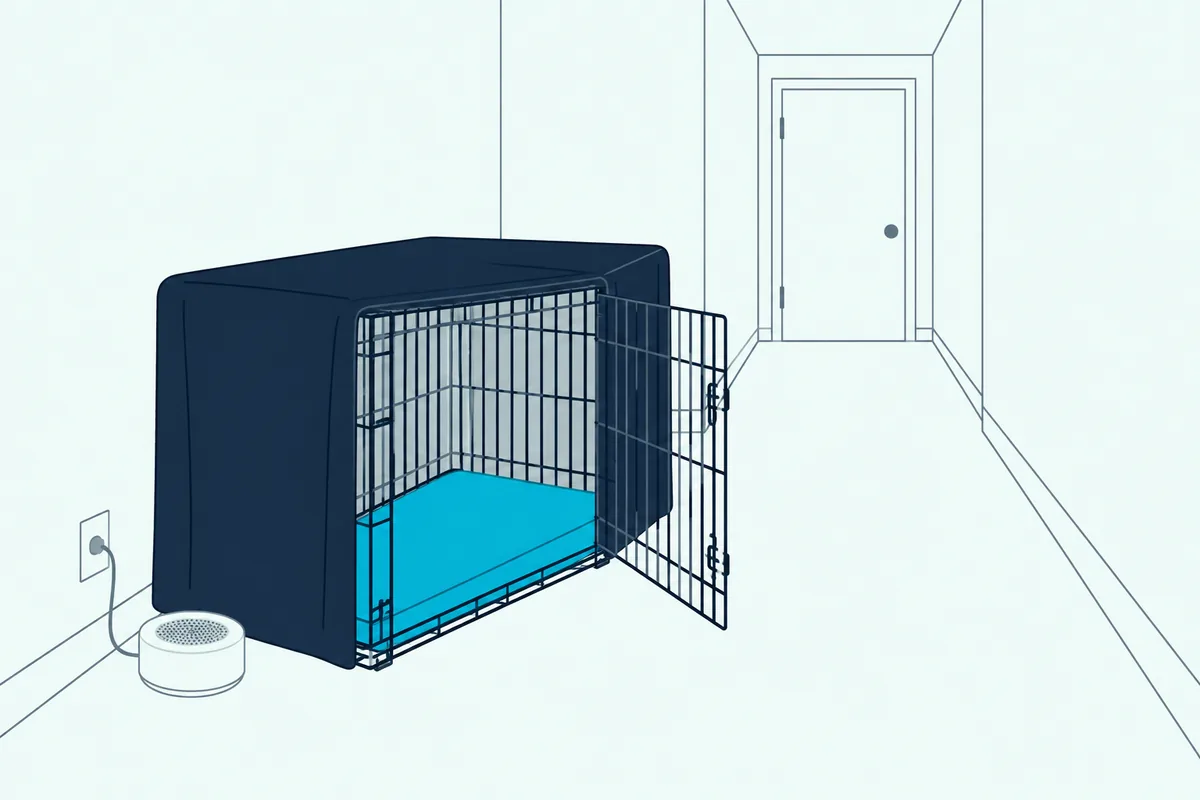
Try this on the next noisy evening: stand in each candidate room with its door closed and listen for a minute. The one where you notice the least outside noise is the one to set up, and its door is the next thing to improve.
The Santa Fe Humane Society’s handout says to bring the dog inside and close the doors and windows when the noise is thunder, then turn on the radio or TV for ambient sound. If that room’s door leaks sound, our guide on how to soundproof the door to that room starts with the gaps around it.
Humane World for Animals says to place a crate in a calm part of the home without constant stimulation or noise. At first, it suggests a bedroom or a nearby hallway, so an older dog doesn’t link the crate with being shut away.
Cornell adds a few steps for the day itself: exercise your dog earlier, keep it on a leash outside once the noise starts, even in a fenced yard, and make sure its ID and microchip details are current. Cornell warns that scared dogs may try to flee, which puts them at risk of injury or getting lost.
A room that faces a busy street needs more than a closed door, and the guide to keeping outside noise out of the room works through its windows, doors and vents. Those vent rims from the Petmate card still apply wherever the crate ends up, so leave its openings clear of walls.
Does a Crate Cover Block Noise?
With the room chosen, a cover is the next layer, and it’s mostly about sight. It barely blocks noise: the Santa Fe Humane Society says insulation such as blankets can help dampen the noise a bit, and the bigger gain is that a covered crate gives a frightened dog a place to hide.
The same handout warns not to trap the dog in its safe place by shutting a door or closing the crate. A fearful dog that thinks it’s stuck can go into escape mode, which makes the situation worse.
For barking set off by people and animals passing a window, the ASPCA’s advice starts with blocking the dog’s view. A cover does that for a crate that sits near the glass, while the room choice above does it for the rest of the house.
AKC says a fleecy blanket may be too much in hot months for a dog prone to overheating, and that a light or cooling blanket could be better in summer. On a hot day, lift the MidWest cover’s sides or use something thinner, and check the TempPro against that 85°F transport ceiling.
Never drape anything thick enough to cover the vents, which brings back the heat problem from earlier. A cover should dim the crate, not close it.
Does White Noise Help a Scared Dog?
A cover handles sight, and sound masking handles what still gets through. It can help: the ASPCA suggests soft music or white noise for fireworks, and Cornell’s veterinarians suggest playing white noise and music together, since layering two different types of sound can help drown out the noise (Cornell).
Masking doesn’t remove a boom. It fills the quiet between booms with steady sound, the way a box fan covers a neighbor’s TV, so each bang stands out less.
Place the machine near the crate but outside it, with the cord where your dog can’t reach it. Start at a low volume, since the Santa Fe Humane Society notes that a dog’s senses are more sensitive than ours and noise is probably louder for them.
Cornell also suggests long-lasting treats such as frozen stuffed Kongs, lick mats or other food toys, and notes that calming classical music may also help reduce stress. Something to work on gives a dog a job besides listening.
The ASPCA’s storm advice reminds owners that one thing doesn’t work for every pet, so keep trying combinations. The LectroFan’s 22 sounds make it easy to try a deeper fan sound one night and a brown noise the next.
How Do You Make the Crate a Safe Spot Before Storm Season?
All of that masking works better when the crate already feels safe. Train it weeks ahead in small steps, because Humane World for Animals says crate training can take days or weeks and that the crate should always be linked with something pleasant.
Its four steps start with letting your dog explore the open crate, with treats tossed nearby, then inside the door, then all the way in. Next come meals inside the crate, with the door closed a little longer each time until your dog stays about 10 minutes after eating.
Once meals go calmly, Humane World suggests short crate stays while you’re home, sitting nearby for five to 10 minutes and then leaving the room briefly. After your dog can stay quietly for about 30 minutes with you mostly out of sight, you can start leaving it crated for short absences or overnight.
Never use the crate as punishment, Humane World and AKC both say. AKC calls the crate a haven, not a jail cell, and Humane World says to keep the door open when you’re home so your dog can go in when it needs a safe space.
Practicing before the first storm is the whole point. A dog that meets its crate for the first time while the sky is booming is the dog Cornell warns about.
How Do You Keep Barking From Reaching the Neighbors?
A safe, quiet crate still won’t hold barking in, which is the other half of this search. Quiet the room and work on the barking itself, because a crate open enough to breathe can’t trap much sound, and WorkSafe Victoria’s 9 dB figure for a 10 percent opening describes exactly this case, noise escaping an enclosure through its gaps.
Start with the room’s leaks: the door gaps, the windows and any vents, the same paths that let storms in. A closed interior door and a sealed window do more for the neighbors than anything wrapped around the crate.
For territorial or alarm barking, the ASPCA suggests letting your dog bark three or four times, then calmly saying “Quiet” and rewarding the silence with a steady stream of tiny treats. It also describes a “go to your spot” routine for the doorbell, and your dog’s crate can be that spot.
The ASPCA calls anti-bark collars punishment devices that aren’t a first choice, especially for barking driven by fear, anxiety or compulsion. It also warns never to muzzle a dog to keep it quiet for long periods, because a dog can’t eat, drink or pant to cool itself in one.
If the barking turns out to be separation-related, Humane World for Animals points you to a professional animal behavior specialist. Counterconditioning and desensitization, not a quieter box, are what it says resolve that problem.
Can You Build a Quieter Crate Yourself?
Room fixes and training take time, so the DIY route tempts, and it’s where most of the risk lives. You can only make a crate a little quieter yourself, because lining it with foam or blankets absorbs some echo inside it, while OSHA separates sound-absorbing materials, which reduce the buildup of reflected sound, from the heavy, dense materials that actually block it.
WorkSafe Victoria’s lining rule for machine enclosures calls for at least 50 mm of dense absorbent behind a facing that’s at least 25 percent open. That’s a thick, heavy build for a box a dog lives in, and it still leaves the vent problem from the top of this page.
The same split applies to acoustic panels on the room’s walls: they absorb echo inside the room, which is acoustic treatment, not soundproofing. They can make the room sound calmer, but they won’t stop barking from reaching the neighbors.
Chewing is the other problem. AKC warns that swallowed chunks of fabric can cause choking or an intestinal blockage, so anything soft you add has to be out of your dog’s reach.
FirstBuild’s Zennel, a sound-proof dog house built with sound-dampening acoustic foam, is presented on its page as a prototype with a call for feedback. Even the people who built a foam-lined dog house showed it as an idea to discuss, not a finished product.
That box-guide rule from the top of this page is the one to keep. Birds raise the same question, and the answer for a soundproof bird cage is also to quiet the room rather than box in the cage.
When Should You Call the Vet?
Those DIY limits are a good reason to bring in help for a dog whose fear doesn’t fade. Call early, well before a known storm season or fireworks date, because Cornell’s veterinarians advise talking about anti-anxiety medication well in advance, trying it first on a day without noise, and giving it early enough before the noise starts.
The ASPCA warns that storm phobias can get worse over time and suggests a test run of any prescribed drug while your regular vet’s office is open. If your dog’s fear, anxiety and stress feel unmanageable, Cornell suggests asking about a referral to a veterinary behaviorist.
At home, the Santa Fe Humane Society describes a slow program. Play a recording of the scary sound just loud enough for your dog to notice while it eats from a food puzzle, then raise the volume over several sessions only as long as your dog stays calm.
Don’t force a dog to “just get over it” by playing the noise until the fear stops, which the same handout calls very dangerous and says can traumatize a dog. Punishment is out too, since Cornell says it only increases a dog’s distress.
The ASPCA’s poison control center adds a practical warning for storm nights. Dogs that chew or swallow things when they’re scared can become seriously ill, so clear the room of anything they could eat.
The Bottom Line
A soundproof dog crate isn’t a safe buy, because its quiet comes from sealing and your dog needs open air on several sides. The best a ventilated crate can do is soften the noise, so the room, the cover and the sound machine do the real work.
Choose a solid-walled kennel or a covered wire crate in an inside room, mask the booms with steady sound, keep an eye on the temperature, and talk to your vet when the fear keeps growing.
Frequently Asked Questions
Should you close the crate door during fireworks?
Not for a frightened dog that isn’t already relaxed being shut in. The Santa Fe Humane Society warns against trapping a fearful dog in its hiding spot by closing the crate, because a dog that thinks it’s stuck can go into escape mode, and Cornell’s veterinarians say to use a crate during fireworks only if your dog is already used to it and sees it as a safe spot. Leave the door open, put the crate in an inside room, and close that room’s door and windows instead.
How long can a dog stay in a crate?
Less time than many schedules assume. Humane World for Animals says puppies under six months shouldn’t stay in a crate for more than three or four hours at a time, and that a dog crated all day and night doesn’t get enough exercise or human contact and can become depressed or anxious. AKC adds that you should never leave a puppy in its crate all day, since it needs bathroom breaks, play and meals. A quieter crate doesn’t change any of those limits.
What room temperature is too hot for a crated dog?
No home rule gives a single number, but the federal rules for dogs in transit say the temperature may not stay above 85°F for more than four hours, and that fans or air conditioning are needed once a cargo space reaches 85°F. Humane World for Animals says a dog’s body temperature shouldn’t reach over 104°F, and that humidity makes heat harder to shed because it hampers panting. Watch for excessive panting, drooling and weakness, which the ASPCA lists among the signs of overheating, and keep flat-faced breeds cooler still.
Do anti-bark collars help a dog that barks in its crate?
The ASPCA doesn’t recommend them as a first choice. It calls anti-bark collars punishment devices, says the collars that deliver noise are ineffective with most dogs, and warns against them especially for barking driven by fear, anxiety or compulsion. It also says virtually all dogs learn not to bark while wearing the collar and go back to barking once it’s off. Work out which kind of barking you’re dealing with first, and see a vet, since some dogs bark because of pain.
Can a muzzle keep a dog quiet in its crate?
No. The ASPCA says never to muzzle a dog to keep it quiet for long periods or when you aren’t supervising it, because a dog can’t eat, drink or pant to cool itself while wearing one, and it calls tying a dog’s muzzle closed with rope, cord or rubber bands dangerous, painful and inhumane. In a crate, where airflow is already limited, the ability to pant matters even more.