Soundproof Bird Cage? What Actually Quiets a Loud Bird
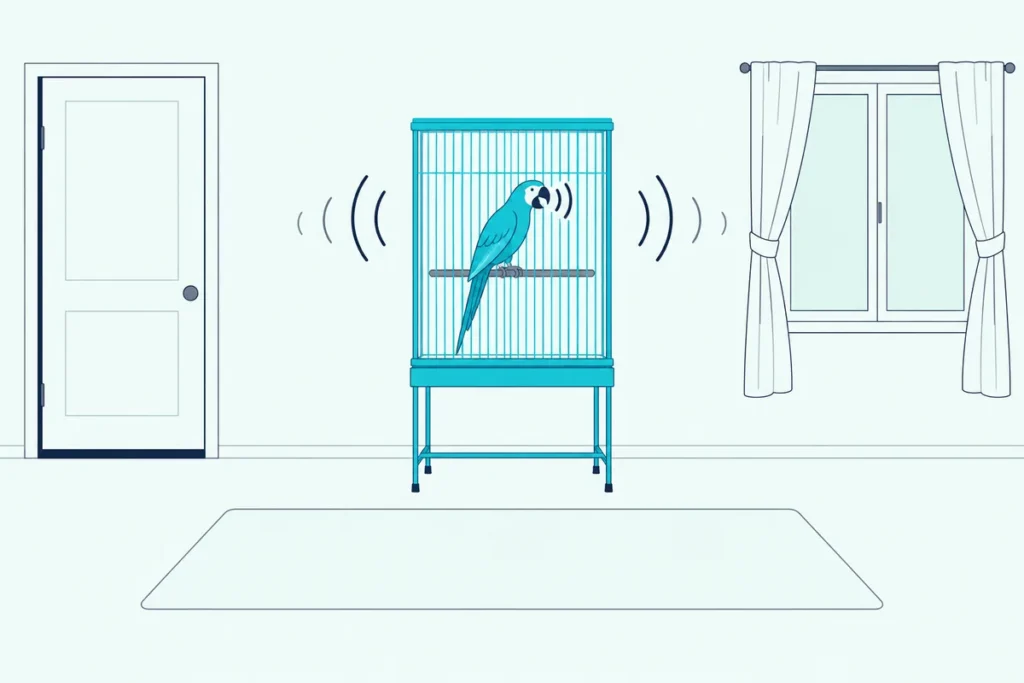
Shopping for a soundproof bird cage usually starts with a complaint, whether from a neighbor through the wall, a roommate before work or your own frayed nerves.
The fixes on sale are covers, foam and acrylic cages, yet a bird needs fresh air, steady warmth and normal light, and anything sealed tight enough to stop sound starts taking those away.
You can still cut what reaches the neighbors and your bedroom by working on the room around the cage and on the reasons your bird is calling.
This guide uses the MSD Veterinary Manual, PetMD’s veterinarians and the World Parrot Trust for the bird’s side, and HUD’s and JELD-WEN’s figures for doors and gaps.
Start with what a cage can and can’t do, then move on to the room fixes and the daily habits that quiet a loud bird.
Can You Soundproof a Bird Cage?
That complaint deserves a straight answer first. You can’t soundproof a bird cage without harming the bird, because blocking sound takes heavy, airtight barriers, and a cage has to let air, warmth and light reach the bird.
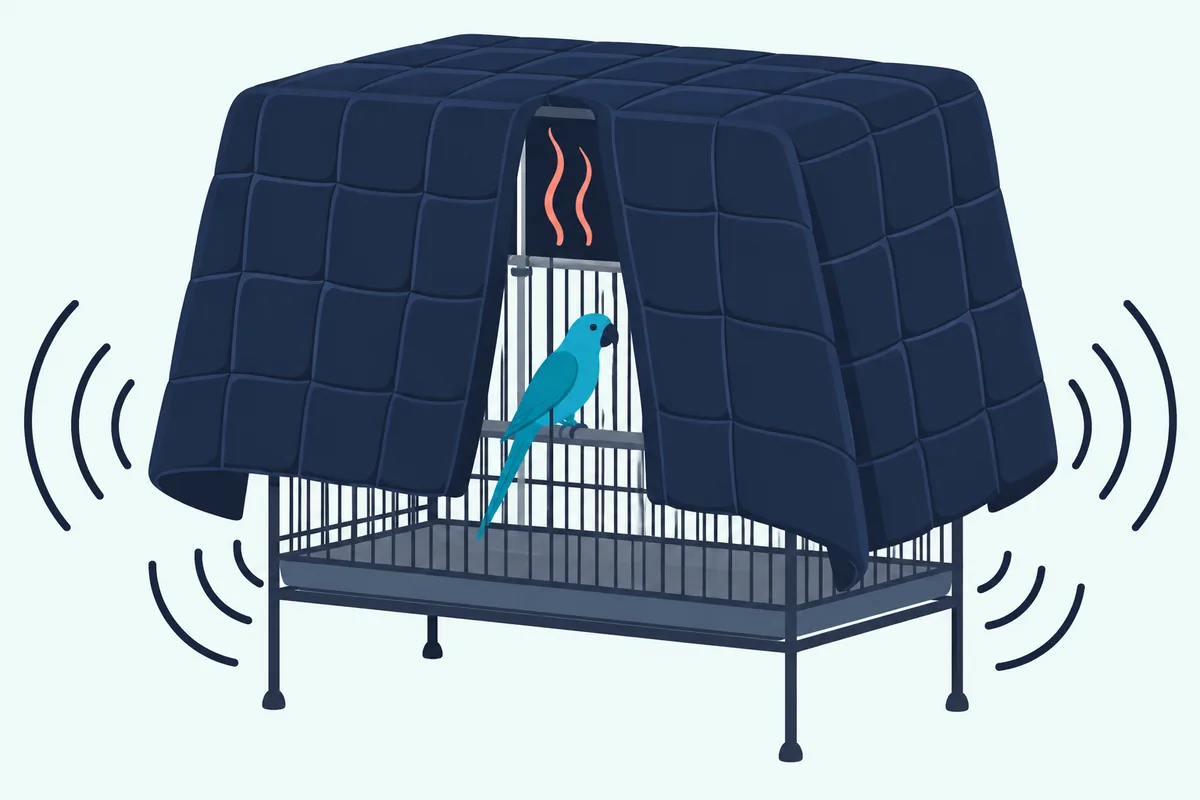
Small leaks undo heavy barriers, too: HUD’s Noise Guidebook says a one-inch square hole, or a 1/16 in crack 16 in long, takes a 50 STC wall down to STC 40. HUD describes STC, sound transmission class, as the number of decibels a material takes off a sound passing through it, so those ten points are a real loss.
A cage cover is fabric with open edges by design, and even purpose-made acoustic curtains rated only STC 13 to 20 in a National University of Singapore study. That’s about the STC 17 HUD gives a common hollow-core door, which its guidebook calls acoustically even weaker than a window.
Here’s how the usual fixes compare, with what each does to the sound and what the bird-care sources say about it.
| Fix | What it does to the sound | What the bird-care sources say |
|---|---|---|
| Fabric cover or blanket on the cage | Absorbs a little, blocks little | MSD: most birds shouldn’t be covered at night; PetMD: a suddenly covered cage can stress a bird |
| Foam or panels fixed to the cage | Absorbs some echo, blocks almost nothing | Within beak reach; PetMD’s vets advise against homemade cages built from building supplies |
| Acrylic cage | Solid sides, but its air holes leak sound | Needs good ventilation and space to stretch (MSD) |
| A box built around the cage | Can’t be sealed without cutting off air | MSD: keep birds in well-ventilated areas, away from fumes |
| Sealing the room’s door | Works on the weakest part of most walls | Fit the seals where the bird can’t chew them |
| Moving the cage off a shared wall | Puts more building between bird and neighbor | MSD: keep the cage away from windows and air conditioning |
| Rewarding quiet, ignoring screams | Cuts how often the bird screams | The World Parrot Trust’s core advice |
The bottom three rows are where the real gains are. Our guide to why felt and fabric absorb sound without blocking it shows, with lab numbers, why the top rows disappoint.
Why Is My Bird So Loud?
That last row, rewarding quiet, starts with the bird itself, because most screaming has a cause you can change. Loud calling is how parrots keep in touch, and the Avian Welfare Coalition says wild parrots live and travel in flocks and stay in constant contact with loud calls.
Parrots aren’t quiet pets, and the Coalition is blunt about it: it says no parrot is quiet and independent, and that birds need hours of social interaction every day.
The World Parrot Trust says that in a home, screaming is more often than not a contact call that has been supersized. A parrot calls the people it lives with in pleasant sounds, nobody answers, so it calls louder, just as you’d raise your voice to a partner who didn’t reply.
Its examples show how owners reward that scream without meaning to. A shouted “shut up” through the door, or a quiet hello in answer to a scream when you get home, gives the bird attention, and the Trust predicts the parrot will scream more after each.
So count the screams for a few days and note what happens just before and just after each one. That record is where the Trust’s method starts, because it shows what the scream is getting your bird.
A sudden change is a different case. Veterinarian Laurie Hess, writing for PetMD, says any bird that suddenly starts screaming or changes how it vocalizes should be checked by a vet, and Chadwell Animal Hospital’s care sheet lists changed or absent vocalizations among emergencies.
Does Covering a Bird Cage Keep It Quiet?
That attention problem is why the classic trick of throwing a cover over the cage backfires. A cover doesn’t block a scream, and vets disagree on whether most birds should be covered even at night, so treat covering as a bedtime routine for birds that accept it, not as a noise fix.
The MSD Veterinary Manual says most birds shouldn’t have their cages covered at night because it can stress them. When it’s cold, it suggests warming the room or moving the cage away from drafty windows instead.
Chadwell Animal Hospital’s care sheet takes the other side for birds that tolerate it: unless covering panics your bird, do it at the same time each evening and leave it on until you wake.
What matters either way is sleep, and PetMD’s vets recommend 10 to 12 hours of sleep in a dark room each night (PetMD). A space that goes dark at bedtime can give that without any cover at all.
Covering by day is the risky version, since PetMD lists a cage that’s suddenly kept covered, or moved to a dark room, among the changes in routine that can stress a bird.
Throwing a cover over the cage the moment your bird screams also hands it the attention the World Parrot Trust warns about. By the Trust’s logic, that rewards the scream.
Is a Soundproof Bird Cage Cover or Blanket Worth Buying?
That sleep-only role means a cover sold to reduce noise promises more than fabric can deliver. No cover can be breathable and soundproof at once, because blocking sound takes mass and an airtight seal, while a safe cover has to let air through.
Prevue Pet Products, which makes the Good Night cover, sells it to reduce distractions and allow uninterrupted sleep, and describes it as lightweight, breathable nylon with no claim about noise (Prevue).
Those curtain numbers from earlier set the ceiling. If a heavy, purpose-made acoustic curtain manages STC 13 to 20, a lighter cover that’s open at its edges can’t be expected to beat it.
A heavy moving blanket wrapped tight around the cage adds mass, but it also blocks the airflow MSD asks for when it says birds belong in well-ventilated areas (MSD).
Warmth is the other limit. PetMD’s vets put a cockatiel’s comfortable range at 65 to 80°F (PetMD), and a thick layer around the cage holds warm air in.
Then comes the beak. MSD notes that birds chew electrical cords (MSD), so loose threads, stuffing and foam on the cage are within reach all day.
If you still want soundproof curtains or a sound blanket in the bird room, hang them on the window or the far wall, out of reach. There they can soften echo without touching the cage.
Are Acrylic Bird Cages Quieter?
Acrylic cages are the other product sold for this problem, including a fully acrylic cage listed as noise reducing. Solid acrylic sides stop more sound than open wire bars, but the cage still needs openings for air, and the openings are where sound escapes.
That’s HUD’s leaky-wall rule again: one square inch of opening is enough to take a 50 STC wall down to 40, so a cage drilled for airflow can’t hold much sound in.
No veterinary or independent test of how much an acrylic cage reduces a bird’s noise is cited here, so read any noise promise on a listing as untested.
What the vets do specify is space and air. MSD says a cage should be at least one and a half times the bird’s wingspan in every direction, and that birds belong in well-ventilated areas.
So if an acrylic bird cage appeals for other reasons, size it by that rule and look closely at its ventilation, rather than buying it for quiet.
What About Building a Soundproof Box Around the Cage?
A homemade box combines every problem above: less air, trapped warmth and building materials within reach of the beak. MSD’s list of household poisons for birds includes epoxy or super glue, model glue, paint and paint thinner, and galvanized metal, all common in a DIY build.
MSD’s heavy-metal section adds that galvanized wire and hardware, often used in homemade cages, can be a major source of zinc poisoning. PetMD’s vets likewise advise against homemade habitats or any made with wood or galvanized wire.
Fumes are the fast danger, because MSD says birds’ airways are very sensitive to chemical fumes. A closed box keeps whatever its glue or paint gives off right beside the bird.
Burton Acoustix’s machine enclosure guide treats ventilation as the hard part even for equipment, and it rules out fully enclosing anything alive.
How Do You Soundproof a Bird Room Instead?
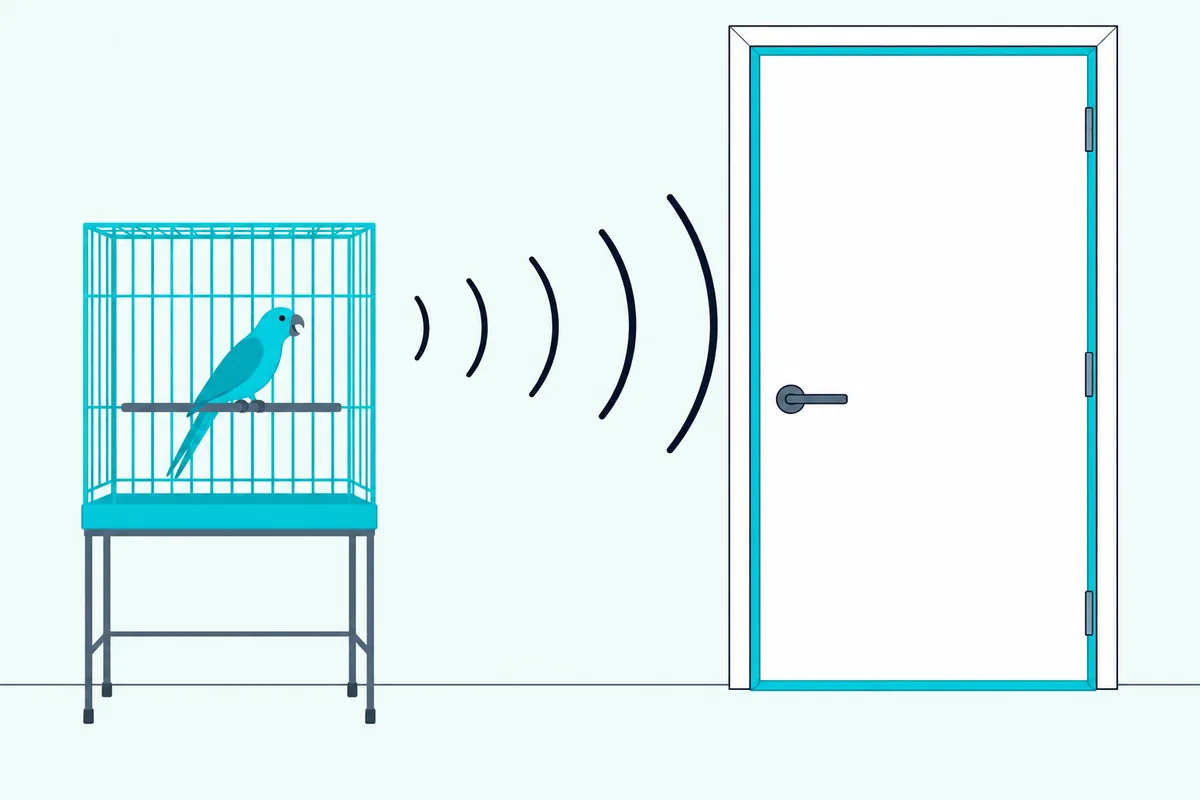
Since the cage can’t be sealed, the walls, door and windows around it have to do the blocking. Soundproof a bird room by putting the most building between the cage and the listener, sealing the gaps around the door and closing the window nearest your neighbor while your bird is loud.
HUD’s guidebook rates ordinary 3/16 in window glass at STC 25, and an open window blocks nothing at all.
Where Should the Cage Go?
Start with placement, because it costs nothing and the vets already have rules for it. MSD says to keep the cage away from windows and air conditioning, where it can get too hot or too cold, and out of the kitchen, because smoke and cooking fumes can harm birds.
Pick an inside wall rather than the one you share with a neighbor, so a room or a hallway sits between the bird and the people complaining. If the cage has to stay on that wall, see how to soundproof a joining wall you share with neighbors.
Several soundproofing blogs tell owners to put the cage in a corner by a window so the noise escapes outside. That aims the sound at the neighbors and puts the bird where MSD says it can overheat or chill.
A window can unsettle the bird, too: PetMD’s Laurie Hess lists the sight or sound of wild animals such as hawks or raccoons outside a window among the things that stress indoor birds. PetMD’s cockatiel sheet adds that window glass filters out the UV light birds need.
Keep the bird near its people, though, because MSD says some birds need to be where people are. The World Parrot Trust suggests moving a caged bird to where it can interact with the family more, which a shut-away spare bedroom can’t do.
Move the cage once and then leave it there, since PetMD lists a change in the cage’s location among stressors for birds.
How Much Does the Door Matter?
After placement, the door is usually the weakest part of the bird room’s walls. HUD says the common hollow-core wood door rates STC 17, and because it takes up about a fifth of a wall, it pulls a 48 STC wall down to 24.
A solid-core wood door with a vinyl seal around its edges and carpet on the floor leaves the same wall at 33, by HUD’s figures, and gasketed stops or a drop-bar threshold closer add more.
Maker figures show the same gap between door types: JELD-WEN’s acoustic ratings list its molded hollow-core interior doors at STC 25 to 27 and its solid-core versions at 29 to 32.
Sealing the gaps is the cheapest gain: a sweep for the bottom and foam weatherstrip for the sides and top. Our suggestion is to fit them where a beak can’t reach, such as the sweep on the outside face of the door, and MSD says birds out of their cages should be supervised anyway.
For the bottom gap, the VITAM AMO door sweep is 2 in by 39 in, needs no tools and cuts to size, according to its listing.
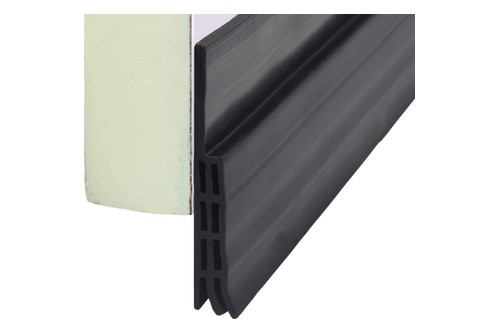
the VITAM AMO door sweep
For the sides and top, Kikerike’s self-adhesive foam weatherstrip is high-density foam, 1/2 in by 1/4 in and 42 ft long, sold for door and window sound isolation, according to its listing.
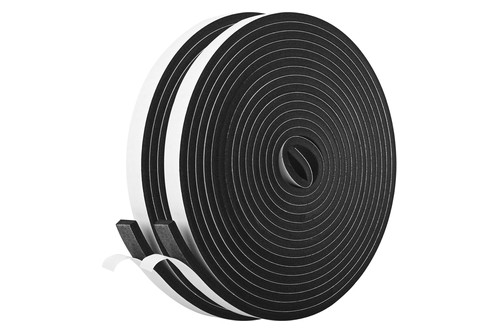
Kikerike’s self-adhesive foam weatherstrip
If the bird room’s door is hollow, these seal-first steps to soundproof a hollow door show what sealing adds and when a solid-core swap is worth it.
What Can You Add Inside the Room Safely?
Once the door is sealed, soft surfaces inside the room can take the edge off the echo, though they won’t stop sound leaving. Rugs, upholstered furniture and heavy curtains absorb some reflected sound, and acoustic panels absorb more, as long as every one hangs well out of the bird’s reach.
Keep foam, fabric and fiberglass off the cage and out of beak range, because PetMD’s vets warn that common building supplies may be toxic to birds when swallowed (PetMD).
Do any building work while the bird is in another room. PetMD lists loud noises such as construction, and even repainting the walls, among the changes that can stress a bird.
Air the space out afterward as well, since MSD’s poison list includes paint, paint thinner and glues, and its vets say birds’ airways are very sensitive to chemical fumes.
How Do You Teach a Bird to Be Quieter?
Those room fixes stop sound on its way out, but training cuts how much of it starts. Teach a bird to be quieter by rewarding the sounds you can live with and giving screams nothing: no shouting back, no rushing in and no cover thrown over the cage.
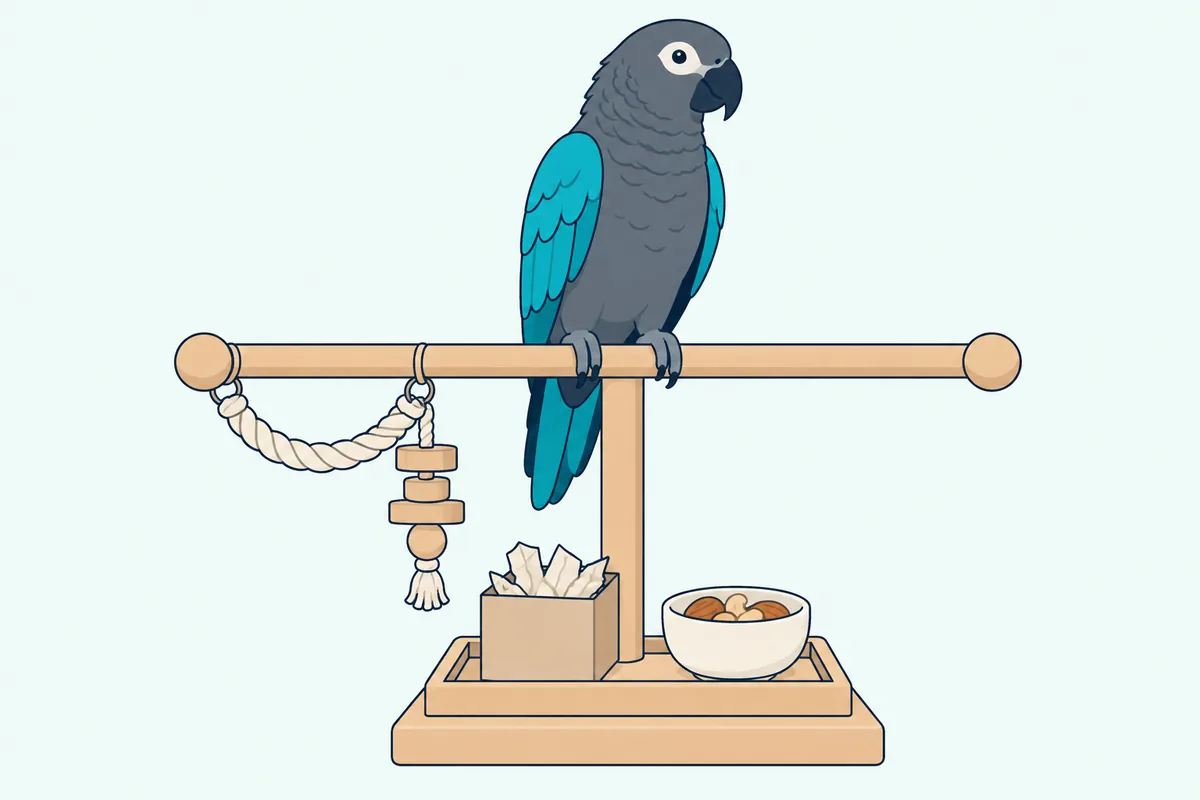
The Trust’s screaming guide starts before the scream, with one-on-one time, toy boxes that hold part of the day’s food, and enough exercise, since it notes that tired birds are less likely to scream.
It also suggests dropping by for a minute or two while the bird is behaving well, so the attention arrives before the scream rather than after it.
Then pick a few sounds you can live with long term, such as whistling, talking or soft calls, and answer those. The Trust’s advice is to withdraw all attention from the scream itself.
It admits that last part is hard, because most of us crack and react with a look or a word. So it advises answering only when you can catch the bird being good the instant the scream stops.
You can train your bird to do other things, too, such as stepping up, foraging or going to a set perch. The Trust says any teaching gives the bird the attention it would otherwise scream for.
Be patient with all of it. The Trust calls screaming one of the most difficult behaviors to change and says the time it takes varies, but that it can be done.
The Bottom Line
No cage can be made soundproof without taking the air, warmth and light a bird needs, so skip soundproof covers, foam on the bars and homemade boxes.
Move the cage off the shared wall and away from the window, seal the room’s door, and spend your effort on rewarding quiet, which is the one fix that changes how often the bird screams.
Frequently Asked Questions
Is There a Soundproof Bird Cage?
No cage is truly soundproof, because a cage that blocked sound would also block air. Acrylic cages sold as noise reducing still need openings for ventilation, and HUD’s guidebook shows what a single square inch of opening costs a wall: it takes a 50 STC wall down to 40. MSD’s vets also ask for a cage at least one and a half times the bird’s wingspan in every direction, kept in a well-ventilated spot.
Should I Cover My Bird’s Cage When It Screams?
No. The World Parrot Trust’s examples show attention after a scream as the reward that keeps screaming going, and walking over to cover the cage is attention. PetMD also lists a cage that’s suddenly kept covered among the changes that can stress a bird. Reward the quiet moments instead, and keep any cover for a regular bedtime if your bird accepts it.
Do I Have to Cover My Bird’s Cage at Night?
Not necessarily. The MSD Veterinary Manual says most birds shouldn’t be covered at night because it can stress them, while Chadwell Animal Hospital’s care sheet says to cover at the same time each evening unless covering panics your bird. Either way, aim for sleep: PetMD’s vets recommend 10 to 12 hours of sleep in a dark room each night.
When Should I Cover My Bird’s Cage in Winter?
No vet source cited here gives a clock time, so work back from your bird’s sleep. PetMD’s vets recommend 10 to 12 hours in a dark room, so a bird you uncover at 7 a.m. would go dark between 7 and 9 p.m. In winter, MSD suggests warming the room or moving the cage away from drafty windows rather than covering it for warmth. If your bird is covered, Chadwell Animal Hospital says to do it at the same time each evening.
Can I Put Acoustic Foam on My Bird’s Cage?
No. Foam on the bars is within reach of the beak, and PetMD’s vets warn that common building supplies may be toxic to birds when swallowed. Foam also absorbs echo rather than blocking sound, so it would do little for the neighbors even if it were safe. Hang acoustic panels on the room’s walls, out of reach, if the space itself is echoey.
Will Moving My Bird to Another Room Make It Quieter?
It can help the neighbors if the new room puts more walls between them, but don’t isolate the bird. The World Parrot Trust explains most screaming as a contact call that gets louder when nobody answers, and it suggests moving a caged bird to where it can interact with the family more. Choose a room your household uses that doesn’t share a wall with the neighbor.
Why Does My Bird Scream When I Leave the Room?
That’s usually a contact call. The World Parrot Trust’s first example is a parrot that screams when its person leaves the room and a person who opens the door to say “shut up,” which it predicts will make the parrot scream more. Drop by while the bird is quiet, answer its softer calls and give the scream nothing.
How Do I Soundproof an Apartment From a Loud Bird?
Start with the steps that cost least: keep the cage off the wall you share and away from windows, seal the bird room’s door with a sweep and weatherstrip, and close the window nearest your neighbor while the bird is loud. HUD’s figures show why the door comes first, since a hollow-core door takes a 48 STC wall down to 24. Our guide to renter-safe soundproofing for the rest of an apartment covers walls, floors and windows.