Best Yamaha Soundbar: Which Current Bar Fits Your TV and Room

Choosing the best Yamaha soundbar starts with a check many older lists skip: whether Yamaha still sells the bar at all.
The YAS-209, YAS-109 and True X Bar 50A still headline plenty of reviews, yet Yamaha’s own US pages mark all three as discontinued, and Dolby Atmos on bars like the SR-B40A stops at an optical cable.
Get the line-up and the port right, and one HDMI cable carries the TV’s sound, the TV remote runs the volume, and the bass ends up where you’ve got room for it.
Yamaha’s current US range splits three ways: SR-B bars about 36 inches wide, SR-C and B200A bars about 24 inches wide, and True X flagships with height speakers.
The quick answer and a table come next, then each pick, the flagships, and how to match a bar to your TV and room.
What Is the Best Yamaha Soundbar?
That check leaves Yamaha’s current US sound bars, and for most living rooms the best Yamaha soundbar is the SR-B40A. It’s the one bar outside the True X flagships that pairs Dolby Atmos over HDMI with a separate wireless subwoofer, and Yamaha’s own How to Shop for a Sound Bar says stand-alone subwoofers are often more powerful and effective than built-in ones.
Short on floor space, you’d look at the SR-B30A, which keeps the Atmos support and the bar size and builds its bass in. The SR-B20A covers DTS soundtracks, the SR-C30A suits a desk or small TV, and the True X Surround 90A is the only system here with height speakers and rear speakers in the box.
| Bar | Speakers Yamaha lists | Subwoofer | TV connection | Surround formats | Width and weight |
|---|---|---|---|---|---|
| SR-B40A | Four 1.8 in fronts, two 1 in tweeters | Wireless, 6.25 in | eARC/ARC, optical | Dolby Atmos, no DTS | 35-7/8 in; 6.4 lb, sub 17.9 lb |
| SR-B30A | Four 1.8 in fronts, two 1 in tweeters | Built in, two 3 in | eARC/ARC, optical | Dolby Atmos, no DTS | 35-7/8 in; 8.6 lb |
| SR-B20A | Two 2-1/8 in fronts, two 1 in tweeters | Built in, two 3 in | ARC, two optical | DTS Digital Surround, Dolby Digital | 35-7/8 in; 7.1 lb |
| SR-C30A | Two 1.8 in fronts | Wireless, 5-1/8 in | ARC, two optical, aux | Dolby Digital | 23-5/8 in; 2.9 lb, sub 12.6 lb |
| SR-C20A | Two 1.8 in fronts | Built in, one 3 in, two passive radiators | ARC, two optical, aux | Dolby Digital | 23-5/8 in; 3.9 lb |
| B200A | Two 1.8 in fronts | Built in, one 3 in | eARC/ARC, optical, aux | Dolby Atmos, no DTS | 23-5/8 in; 3.9 lb |
| True X Bar 90A | Fronts, center, 12 height beam speakers | Wireless, 6-3/4 in | eARC, HDMI in, optical | Dolby Atmos, DTS:X, AURO-3D | 46-1/2 in; 24.3 lb, sub 28 lb |
| True X Surround 90A | As Bar 90A, plus two rear speakers | Wireless, 6-3/4 in | eARC, HDMI in, optical | Dolby Atmos, DTS:X, AURO-3D | 46-1/2 in; 24.3 lb, sub 28 lb, rear speakers 2.2 lb |
Read the table by your TV’s ports first, then by the formats column, because those two decide what the bar can play. Clear Voice for dialogue and Bass Extension appear on every bar here, and all of them have Bluetooth, so none of those separates them.
Every pick met Burton Acoustix’s rating, review and stock checks on 1 November 2026. The descriptions come from Yamaha’s spec pages and user guides.
The SR-C20A, B200A and both True X 90A systems have no buy button here because they didn’t meet those checks that day, so Yamaha’s product pages and dealer locator are the place to start.
| Product | Link |
|---|---|
Most Living Rooms 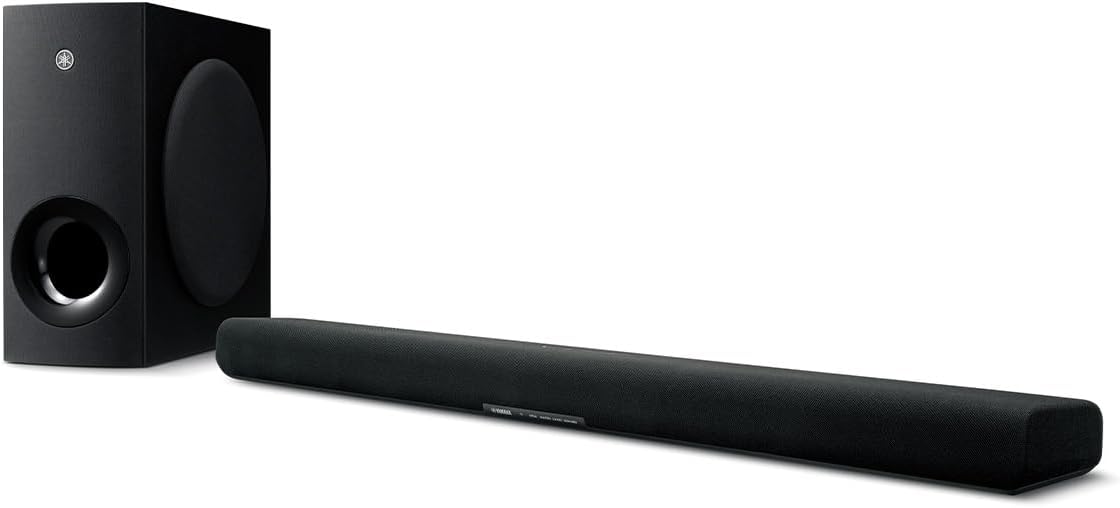 | See ratings |
No Subwoofer Box 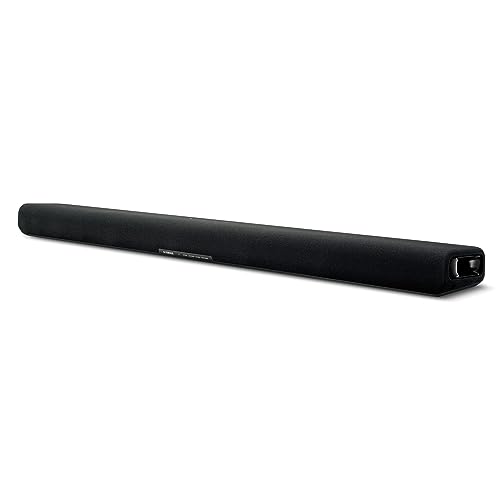 | See ratings |
DTS Soundtracks 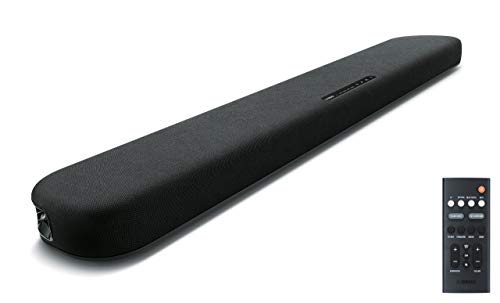 | See ratings |
Desks and Small TVs 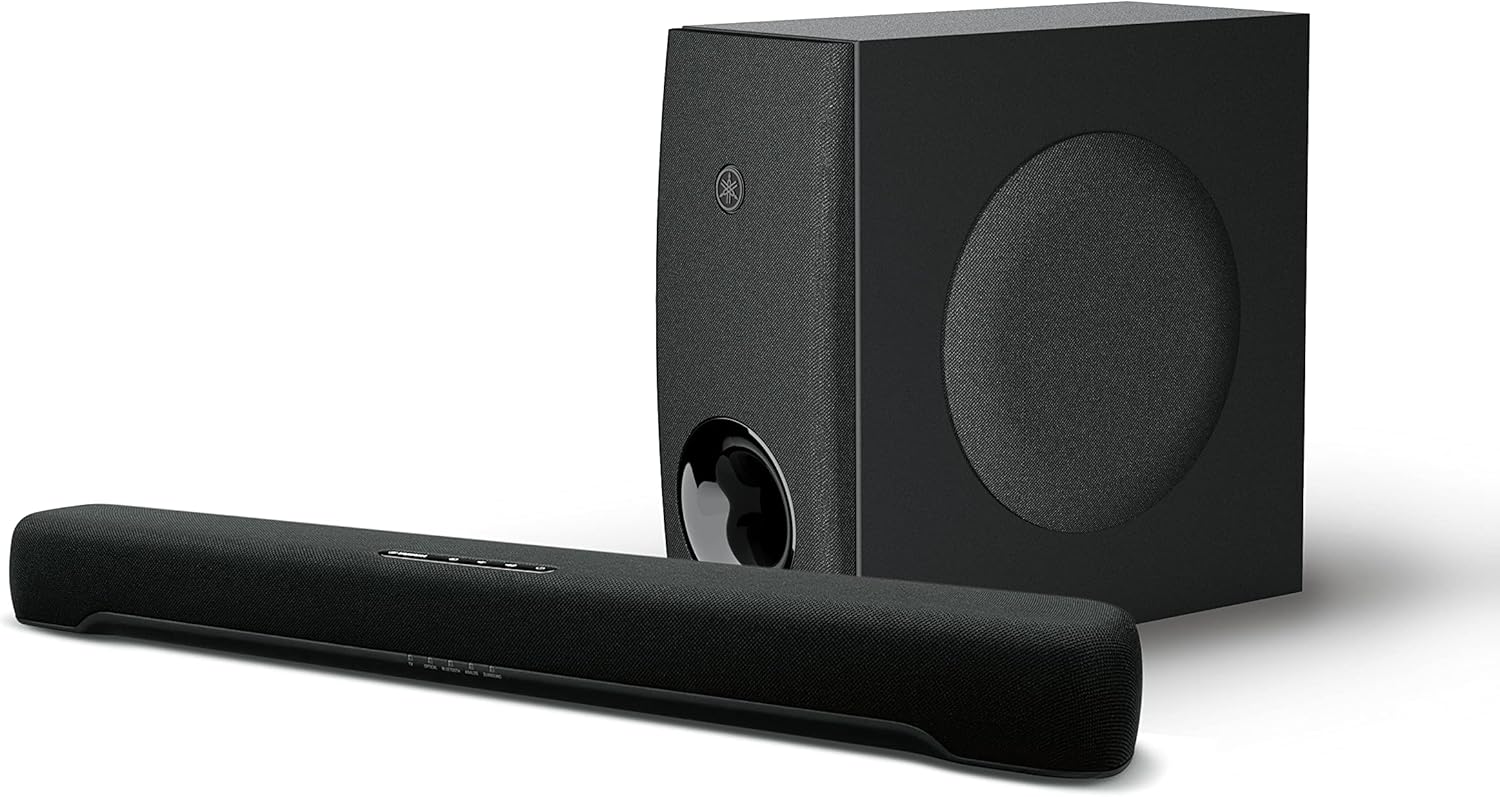 | See ratings |
Which Yamaha Soundbars Play Dolby Atmos?
That formats column splits the range in two. Yamaha’s format lists show Dolby Atmos on the SR-B40A, SR-B30A, B200A and both True X 90A systems, while the SR-B20A, SR-C30A and SR-C20A list no Atmos at all.
The catch sits in the cable: the SR-B40A user guide says Dolby Atmos can’t play when the TV is connected with a digital optical cable, and the SR-B30A and B200A guides say the same. Those bars do accept Atmos from a TV’s eARC or plain ARC HDMI port, so that port is the one to check.
DTS is the other gap, since those three bars’ format tables list PCM and Dolby formats but no DTS. Yamaha’s spec tables also file their Atmos under virtual surround technology, and their driver lists name no height speakers.
Yamaha SR-B40A
For most living rooms, the Yamaha SR-B40A is the pick.
the Yamaha SR-B40A
The SR-B40A specs list 200 W in all: 50 W for each front channel and 100 W for the subwoofer. That subwoofer is the part to plan for, at 7-5/8 by 16-1/2 by 16 inches and 17.9 lb, and it needs its own wall outlet.
Yamaha says the wireless link makes it easy to place anywhere in the room, and the remote sets its level separately from the bar. The Sound Bar Remote app adds tone controls, and the four sound modes are Stereo, Standard, Movie and Game.
The box holds the bar, subwoofer, remote, two power cords and a 1.5 m HDMI cable. You won’t find an HDMI input for a console or player, Wi-Fi or a subwoofer output on its spec table.
Yamaha SR-B30A
If the floor is spoken for, the Yamaha SR-B30A is the pick.
the Yamaha SR-B30A
It’s the same size bar with the same four front drivers and two tweeters, but two 3-inch subwoofer drivers inside replace the separate box, and the total falls to 120 W. Yamaha calls it perfect for smaller living rooms, bedrooms and dens.
Yamaha’s guide also shows a SUBWOOFER OUT jack, so you can add a powered subwoofer later with an RCA mono cable, which the SR-B40A’s spec table rules out. The box has the remote, one power cord and the same 1.5 m HDMI cable.
Yamaha B200A
Yamaha’s newest bar, tagged New on its US page, puts Atmos into the compact 23-5/8-inch shape. Its spec page lists two 1.8-inch fronts at 20 W each and one 3-inch built-in subwoofer at 30 W, with eARC/ARC, one optical input and a 3.5 mm aux jack.
The B200A user guide is dated September 2026, and Amazon listed the bar as a pre-order due 1 November 2026, so it has no track record yet. Yamaha pitches it at gaming setups, bedrooms and anywhere space matters, and the box has an HDMI cable.
When Does the Yamaha SR-B20A Beat an Atmos Bar?
That DTS gap is the SR-B20A’s whole case. It wins when your soundtracks are DTS or your TV connects only by optical, because Yamaha’s guide lists DTS Digital Surround and Dolby Digital on every input, where the SR-B40A, SR-B30A and B200A take only Dolby Digital over optical.
For those setups, the Yamaha SR-B20A is the pick.
the Yamaha SR-B20A
Two optical inputs sit alongside HDMI ARC, and the bar stands 2-1/8 inches tall against the SR-B30A’s 2-5/8, which helps under a low TV. Bass comes from two 3-inch built-in subwoofer drivers, and total power is 120 W, the same figure as the SR-B30A.
Yamaha adds DTS Virtual:X for virtual 3D surround, a gyroscope that adjusts the sound for flat or vertical placement, and Bluetooth switching between two devices. The box has a digital optical cable rather than HDMI, so buy an HDMI cable if you want ARC.
What Fits a Small Room or Desk?
Width is the next split after formats. The SR-C30A, SR-C20A and B200A are 23-5/8 inches wide against 35-7/8 for the SR-B bars, which suits a small TV or a desk.
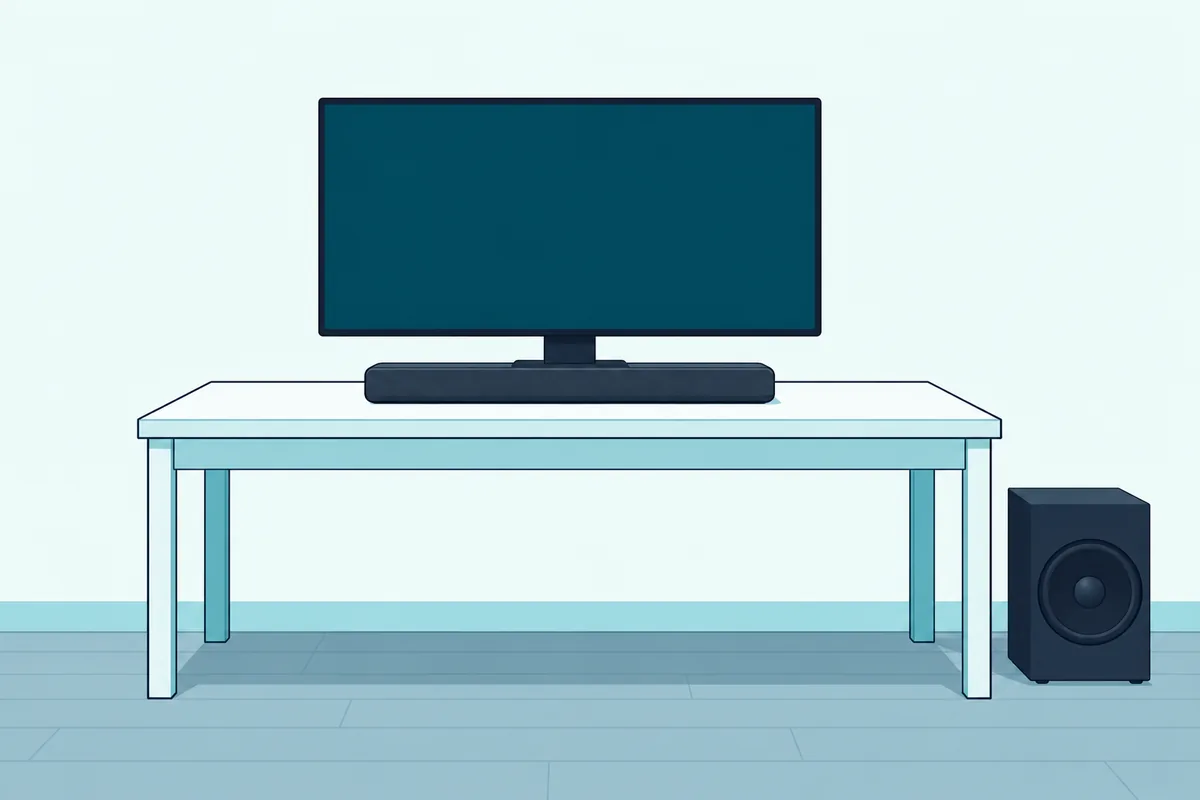
Yamaha says the SR-C20A fits in front of one or many monitors, and calls the SR-C30A great for small spaces and gaming battlestations. Neither lists Atmos or DTS, so you’re choosing them for size, Clear Voice and the extra inputs.
Yamaha SR-C30A
For a desk or small TV with room for a subwoofer, the Yamaha SR-C30A is the pick.
the Yamaha SR-C30A
Yamaha’s specs give it 90 W: 20 W for each 1.8-inch front and 50 W for a 5-1/8-inch wireless subwoofer. That subwoofer measures 13-1/4 by 6-1/4 by 14-3/8 inches and can stand upright or lie flat.
Among the current bars, only its page lists Adaptive Low Volume, which Yamaha says keeps the sound full at low volumes. You also get two optical inputs, one aux input and HDMI ARC, though the box has an optical cable rather than HDMI.
Yamaha SR-C20A
The SR-C20A trades that box for a 3-inch built-in subwoofer and two passive radiators, 100 W in all, in a 3.9 lb bar. Yamaha’s shopping guide names it for smaller spaces and minimalist setups, and Amazon listed it as currently unavailable on 1 November 2026.
How Do True X Bars Differ From the SR-B and SR-C Lines?
Every bar so far relies on front speakers, a subwoofer and processing. True X bars, numbered SR-X in Yamaha’s guides, add dedicated center and height speakers: the True X Bar 90A specs list a center channel, twelve 1-1/8-inch height beam speakers and a 6-3/4-inch wireless subwoofer.

Yamaha’s guide says those beams reflect sound off the ceiling, a technology it traces back to its YSP-1 sound bar over twenty years ago. Its shopping guide says signal processing often generates virtual surround, while True X bars deliver a true 5.1.2-channel experience for Atmos content.
Formats go further too, because the decoder list adds DTS:X and AURO-3D to Dolby Atmos. These are also the only current bars with an HDMI input, with 4K pass-through for a console or player.
Wi-Fi, AirPlay 2, Spotify Connect, TIDAL Connect, Qobuz and MusicCast appear on these two systems, run from the MusicCast Controller app, while the other current bars list Bluetooth and the Sound Bar Remote app.
The True X Surround 90A adds two True X Speaker 3A rear speakers with charging cradles, and they double as portable Bluetooth speakers in Solo mode. On the True X Bar 90A, those speakers are optional and sold separately, and the True X Speaker 1A works too.
Yamaha’s guide asks for clear space above the bar, since the height speakers sit on its top. Its Ceiling Height setting runs from 1.0 to 4.0 m, with 2.5 m, about 8.2 feet, as the default.
How Do You Match a Yamaha Bar to Your TV and Room?
That ceiling setting is a reminder that the room comes first. Yamaha’s shopping guide says how and where the bar will be used matters most, and it notes that closed spaces tend to enhance surround while wide open layouts may need more powerful solutions.
- Closed living room with floor space: the SR-B40A, for Atmos and a separate subwoofer.
- Bedroom, den or small living room: the SR-B30A, which Yamaha pitches at exactly those rooms.
- Desk or small TV: the SR-C30A with a subwoofer box, or the SR-C20A or B200A without one.
- Large or open room: the True X Surround 90A, whose ALL mode Yamaha says makes audio easy to hear anywhere in a large room.
Width is a quick test. A 16:9 screen is about 0.87 times its diagonal, so a 43-inch TV is about 37.5 inches across, a 55-inch about 48 and a 27-inch monitor about 23.5.
That puts the 35-7/8-inch SR-B bars just inside a 43-inch TV, the 46-1/2-inch True X bars just inside a 55-inch, and the 23-5/8-inch compact bars level with a 27-inch monitor. Yamaha also warns against a bar tall enough to block the screen, and the True X bars stand 3-3/8 inches on their feet.
Your TV’s ports settle the rest. Yamaha says one HDMI cable is enough if the TV supports eARC or ARC, with HDMI Control turned on, and that optical is for TVs without ARC and brings no volume sync.
Your TV’s brand changes the details, so compare these bars with other makers’ in Burton’s guides to the best sound bar for an LG TV and soundbars matched to Samsung TVs. If height speakers matter more than the name on the bar, compare other makers’ Atmos bars too.
Does the Box Include an HDMI Cable?
That one-cable setup depends on having the cable, and only some boxes do. The SR-B40A, SR-B30A and B200A include a 1.5 m HDMI cable, about 5 feet, while the SR-B20A, SR-C30A and SR-C20A include a digital optical cable instead.
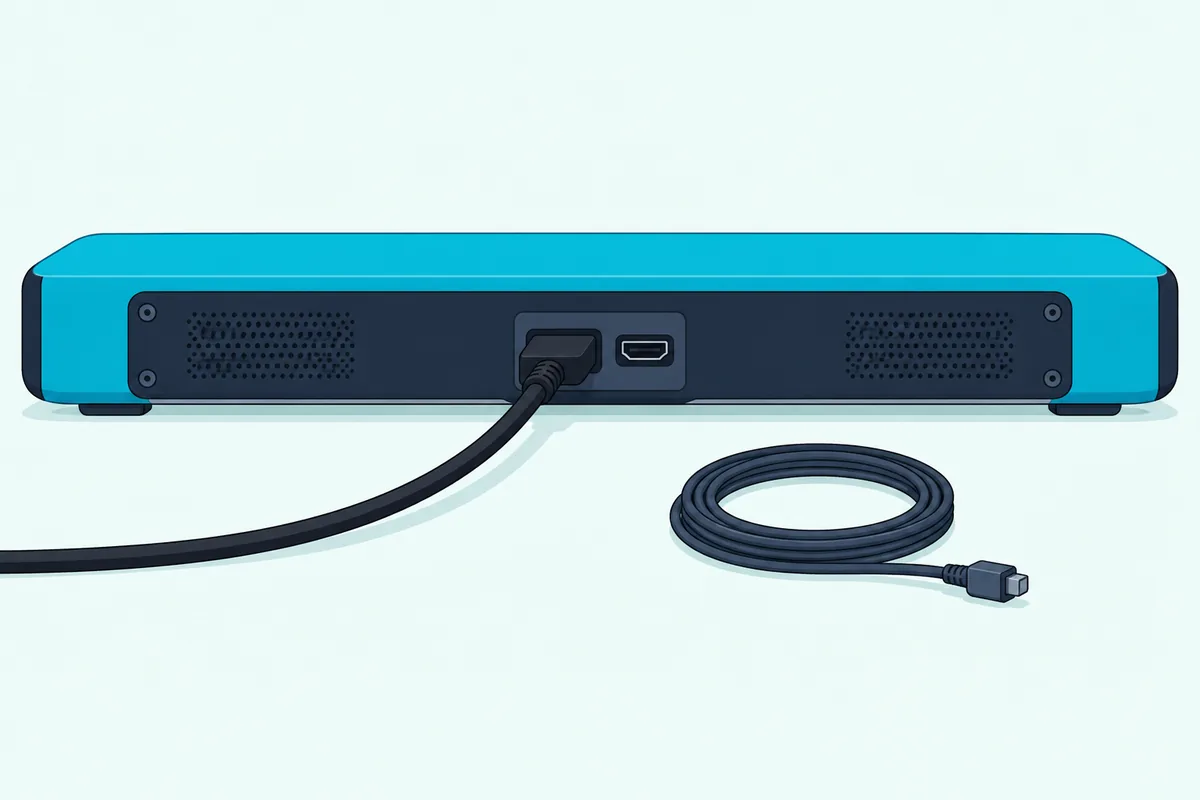
Yamaha’s True X Bar 90A quick guide says no HDMI cable is included, and its list of accessories names no optical cable either.
Which Older Yamaha Soundbars Are Discontinued?
Those box contents apply only to bars Yamaha still lists. Yamaha’s US pages mark the YAS-209, YAS-109, True X Bar 40A and True X Bar 50A as discontinued, and the YAS-209’s page says it’s no longer for sale.
All four carry Alexa built in, and no bar in the table above lists it as a feature. If you already own one, or find one still on sale, follow its own guide, since its app and ports can differ.
Frequently Asked Questions
Can you add a subwoofer to a Yamaha soundbar?
Only on some models. Yamaha’s specs show a subwoofer output on the SR-B30A and SR-B20A, and the SR-B30A guide says to connect a powered subwoofer with an RCA mono cable. The other current bars list no subwoofer output, though the SR-B40A, SR-C30A and True X 90A bars already come with a wireless one.
Can a Yamaha soundbar use rear speakers?
On the current list, only the True X 90A bars can, through True X Surround. The True X Surround 90A includes two True X Speaker 3A units, and the True X Bar 90A accepts a True X Speaker 1A or 3A, sold separately. Yamaha’s SR-B and SR-C spec tables answer no for MusicCast Surround.
Can you wall-mount a Yamaha soundbar?
Yes, each current bar has a wall-mount route. The SR-B bars, SR-C bars and B200A use keyholes on the back, with spacers and a mounting template in the box, and the True X 90A bars use included metal brackets once the legs come off. Yamaha’s SR-B40A guide says to have the dealer or a qualified contractor do the installation.
Which app controls a Yamaha soundbar?
That depends on the line. Yamaha’s spec pages name Sound Bar Remote for the SR-B bars, SR-C bars and B200A, and MusicCast Controller for the True X 90A bars. Each bar also comes with its own remote, and with HDMI Control on, a compatible TV’s remote can run the basics.
Do Yamaha soundbars work with a Roku TV?
They connect as they would to any TV with HDMI ARC or optical, though Yamaha’s guides don’t mention Roku. Burton Acoustix’s Roku TV guide explains what Roku TV Ready adds and includes the SR-B30A.