Fiberglass Insulation vs Rockwool for Soundproofing, Wall by Wall
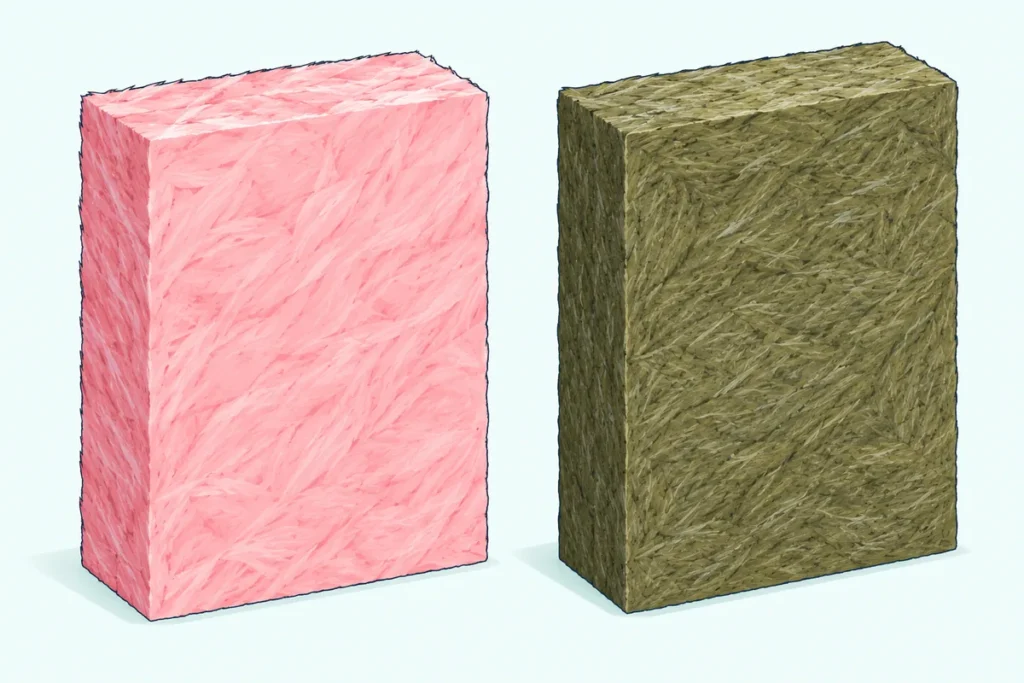
If you’re weighing fiberglass insulation vs rockwool for soundproofing, the same-wall tests below land within 3 STC points of each other, and the lead runs in both directions.
That’s hard to square with the sales talk, because ROCKWOOL’s product guide credits higher density with cutting noise while CertainTeed’s acoustics guide calls that assumption incorrect.
Once you’ve seen the two side by side, you can stop shopping on density and choose on what the sheets do separate: how each batt fits the cavity, how it behaves in a fire and how it handles.
Below are the wall tests, absorption figures by thickness, density, fire ratings, facings and where each material goes, from a stud bay to a bass trap and a box lining.
Start with the same-wall table, because every other number here reads differently once you’ve seen it.
How Does Fiberglass Insulation vs Rockwool for Soundproofing Come Out in the Same Wall?
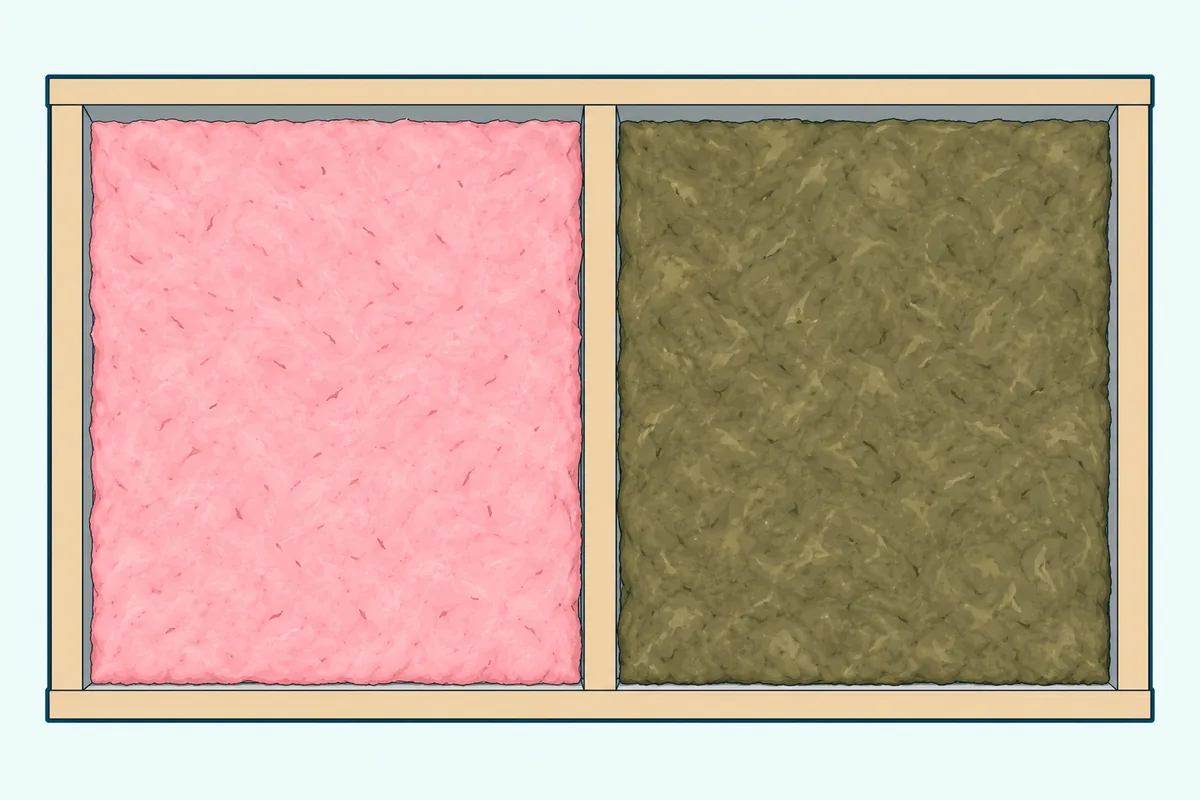
That table takes most of the heat out of the argument. In these tests, which swap the insulation and keep the wall, fiberglass and mineral wool finish within 3 STC points of each other, and neither one leads every time.
STC, or Sound Transmission Class, rates how well a whole wall stops airborne sound, and a higher number means less gets through. The figures come from the makers’ data sheets and tested-assembly tables.
| The wall | Where it’s listed | Fiberglass | Mineral wool |
|---|---|---|---|
| 2×4 outside wall: 1/2 in. gypsum, OSB, house wrap, vinyl siding | NAIMA report, tested at Intertek, 2019 | 34 (R-15 batt) | 34 (R-15 batt) |
| Single studs, 16 in. apart, single drywall | Johns Manville’s Insulating for Acoustics bulletin | 36 | 37 |
| Single studs, 16 in. apart, double drywall | Johns Manville bulletin | 42 | 42 |
| Single studs, 24 in. apart, single drywall | Johns Manville bulletin | 38 | 39 |
| Double studs, 16 in. apart, single drywall | Johns Manville bulletin | 53 | 53 |
| 3 5/8 in. steel studs, 16 in. apart, one 5/8 in. layer each side | NRC series in Owens Corning’s SAB sheet | 49 | 47 |
| Same studs, one layer on one side, two on the other | NRC series in Owens Corning’s SAB sheet | 52 | 53 |
| 3 5/8 in. steel studs, 5/8 in. panels both sides | USG test in Thermafiber’s 2008 brochure | 47 (3 1/2 in.) | 49 (3 in. SAFB) |
| 6 in. steel studs, 16 in. apart, 5/8 in. Fire-Shield each side | National Gypsum SoundBook | 44 (6 in., 20-gauge stud) | 44 (5 1/2 in., 16-gauge stud) |
| 3 5/8 in. 25-gauge steel studs, 24 in. apart, one side on RC-1 channel | National Gypsum SoundBook | 51 (3 1/2 in., Fire-Shield board) | 54 (3 in., Fire-Shield C board) |
| 3 5/8 in. steel studs, 24 in. apart, Fire-Shield one side, SoundBreak XP the other | National Gypsum SoundBook | 55 (3 1/2 in., 20-gauge stud) | 54 (3 in., 25-gauge stud) |
Read the last two columns across: mineral wool leads in five rows by 1 to 3 points, fiberglass leads in two by 1 or 2, and four are level. The widest gap, those 3 points, is also a row where the board’s name changes, from Fire-Shield to Fire-Shield C.
Owens Corning’s PINK Next Gen Sound Attenuation Batts sheet warns that differences of 1 to 2 STC points can occur for the same assembly in the same laboratory. CertainTeed’s guide says construction and lab variations “often exceed 2 or more STC points,” so most of those gaps are the size of the spread one wall can show on its own.
Johns Manville, which sells both fibers, says in its Insulating for Acoustics bulletin that the two are “nearly identical” for transmission and absorption, and calls the tiny differences undetectable to the human ear. Its 2021 Head-to-Head article gives mineral wool “marginally better sound control properties,” then says people wouldn’t be able to tell the two apart in a wall cavity.
NAIMA’s report on wall cavity insulation tested that first row at Intertek Labs in York, Pennsylvania, and the two R-15 batts also tied on OITC, the outdoor-noise rating, at 25. It says variations of 3 or less in STC “can be heard but are generally on the edge of perception,” and concludes that in a residential setting “it does not matter which insulation product is used to fill the cavity.”
Who Ran These Tests, and What Do They Sell?
Conclusions like that one only mean something once you know who’s talking. Every row in that table comes from a company or group with a stake in insulation or drywall, though they don’t all sit on one side.
NAIMA is the association for North American makers of fiberglass, rock wool and slag wool, and its report lists CertainTeed, Johns Manville, Knauf, Owens Corning and ROCKWOOL on its building insulation committee. So fiberglass makers and ROCKWOOL both stand behind that 34-all result, and Intertek ran the tests to ASTM E90.
The two rows on Owens Corning’s sheet come from NRC-CNRC Internal Report IRC-IR-693 of October 1995, from National Research Council Canada’s gypsum board wall study. NRC’s Construction Technology Update No. 1 says the consortium behind it included Owens Corning Fiberglas Canada and Roxul, and it found that the type of sound-absorbing material “has a relatively minor effect.”
Johns Manville and Owens Corning both sit on both sides of this question, since Johns Manville lists Sound & Fire Block mineral wool beside its fiberglass, and Owens Corning’s sheets cover PINK fiberglass batts and Thermafiber SAFB mineral wool, with Thermafiber, Inc. at the same Toledo address. Thermafiber’s 2008 brochure is where the USG row comes from, so treat it as a mineral wool seller’s choice of test; USG’s Acoustical Assemblies catalog lists a matching wall at 40 empty and 49 with 3 inches of SAFB and gives no glass fiber figure for it.
National Gypsum’s SoundBook is a catalog of its own gypsum board walls, so the fill is a named component and not the product on sale. Its pairs aren’t perfect twins, because stud gauge and thickness sometimes change too, which is why the table spells those out.
Why Do Rockwool and Fiberglass Makers Disagree About Density?
Stakes aside, the two camps really do print opposite claims. They disagree because density shows up in one part of the test and not the part that sets STC: Warnock and Quirt’s study of about 400 walls for NRC Canada found the benefits of denser materials “evident at the higher frequencies but not at the low frequencies that determine STC.”
The same study measured its glass fiber batts at about 11 to 16 kg/m³, roughly 0.7 to 1 lb/ft³, and its mineral fiber batts from about 33 to 98 kg/m³, roughly 2 to 6 lb/ft³. It reports that the mineral and cellulose fiber materials “tend to give lower TL values at 125 Hz,” and that its very dense material might have stiffened the steel studs.
On the mineral wool side, ROCKWOOL’s Safe’n’Sound data sheet says a “high density and unique fiber structure absorbs sound,” and its product guide says higher-density batts “more effectively reduce airflow, thereby decreasing sound transmission.” Thermafiber’s 2008 brochure goes further and claims STC ratings up to 4 points above glass fiber, even when the glass fiber was 1/2 inch to 1 inch thicker.
On the fiberglass side, CertainTeed’s Noise Control in Buildings guide calls it “incorrect to assume” that higher density gives better sound transmission loss, and says mineral or rock wool “is not better than low-density fiber glass insulation.” Owens Corning’s Canadian Wall & Floor Assembly Guide adds that glass fiber batts on average match or beat mineral fiber batts of the same thickness at about 265% higher density.
Two documents that don’t sell a batt point somewhere else. National Gypsum’s SoundBook says the thickness of the insulation “has a greater effect on sound transmission loss than the density,” and NRC’s update says sound reduction from 500 to 2,000 Hz tended to rise with density in its small panel tests, with “no important acoustical differences” in STC.
ROCKWOOL’s own fine print adds a twist. The Safe’n’Sound and AFB sheets that sell density both carry a footnote saying “Density is not a performance criteria,” and that density changes with thickness.
The figures themselves don’t compare cleanly, either. ROCKWOOL lists Safe’n’Sound and AFB at a nominal 2.5 lb/ft³ and defines nominal density against a historic benchmark, while Thermafiber’s brochure gives the same nominal 2.5 for SAFB against 0.7 to 0.8 for typical glass fiber, and Owens Corning’s SAB sheet and Johns Manville’s batt sheet print no density at all.
How Much Does Filling the Cavity Add Compared With Changing the Fiber?
Density arguments shrink further next to what an empty wall does. Filling the cavity is the bigger step: Owens Corning’s sheet takes its steel-stud wall from STC 38 empty to 49 with fiberglass and 47 with mineral wool, so the fill adds 9 to 11 points while the choice of fiber moves 2.
Each maker claims about the same ceiling for its own fiber. Owens Corning says its SABs can add 4 to 11 points over an empty cavity, Thermafiber’s brochure says as much as 11 for SAFB, and CertainTeed’s NoiseReducer brochure says 4 to 12.
Wood studs shrink the gain, because the studs tie the two faces of the wall together, and Owens Corning’s Canadian guide notes that metal studs are more resilient than wood. In Johns Manville’s Acoustical Assemblies guide, a 2×4 wall goes from 35 empty to 38 with R-13 batts, and in National Gypsum’s SoundBook from 35 to 36 with 3 1/2 inches of glass fiber.
Johns Manville’s bulletin shows the framing effect in one chart. Single studs at 16 inches go from 33 empty to 36 with fiberglass and 37 with mineral wool, while double studs go from 43 to 53 with either.
NRC’s update says that if the two faces aren’t isolated from each other, sound-absorbing material in the cavity “is rendered ineffective.” Burton Acoustix’s page on what each drywall adds to an insulated wall carries more of those empty and filled pairs.
| 2×4 wood studs, 16 in. apart | Fill | STC | Where it’s listed |
|---|---|---|---|
| 1/2 in. gypsum | None | 35 | Johns Manville guide |
| 1/2 in. gypsum | R-13 fiberglass batts | 38 | Johns Manville guide |
| 1/2 in. gypsum | 3 1/2 in. fiber glass | 39 | CertainTeed guide |
| 1/2 in. Type X gypsum | 3 1/2 in. QuietZone fiberglass | 39 | Owens Corning QuietZone sheet |
| 1/2 in. gypsum | 3 in. Safe’n’Sound or AFB stone wool | 38 | ROCKWOOL IWS-03 |
| 1/2 in. gypsum | 3 1/2 in. Comfortbatt stone wool | 40 | ROCKWOOL IWS-05 |
| 5/8 in. gypsum | R-13 fiberglass batts | 38 | Johns Manville guide |
| 5/8 in. gypsum | 3 in. Safe’n’Sound or AFB stone wool | 38 | ROCKWOOL IWS-02 |
| 5/8 in. Fire-Shield board | 3 1/2 in. glass fiber | 36 | National Gypsum SoundBook |
Those walls came from different labs and years, so they aren’t a head-to-head, and the makers’ catalogs list only their own fiber: ROCKWOOL’s has no fiberglass walls, and Johns Manville’s Acoustical Assemblies guide and CertainTeed’s guide have no mineral wool walls. Even so, every filled wall sits between 36 and 40.
What Moves a Wall’s Rating More Than the Fiber?
That 36-to-40 band is narrow because every wall in it is a plain single row of studs. Resilient channels, more drywall and separate framing all move a wall’s rating further than the fiber does: ROCKWOOL’s catalog takes its 2×4 wall with 3 inches of stone wool from STC 38 (IWS-02) to 51 (IWS-07) on RC Deluxe channels, and Johns Manville’s guide takes its wall with R-13 batts from 38 to 47.
Extra board counts too. Johns Manville’s 38 becomes 45 with two 1/2-inch layers on each side, and ROCKWOOL lists a double-stud wall with a 1-inch air gap at 52 with 3 1/2-inch Comfortbatt in each row.
CertainTeed’s guide turns those ratings into speech you can picture. At STC 35 to 45 it expects half of loud speech to be understood, at 45 to 55 loud speech faintly heard but not understood, and at 55 and higher loud speech usually not heard.
The fiber swaps above barely shift a wall between those bands, while channels take ROCKWOOL’s 38 from the first band into the second.
Those are lab ratings, and Owens Corning’s SAB sheet warns that flanking noise, material quality and construction practice can lead to widely varied STCs for the same assembly in the field. Sealing sits underneath all of it, since CertainTeed’s guide says any gap in an acoustical construction that leaks air will also leak sound.
Burton Acoustix’s page on whether Rockwool works for soundproofing climbs that ladder with ROCKWOOL’s own walls.
Which Absorbs More Sound, Inch for Inch?
Walls aside, the sheets also print how much sound each fiber soaks up, which is a separate measure. Inch for inch, fiberglass and mineral wool batts absorb about the same at 3 to 3 1/2 inches, with a noise reduction coefficient, or NRC, between 1.00 and 1.10 on the makers’ sheets.
NRC rates absorption at a material’s surface, while STC rates a whole wall, and Knauf’s article for contractors stresses that the two are measured differently. So a high NRC tells you about the material, not what the room next door hears.
| Unfaced batt | Thickness | 125 Hz | 500 Hz | NRC | Fiber |
|---|---|---|---|---|---|
| CertainTeed R-13 | 3 1/2 in. | 0.30 | 1.05 | 1.00 | Glass |
| Owens Corning QuietZone | 3 1/2 in. | 0.48 | 1.12 | 1.05 | Glass |
| CertainTeed R-15 | 3 1/2 in. | 0.51 | 1.19 | 1.10 | Glass |
| Thermafiber SAFB | 3 in. | 0.51 | 1.18 | 1.05 | Mineral |
| ROCKWOOL AFB | 3 in. | 0.42 | 1.22 | 1.10 | Mineral |
| ROCKWOOL Safe’n’Sound | 3 in. | 0.44 | 1.22 | 1.10 | Mineral |
| CertainTeed R-19 | 6 1/4 in. | 0.59 | 0.90 | 0.95 | Glass |
| ROCKWOOL AFB | 6 in. | 1.11 | 1.15 | 1.15 | Mineral |
| Thermafiber SAFB | 6 in. | 1.37 | 1.23 | 1.20 | Mineral |
| ROCKWOOL Safe’n’Sound | 6 in. | 1.38 | 1.30 | 1.25 | Mineral |
| CertainTeed R-38 | 12 in. | 1.40 | 1.05 | 1.10 | Glass |
Some of those figures top 1.00, which looks impossible, and CertainTeed’s guide puts it down to diffraction effects that the test standard requires labs to report. The same guide says NRC differences as small as 0.05 can’t be detected by the human ear, and the top six rows span only 0.10.
The gap opens at low frequencies once the batts get thick. At about 6 inches, the mineral wool rows list 1.11 to 1.38 at 125 Hz against 0.59 for CertainTeed’s 6 1/4-inch R-19, although its 12-inch R-38 reaches 1.40.
Does a Denser Board Absorb More Than a Lighter One?
Those batt numbers leave density muddled, but rigid boards make it easier to test, because their sheets print the figure. A denser board doesn’t absorb much more at 2 inches: within each maker’s range below, the NRC moves by 0.05 at most, and ROCKWOOL’s 8 lb/ft³ board lists lower than its 4 and 6 lb/ft³ boards.
| 2 in. product, unfaced | Density (lb/ft³) | 125 Hz | NRC | Fiber |
|---|---|---|---|---|
| Knauf Performance+ Black Acoustical Board | 2.25 | 0.26 | 0.95 | Glass |
| Knauf Performance+ Black Acoustical Board | 3.0 | 0.33 | 0.95 | Glass |
| Knauf Performance+ Acoustical Smooth Board | 6.0 | 0.32 | 1.00 | Glass |
| Owens Corning 703 | 3.0 | 0.15 | 1.00 | Glass |
| Owens Corning 705 | 6.0 | 0.18 | 1.05 | Glass |
| ROCKWOOL AFB (a batt) | 2.5 nominal | 0.22 | 0.95 | Mineral |
| Thermafiber SAFB (a batt) | 2.5 nominal | 0.34 | 0.95 | Mineral |
| ROCKWOOL Rockboard 40 | 4.0 | 0.25 | 1.00 | Mineral |
| ROCKWOOL Rockboard 60 | 6 | 0.28 | 1.00 | Mineral |
| ROCKWOOL Comfortboard 80 | 8 | 0.37 | 0.95 | Mineral |
Knauf’s article on commercial acoustics puts it plainly: thickness largely drives absorption coefficients and NRC, “while density has a smaller effect.” The thickness steps show it, with Owens Corning’s 703 going from NRC 0.70 at 1 inch to 1.00 at 2, and ROCKWOOL’s Comfortboard 80 from 0.75 to 0.95.
The 125 Hz column is where those boards spread, from 0.15 to 0.37, and it doesn’t line up neatly by density or fiber. Knauf’s 3 lb/ft³ fiberglass lists 0.33, ahead of ROCKWOOL’s 4 and 6 lb/ft³ boards at 0.25 and 0.28.
Which One Fits a Stud Cavity Better?
Thickness matters inside the wall too, which makes fit the first real difference between the two. Fiberglass comes closer to a full fill in a 2×4 bay, because Johns Manville and Owens Corning sell 3 1/2-inch batts for a 3 1/2-inch stud, while ROCKWOOL makes Safe’n’Sound 3 or 6 inches thick.
That half inch shows up in ROCKWOOL’s own catalog, which rates a 2×4 wall with 1/2-inch gypsum at 38 with 3 inches of Safe’n’Sound or AFB and 40 with 3 1/2-inch Comfortbatt. Owens Corning’s Canadian guide reports about 5 dB less sound transmission loss with a cavity half filled, and CertainTeed’s guide says complete filling gives the best wall performance.
It doesn’t follow that the batt has to touch both faces. NRC’s update found no significant change when the absorber moved from the middle of the cavity to a position near one face, and partial coverage from bottom to top or from the sides was what lost out.
Length changes how many pieces you handle. Johns Manville’s standard lengths include 93 and 96 inches, QuietZone comes in 93 and 105 inches and Owens Corning’s SAB in 96 inches, against 47 inches for Safe’n’Sound in wood framing and 48 inches for Thermafiber SAFB.
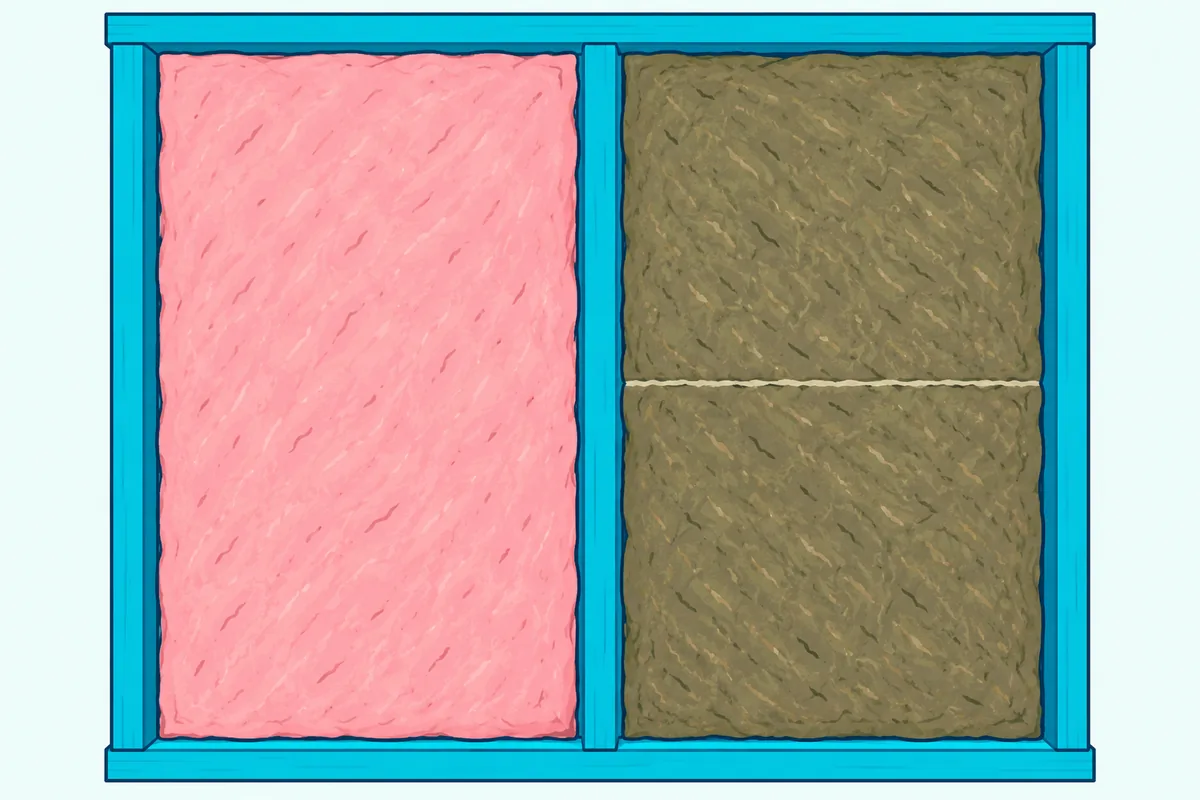
Knauf, which sells fiberglass, says a rock mineral wool product that needs two pieces gives crews more to handle and position. ROCKWOOL’s answer is friction: its product guide says the high density gives a superior friction fit in the stud cavity and resists over-compression during the install.
Snug doesn’t mean packed, though. Johns Manville’s bulletin says the best performance comes from a full cavity, “but not overstuffed,” and NRC’s update warns that overfilling a cavity with a fairly dense, rigid material risks sound passing through the material itself, and that “the stiffer the material, the greater the reduction in the STC.”
Which One Holds Up Better in a Fire?
Fit is a job-site difference, and fire is where the sheets separate most clearly. Mineral wool lists zero flame spread and the higher temperature figures, although unfaced fiberglass also passes the ASTM E136 noncombustibility test.
| Product | ASTM E136 | Flame spread / smoke (ASTM E84) | Heat figure |
|---|---|---|---|
| ROCKWOOL Safe’n’Sound | Noncombustible | 0 / 0 | Up to 1,000°C (product guide) |
| Thermafiber SAFB | Non-combustible | 0 / 0 | Above 1,093°C (2,000°F) |
| Owens Corning PINK Next Gen SAB, unfaced | Non-combustible | Under 25 / under 50 | None on the sheet |
| Johns Manville fiberglass, unfaced | Noncombustible | Under 25 / under 50 | None on the sheet |
| Johns Manville fiberglass, foil-faced | Not listed | Under 75 / under 150 | None on the sheet |
| Johns Manville fiberglass, kraft-faced | Not listed | N/R on the sheet | None on the sheet |
| Owens Corning 703 board, unfaced | Not on the sheet | 5 / 5 | Operating range to 450°F |
Thermafiber’s 2008 brochure says glass fiber begins to disintegrate and melt at about 1,050°F, and describes foil-faced batts in steel stud bays exposed to fire. Fire had penetrated the three glass fiber brands at 17 minutes and they’d melted or fallen away by 55 minutes, while its own insulation stayed intact.
That’s a seller’s account, but Knauf, a fiberglass maker, agrees that rock mineral wool has a higher melting point than fiberglass. Knauf’s point is that ratings for walls and floors come from the complete tested assembly, and Owens Corning says walls with SAB can reach a 2-hour rating under ASTM E119.
So in a fire-rated wall, the listing decides and not the sales sheet. PABCO’s 2025 Sound Design Guide says that where insulation is specified as mineral or glass fiber, the system “shall be built using the type specified” for fire resistance.
NRC’s update backs that up, noting significant differences in fire-resistance ratings between full-size walls identical except for the sound-absorbing material. Owens Corning’s sheet adds that assembly components aren’t intended to be interchanged between assemblies.
Which Is Easier to Handle and Install?
Those fire rows only decide a rated wall, and the everyday difference is in your hands. Fiberglass is the lighter of the two and cuts with a utility knife, while ROCKWOOL recommends a serrated knife for its stone wool, and both sides warn about skin irritation.
Johns Manville says its batts cut with an ordinary utility knife and press into place between studs, and calls fiberglass much more flexible and mineral wool much more rigid, adding that some installers prefer the rigidity. Knauf says rock mineral wool’s greater weight and density may affect handling.
ROCKWOOL’s product guide says its batts cut with a serrated knife such as a bread knife, though Owens Corning’s sheet slits SAFB with a utility knife.
Skin warnings come from both sides. ROCKWOOL’s Safe Use Instruction Sheet says its product may cause temporary mechanical irritation to the eyes and skin, and calls for gloves, a long-sleeve shirt and long pants, with a disposable N95 type dust respirator or better recommended when airborne particulates are above exposure limits.
Johns Manville and CertainTeed both say unfaced fiberglass shouldn’t go in an exposed area where it can touch bare skin. Owens Corning, CertainTeed and Knauf each describe their fiberglass as lower in dust, which is a claim about dust, not a claim of none.
Facings add a second decision. Johns Manville says kraft and standard foil facings “will burn and must not be left exposed,” so they have to sit behind drywall or another approved finish, and QuietZone’s faced batts staple along kraft flanges, with a facing that Owens Corning says isn’t a vapor retarder.
Do Moisture and Mold Separate Them?
Handling matters on the day you install, and moisture is about the years after. Moisture separates them less than fire does: both fibers pass fungi tests, and mineral wool lists the lower water figures, with under 1% by volume for Thermafiber SAFB and 0.2% for Comfortboard 80 against under 5% for Owens Corning’s SAB and Johns Manville’s unfaced batts.
None of those sheets ties a water figure to an STC figure, so treat this as a reason to pick for a damp cavity, and not as a sound difference.
Where Does Each One Go?
Those properties decide placement more than sound does. Either fiber can go in a wall cavity or a ceiling, while the sheets steer each product to a job: Safe’n’Sound to interior partitions, QuietZone to interior cavities only, Comfortbatt to outside walls and 703 board to equipment and ductwork as well as walls and ceilings.
In a Wall Between Rooms
ROCKWOOL’s sheet names interior partitions of wood and steel frame construction for Safe’n’Sound. Owens Corning makes PINK Next Gen SAB for metal stud cavities in interior partitions, in 2 1/2, 3 1/2 and 6 1/2-inch thicknesses, and QuietZone for standard wood framing.
Burton Acoustix’s insulation comparison for walls, ceilings and outside walls sets out the sizes to buy for each stud depth.
In an Outside Wall
QuietZone’s sheet says it’s “not recommended for exterior walls,” and Safe’n’Sound’s names interior partitions, so an outside wall runs through thermal batts such as ROCKWOOL’s Comfortbatt or Johns Manville’s fiberglass. Both reach R-15 in 3 1/2 inches on their sheets, which is the energy side of the same bay.
In a Ceiling or Floor
Joist floors are the one place in these documents where a lab report gives rock fiber a clear nod. Warnock’s 2000 paper on NRC’s joist floor tests notes that “the more dense rock fibre batts give small but definite improvements in sound insulation relative to the glass fibre batts,” in floors built with resilient channels.
Johns Manville’s guide, using NRC’s data, lists a 2×10 joist floor with a 5/8-inch gypsum ceiling at STC 33 and IIC 28 with no insulation or channels, and at 52 and 46 with 6 1/2-inch R-19 batts and channels. ROCKWOOL’s product guide lists 2×10 joists with 6-inch Safe’n’Sound, 5/8-inch Type X and channels at STC 50.
Those two rows come from different builds, so don’t read 52 against 50 as a verdict. Johns Manville notes that where insulation rests on the gypsum board in an attic, the weight of mineral wool at a high R-value could be prohibitive.
Burton Acoustix’s guide to insulating between floors for sound goes through depth and footfall in more detail.
In a Bass Trap
A bass trap is acoustic treatment, not soundproofing: it soaks up low sound inside a room and does nothing to stop it leaving. So the figures that count here are the absorption numbers at 125 Hz, and thickness moves them most in these rows.
Owens Corning’s 703 goes from 0.05 at 1 inch to 0.56 at 4 inches. At the same 4 inches, ROCKWOOL lists 0.73 for AFB, 0.93 for Rockboard 40 and 0.88 for Rockboard 60, and Thermafiber SAFB lists 0.83.
Keep any facing in mind, because it changes the top of the range. Owens Corning’s 2-inch 703 lists 1.00 at 4,000 Hz unfaced and 0.32 with an FRK foil facing, with NRC falling from 1.00 to 0.75.
As a Box Lining
CertainTeed’s guide gives the one lining test here, on an enclosure of 1/2-inch plywood with and without 2 inches of fiber glass. The lining adds 2 dB at 125 and 250 Hz, 4 dB at 500, 1 dB at 1,000, 4 dB at 2,000 and 2 dB at 4,000.
None of the mineral wool sheets here gives a matching lined-box test, so that’s a figure for fiberglass and a gap for rock wool. For heat, Owens Corning lists 703 for an operating range up to 450°F, and ROCKWOOL lists Comfortboard 80 at under 0.5% linear shrinkage at 1,200°F.
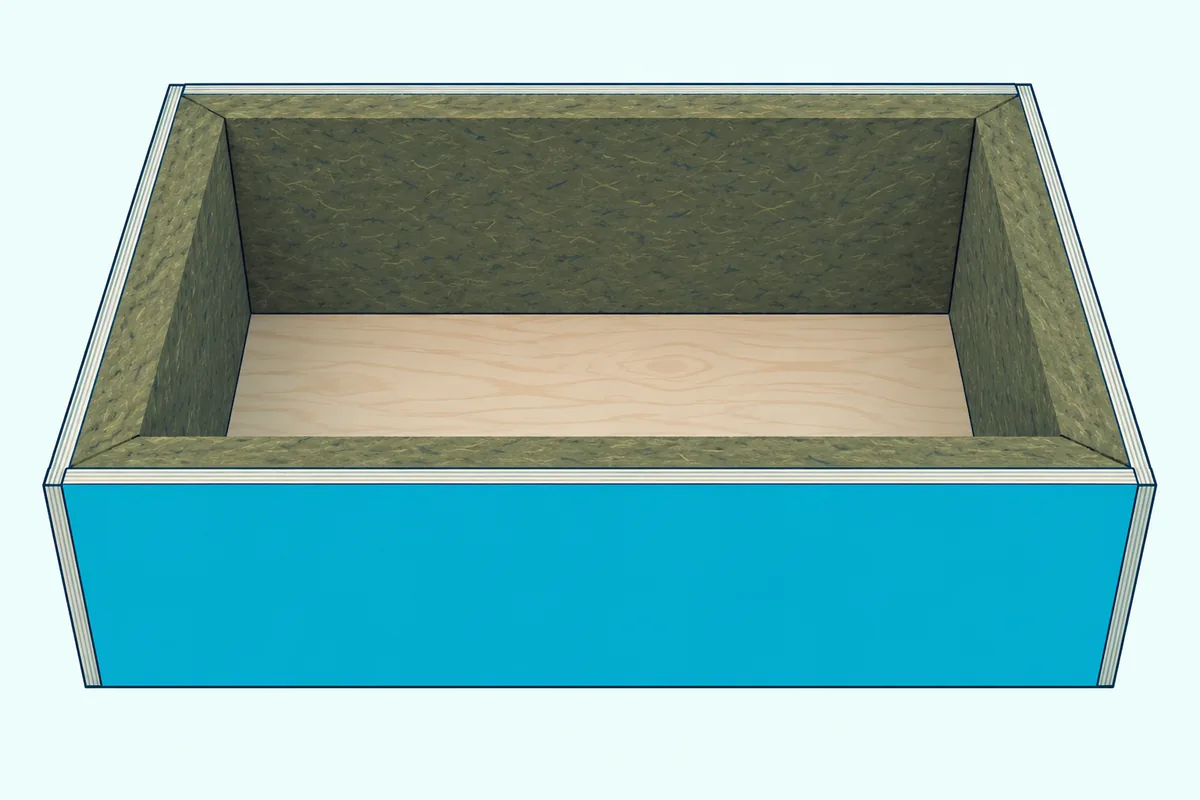
Fuel-burning machines are their own problem, and a lining doesn’t change it. What generator makers say about a lined box comes before any of these numbers.
Are Rockwool, Roxul, Stone Wool and Mineral Wool the Same Thing?
The sheets above use a handful of names for one family, which trips up a lot of shopping lists. Rockwool and Roxul are the same company: ROCKWOOL says ROXUL Inc. took the name of its parent on January 1, 2018, and stone wool is its word for the mineral wool it makes from volcanic rock.
Mineral wool is the wider term. Owens Corning’s Canadian guide writes “mineral fibre (rock/slag wool),” NAIMA lists rock wool and slag wool separately, and Thermafiber’s 2008 brochure says its fibers come from slag, a by-product of iron ore reduction.
Pink is a brand, not a material. Owens Corning’s sheets say the color PINK is its registered trademark, so “pink insulation” means its fiberglass, while CertainTeed’s NoiseReducer sheet describes its own glass fiber as off-white.
How Should You Choose Between Them?
With the names straight, the decision gets shorter. Choose on what the job asks of the insulation, because the same-wall sound gaps are small and the documented differences sit in fit, fire, handling and heat.
| If this is the job | What the makers’ documents point to |
|---|---|
| A fire-rated wall | The insulation type the listed design names |
| An ordinary 2×4 partition you want full | A 3 1/2-inch batt, either R-13 or R-15 fiberglass or Comfortbatt stone wool |
| The fewest pieces in each bay | Fiberglass at 93 or 96 inches against wool at 47 or 48 inches |
| Framing left open | Unfaced batts, since kraft and standard foil facings burn |
| Steel studs | Batts sized for them: 16 or 24 inches wide, such as SAB, SAFB or AFB |
| A joist ceiling on channels | The one lab note favoring denser rock fiber, by a small margin |
| Sound inside a room | Thick unfaced board or batt, with thickness before density |
The Bottom Line
That comparison comes down to a short list. In the same wall, fiberglass insulation and rockwool sit within 3 STC points, with mineral wool ahead a little more often than fiberglass, and NAIMA’s 2×4 test has them level at 34.
So pick the fiber on fit, fire listing and handling, fill the whole cavity, and spend your effort on the channels and layers, which moved those walls by 7 to 13 points, and on sealing.
Frequently Asked Questions
Does Rockwool block sound better than fiberglass?
Marginally, in some walls. Of the same-wall rows here, mineral wool leads five by 1 to 3 STC points, fiberglass leads two by 1 or 2, and four are level, including NAIMA’s 34 and 34. Johns Manville, which sells both, says the difference is so small that people couldn’t tell the two apart in a wall cavity. Thermafiber’s 2008 brochure claims up to 4 points for its product.
What is the STC rating of fiberglass vs mineral wool?
Neither has one on its own. Knauf points out that individual insulation products aren’t assigned STC ratings, because STC rates the complete wall. Filled 2×4 walls in the makers’ tables run from 36 to 40 with either fiber, and steel-stud walls run into the 40s and 50s.
Do you need an air gap with Rockwool?
None of the batt sheets here asks for one beside the batt, and ROCKWOOL’s own catalog rates a full 3 1/2-inch fill 2 points above 3 inches. NRC’s update found no significant change when the absorber moved within the cavity, as long as it covered the whole face. ROCKWOOL’s double-stud walls do have a 1-inch gap between the stud rows, which is framing and not a space left beside the wool.
What is the downside of Rockwool?
The makers’ documents point to three. Safe’n’Sound comes 3 inches thick for a 3 1/2-inch stud bay and 47 inches long, so a wall bay takes more than one piece. Knauf says its weight and density may affect handling, and ROCKWOOL’s own safety sheet lists temporary irritation to eyes and skin, as fiberglass makers do for theirs.
Do mice chew through Rockwool insulation?
ROCKWOOL’s Safe’n’Sound sheet and product guide don’t address rodents. Owens Corning’s Thermafiber SAFB sheet does call that mineral wool “vermin-resistant,” which is a maker’s description of its own batt and doesn’t promise mice will leave it alone. Sealing the gaps they use is a separate job from choosing a fiber.
Is pink insulation good for soundproofing?
Pink is Owens Corning’s fiberglass, and its SAB sheet says those batts can add 4 to 11 STC points over an empty cavity, depending on the construction. In its own table, 3 1/2-inch fiberglass took a steel-stud wall from 38 to 49. On wood studs the gain is smaller, at 35 to 39 on Owens Corning’s own 2×4 pair.
Do fiberglass and Rockwool have the same R-value?
At the sizes that matter for a 2×4 wall, they can. Johns Manville lists R-15 at 3 1/2 inches, and ROCKWOOL lists Comfortbatt at R-15 for the same bay, while Safe’n’Sound’s sheet gives no R-value at all. R-value measures heat flow, not sound, so it won’t settle the comparison above.